

- Market Size (2026)
- USD 9.6 Bn
- Forecast (2036)
- USD 16.9 Bn
- CAGR (2026 to 2036)
- 5.8%
How big is Off-Highway Planetary Hub Drives Market in 2026?
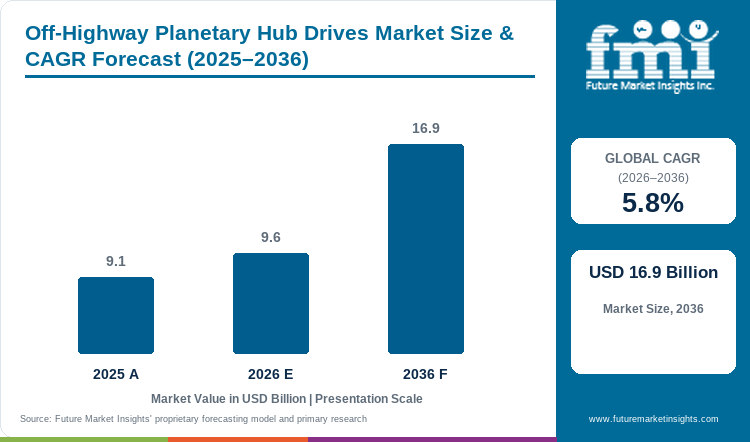
USD 9.6 billion in 2026 and USD 16.9 billion by 2036 at a 5.8% CAGR.
Sales of off-highway planetary hub drives are estimated to rise at 5.8% CAGR through 2036, increasing valuation from USD 9.1 billion in 2025 to USD 9.6 billion in 2026, and reaching USD 16.9 billion by 2036. OEM engineers release hub-drive orders only after planetary reduction satisfies braking and motor-interface requirements for the intended machine platform. Bosch Rexroth expanded its eLION electrification portfolio in February 2025 to include 96-volt systems for compact off-highway machines. OEM work on off-highway electric vehicle programs places more drivetrain responsibility inside traction packages where wheel-end reduction must qualify with motors and controls before serial production.
Mexico is forecast at 6.2% CAGR through 2036 compared with Germany at 4.9% and Japan at 4.4%. The federal road program provides a direct equipment route because Mexico's Presidency announced 4,000 kilometers of initial intervention and procurement of 20 paving trains in February 2025. Repeated paving work increases operating hours for wheel-end drivetrains and brings qualified final reductions into scheduled repair cycles. Suppliers still need distributor stock and engineering support because equipment deployment alone does not determine which hub-drive specification contractors accept.
Key Takeaways
- Machine design-ins and rebuilds raise hub-drive demand because planetary reduction must pass braking, sealing, and duty-cycle validation before an OEM releases production orders.
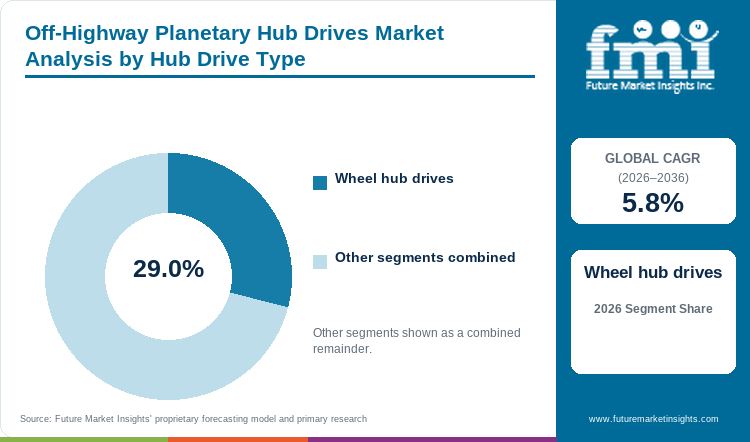
- In 2026, wheel hub drives are expected to lead hub drive type with 29.0% share, supported by compact reduction near each driven wheel.
- Construction equipment is set to lead the equipment type category with 31.0% share in 2026, driven by repeated planetary final-reduction use in wheeled and tracked machines.
- The torque class category is forecast to be led by the 5-20 kNm band at 36.0% share in 2026, attributable to medium torque duties common in compact machines.
- Machine-specific mounting and braking validation slows supplier switching because an alternative drive must pass the qualified duty cycle before serial use.
- Some of the key players in this market include Bonfiglioli S.p.A., Allison Transmission Holdings, Inc., Comer Industries S.p.A., ZF Friedrichshafen AG, Carraro S.p.A., Katsa Oy, Bosch Rexroth AG, Poclain, PMP Industries S.p.A., and Reggiana Riduttori S.r.l.
Analyst Perspective
“Hub-drive suppliers earn design-in value when wheel-end reduction meets braking and packaging requirements without increasing machine complexity. Electrified platforms raise the engineering premium because mechanical reduction must qualify beside motors and controls before production.”
- Nikhil Kaitwade, Principal Consultant, Future Market Insights
How is the off-highway planetary hub drives market segmented?
The off-highway planetary hub drives market is segmented by hub drive type, equipment type, torque class, sales channel, application, and region.
The off-highway planetary hub drives market is segmented by hub drive type, equipment type, torque class, sales channel, application, and region. Hub drive type covers wheel hub drives, track hub drives, axle-integrated planetary hubs, high-torque final drives, and compact reduction hubs. Equipment type spans construction equipment, agricultural machinery, mining vehicles, forestry equipment, and material handling vehicles. Torque class ranges from below 5 kNm to above 50 kNm. Sales channels cover OEM direct, drivetrain Tier-1s, aftermarket replacement, and service/remanufacturing. Applications include final drive, wheel drive, track propulsion, and auxiliary traction.
What operating condition supports wheel hub drive demand within the hub drive type category?
Wheel hub drives position planetary reduction directly at the wheel where packaging space and braking requirements converge with radial load management. Reggiana Riduttori's current Edrives portfolio includes electric heavy-duty wheel and track units built around planetary reduction for mobile applications. That architecture lets OEM engineers match electric motor input with wheel-end torque without adding a separate central reduction stage. Design approval still depends on brake choice and output-shaft geometry because each machine carries different traction loads and service conditions. Comparable automotive gear reducer designs use planetary gearing but off-highway wheel drives face machine-specific shock and contamination requirements.
- Based on hub drive type, wheel hub drives are projected to account for 29.0% in 2026, supported by compact reduction at each driven wheel.
- OEM engineers still validate braking and output-shaft interfaces before a wheel-drive design can move from prototype use into serial machine production.
How does construction equipment shape demand within the equipment type category?
Construction equipment puts planetary final reductions under repeated traction reversals and shock loads that vary sharply between wheeled and tracked machines. PMP Industries presented integrated solutions for construction and material handling at Excon 2025 after expanding its transmission portfolio for mobile equipment. Loaders and compact machines require serviceable wheel-end packages while excavators and crawlers move toward higher-torque travel drives. Compact construction equipment rewards suppliers that can scale ratios and brake options without changing the approved mounting interface for each platform. Field support becomes commercially important because high utilization turns a drive failure into lost machine hours instead of a routine component repair.
- By equipment type, construction equipment is estimated to hold 31.0% in 2026, driven by repeated use of planetary final reduction in wheeled and tracked machines.
- Field support remains important because loaders and tracked machines can accumulate service hours quickly during road and earthmoving work.
Why does the 5-20 kNm band hold a central position within the torque class category?
The 5-20 kNm band covers wheel-end duties where compact machines need meaningful traction torque without the mass of very large mining reductions. Bonfiglioli used Agritechnica 2025 to present electric drive solutions for agricultural machines that place compact reduction beside the driven wheel. Gearbox and gear motors used elsewhere can span broader torque ranges but planetary hub drives in this band must also integrate braking and axle loads. OEM engineers can reuse a qualified reduction family across several compact machine platforms when ratios and interfaces remain configurable. That reuse improves program economics without removing duty-cycle testing for each braking and sealing configuration.
- By torque class, the 5-20 kNm band is forecast to represent 36.0% in 2026, attributable to medium wheel-end duties in compact machines.
- Suppliers can reuse ratios and brake packages across related platforms only after each machine duty receives separate validation.
What makes OEM direct the primary sales channel for planetary hub drives?
OEM direct dominates the purchase route because hub-drive geometry is fixed before a machine enters serial production. Comer Industries and CNH signed a June 2025 agreement covering Steiger tractor axles produced in Rockford for the complete 425-715 horsepower range. The agreement illustrates how drivetrain responsibility is assigned during platform development before replacement channels inherit the installed specification. Power transmission gearbox purchases can occur later in other applications but hub drives require early approval of ratio and mounting interfaces. Suppliers that enter the design stage can support production and service demand without forcing engineers to requalify a new wheel-end package.
- OEM direct is likely to capture 49.0% share in 2026, supported by design-in approval that fixes critical interfaces before serial production.
- Direct engineering access reduces late redesign risk because motor and mounting interfaces are settled before serial production begins.
How does final drive influence selection within the application category?
Final drives carry the last reduction between motor or axle input and the ground-contact interface where shock loads and contamination are concentrated. Carraro released modular rear-drive axle solutions for hydrostatic soil compactors in September 2025 with high reduction ratios and integrated braking options. The application requires torque density because the reduction must fit inside a constrained machine envelope without becoming a service bottleneck. Surface mining equipment illustrates the same service penalty at higher loads where downtime makes field replacement and repair access commercially significant. OEMs qualify sealing and brake behavior alongside ratio selection before approving a final-drive package for production.
- Final drive is projected to hold 41.0% share in 2026, driven by traction loads concentrated at the wheel or track interface.
- Service access affects selection because the final reduction carries high torque in a location exposed to shock and contamination.
What are the drivers, restraints and opportunities in the Off-Highway Planetary Hub Drives Market?
Machine activity expands qualified hub-drive demand, machine-specific validation slows supplier changes, and electrified traction gives suppliers a route to integrate reduction with motors and controls.
- Driver: Construction-equipment production and fleet repair expand the number of machine programs requiring qualified planetary final reductions.
- Restraint: Machine-specific mounting and braking approval extends the engineering work required before a supplier can replace an installed specification.
- Opportunity: Electrified wheel and track architectures let suppliers qualify planetary reduction with motors and controls as one traction package.
Construction-equipment activity reaches hub-drive suppliers only when OEM production or fleet repair requires a qualified final reduction. CECE reported in February 2026 that European construction-equipment sales rose 4.6% during 2025 after the previous downturn. Higher machine activity expands the number of driveline programs and service events where planetary wheel or track reduction can enter an order. Agricultural equipment adds a separate replacement cycle because tractors and handling machines also depend on compact high-torque drivetrain components.
Supplier switching becomes difficult after an OEM approves a wheel-end package because the interface includes more than nominal torque capacity. Comer Industries reported in June 2025 that Caterpillar recognized its quality and new-process validation under the supplier excellence program. Large equipment programs review manufacturing control alongside component geometry before a new production source can enter. A replacement hub drive must also reproduce mounting and brake behavior under the target duty cycle. Sealing and durability remain part of the same approval because a failure transfers warranty risk back to the machine manufacturer. Installed specifications delay substitution until an alternative supplier completes the engineering work needed for a controlled change.
Electric wheel and track architectures give suppliers a higher-value route when mechanical reduction qualifies with motors and controls as one traction package. Carraro announced in November 2025 that it would develop a complete electric tractor driveline for Seederal with a dedicated axle. The same OEM integration route applies to planetary hub programs because machine builders must resolve torque transfer and parking-brake behavior before launch. Material handling equipment creates a parallel compact-machine use case where electric packaging raises the value of integrated reduction.
Which country CAGRs are included in the Off-Highway Planetary Hub Drives Market?
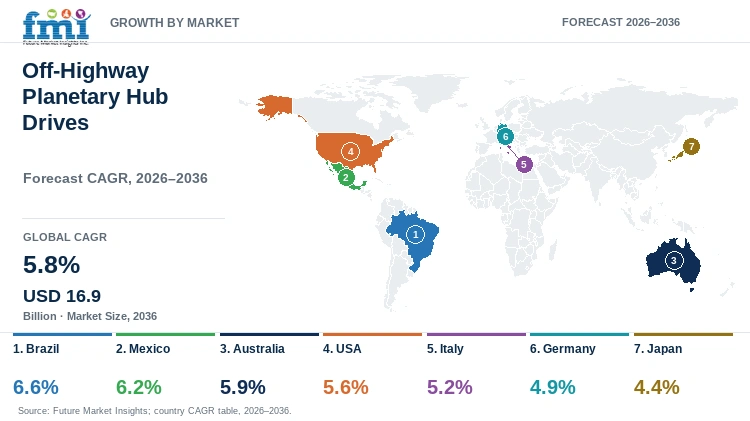
| Country | CAGR |
|---|---|
| Brazil | 6.6% |
| Mexico | 6.2% |
| Australia | 5.9% |
| USA | 5.6% |
| Italy | 5.2% |
| Germany | 4.9% |
| Japan | 4.4% |
How do country-level CAGRs compare in the Off-Highway Planetary Hub Drives Market?
The country CAGRs span 2.2 percentage points between Brazil at 6.6% and Japan at 4.4%. Mexico and Australia form the next growth group while USA and Italy occupy the middle range before Germany and Japan. The spacing describes growth pace rather than current market size and separates countries with different machine-use and service conditions.
- Brazil pairs road-machinery activity with agricultural seasonality, so replacement availability can matter during concentrated equipment-use periods.
- Mexico concentrates maintenance work in national road programs where distributor stock can protect paving fleets from avoidable service delays.
- Australia combines remote operating sites with heavy mining duty, which raises the commercial value of regional repair and parts coverage.
- USA channels component decisions through established OEM programs where supplier continuity depends on quality records and field-service support.
- Italian fleets include many smaller contractors that can defer equipment replacement and rely more heavily on specialist regional distribution.
- Germany combines mature machinery production with long validation cycles that make engineering response important during specification changes.
- Japanese construction programs emphasize automation compatibility, yet long equipment lives can extend the period before a validated component is replaced.
The full report provides country-level CAGR analysis across North America, Latin America, Western Europe, Eastern Europe, East Asia, South Asia and Pacific, and the Middle East and Africa.
Country-wise Analysis
- Brazilian hub-drive demand follows road-machinery utilization and agricultural replacement cycles that both place heavy loads on wheel-end drivetrains. By 2036, Brazil is projected to grow at 6.6% CAGR, supported by new-platform orders and replacement work from machines operating in both sectors. ANFAVEA reported in April 2026 that 37,000 road machines were sold during 2025 and mining strength partly offset weaker construction deliveries. Financing conditions can still postpone fleet replacement even when active mines or farms keep machines working. Drive suppliers need stocked parts and remanufacturing capability because seasonal workloads penalize long repair delays after a qualified reduction fails across regional service networks.
- Mexico's federal road-maintenance program places paving machinery into repeated operating cycles that increase exposure to wheel-end service work. Off-highway planetary hub drive demand in Mexico is forecast to rise at 6.2% CAGR over the forecast period, driven by recurring paving-equipment utilization under the federal program. SICT reported in August 2026 that MegaBachetón work had covered 58,542 kilometers and deployed 5,366 machines during the year. Project phasing can still make parts demand uneven between active corridors and completed sections. Paving fleets also require predictable replacement timing because specialized machines often move between scheduled worksites. Hub-drive suppliers need distributor stock and repair capacity near operating corridors because technical fit alone cannot protect contractors from extended downtime.
- Australian mining fleets operate far from major repair centers and make drivetrain uptime a larger purchasing condition than workshop convenience. Adoption of off-highway planetary hub drives in Australia is estimated to expand at 5.9% CAGR through 2036, supported by heavy-machine renewal tied to ongoing resource projects. CMEIG reported in December 2025 that mining-equipment demand had risen more than 10% over the previous 12 months. Remote operating distances increase the cost of parts delays after a planetary final-drive failure. Forestry equipment adds another dispersed service case where replacement availability influences maintenance planning for mobile fleets. Suppliers need regional repair capacity and sealed high-load drives because operators assess lifecycle support before approving an alternative wheel-end source.
- USA hub-drive purchasing runs through established equipment manufacturers that expect repeatable quality records before approving a different drivetrain source. The USA off-highway planetary hub drives sector is projected to record 5.6% CAGR during the assessment period, supported by equipment production and replacement work that keep qualified suppliers active. AEM reported in March 2026 that construction-equipment manufacturers recorded 2.9% employment growth from 2023 to 2025. That resilience does not remove switching friction because brake and duty-cycle performance still require machine-specific validation. Suppliers with repair capability and available spares can serve production programs and high-utilization fleets through established national service networks. Dealer networks also shape national parts availability after high-utilization fleets move beyond OEM warranty coverage.
- Italian hub-drive demand draws on domestic construction-equipment manufacturing and regional distribution serving earthmoving and road machines after sale. Italy is estimated to post 5.2% CAGR over the forecast period, driven by replacement cycles and project-based equipment purchases that sustain qualified hub-drive demand. Unacea reported in January 2026 that 21,740 construction machines entered the Italian market during 2025 including 1,041 road machines. Small fleets can delay replacement when utilization falls between projects and cash remains tied to other operating needs. Suppliers gain repeat business by supporting OEM design-in and regional repair partners that can return qualified reduction units to service safely and quickly during busy project periods.
- German off-highway buyers combine a mature machinery base with disciplined approval work for components carrying traction loads. Germany's off-highway planetary hub drives outlook is anticipated to advance at 4.9% CAGR over the assessment period, supported by established equipment programs that sustain replacement and platform work. CECE's February 2026 annual report recorded 1% growth in Germany's earthmoving equipment market during 2025 after the previous contraction. That recovery keeps driveline activity moving across new equipment and service demand without shortening validation cycles for a new wheel-end supplier. Suppliers need European repair coverage and engineering response because brake and mounting requirements remain fixed until the OEM accepts a specification change.
- Japanese construction programs are testing more automated and remote work methods that raise requirements for compact interfaces and repeatable control behavior. Off-highway planetary hub drive sales in Japan are forecast to expand at 4.4% CAGR by 2036, attributable to higher-specification drivetrain requirements in automated construction programs. MLIT reported in April 2026 that automated construction cases increased to nine from four and remote-construction cases increased to 41 from 21 during fiscal 2025. Long machine lives still slow component switching after an OEM platform receives formal validation. Suppliers need local engineering support and documented durability because sensor compatibility cannot replace mechanical qualification at a planetary wheel or track drive.
Who are the notable companies in the Off-Highway Planetary Hub Drives Market?
Bonfiglioli S.p.A., Allison Transmission Holdings, Inc., Comer Industries S.p.A., ZF Friedrichshafen AG, Carraro S.p.A., Katsa Oy, Bosch Rexroth AG, Poclain, PMP Industries S.p.A., and Reggiana Riduttori S.r.l. are the notable companies serving this market.
Competition divides between direct planetary-drive specialists and broader off-highway system suppliers that can bundle reduction with axles and electric traction around the same OEM decision. Bonfiglioli S.p.A. and Reggiana Riduttori S.r.l. document wheel or track reduction while Bosch Rexroth AG and Poclain add electric system breadth. Machine qualification and lifecycle support limit entry because a broader industrial gearbox supplier cannot substitute for a validated mobile final drive without matching the machine interface.
- Bonfiglioli S.p.A., Katsa Oy, PMP Industries S.p.A., and Reggiana Riduttori S.r.l. supply dedicated mobile planetary or wheel-drive solutions.
- Allison Transmission Holdings, Inc., Comer Industries S.p.A., ZF Friedrichshafen AG, and Carraro S.p.A. cover broader off-highway driveline systems around final reduction.
- Bosch Rexroth AG and Poclain combine electric drive components with off-highway traction systems serving compact and heavy mobile machinery.
Competitive Benchmarking: Off-Highway Planetary Hub Drives Market
| Company | Mobile Hub/Final-Drive Coverage | Electrified Wheel/Track Integration | Lifecycle Service Fit | Geographic Reach |
|---|---|---|---|---|
| Bonfiglioli S.p.A. | High | High | High | Global |
| Allison Transmission Holdings, Inc. | High | High | High | Global |
| Comer Industries S.p.A. | High | High | Medium | Global |
| ZF Friedrichshafen AG | High | High | High | Global |
| Carraro S.p.A. | Medium | High | Medium | Europe, Americas and Asia |
| Katsa Oy | High | High | Medium | Europe with international projects |
| Bosch Rexroth AG | High | High | High | Global |
| Poclain | High | High | Medium | Global |
| PMP Industries S.p.A. | High | High | Medium | Europe, Asia and Americas |
| Reggiana Riduttori S.r.l. | High | High | Medium | Europe with international distribution |
Scoring basis: High hub/final-drive coverage requires a current direct wheel or track drive family with mobile planetary reduction. Medium reflects a narrower axle or driveline route. High electrified integration requires direct electric traction hardware while Medium reflects adjacent electric drivetrain capability. High lifecycle support requires broad documented service or remanufacturing coverage while Medium indicates narrower support. Geographic reach is descriptive and is not scored.
Key Developments in the Off-Highway Planetary Hub Drives Market
- In March 2026, Carraro S.p.A. presented wheel-loader and telehandler drivelines at CONEXPO with axle and transmission layouts designed for electric or hydrostatic off-highway configurations.
- In March 2026, ZF Friedrichshafen AG introduced its GPT 4F planetary travel gearbox family for construction and mining machines with documented torque coverage reaching 3,000 kNm.
- In January 2026, Allison Transmission Holdings, Inc. completed the acquisition of Dana Incorporated's Off-Highway Drive & Motion Systems business for approximately USD 2.7 billion.
Key Players in the Off-Highway Planetary Hub Drives Market
Mobile Planetary and Wheel-Drive Specialists
- Bonfiglioli S.p.A.
- Katsa Oy
- Reggiana Riduttori S.r.l.
Integrated Off-Highway Driveline Platforms
- Allison Transmission Holdings, Inc.
- Comer Industries S.p.A.
- ZF Friedrichshafen AG
- Carraro S.p.A.
Electric Drive and Mobile-System Suppliers
- Bosch Rexroth AG
- Poclain
- PMP Industries S.p.A.
Off-Highway Planetary Hub Drives Market - Report Scope
| Coverage field | Report scope |
|---|---|
| Market breakdown | By hub drive type, equipment type, torque class, sales channel, application and region. |
| Quantitative Units | USD billion. |
| Market Definition | Complete planetary hub and final-reduction drive units sold for off-highway mobile equipment within the stated segmentation universe. |
| Regions Covered | North America, Latin America, Western Europe, Eastern Europe, East Asia, South Asia and Pacific, and Middle East and Africa. |
| Countries Covered | Brazil, Mexico, Australia, USA, Italy, Germany, Japan, and 30+ countries included in the full report. |
| Key Companies Profiled | Bonfiglioli S.p.A., Allison Transmission Holdings, Inc., Comer Industries S.p.A., ZF Friedrichshafen AG, Carraro S.p.A., Katsa Oy, Bosch Rexroth AG, Poclain, PMP Industries S.p.A., and Reggiana Riduttori S.r.l.. |
| Forecast Period | 2026 to 2036. |
| Approach | Primary and secondary research with market triangulation. |
Off-Highway Planetary Hub Drives Market - Research Methodology
| Method | Approach |
|---|---|
| Primary Research | FMI analysts gathered input from manufacturers, service providers, technology developers, distributors, end users, procurement teams, and subject-matter experts. Interviews examined purchasing decisions, product or service evaluation, adoption barriers, approval requirements, pricing considerations, and expectations for technical or commercial support. Respondents were also asked what evidence is required before a trial, pilot, or initial order develops into regular purchasing. |
| Desk Research | Desk research covered government statistics, regulatory publications, trade data, industry associations, technical literature, standards, company filings, product information, and official corporate announcements. Sources were reviewed for relevance, publication date, geographic coverage, and consistency with the defined market scope. Claims relating to performance, applications, approvals, capacity, investment, and commercial activity were retained only when supported by credible public evidence. |
| Market Sizing and Forecasting | The market model combined the baseline value with historical performance, segment structure, pricing and volume indicators, adoption levels, company participation, and country-level demand conditions. Forecast assumptions considered economic activity, investment trends, regulatory developments, technology adoption, purchasing cycles, supply availability, and barriers to wider market use. Segment and regional estimates were reconciled before the final market total was calculated. |
| Data Validation | Estimates were checked against multiple independent indicators, including public data, company activity, trade patterns, industry developments, and findings from primary interviews. Validation also tested whether products, services, applications, and company revenues fell within the defined market boundaries. Adjacent categories, unsupported claims, overlapping revenues, and activities without direct market relevance were excluded to reduce double counting and maintain consistency across segments and countries. |
Off-Highway Planetary Hub Drives Market by Segments
Off-Highway Planetary Hub Drives Market segmented by Hub Drive Type:
- Wheel hub drives
- Track hub drives
- Axle-integrated planetary hubs
- High-torque final drives
- Compact reduction hubs
Off-Highway Planetary Hub Drives Market segmented by Equipment Type:
- Construction equipment
- Agricultural machinery
- Mining vehicles
- Forestry equipment
- Material handling vehicles
Off-Highway Planetary Hub Drives Market segmented by Torque Class:
- 5-20 kNm
- Below 5 kNm
- 20-50 kNm
- Above 50 kNm
Off-Highway Planetary Hub Drives Market segmented by Sales Channel:
- OEM direct
- Drivetrain Tier-1s
- Aftermarket replacement
- Service/remanufacturing
Off-Highway Planetary Hub Drives Market segmented by Application:
- Final drive
- Wheel drive
- Track propulsion
- Auxiliary traction
Off-Highway Planetary Hub Drives Market by Region:
- North America
- United States
- Canada
- Latin America
- Brazil
- Mexico
- Argentina
- Chile
- Western Europe
- Germany
- France
- United Kingdom
- Italy
- Spain
- Benelux
- Nordics
- Eastern Europe
- Poland
- Czech Republic
- Romania
- Hungary
- East Asia
- China
- Japan
- South Korea
- South Asia and Pacific
- India
- ASEAN
- Australia and New Zealand
- Middle East and Africa
- GCC Countries
- South Africa
- Türkiye
- Israel
Research Sources and Bibliography
- Bosch Rexroth AG. (2025, February 24). Comprehensive electrical portfolio for mobile machines with a wide range of services.
- Presidencia de la República, Mexico. (2025, February 26). Presidenta presenta Programa Nacional de Infraestructura Carretera 2025-2030; se intervendrán 4 mil km para conectar zonas vulnerables.
- Reggiana Riduttori S.r.l. (n.d.). Electric wheel drives - EDRIVES Series. Retrieved September 16, 2026.
- PMP Industries S.p.A. (2025, December 20). PMP at Excon 2025, Bangalore India.
- Bonfiglioli S.p.A. (2025, November). Agritechnica.
- Comer Industries S.p.A. (2025, June 6). Comer Industries and CNH sign cooperation agreement.
- Carraro S.p.A. (2025, September 30). New axles for compactors - dedicated and integrated solutions at the service of efficiency.
- Committee for European Construction Equipment. (2026, February 26). European construction equipment sector sees moderate recovery in 2025 with 4.6% growth in sales.
- Comer Industries S.p.A. (2025, June 13). Caterpillar Supplier Excellence Recognition: Comer Industries is among the top-performing suppliers.
- Carraro S.p.A. (2025, November 12). Carraro and Seederal partner to develop the Next-Generation Fully Electric Tractor.
- Associação Nacional dos Fabricantes de Veículos Automotores. (2026, April 15). Setor de máquinas agrícolas e rodoviárias tem ingresso recorde de importados em 2025 e projeção de recuo em 2026.
- Secretaría de Infraestructura, Comunicaciones y Transportes, Mexico. (2026, August 17). Atiende SICT más de 58 mil km de carreteras con el programa MegaBachetón 2026.
- Construction Mining Equipment Industry Group. (2025, December). CEO’s Address - Summer 2025.
- Association of Equipment Manufacturers. (2026, March 6). New report calls USA equipment manufacturing industry “Selectively Strong”.
- Unacea. (2026, January 28). Italian construction equipment market.
- Committee for European Construction Equipment. (2026, February). Annual Economic Report 2026.
- Ministry of Land, Infrastructure, Transport and Tourism, Japan. (2026, April 28). i-Construction 2.0 second-year results for fiscal 2025.
- Carraro S.p.A. (2026, March 4). Conexpo 2026: between modularity and electrification in Las Vegas.
- ZF Friedrichshafen AG. (2026, March 3). The Future of Construction - Intelligent System Solutions by ZF.
- Allison Transmission Holdings, Inc. (2026, January 2). Allison Transmission completes acquisition of Dana Incorporated’s Off-Highway Drive & Motion Systems business, creating a premier global industrial leader.
- Bonfiglioli S.p.A. (2025, April). Bauma 2025.
- Dana Incorporated. (2025, April 7). Dana Off-Highway Drive and Motion Systems powering OEM sustainability at Bauma 2025.
- Comer Industries S.p.A. (2026, February 5). CONEXPO 2026: for the first time with Comtesco.
- ZF Friedrichshafen AG. (2025, April 4). ZF shows high-tech at the world’s largest construction machinery trade fair Bauma.
- Carraro S.p.A. (2026, March 5). An important engineering services contract with Montra Electric signed by Carraro India for an electric transmission system for agricultural tractors.
- Katsa Oy. (2025, April). Katsa at Bauma exhibition in Munich 7.-13.4.2025.
- Bosch Rexroth AG. (2025, September 25). A software platform for all voltage classes.
- Poclain. (2025, April). Poclain at Bauma Munich 2025.
- PMP Industries S.p.A. (2026, March 15). PMP Industries at CONEXPO 2026 in Las Vegas: innovation and strong presence in the North American market.
- Reggiana Riduttori S.r.l. (2025, November 4). Reggiana Riduttori acquires Borghi Assali Srl.
- Carraro S.p.A. (2026, July 31). Carraro North America inaugurates its new office in Charlotte.
- Bonfiglioli S.p.A. (2026, June). Bonfiglioli at iVT Expo 2026.
- Bosch Rexroth Corporation. (2026, April 13). Bosch Rexroth showcasing simplified solutions for mobile machines at CONEXPO 2026.
- Bonfiglioli S.p.A. (2026, March). CONEXPO | CON/AGG 2026.
- Carraro S.p.A. (2026, July 2). Campodarsego and Solutions & Parts receive Caterpillar Supplier Excellence Recognition.
- PMP Industries S.p.A. (2025, September 28). PMP Industries has inaugurated a new integrated foundry and production plant in Laktaši, Republika Srpska - BiH.
- Comer Industries S.p.A. (n.d.). E-mobility. Retrieved September 16, 2026.
- Bosch Rexroth AG. (n.d.). eLION solutions for mobile machines. Retrieved September 16, 2026.
- Poclain. (n.d.). ePowertrain. Retrieved September 16, 2026.
- PMP Industries S.p.A. (n.d.). Products. Retrieved September 16, 2026.
- ZF Friedrichshafen AG. (n.d.). ZF Aftermarket solutions for construction machinery. Retrieved September 16, 2026.
- Katsa Oy. (n.d.). Vehicles & Rail: Wheel Hub Drives. Retrieved September 16, 2026.
- Twin Disc, Inc. (2024, May 31). Twin Disc, Inc. completes acquisition of Katsa Oy.
This bibliography is provided for reader reference and is not exhaustive. The full report contains the complete reference list and detailed citations.
This Report Answers
- How large is the off-highway planetary hub drives market in 2026?
- Which operating conditions convert equipment activity into qualified hub-drive orders?
- Why do wheel hub drives hold the largest hub-drive-type share?
- How does construction equipment shape planetary final-reduction demand during 2026?
- Why does the 5-20 kNm band lead torque-class demand in 2026?
- How do country CAGRs differ between Brazil and Japan through 2036?
- Which supplier capabilities matter most during OEM qualification and service?
- How are electrified wheel and track architectures changing supplier competition?
Frequently Asked Questions
How big is the off-highway planetary hub drives market in 2026?
The off-highway planetary hub drives market is valued at USD 9.6 billion in 2026 and is projected to reach USD 16.9 billion by 2036. Qualified wheel-end reduction demand rises with new machine programs and service events requiring compact torque multiplication.
What is the CAGR of the off-highway planetary hub drives market from 2026 to 2036?
The off-highway planetary hub drives market is projected to grow at 5.8% CAGR from 2026 to 2036. Growth depends on qualified drivetrain programs and replacement events that convert equipment activity into hub-drive orders.
Which hub drive type leads the off-highway planetary hub drives market?
The wheel hub drives segment is expected to hold 29.0% of hub drive type demand in 2026. Wheel-end packaging places torque multiplication near the driven wheel where braking and compact installation must qualify together.
Which countries record the upper CAGRs in the off-highway planetary hub drives market?
Brazil is projected to grow at 6.6% CAGR and Mexico at 6.2% through 2036. National machinery activity and road-maintenance programs create different service routes even where both countries show comparatively strong expansion.
Which companies are active in the off-highway planetary hub drives market?
Key companies operating in the market include Bonfiglioli S.p.A., Allison Transmission Holdings, Inc., Comer Industries S.p.A., ZF Friedrichshafen AG, Carraro S.p.A., Katsa Oy, Bosch Rexroth AG, Poclain, PMP Industries S.p.A., and Reggiana Riduttori S.r.l.. Their positions differ by direct planetary-drive coverage, electric traction integration, and lifecycle service support.
Preview the report firsthand - request a free sample
Get SampleGet the brochure for pricing and purchase details.
Get PDFTable of Content
- Key Takeaways
- Market Size and CAGR
- Top Growth Driver
- Fastest Growing Segment
- Leading Region
- Key Companies
- Emerging Opportunities
- Executive Summary
- Global Market Outlook
- Demand-side Trends
- Supply-side Trends
- Technology Roadmap Analysis
- Analysis and Recommendations
- Analyst Perspective (What is happening? Why now? What should investors know?)
- Key Questions Answered
- How large is the market?
- What is the CAGR?
- What are key trends?
- Which region dominates?
- Who are the leaders?
- Market Overview
- Market Coverage / Taxonomy
- Market Definition / Scope / Limitations
- Research Methodology
- Chapter Orientation
- Analytical Lens and Working Hypotheses
- Market Structure, Signals, and Trend Drivers
- Benchmarking and Cross-market Comparability
- Market Sizing, Forecasting, and Opportunity Mapping
- Research Design and Evidence Framework
- Desk Research Programme (Secondary Evidence)
- Expert Input and Fieldwork (Primary Evidence)
- Tooling, Models, and Reference Databases
- Data Engineering and Model Build
- Quality Assurance and Audit Trail
- Market Background
- Market Dynamics (Drivers, Restraints, Opportunity, Trends)
- Scenario Forecast (Optimistic, Likely, Conservative)
- Impact Analysis
- AI Impact
- Sustainability Impact
- Regulatory Impact
- Technology Impact
- Consumer / Buyer Analysis
- Purchase Drivers
- Adoption Barriers
- Buyer Journey
- Opportunity Map Analysis
- Product Life Cycle Analysis
- Supply Chain Analysis
- Investment Feasibility Matrix
- Value Chain Analysis
- PESTLE and Porter's Analysis
- Regulatory Landscape
- Regional Parent Market Outlook
- Production and Consumption Statistics
- Import and Export Statistics
- Global Market Analysis and Forecast, 2021 to 2036
- Historical Market Size Value (USD Billion) Analysis, 2021 to 2025
- Current and Future Market Size Value (USD Billion) Projections, 2026 to 2036
- Y-o-Y Growth Trend Analysis
- Absolute $ Opportunity Analysis
- Global Market Pricing Analysis, 2021 to 2036
- Global Market Analysis and Forecast, By Hub Drive Type, 2021 to 2036
- Introduction / Key Findings
- Historical Market Size Value (USD Billion) Analysis By Hub Drive Type, 2021 to 2025
- Current and Future Market Size Value (USD Billion) Analysis and Forecast By Hub Drive Type, 2026 to 2036
- Wheel hub drives
- Track hub drives
- Axle-integrated planetary hubs
- High-torque final drives
- Compact reduction hubs
- Y-o-Y Growth Trend Analysis By Hub Drive Type, 2021 to 2025
- Absolute $ Opportunity Analysis By Hub Drive Type, 2026 to 2036
- Global Market Analysis and Forecast, By Equipment Type, 2021 to 2036
- Introduction / Key Findings
- Historical Market Size Value (USD Billion) Analysis By Equipment Type, 2021 to 2025
- Current and Future Market Size Value (USD Billion) Analysis and Forecast By Equipment Type, 2026 to 2036
- Construction equipment
- Agricultural machinery
- Mining vehicles
- Forestry equipment
- Material handling vehicles
- Y-o-Y Growth Trend Analysis By Equipment Type, 2021 to 2025
- Absolute $ Opportunity Analysis By Equipment Type, 2026 to 2036
- Global Market Analysis and Forecast, By Torque Class, 2021 to 2036
- Introduction / Key Findings
- Historical Market Size Value (USD Billion) Analysis By Torque Class, 2021 to 2025
- Current and Future Market Size Value (USD Billion) Analysis and Forecast By Torque Class, 2026 to 2036
- 5-20 kNm
- Below 5 kNm
- 20-50 kNm
- Above 50 kNm
- Y-o-Y Growth Trend Analysis By Torque Class, 2021 to 2025
- Absolute $ Opportunity Analysis By Torque Class, 2026 to 2036
- Global Market Analysis and Forecast, By Sales Channel, 2021 to 2036
- Introduction / Key Findings
- Historical Market Size Value (USD Billion) Analysis By Sales Channel, 2021 to 2025
- Current and Future Market Size Value (USD Billion) Analysis and Forecast By Sales Channel, 2026 to 2036
- OEM direct
- Drivetrain Tier-1s
- Aftermarket replacement
- Service/remanufacturing
- Y-o-Y Growth Trend Analysis By Sales Channel, 2021 to 2025
- Absolute $ Opportunity Analysis By Sales Channel, 2026 to 2036
- Global Market Analysis and Forecast, By Application, 2021 to 2036
- Introduction / Key Findings
- Historical Market Size Value (USD Billion) Analysis By Application, 2021 to 2025
- Current and Future Market Size Value (USD Billion) Analysis and Forecast By Application, 2026 to 2036
- Final drive
- Wheel drive
- Track propulsion
- Auxiliary traction
- Y-o-Y Growth Trend Analysis By Application, 2021 to 2025
- Absolute $ Opportunity Analysis By Application, 2026 to 2036
- Global Market Analysis and Forecast, By Region, 2021 to 2036
- Introduction
- Historical Market Size Value (USD Billion) Analysis By Region, 2021 to 2025
- Current Market Size Value (USD Billion) Analysis and Forecast By Region, 2026 to 2036
- North America
- Latin America
- Western Europe
- Eastern Europe
- East Asia
- South Asia and Pacific
- Middle East and Africa
- Market Attractiveness Analysis By Region
- North America Market Analysis and Forecast, By Country, 2021 to 2036
- Historical Market Size Value (USD Billion) Trend Analysis By Market Taxonomy, 2021 to 2025
- Market Size Value (USD Billion) Forecast By Market Taxonomy, 2026 to 2036
- By Country
- United States
- Canada
- By Hub Drive Type
- By Equipment Type
- By Torque Class
- By Sales Channel
- By Application
- By Country
- Market Attractiveness Analysis
- By Country
- By Hub Drive Type
- By Equipment Type
- By Torque Class
- By Sales Channel
- By Application
- Key Takeaways
- Latin America Market Analysis and Forecast, By Country
- Historical Market Size Value (USD Billion) Trend Analysis By Market Taxonomy, 2021 to 2025
- Market Size Value (USD Billion) Forecast By Market Taxonomy, 2026 to 2036
- By Country
- Brazil
- Mexico
- Argentina
- Chile
- By Hub Drive Type
- By Equipment Type
- By Torque Class
- By Sales Channel
- By Application
- By Country
- Market Attractiveness Analysis
- By Country
- By Hub Drive Type
- By Equipment Type
- By Torque Class
- By Sales Channel
- By Application
- Key Takeaways
- Western Europe Market Analysis and Forecast, By Country
- Historical Market Size Value (USD Billion) Trend Analysis By Market Taxonomy, 2021 to 2025
- Market Size Value (USD Billion) Forecast By Market Taxonomy, 2026 to 2036
- By Country
- Germany
- France
- United Kingdom
- Italy
- Spain
- Benelux
- Nordics
- By Hub Drive Type
- By Equipment Type
- By Torque Class
- By Sales Channel
- By Application
- By Country
- Market Attractiveness Analysis
- By Country
- By Hub Drive Type
- By Equipment Type
- By Torque Class
- By Sales Channel
- By Application
- Key Takeaways
- Eastern Europe Market Analysis and Forecast, By Country
- Historical Market Size Value (USD Billion) Trend Analysis By Market Taxonomy, 2021 to 2025
- Market Size Value (USD Billion) Forecast By Market Taxonomy, 2026 to 2036
- By Country
- Poland
- Czech Republic
- Romania
- Hungary
- By Hub Drive Type
- By Equipment Type
- By Torque Class
- By Sales Channel
- By Application
- By Country
- Market Attractiveness Analysis
- By Country
- By Hub Drive Type
- By Equipment Type
- By Torque Class
- By Sales Channel
- By Application
- Key Takeaways
- East Asia Market Analysis and Forecast, By Country
- Historical Market Size Value (USD Billion) Trend Analysis By Market Taxonomy, 2021 to 2025
- Market Size Value (USD Billion) Forecast By Market Taxonomy, 2026 to 2036
- By Country
- China
- Japan
- South Korea
- By Hub Drive Type
- By Equipment Type
- By Torque Class
- By Sales Channel
- By Application
- By Country
- Market Attractiveness Analysis
- By Country
- By Hub Drive Type
- By Equipment Type
- By Torque Class
- By Sales Channel
- By Application
- Key Takeaways
- South Asia and Pacific Market Analysis and Forecast, By Country
- Historical Market Size Value (USD Billion) Trend Analysis By Market Taxonomy, 2021 to 2025
- Market Size Value (USD Billion) Forecast By Market Taxonomy, 2026 to 2036
- By Country
- India
- ASEAN
- Australia and New Zealand
- By Hub Drive Type
- By Equipment Type
- By Torque Class
- By Sales Channel
- By Application
- By Country
- Market Attractiveness Analysis
- By Country
- By Hub Drive Type
- By Equipment Type
- By Torque Class
- By Sales Channel
- By Application
- Key Takeaways
- Middle East and Africa Market Analysis and Forecast, By Country
- Historical Market Size Value (USD Billion) Trend Analysis By Market Taxonomy, 2021 to 2025
- Market Size Value (USD Billion) Forecast By Market Taxonomy, 2026 to 2036
- By Country
- GCC Countries
- South Africa
- Türkiye
- Israel
- By Hub Drive Type
- By Equipment Type
- By Torque Class
- By Sales Channel
- By Application
- By Country
- Market Attractiveness Analysis
- By Country
- By Hub Drive Type
- By Equipment Type
- By Torque Class
- By Sales Channel
- By Application
- Key Takeaways
- Key Countries Market Analysis
- United States
- Pricing Analysis
- Market Share Analysis, 2025
- By Hub Drive Type
- By Equipment Type
- By Torque Class
- By Sales Channel
- By Application
- Canada
- Pricing Analysis
- Market Share Analysis, 2025
- By Hub Drive Type
- By Equipment Type
- By Torque Class
- By Sales Channel
- By Application
- Mexico
- Pricing Analysis
- Market Share Analysis, 2025
- By Hub Drive Type
- By Equipment Type
- By Torque Class
- By Sales Channel
- By Application
- Brazil
- Pricing Analysis
- Market Share Analysis, 2025
- By Hub Drive Type
- By Equipment Type
- By Torque Class
- By Sales Channel
- By Application
- Chile
- Pricing Analysis
- Market Share Analysis, 2025
- By Hub Drive Type
- By Equipment Type
- By Torque Class
- By Sales Channel
- By Application
- Germany
- Pricing Analysis
- Market Share Analysis, 2025
- By Hub Drive Type
- By Equipment Type
- By Torque Class
- By Sales Channel
- By Application
- United Kingdom
- Pricing Analysis
- Market Share Analysis, 2025
- By Hub Drive Type
- By Equipment Type
- By Torque Class
- By Sales Channel
- By Application
- Italy
- Pricing Analysis
- Market Share Analysis, 2025
- By Hub Drive Type
- By Equipment Type
- By Torque Class
- By Sales Channel
- By Application
- Spain
- Pricing Analysis
- Market Share Analysis, 2025
- By Hub Drive Type
- By Equipment Type
- By Torque Class
- By Sales Channel
- By Application
- France
- Pricing Analysis
- Market Share Analysis, 2025
- By Hub Drive Type
- By Equipment Type
- By Torque Class
- By Sales Channel
- By Application
- India
- Pricing Analysis
- Market Share Analysis, 2025
- By Hub Drive Type
- By Equipment Type
- By Torque Class
- By Sales Channel
- By Application
- ASEAN
- Pricing Analysis
- Market Share Analysis, 2025
- By Hub Drive Type
- By Equipment Type
- By Torque Class
- By Sales Channel
- By Application
- Australia and New Zealand
- Pricing Analysis
- Market Share Analysis, 2025
- By Hub Drive Type
- By Equipment Type
- By Torque Class
- By Sales Channel
- By Application
- China
- Pricing Analysis
- Market Share Analysis, 2025
- By Hub Drive Type
- By Equipment Type
- By Torque Class
- By Sales Channel
- By Application
- Japan
- Pricing Analysis
- Market Share Analysis, 2025
- By Hub Drive Type
- By Equipment Type
- By Torque Class
- By Sales Channel
- By Application
- South Korea
- Pricing Analysis
- Market Share Analysis, 2025
- By Hub Drive Type
- By Equipment Type
- By Torque Class
- By Sales Channel
- By Application
- Poland
- Pricing Analysis
- Market Share Analysis, 2025
- By Hub Drive Type
- By Equipment Type
- By Torque Class
- By Sales Channel
- By Application
- Hungary
- Pricing Analysis
- Market Share Analysis, 2025
- By Hub Drive Type
- By Equipment Type
- By Torque Class
- By Sales Channel
- By Application
- Türkiye
- Pricing Analysis
- Market Share Analysis, 2025
- By Hub Drive Type
- By Equipment Type
- By Torque Class
- By Sales Channel
- By Application
- South Africa
- Pricing Analysis
- Market Share Analysis, 2025
- By Hub Drive Type
- By Equipment Type
- By Torque Class
- By Sales Channel
- By Application
- Australia
- Pricing Analysis
- Market Share Analysis, 2025
- By Hub Drive Type
- By Equipment Type
- By Torque Class
- By Sales Channel
- By Application
- United States
- Market Structure Analysis
- Competition Dashboard
- Competition Benchmarking
- Market Share Analysis of Top Players
- By Regional
- By Hub Drive Type
- By Equipment Type
- By Torque Class
- By Sales Channel
- By Application
- Emerging Startups
- Innovation Benchmarking
- Competition Analysis
- Competition Deep Dive
- Bonfiglioli S.p.A.
- Overview
- Product Portfolio
- Profitability by Market Segments
- Sales Footprint
- Strategy Overview
- Marketing Strategy
- Product Strategy
- Channel Strategy
- Allison Transmission Holdings, Inc.
- Comer Industries S.p.A.
- ZF Friedrichshafen AG
- Carraro S.p.A.
- Katsa Oy
- Bosch Rexroth AG
- Poclain
- PMP Industries S.p.A.
- Reggiana Riduttori S.r.l.
- Bonfiglioli S.p.A.
- Case Studies
- Success Stories
- Recent Developments
- Competition Deep Dive
- Assumptions & Acronyms Used


