
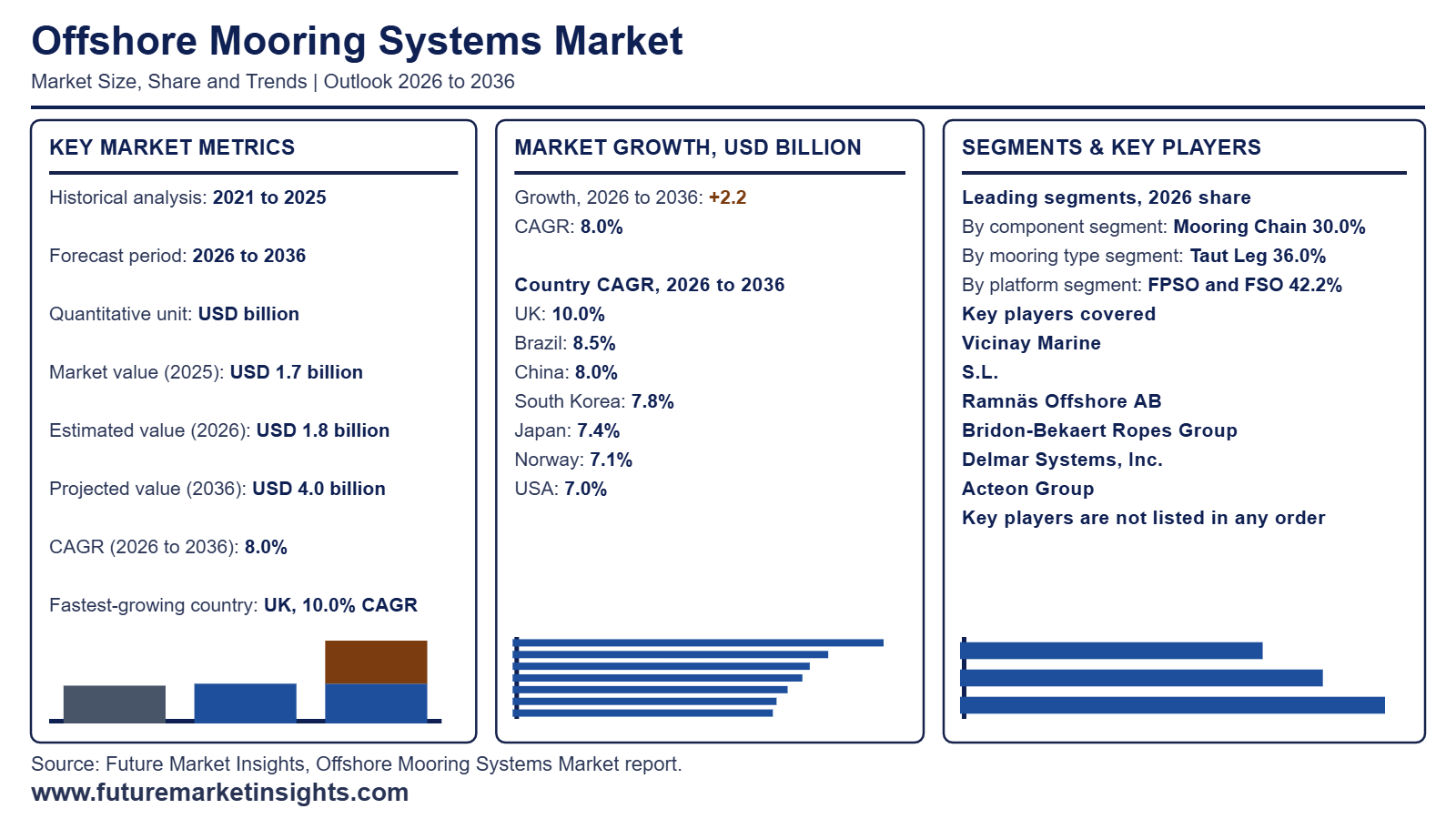
- Market Size (2026)
- USD 1.8 Bn
- Forecast (2036)
- USD 4.0 Bn
- CAGR (2026 to 2036)
- 8.0%
How Big Is the Offshore Mooring Systems Market in 2026?
Global offshore mooring systems market valuation was valued at USD 1.7 billion in 2025 to USD 1.8 billion in 2026 and is estimated to reach USD 4.0 billion by 2036, expanding at an 8.0% CAGR during the forecast period. FMI finds that rising industrial investment in deepwater hydrocarbon production and floating wind arrays generates an incremental opportunity of USD 2.2 billion as marine contractors lock in multi-line station-keeping packages.
| Market Metric | Valuation / Share / Forecast Benchmark |
|---|---|
| 2025 Market Size (Historical) | USD 1.7 billion |
| 2026 Market Size (Estimated) | USD 1.8 billion |
| 2036 Market Size (Projected) | USD 4.0 billion |
| Compound Annual Growth Rate (2026 to 2036) | 8.0% CAGR |
| Incremental Dollar Opportunity (2026 to 2036) | USD 2.2 billion |
| Dominant Component Segment (2026 Share) | Mooring Chain (30.0% share in 2026) | Other Segment Combined (70.0%) |
| Leading Mooring Type Segment (2026 Share) | Taut Leg (36.0% share in 2026) | Other Segment Combined (64.0%) |
| Leading Platform Segment (2026 Share) | FPSO and FSO (42.2% share in 2026) | Other Segment Combined (57.8%) |
| Leading Depth Segment (2026 Share) | 1,000 m to 2,000 m (30.0% share in 2026) | Other Segment Combined (70.0%) |
| Fastest-Growing Country Markets (2026 to 2036) | UK (10.0% CAGR), Brazil (8.5% CAGR), China (8.0% CAGR) |
| Leading Tier-1 Companies | Vicinay Marine, S.L., Ramnäs Offshore AB, Bridon-Bekaert Ropes Group, Delmar Systems, Inc., Acteon Group |
Source: Future Market Insights analysis of the offshore mooring systems market, 2026.
Executive Market Overview
Demand for offshore mooring systems is rising due to sustained capital expenditure on deepwater floating production units and government-backed floating wind auctions. Oilfield operators and marine engineering contractors are expanding buyer adoption of pre-laid multi-line station-keeping packages to avoid forge queue delays and vessel bottlenecks. Regulatory approvals released by the Agência Nacional do Petróleo, Gás Natural e Biocombustíveis (December 2025) authorized the P-78 floating production unit to start operations at the Búzios field with daily capacity for 180,000 barrels of oil and 7.2 million cubic meters of gas. In addition to this, auction results published by the Department for Energy Security and Net Zero (February 2026) awarded Contracts for Difference to the 100.0 MW Erebus and 92.5 MW Pentland floating wind projects, which is pushing parallel orders for subsea umbilicals risers and flowlines. As per FMI, country-level expansion is led by the UK at a 10.0% CAGR and Brazil at an 8.5% CAGR through 2036, outpacing the USA at 7.0% CAGR and Norway at 7.1% CAGR because British floating wind allocation rounds and Brazilian pre-salt vessel schedules are moving into active hardware procurement faster than North American offshore wind leases.
Sales growth across the industry is shaped by buyer preference for fatigue-verified steel links, cut-resistant synthetic ropes, and submerged tensioners that lower offshore hookup risk. FMI analysis suggests that the sibling fpso category will expand at a 12.5% CAGR and subsea equipment will advance at 7.3% CAGR through 2036, whereas offshore mooring systems grow at an 8.0% CAGR on account of station-keeping hardware representing a focused line-and-anchor capital package rather than full hull fabrication. Standards updates documented by DNV Group AS (October 2026) confirm that the third edition of ISO 19901-7 incorporates reliability-based design rules from the NorMoor joint industry project, saving operators NOK 40.0 million for a two-year life extension and NOK 100.0 million for a five-year life extension on a 16-line spread. Market scope covers offshore mooring chains, anchors, synthetic and wire ropes, connectors, fairleads, tensioners, and attributable installation engineering, while excluding floating hulls, turbines, and harbor mooring bollards.
This Report Answers
- How large the offshore mooring systems market is in 2026 and what it reaches by 2036
- Which component, mooring type, platform and depth segments lead in 2026
- What is driving deepwater station-keeping demand and what restrains project awards
- Which countries grow fastest between 2026 and 2036
- What Vicinay Marine, S.L. and other leading players have launched or contracted
- How the offshore mooring systems market is defined, segmented and measured
Analyst Perspective
"Offshore mooring suppliers will expand revenue faster than tonnage volume by bundling pre-qualified subsea tensioners, cut-resistant synthetic fiber sections, and real-time corrosion sensors that reduce offshore hookup vessel days. The primary margin risk is geotechnical redesign and permitting delays in floating wind leases, which can defer hardware fabrication releases by twelve to eighteen months."
- Nikhil Kaitwade, Principal Consultant, Future Market Insights.
Key Market Trends & Insights
- Reliability-Based ISO 19901-7 Calibration Extends Brownfield Mooring Life: Deepwater production operators are increasing adoption of calibrated safety factors to extend the operating life of aging station-keeping spreads without replacing entire chain catenaries prematurely. FMI survey reflects that integrity engineers now prefer targeted link replacement and fairlead refurbishment to keep brownfield units compliant across harsh basins. Technical disclosures from DNV Group AS (October 2026) confirm that incorporating NorMoor joint industry project data into the third edition of ISO 19901-7 enables NOK 40.0 million in cost savings for a two-year life extension and NOK 100.0 million for a five-year extension across a 16-line unit paired with offshore drilling riser overhauls. Standardized degradation modeling is projected to sustain selective replacement orders through 2036.
- Cut-Resistant Fiber Jackets and Low-Recoil Synthetic Lines Gain Traction: Floating production and wind developers are shifting purchasing preferences toward jacketed polyester and high-modulus polyethylene lines due to the need for lower suspended line weight and protection against seabed abrasion. Lighter synthetic mid-sections reduce top-tension loads on fairleads and permit smaller offshore support vessel spreads during pre-lay installation campaigns. Project records from Lankhorst Offshore (May 2025) document the supply of Cabral 512 polyester ropes protected by LankoShield cut-resistant jackets for the 3.0 MW Culzean floating wind pilot in the UK North Sea, while Lankhorst Ropes (August 2026) introduced its Lankoline 3XR low-recoil mooring rope at SMM 2026. Analysts at FMI note that enhanced jacket durability and recoil control will widen synthetic rope sales across deepwater developments through 2036.
- Submerged Corrosion Telemetry and Off-Vessel Tensioning Cut Hookup Exposure: Machinery investment among mooring hardware manufacturers is increasingly directed toward wireless degradation sensors and off-vessel mechanical latch systems that remove hazardous chain-pulling work from platform decks. Placement of tensioning assemblies directly on the mooring line reduces winch weight on the hull and shortens vessel charter durations in ultra-deep water. Joint development records from Tecnalia Research & Innovation (May 2026) highlight the testing of a remote ultrasonic corrosion sensor with Vicinay Marine for submerged chain links, while Bardex Corporation (March 2025) signed a memorandum of understanding with Gabriel Engineering Group to scale off-vessel tensioning and anchoring assemblies paired with wire rope sling handling gear. FMI predicts that condition-based monitoring and deck-free tensioning will reshape buyer specifications through 2036.
What Are the Main Drivers, Restraints, and Opportunities?
FMI's demand analysis indicates that sanctioned deepwater floating production units and government-backed floating wind auctions drive core station-keeping sales, whereas federal leasing pauses and strict soil qualification restrain near-term procurement, leaving brownfield integrity contracts and digital corrosion monitoring as key expansion opportunities.
Driver: Multi-Year Deepwater FPSO Commissioning and Contracted Floating Wind Allocations
Offshore energy developers and floating production operators are procuring high-tensile mooring systems as oil and gas extraction and floating wind projects advance into deepwater environments beyond 1,000 meters. Floating production storage and offloading vessels and floating wind turbines require taut-leg and semi-taut synthetic fiber mooring spreads to maintain precise station-keeping in harsh marine conditions. Offshore installation records published by the International Marine Contractors Association (May 2025) documented record deepwater mooring deployments across South America and West Africa. FMI estimates that expanding deepwater hydrocarbon developments and commercial-scale floating offshore wind farms will drive robust procurement of polyester mooring lines, subsea anchors, and mooring chains through 2036.
Restraint: Geotechnical Requalification Hurdles and Federal Offshore Wind Leasing Pauses
Severe marine fatigue, subsea corrosion, and high vessel installation costs restrain deepwater mooring expansion. Deploying heavy anchor handling tug supply vessels for deepwater pre-lay operations incurs substantial daily charter rates, straining offshore exploration budgets during periods of oil price volatility. In addition, offshore engineering guidelines published by DNV (June 2025) mandate strict non-destructive testing and periodic replacement of mooring chains exposed to microbiologically influenced corrosion and cyclic wave fatigue. Because offshore exploration operators face persistent capital discipline, elevated mobilization fees and stringent mooring recertification cycles encourage field operators to extend existing mooring infrastructure rather than ordering complete replacement systems through 2036.
Opportunity: Brownfield Mooring Integrity Contracts and Submerged Sensor Retrofits
Mooring equipment manufacturers can capture substantial long-term growth by designing lightweight synthetic mooring lines, quick-release connectors, and shared anchor systems tailored for commercial floating offshore wind arrays. Shared mooring configurations allow adjacent floating turbine foundations to connect to common subsea suction piles, reducing seabed footprint and installation costs. Renewable energy technical reports published by the National Renewable Energy Laboratory (September 2025) confirmed that optimized shared mooring layouts reduce floating wind platform balance-of-system capital expenditure by up to 15.0%. FMI projects that commercial floating wind lease auctions across Europe and Asia Pacific will accelerate investments in high-durability synthetic mooring solutions through 2036.
How Is the Offshore Mooring Systems Market Segmented?
Offshore Mooring Systems Market is segmented by Component, Mooring Type, Platform, Depth, and Region. Forecast period from 2026 to 2036.
| Segmentation Axis | Sub-Segments Covered | 2026 Leading Segment & Share | Other Segment Combined & Total |
|---|---|---|---|
| Component | Mooring Chain, Anchors (Drag, Pile, Suction), Synthetic and Wire Rope, Connectors, Fairleads and Tensioners, Installation and Engineering | Mooring Chain (30.0% share in 2026) | Other Segment Combined (70.0%) | Total (100.0%) |
| Mooring Type | Taut Leg, Catenary, Semi-Taut and Spread, Single Point Mooring and Turret | Taut Leg (36.0% share in 2026) | Other Segment Combined (64.0%) | Total (100.0%) |
| Platform | FPSO and FSO, Floating Wind, Floating Production Semi-Submersible, Drilling Rigs | FPSO and FSO (42.2% share in 2026) | Other Segment Combined (57.8%) | Total (100.0%) |
| Depth | 1,000 m to 2,000 m, 300 m to 1,000 m, Above 2,000 m, Below 300 m | 1,000 m to 2,000 m (30.0% share in 2026) | Other Segment Combined (70.0%) | Total (100.0%) |
| Region | North America, Latin America, Western Europe, Eastern Europe, East Asia, South Asia and Pacific, Middle East and Africa | Latin America & Europe (led by UK at 10.0% CAGR) | Global Coverage Across 7 Core Countries (100.0%) |
Source: Future Market Insights analysis of the offshore mooring systems market, 2026.
Why Does the Mooring Chain Segment Lead by Component?
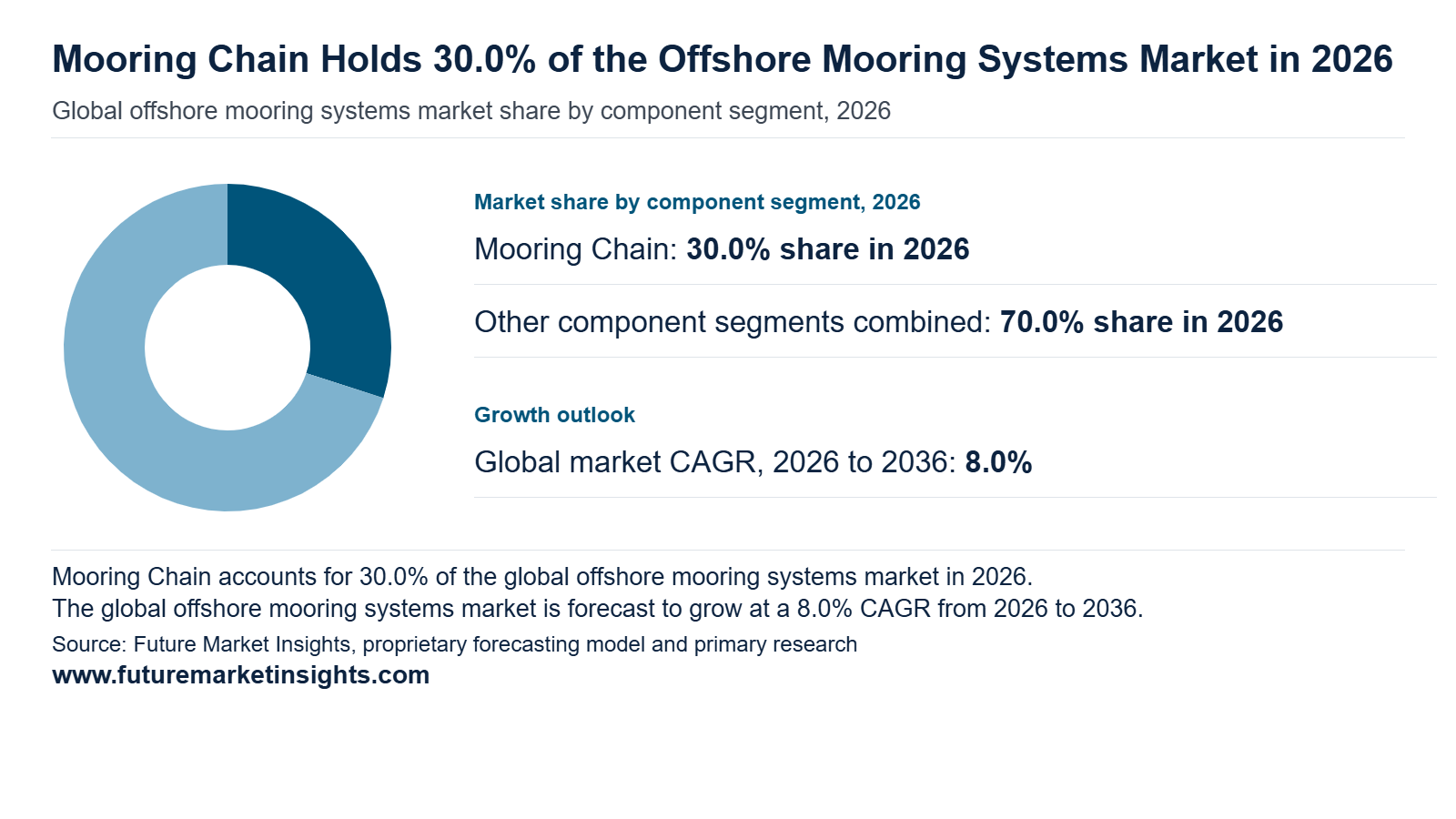
In 2026, 30.0% of component revenue is concentrated in mooring chain, owing to the technical requirement for heavy R4 and R5 studless steel links at top fairlead interfaces and seabed touchdown zones where cyclic bending and rock abrasion damage unprotected fiber lines. Even when naval architects insert lightweight polyester mid-sections to reduce suspended weight, every mooring leg still requires forged top and bottom chain tails to engage platform windlasses and anchor shackles. Technical releases from DNV Group AS (October 2026) confirm that the updated ISO 19901-7 standard integrates fourth-phase NorMoor chain degradation criteria to optimize link replacement intervals, while Tecnalia Research & Innovation (May 2026) and Vicinay Marine tested continuous corrosion telemetry on submerged chain links. FMI's procurement tracking shows that mandatory metallurgical traceability and high interface loading are expected to keep mooring chain as the top component segment through 2036.
What Keeps the Taut Leg Segment Ahead Within Mooring Type?
Buyer preference within the mooring type category places taut leg configurations in the lead with a 36.0% share in 2026, attributed to their compact seabed footprint compared to wide catenary spreads in congested subsea corridors. Inclined lines operating under constant tension transfer vertical and horizontal loads directly into suction piles or vertically loaded anchors, avoiding the long drag-chain sweep that can foul adjacent flowlines and export cables in floating offshore wind energy arrays. Operational reports from the Embassy of the People's Republic of China in the Lao People's Democratic Republic (August 2026) confirm that China connected the 16.0 MW Haiyou Guanlan tension-leg and taut-moored floating wind platform to the Lufeng offshore oilfield grid at a water depth of 136.0 meters, supplying 22.0 million kilowatt-hours annually. FMI believes that superior station-keeping stiffness and reduced seabed disturbance will sustain taut leg leadership through 2036.
How Do FPSO and FSO Installations Shape Platform Demand?
Platform sales data for 2026 shows FPSO and FSO vessels capturing 42.2% of category demand due to permanently stationed hydrocarbon processing hulls requiring high-redundancy sixteen-to-twenty-four-line spreads engineered for uninterrupted twenty-five-year service without dry-docking. Unlike mobile drilling units that relocate every few months using releasable moorings, floating production vessels carry heavy topside processing modules and riser porches that require permanent anchor-to-fairlead integrity management. Regulatory filings from the Agência Nacional do Petróleo, Gás Natural e Biocombustíveis (December 2025) document operational clearance for the P-78 unit at the Búzios field, while corporate disclosures from MODEC, Inc. (November 2025) detail the formal merger of SOFEC into its Mooring Solutions Business Unit effective January 2026. FMI's engineering survey indicates that sustained pre-salt and West African production deployments are projected to keep FPSO and FSO platforms ahead of all other platform types through 2036.
Why Is the 1,000 m to 2,000 m Band the Leading Depth Segment?
Projects situated in the 1,000 m to 2,000 m band account for 30.0% of depth demand in 2026, driven by deepwater oil basins and next-generation floating wind sites that require engineered chain-polyester hybrid lines and high-holding-capacity suction anchors. At these depths, pure steel catenary lines impose excessive vertical weight on the hull, prompting contractors to specify in-line subsea tensioners and cut-resistant synthetic segments. Field deployment records from Acteon Group (August 2026) highlight the award of a third Petrobras contract to InterMoor for deepwater mooring and subsea asset integrity across Brazilian pre-salt basins operating between 1,000 and 2,000 meters, while Lankhorst Offshore (May 2025) supplied jacketed polyester lines for deepwater station-keeping qualification. FMI's project pipeline review suggests that deepwater development campaigns in South America and Europe will preserve the 1,000 m to 2,000 m band's lead through 2036.
Regional & Country Outlook
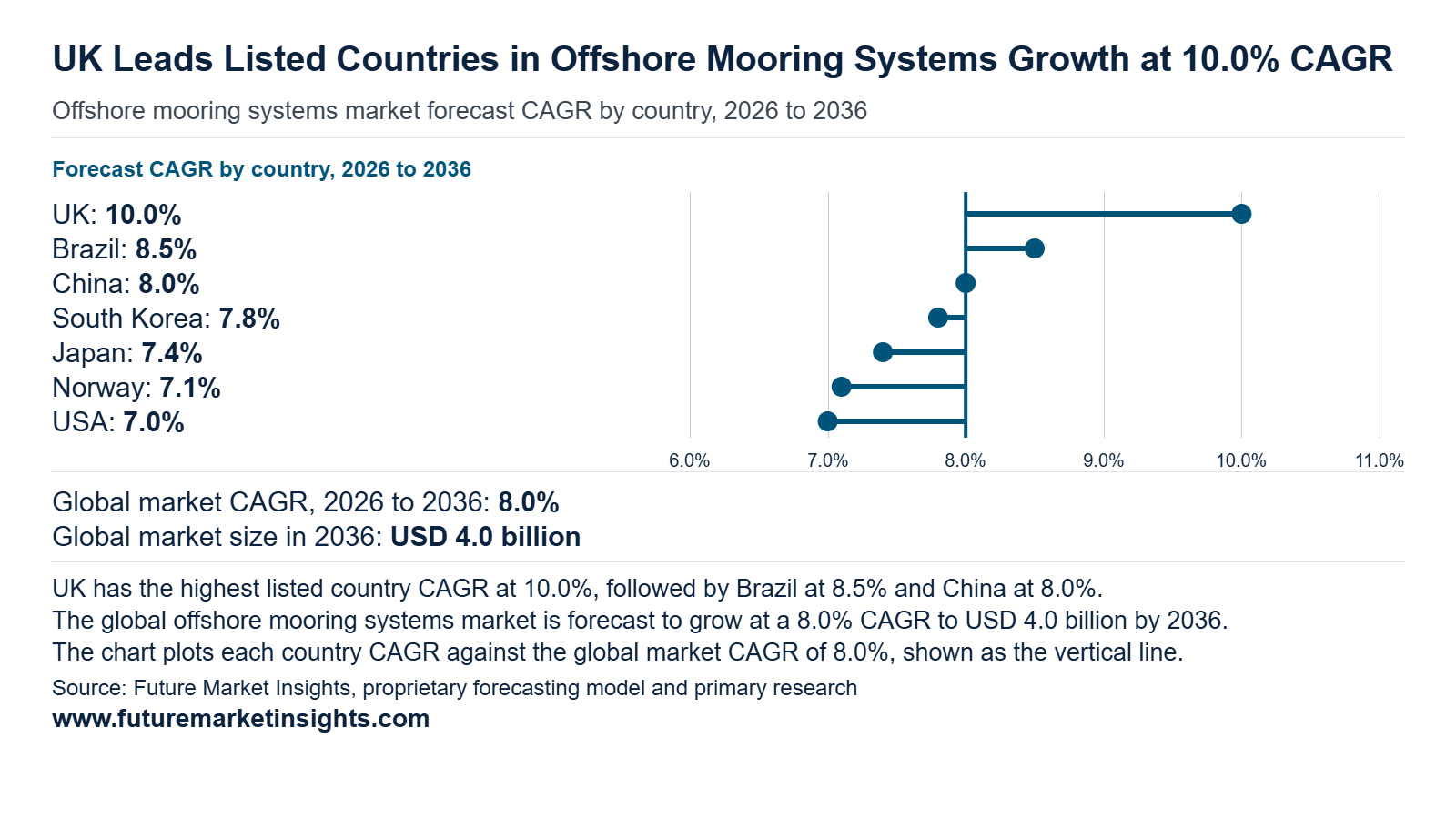
Latin America, Western Europe, and East Asia anchor global offshore mooring systems sales, while European and Asian floating wind corridors post rapid percentage gains as government auction frameworks move into execution. FMI's analysis indicates that the UK leads national growth rates at a 10.0% CAGR from 2026 to 2036, followed by Brazil at 8.5% CAGR and China at 8.0% CAGR. South Korea advances at 7.8% CAGR, Japan at 7.4% CAGR, Norway at 7.1% CAGR, and the USA at 7.0% CAGR, creating a 3.0 percentage point spread across the seven profiled countries as contractors balance deepwater hydrocarbon tenders with floating wind pre-lay schedules.
| Country | 2026 Revenue | 2036 Revenue | 10-Year Addition | 2026 to 2036 CAGR | Global Share (2026 -> 2036) |
|---|---|---|---|---|---|
| Brazil | USD 360.0 million | USD 814.0 million | +USD 454.0 million | 8.5% | 20.0% -> 20.4% |
| USA | USD 324.0 million | USD 637.3 million | +USD 313.3 million | 7.0% | 18.0% -> 15.9% |
| UK | USD 216.0 million | USD 560.2 million | +USD 344.2 million | 10.0% | 12.0% -> 14.0% |
| China | USD 252.0 million | USD 544.0 million | +USD 292.0 million | 8.0% | 14.0% -> 13.6% |
| Norway | USD 180.0 million | USD 357.5 million | +USD 177.5 million | 7.1% | 10.0% -> 8.9% |
| South Korea | USD 126.0 million | USD 267.0 million | +USD 141.0 million | 7.8% | 7.0% -> 6.7% |
| Japan | USD 90.0 million | USD 183.8 million | +USD 93.8 million | 7.4% | 5.0% -> 4.6% |
Source: Future Market Insights analysis of the offshore mooring systems market, 2026.
Brazil
Demand for offshore mooring systems across Brazil is projected to climb from USD 360.0 million in 2026 to USD 814.0 million by 2036, expanding at an 8.5% CAGR and adding USD 454.0 million in new value. In FMI's assessment, Brazil differs from the global market because national procurement is driven almost entirely by ultra-deepwater pre-salt FPSO spread moorings rather than offshore wind, prompting global chain forgers and installation contractors to establish permanent quayside bases in Rio de Janeiro and Espírito Santo. Official regulatory clearances from the Agência Nacional do Petróleo, Gás Natural e Biocombustíveis (December 2025) authorized the P-78 unit to begin operations at the Búzios field with 180,000 barrels per day of oil capacity, while Pré-Sal Petróleo S.A. (October 2025) confirmed that the Almirante Tamandaré unit reached 225,000 barrels per day in August 2025 in addition to contracted P-84 and P-85 hulls. Multi-year stack-up maintenance awards to Acteon Group (August 2026) and Petrobras local-content rules will decide Brazilian deepwater mooring demand through 2036.
USA
Sales of offshore mooring systems in the USA are forecast to grow from USD 324.0 million in 2026 to USD 637.3 million by 2036, exhibiting a 7.0% CAGR that contributes USD 313.3 million in incremental revenue. FMI observes that the American market diverges from European peers because federal wind leasing pauses have shifted supplier focus back toward high-pressure floating production units and mobile drilling rig moorings in the Gulf of America. Production records from the U.S. Energy Information Administration (September 2026) confirm that four deepwater Gulf platforms, namely Shenandoah at 70,000 barrels per day, Ballymore at 58,000 barrels per day, Whale at 38,000 barrels per day, and Salamanca at 25,000 barrels per day, lifted regional offshore output by 10.0% in the first half of 2026, while the Bureau of Ocean Energy Management (July 2025) rescinded designated Wind Energy Areas. Future U.S. market growth through 2036 will depend on Paleogene Gulf tieback sanctioning and brownfield tensioning retrofits.
UK
Buyer adoption of offshore mooring systems within the UK is estimated to surge from USD 216.0 million in 2026 to USD 560.2 million by 2036, advancing at a market-leading 10.0% CAGR and generating USD 344.2 million in expansion value. FMI finds that the UK outpaces every other country because binding Contracts for Difference strike prices are moving Celtic Sea and Scottish floating wind projects from single-turbine pilots into multi-line array procurement coupled with North Sea platform electrification. Auction results published by the Department for Energy Security and Net Zero (February 2026) in Allocation Round 7 awarded Contracts for Difference to the 100.0 MW Erebus project in Wales and the 92.5 MW Pentland project in Scotland, while Lankhorst Offshore (May 2025) delivered LankoShield cut-resistant polyester lines for TotalEnergies' 3.0 MW Culzean floating wind pilot. Port marshaling upgrades in Scottish harbors and shared-anchor array engineering will govern UK supplier sales through 2036.
China
Industrial investment in offshore mooring systems throughout China is projected to rise from USD 252.0 million in 2026 to USD 544.0 million by 2036, progressing at an 8.0% CAGR that adds USD 292.0 million in revenue. FMI's country tracking shows that China stands apart from Western markets because state energy corporations and domestic chain mills co-develop typhoon-resistant taut-leg and tension-leg moorings to power offshore oilfields and provincial wind zones. Official announcements from the Fujian Provincial Department of Industry and Information Technology (July 2025) documented the rollout of a 17.0 MW direct-drive floating wind turbine in Fuqing with a 262.0 meter rotor diameter capable of generating 68.0 million kilowatt-hours annually, while the Embassy of the People's Republic of China in the Lao People's Democratic Republic (August 2026) confirmed continuous grid power from the 16.0 MW Haiyou Guanlan platform. Domestic R5 chain certification and deepwater South China Sea field development will determine Chinese market expansion through 2036.
Norway
Consumption of offshore mooring systems across Norway is forecast to advance from USD 180.0 million in 2026 to USD 357.5 million by 2036, reflecting a 7.1% CAGR and creating USD 177.5 million in new business. FMI expects Norwegian demand to differ from greenfield Asian markets by combining strict life-extension recertification on Norwegian Continental Shelf semi-submersibles with staged floating wind engineering at Utsira Nord. Official awards from the Ministry of Energy, Norway (December 2025) allocated two Utsira Nord floating wind project areas of 500.0 MW each to the Equinor/Vårgrønn and Harald/Deep Wind Offshore/EDF Renewables consortia following the September 2025 application close, while DNV Group AS (October 2026) confirmed that Norwegian Ocean Industry Authority regulations mandate the revised ISO 19901-7 mooring standard. State investment support mechanisms and harsh-environment fatigue rules will shape Norwegian mooring orders through 2036.
South Korea
Offshore mooring systems revenue across South Korea is set to expand from USD 126.0 million in 2026 to USD 267.0 million by 2036, driven by a 7.8% CAGR that contributes USD 141.0 million in incremental sales. In FMI's view, South Korea occupies a distinct position in the global supply chain because Ulsan and Geoje shipyards integrate turret and spread mooring packages onto exported FPSO hulls while domestic utilities bid into centralized floating wind tenders. Tender outcomes released by the Ministry of Climate, Energy and Environment, South Korea (June 2026) selected five offshore wind projects totaling 1,786.0 MW in the first-half 2026 bidding round, including a 532.0 MW floating wind farm, after the Ministry of Climate, Energy and Environment, South Korea (March 2026) enacted its government-led Planned Site system effective March 26, 2026. Grid connection milestones off Ulsan and international FPSO backlog execution will drive South Korean hardware demand through 2036.
Japan
Procurement of offshore mooring systems within Japan is tracking from USD 90.0 million in 2026 to USD 183.8 million by 2036, exhibiting a 7.4% CAGR and adding USD 93.8 million to national market size. FMI notes that Japanese demand differs from European basins because steep near-shore bathymetry and seismic loading force utilities to adopt hybrid-spar and semi-submersible moorings very close to shore, while Tokyo-based EPCs manage global FPSO mooring tenders. Official operational notices from the Ministry of Economy, Trade and Industry, Japan (January 2026) confirmed that the Goto Floating Wind Farm LLC commenced operation of 16.8 MW of hybrid-spar floating wind capacity across eight 2.1 MW turbines off Goto City in Nagasaki Prefecture on January 5, 2026, while MODEC, Inc. (November 2025) consolidated SOFEC into its Tokyo-led Mooring Solutions Business Unit. Exclusive Economic Zone wind legislation and fishery co-existence agreements will decide the pace of Japanese mooring adoption through 2036.
Competitive Environment and Notable Companies
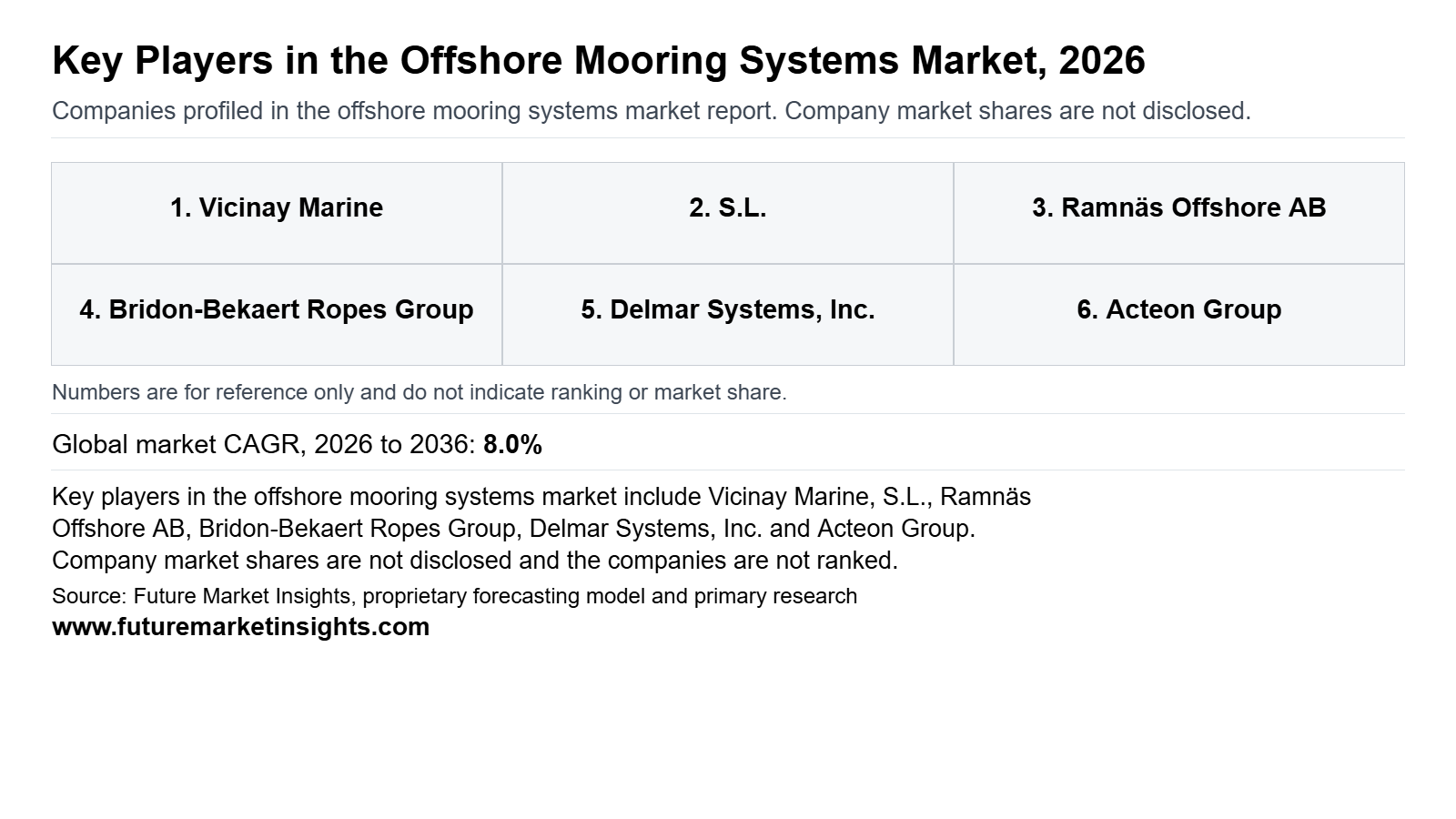
Notable companies operating in the global offshore mooring systems market include Vicinay Marine, S.L., Ramnäs Offshore AB, Bridon-Bekaert Ropes Group, Delmar Systems, Inc., Lankhorst Offshore, Balltec Ltd., Bardex Corporation, Vryhof Anchors B.V., Acteon Group, and MODEC, Inc. FMI's competitive benchmarking shows that rivalry spans three specialized tiers across heavy offshore chain and synthetic rope manufacturers, integrated anchoring and pre-lay installation contractors, and subsea mechanical connector, tensioner, and turret engineering specialists.
How Are Companies Positioned in the Offshore Mooring Systems Market?
Heavy line manufacturers including Vicinay Marine, S.L., Ramnäs Offshore AB, Bridon-Bekaert Ropes Group (December 2025), and Lankhorst Offshore (May 2025) anchor component sales through R4/R5 studless chains, spiral-strand wire ropes, and deepwater polyester lines. Integrated station-keeping contractors including Delmar Systems, Inc. (March 2026), its Vryhof Anchors B.V. division, and Acteon Group (August 2026) via InterMoor deliver geotechnical anchor design and offshore hookup campaigns, while MODEC, Inc. (November 2025), Bardex Corporation (March 2025), and Balltec Ltd., documented in World Intellectual Property Organization (January 2025) patent filings, specialize in turret systems, off-vessel tensioners, and subsea connectors. FMI's supplier mapping indicates that vertical integration between hull engineering and mooring hardware is rising.
What Matters When a Buyer Selects an Offshore Mooring Supplier?
Offshore installation contractors and FPSO owners evaluate suppliers on class-certified fatigue test records under the revised ISO 19901-7 standard from DNV Group AS (October 2026), hydrogen-embrittlement resistance, corrosion telemetry integration, and compatibility with anchor-handling vessel winches. According to FMI's buyer survey, deepwater operators prioritize pre-qualified cut-resistant jackets from Lankhorst Offshore (May 2025) and high-holding-power Stevshark Rex anchors and RAR Plus releasable systems from Delmar Systems, Inc. (March 2026) that eliminate work-class ROV intervention bottlenecks and cut offshore vessel charter days.
Which Capabilities Distinguish Product Offers?
Technical differentiation centers on submerged condition monitoring, cut-resistant fiber armoring, and deck-free tensioning kinematics. Tecnalia Research & Innovation (May 2026) and Vicinay Marine developed a remote corrosion sensor for submerged chain links, while Lankhorst Ropes (August 2026) launched Lankoline 3XR low-recoil synthetic lines paired with LankoShield cut-resistant jackets. On the mechanical interface side, World Intellectual Property Organization (January 2025) patent filings document Balltec's mooring line connector and tensioner assembly (WO2025022110A1), and Delmar Systems, Inc. (March 2026) installed 27.0 metric ton Stevshark Rex anchors with Stevadjuster in-line tensioners in cemented carbonate soils in Australia. FMI's product evaluation confirms that integrated load and corrosion sensing commands a clear pricing premium.
How Does Geographic Reach Affect Competition?
Suppliers with regional chain storage yards, quayside spooling bases, and local engineering teams capture higher tender win rates in local-content basins such as Brazil, the UK North Sea, and the Gulf of America. Acteon Group (February 2026) operates dedicated Brazilian stack-up and integrity facilities supporting multi-year Petrobras contracts, while Vicinay Marine manufactures chains across Spain and Brazil and MODEC, Inc. (November 2025) coordinates global FPSO mooring engineering from Tokyo and Houston. FMI's regional contract audit shows that local spooling and chain preservation yards reduce mobilization lead times by several weeks.
| Verified Company Evidence (2025 to 2026) | Market Effect | Buyer Action |
|---|---|---|
| August 2026: Acteon Group secured its third Petrobras contract via InterMoor for mooring and subsea asset integrity services in Brazil following a 3-year stack-up mooring contract in February 2026 (Acteon Group, August 2026). | Expands recurring brownfield chain inspection, stack-up preservation, and subsea integrity capacity across Brazilian pre-salt FPSOs. | Bundle multi-year onshore chain preservation and offshore integrity audits into deepwater frame agreements. |
| May 2026: Vicinay Marine and Tecnalia Research & Innovation validated a remote corrosion-monitoring sensor for submerged offshore mooring links (Tecnalia Research & Innovation, May 2026). | Enables continuous in-service measurement of submerged metal degradation aligned with ISO 19901-7 life-extension rules. | Specify instrumented chain links at fairlead and touchdown zones to support condition-based life extension. |
| November 2025: MODEC, Inc. announced the formal merger of SOFEC to establish its integrated Mooring Solutions Business Unit effective January 2026 (MODEC, Inc., November 2025). | Consolidates turret, spread mooring, and single-point mooring engineering directly within a tier-1 FPSO contractor. | Evaluate integrated hull-and-mooring turnkey packages against standalone component procurement on newbuild FPSOs. |
| May 2025: Lankhorst Offshore was selected to supply Cabral 512 polyester mooring lines with LankoShield cut-resistant jackets for TotalEnergies' 3 MW Culzean floating wind pilot (Lankhorst Offshore, May 2025). | Demonstrates cut-resistant synthetic fiber line durability during North Sea floating wind handling and operation. | Incorporate cut-resistant polymer jackets on synthetic mid-sections in shared fishing and subsea cable corridors. |
Source: Verified corporate disclosures and Future Market Insights analysis, 2026.
| Company | Core Positioning | Verified Activity & Source Attribution |
|---|---|---|
| Vicinay Marine, S.L. | Offshore R4/R5 studless and studlink mooring chains and connectors | Jointly developed and tested a remote submerged mooring chain corrosion sensor in May 2026 (Tecnalia Research & Innovation, May 2026). |
| Ramnäs Offshore AB | Swedish manufacturer of high-grade offshore mooring chains and shackles | Supplies DNV-certified R3, R4, and R5 studless and studlink chains for harsh-environment platforms and NorMoor JIP testing (DNV Group AS, October 2026). |
| Bridon-Bekaert Ropes Group | BEXCO synthetic mooring ropes and Bridon spiral-strand steel wire ropes | Expanded compacted Dyform 34LR MAX offshore wire rope and BEXCO synthetic floating wind mooring catalog in December 2025 (Bridon-Bekaert Ropes Group, December 2025). |
| Delmar Systems, Inc. | Integrated offshore mooring design, RAR Plus releasable systems, and installation | Installed the first 27.0 metric ton Stevshark Rex anchors and Stevadjuster in-line tensioners in cemented carbonate soils in Australia in March 2026 (Delmar Systems, Inc., March 2026). |
| Lankhorst Offshore | Deepwater polyester and HMPE synthetic mooring ropes and protective jackets | Supplied Cabral 512 polyester lines with LankoShield cut-resistant jackets for the Culzean pilot in May 2025 and launched Lankoline 3XR in August 2026 (Lankhorst Offshore, May 2025). |
| Balltec Ltd. | High-load subsea mooring connectors, MoorLOK links, and tensioners | Published international patent WO2025022110A1 for a mooring line connector assembly and tensioner in January 2025 (World Intellectual Property Organization, January 2025). |
| Bardex Corporation | Off-vessel chain tensioning (BarLatch) and linear chain jack assemblies | Signed an MoU with Gabriel Engineering Group in March 2025 to advance offshore wind anchoring and tensioning solutions (Bardex Corporation, March 2025). |
| Vryhof Anchors B.V. | High-holding-capacity drag-embedment (Stevpris, Stevshark) and suction anchors | Deployed 27.0 metric ton Stevshark Rex anchors with 100.0% proof-loading reliability in Australia in March 2026 (Delmar Systems, Inc., March 2026). |
| Acteon Group | Turnkey mooring engineering, pre-lay installation, and integrity via InterMoor | Secured a 3-year Petrobras stack-up mooring contract in February 2026 and a third Petrobras mooring integrity award in August 2026 (Acteon Group, August 2026). |
| MODEC, Inc. | Turret mooring, spread mooring, and single-point mooring systems via SOFEC | Merged SOFEC in November 2025 to form the integrated MODEC Mooring Solutions Business Unit effective January 2026 (MODEC, Inc., November 2025). |
Source: Verified corporate disclosures and Future Market Insights analysis, 2026.
Key takeaways from the Offshore Mooring Systems Market Report
- The market is valued at USD 1.8 billion in 2026, on course for USD 4.0 billion by 2036.
- Ten-year industry expansion to add USD 2.2 billion at a 8.0% CAGR.
- Component sales are led by mooring chain at 30.0% share in 2026.
- 36.0% of mooring type demand goes to taut leg configurations in 2026.
- UK predicted to grow at notable 10.0% CAGR, ahead of Brazil at 8.5% and China at 8.0%.
Offshore Mooring Systems Market Report Scope and Research Methodology
FMI analysts size the global offshore mooring systems market through primary interviews with offshore chain and synthetic rope manufacturers, naval architects, EPC installation contractors, and oilfield and floating wind procurement leads, combined with desk research across offshore energy regulators, classification society standards, and corporate contract filings. Core 2025 and 2026 valuations reconcile line hardware deliveries, anchor packages, subsea connectors, and attributable hookup engineering across all seven tracked countries and regional basins. FMI's research methodology cross-checks segment shares across Component, Mooring Type, Platform, and Depth axes against sanctioned FPSO line counts and floating wind array layouts, while excluding floating hull fabrication, wind turbines, drilling topsides, and harbor mooring bollards to prevent double counting.
| Coverage Field | Report Scope |
|---|---|
| Market Definition | Revenue from offshore mooring chains, anchors, synthetic and wire ropes, subsea connectors, fairleads, tensioners, and directly attributable station-keeping installation and engineering. |
| Component Segments | Mooring Chain, Anchors (Drag, Pile, Suction), Synthetic and Wire Rope, Connectors, Fairleads and Tensioners, and Installation and Engineering. |
| Mooring Type Segments | Taut Leg, Catenary, Semi-Taut and Spread, and Single Point Mooring and Turret. |
| Platform Segments | FPSO and FSO, Floating Wind, Floating Production Semi-Submersible, and Drilling Rigs. |
| Depth Segments | 1,000 m to 2,000 m, 300 m to 1,000 m, Above 2,000 m, and Below 300 m. |
| Exclusions | Floating hull structures, wind turbines, drilling rig topsides, subsea production trees, and port/harbor mooring bollards. |
| Quantitative Units | USD Billion for global market sizing; USD Million for country-level breakdowns. |
| Historical & Base Years | 2025 (Historical) and 2026 (Estimated Base Year). |
| Forecast Period | 2026 to 2036 (10-Year Projection Window). |
| Regions Covered | North America, Latin America, Western Europe, Eastern Europe, East Asia, South Asia and Pacific, and Middle East and Africa. |
| Countries Profiled | Brazil, USA, UK, China, Norway, South Korea, and Japan. |
| Companies Covered | Vicinay Marine, S.L., Ramnäs Offshore AB, Bridon-Bekaert Ropes Group, Delmar Systems, Inc., Lankhorst Offshore, Balltec Ltd., Bardex Corporation, Vryhof Anchors B.V., Acteon Group, and MODEC, Inc. |
| Research Approach | Primary EPC and manufacturer interviews combined with secondary offshore regulatory, class society, and contract triangulation. |
Source: Future Market Insights analysis of the offshore mooring systems market, 2026.
Research Sources and Bibliography
- Acteon Group. (2026, February 25).Petrobras awards Acteon 3-year stack-up mooring system services contract. https://acteon.com/insights/news/petrobras-awards-acteon-3-year-contract
- Acteon Group. (2026, August 4).InterMoor secures third Petrobras contract for mooring and subsea asset services in Brazil. https://acteon.com/insights/news/intermoor-secures-petrobras-mooring-services-contract-brazil
- Agência Nacional do Petróleo, Gás Natural e Biocombustíveis. (2025, December 22).ANP autoriza início das operações do FPSO P-78 no campo de Búzios. https://www.gov.br/anp/pt-br/canais_atendimento/imprensa/noticias-comunicados/anp-autoriza-inicio-das-operacoes-do-fpso-p-78-no-campo-de-buzios
- Bardex Corporation. (2025, March 28).Bardex Corporation and Gabriel Engineering Group unite to redefine offshore wind mooring solutions. https://www.bardex.com/wp-content/uploads/2025/03/MoU-Ancmt-Bardex-GEG-v2.pdf
- Bridon-Bekaert Ropes Group. (2025, December 17).Mooring catalogue: Bridon Dyform 34LR MAX steel wire ropes and BEXCO synthetic ropes for offshore station keeping. https://ropes.bekaert.com/gb/en/bexco/mooring-catalogue
- Bureau of Ocean Energy Management. (2025, July 30).BOEM rescinds designated Wind Energy Areas on the Outer Continental Shelf. https://www.boem.gov/newsroom/notes-stakeholders/boem-rescinds-designated-wind-energy-areas-outer-continental-shelf
- Bureau of Ocean Energy Management. (2026, January 20).2025 year in review: Strengthening America's offshore energy future. https://www.boem.gov/newsroom/ocean-science-news/2025-year-review-strengthening-americas-offshore-energy-future
- Delmar Systems, Inc. (2026, March 4).First 27mT STEVSHARK REX anchors successfully installed in Australia. https://delmarsystems.com/first-27mt-stevsharkrex-anchors-successfully-installed-in-australia/
- Department for Energy Security and Net Zero. (2026, February 10).Contracts for Difference Allocation Round 7 results (accessible webpage). https://www.gov.uk/government/publications/contracts-for-difference-cfd-allocation-round-7-results/contracts-for-difference-allocation-round-7-results-accessible-webpage
- DNV Group AS. (2026, October 15).DNV-led research results incorporated into international standard for offshore mooring systems. https://www.dnv.com/news/2026/dnv-led-research-results-incorporated-into-international-standard-for-offshore-mooring-systems/
- Embassy of the People's Republic of China in the Lao People's Democratic Republic. (2026, August 7).Floating wind power platform feeds green energy to offshore oilfield. https://la.china-embassy.gov.cn/eng/news/202608/t20260807_12000380.htm
- Fujian Provincial Department of Industry and Information Technology. (2025, July 11).Rollout of the world's largest single-unit capacity 17 MW direct-drive floating offshore wind turbine. https://gxt.fujian.gov.cn/zwgk/xw/hydt/xydt/202507/t20250711_6966399.htm
- Lankhorst Offshore. (2025, May 2).TotalEnergies Culzean floating wind pilot with LankoShield cut-resistant lines. https://www.lankhorstoffshore.com/about-us/news-events/totalenergies-culzean-floating-wind-pilot-with-lankoshield-cut-resistant-lines
- Lankhorst Ropes. (2026, August 3).Lankhorst reduces recoil risk during mooring with introduction of Lankoline 3XR at SMM 2026. https://www.lankhorstropes.com/about-us/news-events/lankhorst-reduces-recoil-risk-during-mooring-with-introduction-of-lankoline-3xr-at-smm
- Ministry of Climate, Energy and Environment, South Korea. (2026, March 17).Offshore wind development overhauled: Shift to government-led Planned Site system from March 26. https://mcee.go.kr/eng/web/board/read.do?boardId=1851100&boardMasterId=522&menuId=461
- Ministry of Climate, Energy and Environment, South Korea. (2026, June 30).2026 H1 offshore wind bidding results: 5 projects selected, 1,786 MW awarded. https://mcee.go.kr/eng/web/board/read.do?boardId=1874880&boardMasterId=522&menuId=461
- Ministry of Economy, Trade and Industry, Japan. (2026, January 5).Operation start of Goto Floating Wind Farm LLC offshore wind power facilities off Goto City, Nagasaki Prefecture. https://www.meti.go.jp/press/2025/01/20260105001/20260105001.html
- Ministry of Energy, Norway. (2025, December 11).Ministry of Energy will award two project areas for offshore wind in Utsira Nord. https://www.regjeringen.no/en/whats-new/energidepartementet-vil-tildele-to-prosjektomrader-for-havvind-i-utsira-nord/id3142741/
- MODEC, Inc. (2025, November 11).MODEC strengthens global offerings with formal merger of SOFEC, creating integrated Mooring Solutions Business Unit. https://www.modec.com/news/2025/20251111_pr_SOFEC-MODEC.html
- Pré-Sal Petróleo S.A. (2025, October 15).Resultado dos contratos de partilha de produção e desempenho operacional no campo de Búzios e Mero. https://www.presalpetroleo.gov.br/wp-content/uploads/2025/10/Resultado-dos-Contratos-de-Partilha-de-Producao-SPE.pdf
- Tecnalia Research & Innovation. (2026, May 12).Vicinay Marine and Tecnalia develop a pioneering sensor to monitor corrosion on mooring lines. https://www.tecnalia.com/en/press-room/vicinay-marine-and-tecnalia-develop-a-pioneering-sensor
- U.S. Energy Information Administration. (2026, September 10).United States on track for record crude oil production in 2026: Federal Gulf of America projects. https://www.eia.gov/todayinenergy/detail.php?id=68125
- World Intellectual Property Organization. (2025, January 30).Mooring line connector assembly and tensioner (Patent Publication WO2025022110A1). https://patents.google.com/patent/WO2025022110A1/en
Table of Content
- Key Takeaways
- Market Size and CAGR
- Top Growth Driver
- Fastest Growing Segment
- Leading Region
- Key Companies
- Emerging Opportunities
- Executive Summary
- Global Market Outlook
- Demand-side Trends
- Supply-side Trends
- Technology Roadmap Analysis
- Analysis and Recommendations
- Analyst Perspective (What is happening? Why now? What should investors know?)
- Key Questions Answered
- How large is the market?
- What is the CAGR?
- What are key trends?
- Which region dominates?
- Who are the leaders?
Read More...
- Market Overview
- Market Coverage / Taxonomy
- Market Definition / Scope / Limitations
- Research Methodology
- Chapter Orientation
- Analytical Lens and Working Hypotheses
- Market Structure, Signals, and Trend Drivers
- Benchmarking and Cross-market Comparability
- Market Sizing, Forecasting, and Opportunity Mapping
- Research Design and Evidence Framework
- Desk Research Programme (Secondary Evidence)
- Expert Input and Fieldwork (Primary Evidence)
- Tooling, Models, and Reference Databases
- Data Engineering and Model Build
- Quality Assurance and Audit Trail
- Market Background
- Market Dynamics (Drivers, Restraints, Opportunity, Trends)
- Scenario Forecast (Optimistic, Likely, Conservative)
- Impact Analysis
- AI Impact
- Sustainability Impact
- Regulatory Impact
- Technology Impact
- Consumer / Buyer Analysis
- Purchase Drivers
- Adoption Barriers
- Buyer Journey
- Opportunity Map Analysis
- Product Life Cycle Analysis
- Supply Chain Analysis
- Investment Feasibility Matrix
- Value Chain Analysis
- PESTLE and Porter's Analysis
- Regulatory Landscape
- Regional Parent Market Outlook
- Production and Consumption Statistics
- Import and Export Statistics
- Global Market Analysis and Forecast, 2021 to 2036
- Historical Market Size Value (USD Billion) Analysis, 2021 to 2025
- Current and Future Market Size Value (USD Billion) Projections, 2026 to 2036
- Y-o-Y Growth Trend Analysis
- Absolute $ Opportunity Analysis
- Global Market Pricing Analysis, 2021 to 2036
- Global Market Analysis and Forecast, By Component, 2021 to 2036
- Introduction / Key Findings
- Historical Market Size Value (USD Billion) Analysis By Component, 2021 to 2025
- Current and Future Market Size Value (USD Billion) Analysis and Forecast By Component, 2026 to 2036
- Mooring Chain
- Anchors (Drag
- Pile
- Suction)
- Synthetic and Wire Rope
- Connectors
- Fairleads and Tensioners
- Installation and Engineering
- Y-o-Y Growth Trend Analysis By Component, 2021 to 2025
- Absolute $ Opportunity Analysis By Component, 2026 to 2036
- Global Market Analysis and Forecast, By Mooring Type, 2021 to 2036
- Introduction / Key Findings
- Historical Market Size Value (USD Billion) Analysis By Mooring Type, 2021 to 2025
- Current and Future Market Size Value (USD Billion) Analysis and Forecast By Mooring Type, 2026 to 2036
- Taut Leg
- Catenary
- Semi-Taut and Spread
- Single Point Mooring and Turret
- Y-o-Y Growth Trend Analysis By Mooring Type, 2021 to 2025
- Absolute $ Opportunity Analysis By Mooring Type, 2026 to 2036
- Global Market Analysis and Forecast, By Platform, 2021 to 2036
- Introduction / Key Findings
- Historical Market Size Value (USD Billion) Analysis By Platform, 2021 to 2025
- Current and Future Market Size Value (USD Billion) Analysis and Forecast By Platform, 2026 to 2036
- FPSO and FSO
- Floating Wind
- Floating Production Semi-Submersible
- Drilling Rigs
- Y-o-Y Growth Trend Analysis By Platform, 2021 to 2025
- Absolute $ Opportunity Analysis By Platform, 2026 to 2036
- Global Market Analysis and Forecast, By Depth, 2021 to 2036
- Introduction / Key Findings
- Historical Market Size Value (USD Billion) Analysis By Depth, 2021 to 2025
- Current and Future Market Size Value (USD Billion) Analysis and Forecast By Depth, 2026 to 2036
- 1
- 000 m to 2
- 000 m
- 300 m to 1
- 000 m
- Above 2
- 000 m
- Below 300 m
- Y-o-Y Growth Trend Analysis By Depth, 2021 to 2025
- Absolute $ Opportunity Analysis By Depth, 2026 to 2036
- Global Market Analysis and Forecast, By Region, 2021 to 2036
- Introduction
- Historical Market Size Value (USD Billion) Analysis By Region, 2021 to 2025
- Current Market Size Value (USD Billion) Analysis and Forecast By Region, 2026 to 2036
- North America
- Western Europe
- East Asia
- South Asia and Pacific
- Market Attractiveness Analysis By Region
- North America Market Analysis and Forecast, By Country, 2021 to 2036
- Historical Market Size Value (USD Billion) Trend Analysis By Market Taxonomy, 2021 to 2025
- Market Size Value (USD Billion) Forecast By Market Taxonomy, 2026 to 2036
- By Country
- United States
- Canada
- By Component
- By Mooring Type
- By Platform
- By Depth
- By Country
- Market Attractiveness Analysis
- By Country
- By Component
- By Mooring Type
- By Platform
- By Depth
- Key Takeaways
- Western Europe Market Analysis and Forecast, By Country
- Historical Market Size Value (USD Billion) Trend Analysis By Market Taxonomy, 2021 to 2025
- Market Size Value (USD Billion) Forecast By Market Taxonomy, 2026 to 2036
- By Country
- United Kingdom
- Germany
- France
- By Component
- By Mooring Type
- By Platform
- By Depth
- By Country
- Market Attractiveness Analysis
- By Country
- By Component
- By Mooring Type
- By Platform
- By Depth
- Key Takeaways
- East Asia Market Analysis and Forecast, By Country
- Historical Market Size Value (USD Billion) Trend Analysis By Market Taxonomy, 2021 to 2025
- Market Size Value (USD Billion) Forecast By Market Taxonomy, 2026 to 2036
- By Country
- China
- Japan
- South Korea
- By Component
- By Mooring Type
- By Platform
- By Depth
- By Country
- Market Attractiveness Analysis
- By Country
- By Component
- By Mooring Type
- By Platform
- By Depth
- Key Takeaways
- South Asia and Pacific Market Analysis and Forecast, By Country
- Historical Market Size Value (USD Billion) Trend Analysis By Market Taxonomy, 2021 to 2025
- Market Size Value (USD Billion) Forecast By Market Taxonomy, 2026 to 2036
- By Country
- India
- Australia
- Rest of world aggregate
- By Component
- By Mooring Type
- By Platform
- By Depth
- By Country
- Market Attractiveness Analysis
- By Country
- By Component
- By Mooring Type
- By Platform
- By Depth
- Key Takeaways
- Key Countries Market Analysis
- United States
- Pricing Analysis
- Market Share Analysis, 2025
- By Component
- By Mooring Type
- By Platform
- By Depth
- Canada
- Pricing Analysis
- Market Share Analysis, 2025
- By Component
- By Mooring Type
- By Platform
- By Depth
- Germany
- Pricing Analysis
- Market Share Analysis, 2025
- By Component
- By Mooring Type
- By Platform
- By Depth
- United Kingdom
- Pricing Analysis
- Market Share Analysis, 2025
- By Component
- By Mooring Type
- By Platform
- By Depth
- France
- Pricing Analysis
- Market Share Analysis, 2025
- By Component
- By Mooring Type
- By Platform
- By Depth
- India
- Pricing Analysis
- Market Share Analysis, 2025
- By Component
- By Mooring Type
- By Platform
- By Depth
- China
- Pricing Analysis
- Market Share Analysis, 2025
- By Component
- By Mooring Type
- By Platform
- By Depth
- Japan
- Pricing Analysis
- Market Share Analysis, 2025
- By Component
- By Mooring Type
- By Platform
- By Depth
- South Korea
- Pricing Analysis
- Market Share Analysis, 2025
- By Component
- By Mooring Type
- By Platform
- By Depth
- Australia
- Pricing Analysis
- Market Share Analysis, 2025
- By Component
- By Mooring Type
- By Platform
- By Depth
- United States
- Market Structure Analysis
- Competition Dashboard
- Competition Benchmarking
- Market Share Analysis of Top Players
- By Regional
- By Component
- By Mooring Type
- By Platform
- By Depth
- Emerging Startups
- Innovation Benchmarking
- Competition Analysis
- Competition Deep Dive
- Vicinay Marine, S.L.
- Overview
- Product Portfolio
- Profitability by Market Segments
- Sales Footprint
- Strategy Overview
- Marketing Strategy
- Product Strategy
- Channel Strategy
- Ramnäs Offshore AB
- Bridon-Bekaert Ropes Group
- Delmar Systems, Inc.
- Lankhorst Offshore
- Balltec Ltd.
- Bardex Corporation
- Vryhof Anchors B.V.
- Acteon Group
- MODEC, Inc.
- Vicinay Marine, S.L.
- Case Studies
- Success Stories
- Recent Developments
- Competition Deep Dive
- Assumptions & Acronyms Used
List of Tables
- Table 1: Global Market Value (USD Billion) Forecast by Region, 2021 to 2036
- Table 2: Global Market Value (USD Billion) Forecast by Component, 2021 to 2036
- Table 3: Global Market Value (USD Billion) Forecast by Mooring Type, 2021 to 2036
- Table 4: Global Market Value (USD Billion) Forecast by Platform, 2021 to 2036
- Table 5: Global Market Value (USD Billion) Forecast by Depth, 2021 to 2036
- Table 6: North America Market Value (USD Billion) Forecast by Country, 2021 to 2036
- Table 7: North America Market Value (USD Billion) Forecast by Component, 2021 to 2036
- Table 8: North America Market Value (USD Billion) Forecast by Mooring Type, 2021 to 2036
- Table 9: North America Market Value (USD Billion) Forecast by Platform, 2021 to 2036
- Table 10: North America Market Value (USD Billion) Forecast by Depth, 2021 to 2036
- Table 11: Western Europe Market Value (USD Billion) Forecast by Country, 2021 to 2036
- Table 12: Western Europe Market Value (USD Billion) Forecast by Component, 2021 to 2036
- Table 13: Western Europe Market Value (USD Billion) Forecast by Mooring Type, 2021 to 2036
- Table 14: Western Europe Market Value (USD Billion) Forecast by Platform, 2021 to 2036
- Table 15: Western Europe Market Value (USD Billion) Forecast by Depth, 2021 to 2036
- Table 16: East Asia Market Value (USD Billion) Forecast by Country, 2021 to 2036
- Table 17: East Asia Market Value (USD Billion) Forecast by Component, 2021 to 2036
- Table 18: East Asia Market Value (USD Billion) Forecast by Mooring Type, 2021 to 2036
- Table 19: East Asia Market Value (USD Billion) Forecast by Platform, 2021 to 2036
- Table 20: East Asia Market Value (USD Billion) Forecast by Depth, 2021 to 2036
- Table 21: South Asia and Pacific Market Value (USD Billion) Forecast by Country, 2021 to 2036
- Table 22: South Asia and Pacific Market Value (USD Billion) Forecast by Component, 2021 to 2036
- Table 23: South Asia and Pacific Market Value (USD Billion) Forecast by Mooring Type, 2021 to 2036
- Table 24: South Asia and Pacific Market Value (USD Billion) Forecast by Platform, 2021 to 2036
- Table 25: South Asia and Pacific Market Value (USD Billion) Forecast by Depth, 2021 to 2036
List of Figures
- Figure 1: Global Market Pricing Analysis
- Figure 2: Global Market Value (USD Billion) Forecast 2021-2036
- Figure 3: Global Market Value Share and BPS Analysis by Component, 2026 and 2036
- Figure 4: Global Market Y-o-Y Growth Comparison by Component, 2026-2036
- Figure 5: Global Market Attractiveness Analysis by Component
- Figure 6: Global Market Value Share and BPS Analysis by Mooring Type, 2026 and 2036
- Figure 7: Global Market Y-o-Y Growth Comparison by Mooring Type, 2026-2036
- Figure 8: Global Market Attractiveness Analysis by Mooring Type
- Figure 9: Global Market Value Share and BPS Analysis by Platform, 2026 and 2036
- Figure 10: Global Market Y-o-Y Growth Comparison by Platform, 2026-2036
- Figure 11: Global Market Attractiveness Analysis by Platform
- Figure 12: Global Market Value Share and BPS Analysis by Depth, 2026 and 2036
- Figure 13: Global Market Y-o-Y Growth Comparison by Depth, 2026-2036
- Figure 14: Global Market Attractiveness Analysis by Depth
- Figure 15: Global Market Value (USD Billion) Share and BPS Analysis by Region, 2026 and 2036
- Figure 16: Global Market Y-o-Y Growth Comparison by Region, 2026-2036
- Figure 17: Global Market Attractiveness Analysis by Region
- Figure 18: North America Market Incremental Dollar Opportunity, 2026-2036
- Figure 19: Western Europe Market Incremental Dollar Opportunity, 2026-2036
- Figure 20: East Asia Market Incremental Dollar Opportunity, 2026-2036
- Figure 21: South Asia and Pacific Market Incremental Dollar Opportunity, 2026-2036
- Figure 22: North America Market Value Share and BPS Analysis by Country, 2026 and 2036
- Figure 23: North America Market Value Share and BPS Analysis by Component, 2026 and 2036
- Figure 24: North America Market Y-o-Y Growth Comparison by Component, 2026-2036
- Figure 25: North America Market Attractiveness Analysis by Component
- Figure 26: North America Market Value Share and BPS Analysis by Mooring Type, 2026 and 2036
- Figure 27: North America Market Y-o-Y Growth Comparison by Mooring Type, 2026-2036
- Figure 28: North America Market Attractiveness Analysis by Mooring Type
- Figure 29: North America Market Value Share and BPS Analysis by Platform, 2026 and 2036
- Figure 30: North America Market Y-o-Y Growth Comparison by Platform, 2026-2036
- Figure 31: North America Market Attractiveness Analysis by Platform
- Figure 32: North America Market Value Share and BPS Analysis by Depth, 2026 and 2036
- Figure 33: North America Market Y-o-Y Growth Comparison by Depth, 2026-2036
- Figure 34: North America Market Attractiveness Analysis by Depth
- Figure 35: Western Europe Market Value Share and BPS Analysis by Country, 2026 and 2036
- Figure 36: Western Europe Market Value Share and BPS Analysis by Component, 2026 and 2036
- Figure 37: Western Europe Market Y-o-Y Growth Comparison by Component, 2026-2036
- Figure 38: Western Europe Market Attractiveness Analysis by Component
- Figure 39: Western Europe Market Value Share and BPS Analysis by Mooring Type, 2026 and 2036
- Figure 40: Western Europe Market Y-o-Y Growth Comparison by Mooring Type, 2026-2036
- Figure 41: Western Europe Market Attractiveness Analysis by Mooring Type
- Figure 42: Western Europe Market Value Share and BPS Analysis by Platform, 2026 and 2036
- Figure 43: Western Europe Market Y-o-Y Growth Comparison by Platform, 2026-2036
- Figure 44: Western Europe Market Attractiveness Analysis by Platform
- Figure 45: Western Europe Market Value Share and BPS Analysis by Depth, 2026 and 2036
- Figure 46: Western Europe Market Y-o-Y Growth Comparison by Depth, 2026-2036
- Figure 47: Western Europe Market Attractiveness Analysis by Depth
- Figure 48: East Asia Market Value Share and BPS Analysis by Country, 2026 and 2036
- Figure 49: East Asia Market Value Share and BPS Analysis by Component, 2026 and 2036
- Figure 50: East Asia Market Y-o-Y Growth Comparison by Component, 2026-2036
- Figure 51: East Asia Market Attractiveness Analysis by Component
- Figure 52: East Asia Market Value Share and BPS Analysis by Mooring Type, 2026 and 2036
- Figure 53: East Asia Market Y-o-Y Growth Comparison by Mooring Type, 2026-2036
- Figure 54: East Asia Market Attractiveness Analysis by Mooring Type
- Figure 55: East Asia Market Value Share and BPS Analysis by Platform, 2026 and 2036
- Figure 56: East Asia Market Y-o-Y Growth Comparison by Platform, 2026-2036
- Figure 57: East Asia Market Attractiveness Analysis by Platform
- Figure 58: East Asia Market Value Share and BPS Analysis by Depth, 2026 and 2036
- Figure 59: East Asia Market Y-o-Y Growth Comparison by Depth, 2026-2036
- Figure 60: East Asia Market Attractiveness Analysis by Depth
- Figure 61: South Asia and Pacific Market Value Share and BPS Analysis by Country, 2026 and 2036
- Figure 62: South Asia and Pacific Market Value Share and BPS Analysis by Component, 2026 and 2036
- Figure 63: South Asia and Pacific Market Y-o-Y Growth Comparison by Component, 2026-2036
- Figure 64: South Asia and Pacific Market Attractiveness Analysis by Component
- Figure 65: South Asia and Pacific Market Value Share and BPS Analysis by Mooring Type, 2026 and 2036
- Figure 66: South Asia and Pacific Market Y-o-Y Growth Comparison by Mooring Type, 2026-2036
- Figure 67: South Asia and Pacific Market Attractiveness Analysis by Mooring Type
- Figure 68: South Asia and Pacific Market Value Share and BPS Analysis by Platform, 2026 and 2036
- Figure 69: South Asia and Pacific Market Y-o-Y Growth Comparison by Platform, 2026-2036
- Figure 70: South Asia and Pacific Market Attractiveness Analysis by Platform
- Figure 71: South Asia and Pacific Market Value Share and BPS Analysis by Depth, 2026 and 2036
- Figure 72: South Asia and Pacific Market Y-o-Y Growth Comparison by Depth, 2026-2036
- Figure 73: South Asia and Pacific Market Attractiveness Analysis by Depth
- Figure 74: Global Market - Tier Structure Analysis
- Figure 75: Global Market - Company Share Analysis
Frequently Asked Questions
How big is the offshore mooring systems market in 2026?
Future Market Insights estimates the global offshore mooring systems market valuation at USD 1.8 billion in 2026, advancing from USD 1.7 billion in 2025 as deepwater production and floating wind tenders progress.
What is the projected size and CAGR of the offshore mooring systems market through 2036?
Global offshore mooring systems revenue is projected to reach USD 4.0 billion by 2036, expanding at an 8.0% CAGR from 2026 to 2036 and generating USD 2.2 billion in incremental opportunity.
Which Component segment leads the offshore mooring systems market in 2026?
Mooring chain leads the component axis with a 30.0% revenue share in 2026 because high-strength steel links withstand severe abrasion and bending loads at fairlead and seabed contact zones.
Which Mooring Type segment captures the largest share of demand?
Taut leg configurations hold 36.0% of mooring type demand in 2026 due to their compact seabed footprint and controlled vertical load transfer in deepwater oil and floating wind developments.
How much share does the FPSO and FSO segment hold by Platform?
FPSO and FSO vessels account for 42.2% of platform revenue in 2026 as permanent hydrocarbon production units require multi-line spreads engineered for twenty-five-year station-keeping integrity.
Why does the 1,000 m to 2,000 m band lead the Depth breakdown?
Projects in the 1,000 m to 2,000 m depth band capture 30.0% of 2026 revenue because major pre-salt and deepwater fields in this range require hybrid chain-polyester lines and specialized subsea tensioners.
Which countries are projected to grow fastest in the offshore mooring systems market?
UK demand leads national growth at a 10.0% CAGR from 2026 to 2036, followed by Brazil at 8.5% CAGR and China at 8.0% CAGR as floating wind auctions and deepwater FPSO deployments scale.
Which companies are profiled as key players in the offshore mooring systems market?
Key profiled companies include Vicinay Marine, S.L., Ramnäs Offshore AB, Bridon-Bekaert Ropes Group, Delmar Systems, Inc., Lankhorst Offshore, Balltec Ltd., Bardex Corporation, Vryhof Anchors B.V., Acteon Group, and MODEC, Inc.
Preview the report firsthand - request a free sample
Get SampleGet the brochure for pricing and purchase details.
Get PDF
