

- Market Size (2026)
- USD 864.2 Mn
- Forecast (2036)
- USD 1483.5 Mn
- CAGR (2026 to 2036)
- 5.6%
How big is Ore Agglomeration Binders Market in 2026?
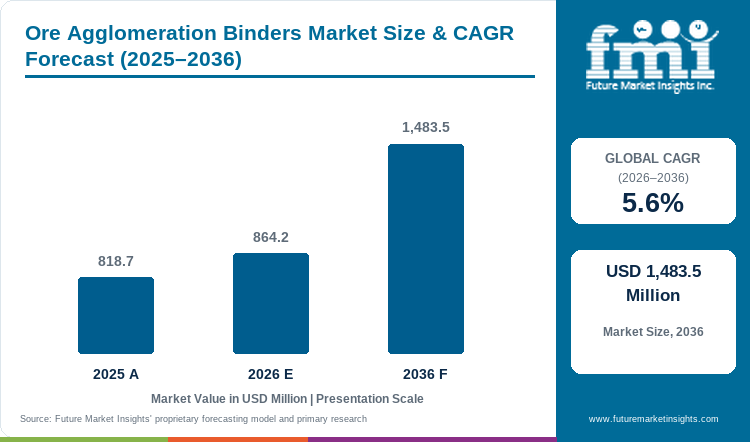
USD 864.2 million in 2026 and USD 1,483.5 million by 2036, expanding at 5.6% CAGR.
Sales of ore agglomeration binders are estimated to rise at 5.6% CAGR through 2036. Valuation rises from USD 818.7 million in 2025 to USD 864.2 million in 2026 and reaches USD 1,483.5 million by 2036. Mine teams use binders when fines reduce flow through a heap or weaken pellet strength. In May 2025, HES International and Binding Solutions agreed to study a 400,000-tonne-per-year plant for cold iron ore pellets in Rotterdam. The planned plant tests lower-energy agglomeration at commercial handling scale.
Brazil is projected to grow at 6.3% CAGR through 2036, compared with 4.2% for Japan. Brazil’s National Mining Agency released the data in March 2026. Iron ore operations recorded 126.96 million tonnes in the fourth quarter of 2025. This large volume keeps binder testing tied to high-throughput pellet and briquette operations. Japanese plants depend more on imported feed and use tighter specifications. The same binder chemistry therefore moves through different testing and stocking cycles.
Key Takeaways
- Finer ore is increasing binder use at mines and metallurgical plants. Sites need stronger pellets and better flow through ore heaps.
- By binder type, cementitious binders are estimated to hold 28.0% share in 2026, supported by familiar dosing and early wet strength.
- In 2026, copper ore is expected to lead ore type with 31.0% share because leach circuits need steady flow and compatible reagents.
- By process, heap leach agglomeration is forecast to represent 38.0% share in 2026. Stable permeability is needed during stacking and irrigation.
- Site trials slow supplier changes because a binder can affect acid use, pellet chemistry, moisture response, or handling strength.
- Some of the key players in this market include Syensqo, BASF, SNF, Kemira, Solenis, Borregaard, Imerys, Clariant, Ecolab / Nalco Water, and Ashland.
Analyst Perspective
"Mine teams do not approve a binder based on strength alone. They also check permeability, chemistry, and supply before using the formulation in regular production."
- Nikhil Kaitwade, Principal Consultant, Future Market Insights
How is the ore agglomeration binders market segmented?
The market is assessed by Binder Type, Ore Type, Process, End Use, Sales Channel and Region.
The market has six main divisions: binder type, ore type, process, end use, sales channel and region. Binder type includes cementitious, polymer, lignosulfonate, clay - bentonite and bio-based systems. Ore type includes copper, gold and iron ore fines. It also includes nickel laterite and battery-metal ores. Process includes heap leach agglomeration, pelletizing and briquetting. It also includes dust-control agglomeration and micro-agglomeration. End use includes mining operations, metallurgical plants, pilot - process labs and mineral processors. Sales channel includes mining chemical suppliers and binder formulators. It also includes direct mine contracts and distributors. Region follows the standard FMI geographic taxonomy.
What makes cementitious binders central to the binder type category?
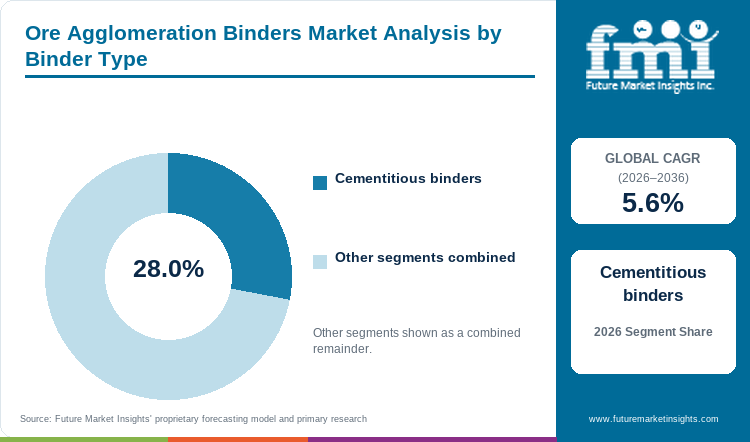
Cementitious binders build early wet strength and work with handling systems already used at many mines. As cement hydrates, it binds fine particles before stacking or pellet handling. Mine teams weigh this strength against added gangue or higher alkalinity. Plants can use existing cement-handling equipment if it matches the dosing setup. Organic binders and bentonite binders are alternatives when acid use or final chemistry limits cement dosage.
- By binder type, cementitious binders are estimated to hold 28.0% in 2026, supported by familiar handling and early wet strength.
- In October 2025, SNF presented FLOFORM agglomeration technologies at a steel-industry event in Verona. The event focused on current agglomeration needs.
How do copper operations evaluate binders within the ore type category?
Copper heaps make binder choice depend on water flow and leach chemistry. Fines can block pore spaces and reduce contact with the leach solution. A binder must hold agglomerates together without raising acid use or hurting recovery. Column and pad trials check flow and acid response before routine use. Mines also review mining flotation chemicals and other reagents because ore changes can affect the full chemical program.
- Based on ore type, copper ore is projected to account for 31.0% in 2026, influenced by the need for stable flow and even solution distribution.
- In December 2025, Rio Tinto produced the first copper from a Johnson Camp heap-leach demonstration using Nuton technology.
What role does heap leach agglomeration play within the process category?
Heap leach agglomeration binds fine particles before the ore reaches the pad. The agglomerates must survive conveying and irrigation without blocking flow. Weak agglomerates can create blind zones and uneven solution movement. Drum time and moisture control how well fines attach to larger particles. Site teams adjust dosage together with moisture and mineral processing equipment settings that control particle contact.
- In 2026, heap leach agglomeration is expected to lead process demand with 38.0% share. Irrigation needs stable permeability.
- In July 2025, the U.S. Bureau of Land Management approved Nevada’s Spring Valley Gold Mine with heap-leach processing.
What supports mining operations within the end use category?
Mining operations control the ore blend, moisture, and binder dose before processing continues. Site teams can change the dose as feed conditions change. That makes binder choice directly linked to recovery and handling. Metallurgical plants focus more on pellet or briquette quality. Mines also compare beneficiation reagents when binder changes affect water balance or separation.
- By end use, mining operations are forecast to represent 58.0% share in 2026 because mine sites control dosage and buy repeat volumes.
- In June 2026, Rio Tinto and China Baowu completed industrial-scale trials using Pilbara Blend ore. The trials covered pelletization and direct reduction.
Why do mining chemical suppliers lead the sales channel category?
Mining chemical suppliers provide both products and field support at remote sites. They help with screening, trials, inventory, and formulation changes as feed conditions shift. One service team can connect lab work with plant stock and field adjustments. Specialist formulators focus more on binder design, while direct contracts suit mature products. Suppliers familiar with flocculant and coagulant programs can also support water and solids handling.
- By sales channel, mining chemical suppliers are estimated to hold 40.0% in 2026. Technical service and regional coverage support their position.
- In November 2025, SNF joined the International Phosphate Beneficiation Conference in Hanoi. The event covered plant-scale beneficiation and process support.
What are the drivers, restraints and opportunities in the Ore Agglomeration Binders Market?
Finer and more variable feeds raise binder use, chemistry-sensitive trials slow switching, and low-dose organic systems can reduce mineral addition.
- Driver: More fines make ore harder to handle. Mines need stable permeability and green strength during agglomeration.
- Restraint: Full-scale testing slows supplier changes because binder chemistry can affect reagent use, final grade, or moisture response.
- Opportunity: Low-dose polymer, lignin, and hybrid systems can reduce mineral addition. Field trials must first confirm stable performance.
Finer feeds raise the cost of weak agglomerates
Mine operators can lose recovery when fines block heap spaces or pellets break during handling. Rio Tinto reported in July 2026 that Q2 global iron ore sales reached 88.8 million tonnes, 5% above Q2 2025. At this scale, weak agglomeration can cause larger losses. Site teams test moisture, binder dose, and drum settings before regular use. Suppliers must keep strength and permeability stable as feed size changes. Mines also review flotation reagents because a binder change cannot disrupt the rest of the chemical program. High throughput makes handling losses more costly.
Qualification slows switching when chemistry and strength trade off
A binder can improve wet strength but still create a chemistry problem. A June 2025 SEC-filed Santa Cruz Copper Project study lists sulfuric acid and sodium chloride additions during ore agglomeration before heap leaching. This design makes it clear that binder tests must include the full leach chemistry. Heap-leach teams test dosage against acid use, percolation, and metal recovery before switching. Pellet plants check a different risk because added silica or alumina can lower final feed quality. A lab result alone is not enough for regular supply. Mines usually require column, pilot-pad, or plant-scale tests using local ore and water conditions. This longer testing period slows supplier changes even after a strong lab result.
Low-dose systems create a route to lower mineral addition
Organic and hybrid binders can reduce mineral addition if they stay stable at site moisture levels. In September 2025, Borregaard opened a larger Mumbai office with three laboratories, including an industrial applications laboratory linked to its lignin business. The new testing capacity gives formulators another place to screen lignin chemistry before customer trials. Low-dose systems are useful when cement or bentonite adds unwanted gangue. The main challenge is keeping performance steady during storage, wet mixing, and handling. Suppliers that match lignosulfonates to local ore behavior can reduce repeated formulation changes. Regional testing can also shorten the time between formulation work and mine-site qualification.
Which country CAGRs are profiled in the Ore Agglomeration Binders Market?
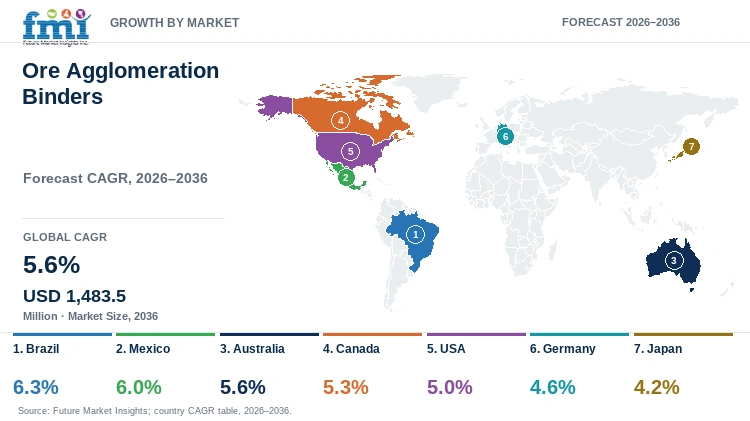
| Country | CAGR |
|---|---|
| Brazil | 6.3% |
| Mexico | 6.0% |
| Australia | 5.6% |
| Canada | 5.3% |
| USA | 5.0% |
| Germany | 4.6% |
| Japan | 4.2% |
How do country-level CAGRs compare in the Ore Agglomeration Binders Market?
Brazil and Mexico form the upper forecast band. Australia and Canada follow. The USA is in the middle, while Germany and Japan grow more slowly. The 2.1 percentage-point spread compares forecast speed, not current revenue. Ore mix, project timing, testing practice, and logistics differ by country.
- Large Brazilian mining groups can test binders at commercial scale.
- Mexico’s mix of mine types requires flexible technical support.
- Australia’s large iron ore operations increase interest in binders that add less gangue.
- Canada’s mix of ore types creates a wider range of binder tests.
- US technical centers can reduce the time needed before field trials.
- German steel plans with lower emissions increase interest in binders that add less gangue.
- Japan’s mature steel industry changes suppliers slowly. Plants keep tight control over specifications.
Similar CAGRs can still lead to different commercial conditions. The full report provides country-level CAGR analysis across North America, Latin America, Western Europe, Eastern Europe, East Asia, South Asia and Pacific, and the Middle East and Africa.
Country-wise Analysis
- Brazilian iron ore and briquette plants use binders during feed preparation for steelmaking. Ore agglomeration binder demand in Brazil is projected to grow at 6.3% CAGR through 2036. IBRAM reported in February 2026 that Brazil exported about 431 million tons of mineral products in 2025. Export volume rose 7.1%, and iron ore made up 62.8% of mineral exports. These large material flows make stable pellet and briquette strength more valuable. Formulations linked to pellet binders move into regular orders after plants confirm the required strength. Plants also check that the binder does not cause an unacceptable loss in final grade.
- Mexican mines use binders in both iron-pellet and copper-processing routes. Each route needs a different type of test. Demand is forecast to expand at 6.0% CAGR through 2036. INEGI reported in June 2026 that April output reached 393,779 tonnes of iron pellets. Copper output reached 43,957 tonnes, up 7.9% from April 2025. Pellet plants focus on strength and gangue control. Copper sites focus on permeability and chemistry. Technical teams must match each trial to the exact ore and process. Related mining tailings flocculants programs also matter when water handling affects plant performance.
- Australian mines place high value on reliable supply because many sites are remote and move large ore volumes to port. Ore agglomeration binder demand in Australia is predicted to advance at 5.6% CAGR through 2036. The Office of the Chief Economist released the data in June 2026. Iron ore export volumes rose 6% year over year in the March quarter. Long supply routes make missed deliveries costly. Mine teams prefer formulations that can be stored safely and adjusted with field support. Local service teams must also align reagent planning with mine schedules.
- Canadian mines depend on long transport routes between remote producing areas, processing plants, and export terminals. Canada is estimated to post 5.3% CAGR over the forecast period. Statistics Canada released the data in July 2026. May rail loadings of iron ores and concentrates fell 12.3% from a year earlier. Mineral flows can change quickly even when plant specifications stay fixed. Binder suppliers must connect qualification with stocking plans that keep operations running during rail or mine-schedule changes. Regional inventory favors binders with consistent lot quality. Clear batch records also help sites accept replacement stock without repeating basic checks.
- US binder demand comes from iron ore, copper, and heap-leach projects, and each project has its own qualification needs. The USA is projected to grow at 5.0% CAGR through 2036. In September 2026, the U.S. Geological Survey published its 2026 mineral data release. It estimated 2025 usable iron ore mine production at 38 million metric tons. Mine teams still test binders against local feed and process chemistry before regular supply. Vendors need test support, domestic logistics, and proof that a formulation protects recovery or pellet quality without creating another operating problem.
- German metallurgical plants judge binders by pellet quality, furnace feed, and cost control. Ore agglomeration binder demand in Germany is forecast to rise at 4.6% CAGR over the assessment period. The German Steel Federation released the data in January 2026. Crude steel production fell to 34.1 million tonnes in 2025. Output was about 9% lower than a year earlier. Lower plant use increases attention to material yield and specification changes. Binder suppliers must justify dosage with clear quality gains. Low-gangue formulations gain attention when they protect iron grade without adding more qualification work.
- Japanese metallurgical plants depend on imported raw materials and strict specification control. Japan is anticipated to record 4.2% CAGR through 2036. The Japan Iron and Steel Federation released the data in August 2026. July crude steel output reached 6.947 million tonnes. Output was 0.4% above July 2025. Imported-feed consistency remains important even when monthly steel output changes only slightly. Binder suppliers need clear grade records and steady shipment quality before plants expand use. Plants approve wider use only after binders perform consistently as ore blends change. Detailed lot records can reduce repeated checks when plants switch between qualified feed blends.
Who are the notable companies in the Ore Agglomeration Binders Market?
Syensqo, BASF, SNF, Kemira, Solenis, Borregaard, Imerys, Clariant, Ecolab / Nalco Water, and Ashland
Competition includes direct binder developers, mining-reagent groups, polymer suppliers, and mineral or lignin feedstock companies. Entry is difficult because each mine must test binders with its own ore, moisture, and downstream chemistry. A broad product range helps only if field tests and supply stay reliable.
- Clariant and SNF document iron ore agglomeration or pellet-binder work. Borregaard documents lignin-based binding applications.
- Syensqo, BASF, and Ecolab / Nalco Water document mining-process chemistry. Their records cover research, field support, or application programs.
- Kemira, Solenis, Ashland, and Imerys supply polymer, organic-binder, cellulosic, or mineral platforms. These materials fall within the defined formulation boundary.
Competitive Benchmarking: Ore Agglomeration Binders Market
| Company | Direct Agglomeration Evidence | Mine-Site Application Support | Binder / Polymer Platform | Geographic Reach |
|---|---|---|---|---|
| Syensqo | Low | High | Medium | Global |
| BASF | Low | High | Medium | Global |
| SNF | High | High | High | Global |
| Kemira | Low | Medium | High | Global |
| Solenis | High | High | High | Global |
| Borregaard | High | Medium | High | Global |
| Imerys | Medium | Low | High | Global |
| Clariant | High | High | High | Global |
| Ecolab / Nalco Water | Low | High | Medium | Global |
| Ashland | Low | Low | High | Global |
Scoring basis: High direct evidence requires an official ore-binder or agglomeration record. Medium requires a documented mineral-binding route. Low means the company has only an adjacent mining role. High application support requires dedicated mining technical or field programs. Medium means current mining support, while Low is indirect. Platform ratings depend on the range of verified binder or polymer chemistry. Geographic reach is descriptive and is not scored.
Key Developments in the Ore Agglomeration Binders Market
- In September 2026, Clariant presented FLOTICOR PA organic binders at ABM Week in São Paulo. The binders target high-strength, low-silica iron ore pellets.
- In March 2026, SNF established a Mining Technical Center in Brazil. The center develops and tests mining solutions under field-relevant conditions.
- In May 2025, BASF moved its global leaching research work to Houston. It also expanded work on new leaching aids for copper processing.
Key Players in the Ore Agglomeration Binders Market
Direct agglomeration and binder chemistry
- Clariant
- SNF
- Borregaard
Mining reagent and process chemistry
- Syensqo
- BASF
- Ecolab / Nalco Water
Functional polymer and process-aid suppliers
- Kemira
- Solenis
- Ashland
Mineral feedstock and specialty materials
- Imerys
Ore Agglomeration Binders Market - Report Scope
| Coverage field | Report scope |
|---|---|
| Market breakdown | By binder type, ore type, process, end use, sales channel and region. |
| Quantitative Units | USD million. |
| Market Definition | Commercial binders used to agglomerate ore fines for heap leaching, pelletizing, briquetting, dust-control agglomeration, and related mineral-processing steps are included. |
| Regions Covered | North America, Latin America, Western Europe, Eastern Europe, East Asia, South Asia and Pacific, and Middle East and Africa. |
| Countries Covered | Brazil, Mexico, Australia, Canada, USA, Germany, Japan, and 20+ countries included in the full report. |
| Key Companies Profiled | Syensqo, BASF, SNF, Kemira, Solenis, Borregaard, Imerys, Clariant, Ecolab / Nalco Water, and Ashland. |
| Forecast Period | 2026 to 2036. |
| Approach | Primary and secondary research with market triangulation. |
Ore Agglomeration Binders Market - Research Methodology
| Method | Approach |
|---|---|
| Primary Research | FMI analysts gathered input from manufacturers, service providers, technology developers, distributors, end users, procurement teams, and subject-matter experts. Interviews examined purchasing decisions, product or service evaluation, adoption barriers, approval requirements, pricing considerations, and expectations for technical or commercial support. Respondents were also asked what evidence is required before a trial, pilot, or initial order develops into regular purchasing. |
| Desk Research | Desk research covered government statistics, regulatory publications, trade data, industry associations, technical literature, standards, company filings, product information, and official corporate announcements. Sources were reviewed for relevance, publication date, geographic coverage, and consistency with the defined market scope. Claims relating to performance, applications, approvals, capacity, investment, and commercial activity were retained only when supported by credible public evidence. |
| Market Sizing and Forecasting | The market model combined the baseline value with historical performance, segment structure, pricing and volume indicators, adoption levels, company participation, and country-level demand conditions. Forecast assumptions considered economic activity, investment trends, regulatory developments, technology adoption, purchasing cycles, supply availability, and barriers to wider market use. Segment and regional estimates were reconciled before the final market total was calculated. |
| Data Validation | Estimates were checked against multiple independent indicators, including public data, company activity, trade patterns, industry developments, and findings from primary interviews. Validation also tested whether products, services, applications, and company revenues fell within the defined market boundaries. Adjacent categories, unsupported claims, overlapping revenues, and activities without direct market relevance were excluded to reduce double counting and maintain consistency across segments and countries. |
Ore Agglomeration Binders Market by Segments
Ore Agglomeration Binders Market segmented by Binder Type:
- Cementitious binders
- Polymer binders
- Lignosulfonate binders
- Clay - bentonite binders
- Bio-based binders
Ore Agglomeration Binders Market segmented by Ore Type:
- Copper ore
- Gold ore
- Iron ore fines
- Nickel laterite
- Battery metal ores
Ore Agglomeration Binders Market segmented by Process:
- Heap leach agglomeration
- Pelletizing
- Briquetting
- Dust control agglomeration
- Micro-agglomeration
Ore Agglomeration Binders Market segmented by End Use:
- Mining operations
- Metallurgical plants
- Pilot - process labs
- Mineral processors
Ore Agglomeration Binders Market segmented by Sales Channel:
- Mining chemical suppliers
- Binder formulators
- Direct mine contracts
- Distributors
Ore Agglomeration Binders Market by Region:
- North America
- United States
- Canada
- Latin America
- Brazil
- Mexico
- Chile
- Rest of Latin America
- Western Europe
- Germany
- United Kingdom
- Italy
- Spain
- France
- Nordics
- Benelux
- Rest of Western Europe
- Eastern Europe
- Russia
- Poland
- Hungary
- Balkan and Baltic States
- Rest of Eastern Europe
- East Asia
- China
- Japan
- South Korea
- South Asia and Pacific
- India
- ASEAN
- Australia and New Zealand
- Rest of South Asia and Pacific
- Middle East and Africa
- Kingdom of Saudi Arabia
- Other GCC Countries
- Türkiye
- South Africa
- Other African Union Countries
- Rest of Middle East and Africa
Research Sources and Bibliography
- Clariant. (2026, September 8). ABM Week 2026.
- Brazilian Mining Institute (IBRAM). (2026, February 3). Mining industry increases revenue, investments and share of trade balance surplus in 2025.
- SNF Mining. (2025, October 28). SNF | Mining at Verona - Innovation Driving a More Sustainable Steel Industry.
- BASF. (2025, May 20). BASF mining solutions strengthens commitment to copper hydrometallurgy and flotation research and development.
- BASF. (2025, June 18). BASF mining solutions and FUCHS announce cooperation to serve the Australian mining industry.
- U.S. Bureau of Land Management. (2025, July). Spring Valley Gold Mine record of decision.
- Rio Tinto. (2026, June 12). China Baowu and Rio Tinto complete Pilbara Blend iron ore pelletization and direct reduction trials.
- SNF Mining. (2026, March 5). SNF has established a Mining Technical Center in Brazil.
- Australian Government, Office of the Chief Economist. (2026, June). Resources and energy quarterly: June 2026.
- National Institute of Statistics and Geography (INEGI). (2026, June 19). Indicators of the mining and metallurgical industry.
- Statistics Canada. (2026, July 27). Railway carloadings, May 2026.
- U.S. Geological Survey. (2026, September 18). Mineral Commodity Summaries 2026 data release.
- German Steel Federation. (2026, January 21). Annual balance of steel production 2025: Fourth crisis year in a row.
- Japan Iron and Steel Federation. (2026, August 21). Steel production overview, July 2026.
- Syensqo. (2025, November 6). Third quarter 2025 results.
- Kemira. (2026, June 18). Kemira and IFF joint venture relocates planned biobased materials manufacturing site to Hanko, Finland.
- Solenis. (2026, April 16). Solenis breaks ground on new 60,000-tonne production facility in Beihai, Guangxi.
- Borregaard. (2025, September 17). Opened new sales office and laboratories in Mumbai.
- Imerys. (2025, March 25). EMILI recognized as strategic project by the European Union.
- Clariant. (2025, February 23). SME MINEXCHANGE 2025.
- Ecolab / Nalco Water. (2025, May 6). Powering the future: Ecolab’s expertise in lithium extraction.
- Ashland. (2025, July 8). Ashland advances manufacturing network optimization and transfers HEC production to Hopewell.
- Southern African Institute of Mining and Metallurgy. (2026, June 24). Global best practices in thickener and dewatering operations for low-grade and complex deposits.
- British Steel. (2025, June 2). British Steel trials greener pellets in blast furnace test.
- Salzgitter AG. (2025, July 28). Salzgitter and Binding Solutions partnering for cold agglomerated pellet technology.
- HES International. (2025, May 19). HES International and Binding Solutions sign an MOU to assess potential for an iron ore cold pelletizing plant at HES Bulk Terminal Rotterdam.
- BHP. (2025, May 11). BHP and China Baowu celebrate commercial-scale DRI trials using Pilbara iron ores.
- Vale. (2026, April). Annual report 2025.
- National Mining Agency of Brazil (ANM). (2026, March 31). Mineral report: Fourth quarter 2025.
- Rio Tinto. (2025, December 4). Rio Tinto’s Nuton technology produces first copper.
- SNF Mining. (2025, November 2). SNF at the International Phosphate Beneficiation Conference.
- Rio Tinto. (2026, July 15). Rio Tinto releases second quarter 2026 production results.
- U.S. Securities and Exchange Commission. (2025, June). Santa Cruz Copper Project S-K 1300 technical report summary: Preliminary feasibility study.
- Metso. (2025, December 8). Metso to deliver compact-sized pellet plant to Greta Energy in India.
- Bureau Veritas Certification France. (2025, October 17). SNF ISO 9001:2015 multi-site certificate.
- Borregaard. (2025, September 25). Grant for Borregaard’s Biomer project.
This bibliography is provided for reader reference and is not exhaustive. The full report contains the complete reference list and detailed citations
This Report Answers
- How large is the ore agglomeration binders market in 2026 and 2036?
- Which operating conditions are increasing binder use in heap leach and pelletizing circuits?
- Which binder type accounts for 28.0% of 2026 binder type demand?
- Which ore type accounts for 31.0% of 2026 ore type demand?
- Why does heap leach agglomeration account for 38.0% of process demand?
- Which country conditions explain the 4.2% to 6.3% forecast range?
- Which companies supply direct binders, mining chemistry, polymers, and related feedstocks?
- How do chemistry and field qualification slow supplier switching?
Frequently Asked Questions
How big is the ore agglomeration binders market in 2026?
The ore agglomeration binders market is valued at USD 864.2 million in 2026. It is projected to reach USD 1,483.5 million by 2036 as finer feeds increase binder use at mines.
What is the CAGR of the ore agglomeration binders market from 2026 to 2036?
The ore agglomeration binders market is projected to grow at 5.6% CAGR between 2026 and 2036. Mines need stable agglomerates as they process variable fines, while plants also apply tighter product-quality limits.
Which binder type leads the ore agglomeration binders market in 2026?
The cementitious binder segment is estimated to hold 28.0% of binder type demand in the ore agglomeration binders market in 2026. Mine teams know the dosing process and gain early wet strength, then they check how the binder affects downstream chemistry.
Which process leads the ore agglomeration binders market in 2026?
The heap leach agglomeration segment is projected to hold 38.0% of process demand in the ore agglomeration binders market in 2026. The segment depends on keeping flow paths open during conveying, stacking, and long periods of irrigation.
Which companies are active in the ore agglomeration binders market?
Key companies operating in the ore agglomeration binders market include Syensqo, BASF, SNF, Kemira, Solenis, Borregaard, Imerys, Clariant, Ecolab / Nalco Water, and Ashland. These companies supply direct binders, mining reagents, functional polymers, mineral materials, and field application support.
Preview the report firsthand - request a free sample
Get SampleGet the brochure for pricing and purchase details.
Get PDFTable of Content
- Key Takeaways
- Market Size and CAGR
- Top Growth Driver
- Fastest Growing Segment
- Leading Region
- Key Companies
- Emerging Opportunities
- Executive Summary
- Global Market Outlook
- Demand-side Trends
- Supply-side Trends
- Technology Roadmap Analysis
- Analysis and Recommendations
- Analyst Perspective (What is happening? Why now? What should investors know?)
- Key Questions Answered
- How large is the market?
- What is the CAGR?
- What are key trends?
- Which region dominates?
- Who are the leaders?
- Market Overview
- Market Coverage / Taxonomy
- Market Definition / Scope / Limitations
- Research Methodology
- Chapter Orientation
- Analytical Lens and Working Hypotheses
- Market Structure, Signals, and Trend Drivers
- Benchmarking and Cross-market Comparability
- Market Sizing, Forecasting, and Opportunity Mapping
- Research Design and Evidence Framework
- Desk Research Programme (Secondary Evidence)
- Expert Input and Fieldwork (Primary Evidence)
- Tooling, Models, and Reference Databases
- Data Engineering and Model Build
- Quality Assurance and Audit Trail
- Market Background
- Market Dynamics (Drivers, Restraints, Opportunity, Trends)
- Scenario Forecast (Optimistic, Likely, Conservative)
- Impact Analysis
- AI Impact
- Sustainability Impact
- Regulatory Impact
- Technology Impact
- Consumer / Buyer Analysis
- Purchase Drivers
- Adoption Barriers
- Buyer Journey
- Opportunity Map Analysis
- Product Life Cycle Analysis
- Supply Chain Analysis
- Investment Feasibility Matrix
- Value Chain Analysis
- PESTLE and Porter's Analysis
- Regulatory Landscape
- Regional Parent Market Outlook
- Production and Consumption Statistics
- Import and Export Statistics
- Global Market Analysis and Forecast, 2021 to 2036
- Historical Market Size Value (USD Million) Analysis, 2021 to 2025
- Current and Future Market Size Value (USD Million) Projections, 2026 to 2036
- Y-o-Y Growth Trend Analysis
- Absolute $ Opportunity Analysis
- Global Market Pricing Analysis, 2021 to 2036
- Global Market Analysis and Forecast, By Binder Type, 2021 to 2036
- Introduction / Key Findings
- Historical Market Size Value (USD Million) Analysis By Binder Type, 2021 to 2025
- Current and Future Market Size Value (USD Million) Analysis and Forecast By Binder Type, 2026 to 2036
- Cementitious binders
- Polymer binders
- Lignosulfonate binders
- Clay - bentonite binders
- Bio-based binders
- Y-o-Y Growth Trend Analysis By Binder Type, 2021 to 2025
- Absolute $ Opportunity Analysis By Binder Type, 2026 to 2036
- Global Market Analysis and Forecast, By Ore Type, 2021 to 2036
- Introduction / Key Findings
- Historical Market Size Value (USD Million) Analysis By Ore Type, 2021 to 2025
- Current and Future Market Size Value (USD Million) Analysis and Forecast By Ore Type, 2026 to 2036
- Copper ore
- Gold ore
- Iron ore fines
- Nickel laterite
- Battery metal ores
- Y-o-Y Growth Trend Analysis By Ore Type, 2021 to 2025
- Absolute $ Opportunity Analysis By Ore Type, 2026 to 2036
- Global Market Analysis and Forecast, By Process, 2021 to 2036
- Introduction / Key Findings
- Historical Market Size Value (USD Million) Analysis By Process, 2021 to 2025
- Current and Future Market Size Value (USD Million) Analysis and Forecast By Process, 2026 to 2036
- Heap leach agglomeration
- Pelletizing
- Briquetting
- Dust control agglomeration
- Micro-agglomeration
- Y-o-Y Growth Trend Analysis By Process, 2021 to 2025
- Absolute $ Opportunity Analysis By Process, 2026 to 2036
- Global Market Analysis and Forecast, By End Use, 2021 to 2036
- Introduction / Key Findings
- Historical Market Size Value (USD Million) Analysis By End Use, 2021 to 2025
- Current and Future Market Size Value (USD Million) Analysis and Forecast By End Use, 2026 to 2036
- Mining operations
- Metallurgical plants
- Pilot - process labs
- Mineral processors
- Y-o-Y Growth Trend Analysis By End Use, 2021 to 2025
- Absolute $ Opportunity Analysis By End Use, 2026 to 2036
- Global Market Analysis and Forecast, By Sales Channel, 2021 to 2036
- Introduction / Key Findings
- Historical Market Size Value (USD Million) Analysis By Sales Channel, 2021 to 2025
- Current and Future Market Size Value (USD Million) Analysis and Forecast By Sales Channel, 2026 to 2036
- Mining chemical suppliers
- Binder formulators
- Direct mine contracts
- Distributors
- Y-o-Y Growth Trend Analysis By Sales Channel, 2021 to 2025
- Absolute $ Opportunity Analysis By Sales Channel, 2026 to 2036
- Global Market Analysis and Forecast, By Region, 2021 to 2036
- Introduction
- Historical Market Size Value (USD Million) Analysis By Region, 2021 to 2025
- Current Market Size Value (USD Million) Analysis and Forecast By Region, 2026 to 2036
- North America
- Latin America
- Western Europe
- Eastern Europe
- East Asia
- South Asia and Pacific
- Middle East and Africa
- Market Attractiveness Analysis By Region
- North America Market Analysis and Forecast, By Country, 2021 to 2036
- Historical Market Size Value (USD Million) Trend Analysis By Market Taxonomy, 2021 to 2025
- Market Size Value (USD Million) Forecast By Market Taxonomy, 2026 to 2036
- By Country
- United States
- Canada
- By Binder Type
- By Ore Type
- By Process
- By End Use
- By Sales Channel
- By Country
- Market Attractiveness Analysis
- By Country
- By Binder Type
- By Ore Type
- By Process
- By End Use
- By Sales Channel
- Key Takeaways
- Latin America Market Analysis and Forecast, By Country
- Historical Market Size Value (USD Million) Trend Analysis By Market Taxonomy, 2021 to 2025
- Market Size Value (USD Million) Forecast By Market Taxonomy, 2026 to 2036
- By Country
- Brazil
- Mexico
- Chile
- Rest of Latin America
- By Binder Type
- By Ore Type
- By Process
- By End Use
- By Sales Channel
- By Country
- Market Attractiveness Analysis
- By Country
- By Binder Type
- By Ore Type
- By Process
- By End Use
- By Sales Channel
- Key Takeaways
- Western Europe Market Analysis and Forecast, By Country
- Historical Market Size Value (USD Million) Trend Analysis By Market Taxonomy, 2021 to 2025
- Market Size Value (USD Million) Forecast By Market Taxonomy, 2026 to 2036
- By Country
- Germany
- United Kingdom
- Italy
- Spain
- France
- Nordics
- Benelux
- Rest of Western Europe
- By Binder Type
- By Ore Type
- By Process
- By End Use
- By Sales Channel
- By Country
- Market Attractiveness Analysis
- By Country
- By Binder Type
- By Ore Type
- By Process
- By End Use
- By Sales Channel
- Key Takeaways
- Eastern Europe Market Analysis and Forecast, By Country
- Historical Market Size Value (USD Million) Trend Analysis By Market Taxonomy, 2021 to 2025
- Market Size Value (USD Million) Forecast By Market Taxonomy, 2026 to 2036
- By Country
- Russia
- Poland
- Hungary
- Balkan and Baltic States
- Rest of Eastern Europe
- By Binder Type
- By Ore Type
- By Process
- By End Use
- By Sales Channel
- By Country
- Market Attractiveness Analysis
- By Country
- By Binder Type
- By Ore Type
- By Process
- By End Use
- By Sales Channel
- Key Takeaways
- East Asia Market Analysis and Forecast, By Country
- Historical Market Size Value (USD Million) Trend Analysis By Market Taxonomy, 2021 to 2025
- Market Size Value (USD Million) Forecast By Market Taxonomy, 2026 to 2036
- By Country
- China
- Japan
- South Korea
- By Binder Type
- By Ore Type
- By Process
- By End Use
- By Sales Channel
- By Country
- Market Attractiveness Analysis
- By Country
- By Binder Type
- By Ore Type
- By Process
- By End Use
- By Sales Channel
- Key Takeaways
- South Asia and Pacific Market Analysis and Forecast, By Country
- Historical Market Size Value (USD Million) Trend Analysis By Market Taxonomy, 2021 to 2025
- Market Size Value (USD Million) Forecast By Market Taxonomy, 2026 to 2036
- By Country
- India
- ASEAN
- Australia and New Zealand
- Rest of South Asia and Pacific
- By Binder Type
- By Ore Type
- By Process
- By End Use
- By Sales Channel
- By Country
- Market Attractiveness Analysis
- By Country
- By Binder Type
- By Ore Type
- By Process
- By End Use
- By Sales Channel
- Key Takeaways
- Middle East and Africa Market Analysis and Forecast, By Country
- Historical Market Size Value (USD Million) Trend Analysis By Market Taxonomy, 2021 to 2025
- Market Size Value (USD Million) Forecast By Market Taxonomy, 2026 to 2036
- By Country
- Kingdom of Saudi Arabia
- Other GCC Countries
- Türkiye
- South Africa
- Other African Union Countries
- Rest of Middle East and Africa
- By Binder Type
- By Ore Type
- By Process
- By End Use
- By Sales Channel
- By Country
- Market Attractiveness Analysis
- By Country
- By Binder Type
- By Ore Type
- By Process
- By End Use
- By Sales Channel
- Key Takeaways
- Key Countries Market Analysis
- United States
- Pricing Analysis
- Market Share Analysis, 2025
- By Binder Type
- By Ore Type
- By Process
- By End Use
- By Sales Channel
- Canada
- Pricing Analysis
- Market Share Analysis, 2025
- By Binder Type
- By Ore Type
- By Process
- By End Use
- By Sales Channel
- Mexico
- Pricing Analysis
- Market Share Analysis, 2025
- By Binder Type
- By Ore Type
- By Process
- By End Use
- By Sales Channel
- Brazil
- Pricing Analysis
- Market Share Analysis, 2025
- By Binder Type
- By Ore Type
- By Process
- By End Use
- By Sales Channel
- Chile
- Pricing Analysis
- Market Share Analysis, 2025
- By Binder Type
- By Ore Type
- By Process
- By End Use
- By Sales Channel
- Germany
- Pricing Analysis
- Market Share Analysis, 2025
- By Binder Type
- By Ore Type
- By Process
- By End Use
- By Sales Channel
- United Kingdom
- Pricing Analysis
- Market Share Analysis, 2025
- By Binder Type
- By Ore Type
- By Process
- By End Use
- By Sales Channel
- Italy
- Pricing Analysis
- Market Share Analysis, 2025
- By Binder Type
- By Ore Type
- By Process
- By End Use
- By Sales Channel
- Spain
- Pricing Analysis
- Market Share Analysis, 2025
- By Binder Type
- By Ore Type
- By Process
- By End Use
- By Sales Channel
- France
- Pricing Analysis
- Market Share Analysis, 2025
- By Binder Type
- By Ore Type
- By Process
- By End Use
- By Sales Channel
- India
- Pricing Analysis
- Market Share Analysis, 2025
- By Binder Type
- By Ore Type
- By Process
- By End Use
- By Sales Channel
- ASEAN
- Pricing Analysis
- Market Share Analysis, 2025
- By Binder Type
- By Ore Type
- By Process
- By End Use
- By Sales Channel
- Australia and New Zealand
- Pricing Analysis
- Market Share Analysis, 2025
- By Binder Type
- By Ore Type
- By Process
- By End Use
- By Sales Channel
- China
- Pricing Analysis
- Market Share Analysis, 2025
- By Binder Type
- By Ore Type
- By Process
- By End Use
- By Sales Channel
- Japan
- Pricing Analysis
- Market Share Analysis, 2025
- By Binder Type
- By Ore Type
- By Process
- By End Use
- By Sales Channel
- South Korea
- Pricing Analysis
- Market Share Analysis, 2025
- By Binder Type
- By Ore Type
- By Process
- By End Use
- By Sales Channel
- Russia
- Pricing Analysis
- Market Share Analysis, 2025
- By Binder Type
- By Ore Type
- By Process
- By End Use
- By Sales Channel
- Poland
- Pricing Analysis
- Market Share Analysis, 2025
- By Binder Type
- By Ore Type
- By Process
- By End Use
- By Sales Channel
- Hungary
- Pricing Analysis
- Market Share Analysis, 2025
- By Binder Type
- By Ore Type
- By Process
- By End Use
- By Sales Channel
- Kingdom of Saudi Arabia
- Pricing Analysis
- Market Share Analysis, 2025
- By Binder Type
- By Ore Type
- By Process
- By End Use
- By Sales Channel
- Türkiye
- Pricing Analysis
- Market Share Analysis, 2025
- By Binder Type
- By Ore Type
- By Process
- By End Use
- By Sales Channel
- South Africa
- Pricing Analysis
- Market Share Analysis, 2025
- By Binder Type
- By Ore Type
- By Process
- By End Use
- By Sales Channel
- Australia
- Pricing Analysis
- Market Share Analysis, 2025
- By Binder Type
- By Ore Type
- By Process
- By End Use
- By Sales Channel
- United States
- Market Structure Analysis
- Competition Dashboard
- Competition Benchmarking
- Market Share Analysis of Top Players
- By Regional
- By Binder Type
- By Ore Type
- By Process
- By End Use
- By Sales Channel
- Emerging Startups
- Innovation Benchmarking
- Competition Analysis
- Competition Deep Dive
- Syensqo
- Overview
- Product Portfolio
- Profitability by Market Segments
- Sales Footprint
- Strategy Overview
- Marketing Strategy
- Product Strategy
- Channel Strategy
- BASF
- SNF
- Kemira
- Solenis
- Borregaard
- Imerys
- Clariant
- Ecolab / Nalco Water
- Ashland
- Syensqo
- Case Studies
- Success Stories
- Recent Developments
- Competition Deep Dive
- Assumptions & Acronyms Used


