

- Market Size (2026)
- USD 0.9 Bn
- Forecast (2036)
- USD 1.5 Bn
- CAGR (2026 to 2036)
- 5.4%
Organic Greens Powder Market Size, Forecast and Outlook By FMI
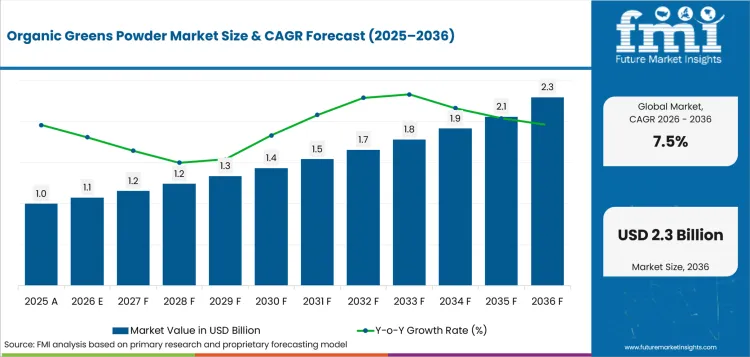
The organic greens powder market value is estimated to grow from USD 1.0 billion in 2025 to USD 2.3 billion by 2036 at 7.5% CAGR as supplement buyers shift toward certified multi-ingredient powder routines. Certified organic products are projected to represent 72.0% share in 2026 since the seal helps shoppers separate verified formulas from standard greens blends. Adult wellness users are expected to secure 55.0% share in 2026 as routine health buyers form the main repeat purchase base.
Key Takeaways, Market Size, and Forecast
- 2026 Market Size: USD 1.1 billion
- 2036 Market Size: USD 2.3 billion
- Forecast CAGR: 7.5% from 2026 to 2036
- Leading Certification: Certified Organic
- Certified Organic Share in 2026: 72.0%
- Leading Consumer Group: Adult Wellness Users
- Adult Wellness Users Share in 2026: 55.0%
- Fastest-growing Country: Saudi Arabia
- Saudi Arabia CAGR: 9.1% by 2036
Summary of Organic Greens Powder Market
- Demand and Growth Drivers
- Supplement buyers are moving toward daily powders that combine organic greens with probiotics and fruit-based taste systems.
- Retailers are giving more attention to brands with organic certificates and microbial testing records.
- Private label programs are using pouches and stick packs to enter wellness aisles without building a full supplement brand.
- Product and Segment View
- Certified organic products are projected to account for 72.0% share in 2026, led by trust in third-party certification.
- Adult wellness users are forecast to hold 55.0% share in 2026, influenced by daily routines and subscription refill behavior.
- Pouches are expected to secure 46.0% share in 2026, supported by lower pack cost and repeat-order convenience.
- Geography and Competitive Outlook
- Saudi Arabia is projected to record 9.1% CAGR by 2036, backed by premium pharmacy retail and imported wellness products.
- South Korea is expected to expand at 8.7% CAGR by 2036 through health functional food habits and stick-pack use.
- AG1 and Amazing Grass compete through consumer trust and product visibility in online wellness channels.
- Bactolac and Vitaquest compete for private label focus on powder blending and compliance support.
- Analyst Opinion
- Nandini Roy Choudhury of Future Market Insights observes: "Organic greens powders are not winning on ingredient count alone. I see the category moving toward proof around sourcing and testing. Taste then decides repeat orders. Brands that explain what is in each scoop without overclaiming should earn stronger repeat purchase."
- Organic Greens Powder Market Value Analysis
- Market value is driven by finished organic multi-ingredient powder revenue before ready-to-drink greens and gummies add separate income.
- Supplier pricing reflects organic certification files and microbial testing before flavor systems affect repeat buying.
- Revenue improves as consumers convert trial pouches into monthly subscriptions and family-size refills.
- Retail trust rises when labels explain organic status and serving size in plain language. Third-party testing adds another trust cue.
- The market is a subcategory of the wider green supplement category and remains below the full dietary supplement boundary through 2036.
Quality control is the main pressure point for organic greens powder suppliers as retailers review botanical inputs and microbial testing files. The United States Food and Drug Administration linked greens powder recalls to Salmonella investigations in 2025 and 2026.
That evidence makes supplier verification more important before new pouches reach online and pharmacy channels. Product design is also moving toward smoother taste and smaller serving formats. Huel launched Daily Greens in the United Kingdom in January 2024 with 91 vitamins and minerals along with wholefood-sourced ingredients. Brands that combine organic documentation with clean mixing performance should win repeat orders more easily.
Why is the Organic Greens Powder Market Growing?
- Daily wellness buyers want one powder that brings greens and fruit powders with probiotic support into a repeatable routine.
- Brand owners are building certified formulas that use organic status as a trust cue before taste and price decide repeat purchase.
- Retailers are asking for testing files after powder recalls showed that long shelf life does not remove microbial risk.
Growth is becoming more disciplined as the green supplement category moves from broad wellness claims into verified powder routines. The Organic Trade Association reported that United States certified organic sales reached USD 76.6 billion in 2025. That scale shows why organic claims can support premium pricing when shoppers already understand certification value.
Supplement behavior gives the category a steady base for repeat purchase. The National Center for Health Statistics reported in May 2026 that 60.2% of United States adults used a dietary supplement during August 2021 to August 2023. Organic greens powder suppliers can use that routine behavior only when labels avoid overclaiming and show clear daily serving guidance.
Market Segmentation Analysis
- Certified organic products are projected to account for 72.0% share in 2026, led by shopper trust in recognized organic seals.
- Adult wellness users are anticipated to hold 55.0% share in 2026 since daily routine buyers repeat more often than trial buyers.
- Pouches are expected to capture 46.0% share in 2026 due to refill convenience and lower pack cost per serving.
- Online DTC is forecast to represent 42.0% share in 2026, guided by subscriptions and brand-led education.
- Leafy greens are projected to account for 38.5% share in 2026, reflected by familiar ingredients such as kale and spinach.
The organic greens powder industry is segmented by ingredient base and certification. It also uses packaging format and sales channel. Consumer group and buyer type complete the commercial view. The structure overlaps with superfood powders where products use plant blends and powder convenience. It differs from standard superfood powders because organic certification is part of the buying filter.
Buyer type matters because brand marketers and private label programs need different production support. A multi nutritional supplement buyer often values dose breadth and pack discipline. Organic greens powder buyers place more weight on source documents and finished-powder microbial testing.
Insights into Organic Greens Powder Market by Ingredient Base
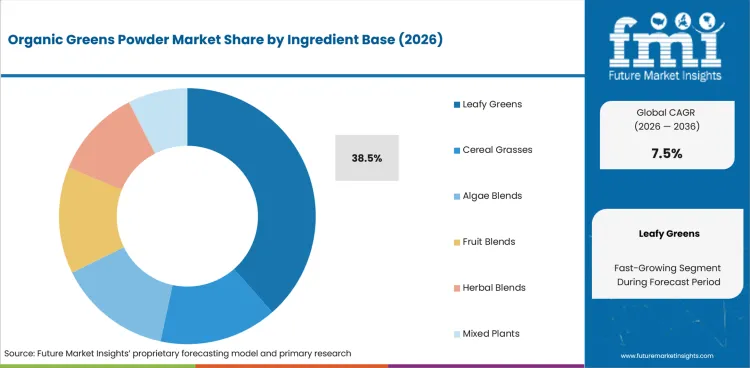
- Leafy greens are projected to account for 38.5% share in 2026, influenced by familiar ingredients and broader taste acceptance. Adjacent vegetable powders remain important inputs when brands need concentrated color and plant identity.
- Algae blends gain use where brands want spirulina and chlorella density, although taste masking and source testing decide repeat purchase.
Insights into Organic Greens Powder Market by Certification
- Certified organic is anticipated to hold 72.0% share in 2026 through formal seals that reduce buyer doubt at shelf level.
- Dual certified products gain value when suppliers combine organic status with vegan or gluten-free documentation for online shoppers.
Insights into Organic Greens Powder Market by Packaging Format
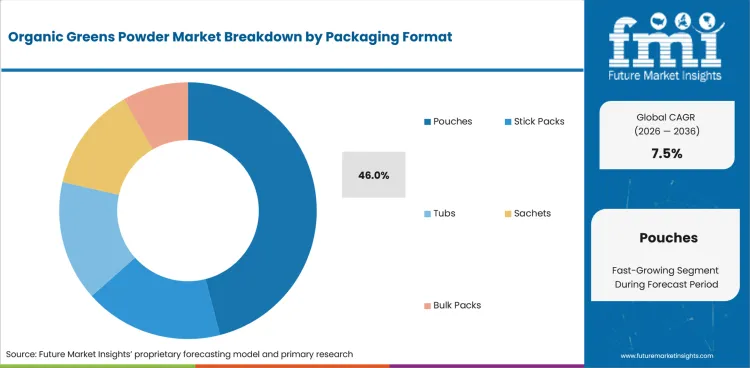
- Pouches are forecast to secure 46.0% share in 2026, shaped by refill economics and lower freight weight.
- Stick packs gain traction because single servings reduce measuring errors and help brands test flavor acceptance.
Insights into Organic Greens Powder Market by Sales Channel
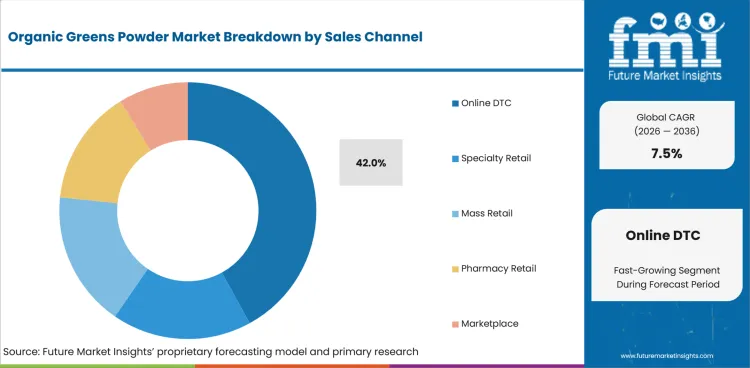
- Online DTC is expected to represent 42.0% share in 2026, supported by subscriptions and brand education pages.
- Specialty retail remains important for shoppers who compare taste and label claims before switching to monthly refills.
Insights into Organic Greens Powder Market by Consumer Group
- Adult wellness users are projected to account for 55.0% share in 2026, led by daily supplement routines and self-care spending.
- Fitness users add incremental demand when greens powders are paired with protein powder routines after workouts.
Insights into Organic Greens Powder Market by Buyer Type
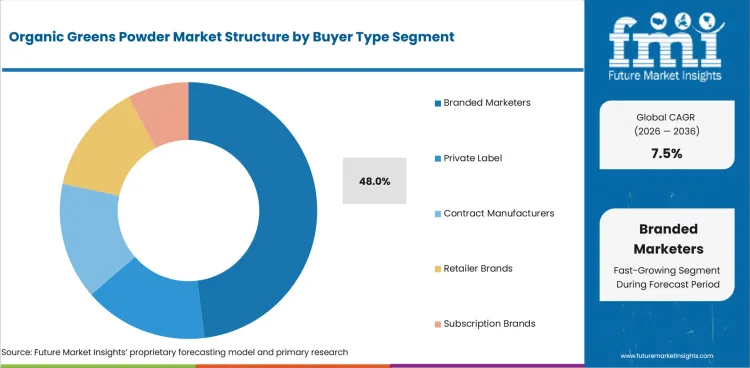
- Branded marketers are expected to hold 48.0% share in 2026 since consumer trust and education content affect repeat purchase.
- Private label programs expand where manufacturers can source spirulina powder and cereal grasses with documented organic files.
Organic Greens Powder Market Drivers, Restraints, and Opportunities
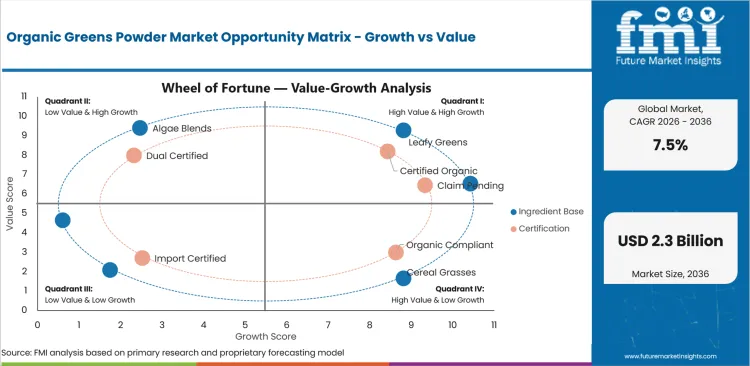
- Driver: Adult supplement users are adding powder formats that can combine herbal supplements with familiar greens ingredients.
- Restraint: Microbial contamination events can tighten retailer review and raise testing cost for small brands.
- Opportunity: Brands using verified moringa products and tested algae inputs can separate themselves from low-documentation blends.
Quality Assurance Pressure Is Reshaping Supplier Selection
Quality assurance now shapes the category more than ingredient count. The United States Food and Drug Administration reported in June 2026 that Live it Up Super Greens was linked to Salmonella illnesses across 21 states. That event shifted attention toward supplier traceability and finished-product testing. The same pressure can help contract manufacturers with strong documentation win more private label business.
Careful Claims and Better Taste Create Retail Headroom
Retail opportunity is still clear when claims remain careful and taste improves. The Council for Responsible Nutrition reported in October 2024 that prebiotic use reached 7.0% of supplement users and magnesium use reached 23.0%. These patterns show that specialty supplement users accept routine products when the benefit is easy to understand. Organic greens powders can fit that behavior by explaining digestion support without making medical claims.
Routine-Based Buyers Are Driving Organic Greens Powder Adoption
Consumer demand is expected to center on adults who already buy supplements and want a simpler daily routine. Purchase decisions often start with certification, then move to taste, serving count and subscription cost. The Council for Responsible Nutrition reported in October 2024 that specialty supplement use increased over time, with prebiotic use reaching 7.0% of supplement users. Organic greens powder brands can fit that behavior as the label explains ingredients clearly and keeps the routine easy to repeat.
Analysis of Organic Greens Powder Market by Key Countries
.webp "Top Country Growth Comparison Organic Greens Powder Market Cagr (2026 2036)")
| Country | CAGR |
|---|---|
| United States | 7.8% |
| Germany | 6.6% |
| United Kingdom | 7.1% |
| Saudi Arabia | 9.1% |
| South Korea | 8.7% |
| Japan | 6.2% |
| Australia | 7.6% |
Source: Future Market Insights, 2026.
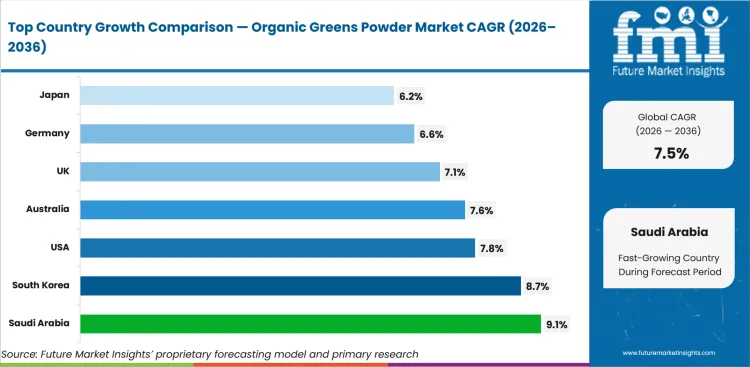
Organic Greens Powder Market CAGR Analysis by Country
- Saudi Arabia is projected to record 9.1% CAGR by 2036 as premium pharmacy channels widen access to imported wellness powders.
- South Korea is expected to expand at 8.7% CAGR through 2036 as health functional food habits support stick-pack greens formats.
- The United States is forecast to grow at 7.8% CAGR by 2036 due to supplement routines and online subscription scale.
- Australia is expected to advance at 7.6% CAGR through 2036 as domestic wellness brands and regulated channels support buyer trust.
- The United Kingdom is forecast at 7.1% CAGR through 2036 as online wellness brands widen daily powder use.
- Germany is expected to post 6.6% CAGR through 2036 as organic retail depth supports demand.
Sales Outlook for Organic Greens Powder Market in the United States
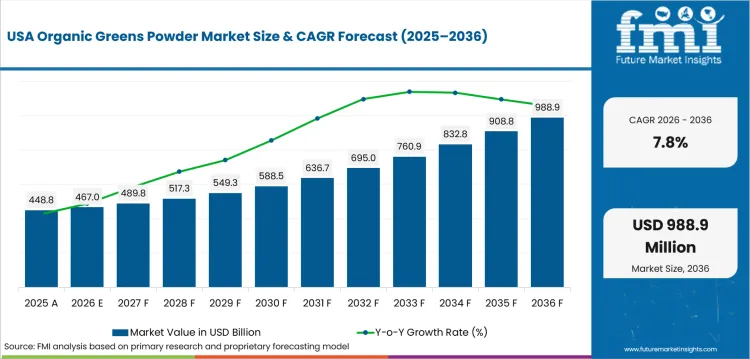
Subscription-led greens powders and natural retail scale center · 2026 to 2036
Country Market Snapshot Table
| Parameter | Value |
|---|---|
| Market Size in 2025 (Value) | USD 285.7 million |
| Market Size in 2026 (Value) | USD 308.0 million |
| Market Forecast in 2036 (Value) | USD 652.7 million |
| CAGR (2026 to 2036) | 7.8% |
| Years Considered | 2021 to 2036 |
| Base Year | 2025 |
| Forecast Period | 2026 to 2036 |
| Units Considered | Value (USD million) |
| Leading Sub-Region | West Coast natural retail and national online subscription networks |
United States Organic Greens Powder Market Outlook
- United States demand is shaped by supplement use habits and broad organic retail reach. Organic greens powder brands use subscription bundles to reduce repeat purchase friction.
- The Organic Trade Association reported certified organic sales of USD 76.6 billion in 2025. That spending base gives organic greens brands a wider trust signal than clean label claims alone.
Key Growth Drivers
- Supplement routines give greens powders a large entry point. The National Center for Health Statistics reported 60.2% of adults used a dietary supplement during August 2021 to August 2023.
- Organic retail reach supports trial beyond natural stores. The United States Department of Agriculture Economic Research Service reported that mass market retail accounted for 55.0% of organic sales in 2024.
- Subscription bundles make monthly use easier when brands sell thirty-serving pouches with shaker bottles and refill reminders.
- Third-party testing matters more after recent greens powder recalls, so brands with lot-level checks can support retailer confidence.
Key Restraints
- Recall exposure can slow retail listing reviews. The United States Food and Drug Administration linked Live it Up Super Greens to 45 illnesses across 21 states in January 2026.
- Organic input cost can raise shelf prices when spirulina and barley grass suppliers face tighter testing requirements.
- Claim wording remains constrained since the United States Food and Drug Administration regulates dietary supplements differently from conventional foods.
What makes United States unique
The United States is unique due to direct-to-consumer subscriptions and large natural retail shelf space.
Key Companies
- AG1 Corporation
- Amazing Grass LLC
- Garden of Life LLC
- KOS Naturals LLC
- Organifi LLC
- Bactolac Pharmaceutical Inc.
- Live it Up LLC
Sales & Marketing Channels
- Brand websites
- Amazon storefronts
- Natural grocery chains
- Mass retail
- Pharmacy aisles
- Fitness studios
Country Segment Breakdown Table
| Segment | Sub-Segments |
|---|---|
| By Ingredient Base | Leafy Greens · Cereal Grasses · Algae Blends · Fruit Blends · Herbal Blends · Mixed Plants |
| By Certification | Certified Organic · Organic Compliant · Dual Certified · Import Certified · Claim Pending |
| By Packaging Format | Pouches · Stick Packs · Tubs · Sachets · Bulk Packs |
| By Sales Channel | Online DTC · Specialty Retail · Mass Retail · Pharmacy Retail · Marketplace |
| By Consumer Group | Adult Wellness · Fitness Users · Digestive Support · Busy Professionals · Older Adults |
| By Buyer Type | Branded Marketers · Private Label · Contract Manufacturers · Retailer Brands · Subscription Brands |
| Key Sub-Regions Covered, Urban Wellness Clusters | California · New York · Texas · Florida · Pacific Northwest · Midwest wellness corridors |
Frequently Asked Questions
How fast is the United States organic greens powder market growing?
Sales in the United States are projected to rise at 7.8% CAGR from 2026 to 2036, supported by supplement routines and subscription retail.
Who leads the United States organic greens powder market?
AG1 and Amazing Grass compete through brand trust and certifications. Garden of Life and Organifi add online repeat sales strength.
What is driving adoption in the United States organic greens powder market?
Organic retail scale and daily supplement use are moving buyers toward multi-ingredient greens powders with documented testing.
Growth Outlook for Organic Greens Powder Market in Germany
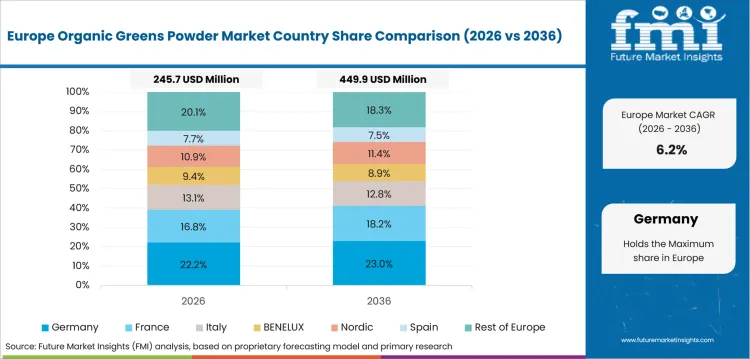
Organic retail depth and EU supplement oversight center · 2026 to 2036
Country Market Snapshot Table
| Parameter | Value |
|---|---|
| Market Size in 2025 (Value) | USD 82.6 million |
| Market Size in 2026 (Value) | USD 88.0 million |
| Market Forecast in 2036 (Value) | USD 166.7 million |
| CAGR (2026 to 2036) | 6.6% |
| Years Considered | 2021 to 2036 |
| Base Year | 2025 |
| Forecast Period | 2026 to 2036 |
| Units Considered | Value (USD million) |
| Leading Sub-Region | Berlin, Bavaria, and North Rhine-Westphalia organic retail clusters |
Germany Organic Greens Powder Market Outlook
- Germany demand is shaped by strict organic expectations and cautious supplement buying behavior. Consumers compare certification detail before accepting premium powder pricing.
- Organics Europe reported that EU organic retail sales reached EUR 49.5 billion in 2024. Germany remains one of the largest organic spend markets within that base.
Key Growth Drivers
- EU organic retail breadth gives Germany a larger certification-aware buyer pool. Organics Europe reported EU organic farmland reached 18.1 million hectares in 2024.
- Food supplement oversight supports safety-led brand sorting. The European Food Safety Authority stated in January 2026 that supplements provide concentrated nutrients and can include additives under EU rules.
- German natural retail channels reward clear origin statements for barley grass and wheatgrass. Chlorella and spirulina inputs need the same proof.
- Domestic wellness brands can use refill pouches to reduce delivered price per serving without weakening certification claims.
Key Restraints
- Health claim limits can narrow pack language. European Union rules require brands to avoid broad wellness promises without approved claim support.
- German buyers often reject vague proprietary blends, which forces suppliers to disclose more ingredient detail than many global brands prefer.
- Retailers can slow new listings when algae inputs lack residue testing documents from recognized laboratories.
What makes Germany unique
Germany is unique due to high organic retail literacy and careful scrutiny of botanical supplement claims.
Key Companies
- Sunday Natural Products GmbH
- Alpha Foods GmbH
- Lebepur GmbH
- Raab Vitalfood GmbH
- foodspring GmbH
- Greenic GmbH
- Your Superfoods GmbH
Sales & Marketing Channels
- Organic supermarkets
- Online wellness stores
- Pharmacy retail
- Sports nutrition sites
- Marketplace sellers
- Drugstores
Market Taxonomy and Sub-Regions Covered
| Segment | Sub-Segments |
|---|---|
| By Ingredient Base | Leafy Greens · Cereal Grasses · Algae Blends · Fruit Blends · Herbal Blends · Mixed Plants |
| By Certification | Certified Organic · Organic Compliant · Dual Certified · Import Certified · Claim Pending |
| By Packaging Format | Pouches · Stick Packs · Tubs · Sachets · Bulk Packs |
| By Sales Channel | Online DTC · Specialty Retail · Mass Retail · Pharmacy Retail · Marketplace |
| By Consumer Group | Adult Wellness · Fitness Users · Digestive Support · Busy Professionals · Older Adults |
| By Buyer Type | Branded Marketers · Private Label · Contract Manufacturers · Retailer Brands · Subscription Brands |
| Key Sub-Regions Covered, Urban Wellness Clusters | Berlin · Bavaria · Hamburg · North Rhine-Westphalia · Hesse · Baden-Wurttemberg |
Frequently Asked Questions
How fast is Germany organic greens powder market growing?
Germany is forecast to grow at 6.6% CAGR through 2036, influenced by organic retail depth and stricter label review.
Who leads Germany organic greens powder market?
Sunday Natural and Alpha Foods compete through certification detail. Lebepur and Raab Vitalfood add online wellness channel reach.
What is driving adoption in Germany organic greens powder market?
Organic retail familiarity and clearer EU supplement oversight support demand for tested powder blends.
Demand Outlook for Organic Greens Powder Market in the United Kingdom
Online wellness brands and organic food recovery center · 2026 to 2036
Country Market Snapshot Table
| Parameter | Value |
|---|---|
| Market Size in 2025 (Value) | USD 71.9 million |
| Market Size in 2026 (Value) | USD 77.0 million |
| Market Forecast in 2036 (Value) | USD 152.9 million |
| CAGR (2026 to 2036) | 7.1% |
| Years Considered | 2021 to 2036 |
| Base Year | 2025 |
| Forecast Period | 2026 to 2036 |
| Units Considered | Value (USD million) |
| Leading Sub-Region | London and national online wellness subscription networks |
United Kingdom Organic Greens Powder Market Outlook
- United Kingdom industry is led by online wellness brands and consumers seeking simple daily nutrition routines. Powder brands position thirty-serving pouches as a repeat habit instead of a one-time trial. Soil Association Certification reported that the UK organic food and drink market reached GBP 3.9 billion in 2025. That recovery supports certified organic positioning for greens powders.
Key Growth Drivers
- Organic food and drink spending gives certified powders a stronger entry point. Soil Association Certification reported 4.2% growth in the UK organic category in 2025.
- Brand-led education is active in the UK. Huel launched Daily Greens in January 2024 with 91 vitamins and minerals along with wholefood-sourced ingredients.
- Direct-to-consumer wellness brands can test flavor and pouch size faster than supermarket-only suppliers.
- Subscription discounts help lower the first-month barrier for buyers who compare greens powders with multivitamins.
Key Restraints
- Price pressure remains visible when pouches cost more than standard multivitamins. This slows conversion among value-focused consumers.
- Taste complaints can reduce repeat purchase when grassy notes are not balanced by fruit flavors or smaller serving sizes.
- Post-Brexit import checks can add paperwork for algae and botanical powders sourced through the European Union.
What makes United Kingdom unique
The United Kingdom is unique due to online nutrition brands and fast product testing through direct consumer feedback.
Key Companies
- Huel Limited
- Rheal Superfoods Limited
- Free Soul Limited
- The Protein Works Limited
- MyProtein Limited
- Nutriseed Limited
- Naturya Limited
Sales & Marketing Channels
- Brand websites
- Subscription bundles
- Amazon storefronts
- Health stores
- Gym channels
- Supermarket wellness aisles
Market Taxonomy and Sub-Regions Covered
| Segment | Sub-Segments |
|---|---|
| By Ingredient Base | Leafy Greens · Cereal Grasses · Algae Blends · Fruit Blends · Herbal Blends · Mixed Plants |
| By Certification | Certified Organic · Organic Compliant · Dual Certified · Import Certified · Claim Pending |
| By Packaging Format | Pouches · Stick Packs · Tubs · Sachets · Bulk Packs |
| By Sales Channel | Online DTC · Specialty Retail · Mass Retail · Pharmacy Retail · Marketplace |
| By Consumer Group | Adult Wellness · Fitness Users · Digestive Support · Busy Professionals · Older Adults |
| By Buyer Type | Branded Marketers · Private Label · Contract Manufacturers · Retailer Brands · Subscription Brands |
| Key Sub-Regions Covered, Urban Wellness Clusters | London · Manchester · Birmingham · Bristol · Scotland · South East England |
Frequently Asked Questions
How fast is the United Kingdom organic greens powder market growing?
The United Kingdom is expected to advance at 7.1% CAGR through 2036 as online wellness brands widen repeat use.
Who leads the United Kingdom organic greens powder market?
Huel and Rheal compete through direct-to-consumer reach. Free Soul and The Protein Works add product variety.
What is driving adoption in the United Kingdom organic greens powder market?
Organic category recovery and subscription-led nutrition brands are moving buyers toward daily greens powder routines.
Sales Outlook for Organic Greens Powder Market in Saudi Arabia
Premium pharmacy retail and imported supplement controls center · 2026 to 2036
Country Market Snapshot Table
| Parameter | Value |
|---|---|
| Market Size in 2025 (Value) | USD 40.3 million |
| Market Size in 2026 (Value) | USD 44.0 million |
| Market Forecast in 2036 (Value) | USD 105.1 million |
| CAGR (2026 to 2036) | 9.1% |
| Years Considered | 2021 to 2036 |
| Base Year | 2025 |
| Forecast Period | 2026 to 2036 |
| Units Considered | Value (USD million) |
| Leading Sub-Region | Riyadh and Jeddah premium pharmacy corridors |
Saudi Arabia Organic Greens Powder Market Outlook
- Saudi Arabia demand is centered in premium pharmacy and online wellness retail. Imported organic greens powders need Arabic labels and clear food supplement classification before broader listing. The Saudi Food and Drug Authority guidance defines food supplements as products used to supplement the normal diet. This definition gives importers a clearer route when formulas avoid medical claims.
Key Growth Drivers
- Regulatory classification supports formal market entry. The Saudi Food and Drug Authority published 2025 guidance covering borderline product classification for food supplements.
- Premium pharmacies are expanding wellness shelf space in Riyadh and Jeddah. This gives organic greens powders a higher-trust entry route than informal marketplace sellers.
- Imported powders can use halal files and organic certificates to reduce buyer concern around mixed botanical ingredients.
- Subscription platforms can support repeat orders where consumers already buy vitamins and sports nutrition online.
Key Restraints
- Product registration can slow launches when botanical extracts require classification review. Importers must resolve food versus herbal product status before selling.
- Hot-climate logistics require moisture control, which raises packaging standards for pouches and stick packs.
- Premium pricing can limit adoption outside major cities when imported organic powders compete with standard multivitamins.
What makes Saudi Arabia unique
Saudi Arabia is unique due to premium pharmacy channels and the need for Arabic compliant supplement labels.
Key Companies
- Nahdi Medical Company
- Al-Dawaa Medical Services Company
- Tamer Group
- Cigalah Healthcare Company
- Jamjoom Pharma
- Dallah Pharma
- Arabian Trade House
Sales & Marketing Channels
- Pharmacy chains
- Online pharmacies
- Premium grocery
- Marketplace sellers
- Fitness clubs
- Distributor-led retail
Market Taxonomy and Sub-Regions Covered
| Segment | Sub-Segments |
|---|---|
| By Ingredient Base | Leafy Greens · Cereal Grasses · Algae Blends · Fruit Blends · Herbal Blends · Mixed Plants |
| By Certification | Certified Organic · Organic Compliant · Dual Certified · Import Certified · Claim Pending |
| By Packaging Format | Pouches · Stick Packs · Tubs · Sachets · Bulk Packs |
| By Sales Channel | Online DTC · Specialty Retail · Mass Retail · Pharmacy Retail · Marketplace |
| By Consumer Group | Adult Wellness · Fitness Users · Digestive Support · Busy Professionals · Older Adults |
| By Buyer Type | Branded Marketers · Private Label · Contract Manufacturers · Retailer Brands · Subscription Brands |
| Key Sub-Regions Covered, Urban Wellness Clusters | Riyadh · Jeddah · Dammam · Khobar · Makkah · Medina |
Frequently Asked Questions
How fast is Saudi Arabia organic greens powder market growing?
Saudi Arabia is projected to record a 9.1% CAGR through 2036, guided by premium pharmacy retail and imported wellness demand.
Who leads Saudi Arabia organic greens powder market?
Nahdi and Al-Dawaa support market access through pharmacy networks. Tamer Group and Cigalah add distribution reach.
What is driving adoption in Saudi Arabia organic greens powder market?
Imported wellness buying and formal supplement classification are moving organic greens powders into premium retail channels.
Opportunity Analysis for Organic Greens Powder Market in South Korea
Health functional food controls and beauty-from-within use center · 2026 to 2036
Country Market Snapshot Table
| Parameter | Value |
|---|---|
| Market Size in 2025 (Value) | USD 60.7 million |
| Market Size in 2026 (Value) | USD 66.0 million |
| Market Forecast in 2036 (Value) | USD 152.0 million |
| CAGR (2026 to 2036) | 8.7% |
| Years Considered | 2021 to 2036 |
| Base Year | 2025 |
| Forecast Period | 2026 to 2036 |
| Units Considered | Value (USD million) |
| Leading Sub-Region | Seoul metropolitan health functional food networks |
South Korea Organic Greens Powder Market Outlook
- South Korea demand is influenced by functional food habits and high trust in regulated health claims. Buyers often compare domestic functional foods with imported organic powders before choosing a routine.
- The United States Department of Agriculture Foreign Agricultural Service reported that South Korea's health functional food industry reached KRW 5.07 trillion in 2024. Imported products accounted for 28.4% of that category.
Key Growth Drivers
- Functional food scale supports powder-format trial. United States Department of Agriculture Foreign Agricultural Service placed the 2024 industry value at USD 3.7 billion.
- Imported supplements have a clear opening. The same source reported that American products accounted for 43.4% of South Korea's imported health functional food value in 2024.
- Beauty-from-within positioning helps greens powders connect gut support with skin and daily energy routines.
- Stick packs match local convenience preferences and reduce the taste barrier for first-time buyers.
Key Restraints
- Functional claim review limits broad body benefit language when organic greens powders lack recognized functional ingredient files.
- Domestic competitors can move faster through established health functional food systems and pharmacy-facing channels.
- Flavor expectations are high in stick packs, so grassy or algae-heavy profiles can lower repeat orders.
What makes South Korea unique
South Korea is unique due to health functional food regulation and high acceptance of stick-pack wellness products.
Key Companies
- CJ Wellcare Corporation
- Kolmar BNH Co. Ltd.
- COSMAX NBT Inc.
- Novarex Co. Ltd.
- Chong Kun Dang Healthcare Corporation
- Korea Ginseng Corporation
- Daesang Wellife Corporation
Sales & Marketing Channels
- Health functional stores
- Online malls
- TV commerce
- Pharmacy retail
- Beauty retailers
- Subscription platforms
Market Taxonomy and Sub-Regions Covered
| Segment | Sub-Segments |
|---|---|
| By Ingredient Base | Leafy Greens · Cereal Grasses · Algae Blends · Fruit Blends · Herbal Blends · Mixed Plants |
| By Certification | Certified Organic · Organic Compliant · Dual Certified · Import Certified · Claim Pending |
| By Packaging Format | Pouches · Stick Packs · Tubs · Sachets · Bulk Packs |
| By Sales Channel | Online DTC · Specialty Retail · Mass Retail · Pharmacy Retail · Marketplace |
| By Consumer Group | Adult Wellness · Fitness Users · Digestive Support · Busy Professionals · Older Adults |
| By Buyer Type | Branded Marketers · Private Label · Contract Manufacturers · Retailer Brands · Subscription Brands |
| Key Sub-Regions Covered, Urban Wellness Clusters | Seoul · Gyeonggi · Busan · Incheon · Daegu · Daejeon |
Frequently Asked Questions
How fast is South Korea organic greens powder market growing?
South Korea is expected to expand at 8.7% CAGR through 2036, supported by functional food habits and imported supplement demand.
Who leads South Korea organic greens powder market?
CJ Wellcare and COSMAX NBT compete through formulation. Kolmar BNH and Novarex add manufacturing and regulatory know-how.
What is driving adoption in South Korea organic greens powder market?
Health functional food scale and stick-pack convenience are moving buyers toward daily greens powder formats.
Growth Outlook for Organic Greens Powder Market in Japan
Organic JAS trust and older adult wellness routines center · 2026 to 2036
Country Market Snapshot Table
| Parameter | Value |
|---|---|
| Market Size in 2025 (Value) | USD 72.5 million |
| Market Size in 2026 (Value) | USD 77.0 million |
| Market Forecast in 2036 (Value) | USD 140.5 million |
| CAGR (2026 to 2036) | 6.2% |
| Years Considered | 2021 to 2036 |
| Base Year | 2025 |
| Forecast Period | 2026 to 2036 |
| Units Considered | Value (USD million) |
| Leading Sub-Region | Tokyo, Osaka, and certified Organic JAS retail networks |
Japan Organic Greens Powder Market Outlook
- Japan demand is shaped by certification trust and older adult supplement routines. Organic greens powders must prove label clarity before they move beyond specialist wellness channels.
- The Ministry of Agriculture, Forestry and Fisheries states that the Organic JAS logo can only be used by certified registered business entities. This keeps importer and certifier selection central to market access.
Key Growth Drivers
- Organic JAS provides a recognized label route for imported plant powders. The Ministry of Agriculture, Forestry and Fisheries lists revised organic standards effective from 2024 and 2025.
- Japan's aging consumer base supports daily wellness routines that favor measured powder servings and mild flavors.
- Domestic supplement brands can bundle greens powders with fiber and probiotics to fit established digestive health use.
- Convenience retail and online channels can support small sachet formats for trial before larger pouch purchase.
Key Restraints
- Organic JAS equivalence and certifier checks can slow import timelines when mixed botanical inputs come from multiple countries.
- Consumers may prefer tablets and drinks over powders when taste or mixing convenience is weak.
- Retailers expect precise nutrient and allergen files, which can raise compliance costs for small overseas brands.
What makes Japan unique
Japan is unique due to Organic JAS label discipline and a large base of older adults using daily wellness products.
Key Companies
- Asahi Group Foods Ltd.
- FANCL Corporation
- DHC Corporation
- Suntory Wellness Limited
- Yakult Honsha Co. Ltd.
- Taisho Pharmaceutical Holdings Co. Ltd.
- Otsuka Holdings Co. Ltd.
Sales & Marketing Channels
- Drugstores
- Convenience retail
- Brand websites
- Pharmacy retail
- TV shopping
- Department store wellness
Market Taxonomy and Sub-Regions Covered
| Segment | Sub-Segments |
|---|---|
| By Ingredient Base | Leafy Greens · Cereal Grasses · Algae Blends · Fruit Blends · Herbal Blends · Mixed Plants |
| By Certification | Certified Organic · Organic Compliant · Dual Certified · Import Certified · Claim Pending |
| By Packaging Format | Pouches · Stick Packs · Tubs · Sachets · Bulk Packs |
| By Sales Channel | Online DTC · Specialty Retail · Mass Retail · Pharmacy Retail · Marketplace |
| By Consumer Group | Adult Wellness · Fitness Users · Digestive Support · Busy Professionals · Older Adults |
| By Buyer Type | Branded Marketers · Private Label · Contract Manufacturers · Retailer Brands · Subscription Brands |
| Key Sub-Regions Covered, Urban Wellness Clusters | Tokyo · Osaka · Kanagawa · Aichi · Fukuoka · Hokkaido |
Frequently Asked Questions
How fast is Japan organic greens powder market growing?
Japan is forecast at 6.2% CAGR through 2036 as Organic JAS trust supports carefully positioned powder products.
Who leads Japan organic greens powder market?
Asahi Group Foods and FANCL compete through brand trust. DHC and Suntory Wellness add compliant supplement labels.
What is driving adoption in Japan organic greens powder market?
Organic JAS certification and older adult wellness routines are supporting steady demand for measured greens powder servings.
Demand Outlook for Organic Greens Powder Market in Australia
Complementary medicine rules and organic wellness brands center · 2026 to 2036
Country Market Snapshot Table
| Parameter | Value |
|---|---|
| Market Size in 2025 (Value) | USD 51.1 million |
| Market Size in 2026 (Value) | USD 55.0 million |
| Market Forecast in 2036 (Value) | USD 114.4 million |
| CAGR (2026 to 2036) | 7.6% |
| Years Considered | 2021 to 2036 |
| Base Year | 2025 |
| Forecast Period | 2026 to 2036 |
| Units Considered | Value (USD million) |
| Leading Sub-Region | Sydney and Melbourne complementary medicine retail channels |
Australia Organic Greens Powder Market Outlook
- Australia demand is shaped by complementary medicine controls and a strong domestic wellness brand base. Buyers expect powders to carry clear ingredient lists and legal supply status.
- The Therapeutic Goods Administration stated in January 2025 that vitamins and low-risk medicines must meet listed medicine criteria before legal supply. This affects greens powders that use therapeutic claims.
Key Growth Drivers
- Complementary medicine oversight supports trusted retail listings. The Therapeutic Goods Administration says supplements and vitamins may need Australian Register of Therapeutic Goods entry.
- Domestic superfood brands already sell organic powders through health stores and online channels, which lowers education needs for new products.
- Single-serve sachets fit travel and gym use, especially when brands reduce clumping and keep flavors mild.
- Retailers value local manufacturing or local testing when imported algae and grass powders need residue documents.
Key Restraints
- Therapeutic claims can trigger tighter review, so brands must decide whether to sell as food-style powders or listed medicines.
- Australia's distance from many organic ingredient origins can raise freight cost and lead-time risk for small brands.
- Taste and texture issues remain a repeat purchase barrier when powders use high algae content or low sweetener levels.
What makes Australia unique
Australia is unique due to local wellness brands and Therapeutic Goods Administration oversight of many supplement claims.
Key Companies
- Nutra Organics Pty Ltd.
- Amazonia Group Pty Ltd.
- Morlife Pty Ltd.
- NutriVital Pty Ltd.
- Vitality Brands Worldwide Pty Ltd.
- Go Vita Distributors Pty Ltd.
- Healthylife Pty Ltd.
Sales & Marketing Channels
- Health stores
- Brand websites
- Pharmacy retail
- Online marketplaces
- Gyms
- Organic grocery
Market Taxonomy and Sub-Regions Covered
| Segment | Sub-Segments |
|---|---|
| By Ingredient Base | Leafy Greens · Cereal Grasses · Algae Blends · Fruit Blends · Herbal Blends · Mixed Plants |
| By Certification | Certified Organic · Organic Compliant · Dual Certified · Import Certified · Claim Pending |
| By Packaging Format | Pouches · Stick Packs · Tubs · Sachets · Bulk Packs |
| By Sales Channel | Online DTC · Specialty Retail · Mass Retail · Pharmacy Retail · Marketplace |
| By Consumer Group | Adult Wellness · Fitness Users · Digestive Support · Busy Professionals · Older Adults |
| By Buyer Type | Branded Marketers · Private Label · Contract Manufacturers · Retailer Brands · Subscription Brands |
| Key Sub-Regions Covered, Urban Wellness Clusters | Sydney · Melbourne · Brisbane · Perth · Adelaide · Gold Coast |
Frequently Asked Questions
How fast is Australia organic greens powder market growing?
Australia is expected to post 7.6% CAGR through 2036 as domestic wellness brands and regulated supply channels support buyer trust.
Who leads Australia organic greens powder market?
Nutra Organics and Amazonia compete through local wellness retail. Morlife and Go Vita add online channel reach.
What is driving adoption in Australia organic greens powder market?
Complementary medicine oversight and domestic superfood brands are supporting demand for certified organic powder blends.
Competitive Landscape and Strategic Positioning
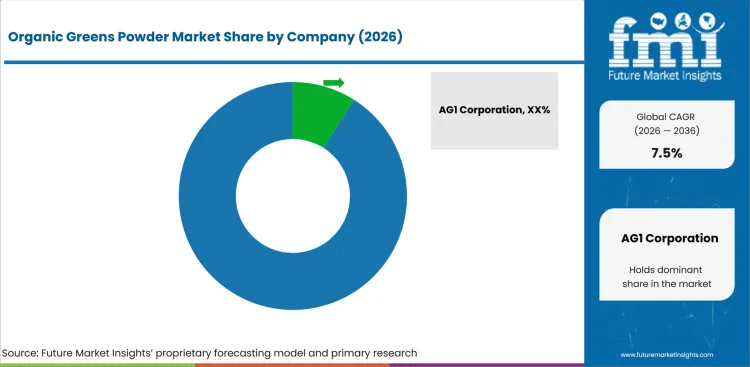
- Established greens powder brands hold an advantage through repeat-use messaging and direct subscription control.
- Contract manufacturers gain relevance when private labels need sourcing files, organic certificates, and microbial testing support.
- Retail-ready packaging supports trial through clear serving counts, dry storage, and simple ingredient panels.
- Taste masking remains a separator because algae, cereal grasses, and moringa can create bitterness when formulas are not balanced.
Consumer brands in the market compete by combining organic proof with routine-building content. AG1 and Amazing Grass compete on daily use and brand trust, while Huel uses direct community feedback to test greens formats. Brands linked to botanical supplements can gain better shelf access when ingredient claims stay specific and documented.
Manufacturing capability has become a practical separator as private labels ask for faster launches without label risk. Bactolac and Vitaquest compete on powder blending, testing records, and supplement production controls. Smaller brands can lose retail opportunities when they cannot provide supplier certificates and lot-level test records quickly.
Regional brands can still win through local taste preferences and faster pack adjustments. Saudi Arabia favors pharmacy-led imported wellness products, while South Korea favors stick packs and functional food positioning. Australia creates an added filter because supplement claims can fall under complementary medicine rules.
Key Companies in the Organic Greens Powder Market
Competition differs across direct-to-consumer greens brands, certified supplement brands, and private label manufacturers. Regional wellness companies add local retail access where imported formulas need country-specific label support.
- Direct-to-Consumer Greens Brands: AG1 Corporation, Amazing Grass LLC, Huel Limited, and Organifi LLC compete through brand education, serving discipline, and subscription retention.
- Certified Supplement Brands: Garden of Life LLC, Nested Naturals Inc., Botanica Health Products Inc., and Amazonia Group Pty Ltd. compete through organic labels, natural retail access, and consumer trust.
- Private Label and Manufacturing Specialists: Bactolac Pharmaceutical Inc., Vitaquest International LLC, COSMAX NBT Inc., and Kolmar BNH Co. Ltd. compete through formulation support, powder processing, and documentation speed.
Competitive Benchmarking: Organic Greens Powder Market
| Company | Relevance to Market Title | Organic Filing Depth | Powder Portfolio | Testing Support | Channel Reach | Geographic Footprint |
|---|---|---|---|---|---|---|
| AG1 Corporation | Daily greens flagship brand | High | Greens drink powder | Third-party testing stated | Subscription-led online scale | United States and international online |
| Amazing Grass LLC | Organic greens specialist | High | Greens blend powders | Organic and non-GMO documentation | Natural retail and online reach | United States and export channels |
| Bactolac Pharmaceutical Inc. | Private label powder maker | High | Custom green food powders | Supplement manufacturing controls | B2B manufacturer access | United States manufacturing base |
| Vitaquest International LLC | Supplement CDMO | High | Powders and particles | Quality and formulation support | Brand owner support | United States and global clients |
| Huel Limited | Daily nutrition brand | Medium | Daily Greens powder | Internal product standards | Direct online community | United Kingdom and online markets |
| Garden of Life LLC | Certified supplement brand | High | Traceable plant blends | Retail compliance support | Retail and pharmacy reach | North America and export channels |
| Organifi LLC | Superfood blend brand | Medium | Flavor-led powders | Brand-led quality files | Direct-to-consumer reach | United States online |
| Amazonia Group Pty Ltd. | Australian greens brand | High | Organic plant powders | Local compliance support | Health stores and online | Australia and export channels |
| COSMAX NBT Inc. | Functional food manufacturer | Medium | Stick-pack supplements | Manufacturing quality files | Health functional food access | South Korea and global clients |
| Kolmar BNH Co. Ltd. | Health supplement producer | Medium | Functional powder support | Regulatory and ingredient files | Brand and distributor support | South Korea |
Key Developments in Organic Greens Powder Market
- In May 2025, AG1 introduced AG1 Next Gen with upgraded probiotics and micronutrients for its daily health drink format.
- In September 2025, Huel introduced Daily Greens Ready-to-drink with 42 vitamins, minerals, superfoods and adaptogens. The launch showed that greens brands are testing convenience formats beyond powder.
- In November 2025, Food To Live recalled Organic Supergreens Powder Mix after an FDA investigation linked a moringa leaf powder supplier lot to Salmonella contamination.
Key Players in the Organic Greens Powder Market
- AG1 Corporation
- Amazing Grass LLC
- Garden of Life LLC
- Organifi LLC
- Huel Limited
- Rheal Superfoods Limited
- Nested Naturals Inc.
- Botanica Health Products Inc.
- Sunday Natural Products GmbH
- Amazonia Group Pty Ltd.
- CJ Wellcare Corporation
- Bactolac Pharmaceutical Inc.
- Vitaquest International LLC
Organic Greens Powder Market - Scope & Definition
| Attribute | Detail |
|---|---|
| Market Definition | Certified or organic-positioned multi-ingredient powder supplements made from leafy greens, cereal grasses, algae ingredients, fruit powders, and supporting botanicals. Products must be sold as powder formats for human wellness use. |
| Functions Covered | Daily greens intake, routine supplement use, digestive support positioning, fruit-and-vegetable powder intake, and private label wellness powder programs. |
| Applications Covered | Pouches, tubs, stick packs, sachets, and bulk finished powder formats used by branded marketers, subscription brands, retailers, and contract manufacturing customers. |
| End-Use Industries | Dietary supplement brands, natural retail, pharmacy wellness, e-commerce supplement sellers, sports nutrition brands, and private label supplement programs. |
| Grades Covered | Certified organic, organic compliant, dual certified, import certified, and claim-pending organic greens powder formats. |
| Inclusions | Finished consumer products and B2B private label programs where the powder is sold under a retailer, wellness brand, or subscription label. |
| Exclusions | Standard greens powders without organic certification or organic ingredient positioning, tablets, gummies, capsules, ready-to-drink cans, juices, frozen smoothie kits, animal nutrition, and clinical nutrition powders. |
Organic Greens Powder Market - Research Methodology
| Method | Description |
|---|---|
| Primary Research | FMI analyst interviews with supplement manufacturers, organic greens powder brands, private label producers, ingredient suppliers, and channel specialists. |
| Desk Research | Review of organic retail data, dietary supplement regulation, organic certification guidance, public recall records, and official company product pages. |
| Market Sizing & Forecasting | The market size has been estimated using a bottom-up product-boundary approach. Each category has been defined by eligible SKUs, supplement revenue pools, channel availability, product positioning, and country-level adoption patterns. Standard greens powders were excluded unless they clearly matched certified organic positioning, multi-ingredient formulation, private label ownership, or powder delivery format. |
| Data Validation | Cross-verification was completed using segment share logic, country CAGR distribution, organic certification relevance, supplier documentation, and private label manufacturing capacity. |
Organic Greens Powder Market - Report Scope
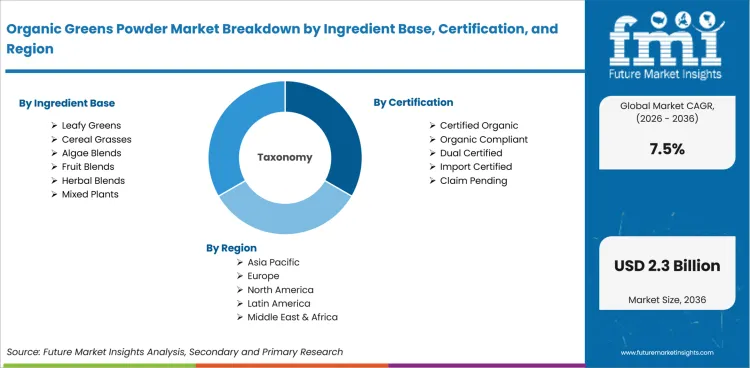
| Item | Value |
|---|---|
| Market size by 2036 | USD 2.3 billion |
| Growth rate | 7.5% CAGR from 2026 to 2036 |
| Forecast period | 2026 to 2036 |
| Base year value (2025) | USD 1.1 billion |
| Historical period | 2021 to 2025 |
| Market coverage | Organic multi-ingredient greens powders for daily wellness use |
| By ingredient base | Leafy greens, algae, grasses, herbs, blended formulations |
| By certification type | USDA Organic, EU Organic, Non-GMO, clean label |
| By packaging format | Pouches, jars, sachets, bulk packs |
| By sales channel | Online retail, health & wellness stores, pharmacies, direct-to-consumer |
| By consumer group | Fitness-oriented consumers, preventive health users, aging population, lifestyle wellness users |
| By buyer type | Individual consumers, institutional buyers |
| Regions covered | North America, Europe, East Asia, South Asia & Pacific, Middle East & Africa |
| Countries covered | United States, Germany, United Kingdom, Saudi Arabia, South Korea, Japan, Australia |
| Scope boundary | Powder products only; gummies, capsules, ready-to-drink formats, and single-ingredient powders excluded |
| Data sources | Organic retail data, supplement regulation sources, supplier disclosures, analyst-built bottom-up sizing |
| Approach | Bottom-up product-boundary approach using eligible SKU revenue, certification status, channel presence, pricing, and country-level demand |
Source: Future Market Insights, 2026.
Organic Greens Powder Market Breakdown by Ingredient Base, Certification, Packaging Format, Sales Channel, Consumer Group, Buyer Type, and Region
Organic Greens Powder Market Segmented by Ingredient Base
- Leafy Greens
- Cereal Grasses
- Algae Blends
- Fruit Blends
- Herbal Blends
- Mixed Plants
Organic Greens Powder Market Segmented by Certification
- Certified Organic
- Organic Compliant
- Dual Certified
- Import Certified
- Claim Pending
Organic Greens Powder Market Segmented by Packaging Format
- Pouches
- Stick Packs
- Tubs
- Sachets
- Bulk Packs
Organic Greens Powder Market Segmented by Sales Channel
- Online DTC
- Specialty Retail
- Mass Retail
- Pharmacy Retail
- Marketplace
Organic Greens Powder Market Segmented by Consumer Group
- Adult Wellness
- Fitness Users
- Digestive Support
- Busy Professionals
- Older Adults
Organic Greens Powder Market Segmented by Buyer Type
- Branded Marketers
- Private Label
- Contract Manufacturers
- Retailer Brands
- Subscription Brands
Organic Greens Powder Market by Region
- North America
- Latin America
- Europe
- East Asia
- South Asia and Pacific
- Middle East and Africa
Research Sources and Bibliography
- Organic Trade Association. (2026, March 4). U.S. organic marketplace achieved growth in 2025.
- United States Department of Agriculture Economic Research Service. (2026, January 27). Organic agriculture.
- United States Food and Drug Administration. (2024, October 1). Dietary supplements.
- United States Food and Drug Administration. (2024, April 24). Current good manufacturing practices for food and dietary supplements.
- United States Food and Drug Administration. (2026, June 3). Outbreak investigation of Salmonella: Moringa leaf powder.
- United States Food and Drug Administration. (2025, November 13). Food To Live voluntarily recalls organic moringa products because of possible health risk.
- United States Department of Agriculture Foreign Agricultural Service. (2026, April 6). South Korea: Health functional food and supplements.
- Soil Association Certification. (2026, March). Organic Market Report 2026.
- Organics Europe. (2026, February). Browse latest production and market data. https://www.organicseurope.bio/about-us/organic-in-europe/
- Ministry of Agriculture, Forestry and Fisheries of Japan. (2025, January 1). Organic Japanese Agricultural Standards.
- Therapeutic Goods Administration. (2025, January 31). How are vitamins regulated in Australia?
- European Food Safety Authority. (2026, January 6). Food supplements.
- Council for Responsible Nutrition. (2024, October 29). CRN survey shows consistent supplement usage with increase in specialty product use over time.
- AG1. (2025, May 4). Meet AG1 Next Gen.
- Amazing Grass. (2026). Super greens powder.
- Bactolac Pharmaceutical, Inc. (2026, April 20). Green food powders.
- Vitaquest International. (2025, April 21). Powdered greens supplement benefits and manufacturing guide.
- Huel. (2024, January 16). Daily Greens has landed in the United Kingdom.
- Huel. (2025, September 4). Introducing Daily Greens ready-to-drink.
This bibliography is provided for reader reference and is not exhaustive. The full report contains the complete reference list and data-source log used during sizing and country analysis.
This Report Answers
- What is the 2026 value and 2036 forecast for the organic greens powder market?
- What certification segment is projected to hold the leading share during the forecast period?
- What packaging format is expected to account for the leading 2026 share?
- How do organic certificates and testing records affect greens powder rollout?
- What companies compete in organic greens powder products and private label manufacturing?
Frequently Asked Questions
What is the organic greens powder market size in 2026?
The organic greens powder market is estimated at USD 1.1 billion in 2026, based on the provided anchor and bottom-up product-boundary checks.
What is the organic greens powder market forecast for 2036?
The market is projected to reach USD 2.3 billion by 2036, reflecting a 7.5% CAGR from 2026 to 2036.
What is the organic greens powder market CAGR?
The organic greens powder market is forecast to expand at 7.5% CAGR from 2026 to 2036.
What segment leads the organic greens powder market?
Certified organic products are projected to lead with 72.0% share in 2026, as organic seals remain the first trust filter for buyers.
What country grows fastest in the organic greens powder market?
Saudi Arabia is projected to record 9.1% CAGR by 2036, supported by premium pharmacy retail and imported wellness demand.
Preview the report firsthand - request a free sample
Get SampleGet the brochure for pricing and purchase details.
Get PDFTable of Content
- Executive Summary
- Global Market Outlook
- Demand to side Trends
- Supply to side Trends
- Technology Roadmap Analysis
- Analysis and Recommendations
- Market Overview
- Market Coverage / Taxonomy
- Market Definition / Scope / Limitations
- Research Methodology
- Chapter Orientation
- Analytical Lens and Working Hypotheses
- Market Structure, Signals, and Trend Drivers
- Benchmarking and Cross-market Comparability
- Market Sizing, Forecasting, and Opportunity Mapping
- Research Design and Evidence Framework
- Desk Research Programme (Secondary Evidence)
- Company Annual and Sustainability Reports
- Peer-reviewed Journals and Academic Literature
- Trade Journals, Industry Magazines, and Analyst Briefs
- Conference Proceedings, Webinars, and Seminar Materials
- Government Statistics Portals and Public Data Releases
- Press Releases and Reputable Media Coverage
- Specialist Newsletters and Curated Briefings
- Sector Databases and Reference Repositories
- FMI Internal Proprietary Databases and Historical Market Datasets
- Subscription Datasets and Paid Sources
- Social Channels, Communities, and Digital Listening Inputs
- Additional Desk Sources
- Expert Input and Fieldwork (Primary Evidence)
- Primary Modes
- Qualitative Interviews and Expert Elicitation
- Quantitative Surveys and Structured Data Capture
- Blended Approach
- Why Primary Evidence is Used
- Field Techniques
- Interviews
- Surveys
- Focus Groups
- Observational and In-context Research
- Social and Community Interactions
- Stakeholder Universe Engaged
- C-suite Leaders
- Board Members
- Presidents and Vice Presidents
- R&D and Innovation Heads
- Technical Specialists
- Domain Subject-matter Experts
- Scientists
- Physicians and Other Healthcare Professionals
- Governance, Ethics, and Data Stewardship
- Research Ethics
- Data Integrity and Handling
- Primary Modes
- Tooling, Models, and Reference Databases
- Desk Research Programme (Secondary Evidence)
- Data Engineering and Model Build
- Data Acquisition and Ingestion
- Cleaning, Normalisation, and Verification
- Synthesis, Triangulation, and Analysis
- Quality Assurance and Audit Trail
- Market Background
- Market Dynamics
- Drivers
- Restraints
- Investment Feasibility Matrix
- Value Chain Analysis
- PESTLE and Porter’s Analysis
- Regulatory Landscape
- Regional Parent Market Outlook
- Production and Consumption Statistics
- Import and Export Statistics
- Global Market Analysis 2021 to 2025 and Forecast, 2026 to 2036
- Historical Market Size Value (USD Million) Analysis, 2021 to 2025
- Current and Future Market Size Value (USD Million) Projections, 2026 to 2036
- Y to o to Y Growth Trend Analysis
- Absolute $ Opportunity Analysis
- Global Market Pricing Analysis 2021 to 2025 and Forecast 2026 to 2036
- Global Market Analysis 2021 to 2025 and Forecast 2026 to 2036, By Ingredient Base
- Introduction / Key Findings
- Historical Market Size Value (USD Million) Analysis By Ingredient Base , 2021 to 2025
- Current and Future Market Size Value (USD Million) Analysis and Forecast By Ingredient Base , 2026 to 2036
- Leafy Greens
- Cereal Grasses
- Algae Blends
- Fruit Blends
- Herbal Blends
- Mixed Plants
- Leafy Greens
- Y to o to Y Growth Trend Analysis By Ingredient Base , 2021 to 2025
- Absolute $ Opportunity Analysis By Ingredient Base , 2026 to 2036
- Global Market Analysis 2021 to 2025 and Forecast 2026 to 2036, By Certification
- Introduction / Key Findings
- Historical Market Size Value (USD Million) Analysis By Certification, 2021 to 2025
- Current and Future Market Size Value (USD Million) Analysis and Forecast By Certification, 2026 to 2036
- Certified Organic
- Organic Compliant
- Dual Certified
- Import Certified
- Claim Pending
- Certified Organic
- Y to o to Y Growth Trend Analysis By Certification, 2021 to 2025
- Absolute $ Opportunity Analysis By Certification, 2026 to 2036
- Global Market Analysis 2021 to 2025 and Forecast 2026 to 2036, By Packaging Format
- Introduction / Key Findings
- Historical Market Size Value (USD Million) Analysis By Packaging Format, 2021 to 2025
- Current and Future Market Size Value (USD Million) Analysis and Forecast By Packaging Format, 2026 to 2036
- Pouches
- Stick Packs
- Tubs
- Sachets
- Bulk Packs
- Pouches
- Y to o to Y Growth Trend Analysis By Packaging Format, 2021 to 2025
- Absolute $ Opportunity Analysis By Packaging Format, 2026 to 2036
- Global Market Analysis 2021 to 2025 and Forecast 2026 to 2036, By Sales Channel
- Introduction / Key Findings
- Historical Market Size Value (USD Million) Analysis By Sales Channel, 2021 to 2025
- Current and Future Market Size Value (USD Million) Analysis and Forecast By Sales Channel, 2026 to 2036
- Online DTC
- Specialty Retail
- Mass Retail
- Pharmacy Retail
- Marketplace
- Online DTC
- Y to o to Y Growth Trend Analysis By Sales Channel, 2021 to 2025
- Absolute $ Opportunity Analysis By Sales Channel, 2026 to 2036
- Global Market Analysis 2021 to 2025 and Forecast 2026 to 2036, By Buyer Type
- Introduction / Key Findings
- Historical Market Size Value (USD Million) Analysis By Buyer Type, 2021 to 2025
- Current and Future Market Size Value (USD Million) Analysis and Forecast By Buyer Type, 2026 to 2036
- Branded Marketers
- Private Label
- Contract Manufacturers
- Retailer Brands
- Subscription Brands
- Branded Marketers
- Y to o to Y Growth Trend Analysis By Buyer Type, 2021 to 2025
- Absolute $ Opportunity Analysis By Buyer Type, 2026 to 2036
- Global Market Analysis 2021 to 2025 and Forecast 2026 to 2036, By Region
- Introduction
- Historical Market Size Value (USD Million) Analysis By Region, 2021 to 2025
- Current Market Size Value (USD Million) Analysis and Forecast By Region, 2026 to 2036
- North America
- Latin America
- Western Europe
- Eastern Europe
- East Asia
- South Asia and Pacific
- Middle East & Africa
- Market Attractiveness Analysis By Region
- North America Market Analysis 2021 to 2025 and Forecast 2026 to 2036, By Country
- Historical Market Size Value (USD Million) Trend Analysis By Market Taxonomy, 2021 to 2025
- Market Size Value (USD Million) Forecast By Market Taxonomy, 2026 to 2036
- By Country
- USA
- Canada
- Mexico
- By Ingredient Base
- By Certification
- By Packaging Format
- By Sales Channel
- By Buyer Type
- By Country
- Market Attractiveness Analysis
- By Country
- By Ingredient Base
- By Certification
- By Packaging Format
- By Sales Channel
- By Buyer Type
- Key Takeaways
- Latin America Market Analysis 2021 to 2025 and Forecast 2026 to 2036, By Country
- Historical Market Size Value (USD Million) Trend Analysis By Market Taxonomy, 2021 to 2025
- Market Size Value (USD Million) Forecast By Market Taxonomy, 2026 to 2036
- By Country
- Brazil
- Chile
- Rest of Latin America
- By Ingredient Base
- By Certification
- By Packaging Format
- By Sales Channel
- By Buyer Type
- By Country
- Market Attractiveness Analysis
- By Country
- By Ingredient Base
- By Certification
- By Packaging Format
- By Sales Channel
- By Buyer Type
- Key Takeaways
- Western Europe Market Analysis 2021 to 2025 and Forecast 2026 to 2036, By Country
- Historical Market Size Value (USD Million) Trend Analysis By Market Taxonomy, 2021 to 2025
- Market Size Value (USD Million) Forecast By Market Taxonomy, 2026 to 2036
- By Country
- Germany
- UK
- Italy
- Spain
- France
- Nordic
- BENELUX
- Rest of Western Europe
- By Ingredient Base
- By Certification
- By Packaging Format
- By Sales Channel
- By Buyer Type
- By Country
- Market Attractiveness Analysis
- By Country
- By Ingredient Base
- By Certification
- By Packaging Format
- By Sales Channel
- By Buyer Type
- Key Takeaways
- Eastern Europe Market Analysis 2021 to 2025 and Forecast 2026 to 2036, By Country
- Historical Market Size Value (USD Million) Trend Analysis By Market Taxonomy, 2021 to 2025
- Market Size Value (USD Million) Forecast By Market Taxonomy, 2026 to 2036
- By Country
- Russia
- Poland
- Hungary
- Balkan & Baltic
- Rest of Eastern Europe
- By Ingredient Base
- By Certification
- By Packaging Format
- By Sales Channel
- By Buyer Type
- By Country
- Market Attractiveness Analysis
- By Country
- By Ingredient Base
- By Certification
- By Packaging Format
- By Sales Channel
- By Buyer Type
- Key Takeaways
- East Asia Market Analysis 2021 to 2025 and Forecast 2026 to 2036, By Country
- Historical Market Size Value (USD Million) Trend Analysis By Market Taxonomy, 2021 to 2025
- Market Size Value (USD Million) Forecast By Market Taxonomy, 2026 to 2036
- By Country
- China
- Japan
- South Korea
- By Ingredient Base
- By Certification
- By Packaging Format
- By Sales Channel
- By Buyer Type
- By Country
- Market Attractiveness Analysis
- By Country
- By Ingredient Base
- By Certification
- By Packaging Format
- By Sales Channel
- By Buyer Type
- Key Takeaways
- South Asia and Pacific Market Analysis 2021 to 2025 and Forecast 2026 to 2036, By Country
- Historical Market Size Value (USD Million) Trend Analysis By Market Taxonomy, 2021 to 2025
- Market Size Value (USD Million) Forecast By Market Taxonomy, 2026 to 2036
- By Country
- India
- ASEAN
- Australia & New Zealand
- Rest of South Asia and Pacific
- By Ingredient Base
- By Certification
- By Packaging Format
- By Sales Channel
- By Buyer Type
- By Country
- Market Attractiveness Analysis
- By Country
- By Ingredient Base
- By Certification
- By Packaging Format
- By Sales Channel
- By Buyer Type
- Key Takeaways
- Middle East & Africa Market Analysis 2021 to 2025 and Forecast 2026 to 2036, By Country
- Historical Market Size Value (USD Million) Trend Analysis By Market Taxonomy, 2021 to 2025
- Market Size Value (USD Million) Forecast By Market Taxonomy, 2026 to 2036
- By Country
- Kingdom of Saudi Arabia
- Other GCC Countries
- Turkiye
- South Africa
- Other African Union
- Rest of Middle East & Africa
- By Ingredient Base
- By Certification
- By Packaging Format
- By Sales Channel
- By Buyer Type
- By Country
- Market Attractiveness Analysis
- By Country
- By Ingredient Base
- By Certification
- By Packaging Format
- By Sales Channel
- By Buyer Type
- Key Takeaways
- Key Countries Market Analysis
- USA
- Pricing Analysis
- Market Share Analysis, 2025
- By Ingredient Base
- By Certification
- By Packaging Format
- By Sales Channel
- By Buyer Type
- Canada
- Pricing Analysis
- Market Share Analysis, 2025
- By Ingredient Base
- By Certification
- By Packaging Format
- By Sales Channel
- By Buyer Type
- Mexico
- Pricing Analysis
- Market Share Analysis, 2025
- By Ingredient Base
- By Certification
- By Packaging Format
- By Sales Channel
- By Buyer Type
- Brazil
- Pricing Analysis
- Market Share Analysis, 2025
- By Ingredient Base
- By Certification
- By Packaging Format
- By Sales Channel
- By Buyer Type
- Chile
- Pricing Analysis
- Market Share Analysis, 2025
- By Ingredient Base
- By Certification
- By Packaging Format
- By Sales Channel
- By Buyer Type
- Germany
- Pricing Analysis
- Market Share Analysis, 2025
- By Ingredient Base
- By Certification
- By Packaging Format
- By Sales Channel
- By Buyer Type
- UK
- Pricing Analysis
- Market Share Analysis, 2025
- By Ingredient Base
- By Certification
- By Packaging Format
- By Sales Channel
- By Buyer Type
- Italy
- Pricing Analysis
- Market Share Analysis, 2025
- By Ingredient Base
- By Certification
- By Packaging Format
- By Sales Channel
- By Buyer Type
- Spain
- Pricing Analysis
- Market Share Analysis, 2025
- By Ingredient Base
- By Certification
- By Packaging Format
- By Sales Channel
- By Buyer Type
- France
- Pricing Analysis
- Market Share Analysis, 2025
- By Ingredient Base
- By Certification
- By Packaging Format
- By Sales Channel
- By Buyer Type
- India
- Pricing Analysis
- Market Share Analysis, 2025
- By Ingredient Base
- By Certification
- By Packaging Format
- By Sales Channel
- By Buyer Type
- ASEAN
- Pricing Analysis
- Market Share Analysis, 2025
- By Ingredient Base
- By Certification
- By Packaging Format
- By Sales Channel
- By Buyer Type
- Australia & New Zealand
- Pricing Analysis
- Market Share Analysis, 2025
- By Ingredient Base
- By Certification
- By Packaging Format
- By Sales Channel
- By Buyer Type
- China
- Pricing Analysis
- Market Share Analysis, 2025
- By Ingredient Base
- By Certification
- By Packaging Format
- By Sales Channel
- By Buyer Type
- Japan
- Pricing Analysis
- Market Share Analysis, 2025
- By Ingredient Base
- By Certification
- By Packaging Format
- By Sales Channel
- By Buyer Type
- South Korea
- Pricing Analysis
- Market Share Analysis, 2025
- By Ingredient Base
- By Certification
- By Packaging Format
- By Sales Channel
- By Buyer Type
- Russia
- Pricing Analysis
- Market Share Analysis, 2025
- By Ingredient Base
- By Certification
- By Packaging Format
- By Sales Channel
- By Buyer Type
- Poland
- Pricing Analysis
- Market Share Analysis, 2025
- By Ingredient Base
- By Certification
- By Packaging Format
- By Sales Channel
- By Buyer Type
- Hungary
- Pricing Analysis
- Market Share Analysis, 2025
- By Ingredient Base
- By Certification
- By Packaging Format
- By Sales Channel
- By Buyer Type
- Kingdom of Saudi Arabia
- Pricing Analysis
- Market Share Analysis, 2025
- By Ingredient Base
- By Certification
- By Packaging Format
- By Sales Channel
- By Buyer Type
- Turkiye
- Pricing Analysis
- Market Share Analysis, 2025
- By Ingredient Base
- By Certification
- By Packaging Format
- By Sales Channel
- By Buyer Type
- South Africa
- Pricing Analysis
- Market Share Analysis, 2025
- By Ingredient Base
- By Certification
- By Packaging Format
- By Sales Channel
- By Buyer Type
- USA
- Market Structure Analysis
- Competition Dashboard
- Competition Benchmarking
- Market Share Analysis of Top Players
- By Regional
- By Ingredient Base
- By Certification
- By Packaging Format
- By Sales Channel
- By Buyer Type
- Competition Analysis
- Competition Deep Dive
- AG1 Corporation
- Overview
- Product Portfolio
- Profitability by Market Segments (Product/Age /Sales Channel/Region)
- Sales Footprint
- Strategy Overview
- Marketing Strategy
- Product Strategy
- Channel Strategy
- Amazing Grass LLC
- Bactolac Pharmaceutical Inc.
- Vitaquest International LLC
- Huel Limited
- Garden of Life LLC
- Organifi LLC
- Amazonia Group Pty Ltd.
- COSMAX NBT Inc.
- Kolmar BNH Co. Ltd.
- AG1 Corporation
- Competition Deep Dive
- Market Dynamics
- Assumptions & Acronyms Used


