

- Market Size (2026)
- USD 720.6 Mn
- Forecast (2036)
- USD 1327.5 Mn
- CAGR (2026 to 2036)
- 6.3%
How big is Organic Sludge Reducers Market in 2026?
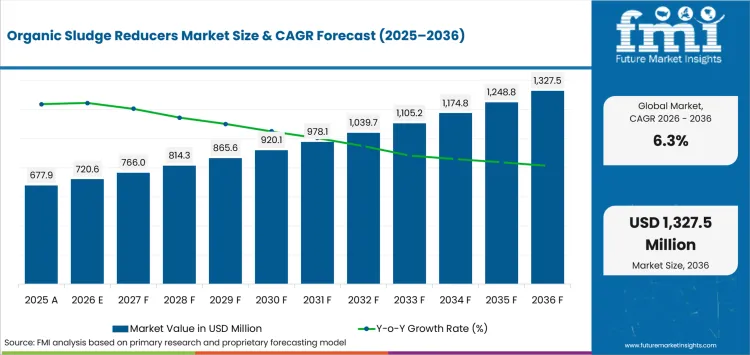
USD 720.6 million in 2026 and USD 1,327.5 million by 2036 at a 6.3% CAGR.
Demand for organic sludge reducers is forecast to expand at 6.3% CAGR between 2026 and 2036, increasing market value from USD 720.6 million in 2026 to USD 1,327.5 million by 2036. Spending rises when operators use biological formulations to slow solids accumulation before dredging, hauling or process expansion becomes necessary. Recurring demand depends on whether dosing produces a measurable operating benefit at the treatment site.
In January 2024, the World Bank approved a USD 310.8 million water environment project in Binh Duong Province, Viet Nam, to expand wastewater services and improve environmental conditions for about 550,000 residents by 2032. Infrastructure of this type adds new biological treatment capacity and increases the value of keeping basins productive after commissioning. Buyers tend to move from trial dosing to repeat purchase when solids control is measurable and effluent quality remains stable.
Key Takeaways of Organic Sludge Reducers Market
- Organic sludge reducers gain relevance when accumulated solids reduce useful treatment volume or increase hauling, dredging and dewatering frequency.
- Bacterial sludge reducers account for 31.0% of Product Type demand in 2026 because they directly reinforce microbial degradation of biodegradable organic solids.
- Liquid holds 41.0% of Form demand in 2026 as direct dosing and rapid dispersion reduce preparation steps in wet treatment systems.
- Wastewater lagoons hold 27.0% of Application demand in 2026 because bottom solids create a visible capacity and maintenance burden.
- Municipal wastewater accounts for 31.0% of End Use demand, while Water treatment distributors hold 35.0% of Sales Channel demand in 2026.
- Philippines and Indonesia record country growth rates of 7.3% and 7.0% CAGR respectively from 2026 to 2036.
- Ecolab / Nalco Water, Veolia Water Technologies, EnviroZyme / Betco, Microbial Discovery Group, Microbe-Lift, Aquafix, Bionetix International, Organica Biotech, Genesis Water Technologies and Hydrite serve the market through biological products, treatment programs or process support.
Analyst Perspective
"Buyers judge organic sludge reduction through operating outcomes. Suppliers need a baseline, dosing protocol and field measurement that show whether treatment can delay hauling or dredging while preserving effluent performance."
- Anurag Sharma, Principal Consultant, Future Market Insights
How is the Organic Sludge Reducers Market segmented?
The market is segmented by product type, form, application, end use, sales channel and region.
Product Type separates bacterial reducers from enzyme products, blended bioaugmentation systems and digestion aids. Form reflects how treatment is stored and dosed. Application identifies where organic solids accumulate, while End Use captures the operating environment and its solids-management economics. Sales Channel reflects whether buyers rely on treatment distributors, direct plant supply, septic dealers or aquaculture input networks. Commercial fit depends on matching biology and dosing practice to the treatment setting.
Why do Bacterial Sludge reducers lead the Product Type category?
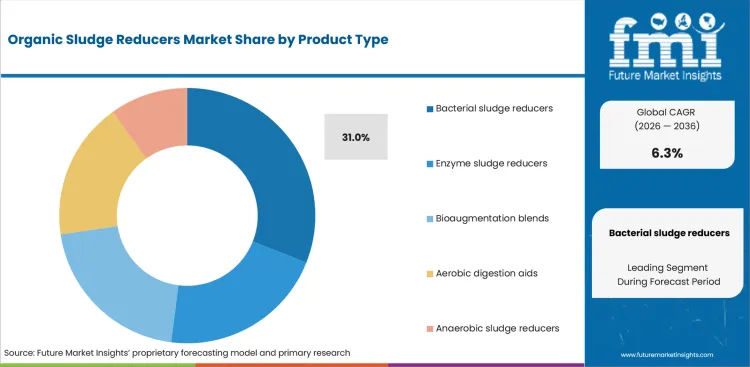
Bacterial sludge reducers reinforce the microbial processes already responsible for degrading biodegradable organic matter. Selected cultures can support treatment after shock loads or when the existing biomass is poorly matched to a difficult substrate. Their value is easier to assess in systems where operators already track aeration, retention time and solids behavior. Recurring use depends on whether introduced organisms remain active under the site's wastewater conditions and dosing schedule.
- Bacterial sludge reducers account for 31.0% of the Product Type category in 2026 because they directly reinforce microbial degradation of organic solids.
- In May 2026, EnviroZyme described a coking-plant bioaugmentation program using targeted microorganisms to strengthen biomass development and improve biological treatment stability.
Why does Liquid lead the Form category?
Liquid formulations reduce preparation steps at sites that already use pumps or manual dosing into wet treatment systems. They disperse quickly and let operators adjust application frequency without mixing a dry concentrate. The workflow advantage is relevant in municipal basins and industrial tanks where dosing can be tied to an operating schedule. Powders, granules and slow-release formats remain useful where storage, freight or low-labor application carries more weight.
- Liquid holds 41.0% of the Form category in 2026 because direct dosing and rapid dispersion reduce preparation steps in continuously wet treatment environments.
- Ecological Laboratories lists MICROBE-LIFT industrial wastewater products that target organic and sludge reduction in liquid treatment formats.
Why do wastewater lagoons lead the Application category?
Wastewater lagoons create a direct link between accumulated organic solids and maintenance economics. Sludge reduces effective basin volume and can increase odor or treatment instability when solids remain in place for long periods. Mechanical removal disrupts operations, so biological reducers are often evaluated as a way to extend the interval between physical interventions. Lagoons also allow routine dosing and depth-based measurement, although temperature and oxygen conditions can change performance through the year.
- Wastewater lagoons hold 27.0% of the Application category in 2026 because organic bottom solids create a recurring capacity and dredging problem.
- In February 2026, Bionetix International reported multi-season wastewater lagoon trials for BIOBOOSTER SR sludge-digesting tablets and compared the program with conventional dredging costs.
Why does Municipal Wastewater lead the End Use category?
Municipal wastewater plants purchase against a public-service requirement and fixed treatment capacity. Operators need to protect effluent performance while containing sludge handling costs and keeping existing basins available. Organic sludge reduction becomes relevant when accumulated solids interfere with digester capacity or increase dewatering and removal frequency. Products that can be introduced without construction have an operating advantage, although plant staff still need a clear baseline and treatment window before extending dosing.
- Municipal wastewater accounts for 31.0% of the End Use category in 2026 because solids management is embedded in routine plant operations and public compliance obligations.
- In December 2025, Aquafix published a City of Monticello, Indiana case study involving an extended-aeration activated sludge treatment system and biological wastewater products used under municipal operating conditions.
Why do Water Treatment Distributors lead the Sales Channel category?
Water treatment distributors connect a technical consumable with customers that often lack specialist biological procurement teams. They can combine product supply with dosing guidance, troubleshooting and repeat delivery, which is useful for smaller municipal plants and industrial sites. Distributor economics also suit recurring treatments because local route density supports replenishment and field follow-up. Direct plant supply remains important for large accounts, while septic and aquaculture channels serve more specialized buying patterns.
- Water treatment distributors hold 35.0% of the Sales Channel category in 2026 because recurring biological treatments benefit from local technical support and replenishment.
- Microbial Discovery Group supplies its Biotifx wastewater program through distribution partners, combining biological products with application guidance and field-support tools for recurring treatment accounts.
What are the drivers, restraints and opportunities in the Organic Sludge Reducers Market?
Demand rises as operators seek lower sludge-handling pressure, while site-dependent biological performance limits conversion and decentralized sanitation plus aquaculture create new dosing opportunities.
- Driver: Operators want to preserve treatment capacity and reduce the frequency of dredging, hauling or sludge removal.
- Restraint: Biological results depend on site conditions, which raises the qualification burden before repeat purchase.
- Opportunity: Decentralized sanitation and aquaculture systems need simple dosing formats backed by field support.
Pressure begins at the treatment asset. When sludge occupies basin volume or increases hauling frequency, operators have an economic reason to test biological dosing before scheduling physical removal. Organic sludge reducers are evaluated alongside sludge treatment chemicals and mechanical solids management, so purchasing depends on whether recurring dosing can reduce intervention cost while maintaining treatment performance.
Full-scale performance remains site dependent. A controlled field trial published in Water Environment Research in November 2025 found no significant general performance improvement from continuous bioaugmentation in the tested aerated stabilization basins. The study reinforces the need for plant-specific baselines and operating controls. The same qualification burden appears across industrial water treatment when temperature, dissolved oxygen, retention time and influent composition vary.
Distributed wastewater sites create a practical opening because many operators cannot justify frequent dredging or large solids-handling upgrades. Indonesia's Ministry of Marine Affairs and Fisheries reported farmed fish output of 6.37 million tonnes in 2024, up 13.64% from the prior year. Greater pond activity expands the number of sites managing organic load and bottom solids. Modular water treatment systems and simple biological dosing programs can fit these dispersed operating environments when local technical support remains available.
Which country CAGRs are forecast in the Organic Sludge Reducers Market?
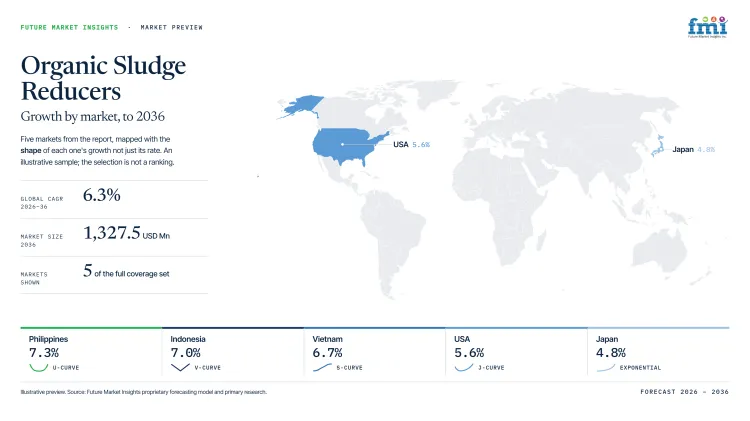
| Country | CAGR |
|---|---|
| Philippines | 7.3% |
| USA | 5.6% |
| Japan | 4.8% |
| Indonesia | 7.0% |
| Vietnam | 6.7% |
| Brazil | 6.3% |
| Mexico | 6.0% |
How do country-level CAGRs compare in the Organic Sludge Reducers Market?
The seven country CAGRs span 2.5 percentage points between Philippines at 7.3% and Japan at 4.8% from 2026 to 2036. Philippines and Indonesia sit in the upper growth band, with Vietnam close behind. Brazil and Mexico track near the overall market pace. USA and Japan expand at lower rates, while mature treatment assets can still support recurring technical-service demand. Growth rate should therefore be read with the installed treatment base and local purchasing process.
- Philippines at 7.3% is 0.3 percentage points above Indonesia at 7.0%. The narrow gap places more weight on channel coverage and local application support than on growth-rate separation.
- Indonesia at 7.0% is 0.3 percentage points above Vietnam at 6.7%. Similar growth rates arise from different demand engines, with aquaculture important in Indonesia and urban wastewater investment important in Vietnam.
- Vietnam at 6.7%, Brazil at 6.3% and Mexico at 6.0% form a middle band. Commercial timing will depend on whether suppliers can attach biological products to infrastructure projects or existing plant rehabilitation.
- Mexico at 6.0% is 0.4 percentage points above USA at 5.6%, while Japan is at 4.8%. Mature markets place more weight on field performance because buyers can compare biological dosing with established mechanical or process alternatives.
Country growth rates need to be read with the installed treatment base and operating cost. Municipalities with mature assets may generate recurring demand for sludge dewatering equipment and biological support even at a lower CAGR, while rapidly expanding markets can require more distributor training before repeat dosing becomes routine.
Country-wise Analysis
- Philippines: Philippine purchasing is influenced by local sewage and septage programs, so suppliers often work through service contractors or municipal relationships. Demand is forecast to rise at 7.3% CAGR from 2026 to 2036. In December 2024, DENR-EMB National Capital Region reported an orientation and seminar on proper septage and sewage management. Uneven treatment infrastructure can limit operator capability, which increases the value of simple dosing protocols and dealer training.
- USA: USA buyers tend to ask for plant-specific operating data because municipal and industrial operators already use established sludge-handling practices. Demand is forecast to rise at 5.6% CAGR from 2026 to 2036. Aquafix published new municipal wastewater case material in 2025, reinforcing the role of defined baselines and sampling methods before commercial dosing expands.
- Japan: Japanese wastewater operators work within mature treatment assets and increasingly evaluate sludge as a resource stream as well as a disposal burden. Demand is forecast to rise at 4.8% CAGR from 2026 to 2036. In April 2024, the Ministry of Land, Infrastructure, Transport and Tourism published municipal case studies on expanding sewage sludge use as fertilizer. Suppliers need to show compatibility with digestion, biosolids quality and downstream recovery plans.
- Indonesia: Indonesian demand combines wastewater infrastructure expansion with a large pond-based aquaculture economy, giving distributors several routes to market. Demand is forecast to rise at 7.0% CAGR from 2026 to 2036. In December 2024, the Ministry of Marine Affairs and Fisheries reported farmed fish output of 6.37 million tonnes, up 13.64% from the prior year. Dispersed operating conditions increase the value of low-labor dosing formats and pond-specific guidance.
- Vietnam: Vietnamese purchasing is moving with new urban wastewater collection and treatment capacity, so biological products can enter during commissioning and later operating optimization. Demand is forecast to rise at 6.7% CAGR from 2026 to 2036. In January 2024, the World Bank approved the Binh Duong Province Water Environment Improvement Project to improve wastewater services for about 550,000 residents by 2032. Treatment contractors and local distributors can support dosing protocols during start-up and maintenance.
- Brazil: Brazil combines municipal sanitation demand with complex industrial effluent streams, so suppliers must fit biological products into existing treatment trains. Demand is forecast to rise at 6.3% CAGR from 2026 to 2036. In September 2024, Veolia Water Technologies announced industrial water and wastewater facilities for Suzano's new pulp mill in Mato Grosso do Sul. Adoption depends on showing where biological dosing complements existing process controls.
- Mexico: Mexican demand is tied to municipal rehabilitation and watershed-restoration priorities where solids control must coexist with broader collection and treatment upgrades. Demand is forecast to rise at 6.0% CAGR from 2026 to 2036. In November 2024, Comisión Nacional del Agua reported a work tour for restoration and sanitation of the Lerma River. Site surveys and defined maintenance targets can improve adoption across facilities with uneven asset condition.
Who are the notable companies in the Organic Sludge Reducers Market?
Ecolab / Nalco Water, Veolia Water Technologies, EnviroZyme / Betco, Microbial Discovery Group, Microbe-Lift, Aquafix, Bionetix International, Organica Biotech, Genesis Water Technologies and Hydrite are notable companies active in this market.
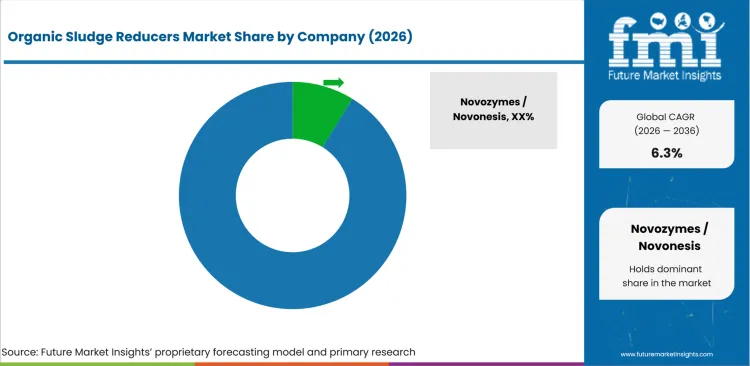
Competition spans integrated water-treatment platforms and specialist biological suppliers. Ecolab / Nalco Water and Veolia Water Technologies combine wastewater process support with broader treatment portfolios. EnviroZyme / Betco, Microbial Discovery Group, Microbe-Lift, Aquafix, Bionetix International and Organica Biotech compete closer to biological dosing. Genesis Water Technologies and Hydrite add system or service capabilities that connect sludge reduction with wider wastewater treatment equipment and operating programs.
- Integrated water-treatment platforms: Ecolab / Nalco Water and Veolia Water Technologies combine wastewater treatment expertise with diagnostics, engineering or broader process support.
- Biological wastewater formulation platforms: EnviroZyme / Betco, Microbial Discovery Group, Microbe-Lift, Aquafix, Bionetix International and Organica Biotech compete through microbial products, dosing programs or application support.
- Integrated treatment and technical-support suppliers: Genesis Water Technologies and Hydrite connect biological treatment with project engineering, system upgrades or wastewater service support.
Competitive Benchmarking: Organic Sludge Reducers Market
Scoring basis: Sludge-Reduction Offering reflects the depth of current microbial, enzyme or bioaugmentation products aimed at organic solids control. Process Support reflects dosing guidance, diagnostics and field-service capability. Application Breadth reflects the range of in-scope wastewater, lagoon, septic and pond settings served. High indicates broad coverage, Medium indicates a focused position and Low indicates a narrow role within the defined market.
| Company | Sludge-Reduction Offering | Process Support | Application Breadth | Geographic Reach |
|---|---|---|---|---|
| Ecolab / Nalco Water | Medium | High | High | Global water-treatment service footprint |
| Veolia Water Technologies | Medium | High | High | Global engineered water and wastewater footprint |
| EnviroZyme / Betco | High | Medium | High | North America with international wastewater distribution |
| Microbial Discovery Group | High | High | High | North America with distributor-led international reach |
| Microbe-Lift | High | Medium | High | United States with international distribution |
| Aquafix | High | High | High | United States with specialist wastewater outreach |
| Bionetix International | High | Medium | High | Canada and North America with international biosolutions distribution |
| Organica Biotech | High | Medium | High | India with international biological-treatment markets |
| Genesis Water Technologies | Medium | High | Medium | United States with global project-oriented water-treatment reach |
| Hydrite | High | High | High | United States with regional wastewater service coverage |
Key Developments in the Organic Sludge Reducers Market
- In April 2025, Aquafix published a Somerset, Kentucky lagoon case study for Sludge RX. Five treatments over seven months were associated with an average 1.42 feet of sludge reduction across the lagoons and a treatment cost reported at 92% below the cited mechanical-dredging estimate.
- In January 2026, Microbial Discovery Group introduced Biotifx AN for anaerobic digesters, combining micronutrients with Bacillus bacteria to support solids digestion and digester stability.
- In February 2026, Bionetix International reported a multi-month BIOBOOSTER SR lagoon trial with sludge-volume reductions of 63% to 70% and compared the biological program with conventional dredging economics.
Key Players in the Organic Sludge Reducers Market
Integrated Water-Treatment Platforms
- Ecolab / Nalco Water
- Veolia Water Technologies
Biological Wastewater Formulation Platforms
- EnviroZyme / Betco
- Microbial Discovery Group
- Microbe-Lift
- Aquafix
- Bionetix International
- Organica Biotech
Integrated Treatment and Technical-Support Suppliers
- Genesis Water Technologies
- Hydrite
Organic Sludge Reducers Market - Report Scope
| Coverage field | Report scope |
|---|---|
| Market breakdown | By product type, form, application, end use, sales channel and region. |
| Quantitative Units | USD million. |
| Market Definition | Revenue includes microbial, enzymatic, bioaugmentation and biological digestion-aid products sold to reduce or control organic sludge across the defined categories. It excludes equipment-only sludge dewatering or drying, hauling and disposal revenue, downstream finished-product revenue, and adjacent chemical treatment products sold as substitutes. |
| Regions Covered | North America, Latin America, Western Europe, Eastern Europe, East Asia, South Asia and Pacific, and Middle East and Africa. |
| Countries Covered | Philippines, USA, Japan, Indonesia, Vietnam, Brazil, Mexico, and additional countries included in the full report. |
| Notable Companies | Ecolab / Nalco Water; Veolia Water Technologies; EnviroZyme / Betco; Microbial Discovery Group; Microbe-Lift; Aquafix; Bionetix International; Organica Biotech; Genesis Water Technologies; Hydrite. |
| Forecast Period | 2026 to 2036. |
| Approach | Primary and secondary research with market triangulation. |
Organic Sludge Reducers Market - Research Methodology
| Method | Approach |
|---|---|
| Primary Research | FMI analysts gathered input from manufacturers, water-treatment distributors, wastewater operators, septic service providers, aquaculture users, procurement teams and subject-matter experts. Interviews examined use cases, dosing practice, purchase triggers, service requirements and repeat-order conditions. |
| Desk Research | Desk research covered government and regulator publications, water and sanitation programs, technical literature, trade information, company filings, product documentation and public project announcements relevant to the defined market. |
| Market Sizing and Forecasting | The market model combined the baseline value with segment structure, pricing and usage indicators, treatment-system installed base, country infrastructure conditions and supplier activity. Forecast assumptions considered wastewater investment, aquaculture activity, operating economics and adoption of recurring biological treatment programs. |
| Data Validation | Cross-checks compared market values, segment totals, country conditions and company activity to maintain consistency across the defined scope and reduce overlap with equipment-only, disposal and adjacent chemical-treatment categories. |
Organic Sludge Reducers Market by Segments
Organic Sludge Reducers Market segmented by Product Type:
- Bacterial sludge reducers
- Enzyme sludge reducers
- Bioaugmentation blends
- Aerobic digestion aids
- Anaerobic sludge reducers
Organic Sludge Reducers Market segmented by Form:
- Liquid
- Powder
- Granules
- Blocks / slow release
Organic Sludge Reducers Market segmented by Application:
- Wastewater lagoons
- Septic systems
- Aquaculture ponds
- Industrial effluent ponds
- Municipal clarifiers
Organic Sludge Reducers Market segmented by End Use:
- Municipal wastewater
- Food processing
- Aquaculture
- Residential septic
- Industrial wastewater
Organic Sludge Reducers Market segmented by Sales Channel:
- Water treatment distributors
- Direct plant supply
- Septic service dealers
- Aquaculture input channel
Organic Sludge Reducers Market by Region:
- North America
- United States
- Canada
- Latin America
- Brazil
- Mexico
- Argentina
- Chile
- Western Europe
- Germany
- France
- United Kingdom
- Italy
- Spain
- Benelux
- Nordics
- Eastern Europe
- Poland
- Czech Republic
- Romania
- Hungary
- East Asia
- China
- Japan
- South Korea
- South Asia and Pacific
- India
- ASEAN
- Australia and New Zealand
- Middle East and Africa
- GCC Countries
- South Africa
- Türkiye
- Israel
Research Sources and Bibliography
- DENR Environmental Management Bureau - National Capital Region (2024, December 3). EMB-NCR Conducts Orientation/Seminar on Proper Septage and Sewage Management.
- Ministry of Marine Affairs and Fisheries, Indonesia (2024, December 19). Menteri Trenggono Berhasil Tingkatkan Produksi Perikanan Budi Daya 13,6% di 2024.
- World Bank (2024, January 12). World Bank Approves Project to Improve Living Environment for Over Half a Million People in Southern Viet Nam.
- Ministry of Land, Infrastructure, Transport and Tourism, Japan (2024, April 8). Sewage sludge resource use case-study publication.
- Comisión Nacional del Agua, Mexico (2024, November 12). Se llevó a cabo el primer recorrido de trabajo para la restauración y saneamiento del río Lerma.
- Ecolab / Nalco Water (2026, March 2). Korean automaker reduces wastewater sludge with expert support from Nalco Water.
- Veolia Water Technologies. BAS biological wastewater treatment technology and municipal wastewater treatment resources.
- Ecological Laboratories. MICROBE-LIFT wastewater treatment products.
- EnviroZyme (2026, May 5). From 29% to 86% Ammonia Removal in Weeks: Rapid Nitrification at a Coking Plant.
- Microbial Discovery Group (2026, January 27). Biotifx AN: microbial support for anaerobic digester performance.
- Aquafix (2025, April 8). Maximizing Lagoon Performance Through Sludge Reduction.
- Bionetix International (2026, February 24). BIOBOOSTER SR Poised to Save Millions in Sludge-Dredging Costs at WWTPs.
- Organica Biotech. CleanMaxx STP - Microbial Solutions for Industry Sewage Treatment.
- Genesis Water Technologies. BioSTIK Biological Wastewater Treatment Advanced Bioreactor Modules.
- Mattingly, A. J., Pagoria, P., Palumbo, J., and de los Reyes, F. L. III (2025, November 12). Does Continuous Bioaugmentation of Aerated Stabilization Basins Improve Performance? A Field Scale Trial With a Control. Water Environment Research, 97(11), e70202.
This bibliography is provided for reader reference and is not exhaustive. The full report contains the complete reference list and detailed citations.
This Report Answers
- How is demand for organic sludge reducers expected to evolve through the forecast period?
- Which wastewater operating pressures and maintenance costs support demand for organic sludge reducers?
- Why do bacterial sludge reducers hold the leading position within Product Type?
- How does the Liquid form influence dosing practice and repeat purchase?
- Why do wastewater lagoons hold the leading position within Application?
- How do growth rates differ across Philippines, USA, Japan, Indonesia, Vietnam, Brazil and Mexico?
- Which companies compete through biological formulations, process support or integrated treatment systems?
- How does site-dependent biological performance limit adoption and repeat dosing?
- What should wastewater operators evaluate before purchasing an organic sludge reducer?
Frequently Asked Questions
How big is the Organic Sludge Reducers Market in 2026?
The organic sludge reducers market is valued at USD 720.6 million in 2026 and is projected to reach USD 1,327.5 million by 2036. Demand is tied to recurring solids-management requirements across lagoons, municipal plants, industrial wastewater systems, septic applications and aquaculture ponds.
What is the CAGR of the Organic Sludge Reducers Market from 2026 to 2036?
The organic sludge reducers market is projected to grow at a 6.3% CAGR between 2026 and 2036. Growth depends on the economics of reducing sludge handling and on biological treatments maintaining stable performance under site-specific operating conditions.
Which Product Type leads the Organic Sludge Reducers Market?
Bacterial sludge reducers are expected to account for 31.0% of Product Type demand in 2026. Their position reflects direct use of microbial cultures to accelerate degradation of biodegradable organic matter in wastewater and pond systems.
Which Form leads the Organic Sludge Reducers Market?
Liquid formulations are expected to hold 41.0% of Form demand in 2026. Direct dosing and rapid dispersion fit sites that already operate wet treatment systems and need adjustable recurring application.
Which Application leads the Organic Sludge Reducers Market?
Wastewater lagoons are expected to account for 27.0% of Application demand in 2026. Accumulated bottom solids reduce effective basin volume and create a recurring comparison between biological treatment and physical dredging.
How much will the Organic Sludge Reducers Market add between 2026 and 2036?
The market is expected to add USD 606.9 million between 2026 and 2036. The increase reflects recurring biological treatment demand as more wastewater and pond operators evaluate ways to manage solids without frequent physical removal.
Which companies are active in the Organic Sludge Reducers Market?
Companies active in the market include Ecolab / Nalco Water, Veolia Water Technologies, EnviroZyme / Betco, Microbial Discovery Group, Microbe-Lift, Aquafix, Bionetix International, Organica Biotech, Genesis Water Technologies and Hydrite.
Preview the report firsthand - request a free sample
Get SampleGet the brochure for pricing and purchase details.
Get PDFTable of Content
- Key Takeaways
- Market Size and CAGR
- Top Growth Driver
- Fastest Growing Segment
- Leading Region
- Key Companies
- Emerging Opportunities
- Executive Summary
- Global Market Outlook
- Demand-side Trends
- Supply-side Trends
- Technology Roadmap Analysis
- Analysis and Recommendations
- Analyst Perspective (What is happening? Why now? What should investors know?)
- Key Questions Answered
- How large is the market?
- What is the CAGR?
- What are key trends?
- Which region dominates?
- Who are the leaders?
- Market Overview
- Market Coverage / Taxonomy
- Market Definition / Scope / Limitations
- Research Methodology
- Chapter Orientation
- Analytical Lens and Working Hypotheses
- Market Structure, Signals, and Trend Drivers
- Benchmarking and Cross-market Comparability
- Market Sizing, Forecasting, and Opportunity Mapping
- Research Design and Evidence Framework
- Desk Research Programme (Secondary Evidence)
- Expert Input and Fieldwork (Primary Evidence)
- Tooling, Models, and Reference Databases
- Data Engineering and Model Build
- Quality Assurance and Audit Trail
- Market Background
- Market Dynamics (Drivers, Restraints, Opportunity, Trends)
- Scenario Forecast (Optimistic, Likely, Conservative)
- Impact Analysis
- AI Impact
- Sustainability Impact
- Regulatory Impact
- Technology Impact
- Consumer / Buyer Analysis
- Purchase Drivers
- Adoption Barriers
- Buyer Journey
- Opportunity Map Analysis
- Product Life Cycle Analysis
- Supply Chain Analysis
- Investment Feasibility Matrix
- Value Chain Analysis
- PESTLE and Porter's Analysis
- Regulatory Landscape
- Regional Parent Market Outlook
- Production and Consumption Statistics
- Import and Export Statistics
- Global Market Analysis and Forecast, 2021 to 2036
- Historical Market Size Value (USD Million) Analysis, 2021 to 2025
- Current and Future Market Size Value (USD Million) Projections, 2026 to 2036
- Y-o-Y Growth Trend Analysis
- Absolute $ Opportunity Analysis
- Global Market Pricing Analysis, 2021 to 2036
- Global Market Analysis and Forecast, By Product Type, 2021 to 2036
- Introduction / Key Findings
- Historical Market Size Value (USD Million) Analysis By Product Type, 2021 to 2025
- Current and Future Market Size Value (USD Million) Analysis and Forecast By Product Type, 2026 to 2036
- Bacterial sludge reducers
- Enzyme sludge reducers
- Bioaugmentation blends
- Aerobic digestion aids
- Anaerobic sludge reducers
- Bacterial sludge reducers
- Y-o-Y Growth Trend Analysis By Product Type, 2021 to 2025
- Absolute $ Opportunity Analysis By Product Type, 2026 to 2036
- Global Market Analysis and Forecast, By Form, 2021 to 2036
- Introduction / Key Findings
- Historical Market Size Value (USD Million) Analysis By Form, 2021 to 2025
- Current and Future Market Size Value (USD Million) Analysis and Forecast By Form, 2026 to 2036
- Liquid
- Powder
- Granules
- Blocks / slow release
- Liquid
- Y-o-Y Growth Trend Analysis By Form, 2021 to 2025
- Absolute $ Opportunity Analysis By Form, 2026 to 2036
- Global Market Analysis and Forecast, By Application, 2021 to 2036
- Introduction / Key Findings
- Historical Market Size Value (USD Million) Analysis By Application, 2021 to 2025
- Current and Future Market Size Value (USD Million) Analysis and Forecast By Application, 2026 to 2036
- Wastewater lagoons
- Septic systems
- Aquaculture ponds
- Industrial effluent ponds
- Municipal clarifiers
- Wastewater lagoons
- Y-o-Y Growth Trend Analysis By Application, 2021 to 2025
- Absolute $ Opportunity Analysis By Application, 2026 to 2036
- Global Market Analysis and Forecast, By End Use, 2021 to 2036
- Introduction / Key Findings
- Historical Market Size Value (USD Million) Analysis By End Use, 2021 to 2025
- Current and Future Market Size Value (USD Million) Analysis and Forecast By End Use, 2026 to 2036
- Municipal wastewater
- Food processing
- Aquaculture
- Residential septic
- Industrial wastewater
- Municipal wastewater
- Y-o-Y Growth Trend Analysis By End Use, 2021 to 2025
- Absolute $ Opportunity Analysis By End Use, 2026 to 2036
- Global Market Analysis and Forecast, By Sales Channel, 2021 to 2036
- Introduction / Key Findings
- Historical Market Size Value (USD Million) Analysis By Sales Channel, 2021 to 2025
- Current and Future Market Size Value (USD Million) Analysis and Forecast By Sales Channel, 2026 to 2036
- Water treatment distributors
- Direct plant supply
- Septic service dealers
- Aquaculture input channel
- Water treatment distributors
- Y-o-Y Growth Trend Analysis By Sales Channel, 2021 to 2025
- Absolute $ Opportunity Analysis By Sales Channel, 2026 to 2036
- Global Market Analysis and Forecast, By Region, 2021 to 2036
- Introduction
- Historical Market Size Value (USD Million) Analysis By Region, 2021 to 2025
- Current Market Size Value (USD Million) Analysis and Forecast By Region, 2026 to 2036
- North America
- Latin America
- Western Europe
- Eastern Europe
- East Asia
- South Asia and Pacific
- Middle East & Africa
- Market Attractiveness Analysis By Region
- North America Market Analysis and Forecast, By Country, 2021 to 2036
- Historical Market Size Value (USD Million) Trend Analysis By Market Taxonomy, 2021 to 2025
- Market Size Value (USD Million) Forecast By Market Taxonomy, 2026 to 2036
- By Country
- USA
- Canada
- By Product Type
- By Form
- By Application
- By End Use
- By Sales Channel
- By Country
- Market Attractiveness Analysis
- By Country
- By Product Type
- By Form
- By Application
- By End Use
- By Sales Channel
- Key Takeaways
- Latin America Market Analysis and Forecast, By Country
- Historical Market Size Value (USD Million) Trend Analysis By Market Taxonomy, 2021 to 2025
- Market Size Value (USD Million) Forecast By Market Taxonomy, 2026 to 2036
- By Country
- Brazil
- Mexico
- Chile
- Rest of Latin America
- By Product Type
- By Form
- By Application
- By End Use
- By Sales Channel
- By Country
- Market Attractiveness Analysis
- By Country
- By Product Type
- By Form
- By Application
- By End Use
- By Sales Channel
- Key Takeaways
- Western Europe Market Analysis and Forecast, By Country
- Historical Market Size Value (USD Million) Trend Analysis By Market Taxonomy, 2021 to 2025
- Market Size Value (USD Million) Forecast By Market Taxonomy, 2026 to 2036
- By Country
- Germany
- UK
- Italy
- Spain
- France
- Nordic
- BENELUX
- Rest of Western Europe
- By Product Type
- By Form
- By Application
- By End Use
- By Sales Channel
- By Country
- Market Attractiveness Analysis
- By Country
- By Product Type
- By Form
- By Application
- By End Use
- By Sales Channel
- Key Takeaways
- Eastern Europe Market Analysis and Forecast, By Country
- Historical Market Size Value (USD Million) Trend Analysis By Market Taxonomy, 2021 to 2025
- Market Size Value (USD Million) Forecast By Market Taxonomy, 2026 to 2036
- By Country
- Russia
- Poland
- Hungary
- Balkan & Baltic
- Rest of Eastern Europe
- By Product Type
- By Form
- By Application
- By End Use
- By Sales Channel
- By Country
- Market Attractiveness Analysis
- By Country
- By Product Type
- By Form
- By Application
- By End Use
- By Sales Channel
- Key Takeaways
- East Asia Market Analysis and Forecast, By Country
- Historical Market Size Value (USD Million) Trend Analysis By Market Taxonomy, 2021 to 2025
- Market Size Value (USD Million) Forecast By Market Taxonomy, 2026 to 2036
- By Country
- China
- Japan
- South Korea
- By Product Type
- By Form
- By Application
- By End Use
- By Sales Channel
- By Country
- Market Attractiveness Analysis
- By Country
- By Product Type
- By Form
- By Application
- By End Use
- By Sales Channel
- Key Takeaways
- South Asia and Pacific Market Analysis and Forecast, By Country
- Historical Market Size Value (USD Million) Trend Analysis By Market Taxonomy, 2021 to 2025
- Market Size Value (USD Million) Forecast By Market Taxonomy, 2026 to 2036
- By Country
- India
- ASEAN
- Australia & New Zealand
- Rest of South Asia and Pacific
- By Product Type
- By Form
- By Application
- By End Use
- By Sales Channel
- By Country
- Market Attractiveness Analysis
- By Country
- By Product Type
- By Form
- By Application
- By End Use
- By Sales Channel
- Key Takeaways
- Middle East & Africa Market Analysis and Forecast, By Country
- Historical Market Size Value (USD Million) Trend Analysis By Market Taxonomy, 2021 to 2025
- Market Size Value (USD Million) Forecast By Market Taxonomy, 2026 to 2036
- By Country
- Kingdom of Saudi Arabia
- Other GCC Countries
- Türkiye
- South Africa
- Other African Union
- Rest of Middle East & Africa
- By Product Type
- By Form
- By Application
- By End Use
- By Sales Channel
- By Country
- Market Attractiveness Analysis
- By Country
- By Product Type
- By Form
- By Application
- By End Use
- By Sales Channel
- Key Takeaways
- Key Countries Market Analysis
- USA
- Pricing Analysis
- Market Share Analysis, 2025
- By Product Type
- By Form
- By Application
- By End Use
- By Sales Channel
- Canada
- Pricing Analysis
- Market Share Analysis, 2025
- By Product Type
- By Form
- By Application
- By End Use
- By Sales Channel
- Mexico
- Pricing Analysis
- Market Share Analysis, 2025
- By Product Type
- By Form
- By Application
- By End Use
- By Sales Channel
- Brazil
- Pricing Analysis
- Market Share Analysis, 2025
- By Product Type
- By Form
- By Application
- By End Use
- By Sales Channel
- Chile
- Pricing Analysis
- Market Share Analysis, 2025
- By Product Type
- By Form
- By Application
- By End Use
- By Sales Channel
- Germany
- Pricing Analysis
- Market Share Analysis, 2025
- By Product Type
- By Form
- By Application
- By End Use
- By Sales Channel
- UK
- Pricing Analysis
- Market Share Analysis, 2025
- By Product Type
- By Form
- By Application
- By End Use
- By Sales Channel
- Italy
- Pricing Analysis
- Market Share Analysis, 2025
- By Product Type
- By Form
- By Application
- By End Use
- By Sales Channel
- Spain
- Pricing Analysis
- Market Share Analysis, 2025
- By Product Type
- By Form
- By Application
- By End Use
- By Sales Channel
- France
- Pricing Analysis
- Market Share Analysis, 2025
- By Product Type
- By Form
- By Application
- By End Use
- By Sales Channel
- India
- Pricing Analysis
- Market Share Analysis, 2025
- By Product Type
- By Form
- By Application
- By End Use
- By Sales Channel
- ASEAN
- Pricing Analysis
- Market Share Analysis, 2025
- By Product Type
- By Form
- By Application
- By End Use
- By Sales Channel
- Australia & New Zealand
- Pricing Analysis
- Market Share Analysis, 2025
- By Product Type
- By Form
- By Application
- By End Use
- By Sales Channel
- China
- Pricing Analysis
- Market Share Analysis, 2025
- By Product Type
- By Form
- By Application
- By End Use
- By Sales Channel
- Japan
- Pricing Analysis
- Market Share Analysis, 2025
- By Product Type
- By Form
- By Application
- By End Use
- By Sales Channel
- South Korea
- Pricing Analysis
- Market Share Analysis, 2025
- By Product Type
- By Form
- By Application
- By End Use
- By Sales Channel
- Russia
- Pricing Analysis
- Market Share Analysis, 2025
- By Product Type
- By Form
- By Application
- By End Use
- By Sales Channel
- Poland
- Pricing Analysis
- Market Share Analysis, 2025
- By Product Type
- By Form
- By Application
- By End Use
- By Sales Channel
- Hungary
- Pricing Analysis
- Market Share Analysis, 2025
- By Product Type
- By Form
- By Application
- By End Use
- By Sales Channel
- Kingdom of Saudi Arabia
- Pricing Analysis
- Market Share Analysis, 2025
- By Product Type
- By Form
- By Application
- By End Use
- By Sales Channel
- Türkiye
- Pricing Analysis
- Market Share Analysis, 2025
- By Product Type
- By Form
- By Application
- By End Use
- By Sales Channel
- South Africa
- Pricing Analysis
- Market Share Analysis, 2025
- By Product Type
- By Form
- By Application
- By End Use
- By Sales Channel
- USA
- Market Structure Analysis
- Competition Dashboard
- Competition Benchmarking
- Market Share Analysis of Top Players
- By Regional
- By Product Type
- By Form
- By Application
- By End Use
- By Sales Channel
- Emerging Startups
- Innovation Benchmarking
- Competition Analysis
- Competition Deep Dive
- Novozymes / Novonesis
- Overview
- Product Portfolio
- Profitability by Market Segments
- Sales Footprint
- Strategy Overview
- Marketing Strategy
- Product Strategy
- Channel Strategy
- Ecolab / Nalco Water
- Veolia Water Technologies
- Bioaugmentation LLC
- Microbe-Lift
- BioWish Technologies
- Aquafix
- Bionetix International
- Organica Biotech
- Genesis Water Technologies
- Novozymes / Novonesis
- Case Studies
- Success Stories
- Recent Developments
- Competition Deep Dive
- Assumptions & Acronyms Used


