
- Market Size (2026)
- USD 176.0 Mn
- Forecast (2036)
- USD 436.2 Mn
- CAGR (2026 to 2036)
- 9.5%
How Big Is the Packaged Cactus Water Market in 2026?
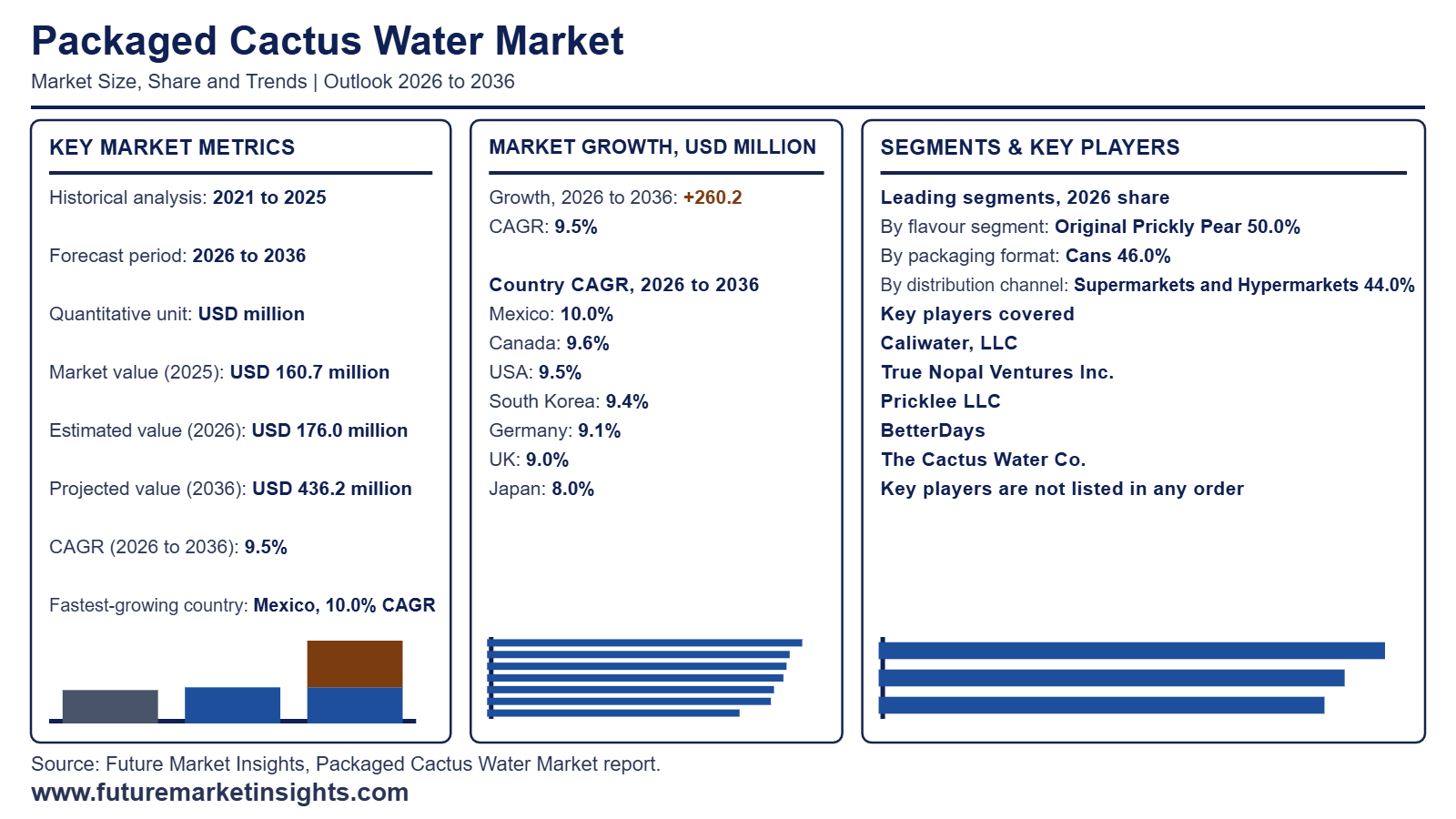
With a valuation of USD 160.7 million in 2025 and moving to USD 176.0 million in 2026, packaged cactus water market size is positioned to attain USD 436.2 million by 2036, exhibiting a CAGR of 9.5%. FMI survey and retail velocity tracking reflects that mainstream supermarket placement and low-sugar electrolyte positioning generate a ten-year incremental opportunity of USD 260.2 million. Beverage buyers and fitness retailers increasingly stock prickly pear and nopal hydration cans as low-calorie alternatives to conventional sports drinks.
| Market Metric | Valuation / Share / Forecast Benchmark |
|---|---|
| 2025 Market Size (Historical) | USD 160.7 million |
| 2026 Market Size (Estimated) | USD 176.0 million |
| 2036 Market Size (Projected) | USD 436.2 million |
| Compound Annual Growth Rate (2026 to 2036) | 9.5% CAGR |
| Incremental Dollar Opportunity (2026 to 2036) | USD 260.2 million |
| Dominant Flavour Segment (2026 Share) | Original Prickly Pear (50.0% share in 2026) | Other Segment Combined (50.0%) |
| Leading Packaging Format (2026 Share) | Cans (46.0% share in 2026) | Other Segment Combined (54.0%) |
| Leading Distribution Channel (2026 Share) | Supermarkets and Hypermarkets (44.0% share in 2026) | Other Segment Combined (56.0%) |
| Leading End-User Segment (2026 Share) | Health-Conscious Adults (53.4% share in 2026) | Other Segment Combined (46.6%) |
| Fastest-Growing Country Markets (2026 to 2036) | Mexico (10.0% CAGR), Canada (9.6% CAGR), USA (9.5% CAGR) |
| Leading Tier-1 Companies | Caliwater, LLC, True Nopal Ventures Inc., Pricklee LLC, BetterDays, The Cactus Water Co. |
Source: Future Market Insights analysis of the packaged cactus water market, 2026.
Executive Market Overview
Buyer adoption of packaged cactus water is rising rapidly as grocery shoppers rotate away from high-sugar isotonic drinks toward prickly pear and nopal beverages that deliver natural betalains and electrolytes at half the calorie load of conventional coconut water. According to consumption patterns that analysts at FMI are witnessing, adult beverage buyers check nutrition panels closely and favor clean-label plant waters merchandised beside electrolyte drinks and hydration boosters. Survey findings published by the International Food Information Council (December 2025) across 3,000 United States adults confirm that 75.0% of consumers actively limit or avoid sugars and 55.0% choose hydration beverages over caloric soft drinks, while agronomic records from the Ministry of Agriculture and Rural Development of Mexico (August 2025) verify 844,255.6 tonnes of annual Mexican nopal production across 12,405.6 hectares. Country-wise growth comparisons show that Mexico at a 10.0% CAGR and Canada at a 9.6% CAGR are witnessing the fastest expansion through 2036 due to domestic nopal processing and front-of-package sugar warning exemptions, whereas Japan records an 8.0% CAGR where ready-to-drink green and barley teas already saturate convenience shelves.
However, issues such as short fresh fruit shelf life and betalain pigment heat sensitivity during thermal pasteurization act as a restraint on co-packing margins. beverage processors protect 12-month shelf stability by adopting controlled 90-degree-Celsius pasteurization and zero-added-sugar recipes that bypass sugar excise levies. FMI's market growth analysis indicates that the packaged cactus water category's 9.5% CAGR through 2036 outpaces mature packaged coconut water and sparkling bottled water because supercenter distribution is scaling from a smaller base, while tracking near GLP-1 hydration products and magnesium sparkling drinks. Corporate financing disclosures from BevNET (March 2026) prove this momentum as Pricklee LLC raised a seed round in March 2026 while rebranding around everyday natural prickly pear hydration. Report scope covers shelf-stable and refrigerated ready-to-drink cactus water in cans, PET bottles, cartons, and glass bottles while excluding raw cactus produce and alcoholic cactus seltzers.
This Report Answers
- How large the packaged cactus water market is in 2026 and what valuation it reaches by 2036
- Which flavour and packaging segments lead consumer adoption in 2026
- What factors are driving low-sugar plant hydration sales and what hurdles restrain growth
- Which countries witness the fastest expansion between 2026 and 2036
- What Caliwater, LLC and True Nopal Ventures Inc. have launched across grocery channels
- How the packaged cactus water market is defined and measured across retail channels
Analyst Perspective
"Packaged cactus water brands will capture durable national grocery velocity by keeping total sugars at or below 3 to 6 grams per 12-ounce can while locking in pasteurized Mexican prickly pear puree supply. Primary downside exposure comes from betalain color degradation during ambient warehouse storage and front-of-package sugar warning triggers in regulated export markets."
- Nandini Roy Choudhury, Principal Consultant, Future Market Insights.
Key Market Trends & Insights
- Tropical Fruit Co-Blends and Celebrity-Backed Retail Rollouts Accelerate Mainstream Trial: Product preference studies show that blending earthy prickly pear juice with dragon fruit or watermelon purees in sleek 12-ounce aluminum cans lowers the taste barrier for first-time shoppers. FMI's analysis suggests that tropical fruit co-flavors help grocery buyers position cactus water directly beside mainstream plant-based beverages in chilled cold-vault doors. Official product specifications from Caliwater, LLC (October 2026) document the October 2026 rollout of Dragonfruit Cactus Water and Watermelon 12-packs and Pineapple cans formulated with 200 milligrams of prickly pear cactus extract and 5 grams of sugar per can. In addition to this, retail disclosures from BevNET (September 2026) confirm that Caliwater debuted across all 10 Erewhon stores in Southern California in September 2026 after appointing Blair Owens as Chief Executive Officer in February 2026 per BevNET (February 2026).
- Thermal and Vacuum Preservation Advances Stabilize Betalain Pigments Over 12-Month Shelf Life: Co-packers and puree processors are upgrading thermal pasteurization parameters to prevent red-violet betalain antioxidants in prickly pear juice from browning before retail sale. Peer-reviewed preservation research published by the National Center for Biotechnology Information (January 2026) demonstrates that while fresh red prickly pear fruit spoils within 3 to 4 weeks across Mexico's 471,000-ton annual harvest, pasteurizing juice at 90 degrees Celsius for 30 minutes combined with vacuum storage retained 141.2 milligrams per liter of betalains and 506.0 milligrams Gallic Acid Equivalent per liter of total phenols over 12 months with zero microbial growth. validated 12-month pigment stability enables brands to ship ambient multipacks nationwide next to plant-based energy drinks without refrigerated freight surcharges. FMI believes that shelf-stable puree standardization will lower unit co-packing costs through 2036.
- Functional Electrolyte, Adaptogen, and Sparkling Line Extensions Target Active Occasions: Beverage formulators are adding ocean trace minerals and L-theanine to carbonated prickly pear juice bases to capture gym recovery and zero-proof social occasions. Launch records from Inside FMCG (January 2025) detail BetterDays introducing a functional sparkling cactus water range in 250 milliliter cans fortified with ginseng and L-theanine at under 22 calories per can. Besides this, sustainability and sourcing disclosures from the Women's Business Enterprise National Council (July 2025) highlight how The Cactus Water Co. markets zero-sugar organic nopal leaf hydration engineered for drought-resilient supply chains. FMI observes that functional fortification helps emerging labels compete for shelf space against specialty lactation hydration beverages.
What Are the Main Drivers, Restraints, and Opportunities?
Consumer sugar reduction habits and drought-resilient Mexican nopal harvests drive retail expansion, whereas fresh fruit perishability and front-of-package nutrition rules restrain margins and mass-merchandise chain listings open new scale.
Driver: Consumer Migration Toward Low-Sugar Plant-Based Electrolyte Hydration
Sales of packaged cactus water are expanding due to health-conscious grocery shoppers replacing sugary sports drinks with plant waters that provide naturally occurring electrolytes under 35 calories per serving. Survey data from the International Food Information Council (December 2025) confirm that 75.0% of United States adults actively limit or avoid dietary sugars, while 30.0% check Nutrition Facts panels for low sugar claims. On the agricultural supply side, production records from the Ministry of Agriculture and Rural Development of Mexico (August 2025) verify 844,255.6 tonnes of annual Mexican nopalitos harvested across 12,405.6 hectares and exported to 35 countries. FMI's consumer demand analysis indicates that strong alignment with sugar-avoidance habits drives repeat basket building across conventional grocery chains.
Restraint: Raw Prickly Pear Perishability and Stricter Front-of-Package Sugar Regulations
Processing raw prickly pear fruit into shelf-stable beverages requires rapid de-spining and enzymatic depectinization before wild yeast fermentation degrades juice quality. Food science findings from the National Center for Biotechnology Information (January 2026) note that unprocessed prickly pear fruit has a post-harvest window of only 3 to 4 weeks, forcing beverage brands to contract specialized aseptic puree processors. From a regulatory compliance standpoint, enforcement notices from the Canadian Food Inspection Agency (November 2025) mandated front-of-package high-sugar warning symbols effective January 1, 2026, while HM Revenue and Customs (October 2026) lowered the United Kingdom soft drinks levy threshold to 4.5 grams of sugar per 100 milliliters. FMI notes that beverage formulators must restrict added sugars to avoid mandatory warning seals and tax surcharges through 2036.
Opportunity: Mass-Merchandise Supercenter Rollouts and Zero-Added-Sugar Reformulation
Cactus water producers are capturing high-volume expansion opportunity by moving beyond coastal specialty boutiques into national mass merchandisers and club stores. Retail expansion disclosures from BevNET (October 2025) document True Nopal Ventures Inc. expanding its zero-added-sugar 1 liter and multipack cartons into 2,362 Walmart stores and national Whole Foods Market locations. In addition to this, financing announcements from BevNET (March 2026) show Pricklee LLC deploying fresh seed capital to expand Northeast and Sunbelt grocery distribution for its 3-gram-sugar prickly pear cans. FMI expects that securing multi-thousand-door supercenter planograms will transform cactus water from a regional specialty into a national hydration staple through 2036.
How Is the Packaged Cactus Water Market Segmented?
Packaged Cactus Water Market is segmented by Flavour, Packaging, Distribution Channel, End User, and Region. Forecast period from 2026 to 2036.
| Segmentation Axis | Sub-Segments Covered | 2026 Leading Segment & Share | Other Segment Combined & Total |
|---|---|---|---|
| Flavour | Original Prickly Pear, Fruit-Blended, Functional with Electrolytes and Added Vitamins, Sparkling | Original Prickly Pear (50.0% share in 2026) | Other Segment Combined (50.0%) | Total (100.0%) |
| Packaging | Cans, PET Bottles, Cartons, Glass Bottles | Cans (46.0% share in 2026) | Other Segment Combined (54.0%) | Total (100.0%) |
| Distribution Channel | Supermarkets and Hypermarkets, Natural and Specialty Stores, Online Retail, Cafes and Foodservice, Convenience Stores | Supermarkets and Hypermarkets (44.0% share in 2026) | Other Segment Combined (56.0%) | Total (100.0%) |
| End User | Health-Conscious Adults, Athletes and Active Consumers, Younger Consumers | Health-Conscious Adults (53.4% share in 2026) | Other Segment Combined (46.6%) | Total (100.0%) |
| Region | North America, Latin America, Western Europe, Eastern Europe, East Asia, South Asia and Pacific, Middle East and Africa | North America (led by Mexico at 10.0% CAGR and Canada at 9.6% CAGR) | Global Coverage Across 7 Core Countries (100.0%) |
Source: Future Market Insights analysis of the packaged cactus water market, 2026.
Why Does Original Prickly Pear Capture Half of Flavour Segment Demand?
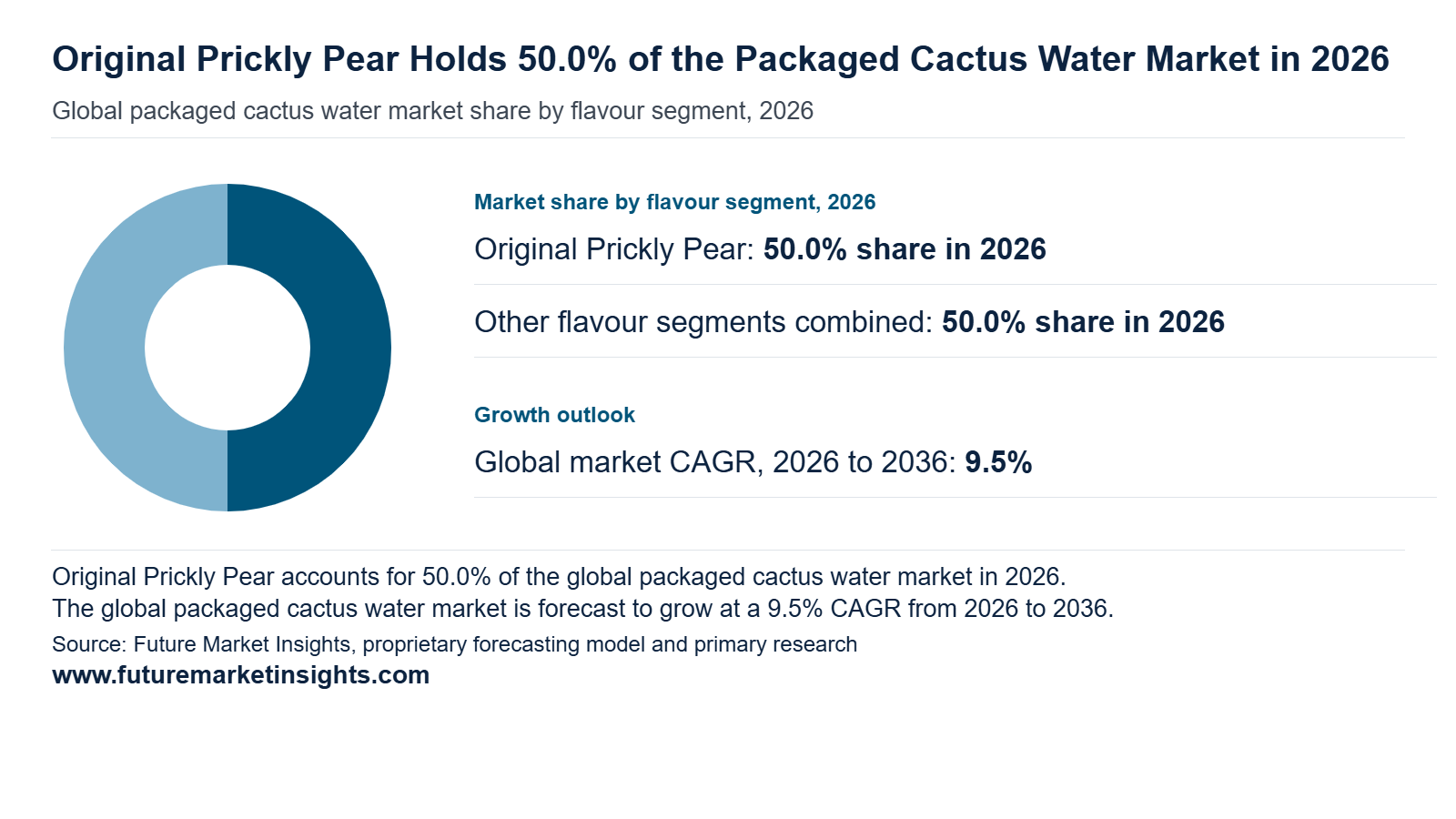
Original Prickly Pear holds a leading 50.0% share of the flavour segment in 2026, while other segment combined accounts for 50.0% across fruit-blended, functional electrolyte, and sparkling variants. FMI's consumer preference analysis indicates that unblended prickly pear SKUs anchor brand identity on retail shelves because shoppers seek authentic magenta betalain color and clean berry-melon taste without masking juices. Product specification records from Pricklee LLC (2026) and True Nopal Ventures Inc. via BevNET (October 2025) confirm that flagship original prickly pear formulations remain the top-selling entry SKU across supermarket chains. While original prickly pear leads baseline reorder velocity, fruit-blended dragon fruit and pineapple variants released by Caliwater, LLC (October 2026) and Caliwater, LLC (September 2026) are expanding trial among soft-drink switchers.
How Do Cans Lead Packaging Format Selection?
In 2026, Cans command 46.0% of packaging revenue, ahead of other segment combined at 54.0% covering PET bottles, cartons, and glass bottles. Beverage formulators prioritize 12-ounce sleek aluminum cans because opaque metal walls block ultraviolet light that would otherwise fade heat-sensitive red betalain pigments during ambient retail display. Product specifications from Caliwater, LLC (October 2026) and Pricklee LLC (2026), and sparkling launch records from Inside FMCG (January 2025), show leading brands standardizing single-serve and 12-pack retail distribution in aluminum cans. In FMI's view, aseptic paperboard cartons led by True Nopal Ventures Inc. in 330 milliliter and 1 liter sizes will retain strong multi-serve pantry share across mass-merchandise grocery aisles.
Why Do Supermarkets and Hypermarkets Anchor Distribution Channel Volume?
Supermarkets and Hypermarkets secure 44.0% of distribution channel revenue in 2026 because nationwide grocery store chains offer the multi-pack beverage merchandising and dedicated natural food aisles necessary to build consumer awareness for novel plant waters. Multi-unit beverage retail placement allows hydration brands to cross-merchandise cactus water alongside coconut water and premium functional juices. In addition, supermarket distribution provides predictable volume velocity and cold-chain beverage display coolers that drive impulse shopper purchases. Analysts at FMI observe that expanding natural grocery shelf allocations and retail promotional agreements will ensure that supermarkets and hypermarkets maintain majority sales distribution through 2036.
What Drives Health-Conscious Adults to Lead the End-User Segment?
Health-Conscious Adults account for a dominant 53.4% share of end-user demand in 2026, with other segment combined representing 46.6% across athletes and younger consumers. According to consumption patterns tracked by FMI, adult grocery buyers managing daily sugar intake and skin antioxidant support purchase cactus water as a clean-label daytime refreshment. Consumer nutrition data from the International Food Information Council (December 2025) show that 75.0% of adults actively limit sugars and 30.0% verify low sugar claims on Nutrition Facts labels guided by the United States Food and Drug Administration (2026). Meanwhile, athletes and younger consumers are increasingly adopting electrolyte-enhanced and kid-friendly pouch formats during outdoor sports.
Regional & Country Outlook
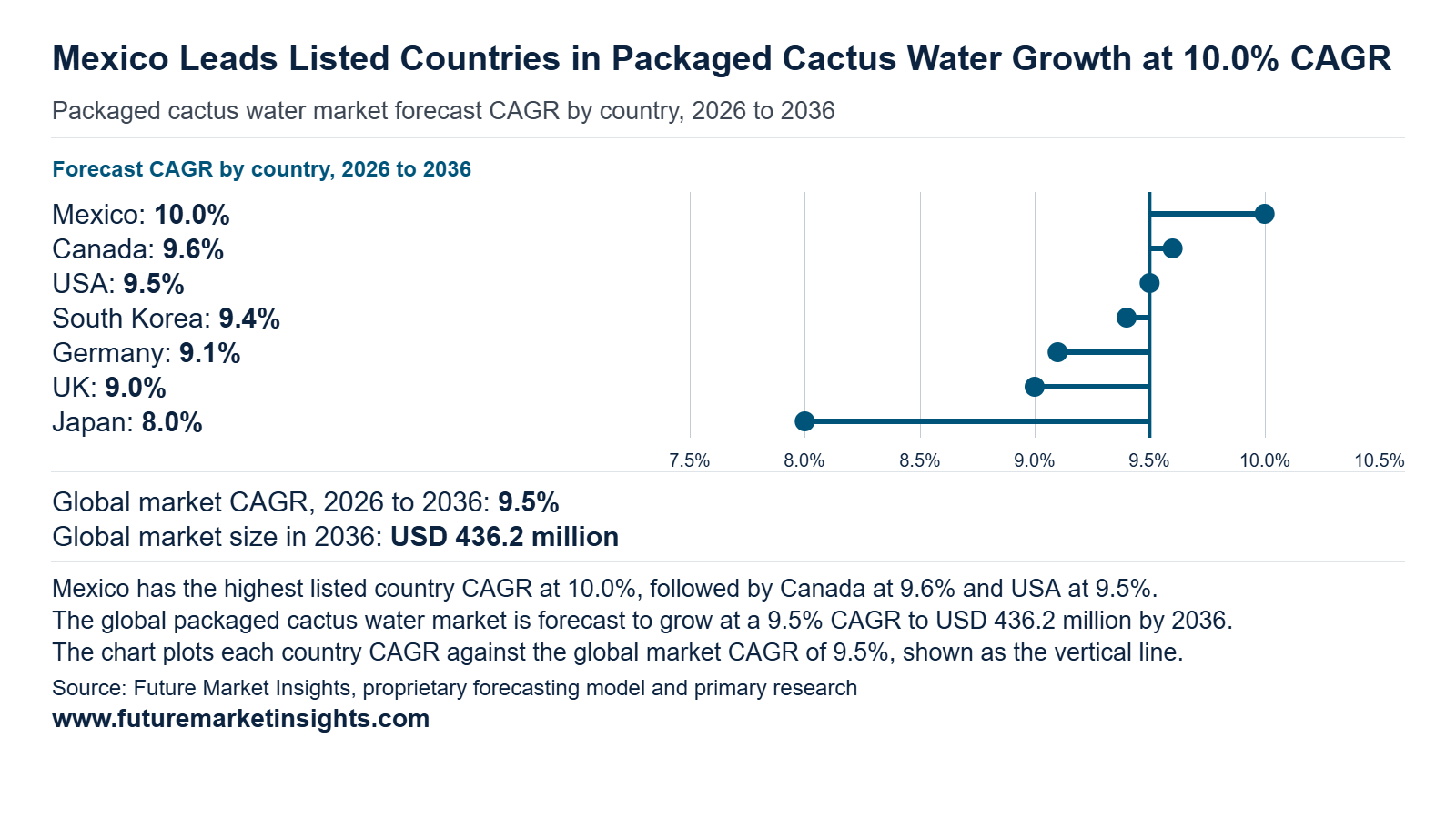
North America and Latin America anchor global packaged cactus water sales, while Western Europe and East Asia register steady specialty retail adoption. FMI's regional outlook shows Mexico leading global growth at a 10.0% CAGR from 2026 to 2036, followed by Canada at a 9.6% CAGR and the USA at a 9.5% CAGR, whereas Japan advances at an 8.0% CAGR across a 2.0 percentage-point growth range.
| Country | 2026 Revenue | 2036 Revenue | 10-Year Addition | 2026 to 2036 CAGR | Global Share (2026 -> 2036) |
|---|---|---|---|---|---|
| Mexico | USD 44.0 million | USD 114.1 million | +USD 70.1 million | 10.0% | 25.0% -> 26.2% |
| Canada | USD 14.1 million | USD 35.3 million | +USD 21.2 million | 9.6% | 8.0% -> 8.1% |
| USA | USD 61.6 million | USD 152.7 million | +USD 91.1 million | 9.5% | 35.0% -> 35.0% |
| South Korea | USD 7.0 million | USD 17.2 million | +USD 10.2 million | 9.4% | 4.0% -> 3.9% |
| Germany | USD 8.8 million | USD 21.0 million | +USD 12.2 million | 9.1% | 5.0% -> 4.8% |
| UK | USD 10.6 million | USD 25.1 million | +USD 14.5 million | 9.0% | 6.0% -> 5.8% |
| Japan | USD 5.3 million | USD 11.4 million | +USD 6.1 million | 8.0% | 3.0% -> 2.6% |
Source: Future Market Insights analysis of the packaged cactus water market, 2026.
USA
Demand for packaged cactus water across USA is projected to climb from USD 61.6 million in 2026 to USD 152.7 million by 2036, advancing at a 9.5% CAGR, contributing +USD 91.1 million in incremental revenue. FMI's country analysis shows that United States sales growth is driven by nationwide supercenter rollouts and strong consumer focus on added-sugar reduction under United States Food and Drug Administration (2026) labeling rules. Retail expansion disclosures from BevNET (October 2025) confirm 2,362 Walmart store placements for True Nopal Ventures Inc., while BevNET (March 2026) and BevNET (September 2026) document new funding and retail velocity for Pricklee LLC and Caliwater, LLC. Continued cold-vault expansion across conventional supermarkets and convenience chains is expected to sustain United States volume leadership through 2036.
Mexico
Demand for packaged cactus water across Mexico is forecast to advance from USD 44.0 million in 2026 to USD 114.1 million by 2036, advancing at a 10.0% CAGR, contributing +USD 70.1 million in incremental revenue. In FMI's assessment, Mexico's rapid expansion stems from domestic processors converting abundant local nopal and tuna fruit harvests into shelf-stable pasteurized cans and cartons that avoid front-of-package excess-sugar warning seals. Agricultural statistics from the Ministry of Agriculture and Rural Development of Mexico (August 2025) report 844,255.6 tonnes of nopalitos harvested across 12,405.6 hectares, while regulatory filings from the Ministry of Economy and COFEPRIS of Mexico (May 2025) extended Phase 2 NOM-051 nutrition warning rules through December 2027 before Phase 3 begins in January 2028. Expanding modern supermarket chains and domestic aseptic bottling capacity are projected to propel Mexican market growth through 2036.
Canada
Demand for packaged cactus water across Canada is estimated to rise from USD 14.1 million in 2026 to USD 35.3 million by 2036, advancing at a 9.6% CAGR, contributing +USD 21.2 million in incremental revenue. FMI notes that Canadian grocery retailers are accelerating shelf allocations for low-sugar plant waters following the January 1, 2026 enforcement of mandatory front-of-package nutrition symbols by the Canadian Food Inspection Agency (November 2025). Because pure prickly pear and nopal hydration drinks contain 0 to 5 grams of sugar per serving, imported cans and cartons bypass high-sugar warning icons on Canadian supermarket shelves. Cross-border North American distributor partnerships and natural grocery demand are anticipated to support Canadian expansion through 2036.
South Korea
Demand for packaged cactus water across South Korea is projected to expand from USD 7.0 million in 2026 to USD 17.2 million by 2036, advancing at a 9.4% CAGR, contributing +USD 10.2 million in incremental revenue. FMI finds that South Korean beauty-from-within consumers and convenience store shoppers actively seek prickly pear beverages for betalain antioxidant and low-calorie hydration benefits. Imported and locally co-packed functional beverages comply with strict sugar and caloric disclosure standards administered by the Ministry of Food and Drug Safety of South Korea (2026). Expanding health-and-beauty store listings and online multipack subscriptions are expected to drive South Korean sales growth through 2036.
Germany
Demand for packaged cactus water across Germany is anticipated to grow from USD 8.8 million in 2026 to USD 21.0 million by 2036, advancing at a 9.1% CAGR, contributing +USD 12.2 million in incremental revenue. FMI observes that German organic supermarkets and fitness channels favor low-calorie botanical waters, provided beverage cans and bottles comply with mandatory national deposit return systems and European Commission (August 2026) packaging rules. Consumer guidance from the German Consumer Advice Center (April 2026) confirms that one-way aluminum cans and plastic beverage bottles between 0.1 and 3.0 liters carry a mandatory EUR 0.25 deposit across German retail chains. Local European co-packing in DPG-compliant cans is projected to support German retail expansion through 2036.
UK
Demand for packaged cactus water across UK is projected to climb from USD 10.6 million in 2026 to USD 25.1 million by 2036, advancing at a 9.0% CAGR, contributing +USD 14.5 million in incremental revenue. FMI highlights that British beverage distributors are prioritizing naturally low-sugar plant waters as tax policy tightens on sweetened soft drinks. Policy publications from HM Revenue and Customs (October 2026) confirm that the United Kingdom Soft Drinks Industry Levy sugar threshold drops from 5.0 grams to 4.5 grams per 100 milliliters on January 1, 2028, giving sub-4.5-gram cactus water formulations a clear shelf-price advantage. Premium grocery and fitness studio placements are anticipated to sustain British category growth through 2036.
Japan
Demand for packaged cactus water across Japan is forecast to advance from USD 5.3 million in 2026 to USD 11.4 million by 2036, advancing at a 8.0% CAGR, contributing +USD 6.1 million in incremental revenue. FMI points out that although Japan's mature ready-to-drink tea and mineral water shelves create intense competition, urban specialty grocers and fitness clubs are adopting imported prickly pear cans as summer electrolyte refreshers. Thermal preservation advances documented by the National Center for Biotechnology Information (January 2026) allow exporters to maintain bright red betalain color across trans-Pacific container shipments into Japanese ports. Seasonal summer promotions and natural supermarket listings are expected to support Japanese sales growth through 2036.
Competitive Environment and Notable Companies
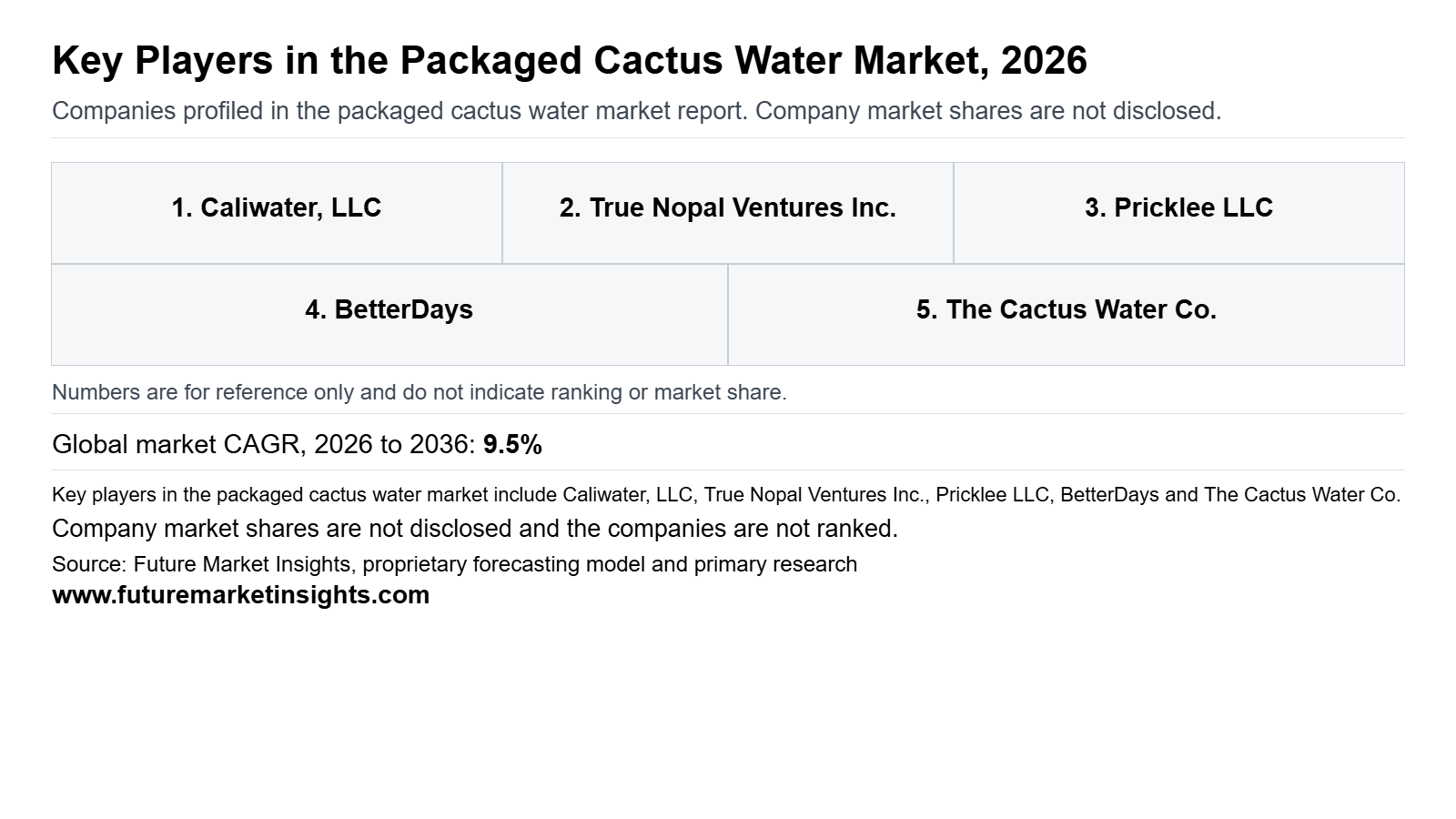
Notable companies operating in the global packaged cactus water market include Caliwater, LLC, True Nopal Ventures Inc., Pricklee LLC, BetterDays, and The Cactus Water Co. FMI's competitive evaluation shows category leaders competing on Mexican prickly pear and nopal sourcing, sugar-per-serving discipline, and national supercenter versus specialty cold-vault distribution.
How Are Brands Positioned Across the Packaged Cactus Water Landscape?
Category pioneers Caliwater, LLC, True Nopal Ventures Inc., and Pricklee LLC anchor North American retail sales by occupying distinct flavor, calorie, and packaging tiers. FMI finds that Caliwater, LLC positions its 12-ounce canned line around organic prickly pear extract blended with fruit juices at 5 grams of sugar and 25 to 35 calories, founded by celebrity co-owners and led by executive management appointed in February 2026 per BevNET (February 2026). True Nopal Ventures Inc. dominates the zero-added-sugar, 100% nopal-and-prickly-pear carton segment across mass merchandisers, while Pricklee LLC targets low-sugar 3-gram canned hydration and The Cactus Water Co. focuses on zero-calorie organic nopal leaf water.
What Matters When a Retail Buyer Selects a Cactus Water Supplier?
Supermarket category managers and distributor buyers evaluate cactus water suppliers on betalain color stability over 12-month ambient shelf life, total sugar grams per 100 milliliters, organic certification, and case fill reliability during summer peak demand. Preservation research from the National Center for Biotechnology Information (January 2026) explains why buyers require validated pasteurization at 90 degrees Celsius to retain 141.2 milligrams per liter of betalains without microbial spoilage. In FMI's view, retail buyers in Canada, the United Kingdom, and Mexico also verify that formulations remain below regulatory sugar thresholds enforced by the Canadian Food Inspection Agency (November 2025), HM Revenue and Customs (October 2026), and the Ministry of Economy and COFEPRIS of Mexico (May 2025).
Which Formulation and Packaging Capabilities Distinguish Product Offers?
Product differentiation centers on fruit-stem versus cladode-leaf extraction, tropical co-flavoring, and functional adaptogen or electrolyte fortification. Product disclosures from Caliwater, LLC (October 2026) and Caliwater, LLC (September 2026) highlight Dragonfruit, Watermelon, and Pineapple 12-ounce cans delivering 200 milligrams of prickly pear extract and five electrolytes, whereas Inside FMCG (January 2025) documents BetterDays combining sparkling cactus water with ginseng and L-theanine in 250 milliliter cans. FMI analysts observe that sustainability records from the Women's Business Enterprise National Council (July 2025) show The Cactus Water Co. differentiating through zero-sugar organic nopal leaf extraction.
How Does Mass-Merchandise Versus Specialty Distribution Reach Affect Competition?
Brands that secure national mass-merchandise and natural supermarket authorizations achieve lower co-packing unit costs and stronger brand visibility than direct-to-consumer-only labels. Distribution announcements from BevNET (October 2025) confirm True Nopal Ventures Inc. expanding into 2,362 Walmart stores and Whole Foods Market, while BevNET (September 2026) and BevNET (March 2026) document Caliwater entering Erewhon across Southern California and Pricklee LLC raising fresh capital to scale retail distribution. FMI notes that broad multi-channel presence insulates leading brands from digital customer-acquisition cost spikes.
| Verified Company Evidence (2025 to 2026) | Market Effect | Buyer Action |
|---|---|---|
| October 2026: Caliwater, LLC commercialized its Dragonfruit Cactus Water and Watermelon and Pineapple 12 oz cans after debuting across Southern California Erewhon stores in September 2026 and appointing CEO Blair Owens in February 2026 (Caliwater, LLC, October 2026; BevNET, September 2026). | Broadens consumer trial beyond unblended prickly pear through tropical fruit co-flavors at 5 g sugar per can. | Allocate cold-vault facings to tropical fruit-blended cactus water SKUs to capture mainstream soft-drink switchers. |
| March 2026: Pricklee LLC completed a brand refresh as a natural hydration drink and raised seed funding to expand retail grocery velocity (BevNET, March 2026). | Strengthens working capital for distributor slotting and in-store sampling of 3 g sugar prickly pear cans. | Partner with funded emerging brands on seasonal summer hydration endcaps in natural and conventional grocers. |
| October 2025: True Nopal Ventures Inc. expanded distribution of its zero-added-sugar cactus water cartons into 2,362 Walmart stores nationwide and Whole Foods Market locations (BevNET, October 2025). | Validates mass-merchandise velocity for multi-serve 1 L and 330 ml zero-added-sugar cactus water cartons. | Stock 1 L multi-serve cartons in ambient juice and plant-water aisles and single-serve chilled cans. |
Source: Verified corporate disclosures and Future Market Insights analysis, 2026.
| Company | Core Positioning | Verified Activity & Source Attribution |
|---|---|---|
| Caliwater, LLC | Organic prickly pear cactus water in 12 oz sleek cans across Wild Prickly Pear, Dragonfruit, Watermelon, and Pineapple | Appointed Blair Owens as CEO in February 2026 (BevNET, February 2026), entered Erewhon in September 2026 (BevNET, September 2026), and commercialized Dragonfruit and Watermelon SKUs (Caliwater, LLC, October 2026). |
| True Nopal Ventures Inc. | Zero-added-sugar prickly pear cactus water in 330 ml and 1 L aseptic cartons | Expanded retail footprint to 2,362 Walmart stores nationwide and launched in Whole Foods Market stores (BevNET, October 2025). |
| Pricklee LLC | Pharmacist-founded low-sugar (3 g) canned prickly pear hydration beverages in Prickly Pear, Strawberry Hibiscus, and Mango Ginger | Rebranded as a natural hydration drink and raised seed capital in March 2026 to scale grocery distribution (BevNET, March 2026; Pricklee LLC, 2026). |
| BetterDays | Australian functional sparkling cactus water in 250 ml cans infused with L-theanine and ginseng | Commercialized sparkling cactus water functional beverage range in 250 ml cans at under 22 calories per serving (Inside FMCG, January 2025). |
| The Cactus Water Co. | WBENC-certified zero-sugar, zero-calorie organic nopal cactus leaf hydration beverage | Featured for sustainable drought-resilient nopal CPG supply chain practices in July 2025 (Women's Business Enterprise National Council, July 2025). |
Source: Verified corporate disclosures and Future Market Insights analysis, 2026.
Key takeaways from the Packaged Cactus Water Market Report
- Global market valuation is estimated at USD 176.0 million in 2026, projected to reach USD 436.2 million by 2036.
- Ten-year market expansion is projected to add USD 260.2 million at a 9.5% CAGR.
- By flavour segment, original prickly pear leads at 50.0% share in 2026.
- 46.0% of packaging share goes to cans in 2026.
- Mexico is expected to grow at a notable 10.0% CAGR, ahead of Canada at 9.6% and USA at 9.5%.
Packaged Cactus Water Market-Report Scope and Research Methodology
Future Market Insights analysts size the global packaged cactus water market through primary interviews with beverage brand executives and grocery category buyers combined with official agricultural, nutritional survey, and food labeling records. Raw material supply is benchmarked against nopal harvest data from the Ministry of Agriculture and Rural Development of Mexico (August 2025) and prickly pear preservation yields from the National Center for Biotechnology Information (January 2026), while consumer demand and regulatory impacts are cross-checked against the International Food Information Council (December 2025), Canadian Food Inspection Agency (November 2025), and HM Revenue and Customs (October 2026). All historical, base-year, and ten-year forecast figures are reconciled in USD million across all segments and countries through 2036.
| Coverage Field | Report Scope |
|---|---|
| Market Definition | Revenue from packaged ready-to-drink cactus water beverages formulated from prickly pear (Opuntia ficus-indica) fruit puree/concentrate or nopal cladode extract. |
| Flavour Segments | Original Prickly Pear, Fruit-Blended, Functional with Electrolytes and Added Vitamins, and Sparkling. |
| Packaging Formats | Cans, PET Bottles, Cartons, and Glass Bottles. |
| Distribution Channels | Supermarkets and Hypermarkets, Natural and Specialty Stores, Online Retail, Cafes and Foodservice, and Convenience Stores. |
| End-User Segments | Health-Conscious Adults, Athletes and Active Consumers, and Younger Consumers. |
| Exclusions | Unprocessed fresh nopal/prickly pear produce, dry powdered drink mixes, topical cactus cosmetics, and alcoholic cactus seltzers. |
| Quantitative Units | USD Million across global market sizing; percentage shares and CAGRs for segments and countries. |
| Historical & Base Years | 2025 (Historical: USD 160.7 million) and 2026 (Estimated Base Year: USD 176.0 million). |
| Forecast Period | 2026 to 2036 (Projected 2036 Valuation: USD 436.2 million at 9.5% CAGR). |
| Regions Covered | North America, Latin America, Western Europe, Eastern Europe, East Asia, South Asia and Pacific, and Middle East and Africa. |
| Countries Profiled | USA, Mexico, Canada, South Korea, Germany, UK, and Japan. |
| Companies Covered | Caliwater, LLC, True Nopal Ventures Inc., Pricklee LLC, BetterDays, and The Cactus Water Co. |
| Research Approach | Primary beverage brand and distributor interviews combined with Mexican agricultural harvest data, peer-reviewed preservation studies, and retail door counts. |
Source: Future Market Insights analysis of the packaged cactus water market, 2026.
Research Sources and Bibliography
- BevNET. (2025, October 14). True Nopal Cactus Water Expands Distribution to 2,362 Walmart Stores. https://www.bevnet.com/pr/2024/10/15/true-nopal-cactus-water-expands-distribution-to-2362-walmart-stores
- BevNET. (2026, February 4). Caliwater Appoints Beverage Industry Veteran Blair Owens as Chief Executive Officer. https://www.bevnet.com/pr/2026/02/04/caliwater-appoints-beverage-industry-veteran-blair-owens-as-chief-executive-officer
- BevNET. (2026, March 4). Pricklee Rebrands as Natural Hydration Drink and Raises USD 2.0 Million. https://www.bevnet.com/news/2026/pricklee-rebrands-as-natural-hydration-drink-raises-2m/
- BevNET. (2026, September 17). Caliwater Makes Erewhon Debut Across Southern California. https://bevnet.com/pr/2026/09/17/caliwater-makes-erewhon-debut-across-southern-california
- Caliwater, LLC. (2026, October 17). Watermelon Cactus Water 12-Pack Product Specification. https://drinkcaliwater.com/products/watermelon-12-pack
- Caliwater, LLC. (2026, October 19). Dragonfruit Cactus Water Product Launch Specification. https://drinkcaliwater.com/products/dragonfruit
- Caliwater, LLC. (2026, September 7). Pineapple Cactus Water 12 oz Can Product Specification. https://drinkcaliwater.com/products/pineapple
- Canadian Food Inspection Agency. (2025, November 17). Notice to Industry: Compliance and Enforcement Approach for Front-of-Package Nutrition Labelling Effective January 1, 2026. https://inspection.canada.ca/en/food-labels/labelling/nutrition-labelling-regulations
- European Commission. (2026, August 12). Packaging and Packaging Waste Regulation Application Framework. https://environment.ec.europa.eu/topics/waste-and-recycling/packaging-waste_en
- German Consumer Advice Center. (2026, April 21). Questions and Answers on One-Way Beverage Deposit and Can Return Obligations. https://www.verbraucherzentrale.de/wissen/umwelt-haushalt/abfall/fragen-und-antworten-alles-zum-einwegpfand-und-dosenpfand-11505
- HM Revenue and Customs. (2026, October 28). Soft Drinks Industry Levy Changes: Lowering Sugar Threshold to 4.5g per 100ml. https://www.gov.uk/government/publications/changes-to-the-soft-drinks-industry-levy/soft-drink-industry-levy-changes
- Inside FMCG. (2025, January 22). BetterDays Launches Sparkling Cactus Water Functional Range in 250 ml Cans. https://insidefmcg.com.au/2024/01/22/betterdays-to-launch-australias-first-sparkling-cactus-water/
- International Food Information Council. (2025, December 3). 2025 IFIC Food and Health Survey: A Focus on Sugars and Sweeteners. https://ific.org/research/2025-food-health-survey-sweeteners/
- Ministry of Agriculture and Rural Development of Mexico. (2025, August 13). Production and Agronomic Value of Nopal in Mexico. https://www.gob.mx/agricultura/articulos/la-grandeza-y-el-sabor-del-nopal-405353
- Ministry of Economy and COFEPRIS of Mexico. (2025, May 15). Agreement on Phase 2 and Phase 3 Implementation of NOM-051 Front-of-Package Warning Seals. https://sidof.segob.gob.mx/notas/docFuente/5764197
- Ministry of Food and Drug Safety of South Korea. (2026). Mandatory Nutrition Labeling Standards for Processed Beverages. https://www.mfds.go.kr/eng/wpge/m_14/contents.do
- National Center for Biotechnology Information. (2026, January 12). Effect of Different Preservation Methods on the Microbiological Quality, Physicochemical, and Antioxidant Properties of Red Prickly Pear Juice. https://pmc.ncbi.nlm.nih.gov/articles/PMC12841050/
- Pricklee LLC. (2026). Prickly Pear Original Canned Cactus Water Specification. https://pricklee.com/products/prickly-pear
- United States Food and Drug Administration. (2026). Added Sugars on the Nutrition Facts Label: Guidance for Beverage Manufacturers. https://www.fda.gov/food/nutrition-facts-label/added-sugars-nutrition-facts-label
- Women's Business Enterprise National Council. (2025, July 22). Sustainability in the CPG Space by The Cactus Water Co.. https://www.wbenc.org/news/sustainability-in-the-cpg-space-by-the-cactus-water-co/
Table of Content
- Key Takeaways
- Market Size and CAGR
- Top Growth Driver
- Fastest Growing Segment
- Leading Region
- Key Companies
- Emerging Opportunities
- Executive Summary
- Global Market Outlook
- Demand-side Trends
- Supply-side Trends
- Technology Roadmap Analysis
- Analysis and Recommendations
- Analyst Perspective (What is happening? Why now? What should investors know?)
- Key Questions Answered
- How large is the market?
- What is the CAGR?
- What are key trends?
- Which region dominates?
- Who are the leaders?
Read More...
- Market Overview
- Market Coverage / Taxonomy
- Market Definition / Scope / Limitations
- Research Methodology
- Chapter Orientation
- Analytical Lens and Working Hypotheses
- Market Structure, Signals, and Trend Drivers
- Benchmarking and Cross-market Comparability
- Market Sizing, Forecasting, and Opportunity Mapping
- Research Design and Evidence Framework
- Desk Research Programme (Secondary Evidence)
- Expert Input and Fieldwork (Primary Evidence)
- Tooling, Models, and Reference Databases
- Data Engineering and Model Build
- Quality Assurance and Audit Trail
- Market Background
- Market Dynamics (Drivers, Restraints, Opportunity, Trends)
- Scenario Forecast (Optimistic, Likely, Conservative)
- Impact Analysis
- AI Impact
- Sustainability Impact
- Regulatory Impact
- Technology Impact
- Consumer / Buyer Analysis
- Purchase Drivers
- Adoption Barriers
- Buyer Journey
- Opportunity Map Analysis
- Product Life Cycle Analysis
- Supply Chain Analysis
- Investment Feasibility Matrix
- Value Chain Analysis
- PESTLE and Porter's Analysis
- Regulatory Landscape
- Regional Parent Market Outlook
- Production and Consumption Statistics
- Import and Export Statistics
- Global Market Analysis and Forecast, 2021 to 2036
- Historical Market Size Value (USD Million) Analysis, 2021 to 2025
- Current and Future Market Size Value (USD Million) Projections, 2026 to 2036
- Y-o-Y Growth Trend Analysis
- Absolute $ Opportunity Analysis
- Global Market Pricing Analysis, 2021 to 2036
- Global Market Analysis and Forecast, By Flavour, 2021 to 2036
- Introduction / Key Findings
- Historical Market Size Value (USD Million) Analysis By Flavour, 2021 to 2025
- Current and Future Market Size Value (USD Million) Analysis and Forecast By Flavour, 2026 to 2036
- Original Prickly Pear
- Fruit-Blended
- Functional with Electrolytes and Added Vitamins
- Sparkling
- Y-o-Y Growth Trend Analysis By Flavour, 2021 to 2025
- Absolute $ Opportunity Analysis By Flavour, 2026 to 2036
- Global Market Analysis and Forecast, By Packaging, 2021 to 2036
- Introduction / Key Findings
- Historical Market Size Value (USD Million) Analysis By Packaging, 2021 to 2025
- Current and Future Market Size Value (USD Million) Analysis and Forecast By Packaging, 2026 to 2036
- Cans
- PET Bottles
- Cartons
- Glass Bottles
- Y-o-Y Growth Trend Analysis By Packaging, 2021 to 2025
- Absolute $ Opportunity Analysis By Packaging, 2026 to 2036
- Global Market Analysis and Forecast, By Distribution Channel, 2021 to 2036
- Introduction / Key Findings
- Historical Market Size Value (USD Million) Analysis By Distribution Channel, 2021 to 2025
- Current and Future Market Size Value (USD Million) Analysis and Forecast By Distribution Channel, 2026 to 2036
- Supermarkets and Hypermarkets
- Natural and Specialty Stores
- Online Retail
- Cafes and Foodservice
- Convenience Stores
- Y-o-Y Growth Trend Analysis By Distribution Channel, 2021 to 2025
- Absolute $ Opportunity Analysis By Distribution Channel, 2026 to 2036
- Global Market Analysis and Forecast, By End User, 2021 to 2036
- Introduction / Key Findings
- Historical Market Size Value (USD Million) Analysis By End User, 2021 to 2025
- Current and Future Market Size Value (USD Million) Analysis and Forecast By End User, 2026 to 2036
- Health-Conscious Adults
- Athletes and Active Consumers
- Younger Consumers
- Y-o-Y Growth Trend Analysis By End User, 2021 to 2025
- Absolute $ Opportunity Analysis By End User, 2026 to 2036
- Global Market Analysis and Forecast, By Region, 2021 to 2036
- Introduction
- Historical Market Size Value (USD Million) Analysis By Region, 2021 to 2025
- Current Market Size Value (USD Million) Analysis and Forecast By Region, 2026 to 2036
- North America
- Western Europe
- East Asia
- South Asia and Pacific
- Market Attractiveness Analysis By Region
- North America Market Analysis and Forecast, By Country, 2021 to 2036
- Historical Market Size Value (USD Million) Trend Analysis By Market Taxonomy, 2021 to 2025
- Market Size Value (USD Million) Forecast By Market Taxonomy, 2026 to 2036
- By Country
- United States
- Canada
- By Flavour
- By Packaging
- By Distribution Channel
- By End User
- By Country
- Market Attractiveness Analysis
- By Country
- By Flavour
- By Packaging
- By Distribution Channel
- By End User
- Key Takeaways
- Western Europe Market Analysis and Forecast, By Country
- Historical Market Size Value (USD Million) Trend Analysis By Market Taxonomy, 2021 to 2025
- Market Size Value (USD Million) Forecast By Market Taxonomy, 2026 to 2036
- By Country
- United Kingdom
- Germany
- France
- By Flavour
- By Packaging
- By Distribution Channel
- By End User
- By Country
- Market Attractiveness Analysis
- By Country
- By Flavour
- By Packaging
- By Distribution Channel
- By End User
- Key Takeaways
- East Asia Market Analysis and Forecast, By Country
- Historical Market Size Value (USD Million) Trend Analysis By Market Taxonomy, 2021 to 2025
- Market Size Value (USD Million) Forecast By Market Taxonomy, 2026 to 2036
- By Country
- China
- Japan
- South Korea
- By Flavour
- By Packaging
- By Distribution Channel
- By End User
- By Country
- Market Attractiveness Analysis
- By Country
- By Flavour
- By Packaging
- By Distribution Channel
- By End User
- Key Takeaways
- South Asia and Pacific Market Analysis and Forecast, By Country
- Historical Market Size Value (USD Million) Trend Analysis By Market Taxonomy, 2021 to 2025
- Market Size Value (USD Million) Forecast By Market Taxonomy, 2026 to 2036
- By Country
- India
- Australia
- Rest of world aggregate
- By Flavour
- By Packaging
- By Distribution Channel
- By End User
- By Country
- Market Attractiveness Analysis
- By Country
- By Flavour
- By Packaging
- By Distribution Channel
- By End User
- Key Takeaways
- Key Countries Market Analysis
- United States
- Pricing Analysis
- Market Share Analysis, 2025
- By Flavour
- By Packaging
- By Distribution Channel
- By End User
- Canada
- Pricing Analysis
- Market Share Analysis, 2025
- By Flavour
- By Packaging
- By Distribution Channel
- By End User
- Germany
- Pricing Analysis
- Market Share Analysis, 2025
- By Flavour
- By Packaging
- By Distribution Channel
- By End User
- United Kingdom
- Pricing Analysis
- Market Share Analysis, 2025
- By Flavour
- By Packaging
- By Distribution Channel
- By End User
- France
- Pricing Analysis
- Market Share Analysis, 2025
- By Flavour
- By Packaging
- By Distribution Channel
- By End User
- India
- Pricing Analysis
- Market Share Analysis, 2025
- By Flavour
- By Packaging
- By Distribution Channel
- By End User
- China
- Pricing Analysis
- Market Share Analysis, 2025
- By Flavour
- By Packaging
- By Distribution Channel
- By End User
- Japan
- Pricing Analysis
- Market Share Analysis, 2025
- By Flavour
- By Packaging
- By Distribution Channel
- By End User
- South Korea
- Pricing Analysis
- Market Share Analysis, 2025
- By Flavour
- By Packaging
- By Distribution Channel
- By End User
- Australia
- Pricing Analysis
- Market Share Analysis, 2025
- By Flavour
- By Packaging
- By Distribution Channel
- By End User
- United States
- Market Structure Analysis
- Competition Dashboard
- Competition Benchmarking
- Market Share Analysis of Top Players
- By Regional
- By Flavour
- By Packaging
- By Distribution Channel
- By End User
- Emerging Startups
- Innovation Benchmarking
- Competition Analysis
- Competition Deep Dive
- Caliwater, LLC
- Overview
- Product Portfolio
- Profitability by Market Segments
- Sales Footprint
- Strategy Overview
- Marketing Strategy
- Product Strategy
- Channel Strategy
- True Nopal Ventures Inc.
- Pricklee LLC
- BetterDays
- The Cactus Water Co.
- Caliwater, LLC
- Case Studies
- Success Stories
- Recent Developments
- Competition Deep Dive
- Assumptions & Acronyms Used
List of Tables
- Table 1: Global Market Value (USD Million) Forecast by Region, 2021 to 2036
- Table 2: Global Market Value (USD Million) Forecast by Flavour, 2021 to 2036
- Table 3: Global Market Value (USD Million) Forecast by Packaging, 2021 to 2036
- Table 4: Global Market Value (USD Million) Forecast by Distribution Channel, 2021 to 2036
- Table 5: Global Market Value (USD Million) Forecast by End User, 2021 to 2036
- Table 6: North America Market Value (USD Million) Forecast by Country, 2021 to 2036
- Table 7: North America Market Value (USD Million) Forecast by Flavour, 2021 to 2036
- Table 8: North America Market Value (USD Million) Forecast by Packaging, 2021 to 2036
- Table 9: North America Market Value (USD Million) Forecast by Distribution Channel, 2021 to 2036
- Table 10: North America Market Value (USD Million) Forecast by End User, 2021 to 2036
- Table 11: Western Europe Market Value (USD Million) Forecast by Country, 2021 to 2036
- Table 12: Western Europe Market Value (USD Million) Forecast by Flavour, 2021 to 2036
- Table 13: Western Europe Market Value (USD Million) Forecast by Packaging, 2021 to 2036
- Table 14: Western Europe Market Value (USD Million) Forecast by Distribution Channel, 2021 to 2036
- Table 15: Western Europe Market Value (USD Million) Forecast by End User, 2021 to 2036
- Table 16: East Asia Market Value (USD Million) Forecast by Country, 2021 to 2036
- Table 17: East Asia Market Value (USD Million) Forecast by Flavour, 2021 to 2036
- Table 18: East Asia Market Value (USD Million) Forecast by Packaging, 2021 to 2036
- Table 19: East Asia Market Value (USD Million) Forecast by Distribution Channel, 2021 to 2036
- Table 20: East Asia Market Value (USD Million) Forecast by End User, 2021 to 2036
- Table 21: South Asia and Pacific Market Value (USD Million) Forecast by Country, 2021 to 2036
- Table 22: South Asia and Pacific Market Value (USD Million) Forecast by Flavour, 2021 to 2036
- Table 23: South Asia and Pacific Market Value (USD Million) Forecast by Packaging, 2021 to 2036
- Table 24: South Asia and Pacific Market Value (USD Million) Forecast by Distribution Channel, 2021 to 2036
- Table 25: South Asia and Pacific Market Value (USD Million) Forecast by End User, 2021 to 2036
List of Figures
- Figure 1: Global Market Pricing Analysis
- Figure 2: Global Market Value (USD Million) Forecast 2021-2036
- Figure 3: Global Market Value Share and BPS Analysis by Flavour, 2026 and 2036
- Figure 4: Global Market Y-o-Y Growth Comparison by Flavour, 2026-2036
- Figure 5: Global Market Attractiveness Analysis by Flavour
- Figure 6: Global Market Value Share and BPS Analysis by Packaging, 2026 and 2036
- Figure 7: Global Market Y-o-Y Growth Comparison by Packaging, 2026-2036
- Figure 8: Global Market Attractiveness Analysis by Packaging
- Figure 9: Global Market Value Share and BPS Analysis by Distribution Channel, 2026 and 2036
- Figure 10: Global Market Y-o-Y Growth Comparison by Distribution Channel, 2026-2036
- Figure 11: Global Market Attractiveness Analysis by Distribution Channel
- Figure 12: Global Market Value Share and BPS Analysis by End User, 2026 and 2036
- Figure 13: Global Market Y-o-Y Growth Comparison by End User, 2026-2036
- Figure 14: Global Market Attractiveness Analysis by End User
- Figure 15: Global Market Value (USD Million) Share and BPS Analysis by Region, 2026 and 2036
- Figure 16: Global Market Y-o-Y Growth Comparison by Region, 2026-2036
- Figure 17: Global Market Attractiveness Analysis by Region
- Figure 18: North America Market Incremental Dollar Opportunity, 2026-2036
- Figure 19: Western Europe Market Incremental Dollar Opportunity, 2026-2036
- Figure 20: East Asia Market Incremental Dollar Opportunity, 2026-2036
- Figure 21: South Asia and Pacific Market Incremental Dollar Opportunity, 2026-2036
- Figure 22: North America Market Value Share and BPS Analysis by Country, 2026 and 2036
- Figure 23: North America Market Value Share and BPS Analysis by Flavour, 2026 and 2036
- Figure 24: North America Market Y-o-Y Growth Comparison by Flavour, 2026-2036
- Figure 25: North America Market Attractiveness Analysis by Flavour
- Figure 26: North America Market Value Share and BPS Analysis by Packaging, 2026 and 2036
- Figure 27: North America Market Y-o-Y Growth Comparison by Packaging, 2026-2036
- Figure 28: North America Market Attractiveness Analysis by Packaging
- Figure 29: North America Market Value Share and BPS Analysis by Distribution Channel, 2026 and 2036
- Figure 30: North America Market Y-o-Y Growth Comparison by Distribution Channel, 2026-2036
- Figure 31: North America Market Attractiveness Analysis by Distribution Channel
- Figure 32: North America Market Value Share and BPS Analysis by End User, 2026 and 2036
- Figure 33: North America Market Y-o-Y Growth Comparison by End User, 2026-2036
- Figure 34: North America Market Attractiveness Analysis by End User
- Figure 35: Western Europe Market Value Share and BPS Analysis by Country, 2026 and 2036
- Figure 36: Western Europe Market Value Share and BPS Analysis by Flavour, 2026 and 2036
- Figure 37: Western Europe Market Y-o-Y Growth Comparison by Flavour, 2026-2036
- Figure 38: Western Europe Market Attractiveness Analysis by Flavour
- Figure 39: Western Europe Market Value Share and BPS Analysis by Packaging, 2026 and 2036
- Figure 40: Western Europe Market Y-o-Y Growth Comparison by Packaging, 2026-2036
- Figure 41: Western Europe Market Attractiveness Analysis by Packaging
- Figure 42: Western Europe Market Value Share and BPS Analysis by Distribution Channel, 2026 and 2036
- Figure 43: Western Europe Market Y-o-Y Growth Comparison by Distribution Channel, 2026-2036
- Figure 44: Western Europe Market Attractiveness Analysis by Distribution Channel
- Figure 45: Western Europe Market Value Share and BPS Analysis by End User, 2026 and 2036
- Figure 46: Western Europe Market Y-o-Y Growth Comparison by End User, 2026-2036
- Figure 47: Western Europe Market Attractiveness Analysis by End User
- Figure 48: East Asia Market Value Share and BPS Analysis by Country, 2026 and 2036
- Figure 49: East Asia Market Value Share and BPS Analysis by Flavour, 2026 and 2036
- Figure 50: East Asia Market Y-o-Y Growth Comparison by Flavour, 2026-2036
- Figure 51: East Asia Market Attractiveness Analysis by Flavour
- Figure 52: East Asia Market Value Share and BPS Analysis by Packaging, 2026 and 2036
- Figure 53: East Asia Market Y-o-Y Growth Comparison by Packaging, 2026-2036
- Figure 54: East Asia Market Attractiveness Analysis by Packaging
- Figure 55: East Asia Market Value Share and BPS Analysis by Distribution Channel, 2026 and 2036
- Figure 56: East Asia Market Y-o-Y Growth Comparison by Distribution Channel, 2026-2036
- Figure 57: East Asia Market Attractiveness Analysis by Distribution Channel
- Figure 58: East Asia Market Value Share and BPS Analysis by End User, 2026 and 2036
- Figure 59: East Asia Market Y-o-Y Growth Comparison by End User, 2026-2036
- Figure 60: East Asia Market Attractiveness Analysis by End User
- Figure 61: South Asia and Pacific Market Value Share and BPS Analysis by Country, 2026 and 2036
- Figure 62: South Asia and Pacific Market Value Share and BPS Analysis by Flavour, 2026 and 2036
- Figure 63: South Asia and Pacific Market Y-o-Y Growth Comparison by Flavour, 2026-2036
- Figure 64: South Asia and Pacific Market Attractiveness Analysis by Flavour
- Figure 65: South Asia and Pacific Market Value Share and BPS Analysis by Packaging, 2026 and 2036
- Figure 66: South Asia and Pacific Market Y-o-Y Growth Comparison by Packaging, 2026-2036
- Figure 67: South Asia and Pacific Market Attractiveness Analysis by Packaging
- Figure 68: South Asia and Pacific Market Value Share and BPS Analysis by Distribution Channel, 2026 and 2036
- Figure 69: South Asia and Pacific Market Y-o-Y Growth Comparison by Distribution Channel, 2026-2036
- Figure 70: South Asia and Pacific Market Attractiveness Analysis by Distribution Channel
- Figure 71: South Asia and Pacific Market Value Share and BPS Analysis by End User, 2026 and 2036
- Figure 72: South Asia and Pacific Market Y-o-Y Growth Comparison by End User, 2026-2036
- Figure 73: South Asia and Pacific Market Attractiveness Analysis by End User
- Figure 74: Global Market - Tier Structure Analysis
- Figure 75: Global Market - Company Share Analysis
Frequently Asked Questions
How big is the packaged cactus water market in 2026?
Future Market Insights estimates the global packaged cactus water market valuation at USD 176.0 million in 2026, rising from USD 160.7 million in 2025 on expanding supermarket and natural-channel distribution.
What is the projected size and CAGR of the packaged cactus water market through 2036?
Global packaged cactus water sales are projected to reach USD 436.2 million by 2036, advancing at a 9.5% CAGR from 2026 to 2036 and adding USD 260.2 million in new revenue.
Which Flavour segment leads the packaged cactus water market in 2026?
Original Prickly Pear leads the flavour axis with a 50.0% revenue share in 2026, matching the combined share of fruit-blended, functional electrolyte, and sparkling variants.
Which Packaging format captures the largest share of packaged cactus water sales?
Cans hold 46.0% of packaging revenue in 2026 because 12-ounce aluminum cans protect light-sensitive betalain antioxidants and chill rapidly in retail cold vaults.
How much share do Supermarkets and Hypermarkets hold in the packaged cactus water market?
Supermarkets and Hypermarkets account for 44.0% of distribution channel revenue in 2026 following multi-thousand-store supercenter and grocery chain rollouts.
Why do Health-Conscious Adults lead packaged cactus water end-user demand?
Health-Conscious Adults capture 53.4% of 2026 revenue as adult shoppers replace high-sugar soft drinks and sports beverages with low-calorie plant hydration.
Which countries are projected to grow fastest in the packaged cactus water market?
Mexico leads national growth at a 10.0% CAGR from 2026 to 2036, followed by Canada at 9.6% CAGR and the USA at 9.5% CAGR.
Which companies are profiled as key players in the packaged cactus water market?
Key profiled companies include Caliwater, LLC, True Nopal Ventures Inc., Pricklee LLC, BetterDays, and The Cactus Water Co.
Preview the report firsthand - request a free sample
Get SampleGet the brochure for pricing and purchase details.
Get PDF
