

- Market Size (2026)
- USD 598.9 Mn
- Forecast (2036)
- USD 948.0 Mn
- CAGR (2026 to 2036)
- 4.7%
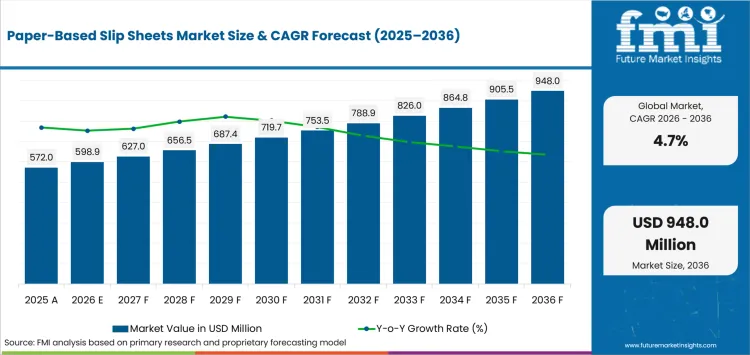
How big is Paper-Based Slip Sheets Market in 2026?
USD 598.9 million in 2026 and USD 948.0 million by 2036 at a 4.7% CAGR.
Demand for paper-based slip sheets is projected to expand as distribution operators remove pallet weight and empty-platform storage from stable one-way loads. Signode connected that operating case directly to slip sheets in June 2025 by describing them as export-ready pallet alternatives that reduce material use and maximize container space. High-volume distribution makes storage density and repeat handling costs visible enough to test a lighter load platform. Receiving sites still need push-pull capability before a thinner platform produces dependable freight or warehouse savings.
Mature fiber systems and receiving practices make country conversion conditions diverge more than the narrow five-country CAGR spread suggests. Germany illustrates the material route because recovered paper already feeds domestic kraft paper conversion. Umweltbundesamt reported in December 2025 that Germany collected 12.4 million tonnes of recovered paper during 2024 with a 78.2% return rate. Brazil places more weight on maritime exposure and receiver readiness owing to its concentration in longer export lanes.
Key Takeaways of Paper-Based Slip Sheets Market
- Distribution operators adopt paper-based slip sheets when lower load-platform weight and reduced empty-platform storage improve qualified lane economics.
- Based on material, kraft paperboard is projected to account for 50.0% in 2026 due to high tensile strength across thin laminated load platforms.
- The single-lip segment is likely to capture 33.0% share in 2026 attributable to one grip edge that simplifies repeatable push-pull handling.
- Uncoated is set to lead the coating category with 37.0% share in 2026 due to dry indoor lanes avoiding unnecessary surface treatment.
- Receiver equipment and operator readiness can delay conversion because both shipping endpoints must handle the scored tab without extra transfers or product damage.
- Signode, Nefab Group, Badger Paperboard, Dura-Fibre, Hammond Paper, Southern States Packaging Company, Novapak Paper Products and Marvatex, Inc. serve paperboard slip-sheet or closely related converting routes documented in current company material.
Analyst Perspective
"Paper-based slip-sheet qualification starts at the receiving dock because a lighter sheet produces no saving if the destination cannot unload its scored tab reliably. Strong offers match load weight and lip geometry to receiver equipment before adding moisture protection or forecasting recurring sheet volume."
- Nandini Roy Choudhury, Principal Consultant, Future Market Insights
How is the Paper-Based Slip Sheets Market segmented?
The paper-based slip sheets market is segmented by material, lip configuration, coating, load capacity, end use, sales channel and region.
Materials are kraft paperboard, corrugated fiberboard and solid fiberboard, while lip configurations are single-lip, two-lip/multi-lip, full four-lip and zero-lip/pull-only. Coatings are uncoated, anti-slip coated and moisture-resistant coated with load capacities up to 1,000 kg, 1,000-2,000 kg and above 2,000 kg. End uses include food and beverage, retail/e-commerce, building/construction, chemicals and pharmaceuticals. Sales channels include direct/OEM, packaging distributors, online and contract supply.
What supports uncoated leadership in the coating category?
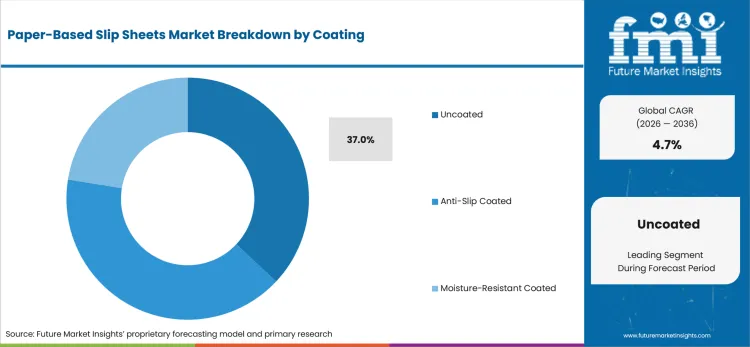
Uncoated sheets suit indoor lanes where board strength and load containment already provide sufficient friction. Added coatings become relevant after humidity or smooth cartons introduce a defined route risk. Badger Paperboard reported in October 2025 that milling operations test paperboard on their own equipment and treat moisture exposure as a shipment-protection concern.
- In 2026, uncoated is expected to lead coating with 37.0% share because many dry warehouse routes avoid added treatment cost and conversion steps.
- Packaging engineers add protective packaging treatment once trials identify moisture or load movement that untreated board cannot manage during storage and unloading.
Why does kraft paperboard lead the material category?
Kraft paperboard carries the pulling force generated at the tab without approaching pallet-scale thickness during repeated push-pull handling. Badger Paperboard described solid-fiber push-pull sheets in April 2025 as virgin kraft linerboard constructions that can add laminated plies for greater strength.
- By material, kraft paperboard is estimated to hold 50.0% in 2026 owing to its strength-to-thickness balance across dense disposable unit loads such as bagged ingredients and compact cartons.
- Packaging engineers adjust unbleached kraft paperboard basis weight and ply count to match load mass while preserving the receiving method across repeat shipments and established push-pull equipment.
Why does single-lip lead the lip configuration category?
Single-lip designs present one scored grip edge to the push-pull attachment on lanes with a fixed approach direction. Extra lips improve directional flexibility but increase orientation choices during wrapping and unloading.
- Single-lip is projected to hold 33.0% share in 2026 owing to one tab supporting a repeatable handling sequence on controlled one-direction shipping lanes.
- Badger Paperboard reported in January 2025 that torn tabs and multi-pick errors can interrupt automated push-pull or palletizer workflows. That failure mode makes tab geometry part of pallet packaging qualification instead of a cosmetic sheet detail for automated handling teams.
Why does direct or OEM supply lead the sales channel category?
Direct supply matters during first qualification because board thickness and lip geometry must match equipment at shipping endpoints. Distributors become practical once the specification remains stable across recurring loads and customer sites.
- The sales channel category is forecast to be led by direct/OEM at 40.0% share in 2026 due to specification work shaping initial orders.
- Badger Paperboard reported in August 2025 that its team uses on-site visits to tailor solid-fiber push-pull sheets by thickness and size. Direct contact reduces rework during initial transport packaging trials before contract supply begins across approved receiving lanes.
What are the drivers, restraints and opportunities in the Paper-Based Slip Sheets Market?
Lower freight and storage burden favors qualified use, receiver handling compatibility limits conversion and clearer packaging records improve the case for engineered paperboard designs.
- Driver: Removing pallet weight and empty-platform storage improves lane economics for stable one-way export and distribution loads.
- Restraint: Push-pull equipment and trained receiving teams remain necessary before a paper-based sheet can replace an established pallet workflow.
- Opportunity: Material documentation and route-specific coatings can shorten qualification as packaging rules increase scrutiny of composition and waste.
Freight and Storage Economics Favor Lightweight Load Platforms
A thin fiber platform provides the clearest freight case on stable one-way loads by removing pallet weight and storage volume without changing the goods shipped. Southern States Packaging Company documented solid-fiber slip sheets in November 2025 with custom lips and moisture-resistant coatings for pallet-replacement use. Repeat demand follows on lanes that can receive paper pallets or slip-sheet loads without added transfer labor.
Receiver Compatibility Raises the Conversion Threshold
Receiver readiness sets the conversion threshold because paper slip sheets depend on push-pull equipment at unloading. Signode stated in June 2025 that its transit-packaging evaluations review existing equipment and automation before installation support and operator training are defined. A lighter load platform loses its freight advantage if the destination adds handling steps or cannot grip the sheet reliably during unloading.
Packaging Rules Reward Better-Documented Fiber Designs
Paperboard converters can win more qualified lanes by documenting material composition and matching coating choices to a defined exposure risk. Regulation (EU) 2025/40 entered into force in February 2025 and applies generally from August 2026 across EU packaging. Clear fiber records make corrugated board packaging reviews easier while route-specific coatings address failures that would otherwise block customer approval during qualification.
Which country CAGRs are profiled in the Paper-Based Slip Sheets Market?
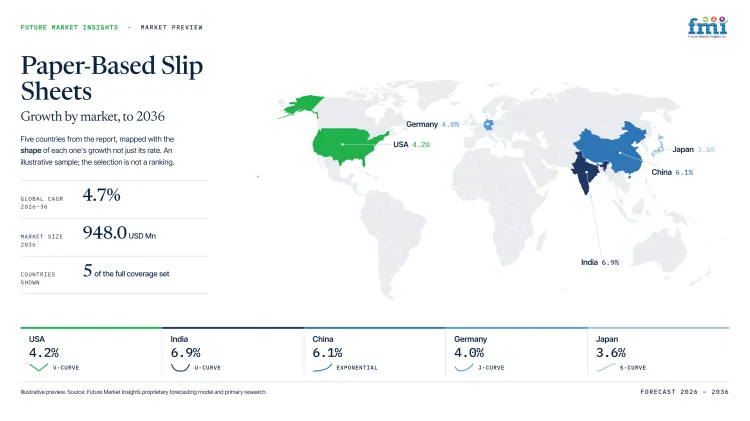
| Country | CAGR |
|---|---|
| Brazil | 5.0% |
| United Kingdom | 4.4% |
| United States | 4.2% |
| Germany | 4.0% |
| Japan | 3.6% |
How do country-level CAGRs compare in the Paper-Based Slip Sheets Market?
The 1.4-point spread forms a compact growth band instead of separate market tiers across current forecasts. Brazil is positioned above a middle United Kingdom-United States cluster because maritime exports reward lower tare weight. Germany and Japan remain close as mature receiving systems require tighter equipment qualification for conventional pallet replacement.
- Brazilian export routes reward lower tare weight but require maritime moisture control.
- United Kingdom packaging rules make fiber classification part of alternative platform cost reviews.
- United States freight scale supports lane trials inside pallet-standardized national distribution networks.
- Germany pairs recovered-paper access with automated warehouses demanding repeatable load safety locally.
- Japan links shorter handling targets with standardized workflows that preserve familiar pallets.
Similar forecast rates mask different qualification routes before recurring orders become practical. The full report provides country-level CAGR analysis across North America, Latin America, Europe, East Asia, South Asia, Oceania and the Middle East and Africa.
Country-wise Analysis
- Brazilian container lanes give lightweight load platforms a clear operating test, with ANTAQ reporting in February 2026 that ports handled 15.3 million TEUs during 2025 with 10.4 million moving on long-haul services across high-volume export terminals. Paper-based slip sheet sales in Brazil are forecast to expand at 5.0% CAGR by 2036, supported by exporters seeking lower tare weight and more container cube across stable bagged or case-packed loads. Humidity during port staging can soften untreated board and overseas receivers may lack push-pull attachments, so successful entry depends on moisture-resistant specifications plus destination training for recurring contracts across broader maritime programs.
- United Kingdom packaging teams record paperboard mass and material classification alongside freight performance as producer-responsibility rules add a compliance cost lens to transport-platform decisions across recurring domestic and export routes plus retailer programs. Defra reported in July 2025 that 4.069 million tonnes of paper and cardboard packaging were recycled during 2024 yet each shipper must confirm its own obligations for each program despite that familiar recovery route. The United Kingdom's paper-based slip sheet outlook is anticipated to advance at 4.4% CAGR over the assessment period, aided by established paper recovery but constrained by receiving equipment that can delay lane conversion.
- Large domestic United States distribution networks move varied freight across facilities built around pallet and forklift routines, so e-commerce packaging programs offer trial volume without removing the cost of changing receiving practices across regional warehouses. Adoption of paper-based slip sheets in the United States is estimated to expand at 4.2% CAGR through 2036, supported by high-throughput distribution and repeat lane testing across national networks. BTS reported in July 2026 that the May Freight Transportation Services Index measured 136.7, giving packaging engineers a broad test base but not removing the need to prove push-pull unloading avoids added touches to secure recurring orders.
- German packaging operations work inside a mature recovered-paper network that favors domestic fiber sourcing, while automated warehouses and established pallet standards demand repeatable board strength plus load safety for a lighter platform to earn approval. Receiving teams need humidity trials and equipment checks across routine storage and destination unloading as moisture can soften the board or incompatible receiving sites can require extra handling during scored-tab unloading. Germany is estimated to post 4.0% CAGR over the forecast period, shaped by a packaging system where Umweltbundesamt reported in May 2026 that national packaging consumption was 17.92 million tonnes and recycling reached 69.4%.
- Japanese shippers face tighter expectations for loading efficiency as logistics policy measures the time freight spends waiting and being handled across normal truck operations instead of treating dock time as an informal local issue. Japan's Ministry of Land Infrastructure Transport and Tourism reported in July 2026 that average waiting and handling time per truck trip was two hours and two minutes for the 2025 survey period. Paper-based slip sheet demand in Japan is predicted to advance at 3.6% CAGR through 2036, influenced by efficiency pressure but limited by standardized workflows that can preserve familiar pallets unless push-pull trials deliver equally disciplined handling.
Who are the notable companies in the Paper-Based Slip Sheets Market?
Signode, Nefab Group, Badger Paperboard, Dura-Fibre, Hammond Paper, Southern States Packaging Company, Novapak Paper Products and Marvatex, Inc. are the notable companies serving this market.
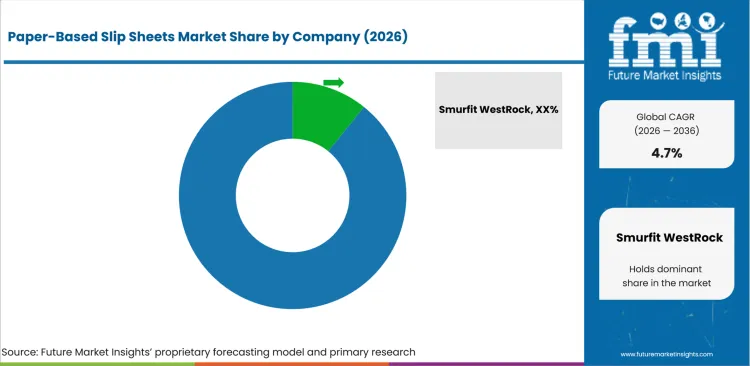
Competition remains fragmented between global load-handling groups and specialist paperboard converters because broad paper capacity does not guarantee qualified push-pull sheets or lane-level receiving support.
- Signode and Nefab Group combine load-handling engineering with industrial packaging programs across multinational receiving environments.
- Badger Paperboard, Dura-Fibre and Southern States Packaging Company compete on laminated board strength plus scoring and coating choices for push-pull loads.
- Hammond Paper and Novapak Paper Products provide regional paperboard conversion, while Marvatex, Inc. supplies solid-fiber slip sheets as a specialist sales agent serving solid fiber laminated load-platform programs manufactured by Fibre Converters, Inc.
Competitive Benchmarking: Paper-Based Slip Sheets Market
| Company | Finished Push-Pull Sheet Scope | Paperboard Conversion Depth | Lane Qualification Support | Geographic Reach |
|---|---|---|---|---|
| Signode | High | Medium | High | Americas, Europe and Asia Pacific |
| Nefab Group | High | Medium | High | Europe, Americas and Asia |
| Badger Paperboard | High | High | High | United States |
| Dura-Fibre | High | High | High | United States and export customers |
| Hammond Paper | Medium | High | Medium | Canada and United States |
| Southern States Packaging Company | High | High | Medium | United States and North American customers |
| Novapak Paper Products | Medium | High | Medium | Canada and North America |
| Marvatex, Inc. | High | Low | Medium | United States |
Key Developments in the Paper-Based Slip Sheets Market
- In April 2026, Nefab Group acquired Vallos s.r.o. in Slovakia and added corrugated production to its local fiber-packaging platform. The completed transaction broadens regional converting resources but does not establish new finished slip-sheet capacity.
- In September 2025, Signode launched the Octopus Prestige stretch wrapper for high-volume automated packaging. Slip-sheet loads still require controlled containment during automated shipment preparation and transfer.
- In September 2025, Nefab opened a 150 thousand square foot Southeast Hub in Braselton, Georgia, producing wood and plywood crates, corrugated packaging, and foam cushioning. The site expands regional converting capacity without establishing a separate finished slip-sheet line.
Key Players in the Paper-Based Slip Sheets Market
Global Load-Handling and Industrial Packaging Providers
- Signode
- Nefab Group
Paperboard Push-Pull Sheet Specialists
- Badger Paperboard
- Dura-Fibre
- Southern States Packaging Company
Regional Paperboard and Material-Handling Suppliers
- Hammond Paper
- Novapak Paper Products
- Marvatex, Inc.
Paper-Based Slip Sheets Market - Report Scope
| Coverage field | Report scope |
|---|---|
| Market breakdown | By material, lip configuration, coating, load capacity, end use, sales channel and region. |
| Quantitative Units | Revenue in USD million and CAGR in %. |
| Market Definition | Finished paper-based push-pull slip sheets sold as load platforms for qualified logistics and material-handling applications. |
| Regions Covered | North America, Latin America, Europe, East Asia, South Asia and Pacific, and Middle East and Africa. |
| Countries Covered | Brazil, United Kingdom, United States, Germany, Japan, and 20+ countries included in the full report. |
| Key Companies Profiled | Signode, Nefab Group, Badger Paperboard, Dura-Fibre, Hammond Paper, Southern States Packaging Company, Novapak Paper Products and Marvatex, Inc. |
| Forecast Period | 2026 to 2036. |
| Approach | Primary and secondary research with market triangulation. |
Paper-Based Slip Sheets Market - Research Methodology
| Method | Approach |
|---|---|
| Primary Research | FMI analysts gathered input from manufacturers, service providers, technology developers, distributors, end users, procurement teams, and subject-matter experts. Interviews examined purchasing decisions, product or service evaluation, adoption barriers, approval requirements, pricing considerations, and expectations for technical or commercial support. Respondents were also asked what evidence is required before a trial, pilot, or initial order develops into regular purchasing. |
| Desk Research | Desk research covered government statistics, regulatory publications, trade data, industry associations, technical literature, standards, company filings, product information, and official corporate announcements. Sources were reviewed for relevance, publication date, geographic coverage, and consistency with the defined market scope. Claims relating to performance, applications, approvals, capacity, investment, and commercial activity were retained only when supported by credible public evidence. |
| Market Sizing and Forecasting | The market model combined the baseline value with historical performance, segment structure, pricing and volume indicators, adoption levels, company participation, and country-level demand conditions. Forecast assumptions considered economic activity, investment trends, regulatory developments, technology adoption, purchasing cycles, supply availability, and barriers to wider market use. Segment and regional estimates were reconciled before the final market total was calculated. |
| Data Validation | Estimates were checked against multiple independent indicators, including public data, company activity, trade patterns, industry developments, and findings from primary interviews. Validation also tested whether products, services, applications, and company revenues fell within the defined market boundaries. Adjacent categories, unsupported claims, overlapping revenues, and activities without direct market relevance were excluded to reduce double counting and maintain consistency across segments and countries. |
Paper-Based Slip Sheets Market by Segments
Paper-Based Slip Sheets Market segmented by Material:
- Kraft Paperboard
- Corrugated Fiberboard
- Solid Fiberboard
Paper-Based Slip Sheets Market segmented by Lip Configuration:
- Single-Lip
- Two-Lip / Multi-Lip
- Full Four-Lip
- Zero-Lip / Pull-Only
Paper-Based Slip Sheets Market segmented by Coating:
- Uncoated
- Anti-Slip Coated
- Moisture-Resistant Coated
Paper-Based Slip Sheets Market segmented by Load Capacity:
- 1,000-2,000 kg
- Up to 1,000 kg
- Above 2,000 kg
Paper-Based Slip Sheets Market segmented by End Use:
- Food & Beverage
- Retail & E-commerce
- Building & Construction
- Chemicals
- Pharmaceuticals
Paper-Based Slip Sheets Market segmented by Sales Channel:
- Direct / OEM
- Packaging Distributors
- Online
- Contract Supply
Paper-Based Slip Sheets Market by Region:
- North America
- United States
- Canada
- Latin America
- Brazil
- Mexico
- Chile
- Rest of Latin America
- Western Europe
- Germany
- United Kingdom
- Italy
- Spain
- France
- Nordics
- Benelux
- Rest of Western Europe
- Eastern Europe
- Russia
- Poland
- Hungary
- Balkan and Baltic States
- Rest of Eastern Europe
- East Asia
- China
- Japan
- South Korea
- South Asia and Pacific
- India
- ASEAN
- Australia and New Zealand
- Rest of South Asia and Pacific
- Middle East and Africa
- Kingdom of Saudi Arabia
- Other GCC Countries
- Türkiye
- South Africa
- Other African Union Countries
- Rest of Middle East and Africa
Research Sources and Bibliography
- Signode. (2025, June 3). Pallet Alternatives for Transit Packaging.
- Umweltbundesamt. (2025, December 17). Altpapier.
- Badger Paperboard. (2025, April). Benefits of Solid Fiber Push-Pull Sheets.
- Badger Paperboard. (2025, January). How Badger's Paperboard Sheets Overcome Multi-Pick Problems & Automation Challenges.
- Badger Paperboard. (2025, October). Paperboard Sheets for Feed Mills and Grain Operations.
- Badger Paperboard. (2025, August). Packaging Solutions Made for Medical Distributors: Safe, Sanitary, and Compliant.
- Southern States Packaging Company. (2025, November 13). Slip Sheets (Solid Fiber) to Replace Pallets & Cut Freight Costs.
- Signode. (2025, June 10). Transit Protection by Signode: For All Load Types.
- European Parliament and Council of the European Union. (2025, January 22). Regulation (EU) 2025/40 of the European Parliament and of the Council of 19 December 2024 on packaging and packaging waste, amending Regulation (EU) 2019/1020 and Directive (EU) 2019/904, and repealing Directive 94/62/EC.
- Agência Nacional de Transportes Aquaviários. (2026, February 10). Setor aquaviário brasileiro movimentou, em 2025, 1,4 bi de toneladas.
- Department for Environment, Food & Rural Affairs. (2025, July 23). UK statistics on waste.
- Bureau of Transportation Statistics. (2026, July 9). The May 2026 Freight Transportation Services Index (TSI) Fell 1.3% from April 2026 and Fell 0.3% from May 2025.
- Umweltbundesamt. (2026, May 13). Verpackungsverbrauch 2023 gesunken, Recyclingquote gestiegen.
- Ministry of Land, Infrastructure, Transport and Tourism, Japan. (2026, July 10). トラックドライバーの1運行当たりの平均拘束時間に関する調査結果の公表 ~荷待ち・荷役等時間が約3時間から約2時間へ減少~.
- Nefab Group. (Retrieved August 12, 2026). Slip sheets as an cost-efficient alternative to pallets.
- Dura-Fibre. (Retrieved August 12, 2026). About Us.
- Hammond Paper Company. (2025, July 10). Marking One Year of Strategic Growth at Hammond Paper Company.
- Southern States Packaging Company. (2025, August 21). What is a Slip Sheet? The Complete Guide for Modern Supply Chains.
- Novapak Paper Products. (Retrieved August 12, 2026). Novapak Paper.
- Marvatex, Inc. (Retrieved August 12, 2026). About.
- Nefab Group. (2026, April 14). Nefab Group acquires Vallos, s.r.o. to expand its offering of complete packaging solutions.
- Signode. (2025, September 15). Signode Launches the Octopus® Prestige™ Stretch Wrapper - A New Benchmark in High-Speed Stretch Wrap.
- Nefab Group. (2025, September 4). Nefab Opens New Southeast Hub in Braselton, Georgia.
This bibliography is provided for reader reference and is not exhaustive. The full report contains the complete reference list and detailed citations
This Report Answers
- How large is the paper-based slip sheets market in 2026 and 2036?
- Which lane conditions make slip sheets economical against conventional pallets?
- Why does kraft paperboard account for 50.0% of material demand in 2026?
- How does single-lip geometry affect push-pull handling on qualified lanes?
- Which conditions keep uncoated sheets suitable without added surface treatment?
- How do forecast conditions differ across the five profiled countries?
- Which companies provide finished push-pull sheets or related paperboard conversion?
- Which equipment and moisture constraints prevent recurring slip-sheet orders?
Frequently Asked Questions
How big is the Paper-Based Slip Sheets Market in 2026?
The paper-based slip sheets market is expected to be valued at USD 598.9 million in 2026 and reach USD 948.0 million by 2036. Lower platform weight improves freight and storage economics across qualified repeat shipments.
What is the CAGR of the Paper-Based Slip Sheets Market from 2026 to 2036?
The paper-based slip sheets market is projected to grow at 4.7% CAGR between 2026 and 2036. Expansion depends on receiver qualification because push-pull equipment determines whether pallet replacement remains practical across both shipping endpoints.
Which material is projected to account for 50.0% of the Paper-Based Slip Sheets Market?
The paper-based slip sheets market is estimated to allocate 50.0% of 2026 material demand to kraft paperboard. Its strength-to-thickness balance lets laminated sheets carry pulling force without adding pallet-scale thickness during qualified handling.
Which lip configuration is projected to account for 33.0% of the Paper-Based Slip Sheets Market?
The paper-based slip sheets market is projected to allocate 33.0% of 2026 lip-configuration demand to single-lip sheets. One scored grip edge fits repeatable push-pull sequences on lanes with controlled receiving setups.
Which companies are active in the Paper-Based Slip Sheets Market?
The paper-based slip sheets market includes eight active companies: Signode, Nefab Group, Badger Paperboard, Dura-Fibre, Hammond Paper, Southern States Packaging Company, Novapak Paper Products and Marvatex, Inc. Their documented roles cover pallet-replacement sheets, paperboard conversion and regional application support across qualified logistics programs.
Preview the report firsthand - request a free sample
Get SampleGet the brochure for pricing and purchase details.
Get PDFTable of Content
- Key Takeaways
- Market Size and CAGR
- Top Growth Driver
- Fastest Growing Segment
- Leading Region
- Key Companies
- Emerging Opportunities
- Executive Summary
- Global Market Outlook
- Demand-side Trends
- Supply-side Trends
- Technology Roadmap Analysis
- Analysis and Recommendations
- Analyst Perspective (What is happening? Why now? What should investors know?)
- Key Questions Answered
- How large is the market?
- What is the CAGR?
- What are key trends?
- Which region dominates?
- Who are the leaders?
- Market Overview
- Market Coverage / Taxonomy
- Market Definition / Scope / Limitations
- Research Methodology
- Chapter Orientation
- Analytical Lens and Working Hypotheses
- Market Structure, Signals, and Trend Drivers
- Benchmarking and Cross-market Comparability
- Market Sizing, Forecasting, and Opportunity Mapping
- Research Design and Evidence Framework
- Desk Research Programme (Secondary Evidence)
- Expert Input and Fieldwork (Primary Evidence)
- Tooling, Models, and Reference Databases
- Data Engineering and Model Build
- Quality Assurance and Audit Trail
- Market Background
- Market Dynamics (Drivers, Restraints, Opportunity, Trends)
- Scenario Forecast (Optimistic, Likely, Conservative)
- Impact Analysis
- AI Impact
- Sustainability Impact
- Regulatory Impact
- Technology Impact
- Consumer / Buyer Analysis
- Purchase Drivers
- Adoption Barriers
- Buyer Journey
- Opportunity Map Analysis
- Product Life Cycle Analysis
- Supply Chain Analysis
- Investment Feasibility Matrix
- Value Chain Analysis
- PESTLE and Porter's Analysis
- Regulatory Landscape
- Regional Parent Market Outlook
- Production and Consumption Statistics
- Import and Export Statistics
- Global Market Analysis and Forecast, 2021 to 2036
- Historical Market Size Value (USD Million) Analysis, 2021 to 2025
- Current and Future Market Size Value (USD Million) Projections, 2026 to 2036
- Y-o-Y Growth Trend Analysis
- Absolute $ Opportunity Analysis
- Global Market Pricing Analysis, 2021 to 2036
- Global Market Analysis and Forecast, By Material, 2021 to 2036
- Introduction / Key Findings
- Historical Market Size Value (USD Million) Analysis By Material, 2021 to 2025
- Current and Future Market Size Value (USD Million) Analysis and Forecast By Material, 2026 to 2036
- Kraft Paperboard
- Corrugated Fiberboard
- Solid Fiberboard
- Kraft Paperboard
- Y-o-Y Growth Trend Analysis By Material, 2021 to 2025
- Absolute $ Opportunity Analysis By Material, 2026 to 2036
- Global Market Analysis and Forecast, By Lip Configuration, 2021 to 2036
- Introduction / Key Findings
- Historical Market Size Value (USD Million) Analysis By Lip Configuration, 2021 to 2025
- Current and Future Market Size Value (USD Million) Analysis and Forecast By Lip Configuration, 2026 to 2036
- Single-Lip
- Two-Lip / Multi-Lip
- Full Four-Lip
- Zero-Lip / Pull-Only
- Single-Lip
- Y-o-Y Growth Trend Analysis By Lip Configuration, 2021 to 2025
- Absolute $ Opportunity Analysis By Lip Configuration, 2026 to 2036
- Global Market Analysis and Forecast, By Coating, 2021 to 2036
- Introduction / Key Findings
- Historical Market Size Value (USD Million) Analysis By Coating, 2021 to 2025
- Current and Future Market Size Value (USD Million) Analysis and Forecast By Coating, 2026 to 2036
- Uncoated
- Anti-Slip Coated
- Moisture-Resistant Coated
- Uncoated
- Y-o-Y Growth Trend Analysis By Coating, 2021 to 2025
- Absolute $ Opportunity Analysis By Coating, 2026 to 2036
- Global Market Analysis and Forecast, By Load Capacity, 2021 to 2036
- Introduction / Key Findings
- Historical Market Size Value (USD Million) Analysis By Load Capacity, 2021 to 2025
- Current and Future Market Size Value (USD Million) Analysis and Forecast By Load Capacity, 2026 to 2036
- 1,000-2,000 kg
- Up to 1,000 kg
- Above 2,000 kg
- 1,000-2,000 kg
- Y-o-Y Growth Trend Analysis By Load Capacity, 2021 to 2025
- Absolute $ Opportunity Analysis By Load Capacity, 2026 to 2036
- Global Market Analysis and Forecast, By End Use, 2021 to 2036
- Introduction / Key Findings
- Historical Market Size Value (USD Million) Analysis By End Use, 2021 to 2025
- Current and Future Market Size Value (USD Million) Analysis and Forecast By End Use, 2026 to 2036
- Food & Beverage
- Retail & E-commerce
- Building & Construction
- Chemicals
- Pharmaceuticals
- Food & Beverage
- Y-o-Y Growth Trend Analysis By End Use, 2021 to 2025
- Absolute $ Opportunity Analysis By End Use, 2026 to 2036
- Global Market Analysis and Forecast, By Sales Channel
- Introduction / Key Findings
- Historical Market Size Value (USD Million) Analysis By Sales Channel, 2021 to 2025
- Current and Future Market Size Value (USD Million) Analysis and Forecast By Sales Channel, 2026 to 2036
- Direct / OEM
- Packaging Distributors
- Online
- Contract Supply
- Direct / OEM
- Y-o-Y Growth Trend Analysis By Sales Channel, 2021 to 2025
- Absolute $ Opportunity Analysis By Sales Channel, 2026 to 2036
- Global Market Analysis and Forecast, By Region, 2021 to 2036
- Introduction
- Historical Market Size Value (USD Million) Analysis By Region, 2021 to 2025
- Current Market Size Value (USD Million) Analysis and Forecast By Region, 2026 to 2036
- North America
- Latin America
- Western Europe
- Eastern Europe
- East Asia
- South Asia and Pacific
- Middle East & Africa
- Market Attractiveness Analysis By Region
- North America Market Analysis and Forecast, By Country, 2021 to 2036
- Historical Market Size Value (USD Million) Trend Analysis By Market Taxonomy, 2021 to 2025
- Market Size Value (USD Million) Forecast By Market Taxonomy, 2026 to 2036
- By Country
- USA
- Canada
- By Material
- By Lip Configuration
- By Coating
- By Load Capacity
- By End Use
- By Sales Channel
- By Country
- Market Attractiveness Analysis
- By Country
- By Material
- By Lip Configuration
- By Coating
- By Load Capacity
- By End Use
- By Sales Channel
- Key Takeaways
- Latin America Market Analysis and Forecast, By Country
- Historical Market Size Value (USD Million) Trend Analysis By Market Taxonomy, 2021 to 2025
- Market Size Value (USD Million) Forecast By Market Taxonomy, 2026 to 2036
- By Country
- Brazil
- Mexico
- Chile
- Rest of Latin America
- By Material
- By Lip Configuration
- By Coating
- By Load Capacity
- By End Use
- By Sales Channel
- By Country
- Market Attractiveness Analysis
- By Country
- By Material
- By Lip Configuration
- By Coating
- By Load Capacity
- By End Use
- By Sales Channel
- Key Takeaways
- Western Europe Market Analysis and Forecast, By Country
- Historical Market Size Value (USD Million) Trend Analysis By Market Taxonomy, 2021 to 2025
- Market Size Value (USD Million) Forecast By Market Taxonomy, 2026 to 2036
- By Country
- Germany
- UK
- Italy
- Spain
- France
- Nordic
- BENELUX
- Rest of Western Europe
- By Material
- By Lip Configuration
- By Coating
- By Load Capacity
- By End Use
- By Sales Channel
- By Country
- Market Attractiveness Analysis
- By Country
- By Material
- By Lip Configuration
- By Coating
- By Load Capacity
- By End Use
- By Sales Channel
- Key Takeaways
- Eastern Europe Market Analysis and Forecast, By Country
- Historical Market Size Value (USD Million) Trend Analysis By Market Taxonomy, 2021 to 2025
- Market Size Value (USD Million) Forecast By Market Taxonomy, 2026 to 2036
- By Country
- Russia
- Poland
- Hungary
- Balkan & Baltic
- Rest of Eastern Europe
- By Material
- By Lip Configuration
- By Coating
- By Load Capacity
- By End Use
- By Sales Channel
- By Country
- Market Attractiveness Analysis
- By Country
- By Material
- By Lip Configuration
- By Coating
- By Load Capacity
- By End Use
- By Sales Channel
- Key Takeaways
- East Asia Market Analysis and Forecast, By Country
- Historical Market Size Value (USD Million) Trend Analysis By Market Taxonomy, 2021 to 2025
- Market Size Value (USD Million) Forecast By Market Taxonomy, 2026 to 2036
- By Country
- China
- Japan
- South Korea
- By Material
- By Lip Configuration
- By Coating
- By Load Capacity
- By End Use
- By Sales Channel
- By Country
- Market Attractiveness Analysis
- By Country
- By Material
- By Lip Configuration
- By Coating
- By Load Capacity
- By End Use
- By Sales Channel
- Key Takeaways
- South Asia and Pacific Market Analysis and Forecast, By Country
- Historical Market Size Value (USD Million) Trend Analysis By Market Taxonomy, 2021 to 2025
- Market Size Value (USD Million) Forecast By Market Taxonomy, 2026 to 2036
- By Country
- India
- ASEAN
- Australia & New Zealand
- Rest of South Asia and Pacific
- By Material
- By Lip Configuration
- By Coating
- By Load Capacity
- By End Use
- By Sales Channel
- By Country
- Market Attractiveness Analysis
- By Country
- By Material
- By Lip Configuration
- By Coating
- By Load Capacity
- By End Use
- By Sales Channel
- Key Takeaways
- Middle East & Africa Market Analysis and Forecast, By Country
- Historical Market Size Value (USD Million) Trend Analysis By Market Taxonomy, 2021 to 2025
- Market Size Value (USD Million) Forecast By Market Taxonomy, 2026 to 2036
- By Country
- Kingdom of Saudi Arabia
- Other GCC Countries
- Türkiye
- South Africa
- Other African Union
- Rest of Middle East & Africa
- By Material
- By Lip Configuration
- By Coating
- By Load Capacity
- By End Use
- By Sales Channel
- By Country
- Market Attractiveness Analysis
- By Country
- By Material
- By Lip Configuration
- By Coating
- By Load Capacity
- By End Use
- By Sales Channel
- Key Takeaways
- Key Countries Market Analysis
- USA
- Pricing Analysis
- Market Share Analysis, 2025
- By Material
- By Lip Configuration
- By Coating
- By Load Capacity
- By End Use
- By Sales Channel
- Canada
- Pricing Analysis
- Market Share Analysis, 2025
- By Material
- By Lip Configuration
- By Coating
- By Load Capacity
- By End Use
- By Sales Channel
- Mexico
- Pricing Analysis
- Market Share Analysis, 2025
- By Material
- By Lip Configuration
- By Coating
- By Load Capacity
- By End Use
- By Sales Channel
- Brazil
- Pricing Analysis
- Market Share Analysis, 2025
- By Material
- By Lip Configuration
- By Coating
- By Load Capacity
- By End Use
- By Sales Channel
- Chile
- Pricing Analysis
- Market Share Analysis, 2025
- By Material
- By Lip Configuration
- By Coating
- By Load Capacity
- By End Use
- By Sales Channel
- Germany
- Pricing Analysis
- Market Share Analysis, 2025
- By Material
- By Lip Configuration
- By Coating
- By Load Capacity
- By End Use
- By Sales Channel
- UK
- Pricing Analysis
- Market Share Analysis, 2025
- By Material
- By Lip Configuration
- By Coating
- By Load Capacity
- By End Use
- By Sales Channel
- Italy
- Pricing Analysis
- Market Share Analysis, 2025
- By Material
- By Lip Configuration
- By Coating
- By Load Capacity
- By End Use
- By Sales Channel
- Spain
- Pricing Analysis
- Market Share Analysis, 2025
- By Material
- By Lip Configuration
- By Coating
- By Load Capacity
- By End Use
- By Sales Channel
- France
- Pricing Analysis
- Market Share Analysis, 2025
- By Material
- By Lip Configuration
- By Coating
- By Load Capacity
- By End Use
- By Sales Channel
- India
- Pricing Analysis
- Market Share Analysis, 2025
- By Material
- By Lip Configuration
- By Coating
- By Load Capacity
- By End Use
- By Sales Channel
- ASEAN
- Pricing Analysis
- Market Share Analysis, 2025
- By Material
- By Lip Configuration
- By Coating
- By Load Capacity
- By End Use
- By Sales Channel
- Australia & New Zealand
- Pricing Analysis
- Market Share Analysis, 2025
- By Material
- By Lip Configuration
- By Coating
- By Load Capacity
- By End Use
- By Sales Channel
- China
- Pricing Analysis
- Market Share Analysis, 2025
- By Material
- By Lip Configuration
- By Coating
- By Load Capacity
- By End Use
- By Sales Channel
- Japan
- Pricing Analysis
- Market Share Analysis, 2025
- By Material
- By Lip Configuration
- By Coating
- By Load Capacity
- By End Use
- By Sales Channel
- South Korea
- Pricing Analysis
- Market Share Analysis, 2025
- By Material
- By Lip Configuration
- By Coating
- By Load Capacity
- By End Use
- By Sales Channel
- Russia
- Pricing Analysis
- Market Share Analysis, 2025
- By Material
- By Lip Configuration
- By Coating
- By Load Capacity
- By End Use
- By Sales Channel
- Poland
- Pricing Analysis
- Market Share Analysis, 2025
- By Material
- By Lip Configuration
- By Coating
- By Load Capacity
- By End Use
- By Sales Channel
- Hungary
- Pricing Analysis
- Market Share Analysis, 2025
- By Material
- By Lip Configuration
- By Coating
- By Load Capacity
- By End Use
- By Sales Channel
- Kingdom of Saudi Arabia
- Pricing Analysis
- Market Share Analysis, 2025
- By Material
- By Lip Configuration
- By Coating
- By Load Capacity
- By End Use
- By Sales Channel
- Türkiye
- Pricing Analysis
- Market Share Analysis, 2025
- By Material
- By Lip Configuration
- By Coating
- By Load Capacity
- By End Use
- By Sales Channel
- South Africa
- Pricing Analysis
- Market Share Analysis, 2025
- By Material
- By Lip Configuration
- By Coating
- By Load Capacity
- By End Use
- By Sales Channel
- USA
- Market Structure Analysis
- Competition Dashboard
- Competition Benchmarking
- Market Share Analysis of Top Players
- By Regional
- By Material
- By Lip Configuration
- By Coating
- By Load Capacity
- By End Use
- By Sales Channel
- Emerging Startups
- Innovation Benchmarking
- Competition Analysis
- Competition Deep Dive
- Smurfit WestRock
- Overview
- Product Portfolio
- Profitability by Market Segments
- Sales Footprint
- Strategy Overview
- Marketing Strategy
- Product Strategy
- Channel Strategy
- International Paper
- Sonoco
- DS Smith
- Mondi Group
- Nefab Group
- Greif
- Mitsubishi HiTec Paper
- Conitex Sonoco
- Badger Paperboard
- Smurfit WestRock
- Case Studies
- Success Stories
- Recent Developments
- Competition Deep Dive
- Assumptions & Acronyms Used


