

- Market Size (2026)
- USD 324.3 Mn
- Forecast (2036)
- USD 565.2 Mn
- CAGR (2026 to 2036)
- 5.7%
How big is Phospholipase Enzyme Market in 2026?
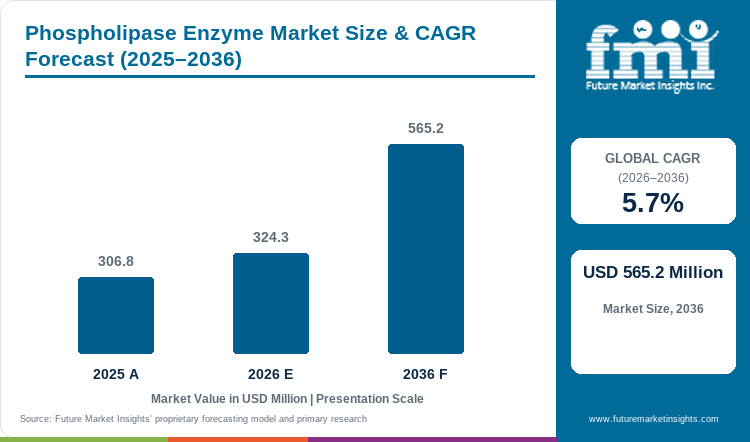
The phospholipase enzyme market reached a valuation of USD 306.8 million in 2025, and is valued at USD 324.3 million in 2026, Industry is projected to reach USD 565.2 million by 2036, expanding at a CAGR of 5.7% over the 2026-2036 period.
Sales in the phospholipase enzyme market are projected to grow at 5.7% CAGR through 2036. Oil refiners are using phospholipase during degumming, which removes gums while keeping more usable oil. PLC is changing gum-forming fat molecules into a usable oil component instead of creating extra free fatty acids. Bakeries are using phospholipase to change flour fats and keep dough steadier during mixing. Plant teams are approving routine use after line trials show a clear result on their equipment.
Country demand is changing with the production job each plant is trying to improve. US refiners are focusing on oil recovery across large soybean-crushing and degumming runs. In March 2026, USDA reported that US processors crushed 75.2 million tons of soybeans during 2025. That volume is giving refiners many chances to test whether phospholipase keeps more usable oil. UK bakeries are focusing on dough performance and rules for food enzymes because each use needs legal support. German refiners are reviewing oil results together with EU use records. Japanese and South Korean plants are putting more weight on local food-additive rules and local-language documents.
Key Takeaways
- Oil processors are using phospholipase to improve oil recovery across full-scale degumming runs with changing crude-oil inputs.
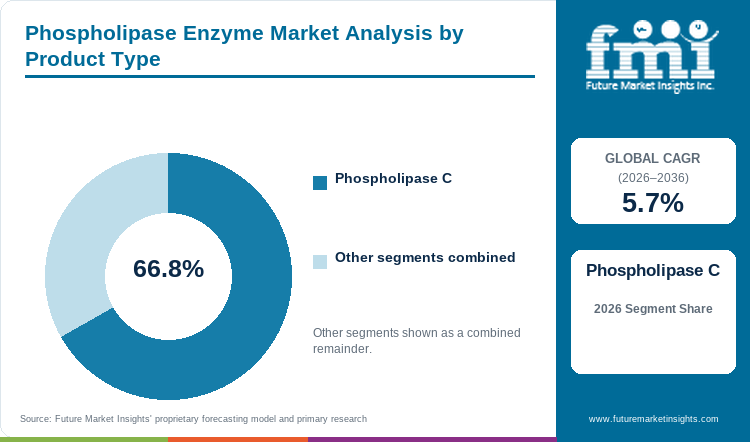
- By product type, phospholipase C is estimated to hold 66.8% in 2026. Refiners are favoring PLC because its reaction is helping protect more usable oil during degumming.
- In 2026, powder is expected to lead form demand with 67.7% share. Plants are choosing dry grades because storage and shipping are easier across food-processing sites.
- Microbial sources are projected to account for 69.1% of source demand in 2026. Producers are using fermentation to maintain steady output and select microbes for specific processing jobs.
- Plant approval is slowing some buying decisions because teams are testing enzyme performance at the required pH, temperature, and processing time.
- Novonesis, dsm-firmenich, IFF, AB Enzymes, and NAGASE are supplying phospholipase products for oil and food processing.
Analyst Perspective
"Plants are expanding phospholipase use as trials are showing clear oil or dough benefits on existing equipment. Manufacturers should build trials around pH, process time, and permitted food use so plant teams spend less time on rework."
- Nandini Roy Choudhury, Principal Consultant, Future Market Insights
How is the phospholipase enzyme market segmented?
The phospholipase enzyme market is segmented three ways: by Product Type, Form, Source, and Region. Phospholipase C leads the Product Type category with 66.8% of 2026 demand, Powder leads the Form category with 67.7%, and Microbial leads the Source category with 69.1%.
Product type includes phospholipase C, phospholipase A2, phospholipase D, phospholipase A1, and phospholipase B. Form separates products into powder and liquid based on storage and dosing needs. Source separates products into microbial, animal, and botanical origins used across production routes. These axes show what the enzyme does, how plants receive it, and where producers are sourcing it.
Why does phospholipase C lead the product type category?
Oil refiners are using phospholipase C to break down gums while keeping more usable oil in the process. Some phospholipase A enzymes create more free fatty acids, which can reduce the oil recovered after processing. Refinery teams are comparing phosphorus removal, oil recovery, enzyme dose, and processing time before approving PLC.
- Phospholipase C is expected to lead product type with 66.8% share in 2026. Refiners are valuing PLC because its reaction is helping protect more neutral oil during degumming.
- In January 2025, a Journal of the American Oil Chemists' Society review examined heat-stable phospholipase C for edible-oil degumming. The review linked heat stability with oil yield during refinery processing.
What supports powder leadership in the form category?
Plants are choosing powder because dry enzyme grades are easier to store and ship. Dry grades fit sites that already handle powdered processing aids. Liquid grades fit lines that meter enzyme into an existing process stream. Buyers are choosing the form that matches their dosing equipment, storage space, and handling routine.
- By form, powder is estimated to hold 67.7% in 2026. Plants are favoring dry grades because storage and shipping are easier with other powdered processing aids.
- NAGASE is offering microbial phospholipase A2 in powder and liquid forms for food applications. Plants are choosing the form that matches their storage setup and dosing equipment.
Why do microbial sources lead the source category?
Producers are using controlled fermentation to make phospholipase in large batches. They are choosing natural or engineered microbes based on the reaction needed in each process. Dose and process time are affecting results, so food plants are checking for stable performance from one batch to the next. Animal and botanical sources remain available, but producers are controlling microbial output more easily across large runs.
- Microbial sources are projected to hold 69.1% of source demand in 2026. Producers are using fermentation for steady output and are selecting strains for specific processing jobs.
- In January 2025, a Food Bioscience study used Bacillus subtilis to produce phospholipase D for food processing. The study showed that microbes can make phospholipase D for controlled food-processing work.
What are the drivers, restraints and opportunities in the phospholipase enzyme market?
In the phospholipase enzyme market, the key driver is improved oil recovery during degumming, the key restraint is plant approval requirements that slow supplier changes, and the key opportunity is wider use in bakery and food processing applications.
- Driver: Oil processors are using phospholipase to keep more usable oil during high-volume refining with changing crude-oil inputs.
- Restraint: Supplier changes are taking longer if an enzyme needs new line settings or another food-use review.
- Opportunity: Bakery and other food plants are using phospholipase to change lipids and improve performance in specific recipes and processes.
Oil refiners are using phospholipase because small recovery gains matter across large production volumes. In August 2026, USDA raised its US soybean-crush forecast to 2.78 billion bushels for 2026/27. The forecast points to more degumming runs where refiners can measure how much oil the enzyme saves. PLC is breaking down gums while keeping more usable oil instead of creating extra free fatty acids. Refinery teams are testing enzyme dose, line time, and crude-oil response before approval. Plant teams are confirming the oil gain on the crude oil that will run through their equipment. Enzyme systems are supporting similar recovery gains as crude-oil quality changes between runs. Dose-response records are helping buying teams choose settings for planned changes in crude-oil quality.
Changes in crude-oil quality, line design, and pH are making plants retest a phospholipase supplier. dsm-firmenich's Purifine guide links degumming results with controlled pH and suitable plant equipment. Some refineries need more tank space or line changes to give the enzyme enough reaction time. Food applications are adding another check because regulators must allow the enzyme for the intended use. Supplier changes are taking longer even when the expected plant benefit is clear. Refinery engineers are testing dose and equipment fit on the line that will use the enzyme. Plant test results are giving later supplier reviews a clear technical starting point. Suppliers are reducing rework by matching process guidance to existing tanks, heat, and pH limits.
Food processors are using phospholipase because the enzyme is helping change lipids inside dough and other foods. In June 2026, IFF published guidance on enzyme-based dough strength for industrial bakery production. The guidance links phospholipase action with flour changes and stress on commercial baking lines. Bakers are testing dough handling and finished-product quality before approving the enzyme. Bakery enzymes are going through line trials with different flour batches and mixing conditions. Food plants are checking whether local rules allow the enzyme for the intended use. Line records are connecting enzyme dose with dough strength under normal production settings. Bakery teams are reviewing those records before using the same dose on another line.
Which country CAGRs are included in the phospholipase enzyme market?
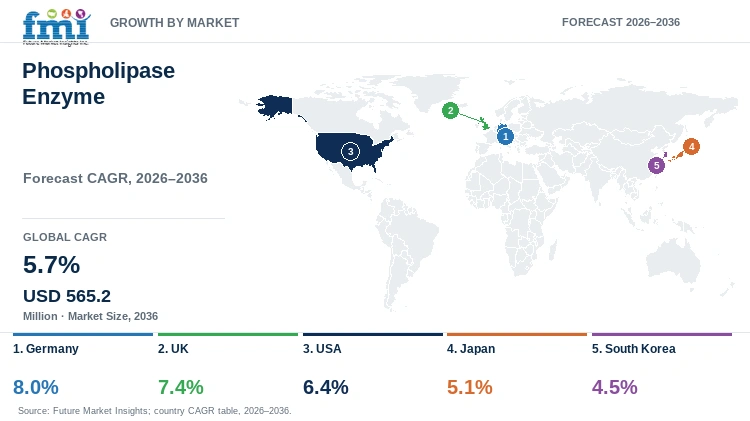
| Country | CAGR |
|---|---|
| Germany | 8.0% |
| UK | 7.4% |
| USA | 6.4% |
| Japan | 5.1% |
| South Korea | 4.5% |
How do country-level CAGRs compare in the phospholipase enzyme market?
Refinery scale, food-processing activity, and enzyme rules are creating different demand conditions across countries. Local plants are responding to different production and approval needs.
- Germany's oils-and-fats plants support enzyme degumming through refinery trials focused on phosphorus removal and recoverable oil.
- Food manufacturers in the UK favor phospholipase for bakery lines that must meet regulated-products requirements.
- Across the USA, large soybean-crush plants focus on oil-recovery gains during phospholipase degumming trials at commercial refineries.
- Japan places emphasis on processing-aid compliance during phospholipase qualification across refinery and local food-processing applications.
- South Korea's food-additive code keeps Korean documentation central during enzyme qualification at local processing plants.
US soybean crushing is keeping refiners focused on oil recovery during degumming trials. UK food processors are placing more weight on bakery performance and food-enzyme rules. Germany, Japan, and South Korea are combining plant trials with local approval records before routine use.
Country-wise Analysis
- Germany is projected to grow at 8.0% CAGR through 2036. Refiners are testing phospholipase because better degumming can remove gums while keeping more usable oil. In June 2026, Germany's Federal Office for Agriculture and Food published preliminary data on national oilseed use and oil sales. EU food-enzyme rules require records for each approved food use. Plants are testing the enzyme at each line's normal pH and temperature before approving a supplier. Supplier changes are taking longer if regulatory records and plant trials do not cover the same use. German buyers are moving faster once EU use records and plant data support the same enzyme application.
- Phospholipase enzyme demand in the UK is forecast to rise at 7.4% CAGR through 2036. Bakeries are using enzymes to manage dough strength, but each food use must fit UK rules. In July 2026, the Office for National Statistics reported that food products made up 22.9% of UK manufacturers' product sales in 2025. The manufacturing base is giving suppliers many bakery sites for enzyme trials. Plants are testing dough behavior on their own lines before approving a supplier. UK bakery teams are relying on legal records and line data before expanding phospholipase use.
- The USA is estimated to post 6.4% CAGR through 2036. Large soybean-crush volumes are giving US refiners a clear reason to test phospholipase for oil recovery. In March 2026, USDA reported that US crushers produced 29.5 billion pounds of crude oil during 2025, up 7% from 2024. Refiners are testing dose and oil recovery within each line's normal pH and temperature limits. FDA safety requirements are shaping which food uses a plant can approve. Site change reviews are slowing supplier switches because each refinery is confirming performance on its own equipment. US refinery teams are pairing dose-response data with the safety record for the intended use.
- In Japan, phospholipase demand is predicted to advance at 5.1% CAGR through 2036. Local vegetable-oil production is giving refiners a practical base for degumming trials. In February 2026, Japan's Ministry of Agriculture reported about 1.6 million tonnes of vegetable crude oil production during 2025. Japan is treating processing aids as food additives, so permitted products must meet local rules. Refiners are testing dose and oil recovery within each line's normal pH and temperature limits. Food plants are reviewing trial results and rule status before changing suppliers. Approvals are taking longer if a successful plant trial lacks the required food-use record. Japanese processors are moving faster when local approval records and line data cover the same use.
- Phospholipase enzyme sales in South Korea are forecast to expand at 4.5% CAGR by 2036. Food-additive rules and Korean-language records are shaping how local plants approve enzymes. In July 2026, South Korea's Ministry of Food and Drug Safety issued Notice 2026-50 and updated the Food Additives Code. The code is making the approved-use record part of each plant review. Food plants are testing enzyme performance across the required temperature and pH range. Paperwork is slowing supplier changes if trial results do not match an allowed use. Korean processors are clearing routine production faster when local compliance records and plant data support the same application.
Who are the notable companies in the phospholipase enzyme market?
Novonesis, dsm-firmenich, IFF, AB Enzymes and NAGASE are notable companies in the phospholipase enzyme market.
Refiners are comparing phospholipase products by reaction type, oil recovery, pH range, and available line time. Novonesis, dsm-firmenich, and AB Enzymes are offering named products for oil degumming or lecithin processing. Lecithin is helping food makers keep fat and water mixed during processing. IFF and NAGASE are offering phospholipase products for bakery and other food uses. Buying teams are matching each product to the production step they want to improve.
- Novonesis, dsm-firmenich, and AB Enzymes are selling phospholipase products for oil degumming and lecithin processing.
- IFF is selling ENOVERA, a phospholipase-based product that is helping industrial bakeries strengthen dough in North America and Europe.
- NAGASE is selling phospholipase A2 in liquid and powder forms for bakery and lecithin processing.
Competitive Benchmarking: Phospholipase Enzyme Market
| Company | Oil Degumming Capability | Food Use Coverage | Application Support | Geographic Reach |
|---|---|---|---|---|
| Novonesis | High | High | Medium | United States and Europe |
| dsm-firmenich | High | Medium | High | Europe and China |
| IFF | Low | Medium | High | North America and Europe |
| AB Enzymes | High | High | High | Europe, India and Australia/New Zealand |
| NAGASE | Medium | High | Medium | Japan, Europe and North America |
The benchmark checks whether each company has a named phospholipase product for edible-oil processing. Food Use Coverage shows how many food uses have direct proof for each company's phospholipase products. Application Support shows whether buyers can access process guides, case studies, or product help. A High rating means direct proof covers a broad set of uses in that area. A Medium rating means direct proof covers fewer uses within that area. A Low rating means the evidence shows related enzyme work without a named phospholipase product for that area.
Key Developments in the Phospholipase Enzyme Market
- In September 2026, FSANZ accepted DSM Food Specialties' A1361 phospholipase A1 application for review as a processing aid. The application covers phospholipase use in bakery and cereal processing. FSANZ had not granted final approval for the application by September 2026.
- In November 2025, Novonesis launched Quara Supreme for water degumming of vegetable oils. The heat-stable phospholipase C works within normal line times and avoids extra free fatty acids during oil processing.
- In October 2025, EFSA completed its safety review of AB Enzymes' phospholipase A2. The review covered egg products, oil degumming, and lecithin processing under the listed use conditions.
Key Players in the Phospholipase Enzyme Market
Oil-Processing Phospholipase Platforms
- Novonesis
- dsm-firmenich
- AB Enzymes
Bakery and Food-Function Phospholipase Solutions
- IFF
Food and Lecithin Phospholipase Solutions
- NAGASE
Phospholipase Enzyme Market - Report Scope
| Coverage field | Report scope |
|---|---|
| Market breakdown | Product Type, Form, Source |
| Quantitative Units | USD Million |
| Market Definition | Revenue from commercial phospholipase enzyme preparations sold within the listed Product Type, Form and Source universe. The scope excludes downstream finished-product revenue, equipment and services sold separately, non-phospholipase enzymes without defined phospholipase activity, and adjacent or substitute processing products. |
| Regions Covered | North America, Latin America, Western Europe, Eastern Europe, East Asia, South Asia and Pacific, Middle East and Africa |
| Countries Covered | South Korea, UK, Japan, USA, Germany |
| Key Companies Profiled | Novonesis, dsm-firmenich, IFF, AB Enzymes, NAGASE |
| Forecast Period | 2026 to 2036 |
| Approach | Primary and secondary research with market triangulation. |
Phospholipase Enzyme Market - Research Methodology
| Method | Approach |
|---|---|
| Primary Research | FMI analysts gathered input from manufacturers, service providers, technology developers, distributors, end users, procurement teams, and subject-matter experts. Interviews examined purchasing decisions, product or service evaluation, adoption barriers, approval requirements, pricing considerations, and expectations for technical or commercial support. Respondents were also asked what evidence is required before a trial, pilot, or initial order develops into regular purchasing. |
| Desk Research | Desk research covered government statistics, regulatory publications, trade data, industry associations, technical literature, standards, company filings, product information, and official corporate announcements. Sources were reviewed for relevance, publication date, geographic coverage, and consistency with the defined market scope. Claims relating to performance, applications, approvals, capacity, investment, and commercial activity were retained only when supported by credible public evidence. |
| Market Sizing and Forecasting | The market model combined the baseline value with historical performance, segment structure, pricing and volume indicators, adoption levels, company participation, and country-level demand conditions. Forecast assumptions considered economic activity, investment trends, regulatory developments, technology adoption, purchasing cycles, supply availability, and barriers to wider market use. Segment and regional estimates were reconciled before the final market total was calculated. |
| Data Validation | Estimates were checked against multiple independent indicators, including public data, company activity, trade patterns, industry developments, and findings from primary interviews. Validation also tested whether products, services, applications, and company revenues fell within the defined market boundaries. Adjacent categories, unsupported claims, overlapping revenues, and activities without direct market relevance were excluded to reduce double counting and maintain consistency across segments and countries. |
Phospholipase Enzyme Market by Segments
Phospholipase Enzyme Market segmented by Product Type:
- Phospholipase C
- Phospholipase A2
- Phospholipase D
- Phospholipase A1
- Phospholipase B
Phospholipase Enzyme Market segmented by Form:
- Powder
- Liquid
Phospholipase Enzyme Market segmented by Source:
- Microbial
- Animal
- Botanical
Phospholipase Enzyme Market by Region:
- North America
- United States
- Canada
- Latin America
- Brazil
- Mexico
- Argentina
- Chile
- Western Europe
- Germany
- France
- United Kingdom
- Italy
- Spain
- Benelux
- Nordics
- Eastern Europe
- Poland
- Czech Republic
- Romania
- Hungary
- East Asia
- China
- Japan
- South Korea
- South Asia and Pacific
- India
- ASEAN
- Australia and New Zealand
- Middle East and Africa
- GCC Countries
- South Africa
- Türkiye
- Israel
Research Sources and Bibliography
- Shakilanishi, S., & Shanthi, C. (2024). An overview on preparation of enzymes for industrial use. Biocatalysis and Biotransformation, 42(4), 485-496.
- European Food Safety Authority. (2025, October 15). Updated safety evaluation of the food enzyme phospholipase A2 from the genetically modified Trichoderma reesei strain RF8793.
- U.S. Food and Drug Administration. (2026, July 22). GRN No. 651: Phospholipase A1 from Talaromyces leycettanus produced in Aspergillus niger.
- IFF. (2023, May 4). IFF Launches ENOVERA 2000 Range to Replace Up to 50 Percent Vital Gluten in Whole Wheat Bread.
- IFF. (n.d.). ENOVERA: Next-generation dough strengthening.
- dsm-firmenich. (n.d.). Purifine LM.
- dsm-firmenich. (n.d.). Purifine.
- AB Enzymes. (n.d.). ROHALASE PL-XTRA.
- Office for National Statistics. (2026, July 24). UK manufacturers’ sales by product: 2025.
- UK Government. (n.d.). Food enzymes authorisation guidance.
- USDA Economic Research Service. (2026, August 14). Oil Crops Outlook: August 2026.
- Consumer Affairs Agency, Japan. (n.d.). Food Additives.
- Ministry of Agriculture, Forestry and Fisheries, Japan. (n.d.). Types of vegetable oils and 2025 crude-oil production.
- Ministry of Agriculture, Food and Rural Affairs, Republic of Korea. (2025, July 31). The Result of the Survey on the Korean Food Industry for the Year 2024.
- Ministry of Food and Drug Safety, Republic of Korea. (2023, October 30). Food Additives Code (#2023-60, 2023.9.20.).
- Federal Ministry of Agriculture, Germany. (n.d.). Oils and Fats Supply Balances.
- Food Standards Australia New Zealand. (2025, December 18). FSANZ Board Communique: 9 & 10 December Meeting.
- Food Standards Australia New Zealand. (2026, February 26). Amendment No. 248.
- Food Standards Australia New Zealand. (2026, September 8). A1361 - Phospholipase A1 from Fusarium commune for use as a processing aid.
- IFF. (2026, April). How to Bake on Strength: Turning Today's Bakery Challenges into Reliable Results.
- IFF. (2026, June 4). Label-Friendly by Design: How Enzymes Are Changing the Future of Baking.
- IFF. (2025, May 13). Boosting Dough Strength in Industrial Baking: Enzyme Solutions That Raise the Game.
- NAGASE. (2026, July). Phospholipase A2: Precision Hydrolysis for Food and Oil Processing.
- USDA National Agricultural Statistics Service. (2026, March 2). Fats and Oils: Oilseed Crushings, Production, Consumption and Stocks 2025 Summary.
- Federal Office for Agriculture and Food, Germany. (2026, June 22). Report on oils and fats for Germany - preliminary figures.
- Ministry of Agriculture, Forestry and Fisheries, Japan. (2026, January 30). Oil Production Survey: December 2025.
- Ministry of Food and Drug Safety, Republic of Korea. (2026, July 13). Food Additives Code, Notice No. 2026-50.
- European Food Safety Authority. (2026, July 15). Safety evaluation of an extension of use of phospholipase A1 from Aspergillus niger strain NZYM-FP.
- Val, D. S., Di Nardo, L., Marchisio, F., Lacava, F., Aguirre, A., Peiru, S., Castelli, M. E., Espariz, M., Abriata, L. A., Menzella, H. G., & Rasia, R. M. (2025). Thermostable phospholipase C: A key to efficient and sustainable enzymatic oil degumming processes. Journal of the American Oil Chemists' Society, 102(5), 923-929.
- Food Bioscience. (2025, January). Development of a platform strain for integration expression of phospholipase D and its application in improving phosphatidylserine content of egg yolk.
- Novonesis. (2025, November 26). Novonesis launches thermostable solution to increase oil yield in water degumming without adding complexity.
- dsm-firmenich. (2026, February 20). dsm-firmenich publishes 2025 Integrated Annual Report.
- IFF. (n.d.). Dr. David Wilson: IFF Scientific Leadership Expert. Retrieved September 24, 2026.
- IFF. (n.d.). THRIVE4U Premium Enzymes. Retrieved September 24, 2026.
- Ministry of Agriculture, Forestry and Fisheries, Japan. (2026, February 24). Oil Production Survey: 2025 final results.
- USDA National Agricultural Statistics Service. (2026, March 13). North American Grain and Oilseed Crushing Annual Summary.
This bibliography lists the public evidence used throughout the article. The full report contains the complete reference list and detailed source notes for model inputs.
This Report Answers
- How large is the Phospholipase Enzyme Market in 2026, and what value is forecast for 2036?
- Which operating conditions and business pressures support phospholipase enzyme demand?
- Why does phospholipase C hold 66.8% of product type demand?
- Why does powder hold 67.7% of form demand in 2026?
- How do country growth rates differ across Germany, UK, USA, Japan and South Korea?
- Which companies make phospholipase products or related enzyme products for food processing?
- What limits phospholipase use, plant approval, or supplier switching?
- What should buyers evaluate during phospholipase enzyme selection for production?
Frequently Asked Questions
How big is the Phospholipase Enzyme Market in 2026, and what is forecast for 2036?
The phospholipase enzyme market is valued at USD 324.3 million in 2026 and is projected to reach USD 565.2 million by 2036.
What is the CAGR of the Phospholipase Enzyme Market from 2026 to 2036?
The phospholipase enzyme market is projected to grow at a CAGR of 5.7% from 2026 to 2036. Plant trials and food-use rules influence how buyers approve phospholipase for routine production.
Which product type segment leads the Phospholipase Enzyme Market?
Phospholipase C leads the phospholipase enzyme market by Product Type with a 66.8% share in 2026. PLC helps protect recoverable oil during degumming without creating as many free fatty acids as some phospholipase A routes.
Which form segment leads the Phospholipase Enzyme Market?
Powder leads the phospholipase enzyme market by Form with a 67.7% share in 2026. Plants choose dry grades because storage and shipping are easier for processing operations.
Which countries are included in the country CAGR comparison?
The phospholipase enzyme market country CAGR comparison includes Germany, the UK, the USA, Japan, and South Korea from 2026 to 2036.
Which companies are active in the Phospholipase Enzyme Market?
Notable companies in the phospholipase enzyme market include Novonesis, dsm-firmenich, IFF, AB Enzymes, and NAGASE. These companies provide products for oil degumming, lecithin processing, bakery applications, and other food uses.
Preview the report firsthand - request a free sample
Get SampleGet the brochure for pricing and purchase details.
Get PDFTable of Content
- Key Takeaways
- Market Size and CAGR
- Top Growth Driver
- Fastest Growing Segment
- Leading Region
- Key Companies
- Emerging Opportunities
- Executive Summary
- Global Market Outlook
- Demand-side Trends
- Supply-side Trends
- Technology Roadmap Analysis
- Analysis and Recommendations
- Analyst Perspective (What is happening? Why now? What should investors know?)
- Key Questions Answered
- How large is the market?
- What is the CAGR?
- What are key trends?
- Which region dominates?
- Who are the leaders?
- Market Overview
- Market Coverage / Taxonomy
- Market Definition / Scope / Limitations
- Research Methodology
- Chapter Orientation
- Analytical Lens and Working Hypotheses
- Market Structure, Signals, and Trend Drivers
- Benchmarking and Cross-market Comparability
- Market Sizing, Forecasting, and Opportunity Mapping
- Research Design and Evidence Framework
- Desk Research Programme (Secondary Evidence)
- Expert Input and Fieldwork (Primary Evidence)
- Tooling, Models, and Reference Databases
- Data Engineering and Model Build
- Quality Assurance and Audit Trail
- Market Background
- Market Dynamics (Drivers, Restraints, Opportunity, Trends)
- Scenario Forecast (Optimistic, Likely, Conservative)
- Impact Analysis
- AI Impact
- Sustainability Impact
- Regulatory Impact
- Technology Impact
- Consumer / Buyer Analysis
- Purchase Drivers
- Adoption Barriers
- Buyer Journey
- Opportunity Map Analysis
- Product Life Cycle Analysis
- Supply Chain Analysis
- Investment Feasibility Matrix
- Value Chain Analysis
- PESTLE and Porter's Analysis
- Regulatory Landscape
- Regional Parent Market Outlook
- Production and Consumption Statistics
- Import and Export Statistics
- Global Market Analysis and Forecast, 2021 to 2036
- Historical Market Size Value (USD Million) Analysis, 2021 to 2025
- Current and Future Market Size Value (USD Million) Projections, 2026 to 2036
- Y-o-Y Growth Trend Analysis
- Absolute $ Opportunity Analysis
- Global Market Pricing Analysis, 2021 to 2036
- Global Market Analysis and Forecast, By Product Type, 2021 to 2036
- Introduction / Key Findings
- Historical Market Size Value (USD Million) Analysis By Product Type, 2021 to 2025
- Current and Future Market Size Value (USD Million) Analysis and Forecast By Product Type, 2026 to 2036
- Phospholipase C
- Phospholipase A2
- Phospholipase D
- Phospholipase A1
- Phospholipase B
- Y-o-Y Growth Trend Analysis By Product Type, 2021 to 2025
- Absolute $ Opportunity Analysis By Product Type, 2026 to 2036
- Global Market Analysis and Forecast, By Form, 2021 to 2036
- Introduction / Key Findings
- Historical Market Size Value (USD Million) Analysis By Form, 2021 to 2025
- Current and Future Market Size Value (USD Million) Analysis and Forecast By Form, 2026 to 2036
- Powder
- Liquid
- Y-o-Y Growth Trend Analysis By Form, 2021 to 2025
- Absolute $ Opportunity Analysis By Form, 2026 to 2036
- Global Market Analysis and Forecast, By Source, 2021 to 2036
- Introduction / Key Findings
- Historical Market Size Value (USD Million) Analysis By Source, 2021 to 2025
- Current and Future Market Size Value (USD Million) Analysis and Forecast By Source, 2026 to 2036
- Microbial
- Animal
- Botanical
- Y-o-Y Growth Trend Analysis By Source, 2021 to 2025
- Absolute $ Opportunity Analysis By Source, 2026 to 2036
- Global Market Analysis and Forecast, By Region, 2021 to 2036
- Introduction
- Historical Market Size Value (USD Million) Analysis By Region, 2021 to 2025
- Current Market Size Value (USD Million) Analysis and Forecast By Region, 2026 to 2036
- North America
- Latin America
- Western Europe
- Eastern Europe
- East Asia
- South Asia and Pacific
- Middle East and Africa
- Market Attractiveness Analysis By Region
- North America Market Analysis and Forecast, By Country, 2021 to 2036
- Historical Market Size Value (USD Million) Trend Analysis By Market Taxonomy, 2021 to 2025
- Market Size Value (USD Million) Forecast By Market Taxonomy, 2026 to 2036
- By Country
- United States
- Canada
- By Product Type
- By Form
- By Source
- By Country
- Market Attractiveness Analysis
- By Country
- By Product Type
- By Form
- By Source
- Key Takeaways
- Latin America Market Analysis and Forecast, By Country
- Historical Market Size Value (USD Million) Trend Analysis By Market Taxonomy, 2021 to 2025
- Market Size Value (USD Million) Forecast By Market Taxonomy, 2026 to 2036
- By Country
- Brazil
- Mexico
- Argentina
- Chile
- By Product Type
- By Form
- By Source
- By Country
- Market Attractiveness Analysis
- By Country
- By Product Type
- By Form
- By Source
- Key Takeaways
- Western Europe Market Analysis and Forecast, By Country
- Historical Market Size Value (USD Million) Trend Analysis By Market Taxonomy, 2021 to 2025
- Market Size Value (USD Million) Forecast By Market Taxonomy, 2026 to 2036
- By Country
- Germany
- France
- United Kingdom
- Italy
- Spain
- Benelux
- Nordics
- By Product Type
- By Form
- By Source
- By Country
- Market Attractiveness Analysis
- By Country
- By Product Type
- By Form
- By Source
- Key Takeaways
- Eastern Europe Market Analysis and Forecast, By Country
- Historical Market Size Value (USD Million) Trend Analysis By Market Taxonomy, 2021 to 2025
- Market Size Value (USD Million) Forecast By Market Taxonomy, 2026 to 2036
- By Country
- Poland
- Czech Republic
- Romania
- Hungary
- By Product Type
- By Form
- By Source
- By Country
- Market Attractiveness Analysis
- By Country
- By Product Type
- By Form
- By Source
- Key Takeaways
- East Asia Market Analysis and Forecast, By Country
- Historical Market Size Value (USD Million) Trend Analysis By Market Taxonomy, 2021 to 2025
- Market Size Value (USD Million) Forecast By Market Taxonomy, 2026 to 2036
- By Country
- China
- Japan
- South Korea
- By Product Type
- By Form
- By Source
- By Country
- Market Attractiveness Analysis
- By Country
- By Product Type
- By Form
- By Source
- Key Takeaways
- South Asia and Pacific Market Analysis and Forecast, By Country
- Historical Market Size Value (USD Million) Trend Analysis By Market Taxonomy, 2021 to 2025
- Market Size Value (USD Million) Forecast By Market Taxonomy, 2026 to 2036
- By Country
- India
- ASEAN
- Australia and New Zealand
- By Product Type
- By Form
- By Source
- By Country
- Market Attractiveness Analysis
- By Country
- By Product Type
- By Form
- By Source
- Key Takeaways
- Middle East and Africa Market Analysis and Forecast, By Country
- Historical Market Size Value (USD Million) Trend Analysis By Market Taxonomy, 2021 to 2025
- Market Size Value (USD Million) Forecast By Market Taxonomy, 2026 to 2036
- By Country
- GCC Countries
- South Africa
- Türkiye
- Israel
- By Product Type
- By Form
- By Source
- By Country
- Market Attractiveness Analysis
- By Country
- By Product Type
- By Form
- By Source
- Key Takeaways
- Key Countries Market Analysis
- United States
- Pricing Analysis
- Market Share Analysis, 2025
- By Product Type
- By Form
- By Source
- Canada
- Pricing Analysis
- Market Share Analysis, 2025
- By Product Type
- By Form
- By Source
- Mexico
- Pricing Analysis
- Market Share Analysis, 2025
- By Product Type
- By Form
- By Source
- Brazil
- Pricing Analysis
- Market Share Analysis, 2025
- By Product Type
- By Form
- By Source
- Chile
- Pricing Analysis
- Market Share Analysis, 2025
- By Product Type
- By Form
- By Source
- Germany
- Pricing Analysis
- Market Share Analysis, 2025
- By Product Type
- By Form
- By Source
- United Kingdom
- Pricing Analysis
- Market Share Analysis, 2025
- By Product Type
- By Form
- By Source
- Italy
- Pricing Analysis
- Market Share Analysis, 2025
- By Product Type
- By Form
- By Source
- Spain
- Pricing Analysis
- Market Share Analysis, 2025
- By Product Type
- By Form
- By Source
- France
- Pricing Analysis
- Market Share Analysis, 2025
- By Product Type
- By Form
- By Source
- India
- Pricing Analysis
- Market Share Analysis, 2025
- By Product Type
- By Form
- By Source
- ASEAN
- Pricing Analysis
- Market Share Analysis, 2025
- By Product Type
- By Form
- By Source
- Australia and New Zealand
- Pricing Analysis
- Market Share Analysis, 2025
- By Product Type
- By Form
- By Source
- China
- Pricing Analysis
- Market Share Analysis, 2025
- By Product Type
- By Form
- By Source
- Japan
- Pricing Analysis
- Market Share Analysis, 2025
- By Product Type
- By Form
- By Source
- South Korea
- Pricing Analysis
- Market Share Analysis, 2025
- By Product Type
- By Form
- By Source
- Poland
- Pricing Analysis
- Market Share Analysis, 2025
- By Product Type
- By Form
- By Source
- Hungary
- Pricing Analysis
- Market Share Analysis, 2025
- By Product Type
- By Form
- By Source
- Türkiye
- Pricing Analysis
- Market Share Analysis, 2025
- By Product Type
- By Form
- By Source
- South Africa
- Pricing Analysis
- Market Share Analysis, 2025
- By Product Type
- By Form
- By Source
- United States
- Market Structure Analysis
- Competition Dashboard
- Competition Benchmarking
- Market Share Analysis of Top Players
- By Regional
- By Product Type
- By Form
- By Source
- Emerging Startups
- Innovation Benchmarking
- Competition Analysis
- Competition Deep Dive
- Novonesis
- Overview
- Product Portfolio
- Profitability by Market Segments
- Sales Footprint
- Strategy Overview
- Marketing Strategy
- Product Strategy
- Channel Strategy
- dsm-firmenich
- IFF
- AB Enzymes
- NAGASE
- Novonesis
- Case Studies
- Success Stories
- Recent Developments
- Competition Deep Dive
- Assumptions & Acronyms Used


