

- Industry Size (2026)
- USD 3.4 Bn
- Forecast (2036)
- USD 6.5 Bn
- CAGR (2026 to 2036)
- 6.1%
PIR Blowmolding Market Size, Market Forecast and Outlook By FMI
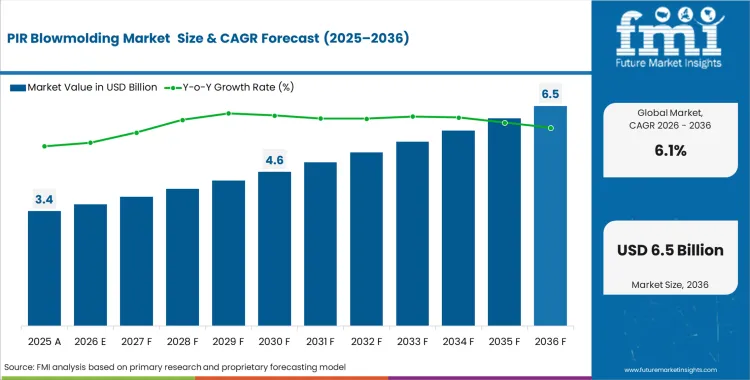
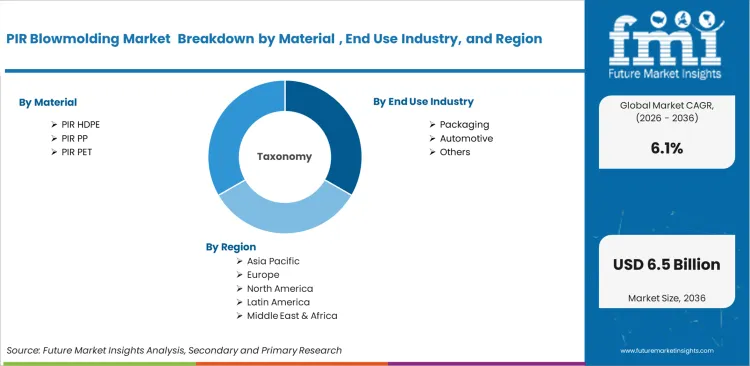
The global PIR blowmolding market is projected to be valued at USD 3.4 Billion in 2025 and is expected to reach USD 6.5 Billion by 2036, expanding at a CAGR of 6.1% over the forecast period. The market is expected to reach around USD 3.4 Billion in 2026. Growth is being shaped by rising recycled-content adoption in rigid plastics, with PIR HDPE accounting for a 38.7% share by material type and Packaging representing a 41.9% share by end use, while leading participants include ALPLA Group, Berry Global Inc., Amcor plc, Silgan Holdings Inc., Plastipak Holdings, Inc., Greif, Inc., and Mauser Packaging Solutions.
Summary of PIR Blowmolding Market
- Market Snapshot
- The PIR blowmolding market is estimated at USD 3.4 Billion in 2025 and is forecast to reach USD 6.5 Billion by 2036.
- The market is anticipated to expand at a CAGR 6.1%, supported by circular packaging targets and recycled resin integration.
- PIR HDPE leads material demand with 38.7% share, while Packaging dominates end use with 41.9% share.
- Demand and Growth Drivers
- Demand is being reinforced by brand-owner commitments to increase post-industrial recycled content in rigid containers and industrial packaging.
- Converters and packaging buyers are prioritizing PIR blowmolded formats to balance sustainability goals with process consistency and cost control.
- Industrial, household chemical, personal care, and food-adjacent applications continue to generate steady volume requirements for recycled-content bottles, drums, and jerrycans.
- Product and Segment View
- PIR HDPE remains the most commercially established material due to its durability, chemical resistance, and compatibility with blowmolding lines.
- Bottles, containers, drums, and intermediate rigid packaging formats represent the core product categories in PIR blowmolding.
- Product development is increasingly focused on lightweighting, multilayer optimization, and improved aesthetics for recycled-content packaging.
- Geography and Competitive Outlook
- East Asia is emerging as a high-opportunity region due to manufacturing scale, recycling infrastructure expansion, and export-oriented packaging demand.
- North America and Europe remain important markets because of regulatory pressure, corporate sustainability mandates, and mature packaging conversion industries.
- Regional growth patterns are influenced by resin availability, collection and sorting efficiency, and end-market acceptance of recycled-content rigid plastics.
- Analyst Opinion
- Ismail Sutaria, Senior Consultant at FMI says, 'According to Daniel Mercer, PIR blowmolding is moving from a compliance-led niche to a mainstream rigid-packaging strategy anchored in supply security, recycled-content performance, and scalable circularity.'
Post-Industrial Recycled (PIR) Blow Molding Market Definition
PIR blowmolding refers to the production of hollow plastic articles using blowmolding processes that incorporate post-industrial recycled resin derived from manufacturing scrap, trim, off-spec material, and other industrial plastic waste streams. The market covers recycled-content rigid packaging and industrial containers produced from materials such as HDPE and related polymers. It is positioned at the intersection of plastics circularity, packaging sustainability, and cost-efficient resin utilization.
Post-Industrial Recycled (PIR) Blow Molding Market Inclusions
- Blowmolded bottles, containers, jerrycans, drums, and other hollow rigid plastic products manufactured with post-industrial recycled resin content.
- Material analysis covering PIR HDPE and other relevant recycled polymers used in extrusion blowmolding and related blowmolding applications.
- Demand assessment across packaging, industrial, consumer, and regional end-use environments for PIR-based rigid plastic formats.
Post-Industrial Recycled (PIR) Blow Molding Market Exclusions
- Products manufactured exclusively from virgin resin without any post-industrial recycled content.
- Mechanical recycling operations, resin reprocessing equipment markets, and waste collection services as standalone industries.
- Injection molding, thermoforming, and other plastic conversion technologies not directly classified under blowmolding.
Post-Industrial Recycled (PIR) Blow Molding Market Research Methodology
The report is based on a combination of secondary research, company-level assessment, trade and regulatory review, and analysis of recycled plastics adoption trends across rigid packaging value chains. Market sizing and forecasting are developed through triangulation of demand indicators, material utilization patterns, end-use penetration, and competitive developments. Qualitative insights are supported by evaluation of sustainability commitments, converter strategies, and regional manufacturing dynamics.
Key Drivers, Restraints, and Trends in Post-Industrial Recycled (PIR) Blow Molding Market
Drivers
The PIR blowmolding market is being driven by increasing pressure on packaging producers and brand owners to raise recycled-content usage in rigid plastic formats. Post-industrial recycled resin offers a practical route to improve sustainability metrics while maintaining relatively stable material performance compared with more variable waste-derived streams. Demand is also supported by cost optimization efforts, as converters seek to reduce exposure to virgin resin price volatility and improve material efficiency. In addition, regulatory momentum and procurement standards across consumer goods, chemicals, and industrial packaging are accelerating adoption of PIR-based blowmolded products.
Restraints
Market expansion is constrained by inconsistent availability and quality of post-industrial recycled feedstock across regions and applications. Performance limitations, color variability, contamination concerns, and customer specifications can restrict the use of PIR resin in higher-visibility or highly regulated packaging formats. The market also faces operational challenges related to resin blending, process adjustments, and certification requirements for recycled-content claims. Furthermore, competition from virgin polymers and alternative recycled resin pathways can pressure margins and slow broader substitution rates.
Trends
A notable market trend is the growing integration of PIR resin into mainstream rigid packaging portfolios rather than limiting its use to secondary or industrial applications. Producers are increasingly investing in closed-loop manufacturing systems, scrap recovery programs, and advanced compounding to improve consistency in recycled-content blowmolding. Another visible trend is the alignment of sustainability messaging with functional packaging performance, especially in household, industrial, and transport packaging segments. Regional supply-chain localization is also gaining importance as converters seek dependable recycled resin sourcing and lower logistics-related emissions.
Segmental Analysis
Post-Industrial Recycled (PIR) Blow Molding Market Analysis by Material Type
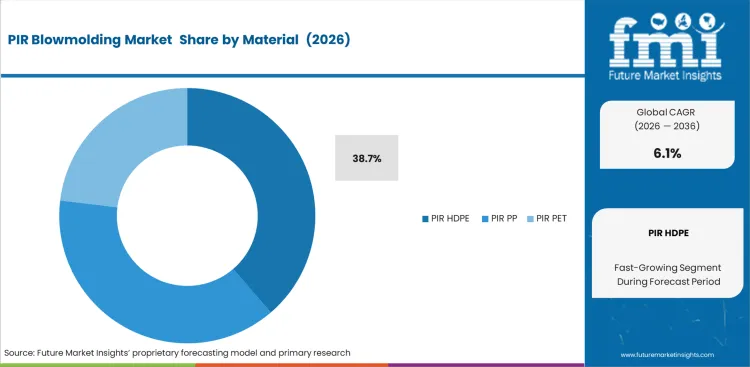
Within material type, PIR HDPE holds 38.7% share, reflecting its strong suitability for blowmolding applications that require toughness, chemical resistance, and dimensional stability. Its established processing profile enables converters to incorporate recycled content with comparatively limited disruption to existing production lines. PIR HDPE is particularly favored in bottles, jerrycans, drums, and household or industrial containers where mechanical performance remains a critical purchasing criterion. Continued leadership of this segment is expected as manufacturers refine resin sorting, blending, and quality-control practices to support broader end-use acceptance.
Post-Industrial Recycled (PIR) Blow Molding Market Analysis by End Use Industry
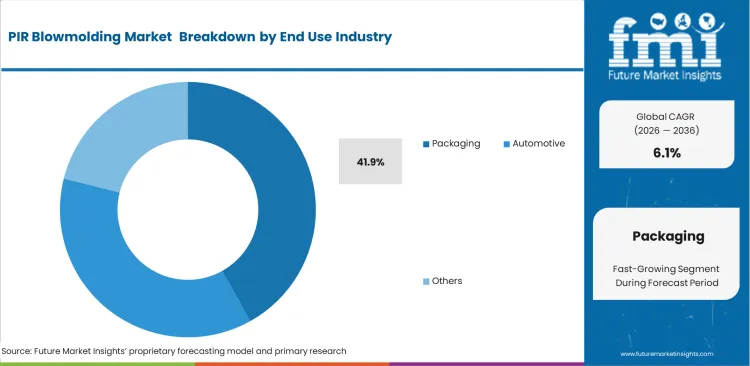
By end use industry, Packaging commands 41.9% share, underscoring the central role of recycled-content rigid containers in sustainability-driven procurement strategies. Consumer goods, personal care, home care, and industrial packaging buyers are increasingly specifying PIR content to meet internal circularity targets and external regulatory expectations. Blowmolded packaging formats benefit from design flexibility, lightweighting potential, and compatibility with high-volume production environments. As a result, the packaging segment is likely to remain the primary revenue generator for PIR blowmolding suppliers over the forecast period.
Post-Industrial Recycled (PIR) Blow Molding Market Analysis by Region
East Asia represents a strategically important regional market due to its extensive plastics processing base, export manufacturing strength, and rising investment in recycling-linked supply chains. The region benefits from large-scale demand for rigid packaging across chemicals, consumer products, food-adjacent applications, and industrial distribution. Manufacturers in East Asia are increasingly positioned to scale PIR blowmolding through integrated production networks and cost-competitive conversion capabilities. Regional momentum is further supported by evolving sustainability policies and growing customer acceptance of recycled-content packaging solutions.
Competitive Aligners for Market Players
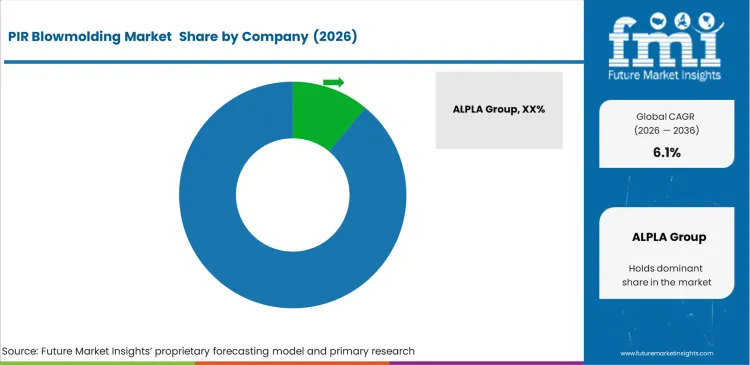
ALPLA Group remains a prominent participant in PIR blowmolding through its emphasis on circular packaging integration, in-house recycling capabilities, and close collaboration with consumer goods customers. Berry Global Inc. is leveraging its broad rigid packaging portfolio and material science expertise to expand recycled-content offerings across bottles and containers while aligning with customer sustainability roadmaps. Amcor plc continues to strengthen its position by combining packaging design, recycled resin incorporation, and global customer access to support scalable adoption of more sustainable rigid formats. These companies are competing through resin sourcing partnerships, product redesign, and operational investments that improve the consistency and commercial viability of PIR-based blowmolded packaging.
Silgan Holdings Inc. maintains relevance in the market by serving established packaging categories where recycled-content integration must be balanced with performance, compliance, and high-volume manufacturing efficiency. Plastipak Holdings, Inc. is advancing its presence through packaging innovation, recycling-linked capabilities, and customer-specific development programs that support greater use of recycled material in rigid containers. Greif, Inc. and Mauser Packaging Solutions are particularly influential in industrial packaging, where drums, jerrycans, and reconditioned or recycled-content formats align well with circular economy objectives and durability requirements. Competitive intensity is therefore shaped by a mix of packaging specialization, feedstock access, technical processing capability, and the ability to deliver verified recycled-content solutions at scale.
Key Players in Post-Industrial Recycled (PIR) Blow Molding Market
- ALPLA Group
- Berry Global Inc.
- Amcor plc
- Silgan Holdings Inc.
- Plastipak Holdings, Inc.
- Greif, Inc.
- Mauser Packaging Solutions
- Logoplaste
- Retal Industries Ltd.
- Alpha Packaging
Strategic Outlook by FMI on Post-Industrial Recycled (PIR) Blow Molding Market
FMI views the PIR blowmolding market as a structurally attractive segment within recycled plastics conversion, supported by measurable sustainability demand and practical compatibility with existing rigid packaging systems. Strategic success will depend on securing reliable feedstock, improving resin consistency, and aligning product development with end-user performance expectations. Companies that integrate recycling, compounding, and blowmolding capabilities are likely to gain a competitive advantage in both cost control and customer retention. Over the long term, market leaders are expected to differentiate through traceability, application-specific formulation, and regionally resilient supply networks.
Scope of the Report
| Metric | Value |
|---|---|
| Market Value | USD 3.4 Billion in 2025 to USD 6.5 Billion by 2036 |
| CAGR | 6.1% from 2026 to 2036 |
| Base Year | 2025 |
| Forecast Period | 2026 to 2036 |
| Material Type Segmentation | PIR HDPE, PIR PP, PIR PET, PIR PVC, Others |
| End Use Industry Segmentation | Packaging, Automotive, Consumer Goods, Industrial & Chemical Containers, Building & Construction, Others |
| Region Segmentation | North America, Latin America, Western Europe, Eastern Europe, East Asia, South Asia and Pacific, Middle East and Africa |
| Regions Covered | North America, Latin America, Western Europe, Eastern Europe, East Asia, South Asia and Pacific, Middle East and Africa |
Bibliography
- OECD. 2024. Global Plastics Outlook: Policy Scenarios to 2060.
- European Commission. 2025. Circular Economy and Packaging Waste Policy Update.
- USA Environmental Protection Agency. 2024. Advancing Sustainable Materials Management: Plastics and Packaging.
- World Bank. 2023. Recycling Markets and Secondary Materials in Emerging Manufacturing Economies.
- PlasticsEurope. 2024. Plastics Market Data and Circularity Progress Report.
- Ellen MacArthur Foundation. 2025. Global Commitment Progress on Reusable and Recycled Packaging.
- American Chemistry Council. 2024. Recycled Plastics Demand, Supply, and End-Use Trends.
Frequently Asked Questions
How big is the PIR Blowmolding Market?
The PIR blowmolding market is valued at USD 3.4 Billion in 2025 and is projected to reach USD 6.5 Billion by 2036.
What is the CAGR?
The market is forecast to expand at a CAGR 6.1% during the forecast period.
Which material type leads?
PIR HDPE is the leading material type, accounting for 38.7% share.
Which end use industry leads?
Packaging is the leading end use industry with 41.9% share.
What drives growth?
Growth is driven by rising recycled-content mandates, corporate sustainability targets, demand for circular rigid packaging, and the need to reduce dependence on virgin resin.
Who are the key companies?
Key companies include ALPLA Group, Berry Global Inc., Amcor plc, Silgan Holdings Inc., Plastipak Holdings, Inc., Greif, Inc., and Mauser Packaging Solutions.
Preview the report firsthand - request a free sample
Get SampleGet the brochure for pricing and purchase details.
Get PDFTable of Content
- Executive Summary
- Global Market Outlook
- Demand-side Trends
- Supply-side Trends
- Technology Roadmap Analysis
- Analysis and Recommendations
- Market Overview
- Market Coverage / Taxonomy
- Market Definition / Scope / Limitations
- Research Methodology
- Chapter Orientation
- Analytical Lens and Working Hypotheses
- Market Structure, Signals, and Trend Drivers
- Benchmarking and Cross-market Comparability
- Market Sizing, Forecasting, and Opportunity Mapping
- Research Design and Evidence Framework
- Desk Research Programme (Secondary Evidence)
- Company Annual and Sustainability Reports
- Peer-reviewed Journals and Academic Literature
- Corporate Websites, Product Literature, and Technical Notes
- Earnings Decks and Investor Briefings
- Statutory Filings and Regulatory Disclosures
- Technical White Papers and Standards Notes
- Additional Desk Sources
- Expert Input and Fieldwork (Primary Evidence)
- Primary Modes
- Qualitative Interviews and Expert Elicitation
- Quantitative Surveys and Structured Data Capture
- Blended Approach
- Why Primary Evidence is Used
- Field Techniques
- Interviews
- Surveys
- Focus Groups
- Observational and In-context Research
- Social and Community Interactions
- Stakeholder Universe Engaged
- C-suite Leaders
- Board Members
- Presidents and Vice Presidents
- R&D and Innovation Heads
- Technical Specialists
- Domain Subject-matter Experts
- Scientists
- Physicians and Other Healthcare Professionals
- Governance, Ethics, and Data Stewardship
- Research Ethics
- Data Integrity and Handling
- Primary Modes
- Tooling, Models, and Reference Databases
- Desk Research Programme (Secondary Evidence)
- Data Engineering and Model Build
- Data Acquisition and Ingestion
- Cleaning, Normalisation, and Verification
- Synthesis, Triangulation, and Analysis
- Quality Assurance and Audit Trail
- Market Background
- Market Dynamics
- Drivers
- Restraints
- Opportunity
- Trends
- Scenario Forecast
- Demand in Optimistic Scenario
- Demand in Likely Scenario
- Demand in Conservative Scenario
- Opportunity Map Analysis
- Product Life Cycle Analysis
- Supply Chain Analysis
- Investment Feasibility Matrix
- Value Chain Analysis
- PESTLE and Porter’s Analysis
- Regulatory Landscape
- Regional Parent Market Outlook
- Production and Consumption Statistics
- Import and Export Statistics
- Market Dynamics
- Global Market Analysis 2021 to 2025 and Forecast, 2026 to 2036
- Historical Market Size Value (USD Million) Analysis, 2021 to 2025
- Current and Future Market Size Value (USD Million) Projections, 2026 to 2036
- Y-o-Y Growth Trend Analysis
- Absolute $ Opportunity Analysis
- Global Market Pricing Analysis 2021 to 2025 and Forecast 2026 to 2036
- Global Market Analysis 2021 to 2025 and Forecast 2026 to 2036, By Material
- Introduction / Key Findings
- Historical Market Size Value (USD Million) Analysis By Material , 2021 to 2025
- Current and Future Market Size Value (USD Million) Analysis and Forecast By Material , 2026 to 2036
- PIR HDPE
- PIR PP
- PIR PET
- PIR HDPE
- Y-o-Y Growth Trend Analysis By Material , 2021 to 2025
- Absolute $ Opportunity Analysis By Material , 2026 to 2036
- Global Market Analysis 2021 to 2025 and Forecast 2026 to 2036, By End Use Industry
- Introduction / Key Findings
- Historical Market Size Value (USD Million) Analysis By End Use Industry, 2021 to 2025
- Current and Future Market Size Value (USD Million) Analysis and Forecast By End Use Industry, 2026 to 2036
- Packaging
- Automotive
- Others
- Packaging
- Y-o-Y Growth Trend Analysis By End Use Industry, 2021 to 2025
- Absolute $ Opportunity Analysis By End Use Industry, 2026 to 2036
- Global Market Analysis 2021 to 2025 and Forecast 2026 to 2036, By Region
- Introduction
- Historical Market Size Value (USD Million) Analysis By Region, 2021 to 2025
- Current Market Size Value (USD Million) Analysis and Forecast By Region, 2026 to 2036
- North America
- Latin America
- Western Europe
- Eastern Europe
- East Asia
- South Asia and Pacific
- Middle East & Africa
- Market Attractiveness Analysis By Region
- North America Market Analysis 2021 to 2025 and Forecast 2026 to 2036, By Country
- Historical Market Size Value (USD Million) Trend Analysis By Market Taxonomy, 2021 to 2025
- Market Size Value (USD Million) Forecast By Market Taxonomy, 2026 to 2036
- By Country
- USA
- Canada
- Mexico
- By Material
- By End Use Industry
- By Country
- Market Attractiveness Analysis
- By Country
- By Material
- By End Use Industry
- Key Takeaways
- Latin America Market Analysis 2021 to 2025 and Forecast 2026 to 2036, By Country
- Historical Market Size Value (USD Million) Trend Analysis By Market Taxonomy, 2021 to 2025
- Market Size Value (USD Million) Forecast By Market Taxonomy, 2026 to 2036
- By Country
- Brazil
- Chile
- Rest of Latin America
- By Material
- By End Use Industry
- By Country
- Market Attractiveness Analysis
- By Country
- By Material
- By End Use Industry
- Key Takeaways
- Western Europe Market Analysis 2021 to 2025 and Forecast 2026 to 2036, By Country
- Historical Market Size Value (USD Million) Trend Analysis By Market Taxonomy, 2021 to 2025
- Market Size Value (USD Million) Forecast By Market Taxonomy, 2026 to 2036
- By Country
- Germany
- UK
- Italy
- Spain
- France
- Nordic
- BENELUX
- Rest of Western Europe
- By Material
- By End Use Industry
- By Country
- Market Attractiveness Analysis
- By Country
- By Material
- By End Use Industry
- Key Takeaways
- Eastern Europe Market Analysis 2021 to 2025 and Forecast 2026 to 2036, By Country
- Historical Market Size Value (USD Million) Trend Analysis By Market Taxonomy, 2021 to 2025
- Market Size Value (USD Million) Forecast By Market Taxonomy, 2026 to 2036
- By Country
- Russia
- Poland
- Hungary
- Balkan & Baltic
- Rest of Eastern Europe
- By Material
- By End Use Industry
- By Country
- Market Attractiveness Analysis
- By Country
- By Material
- By End Use Industry
- Key Takeaways
- East Asia Market Analysis 2021 to 2025 and Forecast 2026 to 2036, By Country
- Historical Market Size Value (USD Million) Trend Analysis By Market Taxonomy, 2021 to 2025
- Market Size Value (USD Million) Forecast By Market Taxonomy, 2026 to 2036
- By Country
- China
- Japan
- South Korea
- By Material
- By End Use Industry
- By Country
- Market Attractiveness Analysis
- By Country
- By Material
- By End Use Industry
- Key Takeaways
- South Asia and Pacific Market Analysis 2021 to 2025 and Forecast 2026 to 2036, By Country
- Historical Market Size Value (USD Million) Trend Analysis By Market Taxonomy, 2021 to 2025
- Market Size Value (USD Million) Forecast By Market Taxonomy, 2026 to 2036
- By Country
- India
- ASEAN
- Australia & New Zealand
- Rest of South Asia and Pacific
- By Material
- By End Use Industry
- By Country
- Market Attractiveness Analysis
- By Country
- By Material
- By End Use Industry
- Key Takeaways
- Middle East & Africa Market Analysis 2021 to 2025 and Forecast 2026 to 2036, By Country
- Historical Market Size Value (USD Million) Trend Analysis By Market Taxonomy, 2021 to 2025
- Market Size Value (USD Million) Forecast By Market Taxonomy, 2026 to 2036
- By Country
- Kingdom of Saudi Arabia
- Other GCC Countries
- Turkiye
- South Africa
- Other African Union
- Rest of Middle East & Africa
- By Material
- By End Use Industry
- By Country
- Market Attractiveness Analysis
- By Country
- By Material
- By End Use Industry
- Key Takeaways
- Key Countries Market Analysis
- USA
- Pricing Analysis
- Market Share Analysis, 2025
- By Material
- By End Use Industry
- Canada
- Pricing Analysis
- Market Share Analysis, 2025
- By Material
- By End Use Industry
- Mexico
- Pricing Analysis
- Market Share Analysis, 2025
- By Material
- By End Use Industry
- Brazil
- Pricing Analysis
- Market Share Analysis, 2025
- By Material
- By End Use Industry
- Chile
- Pricing Analysis
- Market Share Analysis, 2025
- By Material
- By End Use Industry
- Germany
- Pricing Analysis
- Market Share Analysis, 2025
- By Material
- By End Use Industry
- UK
- Pricing Analysis
- Market Share Analysis, 2025
- By Material
- By End Use Industry
- Italy
- Pricing Analysis
- Market Share Analysis, 2025
- By Material
- By End Use Industry
- Spain
- Pricing Analysis
- Market Share Analysis, 2025
- By Material
- By End Use Industry
- France
- Pricing Analysis
- Market Share Analysis, 2025
- By Material
- By End Use Industry
- India
- Pricing Analysis
- Market Share Analysis, 2025
- By Material
- By End Use Industry
- ASEAN
- Pricing Analysis
- Market Share Analysis, 2025
- By Material
- By End Use Industry
- Australia & New Zealand
- Pricing Analysis
- Market Share Analysis, 2025
- By Material
- By End Use Industry
- China
- Pricing Analysis
- Market Share Analysis, 2025
- By Material
- By End Use Industry
- Japan
- Pricing Analysis
- Market Share Analysis, 2025
- By Material
- By End Use Industry
- South Korea
- Pricing Analysis
- Market Share Analysis, 2025
- By Material
- By End Use Industry
- Russia
- Pricing Analysis
- Market Share Analysis, 2025
- By Material
- By End Use Industry
- Poland
- Pricing Analysis
- Market Share Analysis, 2025
- By Material
- By End Use Industry
- Hungary
- Pricing Analysis
- Market Share Analysis, 2025
- By Material
- By End Use Industry
- Kingdom of Saudi Arabia
- Pricing Analysis
- Market Share Analysis, 2025
- By Material
- By End Use Industry
- Turkiye
- Pricing Analysis
- Market Share Analysis, 2025
- By Material
- By End Use Industry
- South Africa
- Pricing Analysis
- Market Share Analysis, 2025
- By Material
- By End Use Industry
- USA
- Market Structure Analysis
- Competition Dashboard
- Competition Benchmarking
- Market Share Analysis of Top Players
- By Regional
- By Material
- By End Use Industry
- Competition Analysis
- Competition Deep Dive
- ALPLA Group
- Overview
- Product Portfolio
- Profitability by Market Segments (Product/Age /Sales Channel/Region)
- Sales Footprint
- Strategy Overview
- Marketing Strategy
- Product Strategy
- Channel Strategy
- Berry Global Inc.
- Amcor plc
- Silgan Holdings Inc.
- Plastipak Holdings, Inc.
- Greif, Inc.
- Mauser Packaging Solutions
- ALPLA Group
- Competition Deep Dive
- Assumptions & Acronyms Used


