

- Market Size (2026)
- USD 558.9 Mn
- Forecast (2036)
- USD 919.1 Mn
- CAGR (2026 to 2036)
- 5.1%
How big is Pore Minimizing Products Market in 2026?
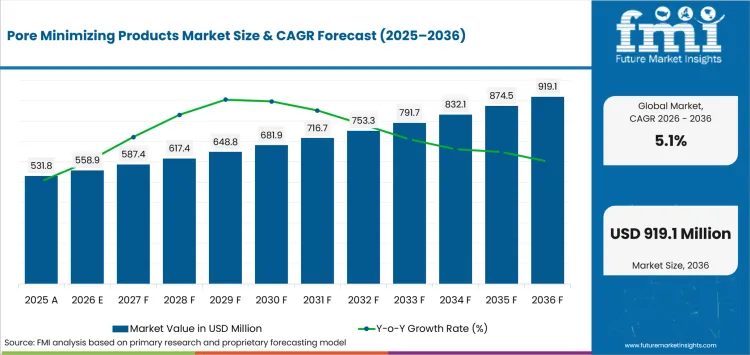
USD 558.9 Million in 2026 and USD 919.1 Million by 2036 at a 5.1% CAGR.
Demand for pore minimizing products is projected to rise at 5.1% CAGR through 2036, increasing valuation from USD 558.9 million to USD 919.1 million. Visible pore concerns often overlap with uneven texture and complexion needs that pull several facial-care steps into the same routine. Beiersdorf documented the March 2025 global launch of NIVEA LUMINOUS630 Skin Glow with niacinamide ingredients and refined pores among the stated visible outcomes. Repeat demand is significant when each cleanser or treatment has a distinct cosmetic job and tolerability supports continued use.
Channel structure determines how quickly the same pore concern moves from initial discovery into routine replenishment within each retail system. IKW recorded 22.5% growth in German cosmetics e-commerce during 2025, making online retail the sector’s fastest-growing purchase channel. Digital education can introduce astringent skin care routines while drugstores preserve convenient repeat access for facial care. Country growth therefore depends on launch compliance and channel fit instead of digital discovery alone.
Key Takeaways
- Demand for pore minimizing products is rising as consumers manage oiliness and congestion alongside uneven texture or firmness within repeat facial-care routines.
- Based on product type, core - classic lines are projected to account for 31.0% in 2026 due to familiar cleansing and smoothing use cases.
- By nature, conventional products are estimated to hold 52.0% in 2026 owing to broad ingredient choice and flexible mass or premium positioning.
- In 2026, liquid & serum formats are expected to lead format with 24.0% share because light textures fit active-led layering and targeted application.
- Irritation risk and weak claim substantiation can reduce repeat purchase when users expect permanent structural pore change from appearance-focused cosmetic products.
- Some of the key players in this market include Kao Corporation, Estee Lauder Companies, Amorepacific, Beiersdorf, L'Oreal, e.l.f. Beauty, Shiseido, and Unilever.
Analyst Perspective
"Pore-care portfolios earn repeat revenue when each cleanser or serum addresses a defined job such as decongestion or texture smoothing. Brands should compare claim evidence with irritation risk because a strong first-use effect has little commercial value if the routine is difficult to maintain."
- Rahul Pandita, Principal Consultant, Future Market Insights
How is the pore minimizing products market segmented?
The pore minimizing products market is segmented by product type, nature, format, price positioning, sales channel and region.
Market taxonomy covers product type, nature, format, price positioning, sales channel and region for analysis. Product type includes core - classic lines, targeted treatments, sensitive lines, premium clinical lines and kits for routine breadth. Nature covers conventional, vegan and cruelty-free, natural and organic, dermocosmetic clinical, plus fragrance-free and sensitive products. Format includes liquids and serums, creams and balms, solids, mists, patches and powders for different application routines. Price positioning spans mass, masstige, premium and professional offers while sales channels include e-commerce and DTC, specialty beauty, pharmacies, supermarkets and salons.
Why do liquid & serum formats lead the format category?
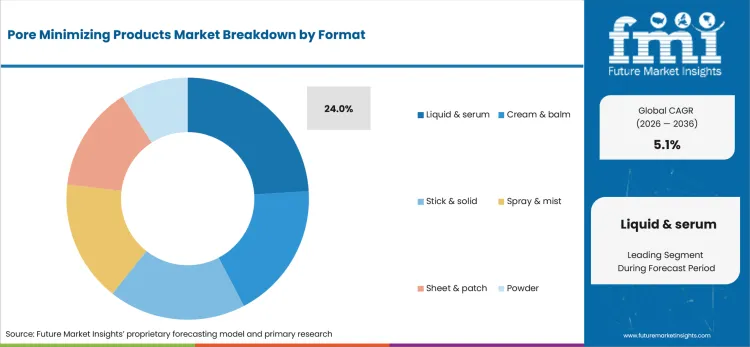
Liquid serums fit targeted routines because light dosing carries active ingredients without the heavier feel of creams or portable stick-format face serums. Their layering role also lets brands pair pore refinement with hydration or tone benefits inside one facial-care routine.
- The liquid & serum segment is likely to capture 24.0% share in 2026 attributable to controlled dosing and fast layering within targeted pore routines.
- The Estée Lauder Companies disclosed fiscal 2025 serum innovation under The Ordinary and expanded the brand into Amazon Premium Beauty. This distribution pattern gives niacinamide serums and other active-led liquids more room for education before repeat purchase within digitally researched facial-care routines.
Why do core - classic lines lead the product type category?
Core products reduce the decision burden because cleansers and basic treatments describe a familiar congestion-control job that fits existing routines. Retailers also gain a clear entry-price product before consumers move into higher-intensity active treatments or multi-step routines.
- Core - classic lines are set to lead the product type category with 31.0% share in 2026 due to familiar use cases and accessible trial pricing.
- Kao reported a November 2025 face-cleansing test on 27 Japanese adults that reduced measured keratotic-plug area by about 20%. The result does not prove the approved share but explains why cleansing provides a practical entry point beside anti-acne cosmetics.
Why does conventional lead the nature category?
Conventional formulations give brands wider freedom to balance exfoliation and sebum control with hydration and texture. Formulation breadth supports mass and premium positioning without forcing every product into a narrower natural or fragrance-free proposition.
- By nature, conventional products are forecast to represent 52.0% in 2026 driven by formulation breadth that serves several pore-related cosmetic jobs.
- Beiersdorf's 2025 R&D review documented the relaunch of Eucerin DERMOPURE CLINICAL with reformulated products for acne-prone skin and clearer dermatologist-linked positioning. The relaunch shows how specialized dermocosmetic and repairing skin care lines can coexist beside broader conventional ranges in the same retail set.
Why does e-commerce & DTC lead the sales channel category?
Pore concerns are highly searchable because users describe blackheads or texture before they choose an ingredient. E-commerce can turn that symptom-led search into comparison and regimen education before a first purchase.
- The sales channel category is forecast to be led by e-commerce & DTC at 30.0% share in 2026 due to problem-led search and convenient repeat ordering.
- In September 2025, e.l.f. Beauty announced that rhode launched in Sephora after building its initial business through direct channels. The move shows why customized skincare discovery can begin online and later expand into physical retail for texture testing and convenient replenishment within repeat facial care.
What are the drivers, restraints and opportunities in the Pore Minimizing Products Market?
Recurring congestion and texture concerns support repeat routines. Claim substantiation and irritation risk constrain conversion. Gentler multi-benefit systems support differentiated offers for sensitive or multi-concern routines.
- Driver: Visible pores arise from different causes that can place cleansing and treatment products in the same repeat routine.
- Restraint: Cosmetic claims must stay within substantiated appearance outcomes while aggressive active combinations can weaken tolerability and repeat use.
- Opportunity: Clear sequencing and sensitive-skin options can convert problem-led discovery into smaller routines that consumers can maintain consistently.
Multiple pore mechanisms widen the routine
Pore appearance changes with congestion and surface texture so one formula rarely addresses every routine need. In March 2026, Amorepacific introduced IOPE XMD in North America with clinical testing that included pore refinement among its measured skin outcomes. The launch gives global skincare portfolios a direct route from visible texture concerns to serum-based repeat use while cleansing products handle oil and keratotic buildup.
Safety review raises the cost of vague active claims
Active-led pore formulas face a higher commercial launch burden after an ingredient enters formal safety review. In its October 2025 update, the UK Office for Product Safety and Standards requested information on seven substances with suspected endocrine-disrupting properties. Complete study reports were also requested for pivotal evidence, so weak ingredient files can narrow claims or delay packaging and retailer commitments.
Digital retail turns problem-led search into guided routines
Digital retail can explain product sequence and texture before consumers commit to several pore-focused products. Amorepacific announced AESTURA’s July 2025 Sephora Canada launch with a sensitive-skin routine spanning cleanser and serum plus cream formats. The launch gives redness-relief skincare and pore-focused routines a retail model that pairs trial with low-irritation positioning, while simple regimen guidance protects repeat purchase from active overload.
Which country CAGRs are profiled in the Pore Minimizing Products Market?
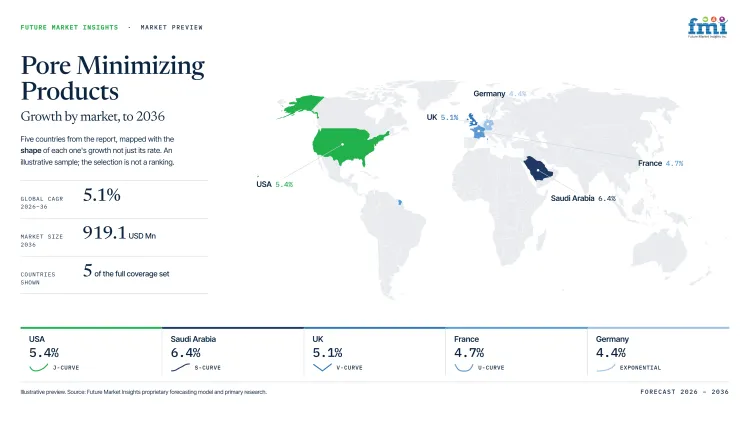
| Country | CAGR |
|---|---|
| Saudi Arabia | 6.3% |
| UAE | 6.0% |
| South Korea | 5.7% |
| USA | 5.4% |
| UK | 5.1% |
How do country-level CAGRs compare in the Pore Minimizing Products Market?
The profiled countries span a narrow 1.2 percentage points between Saudi Arabia at 6.3% and the UK at 5.1%. Saudi Arabia and the UAE form the Gulf band while South Korea and the USA follow, leaving the UK near the global rate despite different current retail and compliance conditions.
- Saudi Arabia: SFDA oversight makes documentation timing central to imported facial-care launches.
- UAE: Montaji+ registration meets dense specialist retail and fast digital beauty discovery.
- South Korea: Layered routines reward texture innovation while generic claims lose credibility.
- USA: MoCRA listing duties sit behind mass retail and direct online distribution.
- UK: Responsible Person obligations shape entry beside high-street trial and repeat replenishment.
Comparable CAGRs require different launch budgets because compliance effort and retail concentration alter conversion costs. The full report provides country-level CAGR analysis across North America, Latin America, Europe, East Asia, South Asia, Oceania and the Middle East and Africa.
Country-wise Analysis
- Imported beauty brands dominate Saudi facial-care shelves, so distributors must finish notification and Arabic-ready documentation before global SKUs enter major pharmacy or prestige channels. Saudi Arabia is projected to grow at 6.3% CAGR through 2036 because local retail access expands quickly after compliant inventory is cleared for sale. SFDA’s December 2025 digital-transformation update described planned AI checks for cosmetic product images and ingredient compliance within regulatory oversight. The faster review tools do not remove distributor coordination, and campaign timing can still leave approved stock behind major seasonal beauty promotions. Arabic-ready files and synchronized inventory therefore determine whether national launches support wider Gulf marketing without sacrificing on-shelf availability.
- Dubai’s dense specialist beauty retail lets imported skin-care brands move quickly from approved inventory to physical trial in malls and prestige stores. Dubai Municipality unveiled Montaji+ in October 2025 with AI-assisted processing intended to streamline registration and laboratory testing for consumer products. The UAE market is forecast to expand at 6.0% CAGR through 2036 helped by digital discovery and a large international beauty assortment. Registration timing is a material friction because premium retail costs rise while inventory waits outside the campaign window. Fast discovery therefore does not guarantee attractive launch economics if approved stock misses Dubai’s highest-traffic seasonal beauty periods.
- South Korean facial care is built around layered routines and frequent texture changes, which makes shoppers quick to compare cleansing and treatment steps. Pore minimizing product demand in South Korea is estimated to expand at 5.7% CAGR through 2036 reflecting rapid routine innovation. MFDS recorded an April 2025 cosmetics cooperation agreement with the Philippine FDA that included regulatory information exchange and technical cooperation. Regulatory familiarity helps international brands frame specific product jobs for informed shoppers, but strong domestic competition leaves little room for generic positioning. Functional-cosmetic claim boundaries also limit how far global efficacy language can be transferred into local pore-care communication.
- USA consumers can switch between mass primers and active serums through national chains plus direct online channels with little format-specific distribution rebuilding during a new launch. FDA data counted 1,298,361 active cosmetic product listings as of June 30 2026 under the national MoCRA registration system. USA demand is forecast to rise at 5.4% CAGR through 2036 given broad retail access and frequent digital product discovery. Annual product updates and biennial facility renewals raise operating workload before smaller brands can scale paid acquisition nationwide. As digital acquisition expands, companies with disciplined listing systems are better placed to add channels without slowing compliance work.
- UK pore-care discovery increasingly starts online, while major high-street beauty and prestige counters still matter for texture testing and routine comparison. UK demand is projected to grow at 5.1% CAGR through 2036 tied to broad digital reach and mature beauty retail. OPSS’s July 2026 update counted 861,686 cosmetic notifications in the SCPN system as of May 28 2026. Each Great Britain launch still requires a Responsible Person and complete safety documentation before retailer activation can match marketing spend. Digital-first entrants therefore gain discovery speed, but larger groups retain an advantage if notification files and store replenishment already work together.
Who are the notable companies in the Pore Minimizing Products Market?
Kao Corporation, Estee Lauder Companies, Amorepacific, Beiersdorf, L'Oreal, e.l.f. Beauty, Shiseido, Unilever are the notable companies serving this market.
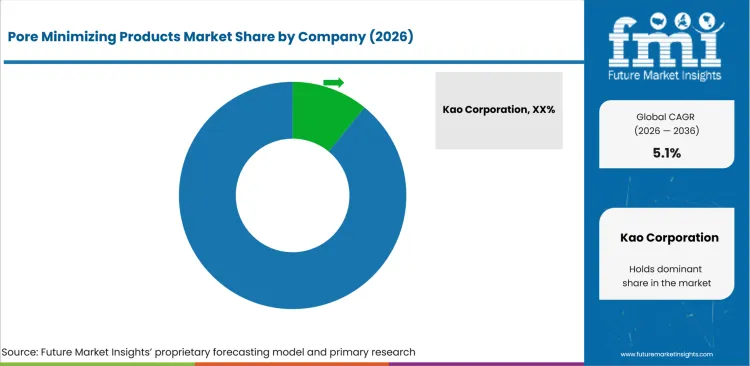
Competition depends on the cosmetic job each company owns in practice rather than corporate scale alone. Kao Corporation and Shiseido publish direct pore or texture research that supports Asian routine-led positioning. Beiersdorf and L'Oreal use complexion or uneven skin tone treatment portfolios that overlap visible-pore concerns without relying on one mechanism. Estee Lauder Companies and Amorepacific extend active-led skin care through prestige and digital channels. e.l.f. Beauty and Unilever widen access through mass or selective retail portfolios. Entry barriers depend on evidence quality and tolerability because complicated routines raise acquisition costs without guaranteeing repeat purchase.
- Pore research and treatment platforms: Kao Corporation, Estee Lauder Companies, Amorepacific, Beiersdorf and L'Oreal compete through cleansing or active-led facial-care routes.
- Digital and accessible skin care: e.l.f. Beauty uses mass pricing and direct channels while selective retail extends routine trial.
- Prestige and multi-brand skin care: Shiseido and Unilever use established consumer reach to distribute treatment-led facial-care portfolios.
Competitive Benchmarking: Pore Minimizing Products Market
| Company | Pore-Focused Portfolio Depth | Mechanism Breadth | Sensitive / Clinical Positioning | Geographic Reach |
|---|---|---|---|---|
| Kao Corporation | High | High | High | Japan, Asia and Europe |
| Estee Lauder Companies | High | High | High | Global |
| Amorepacific | High | High | Medium | East Asia, North America and Europe |
| Beiersdorf | High | High | High | Global |
| L'Oreal | High | High | High | Global |
| e.l.f. Beauty | Medium | Medium | Medium | North America, UK, Europe and GCC |
| Shiseido | Medium | High | Medium | Global |
| Unilever | Medium | High | High | Global |
Scoring basis: High pore-focused portfolio depth requires three or more documented product routes while Medium requires two and Low identifies one verified route. High mechanism breadth requires at least three documented pore-care jobs while Medium requires two and Low identifies one. High sensitive / clinical positioning requires several documented sensitive-skin or dermatologist-linked platforms while Medium reflects narrower coverage and Low identifies one verified route. Ratings rely on current official company filings and newsroom evidence for the named brands and platforms.
Key Developments in the Pore Minimizing Products Market
- In August 2025, e.l.f. Beauty completed its acquisition of rhode and added a skin-care brand with direct distribution plus planned Sephora expansion.
- In March 2025, L'Oreal completed its acquisition of Korean dermo-mass skin-care brand Dr.G and expanded its dermatological beauty portfolio in Asia.
- In January 2025, Shiseido announced a renewed ULTIMUNE serum for March launch with pore appearance included among the visible skin-quality concerns addressed.
Key Players in the Pore Minimizing Products Market
Pore Research and Active-Led Treatment Platforms
- Kao Corporation
- Estee Lauder Companies
- Amorepacific
- Beiersdorf
- L'Oreal
Digitally Built Accessible Skin Care
- e.l.f. Beauty
Prestige and Multi-Brand Skin Care
- Shiseido
- Unilever
Pore Minimizing Products Market - Report Scope
| Coverage field | Report scope |
|---|---|
| Market breakdown | By product type, nature, format, price positioning, sales channel and region. |
| Quantitative Units | USD million. |
| Market Definition | Commercial facial skin-care and cosmetic products positioned to reduce the visible appearance of pores or closely linked congestion and texture concerns. |
| Regions Covered | North America, Latin America, Europe, East Asia, South Asia and Pacific, and Middle East and Africa. |
| Countries Covered | Saudi Arabia, UAE, South Korea, USA, UK, and 20+ countries included in the full report. |
| Key Companies Profiled | Kao Corporation, Estee Lauder Companies, Amorepacific, Beiersdorf, L'Oreal, e.l.f. Beauty, Shiseido, Unilever. |
| Forecast Period | 2026 to 2036. |
| Approach | Primary and secondary research with market triangulation. |
Pore Minimizing Products Market - Research Methodology
| Method | Approach |
|---|---|
| Primary Research | FMI analysts gathered input from manufacturers, service providers, technology developers, distributors, end users, procurement teams, and subject-matter experts. Interviews examined purchasing decisions, product or service evaluation, adoption barriers, approval requirements, pricing considerations, and expectations for technical or commercial support. Respondents were also asked what evidence is required before a trial, pilot, or initial order develops into regular purchasing. |
| Desk Research | Desk research covered government statistics, regulatory publications, trade data, industry associations, technical literature, standards, company filings, product information, and official corporate announcements. Sources were reviewed for relevance, publication date, geographic coverage, and consistency with the defined market scope. Claims relating to performance, applications, approvals, capacity, investment, and commercial activity were retained only when supported by credible public evidence. |
| Market Sizing and Forecasting | The market model combined the baseline value with historical performance, segment structure, pricing and volume indicators, adoption levels, company participation, and country-level demand conditions. Forecast assumptions considered economic activity, investment trends, regulatory developments, technology adoption, purchasing cycles, supply availability, and barriers to wider market use. Segment and regional estimates were reconciled before the final market total was calculated. |
| Data Validation | Estimates were checked against multiple independent indicators, including public data, company activity, trade patterns, industry developments, and findings from primary interviews. Validation also tested whether products, services, applications, and company revenues fell within the defined market boundaries. Adjacent categories, unsupported claims, overlapping revenues, and activities without direct market relevance were excluded to reduce double counting and maintain consistency across segments and countries. |
Pore Minimizing Products Market by Segments
Pore Minimizing Products Market segmented by Product Type:
- Core / classic lines
- Targeted treatment lines
- Sensitive & gentle lines
- Premium & clinical lines
- Kits & sets
Pore Minimizing Products Market segmented by Nature:
- Conventional
- Vegan & cruelty-free
- Natural & organic
- Dermocosmetic / clinical
- Fragrance-free & sensitive
Pore Minimizing Products Market segmented by Format:
- Liquid & serum
- Cream & balm
- Stick & solid
- Spray & mist
- Sheet & patch
- Powder
Pore Minimizing Products Market segmented by Price Positioning:
- Mass
- Masstige
- Premium
- Professional
Pore Minimizing Products Market segmented by Sales Channel:
- E-commerce & DTC
- Specialty beauty retail
- Pharmacies & drugstores
- Supermarkets & hypermarkets
- Salons & spas
Pore Minimizing Products Market by Region:
- North America
- United States
- Canada
- Latin America
- Brazil
- Mexico
- Argentina
- Chile
- Western Europe
- Germany
- France
- United Kingdom
- Italy
- Spain
- Benelux
- Nordics
- Eastern Europe
- Poland
- Czech Republic
- Romania
- Hungary
- East Asia
- China
- Japan
- South Korea
- South Asia and Pacific
- India
- ASEAN
- Australia and New Zealand
- Middle East and Africa
- GCC Countries
- South Africa
- Türkiye
- Israel
Research Sources and Bibliography
- Beiersdorf. (2026). Research and Development - Beiersdorf Annual Report 2025
- IKW. (2025, December 3). Market Data
- Amorepacific. (2026, March 18). Clinical Grade IOPE Begins Its Global Journey with Professional PDRN Treatment-level
- The Estée Lauder Companies. (2025, February 4). The Estée Lauder Companies Reports Fiscal 2025 Second Quarter Results
- e.l.f. Beauty. (2025, September 4). rhode Launches in Sephora
- Kao Corporation. (2026, March 4). Keratotic Plug Disintegrating and Cleansing (KPDC) Technology Combined with Hydrophilic Micropowders Enables Removal of Keratotic Plugs Deep Within Pores
- Office for Product Safety and Standards. (2026, February 5). Call for data: safety of cosmetic ingredients
- Amorepacific. (2025, July 25). AESTURA, Korea's #1 Dermatologist-Recommended Dermocosmetic Brand for Sensitive Skin Launches Exclusively at Sephora Canada
- Saudi Food and Drug Authority. (2025, December 14). SFDA Leads Digital Transformation in Drug and Cosmetic Safety Regulation
- Dubai Municipality. (2025, October 27). Product safety at Beautyworld Middle East 2025
- Ministry of Food and Drug Safety, Republic of Korea. (2026, May 27). Bilateral Cooperation
- USA Food and Drug Administration. (2026, July 2). Registration & Listing of Cosmetic Product Facilities and Products
- Office for Product Safety and Standards. (2026, July 17). New data on UK cosmetic product safety notifications
- e.l.f. Beauty. (2025, August 6). e.l.f. Beauty Announces First Quarter Fiscal 2026 Results
- L'Oreal. (2025, April 17). First quarter 2025 sales
- Shiseido Company, Limited. (2025, January 22). Backed by world-leading skin research, SHISEIDO’s iconic ULTIMUNE is a serum reborn - to slow the skin aging cycle.
- Kao Corporation. (2026, March 19). Kao’s Bioré Accelerates Global Growth with Entry into the South Korean Market and the Launch of a Unified Global Campaign
- The Estée Lauder Companies. (2025, May 16). Origins Launches in the USA Amazon Premium Beauty Store
- Amorepacific. (2026, March 5). AESTURA Announces Official Launch at Sephora Across 17 European Countries
- Beiersdorf. (2025, June 5). Beiersdorf strengthens its global production network and invests €300 million in plant expansion in Poznań
- L'Oreal. (2026, April 2). L'Oréal and Institut Pasteur Announce Historic Partnership to Advance Skin Health Science
- e.l.f. Beauty. (2026, April 30). rhode Continues Its Global Retail Expansion Into Sephora Europe
- Shiseido Company, Limited. (2025, June 12). Shiseido Expands Beauty Showcase at Fukuoka Airport
- Unilever. (2025, July 31). First half performance supports full year confidence
This bibliography is provided for reader reference and is not exhaustive. The full report contains the complete reference list and detailed citations
This Report Answers
- How large is the pore minimizing products market in 2026 and what value is projected for 2036?
- Which visible skin concerns support repeat demand for pore minimizing products?
- Why do core - classic lines hold the leading product type position in 2026?
- How do conventional formulations and liquid serum formats shape portfolio design?
- Why does e-commerce and DTC account for the largest sales-channel share in 2026?
- How do country growth rates differ among Saudi Arabia, UAE, South Korea, USA and UK?
- Which companies compete through pore research, active-led skin care and routine-focused product systems?
- What limits repeat purchase when claims or active combinations exceed consumer tolerability?
- Which operating conditions should brands test before entering or expanding in this market?
Frequently Asked Questions
How big is the pore minimizing products market in 2026?
The pore minimizing products market is valued at USD 558.9 million in 2026 and is projected to reach USD 919.1 million by 2036. Repeat routines for congestion and visible texture support replenishment through mass and specialist beauty channels.
What is the CAGR of the pore minimizing products market from 2026 to 2036?
The pore minimizing products market is projected to grow at a CAGR of 5.1% between 2026 and 2036. Expansion follows repeat facial-care use and wider access through digital plus specialist channels that simplify discovery and replenishment.
Which product type leads the pore minimizing products market?
The core - classic lines segment is expected to hold 31.0% of the pore minimizing products market in 2026, driven by familiar cleansing uses that reduce trial friction. Repeat replenishment keeps these familiar products visible in mass and specialist beauty assortments during regular shopping cycles.
Which countries are projected to record the highest growth in the pore minimizing products market?
Saudi Arabia is projected to grow at 6.3% CAGR, followed by the UAE at 6.0% and South Korea at 5.7% through 2036. Country-specific registration and retail structures determine how quickly compliant products convert discovery into repeat replenishment.
Which companies are active in the pore minimizing products market?
Key companies operating in the pore minimizing products market include Kao Corporation, Estee Lauder Companies, Amorepacific, Beiersdorf, L'Oreal, e.l.f. Beauty, Shiseido, and Unilever. These companies compete through pore research and active-led treatments while retail access and sensitive-skin positioning separate their commercial approaches.
Preview the report firsthand - request a free sample
Get SampleGet the brochure for pricing and purchase details.
Get PDFTable of Content
- Key Takeaways
- Market Size and CAGR
- Top Growth Driver
- Fastest Growing Segment
- Leading Region
- Key Companies
- Emerging Opportunities
- Executive Summary
- Global Market Outlook
- Demand-side Trends
- Supply-side Trends
- Technology Roadmap Analysis
- Analysis and Recommendations
- Analyst Perspective (What is happening? Why now? What should investors know?)
- Key Questions Answered
- How large is the market?
- What is the CAGR?
- What are key trends?
- Which region dominates?
- Who are the leaders?
- Market Overview
- Market Coverage / Taxonomy
- Market Definition / Scope / Limitations
- Research Methodology
- Chapter Orientation
- Analytical Lens and Working Hypotheses
- Market Structure, Signals, and Trend Drivers
- Benchmarking and Cross-market Comparability
- Market Sizing, Forecasting, and Opportunity Mapping
- Research Design and Evidence Framework
- Desk Research Programme (Secondary Evidence)
- Expert Input and Fieldwork (Primary Evidence)
- Tooling, Models, and Reference Databases
- Data Engineering and Model Build
- Quality Assurance and Audit Trail
- Market Background
- Market Dynamics (Drivers, Restraints, Opportunity, Trends)
- Scenario Forecast (Optimistic, Likely, Conservative)
- Impact Analysis
- AI Impact
- Sustainability Impact
- Regulatory Impact
- Technology Impact
- Consumer / Buyer Analysis
- Purchase Drivers
- Adoption Barriers
- Buyer Journey
- Opportunity Map Analysis
- Product Life Cycle Analysis
- Supply Chain Analysis
- Investment Feasibility Matrix
- Value Chain Analysis
- PESTLE and Porter's Analysis
- Regulatory Landscape
- Regional Parent Market Outlook
- Production and Consumption Statistics
- Import and Export Statistics
- Global Market Analysis and Forecast, 2021 to 2036
- Historical Market Size Value (USD Million) Analysis, 2021 to 2025
- Current and Future Market Size Value (USD Million) Projections, 2026 to 2036
- Y-o-Y Growth Trend Analysis
- Absolute $ Opportunity Analysis
- Global Market Pricing Analysis, 2021 to 2036
- Global Market Analysis and Forecast, By Product Type, 2021 to 2036
- Introduction / Key Findings
- Historical Market Size Value (USD Million) Analysis By Product Type, 2021 to 2025
- Current and Future Market Size Value (USD Million) Analysis and Forecast By Product Type, 2026 to 2036
- Core / classic lines
- Targeted treatment lines
- Sensitive & gentle lines
- Premium & clinical lines
- Kits & sets
- Core / classic lines
- Y-o-Y Growth Trend Analysis By Product Type, 2021 to 2025
- Absolute $ Opportunity Analysis By Product Type, 2026 to 2036
- Global Market Analysis and Forecast, By Nature, 2021 to 2036
- Introduction / Key Findings
- Historical Market Size Value (USD Million) Analysis By Nature, 2021 to 2025
- Current and Future Market Size Value (USD Million) Analysis and Forecast By Nature, 2026 to 2036
- Conventional
- Vegan & cruelty-free
- Natural & organic
- Dermocosmetic / clinical
- Fragrance-free & sensitive
- Conventional
- Y-o-Y Growth Trend Analysis By Nature, 2021 to 2025
- Absolute $ Opportunity Analysis By Nature, 2026 to 2036
- Global Market Analysis and Forecast, By Format, 2021 to 2036
- Introduction / Key Findings
- Historical Market Size Value (USD Million) Analysis By Format, 2021 to 2025
- Current and Future Market Size Value (USD Million) Analysis and Forecast By Format, 2026 to 2036
- Liquid & serum
- Cream & balm
- Stick & solid
- Spray & mist
- Sheet & patch
- Powder
- Liquid & serum
- Y-o-Y Growth Trend Analysis By Format, 2021 to 2025
- Absolute $ Opportunity Analysis By Format, 2026 to 2036
- Global Market Analysis and Forecast, By Price Positioning, 2021 to 2036
- Introduction / Key Findings
- Historical Market Size Value (USD Million) Analysis By Price Positioning, 2021 to 2025
- Current and Future Market Size Value (USD Million) Analysis and Forecast By Price Positioning, 2026 to 2036
- Mass
- Masstige
- Premium
- Professional
- Mass
- Y-o-Y Growth Trend Analysis By Price Positioning, 2021 to 2025
- Absolute $ Opportunity Analysis By Price Positioning, 2026 to 2036
- Global Market Analysis and Forecast, By Sales Channel, 2021 to 2036
- Introduction / Key Findings
- Historical Market Size Value (USD Million) Analysis By Sales Channel, 2021 to 2025
- Current and Future Market Size Value (USD Million) Analysis and Forecast By Sales Channel, 2026 to 2036
- E-commerce & DTC
- Specialty beauty retail
- Pharmacies & drugstores
- Supermarkets & hypermarkets
- Salons & spas
- E-commerce & DTC
- Y-o-Y Growth Trend Analysis By Sales Channel, 2021 to 2025
- Absolute $ Opportunity Analysis By Sales Channel, 2026 to 2036
- Global Market Analysis and Forecast, By Region, 2021 to 2036
- Introduction
- Historical Market Size Value (USD Million) Analysis By Region, 2021 to 2025
- Current Market Size Value (USD Million) Analysis and Forecast By Region, 2026 to 2036
- North America
- Latin America
- Western Europe
- Eastern Europe
- East Asia
- South Asia and Pacific
- Middle East & Africa
- Market Attractiveness Analysis By Region
- North America Market Analysis and Forecast, By Country, 2021 to 2036
- Historical Market Size Value (USD Million) Trend Analysis By Market Taxonomy, 2021 to 2025
- Market Size Value (USD Million) Forecast By Market Taxonomy, 2026 to 2036
- By Country
- USA
- Canada
- By Product Type
- By Nature
- By Format
- By Price Positioning
- By Sales Channel
- By Country
- Market Attractiveness Analysis
- By Country
- By Product Type
- By Nature
- By Format
- By Price Positioning
- By Sales Channel
- Key Takeaways
- Latin America Market Analysis and Forecast, By Country
- Historical Market Size Value (USD Million) Trend Analysis By Market Taxonomy, 2021 to 2025
- Market Size Value (USD Million) Forecast By Market Taxonomy, 2026 to 2036
- By Country
- Brazil
- Mexico
- Chile
- Rest of Latin America
- By Product Type
- By Nature
- By Format
- By Price Positioning
- By Sales Channel
- By Country
- Market Attractiveness Analysis
- By Country
- By Product Type
- By Nature
- By Format
- By Price Positioning
- By Sales Channel
- Key Takeaways
- Western Europe Market Analysis and Forecast, By Country
- Historical Market Size Value (USD Million) Trend Analysis By Market Taxonomy, 2021 to 2025
- Market Size Value (USD Million) Forecast By Market Taxonomy, 2026 to 2036
- By Country
- Germany
- UK
- Italy
- Spain
- France
- Nordic
- BENELUX
- Rest of Western Europe
- By Product Type
- By Nature
- By Format
- By Price Positioning
- By Sales Channel
- By Country
- Market Attractiveness Analysis
- By Country
- By Product Type
- By Nature
- By Format
- By Price Positioning
- By Sales Channel
- Key Takeaways
- Eastern Europe Market Analysis and Forecast, By Country
- Historical Market Size Value (USD Million) Trend Analysis By Market Taxonomy, 2021 to 2025
- Market Size Value (USD Million) Forecast By Market Taxonomy, 2026 to 2036
- By Country
- Russia
- Poland
- Hungary
- Balkan & Baltic
- Rest of Eastern Europe
- By Product Type
- By Nature
- By Format
- By Price Positioning
- By Sales Channel
- By Country
- Market Attractiveness Analysis
- By Country
- By Product Type
- By Nature
- By Format
- By Price Positioning
- By Sales Channel
- Key Takeaways
- East Asia Market Analysis and Forecast, By Country
- Historical Market Size Value (USD Million) Trend Analysis By Market Taxonomy, 2021 to 2025
- Market Size Value (USD Million) Forecast By Market Taxonomy, 2026 to 2036
- By Country
- China
- Japan
- South Korea
- By Product Type
- By Nature
- By Format
- By Price Positioning
- By Sales Channel
- By Country
- Market Attractiveness Analysis
- By Country
- By Product Type
- By Nature
- By Format
- By Price Positioning
- By Sales Channel
- Key Takeaways
- South Asia and Pacific Market Analysis and Forecast, By Country
- Historical Market Size Value (USD Million) Trend Analysis By Market Taxonomy, 2021 to 2025
- Market Size Value (USD Million) Forecast By Market Taxonomy, 2026 to 2036
- By Country
- India
- ASEAN
- Australia & New Zealand
- Rest of South Asia and Pacific
- By Product Type
- By Nature
- By Format
- By Price Positioning
- By Sales Channel
- By Country
- Market Attractiveness Analysis
- By Country
- By Product Type
- By Nature
- By Format
- By Price Positioning
- By Sales Channel
- Key Takeaways
- Middle East & Africa Market Analysis and Forecast, By Country
- Historical Market Size Value (USD Million) Trend Analysis By Market Taxonomy, 2021 to 2025
- Market Size Value (USD Million) Forecast By Market Taxonomy, 2026 to 2036
- By Country
- Kingdom of Saudi Arabia
- Other GCC Countries
- Türkiye
- South Africa
- Other African Union
- Rest of Middle East & Africa
- By Product Type
- By Nature
- By Format
- By Price Positioning
- By Sales Channel
- By Country
- Market Attractiveness Analysis
- By Country
- By Product Type
- By Nature
- By Format
- By Price Positioning
- By Sales Channel
- Key Takeaways
- Key Countries Market Analysis
- USA
- Pricing Analysis
- Market Share Analysis, 2025
- By Product Type
- By Nature
- By Format
- By Price Positioning
- By Sales Channel
- Canada
- Pricing Analysis
- Market Share Analysis, 2025
- By Product Type
- By Nature
- By Format
- By Price Positioning
- By Sales Channel
- Mexico
- Pricing Analysis
- Market Share Analysis, 2025
- By Product Type
- By Nature
- By Format
- By Price Positioning
- By Sales Channel
- Brazil
- Pricing Analysis
- Market Share Analysis, 2025
- By Product Type
- By Nature
- By Format
- By Price Positioning
- By Sales Channel
- Chile
- Pricing Analysis
- Market Share Analysis, 2025
- By Product Type
- By Nature
- By Format
- By Price Positioning
- By Sales Channel
- Germany
- Pricing Analysis
- Market Share Analysis, 2025
- By Product Type
- By Nature
- By Format
- By Price Positioning
- By Sales Channel
- UK
- Pricing Analysis
- Market Share Analysis, 2025
- By Product Type
- By Nature
- By Format
- By Price Positioning
- By Sales Channel
- Italy
- Pricing Analysis
- Market Share Analysis, 2025
- By Product Type
- By Nature
- By Format
- By Price Positioning
- By Sales Channel
- Spain
- Pricing Analysis
- Market Share Analysis, 2025
- By Product Type
- By Nature
- By Format
- By Price Positioning
- By Sales Channel
- France
- Pricing Analysis
- Market Share Analysis, 2025
- By Product Type
- By Nature
- By Format
- By Price Positioning
- By Sales Channel
- India
- Pricing Analysis
- Market Share Analysis, 2025
- By Product Type
- By Nature
- By Format
- By Price Positioning
- By Sales Channel
- ASEAN
- Pricing Analysis
- Market Share Analysis, 2025
- By Product Type
- By Nature
- By Format
- By Price Positioning
- By Sales Channel
- Australia & New Zealand
- Pricing Analysis
- Market Share Analysis, 2025
- By Product Type
- By Nature
- By Format
- By Price Positioning
- By Sales Channel
- China
- Pricing Analysis
- Market Share Analysis, 2025
- By Product Type
- By Nature
- By Format
- By Price Positioning
- By Sales Channel
- Japan
- Pricing Analysis
- Market Share Analysis, 2025
- By Product Type
- By Nature
- By Format
- By Price Positioning
- By Sales Channel
- South Korea
- Pricing Analysis
- Market Share Analysis, 2025
- By Product Type
- By Nature
- By Format
- By Price Positioning
- By Sales Channel
- Russia
- Pricing Analysis
- Market Share Analysis, 2025
- By Product Type
- By Nature
- By Format
- By Price Positioning
- By Sales Channel
- Poland
- Pricing Analysis
- Market Share Analysis, 2025
- By Product Type
- By Nature
- By Format
- By Price Positioning
- By Sales Channel
- Hungary
- Pricing Analysis
- Market Share Analysis, 2025
- By Product Type
- By Nature
- By Format
- By Price Positioning
- By Sales Channel
- Kingdom of Saudi Arabia
- Pricing Analysis
- Market Share Analysis, 2025
- By Product Type
- By Nature
- By Format
- By Price Positioning
- By Sales Channel
- Türkiye
- Pricing Analysis
- Market Share Analysis, 2025
- By Product Type
- By Nature
- By Format
- By Price Positioning
- By Sales Channel
- South Africa
- Pricing Analysis
- Market Share Analysis, 2025
- By Product Type
- By Nature
- By Format
- By Price Positioning
- By Sales Channel
- USA
- Market Structure Analysis
- Competition Dashboard
- Competition Benchmarking
- Market Share Analysis of Top Players
- By Regional
- By Product Type
- By Nature
- By Format
- By Price Positioning
- By Sales Channel
- Emerging Startups
- Innovation Benchmarking
- Competition Analysis
- Competition Deep Dive
- Kao Corporation
- Overview
- Product Portfolio
- Profitability by Market Segments
- Sales Footprint
- Strategy Overview
- Marketing Strategy
- Product Strategy
- Channel Strategy
- Estee Lauder Companies
- Amorepacific
- Beiersdorf
- L'Oreal
- e.l.f. Beauty
- Shiseido
- Coty
- Unilever
- Procter & Gamble
- Kao Corporation
- Case Studies
- Success Stories
- Recent Developments
- Competition Deep Dive
- Assumptions & Acronyms Used


