
- Market Size (2026)
- USD 184.8 Mn
- Forecast (2036)
- USD 321.6 Mn
- CAGR (2026 to 2036)
- 5.7%
How big is Prescription Delivery Service Market in 2026?
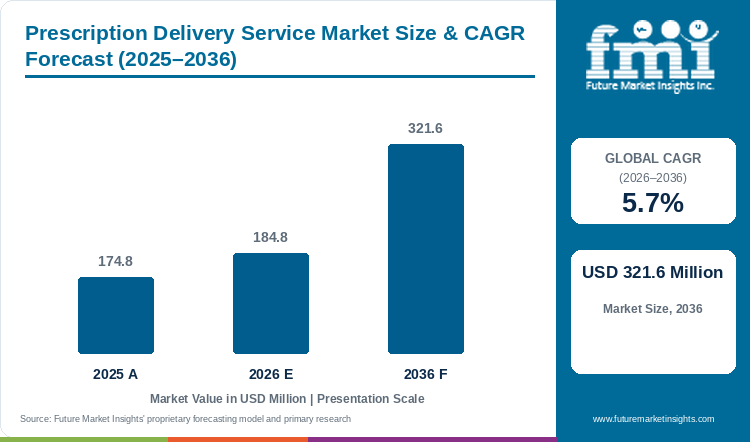
Demand is projected to expand at 5.7% CAGR from 2026 to 2036. Market value rises from USD 174.8 million in 2025 to USD 184.76 million in 2026 and USD 321.65 million by 2036.
The prescription delivery service market is estimated at USD 184.76 million in 2026 and is projected to reach USD 321.65 million by 2036, with a CAGR of 5.7% across the forecast period. Demand reflects the need to connect appropriate pharmacy dispensing with the practical receipt of medicines, particularly where patients face difficulty collecting repeat treatments or coordinating their supply. The service therefore involves more than transport, because prescription verification, pharmacist access and suitable handling remain relevant before the medicine reaches the customer. FDA’s online-pharmacy guidance emphasizes the distinction between legitimate pharmacy services and unsafe sellers, while WHO guidance addresses the storage and distribution requirements of temperature-sensitive products. [1][2] Digital order visibility can improve the experience when it reflects the actual dispensing status, as illustrated by prescription tracking within the NHS App. [4] National rules also affect the commercial model: European countries do not all permit online sales of prescription medicines, so a delivery service must be understood within the local supply framework. [3] Growth consequently depends on dependable pharmacy and logistics coordination, with convenience supporting adoption only when the underlying medicine-supply process remains appropriate.
Key Market Trends & Insights
- Order tracking is becoming more useful when patients can distinguish between a prescription being requested, prepared and ready for collection or delivery. [4]
- Pharmacy and logistics coordination remains central because appropriate dispensing, storage and handover requirements continue to apply when medicines are delivered to the patient. [1][2]
- Digital service models need to reflect national medicine-supply conditions, since permission to sell prescription products online differs between European countries. [3]
Regional Highlights
- India leads the profiled growth outlook as digital healthcare access and medicine-delivery services develop within the country’s broader pharmacy environment.
- European markets require country-specific service arrangements because online prescription-medicine sales are not governed by a single permission applying uniformly across the region. [3]
- England’s NHS prescription tracking service illustrates how patients can receive more detailed information about preparation and readiness for collection or delivery. [4]
Market Size & Forecast
Table 1: Market Size and Forecast for Prescription Delivery Service Market (USD million and percentage), 2025 to 2036
| Metric | Value |
|---|---|
| 2025 market value | USD 174.8 million |
| 2026 market value | USD 184.76 million |
| 2036 market value | USD 321.65 million |
| CAGR 2026 to 2036 | 5.7% |
| Revenue increase 2026 to 2036 | USD 136.89 million |
| Market expansion 2026 to 2036 | 1.74 times |
The forecast through 2036 follows the ability of ePharmacy services and other pharmacy providers to connect legitimate medicine supply with dependable receipt. Digital access can simplify repeat requests and status updates when the information reflects the actual stage of preparation. Providers also need product-appropriate storage, pharmacist access and a clear handover route, making the pharmacy and delivery arrangement central to continued use as customers rely on the service for ongoing treatment needs. [1][2][3][4]
What operating requirements shape prescription delivery?
A prescription delivery service needs to coordinate the pharmacy’s clinical and dispensing responsibilities with transport and receipt, while respecting the rules applying in the customer’s location. FDA guidance, WHO distribution requirements and European online-medicine information illustrate different parts of this requirement. The practical implication is that a faster delivery promise remains useful only when the underlying supply process is appropriate and dependable. [1][2][3]
Table 2: Industry evidence relevant to the prescription delivery service market
| Indicator | Data point or observation | Market relevance | Source |
|---|---|---|---|
| Legitimate supply | FDA identifies prescription and pharmacist-access safeguards for online pharmacies. | Delivery convenience needs a suitable pharmacy service. | [1] |
| Product handling | WHO addresses storage and transport of temperature-sensitive medicines. | Logistics requirements depend on the product. | [2] |
| National conditions | European countries differ on online sales of prescription medicines. | A service model needs to match the local supply framework. | [3] |
Analyst Perspective
"Patients now expect verified fulfillment, secure delivery, and real-time order visibility."
- Anurag Sharma, Associate Vice President, FMI
How is the Prescription Delivery Service Market segmented?
The market is segmented by Service Type, Distribution Channel, Delivery Technology, and Region.
Service type determines what is being supplied, with prescription medicines requiring dispensing safeguards and supplements, diagnostic kits or OTC products bringing their own handling needs. Distribution channels identify the pharmacy, institution or clinic through which supply is organized, while delivery technology describes how the prepared order reaches the recipient. These dimensions connect at fulfillment: the product must be available and appropriately dispensed before mail, physical transport or another delivery option can complete the service. Comparing demand across the axes therefore requires attention to the medicine’s conditions, the supplying organization and the national rules under which delivery operates. [1][2][3][4]
Why does the prescription drugs segment lead demand by service type?
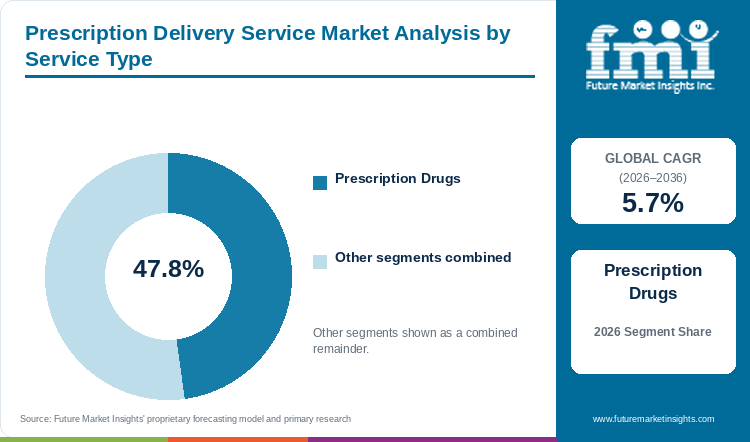
The Prescription Drugs segment is projected to account for 47.8% of service type demand in 2026.
Table 3: Service Type Share for Prescription Delivery Service Market (percentage share), 2026
| Service Type | Estimated share (2026) |
|---|---|
| Prescription Drugs | 47.8% |
| Other service type segments | 52.2% |
| Total | 100.0% |
Table 4: Segment Position and Market Growth for Prescription Delivery Service Market, 2026 to 2036
| Metric | Value |
|---|---|
| Global CAGR (2026 to 2036) | 5.7% |
| Profiled service type segment | Prescription Drugs |
Prescription drugs lead the service-type mix because recurring treatment can create a continuing need for appropriate medicine supply, particularly when collection from a pharmacy is inconvenient or difficult. The delivery service must remain connected to valid dispensing and access to professional advice, since transport does not remove the responsibilities associated with supplying a prescription medicine. FDA’s guidance describes safeguards relevant to legitimate online pharmacies, including prescription requirements and access to a licensed pharmacist. [1] Commercial demand therefore depends on the reliability of the complete process, from the request and pharmacy review through preparation and receipt. Clear status information can help the patient understand progress, while national rules determine the arrangements through which the medicine may be supplied. [3][4]
- Prescription Drugs are projected to account for 47.8% of service-type demand in 2026, supported by recurring treatment needs and patients seeking dependable medicine supply without pharmacy collection. [1]
- Prescription-medicine delivery needs to retain the appropriate dispensing and professional safeguards, with the commercial model adapted to the rules applying in the customer’s location. [1][3]
Why does the pharmacy store segment lead demand by distribution channel?
The Pharmacy Store segment is projected to account for 38.4% of distribution channel demand in 2026.
Table 5: Distribution Channel Share for Prescription Delivery Service Market (percentage share), 2026
| Distribution Channel | Estimated share (2026) |
|---|---|
| Pharmacy Store | 38.4% |
| Other distribution channel segments | 61.6% |
| Total | 100.0% |
Pharmacy stores hold the leading distribution-channel position because they connect the medicine-supply process with the local or wider service through which a patient receives a delivered order. Their role can include dispensing, answering questions and coordinating the handover, making the pharmacy more than a collection point for a courier. The usefulness of delivery also depends on whether the patient receives clear information when an item is still being prepared or is not yet available. NHS prescription tracking illustrates the value of distinguishing these stages within the customer experience. [4] Providers can consequently build demand around a dependable pharmacy relationship, with logistics and order visibility supporting the professional supply function rather than replacing it. [1]
- Pharmacy Store is projected to hold 38.4% of distribution-channel demand in 2026, connecting dispensing and professional advice with the arrangements for delivery and receipt. [1]
- A pharmacy-led channel can connect dispensing and customer advice with delivery arrangements, helping patients understand both order progress and the appropriate route for questions. [1][4]
What are the drivers, restraints, and opportunities in the Prescription Delivery Service Market?
A dependable delivery promise begins with a medicine ready for appropriate supply, making pharmacy coordination the foundation of customer convenience. Providers can build repeat use by showing accurate preparation status and maintaining suitable transport and handover conditions, with a clear route for pharmacist advice when a patient needs help with the prescription or its availability. [1][2][3][4]
Driver
Repeat treatment and difficulties collecting medicines create demand for services that connect a suitable pharmacy with the patient’s circumstances. Electronic prescribing helps organize prescription information within the supply process, while pharmacy review and preparation establish whether an order is ready to be dispatched. [1][4] Patients can make better use of delivery when they receive accurate progress information and retain a clear route to professional advice, supporting a dependable service relationship beyond the convenience of placing an order. [1][4]
Restraint
Medicine delivery can be constrained by the product’s handling requirements, the availability of stock and the rules applying to supply in the customer’s location. [2][3] A delivery promise may also become difficult to meet when preparation or prescription review is incomplete, making accurate status information important. [4] Providers therefore need to maintain pharmacy and logistics coordination, because speed alone cannot address an unsuitable dispensing arrangement or a product whose storage conditions are not preserved during transport.
Opportunity
Pharmaceutical cold chain packaging becomes relevant when a supplied medicine needs defined temperature conditions during transport, making the handling plan part of the delivery proposition. [2] Providers can connect these product requirements with accurate preparation and dispatch information, helping the patient understand what happens before receipt. [4] Better coordination between the pharmacy and transport partner can then support repeat use, provided the service maintains suitable handover arrangements and access to pharmacy advice for questions about supply. [1][3]
Which country CAGRs are profiled in the Prescription Delivery Service Market?
Table 6: Country CAGR Comparison for Prescription Delivery Service Market (CAGR percentage), 2026 to 2036
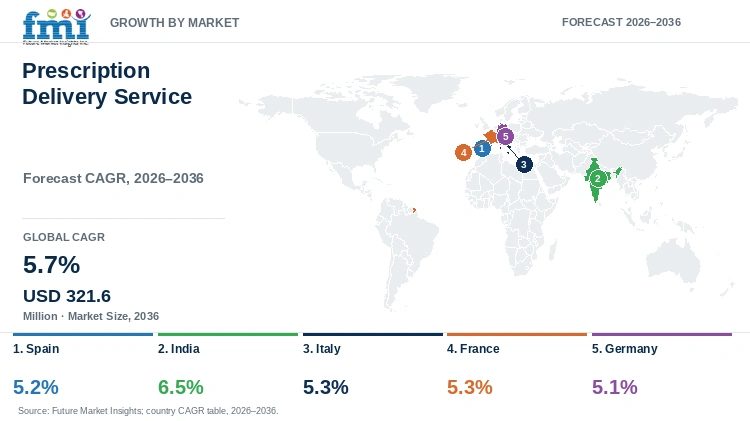
| Country | CAGR | Forecast period |
|---|---|---|
| Spain | 5.2% | 2026 to 2036 |
| India | 6.5% | 2026 to 2036 |
| Italy | 5.3% | 2026 to 2036 |
| France | 5.3% | 2026 to 2036 |
| Germany | 5.1% | 2026 to 2036 |
Country-wise Analysis
Spain Prescription Delivery Service Market Outlook (2026 to 2036)
Spain’s demand outlook is associated with recurring medicine needs and the appeal of a dependable supply arrangement for people managing long-term conditions. Delivery can support access, but the service needs to be distinguished from the permission to sell a prescription medicine online, because European countries set their own conditions for these activities. [3] Spain is projected at a CAGR of 5.2% from 2026 to 2036. For providers, the commercial requirement is therefore to coordinate an appropriate pharmacy process with clear information about preparation and receipt, rather than assume that a convenient ordering interface establishes a lawful supply route. Product handling also remains relevant where a medicine requires specific storage conditions during the final delivery stage. [2]
India Prescription Delivery Service Market Outlook (2026 to 2036)
India’s digital healthcare and pharmacy environment supports interest in medicine-delivery services, with the market outlook identifying broader access and online service use as demand factors. A large serviceable population still needs a workable local fulfillment route, because the usefulness of a digital request depends on whether the medicine can be dispensed appropriately and delivered under suitable conditions. WHO’s guidance on temperature-sensitive products illustrates why transport requirements vary with the item supplied. [2] India is projected to expand at a CAGR of 6.5% from 2026 to 2036. Providers can address this demand through dependable pharmacy relationships and clear status information, helping customers understand the process from preparation to receipt while preserving access to relevant professional advice.
Italy Prescription Delivery Service Market Outlook (2026 to 2036)
Italy’s aging population contributes to the practical appeal of medicine delivery where patients face repeated collection needs, while the appropriate service depends on the local conditions governing medicine supply. [3] The commercial model cannot be assumed to follow a uniform European permission for online prescription sales, since the rules differ between countries. [3] Italy is projected at a CAGR of 5.3% from 2026 to 2036. Providers therefore need to connect the permitted pharmacy arrangement with a dependable handover and information that the patient can understand. Delivery technology is useful when it supports those requirements, but a new transport method does not itself resolve dispensing, stock availability or the need to preserve product-specific storage conditions during the journey. [2]
France Prescription Delivery Service Market Outlook (2026 to 2036)
Collaboration between pharmacy, service and logistics participants forms part of France’s delivery-service outlook, creating a need to define who is responsible for each stage of fulfillment. That coordination must remain within the French medicine-supply framework, rather than assume that all forms of online prescription selling are permitted across Europe. Official European guidance explicitly recognizes differences between national arrangements. [3] A 5.3% CAGR is projected for France from 2026 to 2036. Clear responsibility can help a service manage preparation status, customer questions and the physical handover, particularly when an order contains products with different availability or handling requirements. The customer benefit consequently depends on a reliable supply relationship as well as the convenience of the delivery channel. [2]
Germany Prescription Delivery Service Market Outlook (2026 to 2036)
Timely medicine fulfillment is a commercial priority within Germany’s market outlook, but the practical value of speed depends on the pharmacy’s ability to prepare the order and communicate its actual status. A service that distinguishes request, preparation and readiness gives the patient more useful information than a delivery promise disconnected from stock or dispensing progress. The NHS tracking model illustrates those stages, while the German operating arrangement remains governed by its own national supply conditions. [3][4] Germany is projected to record a CAGR of 5.1% from 2026 to 2036. Providers can compete through reliable execution and clear customer support, with transport conditions and professional access retained as part of the medicine-supply process rather than treated as optional additions. [1][2]
Who are the notable companies in the Prescription Delivery Service Market?
CVS Health; Walgreens; Walmart; OptumRx; Amazon (PillPack)
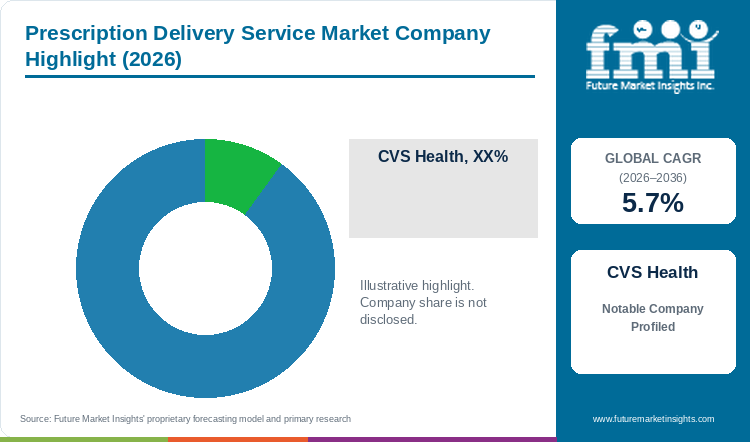
Pharmacy networks, home-delivery providers and digital businesses organize fulfillment through different combinations of dispensing capacity and transport partners. Pharmaceutical logistics supports the movement and handling of medicines within those arrangements, bringing product requirements into supplier comparison. [2] Buyers and customers can assess the pharmacy relationship, order visibility and reliability of receipt together, with attention to the activities a provider performs directly and the dispensing or delivery functions carried out by its partners. [1][3][4]
Competitive Benchmarking: Prescription Delivery Service Market
Table 7: Competitive positioning for the prescription delivery service market
| Company | Positioning | Commercial distinction |
|---|---|---|
| CVS Health | Pharmacy and prescription fulfillment | Combines pharmacy services with prescription-delivery access. |
| Walgreens | Retail pharmacy and delivery | Serves medicine needs through pharmacy-linked fulfillment channels. |
| Walmart | Retail pharmacy access | Participates in pharmacy services and prescription fulfillment. |
| OptumRx | Pharmacy benefit and home-delivery services | Supports prescription supply through managed pharmacy channels. |
| Amazon (PillPack) | Digital pharmacy and home delivery | Connects prescription fulfillment with a home-delivery service model. |
Key Developments in the Prescription Delivery Service Market
- NHS prescription tracking launched in September 2024 and continues to extend through participating pharmacy-system suppliers, giving patients information about preparation and readiness for collection or delivery. [4]
- The European Union’s current online-medicine guidance retains the distinction between national rules for prescription sales and the common verification logo used by authorized online medicine retailers. [3]
- FDA’s current online-pharmacy information identifies prescription, licensing and pharmacist-access safeguards, reinforcing the operational requirements that distinguish appropriate medicine supply from an ordinary parcel service. [1]
Key Players in the Prescription Delivery Service Market
Pharmacy and prescription fulfillment
- CVS Health
Retail pharmacy and delivery
- Walgreens
Retail pharmacy access
- Walmart
Pharmacy benefit and home-delivery services
- OptumRx
Digital pharmacy and home delivery
- Amazon (PillPack)
Prescription Delivery Service Market - Report Scope
Table 8: Report Scope for Prescription Delivery Service Market, 2026 to 2036
| Coverage field | Report scope |
|---|---|
| Market | Prescription Delivery Service Market |
| Historical reference year | 2025 |
| Base year | 2026 |
| Forecast period | 2026 to 2036 |
| Quantitative units | USD million and percentage shares/CAGRs |
| 2026 market value | USD 184.76 million |
| 2036 market value | USD 321.65 million |
| Forecast CAGR | 5.7% from 2026 to 2036 |
| Segmentation | service type, distribution channel, delivery technology |
| Country profiles | Spain, India, Italy, France, Germany |
Prescription Delivery Service Market - Research Methodology
Table 9: Research Methodology for Prescription Delivery Service Market, 2026 edition
| Method | Approach |
|---|---|
| Market definition | Products, services and commercial applications are separated according to their function and purchasing context. |
| Secondary research | FMI market coverage is assessed alongside official technical guidance, regulatory material and relevant first-party disclosures. |
| Segmentation | Demand is organized by the stated category axes, retaining the distinction between segment shares and growth rates. |
| Country assessment | Local care pathways, purchasing conditions and service availability inform the interpretation of each geographic outlook. |
| Competitive assessment | Participants are compared by relevant offering, customer setting and delivery capability rather than unsupported company rankings. |
| Consistency review | Market values, forecast periods, units, segment labels and country growth rates are checked for agreement throughout the analysis. |
Prescription Delivery Service Market by Segments
Prescription Delivery Service Market segmented by Service Type:
- Prescription Drugs
- Wellness Supplement
- Diagnostic Kits
- OTC Drugs
Prescription Delivery Service Market segmented by Distribution Channel:
- Pharmacy Store
- Retail Pharmacy
- Drug Stores
- Healthcare Institutions
- Clinics
- Others
- Retail Pharmacy
Prescription Delivery Service Market segmented by Delivery Technology:
- In-mail Based
- Drone Based
- Physical Delivery
- Others
Prescription Delivery Service Market by Region
- North America
- United States
- Canada
- Latin America
- Brazil
- Mexico
- Argentina
- Chile
- Western Europe
- Germany
- France
- United Kingdom
- Italy
- Spain
- Benelux
- Nordics
- Eastern Europe
- Poland
- Czech Republic
- Romania
- Hungary
- East Asia
- China
- Japan
- South Korea
- South Asia and Pacific
- India
- ASEAN
- Australia and New Zealand
- Middle East and Africa
- GCC Countries
- South Africa
- Türkiye
- Israel
Research Sources and Bibliography
- [1] US Food and Drug Administration. Accessed 15 October 2026. How to Buy Medicines Safely From an Online Pharmacy
- [2] World Health Organization. Accessed 15 October 2026. Model guidance for storage and transport of time-and temperature-sensitive pharmaceutical products
- [3] European Union. Accessed 15 October 2026. Buying medicine online
- [4] NHS England Digital. Accessed 15 October 2026. National Patient Prescription Tracking Service
This Report Answers
- How big is the prescription delivery service market in 2026?
- What is the market outlook through 2036?
- Which segments lead demand in 2026?
- Which countries are examined in the forecast?
- Which companies participate in the market?
Table of Content
Table of Content
- Key Takeaways
- Market Size and CAGR
- Top Growth Driver
- Fastest Growing Segment
- Leading Region
- Key Companies
- Emerging Opportunities
- Executive Summary
- Global Market Outlook
- Demand-side Trends
- Supply-side Trends
- Technology Roadmap Analysis
- Analysis and Recommendations
- Analyst Perspective (What is happening? Why now? What should investors know?)
- Key Questions Answered
- How large is the market?
- What is the CAGR?
- What are key trends?
- Which region dominates?
- Who are the leaders?
Read More...
- Market Overview
- Market Coverage / Taxonomy
- Market Definition / Scope / Limitations
- Research Methodology
- Chapter Orientation
- Analytical Lens and Working Hypotheses
- Market Structure, Signals, and Trend Drivers
- Benchmarking and Cross-market Comparability
- Market Sizing, Forecasting, and Opportunity Mapping
- Research Design and Evidence Framework
- Desk Research Programme (Secondary Evidence)
- Expert Input and Fieldwork (Primary Evidence)
- Tooling, Models, and Reference Databases
- Data Engineering and Model Build
- Quality Assurance and Audit Trail
- Market Background
- Market Dynamics (Drivers, Restraints, Opportunity, Trends)
- Scenario Forecast (Optimistic, Likely, Conservative)
- Impact Analysis
- AI Impact
- Sustainability Impact
- Regulatory Impact
- Technology Impact
- Consumer / Buyer Analysis
- Purchase Drivers
- Adoption Barriers
- Buyer Journey
- Opportunity Map Analysis
- Product Life Cycle Analysis
- Supply Chain Analysis
- Investment Feasibility Matrix
- Value Chain Analysis
- PESTLE and Porter's Analysis
- Regulatory Landscape
- Regional Parent Market Outlook
- Production and Consumption Statistics
- Import and Export Statistics
- Global Market Analysis and Forecast, 2021 to 2036
- Historical Market Size Value (USD Million) Analysis, 2021 to 2025
- Current and Future Market Size Value (USD Million) Projections, 2026 to 2036
- Y-o-Y Growth Trend Analysis
- Absolute $ Opportunity Analysis
- Global Market Pricing Analysis, 2021 to 2036
- Global Market Analysis and Forecast, By Service Type, 2021 to 2036
- Introduction / Key Findings
- Historical Market Size Value (USD Million) Analysis By Service Type, 2021 to 2025
- Current and Future Market Size Value (USD Million) Analysis and Forecast By Service Type, 2026 to 2036
- Prescription Drugs
- Wellness Supplement
- Diagnostic Kits
- OTC Drugs
- Y-o-Y Growth Trend Analysis By Service Type, 2021 to 2025
- Absolute $ Opportunity Analysis By Service Type, 2026 to 2036
- Global Market Analysis and Forecast, By Distribution Channel, 2021 to 2036
- Introduction / Key Findings
- Historical Market Size Value (USD Million) Analysis By Distribution Channel, 2021 to 2025
- Current and Future Market Size Value (USD Million) Analysis and Forecast By Distribution Channel, 2026 to 2036
- Pharmacy Store
- Retail Pharmacy
- Drug Stores
- Healthcare Institutions
- Clinics
- Others
- Y-o-Y Growth Trend Analysis By Distribution Channel, 2021 to 2025
- Absolute $ Opportunity Analysis By Distribution Channel, 2026 to 2036
- Global Market Analysis and Forecast, By Delivery Technology, 2021 to 2036
- Introduction / Key Findings
- Historical Market Size Value (USD Million) Analysis By Delivery Technology, 2021 to 2025
- Current and Future Market Size Value (USD Million) Analysis and Forecast By Delivery Technology, 2026 to 2036
- In-mail Based
- Drone Based
- Physical Delivery
- Others
- Y-o-Y Growth Trend Analysis By Delivery Technology, 2021 to 2025
- Absolute $ Opportunity Analysis By Delivery Technology, 2026 to 2036
- Global Market Analysis and Forecast, By Region, 2021 to 2036
- Introduction
- Historical Market Size Value (USD Million) Analysis By Region, 2021 to 2025
- Current Market Size Value (USD Million) Analysis and Forecast By Region, 2026 to 2036
- North America
- Latin America
- Western Europe
- Eastern Europe
- East Asia
- South Asia and Pacific
- Middle East & Africa
- Market Attractiveness Analysis By Region
- North America Market Analysis and Forecast, By Country, 2021 to 2036
- Historical Market Size Value (USD Million) Trend Analysis By Market Taxonomy, 2021 to 2025
- Market Size Value (USD Million) Forecast By Market Taxonomy, 2026 to 2036
- By Country
- USA
- Canada
- Mexico
- By Service Type
- By Distribution Channel
- By Delivery Technology
- By Country
- Market Attractiveness Analysis
- By Country
- By Service Type
- By Distribution Channel
- By Delivery Technology
- Key Takeaways
- Latin America Market Analysis and Forecast, By Country
- Historical Market Size Value (USD Million) Trend Analysis By Market Taxonomy, 2021 to 2025
- Market Size Value (USD Million) Forecast By Market Taxonomy, 2026 to 2036
- By Country
- Brazil
- Chile
- Rest of Latin America
- By Service Type
- By Distribution Channel
- By Delivery Technology
- By Country
- Market Attractiveness Analysis
- By Country
- By Service Type
- By Distribution Channel
- By Delivery Technology
- Key Takeaways
- Western Europe Market Analysis and Forecast, By Country
- Historical Market Size Value (USD Million) Trend Analysis By Market Taxonomy, 2021 to 2025
- Market Size Value (USD Million) Forecast By Market Taxonomy, 2026 to 2036
- By Country
- Germany
- UK
- Italy
- Spain
- France
- Nordic
- BENELUX
- Rest of Western Europe
- By Service Type
- By Distribution Channel
- By Delivery Technology
- By Country
- Market Attractiveness Analysis
- By Country
- By Service Type
- By Distribution Channel
- By Delivery Technology
- Key Takeaways
- Eastern Europe Market Analysis and Forecast, By Country
- Historical Market Size Value (USD Million) Trend Analysis By Market Taxonomy, 2021 to 2025
- Market Size Value (USD Million) Forecast By Market Taxonomy, 2026 to 2036
- By Country
- Russia
- Poland
- Hungary
- Balkan & Baltic
- Rest of Eastern Europe
- By Service Type
- By Distribution Channel
- By Delivery Technology
- By Country
- Market Attractiveness Analysis
- By Country
- By Service Type
- By Distribution Channel
- By Delivery Technology
- Key Takeaways
- East Asia Market Analysis and Forecast, By Country
- Historical Market Size Value (USD Million) Trend Analysis By Market Taxonomy, 2021 to 2025
- Market Size Value (USD Million) Forecast By Market Taxonomy, 2026 to 2036
- By Country
- China
- Japan
- South Korea
- By Service Type
- By Distribution Channel
- By Delivery Technology
- By Country
- Market Attractiveness Analysis
- By Country
- By Service Type
- By Distribution Channel
- By Delivery Technology
- Key Takeaways
- South Asia and Pacific Market Analysis and Forecast, By Country
- Historical Market Size Value (USD Million) Trend Analysis By Market Taxonomy, 2021 to 2025
- Market Size Value (USD Million) Forecast By Market Taxonomy, 2026 to 2036
- By Country
- India
- ASEAN
- Australia & New Zealand
- Rest of South Asia and Pacific
- By Service Type
- By Distribution Channel
- By Delivery Technology
- By Country
- Market Attractiveness Analysis
- By Country
- By Service Type
- By Distribution Channel
- By Delivery Technology
- Key Takeaways
- Middle East & Africa Market Analysis and Forecast, By Country
- Historical Market Size Value (USD Million) Trend Analysis By Market Taxonomy, 2021 to 2025
- Market Size Value (USD Million) Forecast By Market Taxonomy, 2026 to 2036
- By Country
- Kingdom of Saudi Arabia
- Other GCC Countries
- Turkiye
- South Africa
- Other African Union
- Rest of Middle East & Africa
- By Service Type
- By Distribution Channel
- By Delivery Technology
- By Country
- Market Attractiveness Analysis
- By Country
- By Service Type
- By Distribution Channel
- By Delivery Technology
- Key Takeaways
- Key Countries Market Analysis
- USA
- Pricing Analysis
- Market Share Analysis, 2025
- By Service Type
- By Distribution Channel
- By Delivery Technology
- Canada
- Pricing Analysis
- Market Share Analysis, 2025
- By Service Type
- By Distribution Channel
- By Delivery Technology
- Mexico
- Pricing Analysis
- Market Share Analysis, 2025
- By Service Type
- By Distribution Channel
- By Delivery Technology
- Brazil
- Pricing Analysis
- Market Share Analysis, 2025
- By Service Type
- By Distribution Channel
- By Delivery Technology
- Chile
- Pricing Analysis
- Market Share Analysis, 2025
- By Service Type
- By Distribution Channel
- By Delivery Technology
- Germany
- Pricing Analysis
- Market Share Analysis, 2025
- By Service Type
- By Distribution Channel
- By Delivery Technology
- UK
- Pricing Analysis
- Market Share Analysis, 2025
- By Service Type
- By Distribution Channel
- By Delivery Technology
- Italy
- Pricing Analysis
- Market Share Analysis, 2025
- By Service Type
- By Distribution Channel
- By Delivery Technology
- Spain
- Pricing Analysis
- Market Share Analysis, 2025
- By Service Type
- By Distribution Channel
- By Delivery Technology
- France
- Pricing Analysis
- Market Share Analysis, 2025
- By Service Type
- By Distribution Channel
- By Delivery Technology
- India
- Pricing Analysis
- Market Share Analysis, 2025
- By Service Type
- By Distribution Channel
- By Delivery Technology
- ASEAN
- Pricing Analysis
- Market Share Analysis, 2025
- By Service Type
- By Distribution Channel
- By Delivery Technology
- Australia & New Zealand
- Pricing Analysis
- Market Share Analysis, 2025
- By Service Type
- By Distribution Channel
- By Delivery Technology
- China
- Pricing Analysis
- Market Share Analysis, 2025
- By Service Type
- By Distribution Channel
- By Delivery Technology
- Japan
- Pricing Analysis
- Market Share Analysis, 2025
- By Service Type
- By Distribution Channel
- By Delivery Technology
- South Korea
- Pricing Analysis
- Market Share Analysis, 2025
- By Service Type
- By Distribution Channel
- By Delivery Technology
- Russia
- Pricing Analysis
- Market Share Analysis, 2025
- By Service Type
- By Distribution Channel
- By Delivery Technology
- Poland
- Pricing Analysis
- Market Share Analysis, 2025
- By Service Type
- By Distribution Channel
- By Delivery Technology
- Hungary
- Pricing Analysis
- Market Share Analysis, 2025
- By Service Type
- By Distribution Channel
- By Delivery Technology
- Kingdom of Saudi Arabia
- Pricing Analysis
- Market Share Analysis, 2025
- By Service Type
- By Distribution Channel
- By Delivery Technology
- South Africa
- Pricing Analysis
- Market Share Analysis, 2025
- By Service Type
- By Distribution Channel
- By Delivery Technology
- USA
- Market Structure Analysis
- Competition Dashboard
- Competition Benchmarking
- Market Share Analysis of Top Players
- By Regional
- By Service Type
- By Distribution Channel
- By Delivery Technology
- Emerging Startups
- Innovation Benchmarking
- Competition Analysis
- Competition Deep Dive
- CVS Health
- Overview
- Product Portfolio
- Profitability by Market Segments
- Sales Footprint
- Strategy Overview
- Marketing Strategy
- Product Strategy
- Channel Strategy
- Walgreens
- Walmart
- OptumRx
- Amazon (PillPack)
- CVS Health
- Case Studies
- Success Stories
- Recent Developments
- Competition Deep Dive
- Assumptions & Acronyms Used
List of Tables
- Table 1: Global Market Value (USD Million) Forecast by Region, 2021 to 2036
- Table 2: Global Market Value (USD Million) Forecast by Service Type, 2021 to 2036
- Table 3: Global Market Value (USD Million) Forecast by Distribution Channel, 2021 to 2036
- Table 4: Global Market Value (USD Million) Forecast by Delivery Technology, 2021 to 2036
- Table 5: North America Market Value (USD Million) Forecast by Country, 2021 to 2036
- Table 6: North America Market Value (USD Million) Forecast by Service Type, 2021 to 2036
- Table 7: North America Market Value (USD Million) Forecast by Distribution Channel, 2021 to 2036
- Table 8: North America Market Value (USD Million) Forecast by Delivery Technology, 2021 to 2036
- Table 9: Latin America Market Value (USD Million) Forecast by Country, 2021 to 2036
- Table 10: Latin America Market Value (USD Million) Forecast by Service Type, 2021 to 2036
- Table 11: Latin America Market Value (USD Million) Forecast by Distribution Channel, 2021 to 2036
- Table 12: Latin America Market Value (USD Million) Forecast by Delivery Technology, 2021 to 2036
- Table 13: Western Europe Market Value (USD Million) Forecast by Country, 2021 to 2036
- Table 14: Western Europe Market Value (USD Million) Forecast by Service Type, 2021 to 2036
- Table 15: Western Europe Market Value (USD Million) Forecast by Distribution Channel, 2021 to 2036
- Table 16: Western Europe Market Value (USD Million) Forecast by Delivery Technology, 2021 to 2036
- Table 17: Eastern Europe Market Value (USD Million) Forecast by Country, 2021 to 2036
- Table 18: Eastern Europe Market Value (USD Million) Forecast by Service Type, 2021 to 2036
- Table 19: Eastern Europe Market Value (USD Million) Forecast by Distribution Channel, 2021 to 2036
- Table 20: Eastern Europe Market Value (USD Million) Forecast by Delivery Technology, 2021 to 2036
- Table 21: East Asia Market Value (USD Million) Forecast by Country, 2021 to 2036
- Table 22: East Asia Market Value (USD Million) Forecast by Service Type, 2021 to 2036
- Table 23: East Asia Market Value (USD Million) Forecast by Distribution Channel, 2021 to 2036
- Table 24: East Asia Market Value (USD Million) Forecast by Delivery Technology, 2021 to 2036
- Table 25: South Asia and Pacific Market Value (USD Million) Forecast by Country, 2021 to 2036
- Table 26: South Asia and Pacific Market Value (USD Million) Forecast by Service Type, 2021 to 2036
- Table 27: South Asia and Pacific Market Value (USD Million) Forecast by Distribution Channel, 2021 to 2036
- Table 28: South Asia and Pacific Market Value (USD Million) Forecast by Delivery Technology, 2021 to 2036
- Table 29: Middle East & Africa Market Value (USD Million) Forecast by Country, 2021 to 2036
- Table 30: Middle East & Africa Market Value (USD Million) Forecast by Service Type, 2021 to 2036
- Table 31: Middle East & Africa Market Value (USD Million) Forecast by Distribution Channel, 2021 to 2036
- Table 32: Middle East & Africa Market Value (USD Million) Forecast by Delivery Technology, 2021 to 2036
List of Figures
- Figure 1: Global Market Pricing Analysis
- Figure 2: Global Market Value (USD Million) Forecast 2021-2036
- Figure 3: Global Market Value Share and BPS Analysis by Service Type, 2026 and 2036
- Figure 4: Global Market Y-o-Y Growth Comparison by Service Type, 2026-2036
- Figure 5: Global Market Attractiveness Analysis by Service Type
- Figure 6: Global Market Value Share and BPS Analysis by Distribution Channel, 2026 and 2036
- Figure 7: Global Market Y-o-Y Growth Comparison by Distribution Channel, 2026-2036
- Figure 8: Global Market Attractiveness Analysis by Distribution Channel
- Figure 9: Global Market Value Share and BPS Analysis by Delivery Technology, 2026 and 2036
- Figure 10: Global Market Y-o-Y Growth Comparison by Delivery Technology, 2026-2036
- Figure 11: Global Market Attractiveness Analysis by Delivery Technology
- Figure 12: Global Market Value (USD Million) Share and BPS Analysis by Region, 2026 and 2036
- Figure 13: Global Market Y-o-Y Growth Comparison by Region, 2026-2036
- Figure 14: Global Market Attractiveness Analysis by Region
- Figure 15: North America Market Incremental Dollar Opportunity, 2026-2036
- Figure 16: Latin America Market Incremental Dollar Opportunity, 2026-2036
- Figure 17: Western Europe Market Incremental Dollar Opportunity, 2026-2036
- Figure 18: Eastern Europe Market Incremental Dollar Opportunity, 2026-2036
- Figure 19: East Asia Market Incremental Dollar Opportunity, 2026-2036
- Figure 20: South Asia and Pacific Market Incremental Dollar Opportunity, 2026-2036
- Figure 21: Middle East & Africa Market Incremental Dollar Opportunity, 2026-2036
- Figure 22: North America Market Value Share and BPS Analysis by Country, 2026 and 2036
- Figure 23: North America Market Value Share and BPS Analysis by Service Type, 2026 and 2036
- Figure 24: North America Market Y-o-Y Growth Comparison by Service Type, 2026-2036
- Figure 25: North America Market Attractiveness Analysis by Service Type
- Figure 26: North America Market Value Share and BPS Analysis by Distribution Channel, 2026 and 2036
- Figure 27: North America Market Y-o-Y Growth Comparison by Distribution Channel, 2026-2036
- Figure 28: North America Market Attractiveness Analysis by Distribution Channel
- Figure 29: North America Market Value Share and BPS Analysis by Delivery Technology, 2026 and 2036
- Figure 30: North America Market Y-o-Y Growth Comparison by Delivery Technology, 2026-2036
- Figure 31: North America Market Attractiveness Analysis by Delivery Technology
- Figure 32: Latin America Market Value Share and BPS Analysis by Country, 2026 and 2036
- Figure 33: Latin America Market Value Share and BPS Analysis by Service Type, 2026 and 2036
- Figure 34: Latin America Market Y-o-Y Growth Comparison by Service Type, 2026-2036
- Figure 35: Latin America Market Attractiveness Analysis by Service Type
- Figure 36: Latin America Market Value Share and BPS Analysis by Distribution Channel, 2026 and 2036
- Figure 37: Latin America Market Y-o-Y Growth Comparison by Distribution Channel, 2026-2036
- Figure 38: Latin America Market Attractiveness Analysis by Distribution Channel
- Figure 39: Latin America Market Value Share and BPS Analysis by Delivery Technology, 2026 and 2036
- Figure 40: Latin America Market Y-o-Y Growth Comparison by Delivery Technology, 2026-2036
- Figure 41: Latin America Market Attractiveness Analysis by Delivery Technology
- Figure 42: Western Europe Market Value Share and BPS Analysis by Country, 2026 and 2036
- Figure 43: Western Europe Market Value Share and BPS Analysis by Service Type, 2026 and 2036
- Figure 44: Western Europe Market Y-o-Y Growth Comparison by Service Type, 2026-2036
- Figure 45: Western Europe Market Attractiveness Analysis by Service Type
- Figure 46: Western Europe Market Value Share and BPS Analysis by Distribution Channel, 2026 and 2036
- Figure 47: Western Europe Market Y-o-Y Growth Comparison by Distribution Channel, 2026-2036
- Figure 48: Western Europe Market Attractiveness Analysis by Distribution Channel
- Figure 49: Western Europe Market Value Share and BPS Analysis by Delivery Technology, 2026 and 2036
- Figure 50: Western Europe Market Y-o-Y Growth Comparison by Delivery Technology, 2026-2036
- Figure 51: Western Europe Market Attractiveness Analysis by Delivery Technology
- Figure 52: Eastern Europe Market Value Share and BPS Analysis by Country, 2026 and 2036
- Figure 53: Eastern Europe Market Value Share and BPS Analysis by Service Type, 2026 and 2036
- Figure 54: Eastern Europe Market Y-o-Y Growth Comparison by Service Type, 2026-2036
- Figure 55: Eastern Europe Market Attractiveness Analysis by Service Type
- Figure 56: Eastern Europe Market Value Share and BPS Analysis by Distribution Channel, 2026 and 2036
- Figure 57: Eastern Europe Market Y-o-Y Growth Comparison by Distribution Channel, 2026-2036
- Figure 58: Eastern Europe Market Attractiveness Analysis by Distribution Channel
- Figure 59: Eastern Europe Market Value Share and BPS Analysis by Delivery Technology, 2026 and 2036
- Figure 60: Eastern Europe Market Y-o-Y Growth Comparison by Delivery Technology, 2026-2036
- Figure 61: Eastern Europe Market Attractiveness Analysis by Delivery Technology
- Figure 62: East Asia Market Value Share and BPS Analysis by Country, 2026 and 2036
- Figure 63: East Asia Market Value Share and BPS Analysis by Service Type, 2026 and 2036
- Figure 64: East Asia Market Y-o-Y Growth Comparison by Service Type, 2026-2036
- Figure 65: East Asia Market Attractiveness Analysis by Service Type
- Figure 66: East Asia Market Value Share and BPS Analysis by Distribution Channel, 2026 and 2036
- Figure 67: East Asia Market Y-o-Y Growth Comparison by Distribution Channel, 2026-2036
- Figure 68: East Asia Market Attractiveness Analysis by Distribution Channel
- Figure 69: East Asia Market Value Share and BPS Analysis by Delivery Technology, 2026 and 2036
- Figure 70: East Asia Market Y-o-Y Growth Comparison by Delivery Technology, 2026-2036
- Figure 71: East Asia Market Attractiveness Analysis by Delivery Technology
- Figure 72: South Asia and Pacific Market Value Share and BPS Analysis by Country, 2026 and 2036
- Figure 73: South Asia and Pacific Market Value Share and BPS Analysis by Service Type, 2026 and 2036
- Figure 74: South Asia and Pacific Market Y-o-Y Growth Comparison by Service Type, 2026-2036
- Figure 75: South Asia and Pacific Market Attractiveness Analysis by Service Type
- Figure 76: South Asia and Pacific Market Value Share and BPS Analysis by Distribution Channel, 2026 and 2036
- Figure 77: South Asia and Pacific Market Y-o-Y Growth Comparison by Distribution Channel, 2026-2036
- Figure 78: South Asia and Pacific Market Attractiveness Analysis by Distribution Channel
- Figure 79: South Asia and Pacific Market Value Share and BPS Analysis by Delivery Technology, 2026 and 2036
- Figure 80: South Asia and Pacific Market Y-o-Y Growth Comparison by Delivery Technology, 2026-2036
- Figure 81: South Asia and Pacific Market Attractiveness Analysis by Delivery Technology
- Figure 82: Middle East & Africa Market Value Share and BPS Analysis by Country, 2026 and 2036
- Figure 83: Middle East & Africa Market Value Share and BPS Analysis by Service Type, 2026 and 2036
- Figure 84: Middle East & Africa Market Y-o-Y Growth Comparison by Service Type, 2026-2036
- Figure 85: Middle East & Africa Market Attractiveness Analysis by Service Type
- Figure 86: Middle East & Africa Market Value Share and BPS Analysis by Distribution Channel, 2026 and 2036
- Figure 87: Middle East & Africa Market Y-o-Y Growth Comparison by Distribution Channel, 2026-2036
- Figure 88: Middle East & Africa Market Attractiveness Analysis by Distribution Channel
- Figure 89: Middle East & Africa Market Value Share and BPS Analysis by Delivery Technology, 2026 and 2036
- Figure 90: Middle East & Africa Market Y-o-Y Growth Comparison by Delivery Technology, 2026-2036
- Figure 91: Middle East & Africa Market Attractiveness Analysis by Delivery Technology
- Figure 92: Global Market - Tier Structure Analysis
- Figure 93: Global Market - Company Share Analysis
Frequently Asked Questions
How big is the prescription delivery service market in 2026?
The market is estimated at USD 184.76 million in 2026, compared with USD 174.8 million in 2025.
What is the market outlook through 2036?
Market value is projected to reach USD 321.65 million by 2036, with a CAGR of 5.7% from 2026 to 2036.
Which segments lead demand in 2026?
The Prescription Drugs segment is projected to hold 47.8% of service type demand in 2026. Pharmacy Store is projected to hold 38.4% of distribution channel demand in 2026.
Which countries are examined in the forecast?
The country analysis covers Spain, India, Italy, France, Germany, considering local demand conditions and the outlook from 2026 to 2036.
Which companies participate in the market?
Relevant participants include CVS Health, Walgreens, Walmart, OptumRx, Amazon (PillPack), whose portfolios serve different requirements within the market.
Preview the report firsthand - request a free sample
Get SampleGet the brochure for pricing and purchase details.
Get PDF
