

- Market Size (2026)
- USD 624.7 Mn
- Forecast (2036)
- USD 1206.1 Mn
- CAGR (2026 to 2036)
- 6.8%
How big is Produce Clamshells Market in 2026?
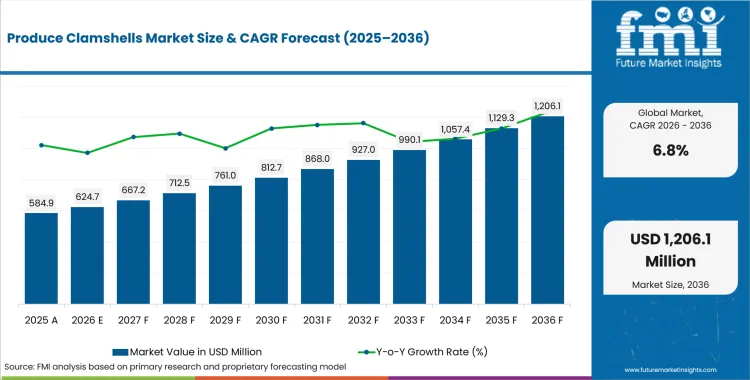
USD 624.7 million in 2026 and USD 1206.1 million by 2036 at a 6.8% CAGR.
Demand for produce clamshells is projected to expand at 6.8% CAGR between 2026 and 2036, increasing valuation from USD 624.7 million in 2026 to USD 1206.1 million by 2036. Packaging conversion is the main expansion route because operators must change resin or fiber content without losing closure performance or line handling. CalRecycle's September 2025 covered-material guidance explicitly includes clamshells and hinged food containers under SB 54 categories. The rule puts resin identification and recovery documentation into package specifications for accounts changing an incumbent format.
Country conditions determine which conversion route moves first as recovery systems value the same resin claim differently. Eurostat reported in October 2025 that 2023 plastic-packaging recycling rates ranged from 23.0% in Hungary to 59.5% in Belgium. The 36.5-point gap changes how much commercial weight a recyclability claim carries before a rigid clamshell is approved. Manufacturers that preserve dimensions and case packs while changing material can shorten qualification work in markets with different recovery performance.
Key Takeaways
- Demand is rising as produce packers and foodservice operators replace incumbent formats without sacrificing closure performance, stackability, product visibility, or distributor replenishment.
- Standard formats are projected to hold 41.0% of format type in 2026 because familiar footprints reduce tooling changes and pack-out disruption.
- In 2026, rPET & PP are expected to lead material with 27.0% share because clear display and heat-capable rigid performance fit common foodservice use.
- By format size, standard meal formats are estimated to hold 43.0% in 2026 owing to prepared-food programs requiring repeatable portions that stack efficiently during transport.
- Fragmented recycling rules and collection systems slow conversion by forcing each material claim to pass local recovery, food-contact, and operating checks.
- Some of the key players in this market include Inline Plastics, Amcor, Duni Group, Sabert Corporation, Graphic Packaging International, Novolex, Dart Container Corporation, and Detmold Group.
Analyst Perspective
“Produce clamshell programs should compare closure failure risk and nesting loss before a material change reaches chainwide purchasing approval. Commercial value comes from preserving pack-out dimensions and case counts while documenting the recovery route for each approved resin or fiber format.”
- Nandini Roy Choudhury, Principal Consultant, Future Market Insights
How is the produce clamshells market segmented?
The produce clamshells market is segmented by format type, material, format size, end use, sales channel and region.
Format type includes standard, recyclable-optimized, premium and branded, and custom-engineered formats. Material covers rPET & PP, molded fiber and bagasse, paperboard, compostable polymers, and aluminium. Format size separates standard meal, single-serve, and family and catering formats. End use covers QSR chains, delivery platforms, coffee and beverage, institutional catering, and retail deli. Sales channel includes broadline foodservice distributors, direct chain contracts, packaging distributors, and online channels.
What supports QSR chains in the end use category?
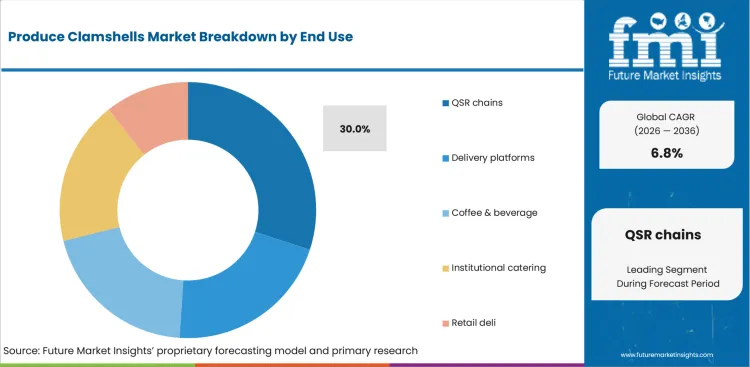
QSR chains turn packaging into an operating standard because one menu item can move through hundreds of locations. A failed container change can slow service and force field teams to manage inconsistent pack-out.
- By end use, QSR chains are forecast to represent 30.0% in 2026 since centralized specifications concentrate repeat demand into approved formats.
- Regional production becomes valuable once the same format must reach many restaurants on a fixed replenishment schedule. Detmold Group opened a Spartanburg facility in July 2026 to supply major QSR customers with locally produced paper-based packaging.
What makes standard formats central to the format type category?
Standard formats limit operational change during a material switch by fitting familiar footprints to shelves and pack-out stations. Multi-site programs value that continuity since every new footprint requires testing and revised distributor case counts.
- By format type, standard formats are estimated to hold 41.0% in 2026 owing to repeatable geometry that limits tooling and distributor-stock changes.
- Rigid foodservice accounts also need proof that a familiar shape can pass common recyclability criteria. In May 2025, Dart Container Corporation earned APR Design for Recyclability recognition for hinged containers with a documented qualification route for rigid-format accounts.
Why do rPET & PP lead the material category?
rPET and PP solve different operating requirements in rigid hinged packaging used for chilled and heat-tolerant foods. Clear rPET preserves product visibility while PP accommodates higher heat exposure or microwave use conditions.
- In 2026, rPET & PP are expected to lead material with 27.0% share because both resins fit established thermoforming and closure practices.
- Foodservice accounts also avoid material changes that force new filling or sealing routines during normal pack-out. Duni Group stated in July 2026 that key Duniform families were shifting to pure PP mono-material construction while preserving intended customer use.
How does standard meal hold the format size lead?
Standard meal formats occupy the high-frequency middle of the size range for prepared food and mixed portions. They provide useful capacity without the storage penalty or rigidity burden of larger family packs.
- Standard meal is projected to hold 43.0% of format size in 2026 attributable to portion capacity and transport efficiency fitting frequent prepared-food service.
- Chilled-food programs need familiar meal-size structures that preserve display visibility and distributor handling during material changes. Graphic Packaging International introduced a European paperboard sushi portfolio in May 2025 with clamshell and tray formats that preserve product visibility.
What are the drivers, restraints and opportunities in the Produce Clamshells Market?
Packaging conversion increases specification work while uneven recovery rules delay one-material rollouts and favor region-ready alternatives.
- Driver: Packaging rules increase specification work for recyclable, recycled-content, reusable, or fiber formats that preserve food protection.
- Restraint: Recovery systems and recyclability classifications differ by jurisdiction, which prevents one material claim from carrying the same commercial meaning everywhere.
- Opportunity: Manufacturers can shorten conversion cycles by keeping proven geometry while offering documented resin, fiber, and reuse routes for regional programs.
Regulatory Conversion Turns Package Design into a Purchasing Requirement
Packaging rules now alter the specification work attached to clamshell material conversion for regulated foodservice accounts. CalRecycle's September 2025 disposal study estimated 75,115 tons of solid-polystyrene hinged containers and related rigid forms in California's annual waste stream. That measured volume places resin choice and recovery documentation beside closure performance during account reviews. Manufacturers gain a clearer repeat-order path when replacement formats preserve incumbent case dimensions.
Recovery Rules Increase Qualification Work
Regional recovery rules can classify the same rigid clamshell differently even when package performance is unchanged. PackUK's September 2025 supplementary guidance says rigid plastic packaging should be classified by its closest format and assesses tray lidding films separately. Separate format classifications increase the evidence package needed before a multi-country clamshell launch receives approval. Operators therefore limit material-specific SKUs when each regional version needs another recyclability assessment.
Stable Geometry Supports Multiple Conversion Routes
A controlled material change has commercial value when the operator keeps the same service routine. Duni Group launched Relevo in Sweden during August 2025 with distributor Carepa and gave foodservice users a borrow-and-return route for reusable takeaway containers. The return system shifts part of the conversion burden into container collection and replenishment logistics. Manufacturers can apply similar regional programs to fiber or compostable foodservice packaging where collection systems accept the chosen format.
Which country CAGRs are profiled in the Produce Clamshells Market?
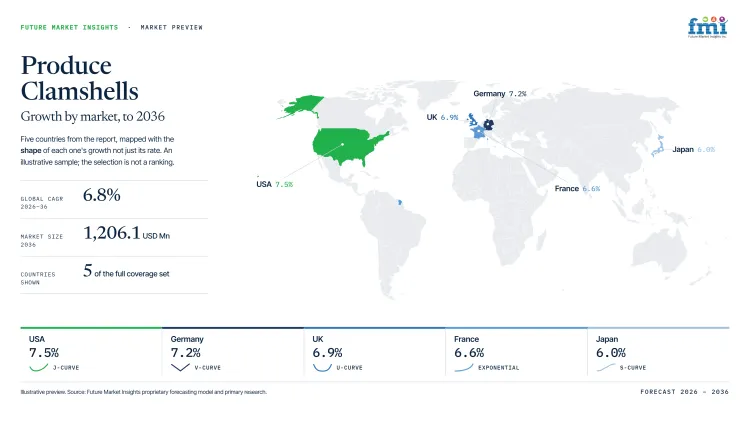
| Country | CAGR |
|---|---|
| UAE | 8.4% |
| South Korea | 7.8% |
| USA | 7.5% |
| Germany | 7.2% |
| UK | 6.9% |
How do country-level CAGRs compare in the Produce Clamshells Market?
The rates span 1.5 percentage points from UAE at 8.4% to the UK at 6.9%. UAE and South Korea form the faster conversion group while USA and Germany occupy a middle band. The UK closes the range as recyclability reporting puts packaging design into producer obligations and disposal-fee calculations.
- UAE deadlines make compliant distributor stock a near-term constraint for foodservice conversion.
- South Korea ties resin traceability to a national virgin-plastic reduction target for 2030.
- USA chains reconcile national case specifications with differing state recovery rules and inventories.
- Germany’s mature dual-system network makes polymer identification central to rigid-package recyclability performance.
- UK RAM ratings place recyclability evidence directly into disposal-fee calculations for packaging.
Similar CAGRs produce different qualification costs and stocking decisions for clamshell manufacturers. The full report provides country-level CAGR analysis across North America, Latin America, Europe, East Asia, South Asia, Oceania and the Middle East and Africa.
Country-wise Analysis
- Dubai foodservice operators enter 2026 with a fixed replacement calendar for several single-use plastic items and previously restricted polystyrene food containers during busy takeaway service. Produce clamshell sales in the UAE are forecast to expand at 8.4% CAGR by 2036 because restaurant groups must qualify compliant alternatives without disrupting routine takeaway service. Dubai Municipality confirmed in December 2025 that the final phase starts on January 1 2026 and extends the ban to additional plates plus cups and lids. Local distributors with approved fiber or reusable-compatible packs can convert Dubai accounts faster as operators need replacements available on normal replenishment schedules.
- South Korean rigid-pack programs increasingly screen recycled-resin traceability before a food-package change reaches production on automated forming lines. The Ministry of Climate Energy and Environment stated in April 2026 that Korea targets a 30% reduction in virgin plastic use by 2030 against projected plastic-waste generation. Adoption of produce clamshells in South Korea is estimated to expand at 7.8% CAGR through 2036 tied to processors scaling documented PET and PP supply. Local resin and converting capacity supports qualification but recycled-feedstock consistency can raise rejection risk during repeat runs. Food processors therefore favor manufacturers that provide traceable resin records and stable batch quality before a recycled-content clamshell enters repeat commercial production.
- National foodservice chains in the USA usually want one approved clamshell case that broadline distributors can replenish for prepared-food and produce programs despite state packaging rules. By 2036, the USA is projected to grow at 7.5% CAGR aided by large restaurant networks and repeat distributor purchasing. The Foodservice Packaging Institute reported in May 2026 that half of respondents expected 2026 volume growth and nearly 40% of North American manufacturers planned corporate expansion. That scale supports standardized case packs although state recovery requirements can fragment national SKU plans and force separate documentation for alternative materials before routine commercial chainwide conversion.
- German takeaway and prepared-food programs operate inside a mature dual-system recycling network that gives package design a measurable recovery test. The German Environment Agency stated in January 2026 that plastic packaging reached a 70% material-recycling rate during 2024. That infrastructure favors clamshells with clear polymer identification and separable components but composite structures face more complicated sorting and recovery checks. Germany is estimated to post 7.2% CAGR over the forecast period reflecting established recovery capacity and continued foodservice packaging replacement. The practical constraint is not collection access but proving that each revised closure or material mix fits sorting rules without weakening food protection.
- UK foodservice packaging programs carry recyclability reporting duties for household packs and formats discarded in bins. PackUK guidance updated in August 2026 requires relevant packaging to be rated red amber or green and confirms those ratings affect disposal fees. Produce clamshell demand in the UK is forecast to rise at 6.9% CAGR over the forecast period given the direct cost link between package design and producer obligations. That rule gives recyclable mono-material formats a commercial enabler but each switch still has to preserve closure strength and temperature performance. The next competitive test is whether manufacturers can document a better RAM rating without forcing restaurant chains to alter pack-out routines.
Who are the notable companies in the Produce Clamshells Market?
Inline Plastics, Amcor, Duni Group, Sabert Corporation, Graphic Packaging International, Novolex, Dart Container Corporation, and Detmold Group are the notable companies profiled in this market.
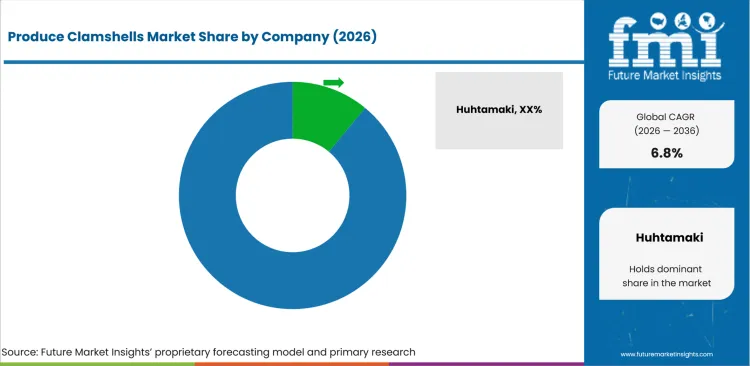
Competition favors manufacturers that qualify several material routes without disrupting high-volume foodservice programs or produce packing lines. Tooling and food-contact controls raise entry barriers since rigid platforms and fiber specialists must preserve closure performance during material changes.
- Scaled rigid platforms: Inline Plastics, Amcor, Sabert Corporation, Novolex, and Dart Container Corporation support repeat programs with documented closure performance and channel fit.
- Fiber conversion platforms: Graphic Packaging International and Detmold Group serve accounts comparing rigid clamshells with fresh produce trays during material changes.
- Takeaway specialist: Duni Group serves foodservice operators that need material transition, sealed meal formats, and reusable service options within one purchasing relationship.
Competitive Benchmarking: Produce Clamshells Market
| Company | Rigid / Hinged Food-Container Depth | Material Transition Options | Foodservice Channel Fit | Geographic Reach |
|---|---|---|---|---|
| Inline Plastics | High | High | Medium | North America |
| Amcor | High | High | High | Global |
| Duni Group | Medium | High | High | Europe plus selected global markets |
| Sabert Corporation | High | High | High | North America, Europe and Asia |
| Graphic Packaging International | Medium | Medium | High | North America and Europe |
| Novolex | High | High | High | North America and Europe |
| Dart Container Corporation | High | High | High | North America |
| Detmold Group | Medium | High | High | Australia, Asia, North America and Middle East |
Scoring basis: High rigid or hinged depth requires two documented food-container families while Medium requires one and Low identifies adjacent coverage. High material-transition options require two verified substrate routes while Medium requires one alternative and Low marks a single-material focus. High foodservice fit requires QSR or multi-site evidence plus distribution support while Medium marks narrower coverage and Low identifies adjacent activity. Geographic reach records operating regions documented in company announcements or public filings from the 2025-2026 evidence window.
Key Developments in the Produce Clamshells Market
- In August 2026, Sabert Corporation opened a 300,000-square-foot Georgia distribution facility serving Southeast foodservice accounts with molded-fiber, paper and plastic packaging.
- In March 2026, Inline Plastics introduced the first black-base 8×6 Safe-T-Chef clamshell with built-in tamper protection for prepared-meal and hot-food programs.
- In April 2025, Novolex completed its combination with Pactiv Evergreen and expanded manufacturing plus channel coverage for multi-site foodservice accounts.
Key Players in the Produce Clamshells Market
Rigid and Multi-Material Packaging Platforms
- Inline Plastics
- Amcor
Takeaway and Rigid Foodservice Specialists
- Duni Group
- Sabert Corporation
Paperboard and Broad Foodservice Platforms
- Graphic Packaging International
- Novolex
Rigid and Fiber Conversion Manufacturers
- Dart Container Corporation
- Detmold Group
Produce Clamshells Market - Report Scope
| Coverage field | Report scope |
|---|---|
| Market breakdown | By format type, material, format size, end use, sales channel and region. |
| Quantitative Units | USD million. |
| Market Definition | Rigid or fiber-based hinged produce and prepared-food clamshell containers supplied through qualified commercial packaging routes. |
| Regions Covered | North America, Latin America, Europe, East Asia, South Asia and Pacific, and Middle East and Africa. |
| Countries Covered | UAE, South Korea, USA, Germany, UK, and 20+ countries included in the full report. |
| Key Companies Profiled | Inline Plastics, Amcor, Duni Group, Sabert Corporation, Graphic Packaging International, Novolex, Dart Container Corporation, Detmold Group. |
| Forecast Period | 2026 to 2036. |
| Approach | Primary and secondary research with market triangulation. |
Produce Clamshells Market - Research Methodology
| Method | Approach |
|---|---|
| Primary Research | FMI analysts gathered input from manufacturers, service providers, technology developers, distributors, end users, procurement teams, and subject-matter experts. Interviews examined purchasing decisions, product or service evaluation, adoption barriers, approval requirements, pricing considerations, and expectations for technical or commercial support. Respondents were also asked what evidence is required before a trial, pilot, or initial order develops into regular purchasing. |
| Desk Research | Desk research covered government statistics, regulatory publications, trade data, industry associations, technical literature, standards, company filings, product information, and official corporate announcements. Sources were reviewed for relevance, publication date, geographic coverage, and consistency with the defined market scope. Claims relating to performance, applications, approvals, capacity, investment, and commercial activity were retained only when supported by credible public evidence. |
| Market Sizing and Forecasting | The market model combined the baseline value with historical performance, segment structure, pricing and volume indicators, adoption levels, company participation, and country-level demand conditions. Forecast assumptions considered economic activity, investment trends, regulatory developments, technology adoption, purchasing cycles, supply availability, and barriers to wider market use. Segment and regional estimates were reconciled before the final market total was calculated. |
| Data Validation | Estimates were checked against multiple independent indicators, including public data, company activity, trade patterns, industry developments, and findings from primary interviews. Validation also tested whether products, services, applications, and company revenues fell within the defined market boundaries. Adjacent categories, unsupported claims, overlapping revenues, and activities without direct market relevance were excluded to reduce double counting and maintain consistency across segments and countries. |
Produce Clamshells Market by Segments
Produce Clamshells Market segmented by Format Type:
- Standard formats
- Recyclable-optimized formats
- Premium & branded formats
- Custom-engineered formats
Produce Clamshells Market segmented by Material:
- rPET & PP
- Molded fiber & bagasse
- Paperboard
- Compostable polymers
- Aluminium
Produce Clamshells Market segmented by Format Size:
- Standard meal
- Single-serve
- Family & catering
Produce Clamshells Market segmented by End Use:
- QSR chains
- Delivery platforms
- Coffee & beverage
- Institutional catering
- Retail deli
Produce Clamshells Market segmented by Sales Channel:
- Broadline foodservice distributors
- Direct chain contracts
- Packaging distributors
- Online
Produce Clamshells Market by Region:
- North America
- United States
- Canada
- Latin America
- Brazil
- Mexico
- Argentina
- Chile
- Western Europe
- Germany
- France
- United Kingdom
- Italy
- Spain
- Benelux
- Nordics
- Eastern Europe
- Poland
- Czech Republic
- Romania
- Hungary
- East Asia
- China
- Japan
- South Korea
- South Asia and Pacific
- India
- ASEAN
- Australia and New Zealand
- Middle East and Africa
- GCC Countries
- South Africa
- Türkiye
- Israel
Research Sources and Bibliography
- California Department of Resources Recycling and Recovery (2025, September 8). Covered Material Categories Reporting Guidance.
- Eurostat (2025, October 10). Packaging waste statistics.
- Dart Container Corporation (2025, May 12). Dart products earn sustainability recognition.
- Duni Group (2026, July 7). Duni Group strengthens recyclability across the Duniform® range.
- Graphic Packaging International (2025, May 14). Graphic Packaging Launches New Portfolio of Paperboard Sushi Packaging To Support Regulatory Compliance of European Foodservice Operators.
- Detmold Group (2026, July 20). Detpak Is Now Manufacturing in the United States.
- California Department of Resources Recycling and Recovery (2025, September 30). What’s in California Landfills: Measuring Single-Use Packaging and Plastic Food Service Ware Disposed Of - Appendix 1.
- PackUK & Department for Environment, Food & Rural Affairs (2025, September 4). Recyclability assessment methodology: supplementary guidance.
- Duni Group (2025, August 19). Duni Group launches Relevo reusable system in Sweden.
- Dubai Municipality (2025, December 24). Dubai to enforce final phase of single-use plastic ban from 2026.
- Ministry of Climate, Energy and Environment, Republic of Korea (2026, April 28). Breaking Free from Oil Imports: Toward a Sustainable, Plastic-Free Circular Economy.
- Foodservice Packaging Institute (2026, May 27). Foodservice Packaging Industry Continues to Stabilize as FPI Releases 2026 State of the Industry Report.
- German Environment Agency & Central Agency Packaging Register (2026, January 27). Facts against myths: Packaging waste recycling in Germany is working.
- Department for Environment, Food & Rural Affairs, Environment Agency, & PackUK (2026, August 19). Check what to report for EPR for packaging as a large producer.
- Sabert Corporation (2026, August 18). Sabert Opens Fifth USA Distribution Facility in Georgia to Meet Growing Customer Demand.
- Inline Plastics (2026, March 20). Inline Plastics Introduces First 8×6 Black-Base Safe-T-Chef® Clamshell with Built-In Tamper Protection.
- Novolex (2025, April 1). Novolex and Pactiv Evergreen Inc. Complete Combination, Creating a Leading Manufacturer in Food, Beverage and Specialty Packaging.
- Amcor (2025, June 24). Amcor and Cofigeo partner to create multi-compartment tray designed for convenience and sustainability.
- Inline Plastics (2025, August 15). Inline Plastics Introduces Safe-T-Chef® 9×9 Compartmented Containers.
- Inline Plastics (2026, April 6). Inline Plastics Introduces New Safe-T-Fresh® 4-Compartment Clamshell with Anti-Migration Technology.
- Amcor (2026, April 21). Amcor Accelerates All-in-One Fiber Packaging Innovation Through Strategic Collaboration with Metsä Group and G. Mondini.
- Sabert Corporation (2025, September 10). Nuvida Achieves APR PCR Certification for Entire Resin Portfolio, Advancing Circular Economy Goals.
- Huhtamaki (2026, August). Huhtamaki Roadshow Presentation, August-September 2026.
- Duni Group (2026, April 29). Duni Group Wins Two Cooking Awards.
- Inline Plastics (2025, February 10). It’s Time to Mix Things Up! Inline Plastics Launches a New Insert for 7” x 7” Safe-T-Fresh® Squares!
- Placon (2025, March 31). Placon Launches New Dip Cup Container Line.
- Amcor (2026, May 18). Amcor introduces recycle-ready dip cup packaging to help brands meet sustainability regulations.
- Duni Group (2026, May 5). Duni Group launches black paper-based packaging collection that facilitates sorting and contributes to lower climate impact.
- Sabert Corporation (2026, May 19). Sabert to Showcase Multi-Substrate Sustainable Food Packaging Portfolio at IDDBA 2026.
- Graphic Packaging International (2025, August 20). Graphic Packaging Adds PaperSeal® Pressed MAP Tray to Award-Winning Food Packaging Portfolio.
- Novolex (2025, May 1). Eco-Products and DNO Produce Help Bring Environmental Sustainability to K-12 School Cafeterias.
- Dart Container Corporation (2025, June 5). Score! Dart reusables in play at pro soccer venue.
- Inline Plastics (2026, August 18). Inline Plastics Expands Bakery Portfolio with New Package for Tarts, Quiches, and Pies.
This bibliography is provided for reader reference and is not exhaustive. The full report contains the complete reference list and detailed citations
This Report Answers
- What is the produce clamshells market size in 2026 and 2036?
- Why do standard formats lead the format type category?
- How do rPET and PP affect rigid clamshell material selection?
- Why do standard meal formats lead the format size category?
- How do QSR chains shape repeat clamshell specifications?
- Which profiled countries have the highest produce clamshell CAGRs?
- How do local recovery systems alter material qualification?
- Which companies compete in rigid, fiber, paperboard, and reusable packaging routes?
- What should commercial teams compare before a clamshell material conversion?
Frequently Asked Questions
How big is the produce clamshells market in 2026?
The produce clamshells market is valued at USD 624.7 million in 2026 and is projected to reach USD 1,206.1 million by 2036. Growth comes from material conversions that preserve closure performance while changing resin or fiber content.
What is the CAGR of the produce clamshells market from 2026 to 2036?
The produce clamshells market is projected to grow at a CAGR of 6.8% between 2026 and 2036. Expansion is supported by foodservice replacement demand and packaging rules that increase specification work for documented material choices.
Which format type leads the produce clamshells market?
The standard formats segment is expected to hold 41.0% of the produce clamshells market in 2026, driven by repeatable footprints that reduce tooling changes and distributor-stock disruption. Familiar geometry also shortens qualification work during resin or fiber conversion without changing pack-out dimensions.
Which countries are projected to record the highest growth in the produce clamshells market?
UAE is projected to grow at 8.4% CAGR, followed by South Korea at 7.8% and the USA at 7.5% through 2036. Faster conversion schedules and repeat foodservice purchasing support growth in these profiled countries with active packaging transitions.
Which companies are active in the produce clamshells market?
Key companies operating in the produce clamshells market include Inline Plastics, Amcor, Duni Group, Sabert Corporation, Graphic Packaging International, Novolex, Dart Container Corporation, and Detmold Group. These companies compete by matching material choice with closure engineering while supporting foodservice distribution and regional conversions.
Preview the report firsthand - request a free sample
Get SampleGet the brochure for pricing and purchase details.
Get PDFTable of Content
- Key Takeaways
- Market Size and CAGR
- Top Growth Driver
- Fastest Growing Segment
- Leading Region
- Key Companies
- Emerging Opportunities
- Executive Summary
- Global Market Outlook
- Demand-side Trends
- Supply-side Trends
- Technology Roadmap Analysis
- Analysis and Recommendations
- Analyst Perspective (What is happening? Why now? What should investors know?)
- Key Questions Answered
- How large is the market?
- What is the CAGR?
- What are key trends?
- Which region dominates?
- Who are the leaders?
- Market Overview
- Market Coverage / Taxonomy
- Market Definition / Scope / Limitations
- Research Methodology
- Chapter Orientation
- Analytical Lens and Working Hypotheses
- Market Structure, Signals, and Trend Drivers
- Benchmarking and Cross-market Comparability
- Market Sizing, Forecasting, and Opportunity Mapping
- Research Design and Evidence Framework
- Desk Research Programme (Secondary Evidence)
- Expert Input and Fieldwork (Primary Evidence)
- Tooling, Models, and Reference Databases
- Data Engineering and Model Build
- Quality Assurance and Audit Trail
- Market Background
- Market Dynamics (Drivers, Restraints, Opportunity, Trends)
- Scenario Forecast (Optimistic, Likely, Conservative)
- Impact Analysis
- AI Impact
- Sustainability Impact
- Regulatory Impact
- Technology Impact
- Consumer / Buyer Analysis
- Purchase Drivers
- Adoption Barriers
- Buyer Journey
- Opportunity Map Analysis
- Product Life Cycle Analysis
- Supply Chain Analysis
- Investment Feasibility Matrix
- Value Chain Analysis
- PESTLE and Porter's Analysis
- Regulatory Landscape
- Regional Parent Market Outlook
- Production and Consumption Statistics
- Import and Export Statistics
- Global Market Analysis and Forecast, 2021 to 2036
- Historical Market Size Value (USD Million) Analysis, 2021 to 2025
- Current and Future Market Size Value (USD Million) Projections, 2026 to 2036
- Y-o-Y Growth Trend Analysis
- Absolute $ Opportunity Analysis
- Global Market Pricing Analysis, 2021 to 2036
- Global Market Analysis and Forecast, By Format Type, 2021 to 2036
- Introduction / Key Findings
- Historical Market Size Value (USD Million) Analysis By Format Type, 2021 to 2025
- Current and Future Market Size Value (USD Million) Analysis and Forecast By Format Type, 2026 to 2036
- Standard formats
- Recyclable-optimized formats
- Premium & branded formats
- Custom-engineered formats
- Standard formats
- Y-o-Y Growth Trend Analysis By Format Type, 2021 to 2025
- Absolute $ Opportunity Analysis By Format Type, 2026 to 2036
- Global Market Analysis and Forecast, By Material, 2021 to 2036
- Introduction / Key Findings
- Historical Market Size Value (USD Million) Analysis By Material, 2021 to 2025
- Current and Future Market Size Value (USD Million) Analysis and Forecast By Material, 2026 to 2036
- rPET & PP
- Molded fiber & bagasse
- Paperboard
- Compostable polymers
- Aluminium
- rPET & PP
- Y-o-Y Growth Trend Analysis By Material, 2021 to 2025
- Absolute $ Opportunity Analysis By Material, 2026 to 2036
- Global Market Analysis and Forecast, By Format Size, 2021 to 2036
- Introduction / Key Findings
- Historical Market Size Value (USD Million) Analysis By Format Size, 2021 to 2025
- Current and Future Market Size Value (USD Million) Analysis and Forecast By Format Size, 2026 to 2036
- Standard meal
- Single-serve
- Family & catering
- Standard meal
- Y-o-Y Growth Trend Analysis By Format Size, 2021 to 2025
- Absolute $ Opportunity Analysis By Format Size, 2026 to 2036
- Global Market Analysis and Forecast, By End Use, 2021 to 2036
- Introduction / Key Findings
- Historical Market Size Value (USD Million) Analysis By End Use, 2021 to 2025
- Current and Future Market Size Value (USD Million) Analysis and Forecast By End Use, 2026 to 2036
- QSR chains
- Delivery platforms
- Coffee & beverage
- Institutional catering
- Retail deli
- QSR chains
- Y-o-Y Growth Trend Analysis By End Use, 2021 to 2025
- Absolute $ Opportunity Analysis By End Use, 2026 to 2036
- Global Market Analysis and Forecast, By Sales Channel, 2021 to 2036
- Introduction / Key Findings
- Historical Market Size Value (USD Million) Analysis By Sales Channel, 2021 to 2025
- Current and Future Market Size Value (USD Million) Analysis and Forecast By Sales Channel, 2026 to 2036
- Broadline foodservice distributors
- Direct chain contracts
- Packaging distributors
- Online
- Broadline foodservice distributors
- Y-o-Y Growth Trend Analysis By Sales Channel, 2021 to 2025
- Absolute $ Opportunity Analysis By Sales Channel, 2026 to 2036
- Global Market Analysis and Forecast, By Region, 2021 to 2036
- Introduction
- Historical Market Size Value (USD Million) Analysis By Region, 2021 to 2025
- Current Market Size Value (USD Million) Analysis and Forecast By Region, 2026 to 2036
- North America
- Latin America
- Western Europe
- Eastern Europe
- East Asia
- South Asia and Pacific
- Middle East & Africa
- Market Attractiveness Analysis By Region
- North America Market Analysis and Forecast, By Country, 2021 to 2036
- Historical Market Size Value (USD Million) Trend Analysis By Market Taxonomy, 2021 to 2025
- Market Size Value (USD Million) Forecast By Market Taxonomy, 2026 to 2036
- By Country
- USA
- Canada
- By Format Type
- By Material
- By Format Size
- By End Use
- By Sales Channel
- By Country
- Market Attractiveness Analysis
- By Country
- By Format Type
- By Material
- By Format Size
- By End Use
- By Sales Channel
- Key Takeaways
- Latin America Market Analysis and Forecast, By Country
- Historical Market Size Value (USD Million) Trend Analysis By Market Taxonomy, 2021 to 2025
- Market Size Value (USD Million) Forecast By Market Taxonomy, 2026 to 2036
- By Country
- Brazil
- Mexico
- Chile
- Rest of Latin America
- By Format Type
- By Material
- By Format Size
- By End Use
- By Sales Channel
- By Country
- Market Attractiveness Analysis
- By Country
- By Format Type
- By Material
- By Format Size
- By End Use
- By Sales Channel
- Key Takeaways
- Western Europe Market Analysis and Forecast, By Country
- Historical Market Size Value (USD Million) Trend Analysis By Market Taxonomy, 2021 to 2025
- Market Size Value (USD Million) Forecast By Market Taxonomy, 2026 to 2036
- By Country
- Germany
- UK
- Italy
- Spain
- France
- Nordic
- BENELUX
- Rest of Western Europe
- By Format Type
- By Material
- By Format Size
- By End Use
- By Sales Channel
- By Country
- Market Attractiveness Analysis
- By Country
- By Format Type
- By Material
- By Format Size
- By End Use
- By Sales Channel
- Key Takeaways
- Eastern Europe Market Analysis and Forecast, By Country
- Historical Market Size Value (USD Million) Trend Analysis By Market Taxonomy, 2021 to 2025
- Market Size Value (USD Million) Forecast By Market Taxonomy, 2026 to 2036
- By Country
- Russia
- Poland
- Hungary
- Balkan & Baltic
- Rest of Eastern Europe
- By Format Type
- By Material
- By Format Size
- By End Use
- By Sales Channel
- By Country
- Market Attractiveness Analysis
- By Country
- By Format Type
- By Material
- By Format Size
- By End Use
- By Sales Channel
- Key Takeaways
- East Asia Market Analysis and Forecast, By Country
- Historical Market Size Value (USD Million) Trend Analysis By Market Taxonomy, 2021 to 2025
- Market Size Value (USD Million) Forecast By Market Taxonomy, 2026 to 2036
- By Country
- China
- Japan
- South Korea
- By Format Type
- By Material
- By Format Size
- By End Use
- By Sales Channel
- By Country
- Market Attractiveness Analysis
- By Country
- By Format Type
- By Material
- By Format Size
- By End Use
- By Sales Channel
- Key Takeaways
- South Asia and Pacific Market Analysis and Forecast, By Country
- Historical Market Size Value (USD Million) Trend Analysis By Market Taxonomy, 2021 to 2025
- Market Size Value (USD Million) Forecast By Market Taxonomy, 2026 to 2036
- By Country
- India
- ASEAN
- Australia & New Zealand
- Rest of South Asia and Pacific
- By Format Type
- By Material
- By Format Size
- By End Use
- By Sales Channel
- By Country
- Market Attractiveness Analysis
- By Country
- By Format Type
- By Material
- By Format Size
- By End Use
- By Sales Channel
- Key Takeaways
- Middle East & Africa Market Analysis and Forecast, By Country
- Historical Market Size Value (USD Million) Trend Analysis By Market Taxonomy, 2021 to 2025
- Market Size Value (USD Million) Forecast By Market Taxonomy, 2026 to 2036
- By Country
- Kingdom of Saudi Arabia
- Other GCC Countries
- Türkiye
- South Africa
- Other African Union
- Rest of Middle East & Africa
- By Format Type
- By Material
- By Format Size
- By End Use
- By Sales Channel
- By Country
- Market Attractiveness Analysis
- By Country
- By Format Type
- By Material
- By Format Size
- By End Use
- By Sales Channel
- Key Takeaways
- Key Countries Market Analysis
- USA
- Pricing Analysis
- Market Share Analysis, 2025
- By Format Type
- By Material
- By Format Size
- By End Use
- By Sales Channel
- Canada
- Pricing Analysis
- Market Share Analysis, 2025
- By Format Type
- By Material
- By Format Size
- By End Use
- By Sales Channel
- Mexico
- Pricing Analysis
- Market Share Analysis, 2025
- By Format Type
- By Material
- By Format Size
- By End Use
- By Sales Channel
- Brazil
- Pricing Analysis
- Market Share Analysis, 2025
- By Format Type
- By Material
- By Format Size
- By End Use
- By Sales Channel
- Chile
- Pricing Analysis
- Market Share Analysis, 2025
- By Format Type
- By Material
- By Format Size
- By End Use
- By Sales Channel
- Germany
- Pricing Analysis
- Market Share Analysis, 2025
- By Format Type
- By Material
- By Format Size
- By End Use
- By Sales Channel
- UK
- Pricing Analysis
- Market Share Analysis, 2025
- By Format Type
- By Material
- By Format Size
- By End Use
- By Sales Channel
- Italy
- Pricing Analysis
- Market Share Analysis, 2025
- By Format Type
- By Material
- By Format Size
- By End Use
- By Sales Channel
- Spain
- Pricing Analysis
- Market Share Analysis, 2025
- By Format Type
- By Material
- By Format Size
- By End Use
- By Sales Channel
- France
- Pricing Analysis
- Market Share Analysis, 2025
- By Format Type
- By Material
- By Format Size
- By End Use
- By Sales Channel
- India
- Pricing Analysis
- Market Share Analysis, 2025
- By Format Type
- By Material
- By Format Size
- By End Use
- By Sales Channel
- ASEAN
- Pricing Analysis
- Market Share Analysis, 2025
- By Format Type
- By Material
- By Format Size
- By End Use
- By Sales Channel
- Australia & New Zealand
- Pricing Analysis
- Market Share Analysis, 2025
- By Format Type
- By Material
- By Format Size
- By End Use
- By Sales Channel
- China
- Pricing Analysis
- Market Share Analysis, 2025
- By Format Type
- By Material
- By Format Size
- By End Use
- By Sales Channel
- Japan
- Pricing Analysis
- Market Share Analysis, 2025
- By Format Type
- By Material
- By Format Size
- By End Use
- By Sales Channel
- South Korea
- Pricing Analysis
- Market Share Analysis, 2025
- By Format Type
- By Material
- By Format Size
- By End Use
- By Sales Channel
- Russia
- Pricing Analysis
- Market Share Analysis, 2025
- By Format Type
- By Material
- By Format Size
- By End Use
- By Sales Channel
- Poland
- Pricing Analysis
- Market Share Analysis, 2025
- By Format Type
- By Material
- By Format Size
- By End Use
- By Sales Channel
- Hungary
- Pricing Analysis
- Market Share Analysis, 2025
- By Format Type
- By Material
- By Format Size
- By End Use
- By Sales Channel
- Kingdom of Saudi Arabia
- Pricing Analysis
- Market Share Analysis, 2025
- By Format Type
- By Material
- By Format Size
- By End Use
- By Sales Channel
- Türkiye
- Pricing Analysis
- Market Share Analysis, 2025
- By Format Type
- By Material
- By Format Size
- By End Use
- By Sales Channel
- South Africa
- Pricing Analysis
- Market Share Analysis, 2025
- By Format Type
- By Material
- By Format Size
- By End Use
- By Sales Channel
- USA
- Market Structure Analysis
- Competition Dashboard
- Competition Benchmarking
- Market Share Analysis of Top Players
- By Regional
- By Format Type
- By Material
- By Format Size
- By End Use
- By Sales Channel
- Emerging Startups
- Innovation Benchmarking
- Competition Analysis
- Competition Deep Dive
- Huhtamaki
- Overview
- Product Portfolio
- Profitability by Market Segments
- Sales Footprint
- Strategy Overview
- Marketing Strategy
- Product Strategy
- Channel Strategy
- Berry Global
- Duni
- Pactiv Evergreen
- Sabert
- Graphic Packaging
- Genpak
- Novolex
- Dart Container
- Detmold Group
- Huhtamaki
- Case Studies
- Success Stories
- Recent Developments
- Competition Deep Dive
- Assumptions & Acronyms Used


