

- Market Size (2026)
- USD 860.7 Mn
- Forecast (2036)
- USD 1512.5 Mn
- CAGR (2026 to 2036)
- 5.8%
How big is Rebar Cutting Machine Market in 2026?
USD 860.7 million in 2026 and USD 1512.5 million by 2036 at a 5.8% CAGR.
Demand for rebar cutting machines is projected to expand at 5.8% CAGR between 2026 and 2036, increasing valuation from USD 860.7 million in 2026 to USD 1512.5 million by 2036. Fabricators and contractors continue to automate repetitive steel-processing tasks to improve productivity and workflow consistency across construction projects.
Market performance depends on the volume of construction activity flowing through fabrication yards and contractor networks. Türkiye is expected to outperform Japan, with growth projected at 5.5% CAGR compared with 4.2% CAGR through 2036. TurkStat reported that construction production increased 7.5% year over year in December 2025. Higher project activity creates additional demand for reinforcing steel processing and equipment utilization. Japan's more mature construction environment places greater emphasis on replacement purchases and productivity upgrades rather than capacity expansion.
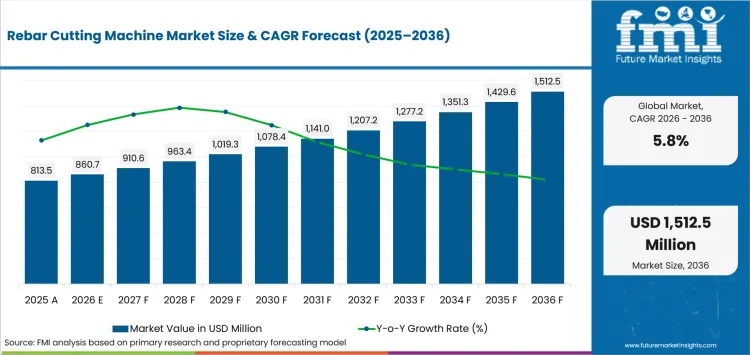
Key Takeaways of Rebar Cutting Machine Market
- Contractors and rebar fabricators increasingly use powered cutters to standardize cut length and cycle timing across recurring reinforcement schedules.
- Based on machine type, bench cutters are projected to account for 28.0% in 2026 due to repeatable cutting from fixed workstations.
- By bar diameter, the 16-32 mm segment is estimated to hold 43.0% in 2026 owing to frequent use across routine structural reinforcement.
- In 2026, electric machines are expected to lead power source with 48.0% share as mains supply supports repeated cutting across organized shifts.
- Steel price movement and uneven project utilization can delay equipment replacement among contractors with uncertain cutting volumes.
- Toyo Kensetsu Kohki Co., Ltd., Ogura & Co., Ltd., BN Products-USA (Benner-Nawman), SIMA, Gensco Equipment, HiKOKI, Schnell S.p.A. and KRB Machinery serve the market.
Analyst Perspective
“Rebar cutting economics depend on matching machine format with bar diameter and the amount of steel processed during a normal shift. Fabrication yards gain more from automated loading once recurring volume keeps fixed cutting equipment productive across scheduled reinforcement batches.”
- Nikhil Kaitwade, Principal Consultant, Future Market Insights
How is the Rebar Cutting Machine Market segmented?
The rebar cutting machine market is segmented by machine type and bar diameter across power source and end use with sales channel and region.
Market taxonomy covers machine type, bar diameter, power source, end use, sales channel, and region for analysis. Machine type includes bench cutters, portable cutters, hydraulic cutters, CNC cutting lines, and battery-powered cutters across fixed or mobile formats. Bar diameter spans below 16 mm, 16-32 mm, 32-50 mm, and above 50 mm across electric, hydraulic, battery, and pneumatic power sources. End use includes building construction, infrastructure contractors, rebar fabrication yards, and precast plants, with equipment dealers, direct manufacturers, rental companies, and retail or online sales channels.
Why does the 16-32 mm category lead demand within bar diameter?
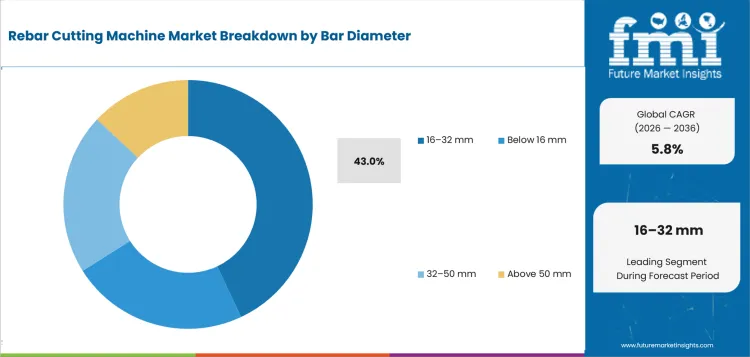
Cutting capacity must cover the bar sizes used most often without adding unnecessary machine weight or higher cutting force. The 16-32 mm range fits routine structural reinforcement across many building and civil fabrication schedules.
- The 16-32 mm segment is projected to hold 43.0% share in 2026 owing to frequent use of mid-range reinforcement.
- Portable machines in this range give site crews broader project coverage without moving to the heaviest cutting systems. Ogura launched the HCC-19MX 40V max cordless rebar cutter in June 2025 for bars up to D20 size. Larger systems cover heavier bars but add mass that mobile crews do not routinely need.
Why do bench cutters lead demand within the machine type category?
Bench cutters suit fabrication yards that repeat measured bar lengths across scheduled reinforcement batches and need stable working positions. Schnell presented the Robomaster 60 UN.O. PRO robotic shaping center at Bauma in April 2025, demonstrating fully automated bending without operator intervention as part of its UN.O. (UNmanned Operation) program.
- Based on machine type, bench cutters are projected to account for 28.0% in 2026 due to fixed workstation repeatability.
- Fixed cutters accept supports and loading equipment that reduce manual repositioning during higher-volume bar schedules and simplify cut-length checks across organized reinforcement shifts. Fabricators comparing metal cutting tools can justify a dedicated station once recurring production keeps the equipment consistently occupied.
Why does electric power lead demand within the power source category?
Ogura launched the HCC-F1640 40V max cordless rebar cutter in June 2025 as another battery-powered field option. Electric machines remain better suited to organized work areas that need repeated cutting across full shifts with predictable mains power.
- By power source, electric machines are forecast to represent 48.0% in 2026 driven by continuous workshop power for repeated cutting.
- Battery models improve mobility but require charging plans during heavier cutting work across dispersed sites. Fabrication teams compare electric power tools against throughput during selection of stationary or mobile formats. Heavy cordless tools suit shorter site sequences as mobility offsets battery rotation during routine work.
Why does building construction lead demand within the end use category?
Building projects create recurring bar-cutting work across foundations and reinforced frames as crews prepare steel to drawing-specific lengths. Portable power tools handle dispersed site cuts and fixed machines serve repeated batches at organized staging areas.
- In 2026, building construction is expected to lead end use with 34.0% share due to recurring reinforcement preparation across projects.
- Residential activity keeps foundation and frame cutting schedules active across contractors and steel crews nationwide. USA Census Bureau reported June 2026 starts at a seasonally adjusted annual rate of 1.427 million. Equipment utilization changes with project sequencing as cutting demand varies across concrete placement stages nationwide.
What are the drivers, restraints and opportunities in the Rebar Cutting Machine Market?
Construction programs sustain recurring cutting work while steel price shifts tighten equipment economics and labor gaps increase interest in automated bar handling.
- Driver: Building and infrastructure schedules reward faster cutting that standardizes bar preparation across recurring reinforcement work.
- Restraint: Steel price changes can delay equipment replacement as contractors reassess project budgets and expected machine utilization.
- Opportunity: Automated feeding and cutting reduce manual transfers across fabrication yards that process repeated bar schedules.
Construction Work Supports Repeatable Cutting Demand
Construction programs generate recurring reinforcement schedules, and Eurostat reported EU construction production increased 1.8% year over year in May 2026 across the bloc. Steadier activity raises cutter utilization and strengthens the case for compact construction equipment across repeated project schedules. Construction equipment attachments face similar utilization tests as contractors compare dedicated tools against expected project workloads.
Steel Price Movement Pressures Equipment Economics
Steel input costs influence project margins and change the timing of equipment purchases across smaller contractors and fabrication businesses. The USA Bureau of Labor Statistics reported steel mill product prices increased 3.6% from May to June 2026. Rental or deferred replacement becomes more practical as uncertain reinforcement costs make equipment utilization harder to forecast.
Labor Gaps Increase the Case for Automated Bar Handling
Fabrication yards can reduce repeated manual transfers by linking bar loading with cutting systems across scheduled production runs. The European Commission reported in December 2025 that 25% to 30% of construction firms said labor shortages limited output. Construction 4.0 systems become more relevant as fabricators seek steadier throughput without expanding manual staffing at the same rate.
Which country CAGRs are profiled in the Rebar Cutting Machine Market?
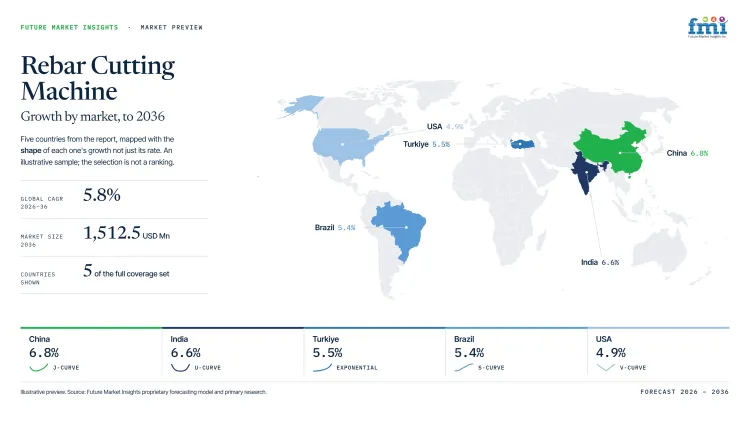
| Country | CAGR |
|---|---|
| China | 6.8% |
| Türkiye | 5.5% |
| Brazil | 5.4% |
| United States | 4.9% |
| Germany | 4.5% |
| Japan | 4.2% |
How do country-level CAGRs compare in the Rebar Cutting Machine Market?
The country comparison spans 2.6 percentage points and reveals three distinct growth groups across the rebar cutting machine market. China leads clearly at 6.8%, while Türkiye and Brazil form a closely aligned middle group separated by 0.1 percentage points. The United States, Germany and Japan form the lower tier, with a 0.7-point gap between the USA and Germany and a 0.3-point gap between Germany and Japan.
- China leads the comparison at a 6.8% CAGR through 2036, supported by large-scale construction activity, infrastructure development and continued investment in automated equipment for high-volume rebar processing.
- Türkiye follows at a 5.5% CAGR, remaining 1.3 percentage points below China. Construction activity, infrastructure projects and demand for efficient reinforcement processing support rebar cutting machine adoption.
- Brazil records a 5.4% CAGR, 0.1 percentage points below Türkiye. Infrastructure development, commercial construction and modernization of construction equipment support steady demand.
- The United States grows at a 4.9% CAGR, creating a 0.5-percentage-point gap from Brazil. Equipment replacement, construction activity and demand for productive job-site machinery provide a stable base for market expansion.
- Germany records a 4.5% CAGR, 0.4 percentage points below the USA. Automation, equipment modernization and precision requirements across construction applications support demand for advanced rebar cutting machines.
- Japan records a 4.2% CAGR, 0.3 percentage points below Germany and the lowest among the profiled countries. Mature construction infrastructure, replacement demand and emphasis on efficient equipment support gradual market growth.
Comparable CAGRs can still produce different market conditions. Differences in construction activity, infrastructure investment, equipment replacement cycles, automation adoption and job-site productivity requirements influence rebar cutting machine demand across countries. The full report provides country-level CAGR analysis across major regions and individual markets within the rebar cutting machine market.
Country-wise Analysis
- Türkiye’s transport pipeline gives infrastructure contractors recurring reinforcement work across roads and dense urban construction that requires measured bar preparation at several project stages ahead of concrete placement during active civil works nationwide. Adoption of rebar cutting machines in Türkiye is estimated to expand at 5.5% CAGR through 2036 supported by the Investment Office reporting USD 16.3 billion for transportation and communications in February 2025. Imported equipment costs and uneven project timing remain frictions for smaller contractors so local dealer inventory and repair coverage can reduce downtime and convert public works activity into steadier machine orders across contractor fleets.
- Brazil’s dispersed construction geography makes regional inventory and repair reach as relevant as cutter capacity for contractors working beyond the largest metropolitan markets and moving machines regularly between distant building and infrastructure jobs. By 2036, Brazil is projected to grow at 5.4% CAGR aided by IBGE reporting 2.5 million construction workers during 2024 in its June 2026 industry release across a broad national operating base. Long service distances and uneven specialist coverage can extend downtime for portable cutters and fixed machines so distributors with mobile repair support and stocked equipment can serve recurring regional project schedules more reliably nationwide.
- United States contractors replace portable cutters and fabrication equipment across housing and civil projects that generate different utilization patterns for rebar preparation machinery across regional fleets and organized fabrication yards plus mobile jobsite crews. United States demand is estimated to post 4.9% CAGR over the forecast period supported by the USA Department of Transportation announcing USD 1.73 billion for nationwide BUILD infrastructure projects in July 2026. High labor costs favor mechanized cutting but varied project cycles make flexible inventory and repair coverage more useful than oversized equipment across every contractor fleet or fabrication operation serving several diverse project types nationwide.
- German contractors and reinforcement fabricators are rebuilding equipment plans as construction orders recover from a weak cycle that delayed machinery replacement decisions and raised scrutiny over capital spending across fabrication operations and contractor fleets. Rebar cutting machine demand in Germany is forecast to rise at 4.5% CAGR over the forecast period shaped by Destatis reporting real main-construction orders increased 6.8% during 2025 across Germany in February 2026. Financing discipline remains a limiting condition so fabrication shops require dependable service and measurable utilization gains to justify higher-cost automated cutting lines or established-machine replacement during planned renewal cycles across annual capital budgets.
- Japanese construction teams work within mature urban building practices that favor compact powered cutters and carefully sequenced reinforcement tasks on constrained sites with limited staging space for larger fabrication equipment across dense project locations. In December 2025, Japan’s Ministry of Land Infrastructure Transport and Tourism reported that about one quarter of construction skilled workers were aged 60 or older across the construction workforce amid ongoing hiring pressures. The Japan rebar cutting machine sector is projected to record 4.2% CAGR during the assessment period shaped by replacement demand for tools that reduce handling effort without adding site complexity across dense projects.
Who are the notable companies in the Rebar Cutting Machine Market?
Toyo Kensetsu Kohki Co., Ltd., Ogura & Co., Ltd., BN Products-USA (Benner-Nawman), SIMA (Sociedad Industrial de Maquinaria Andaluza, S.A.), Gensco Equipment, HiKOKI, Schnell S.p.A., and KRB Machinery.
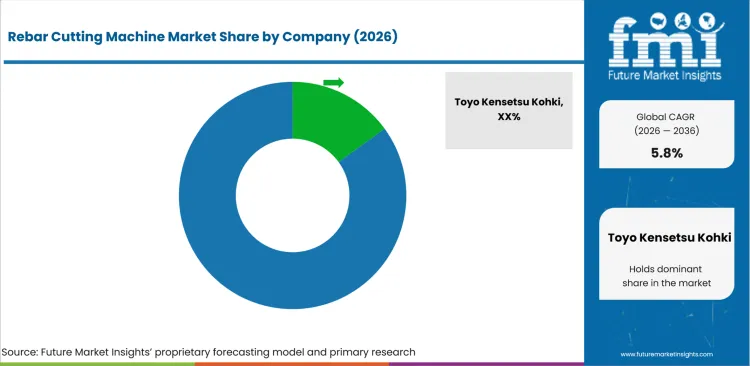
Competition spans rebar fabrication systems and fixed cutting machines alongside electro-hydraulic tools used on construction sites. Fabrication-system companies compete on automation depth and material handling across recurring production schedules, whereas portable-tool companies emphasize mobility and dealer access for moving site work. Service coverage remains a practical entry barrier as cutter downtime interrupts scheduled steel preparation for teams relying on sawing and cutting tools.
- Toyo Kensetsu Kohki, Schnell and KRB Machinery concentrate on automated fabrication equipment with cutting systems and coordinated material handling.
- Ogura, BN Products-USA and HiKOKI focus more heavily on portable powered cutters that construction crews can carry between reinforcement tasks.
- SIMA and Gensco Equipment combine rebar-processing machinery with broader construction equipment ranges and distributor-supported access across regional markets.
Competitive Benchmarking: Rebar Cutting Machine Market
| Company | Cutting Format Breadth | Automation Integration | Portable Cutter Coverage | Geographic Reach |
|---|---|---|---|---|
| Toyo Kensetsu Kohki Co., Ltd. | High | High | Medium | Global |
| Ogura & Co., Ltd. | Medium | Low | High | Global |
| BN Products-USA (Benner-Nawman) | Medium | Low | High | North America and Latin America |
| SIMA | Medium | Medium | Medium | Global |
| Gensco Equipment | High | Medium | High | North America |
| HiKOKI | Low | Low | Medium | Global |
| Schnell S.p.A. | High | High | Low | Global |
| KRB Machinery | High | High | Low | Global |
Key Developments in the Rebar Cutting Machine Market
- In May 2026, Ogura launched the HSC-25MX 40V max cordless tip saw cutter for mobile rebar cutting work across construction and fabrication tasks. The release added another battery-powered format beside its existing electro-hydraulic cutter range for field crews. Site crews gain a portable cutting route for shorter sequences that do not justify moving fixed equipment between work areas.
- In November 2025, KRB Machinery announced a partnership with MEP combining KRB shearlines and automatic bar benders with MEP coil-processing systems for reinforcement fabrication. The companies framed the arrangement around staged automation and smaller equipment footprints inside fabrication yards. Fabricators can add bar and coil capacity in steps as recurring production volume expands across available floor space.
- In October 2025, Schnell S.p.A. detailed its Automatic Factory concept with cutting lines connected to Ground Buffer storage and OPTIFLOW production management for rebar plants. The configuration separates cutting from bending as automated storage manages cut material between production stages. Higher-volume fabrication shops can coordinate bar flow with fewer manual transfers across scheduled production and reduce repeated handling.
Key Players in the Rebar Cutting Machine Market
Automated Rebar Fabrication Systems
- Toyo Kensetsu Kohki Co., Ltd.
- Schnell S.p.A.
- KRB Machinery
Portable Powered Cutting Tools
- Ogura & Co., Ltd.
- BN Products-USA (Benner-Nawman)
- HiKOKI
Construction and Rebar Processing Equipment
- SIMA (Sociedad Industrial de Maquinaria Andaluza, S.A.)
- Gensco Equipment
Rebar Cutting Machine Market - Report Scope
| Coverage field | Report scope |
|---|---|
| Market breakdown | By machine type, bar diameter, power source, end use, sales channel and region. |
| Quantitative Units | Revenue in USD million and CAGR in %. |
| Market Definition | Commercial machines and powered tools used to cut reinforcing steel bars across construction sites, fabrication yards and precast operations. |
| Regions Covered | North America, Latin America, Europe, East Asia, South Asia and Pacific and Middle East and Africa. |
| Countries Covered | Türkiye, Brazil, United States, Germany, Japan and 20+ countries included in the full report. |
| Key Companies Profiled | Toyo Kensetsu Kohki Co., Ltd., Ogura & Co., Ltd., BN Products-USA (Benner-Nawman), SIMA (Sociedad Industrial de Maquinaria Andaluza, S.A.), Gensco Equipment, HiKOKI, Schnell S.p.A., and KRB Machinery. |
| Forecast Period | 2026 to 2036. |
| Approach | Primary and secondary research with market triangulation. |
Rebar Cutting Machine Market - Research Methodology
| Method | Approach |
|---|---|
| Primary Research | FMI analysts gathered input from manufacturers, service providers, technology developers, distributors, end users, procurement teams, and subject-matter experts. Interviews examined purchasing decisions, product or service evaluation, adoption barriers, approval requirements, pricing considerations, and expectations for technical or commercial support. Respondents were also asked what evidence is required before a trial, pilot, or initial order develops into regular purchasing. |
| Desk Research | Desk research covered government statistics, regulatory publications, trade data, industry associations, technical literature, standards, company filings, product information, and official corporate announcements. Sources were reviewed for relevance, publication date, geographic coverage, and consistency with the defined market scope. Claims relating to performance, applications, approvals, capacity, investment, and commercial activity were retained only when supported by credible public evidence. |
| Market Sizing and Forecasting | The market model combined the baseline value with historical performance, segment structure, pricing and volume indicators, adoption levels, company participation, and country-level demand conditions. Forecast assumptions considered economic activity, investment trends, regulatory developments, technology adoption, purchasing cycles, supply availability, and barriers to wider market use. Segment and regional estimates were reconciled before the final market total was calculated. |
| Data Validation | Estimates were checked against multiple independent indicators, including public data, company activity, trade patterns, industry developments, and findings from primary interviews. Validation also tested whether products, services, applications, and company revenues fell within the defined market boundaries. Adjacent categories, unsupported claims, overlapping revenues, and activities without direct market relevance were excluded to reduce double counting and maintain consistency across segments and countries. |
Rebar Cutting Machine Market by Segments
Rebar Cutting Machine Market segmented by Machine Type:
- Bench Cutters
- Portable Cutters
- Hydraulic Cutters
- CNC Cutting Lines
- Battery-powered Cutters
Rebar Cutting Machine Market segmented by Bar Diameter:
- Below 16 mm
- 16-32 mm
- 32-50 mm
- Above 50 mm
Rebar Cutting Machine Market segmented by Power Source:
- Electric
- Hydraulic
- Battery
- Pneumatic
Rebar Cutting Machine Market segmented by End Use:
- Building Construction
- Infrastructure Contractors
- Rebar Fabrication Yards
- Precast Plants
Rebar Cutting Machine Market segmented by Sales Channel:
- Equipment Dealers
- Direct Manufacturer
- Rental Companies
- Retail or Online
Rebar Cutting Machine Market by Region:
- North America
- United States
- Canada
- Latin America
- Brazil
- Mexico
- Chile
- Rest of Latin America
- Western Europe
- Germany
- United Kingdom
- Italy
- Spain
- France
- Nordics
- Benelux
- Rest of Western Europe
- Eastern Europe
- Russia
- Poland
- Hungary
- Balkan and Baltic States
- Rest of Eastern Europe
- East Asia
- China
- Japan
- South Korea
- South Asia and Pacific
- India
- ASEAN
- Australia and New Zealand
- Rest of South Asia and Pacific
- Middle East and Africa
- Kingdom of Saudi Arabia
- Other GCC Countries
- Türkiye
- South Africa
- Other African Union Countries
- Rest of Middle East and Africa
Research Sources and Bibliography
- Toyo Kensetsu Kohki Co., Ltd. (2026, April 27). CSA-180Y4-PHV.
- Turkish Statistical Institute. (2026, February 16). Construction Production Index - December 2025.
- Schnell S.p.A. (2025, April 7). BAUMA 2025.
- Ogura & Co., Ltd. (2025, June 12). Launched the New 40V max Cordless Rebar Cutter: HCC-19MX.
- Ogura & Co., Ltd. (2025, June 4). Launched the New 40V max Cordless Rebar Cutter: HCC-F1640.
- USA Census Bureau. (2026, July 17). MONTHLY NEW RESIDENTIAL CONSTRUCTION, JUNE 2026.
- Eurostat. (2026, July 20). Production in construction up by 0.4% in the euro area and by 0.3% in the EU.
- USA Bureau of Labor Statistics. (2026, July 15). Producer Price Index News Release - 2026 M06 Results.
- European Commission. (2025, December 15). Commission presents new initiatives to support Europe’s construction ecosystem.
- Investment Office of the Presidency of Türkiye. (2025, February 20). Türkiye Allocates USD 46.2 Billion to Public Investments in 2025.
- Brazilian Institute of Geography and Statistics. (2026, June 10). In 2024, Construction Industry generates R$522.5 billion; employs 2.5 million.
- USA Department of Transportation. (2026, July 7). Trump’s Transportation Secretary Sean P. Duffy Invests $1.73 Billion in Infrastructure Across America Supporting Jobs and Big, Beautiful Projects.
- Federal Statistical Office of Germany. (2026, February 25). KORREKTUR: Auftragseingang im Bauhauptgewerbe 2025 um 6,8 % höher als im Vorjahr.
- Ministry of Land, Infrastructure, Transport and Tourism of Japan. (2025, December 26).
- Toyo Kensetsu Kohki Co., Ltd. (Retrieved August 10, 2026).
- Ogura & Co., Ltd. (Retrieved August 10, 2026). Company Information - Ogura Industrial Tools -.
- BN Products-USA. (Retrieved August 10, 2026). Learn About Our Company & Products | BN Products-USA, LLC.
- BN Products-USA. (Retrieved August 10, 2026). BN Products-USA, LLC - Professional Contractor Tools.
- Sociedad Industrial de Maquinaria Andaluza, S.A. (Retrieved August 10, 2026). About SIMA | Sima.
- Gensco Equipment. (Retrieved August 10, 2026). About Gensco Equipment.
- HiKOKI. (2025, September 1). Instruction manual - HiKOKI.
- Schnell S.p.A. (Retrieved August 10, 2026). Schnell | SCHNELL.
- KRB Machinery. (Retrieved August 10, 2026). KRB Machinery: Rebar Bending and Shearing Equipment.
- Ogura & Co., Ltd. (2026, May 19). Launched the New 40V max Cordless Tip Saw Cutter: HSC-25MX.
- KRB Machinery. (2025, November 5). Why KRB and MEP Partnered.
- Schnell S.p.A. (2025, October 7). The Schnell Automatic Factory: Total Automation and Zero Waste.
This bibliography is provided for reader reference and is not exhaustive. The full report contains the complete reference list and detailed citations.
This Report Answers
- How large is the rebar cutting machine market in 2026 and what value is projected by 2036?
- Which machine type and bar diameter categories account for the largest approved 2026 shares?
- Why do bench cutters remain useful for fabrication yards that process repetitive reinforcement schedules?
- How do steel prices and construction activity influence rebar cutting machine purchasing decisions?
- Which profiled countries record the fastest and slowest forecast growth during the assessment period?
- How do construction labor constraints change the case for automated bar handling and cutting?
- Which companies serve portable cutting tools and integrated rebar fabrication systems?
- What capabilities separate automated cutting-line companies from portable-tool specialists in this market?
- Which recent company developments are changing rebar cutting automation and cordless equipment options?
Frequently Asked Questions
How big is the rebar cutting machine market in 2026?
The rebar cutting machine market is estimated at USD 860.7 million in 2026 and is projected to reach USD 1,512.5 million by 2036. Growth is driven by increasing mechanization of rebar fabrication and rising construction activity across infrastructure and building projects.
What is the CAGR of the rebar cutting machine market from 2026 to 2036?
The rebar cutting machine market is projected to grow at a CAGR of 5.8% between 2026 and 2036. Expansion is supported by recurring demand for reinforcement processing equipment and the gradual replacement of manual cutting methods.
Which machine type segment is projected to account for 28.0% of the rebar cutting machine market?
Bench cutters are projected to account for 28.0% of the market in 2026. Their leading share is driven by suitability for repetitive cutting tasks and efficient material handling in rebar fabrication facilities.
How much is the rebar cutting machine market projected to add between 2026 and 2036?
The rebar cutting machine market is expected to add USD 651.8 million in value between 2026 and 2036. Growth reflects increasing adoption of powered cutting equipment across construction sites and steel processing operations.
Which companies are active in the rebar cutting machine market?
Key companies operating in the market include Toyo Kensetsu Kohki, Ogura, BN Products-USA, SIMA, Gensco Equipment, HiKOKI, Schnell, and KRB Machinery. These companies provide portable cutters, fabrication equipment, and automated rebar processing systems for construction applications.
Preview the report firsthand - request a free sample
Get SampleGet the brochure for pricing and purchase details.
Get PDFTable of Content
- Key Takeaways
- Market Size and CAGR
- Top Growth Driver
- Fastest Growing Segment
- Leading Region
- Key Companies
- Emerging Opportunities
- Executive Summary
- Global Market Outlook
- Demand-side Trends
- Supply-side Trends
- Technology Roadmap Analysis
- Analysis and Recommendations
- Analyst Perspective (What is happening? Why now? What should investors know?)
- Key Questions Answered
- How large is the market?
- What is the CAGR?
- What are key trends?
- Which region dominates?
- Who are the leaders?
- Market Overview
- Market Coverage / Taxonomy
- Market Definition / Scope / Limitations
- Research Methodology
- Chapter Orientation
- Analytical Lens and Working Hypotheses
- Market Structure, Signals, and Trend Drivers
- Benchmarking and Cross-market Comparability
- Market Sizing, Forecasting, and Opportunity Mapping
- Research Design and Evidence Framework
- Desk Research Programme (Secondary Evidence)
- Expert Input and Fieldwork (Primary Evidence)
- Tooling, Models, and Reference Databases
- Data Engineering and Model Build
- Quality Assurance and Audit Trail
- Market Background
- Market Dynamics (Drivers, Restraints, Opportunity, Trends)
- Scenario Forecast (Optimistic, Likely, Conservative)
- Impact Analysis
- AI Impact
- Sustainability Impact
- Regulatory Impact
- Technology Impact
- Consumer / Buyer Analysis
- Purchase Drivers
- Adoption Barriers
- Buyer Journey
- Opportunity Map Analysis
- Product Life Cycle Analysis
- Supply Chain Analysis
- Investment Feasibility Matrix
- Value Chain Analysis
- PESTLE and Porter's Analysis
- Regulatory Landscape
- Regional Parent Market Outlook
- Production and Consumption Statistics
- Import and Export Statistics
- Global Market Analysis and Forecast, 2021 to 2036
- Historical Market Size Value (USD Million) Analysis, 2021 to 2025
- Current and Future Market Size Value (USD Million) Projections, 2026 to 2036
- Y-o-Y Growth Trend Analysis
- Absolute $ Opportunity Analysis
- Global Market Pricing Analysis, 2021 to 2036
- Global Market Analysis and Forecast, By Machine Type, 2021 to 2036
- Introduction / Key Findings
- Historical Market Size Value (USD Million) Analysis By Machine Type, 2021 to 2025
- Current and Future Market Size Value (USD Million) Analysis and Forecast By Machine Type, 2026 to 2036
- Bench Cutters
- Portable Cutters
- Hydraulic Cutters
- CNC Cutting Lines
- Battery-powered Cutters
- Bench Cutters
- Y-o-Y Growth Trend Analysis By Machine Type, 2021 to 2025
- Absolute $ Opportunity Analysis By Machine Type, 2026 to 2036
- Global Market Analysis and Forecast, By Bar Diameter, 2021 to 2036
- Introduction / Key Findings
- Historical Market Size Value (USD Million) Analysis By Bar Diameter, 2021 to 2025
- Current and Future Market Size Value (USD Million) Analysis and Forecast By Bar Diameter, 2026 to 2036
- 16–32 mm
- Below 16 mm
- 32–50 mm
- Above 50 mm
- 16–32 mm
- Y-o-Y Growth Trend Analysis By Bar Diameter, 2021 to 2025
- Absolute $ Opportunity Analysis By Bar Diameter, 2026 to 2036
- Global Market Analysis and Forecast, By Power Source, 2021 to 2036
- Introduction / Key Findings
- Historical Market Size Value (USD Million) Analysis By Power Source, 2021 to 2025
- Current and Future Market Size Value (USD Million) Analysis and Forecast By Power Source, 2026 to 2036
- Electric
- Hydraulic
- Battery
- Pneumatic
- Electric
- Y-o-Y Growth Trend Analysis By Power Source, 2021 to 2025
- Absolute $ Opportunity Analysis By Power Source, 2026 to 2036
- Global Market Analysis and Forecast, By End Use, 2021 to 2036
- Introduction / Key Findings
- Historical Market Size Value (USD Million) Analysis By End Use, 2021 to 2025
- Current and Future Market Size Value (USD Million) Analysis and Forecast By End Use, 2026 to 2036
- Building Construction
- Infrastructure Contractors
- Rebar Fabrication Yards
- Precast Plants
- Building Construction
- Y-o-Y Growth Trend Analysis By End Use, 2021 to 2025
- Absolute $ Opportunity Analysis By End Use, 2026 to 2036
- Global Market Analysis and Forecast, By Sales Channel, 2021 to 2036
- Introduction / Key Findings
- Historical Market Size Value (USD Million) Analysis By Sales Channel, 2021 to 2025
- Current and Future Market Size Value (USD Million) Analysis and Forecast By Sales Channel, 2026 to 2036
- Equipment Dealers
- Direct Manufacturer
- Rental Companies
- Retail or Online
- Equipment Dealers
- Y-o-Y Growth Trend Analysis By Sales Channel, 2021 to 2025
- Absolute $ Opportunity Analysis By Sales Channel, 2026 to 2036
- Global Market Analysis and Forecast, By Region, 2021 to 2036
- Introduction
- Historical Market Size Value (USD Million) Analysis By Region, 2021 to 2025
- Current Market Size Value (USD Million) Analysis and Forecast By Region, 2026 to 2036
- North America
- Latin America
- Western Europe
- Eastern Europe
- East Asia
- South Asia and Pacific
- Middle East & Africa
- Market Attractiveness Analysis By Region
- North America Market Analysis and Forecast, By Country, 2021 to 2036
- Historical Market Size Value (USD Million) Trend Analysis By Market Taxonomy, 2021 to 2025
- Market Size Value (USD Million) Forecast By Market Taxonomy, 2026 to 2036
- By Country
- USA
- Canada
- By Machine Type
- By Bar Diameter
- By Power Source
- By End Use
- By Sales Channel
- By Country
- Market Attractiveness Analysis
- By Country
- By Machine Type
- By Bar Diameter
- By Power Source
- By End Use
- By Sales Channel
- Key Takeaways
- Latin America Market Analysis and Forecast, By Country
- Historical Market Size Value (USD Million) Trend Analysis By Market Taxonomy, 2021 to 2025
- Market Size Value (USD Million) Forecast By Market Taxonomy, 2026 to 2036
- By Country
- Brazil
- Mexico
- Chile
- Rest of Latin America
- By Machine Type
- By Bar Diameter
- By Power Source
- By End Use
- By Sales Channel
- By Country
- Market Attractiveness Analysis
- By Country
- By Machine Type
- By Bar Diameter
- By Power Source
- By End Use
- By Sales Channel
- Key Takeaways
- Western Europe Market Analysis and Forecast, By Country
- Historical Market Size Value (USD Million) Trend Analysis By Market Taxonomy, 2021 to 2025
- Market Size Value (USD Million) Forecast By Market Taxonomy, 2026 to 2036
- By Country
- Germany
- UK
- Italy
- Spain
- France
- Nordic
- BENELUX
- Rest of Western Europe
- By Machine Type
- By Bar Diameter
- By Power Source
- By End Use
- By Sales Channel
- By Country
- Market Attractiveness Analysis
- By Country
- By Machine Type
- By Bar Diameter
- By Power Source
- By End Use
- By Sales Channel
- Key Takeaways
- Eastern Europe Market Analysis and Forecast, By Country
- Historical Market Size Value (USD Million) Trend Analysis By Market Taxonomy, 2021 to 2025
- Market Size Value (USD Million) Forecast By Market Taxonomy, 2026 to 2036
- By Country
- Russia
- Poland
- Hungary
- Balkan & Baltic
- Rest of Eastern Europe
- By Machine Type
- By Bar Diameter
- By Power Source
- By End Use
- By Sales Channel
- By Country
- Market Attractiveness Analysis
- By Country
- By Machine Type
- By Bar Diameter
- By Power Source
- By End Use
- By Sales Channel
- Key Takeaways
- East Asia Market Analysis and Forecast, By Country
- Historical Market Size Value (USD Million) Trend Analysis By Market Taxonomy, 2021 to 2025
- Market Size Value (USD Million) Forecast By Market Taxonomy, 2026 to 2036
- By Country
- China
- Japan
- South Korea
- By Machine Type
- By Bar Diameter
- By Power Source
- By End Use
- By Sales Channel
- By Country
- Market Attractiveness Analysis
- By Country
- By Machine Type
- By Bar Diameter
- By Power Source
- By End Use
- By Sales Channel
- Key Takeaways
- South Asia and Pacific Market Analysis and Forecast, By Country
- Historical Market Size Value (USD Million) Trend Analysis By Market Taxonomy, 2021 to 2025
- Market Size Value (USD Million) Forecast By Market Taxonomy, 2026 to 2036
- By Country
- India
- ASEAN
- Australia & New Zealand
- Rest of South Asia and Pacific
- By Machine Type
- By Bar Diameter
- By Power Source
- By End Use
- By Sales Channel
- By Country
- Market Attractiveness Analysis
- By Country
- By Machine Type
- By Bar Diameter
- By Power Source
- By End Use
- By Sales Channel
- Key Takeaways
- Middle East & Africa Market Analysis and Forecast, By Country
- Historical Market Size Value (USD Million) Trend Analysis By Market Taxonomy, 2021 to 2025
- Market Size Value (USD Million) Forecast By Market Taxonomy, 2026 to 2036
- By Country
- Kingdom of Saudi Arabia
- Other GCC Countries
- Türkiye
- South Africa
- Other African Union
- Rest of Middle East & Africa
- By Machine Type
- By Bar Diameter
- By Power Source
- By End Use
- By Sales Channel
- By Country
- Market Attractiveness Analysis
- By Country
- By Machine Type
- By Bar Diameter
- By Power Source
- By End Use
- By Sales Channel
- Key Takeaways
- Key Countries Market Analysis
- USA
- Pricing Analysis
- Market Share Analysis, 2025
- By Machine Type
- By Bar Diameter
- By Power Source
- By End Use
- By Sales Channel
- Canada
- Pricing Analysis
- Market Share Analysis, 2025
- By Machine Type
- By Bar Diameter
- By Power Source
- By End Use
- By Sales Channel
- Mexico
- Pricing Analysis
- Market Share Analysis, 2025
- By Machine Type
- By Bar Diameter
- By Power Source
- By End Use
- By Sales Channel
- Brazil
- Pricing Analysis
- Market Share Analysis, 2025
- By Machine Type
- By Bar Diameter
- By Power Source
- By End Use
- By Sales Channel
- Chile
- Pricing Analysis
- Market Share Analysis, 2025
- By Machine Type
- By Bar Diameter
- By Power Source
- By End Use
- By Sales Channel
- Germany
- Pricing Analysis
- Market Share Analysis, 2025
- By Machine Type
- By Bar Diameter
- By Power Source
- By End Use
- By Sales Channel
- UK
- Pricing Analysis
- Market Share Analysis, 2025
- By Machine Type
- By Bar Diameter
- By Power Source
- By End Use
- By Sales Channel
- Italy
- Pricing Analysis
- Market Share Analysis, 2025
- By Machine Type
- By Bar Diameter
- By Power Source
- By End Use
- By Sales Channel
- Spain
- Pricing Analysis
- Market Share Analysis, 2025
- By Machine Type
- By Bar Diameter
- By Power Source
- By End Use
- By Sales Channel
- France
- Pricing Analysis
- Market Share Analysis, 2025
- By Machine Type
- By Bar Diameter
- By Power Source
- By End Use
- By Sales Channel
- India
- Pricing Analysis
- Market Share Analysis, 2025
- By Machine Type
- By Bar Diameter
- By Power Source
- By End Use
- By Sales Channel
- ASEAN
- Pricing Analysis
- Market Share Analysis, 2025
- By Machine Type
- By Bar Diameter
- By Power Source
- By End Use
- By Sales Channel
- Australia & New Zealand
- Pricing Analysis
- Market Share Analysis, 2025
- By Machine Type
- By Bar Diameter
- By Power Source
- By End Use
- By Sales Channel
- China
- Pricing Analysis
- Market Share Analysis, 2025
- By Machine Type
- By Bar Diameter
- By Power Source
- By End Use
- By Sales Channel
- Japan
- Pricing Analysis
- Market Share Analysis, 2025
- By Machine Type
- By Bar Diameter
- By Power Source
- By End Use
- By Sales Channel
- South Korea
- Pricing Analysis
- Market Share Analysis, 2025
- By Machine Type
- By Bar Diameter
- By Power Source
- By End Use
- By Sales Channel
- Russia
- Pricing Analysis
- Market Share Analysis, 2025
- By Machine Type
- By Bar Diameter
- By Power Source
- By End Use
- By Sales Channel
- Poland
- Pricing Analysis
- Market Share Analysis, 2025
- By Machine Type
- By Bar Diameter
- By Power Source
- By End Use
- By Sales Channel
- Hungary
- Pricing Analysis
- Market Share Analysis, 2025
- By Machine Type
- By Bar Diameter
- By Power Source
- By End Use
- By Sales Channel
- Kingdom of Saudi Arabia
- Pricing Analysis
- Market Share Analysis, 2025
- By Machine Type
- By Bar Diameter
- By Power Source
- By End Use
- By Sales Channel
- Türkiye
- Pricing Analysis
- Market Share Analysis, 2025
- By Machine Type
- By Bar Diameter
- By Power Source
- By End Use
- By Sales Channel
- South Africa
- Pricing Analysis
- Market Share Analysis, 2025
- By Machine Type
- By Bar Diameter
- By Power Source
- By End Use
- By Sales Channel
- USA
- Market Structure Analysis
- Competition Dashboard
- Competition Benchmarking
- Market Share Analysis of Top Players
- By Regional
- By Machine Type
- By Bar Diameter
- By Power Source
- By End Use
- By Sales Channel
- Emerging Startups
- Innovation Benchmarking
- Competition Analysis
- Competition Deep Dive
- Toyo Kensetsu Kohki
- Overview
- Product Portfolio
- Profitability by Market Segments
- Sales Footprint
- Strategy Overview
- Marketing Strategy
- Product Strategy
- Channel Strategy
- Ogura
- Benner-Nawman
- SIMA
- Ellsen Machinery
- Jaypee India
- Gensco Equipment
- HiKOKI
- Schnell
- KRB Machinery
- Toyo Kensetsu Kohki
- Case Studies
- Success Stories
- Recent Developments
- Competition Deep Dive
- Assumptions & Acronyms Used


