

- Market Size (2026)
- USD 720.6 Mn
- Forecast (2036)
- USD 1541.4 Mn
- CAGR (2026 to 2036)
- 7.9%
How big is Remote Monitoring Sensors Market in 2026?
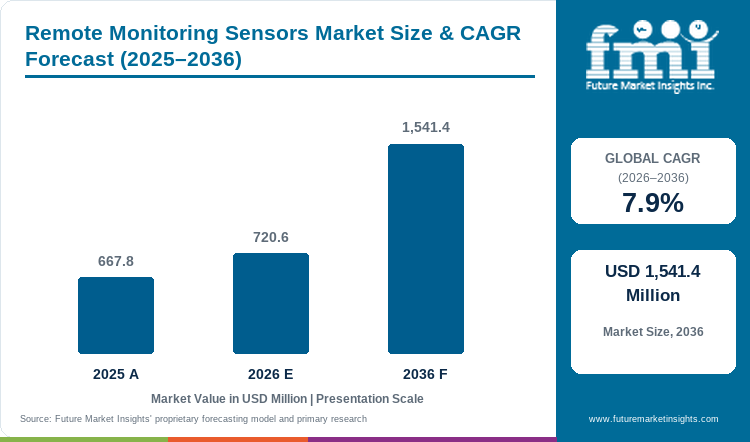
USD 720.6 million in 2026 and USD 1,541.4 million by 2036 at a 7.9% CAGR.
Demand for remote monitoring sensors is projected to expand at 7.9% CAGR between 2026 and 2036, growing from USD 667.8 million in 2025 to USD 720.6 million in 2026, and escalating to USD 1,541.4 million by 2036. Owners buy alerts to catch bilge water, battery or access events before damage spreads. The USA Coast Guard recorded 3,887 recreational boating incidents and about USD 88 million in property damage during 2024. The loss record supports adjacent marine electronics upgrades where onboard systems already collect alert data.
Country conditions separate adoption cases because connectivity, safety exposure and marine service routes differ by operating geography. Canada and Norway convert boating participation and cold-water risk into earlier monitoring interest among boat owners. Australia and the UK require suppliers to prove cellular coverage at berth level before owners rely on alerts. Ofcom reported in May 2026 that good 4G coverage from at least one operator covered 96% of UK landmass while all operators covered 84%. Those coverage differences keep fallback connectivity relevant for remote coasts and offshore storage sites where boats move.
Key Takeaways
- Unattended vessels are raising demand for sensors that turn high-water, battery, access and movement events into actionable alerts.
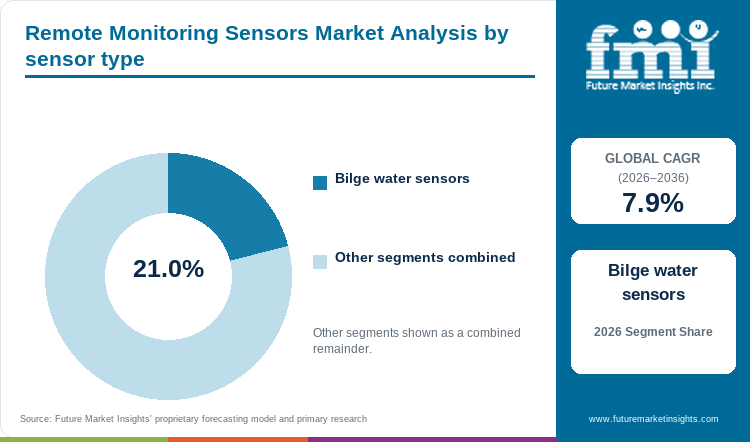
- By sensor type, bilge water sensors are projected to account for 21.0% in 2026 because water ingress can become a loss event between dockside checks.
- In 2026, cellular is expected to hold 31.0% of connectivity demand because many marina and nearshore locations can use established mobile networks.
- By vessel type, recreational boats are forecast to represent 34.0% in 2026 as private owners support retrofit and boatbuilder-embedded sales routes.
- Signal gaps, device power loss and unclear alert responsibility can limit adoption when owners cannot trust the notification path.
- Some of the key players in this market include Siren Marine, Garmin, Yacht Sentinel, Boat Fix, Sentinel Marine Solutions, Victron Energy, Digital Yacht, GOST, Sensar Marine, and Maretron.
Analyst Perspective
"Remote monitoring sensors earn buyer confidence only when the alert path survives real berth conditions and service handoffs. Suppliers that pair low-power sensing with verified connectivity can convert occasional owner interest into repeat hardware and subscription revenue."
- Nikhil Kaitwade, Principal Consultant, Future Market Insights
How is the remote monitoring sensors market segmented?
The market is segmented by sensor type, connectivity, vessel type, function, and sales channel.
The remote monitoring sensors market is segmented by sensor type, connectivity, vessel type, function, sales channel and region. Sensor type covers bilge water, battery, door and hatch, temperature, fuel and level, and security motion sensors used aboard vessels. Connectivity includes cellular, Wi-Fi, Bluetooth, satellite, and LoRa - low-power wireless routes for moving alert data. Vessel type covers recreational boats, yachts, commercial fleets, fishing vessels, and marina-stored boats with different installation conditions. Function includes theft - security, battery health, bilge - flood, engine - environment, and geofence alerts for unattended vessels. Sales channels include telematics platforms, marine dealers, e-commerce - direct, and boat OEM embedded routes.
How do bilge water sensors shape demand within the sensor type category?
Bilge water sensing addresses a failure mode that can escalate before an owner reaches the dock. The device must detect abnormal water early and route the alert to a responsible person. Battery warnings often travel with bilge alerts because pump cycling can drain power before water is noticed, making marine battery sensors relevant to the same service call.
- By sensor type, bilge water sensors are estimated to hold 21.0% in 2026 owing to direct loss-prevention value for unattended boats.
- Owners and service yards specify bilge alerts when pump activity, water level and battery status need one practical notification path.
What supports cellular demand within the connectivity category?
Cellular connectivity fits boats kept in marinas, dry stacks and nearshore locations where owners expect phone-based alerts. Suppliers still need to validate reception at the actual berth because marina structures and local terrain can weaken coverage claims. Australia’s ACMA introduced standardized 4G and 5G coverage-map categories in March 2026, which makes marine communication claims easier to compare before installation.
- In 2026, cellular is expected to lead connectivity with 31.0% share because it fits marina and nearshore monitoring needs.
- Satellite and LoRa - low-power wireless remain practical where coastal travel, storage sites or marina layouts make mobile coverage less dependable.
How do recreational boats influence selection within the vessel type category?
Recreational boats create an installed base in which owners leave vessels unattended for days or weeks. Owners buy monitoring for avoided damage and convenience because most private boats lack continuous professional oversight. Boat Fix announced in October 2025 that Veranda Luxury Pontoons would offer its VIP service with 2026 models, moving recreational boating monitoring into the ownership package.
- By vessel type, recreational boats are forecast to represent 34.0% in 2026 due to a wide retrofit and boatbuilder channel.
- Dealer installation reaches existing owners while boat OEM embedded channels reduce wiring friction at the point of delivery.
What role do theft - security alerts play within the function category?
Theft - security alerts turn vessel movement or entry changes into a response trigger for owners. Owners can verify the event, contact a marina team or escalate to a security service. Viam announced a May 2025 partnership with GOST to add Specter Ai facial recognition and CAN bus data to protected vessels. Visual confirmation makes boat camera systems relevant when owners evaluate security alerts for unattended boats.
- The theft - security alerts segment is likely to capture 22.0% share in 2026 because unauthorized access has a direct response path.
- Suppliers must reduce nuisance alerts before owners trust geofence, hatch, motion or video signals during routine marina use.
What drives telematics platforms within the sales channel category?
Telematics platforms package sensors, connectivity, alert logic and the user interface inside one commercial relationship. Buyers avoid coordinating separate hardware, gateways, data plans and notification workflows before installation begins. Digital Yacht demonstrated Njord Cloud and AI in September 2026 with remote NMEA 2000 viewing, placing marine data loggers closer to the monitoring decision.
- Telematics platforms are set to lead sales channel demand with 32.0% share in 2026 because they reduce buyer assembly work.
- Platform providers can add maintenance cues and sensor inputs after installation when the first alert functions prove reliable.
What are the drivers, restraints, and opportunities in the Remote Monitoring Sensors Market?
Unattended-vessel risk supports demand, power and coverage dependencies restrain confidence, and OEM-embedded multi-network systems widen the revenue path.
- Driver: Owners and fleets want earlier warning when high water, low battery, access events or movement occur without anyone aboard.
- Restraint: Sensor value falls when power, coverage or alert routing fails at the berth or cruising area.
- Opportunity: Boatbuilders and telematics providers can reduce retrofit friction by installing verified sensor and connectivity packages before delivery.
Late discovery of an onboard fault gives owners a practical reason to install remote monitoring sensors. The USA Coast Guard’s 2024 recreational boating statistics recorded 3,887 incidents and about USD 88 million in property damage. Remote sensors cannot prevent every accident, but they shorten response time for bilge water and battery-voltage warnings.
Alert reliability is the binding restraint because the system depends on links outside the sensor itself. ACMA’s 2026 standard requires Australian operators to classify 4G and 5G coverage as good, moderate, basic or no coverage. Owners still need maritime satellite communication or local-wireless fallback when a marina or coastline falls outside dependable cellular service.
Boatbuilder installation improves the opportunity because monitoring enters the boat before wiring access becomes expensive during buildout. Yamaha’s Siren Marine and Dometic announced cloud-based HVAC control in October 2025 for Siren Pro 3 systems. Suppliers that coordinate sensors, power paths and service responsibility can make marine CAN gateways part of an installed package.
Which country CAGRs are profiled in the Remote Monitoring Sensors Market?
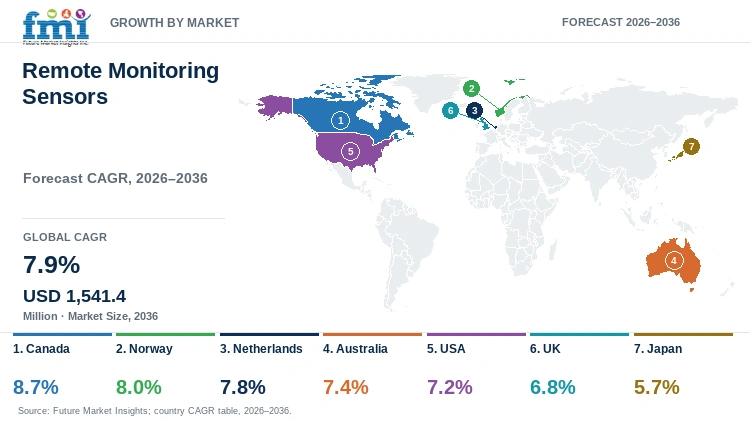
| Country | CAGR |
|---|---|
| Canada | 8.7% |
| Norway | 8.0% |
| Netherlands | 7.8% |
| Australia | 7.4% |
| USA | 7.2% |
| UK | 6.8% |
| Japan | 5.7% |
How do country-level CAGRs compare in the Remote Monitoring Sensors Market?
The profiled country CAGRs span 3.0 percentage points between Canada and Japan in the supplied forecast set. Canada, Norway and the Netherlands form the upper group because participation, coastline conditions and dense marina use create visible alert needs. Australia, the USA and the UK occupy the middle range, while Japan shows slower service-fit conversion.
- Canada’s large recreational boating fleet and improved vessel-registration systems strengthen owner identification and service-response capabilities.
- In Norway, cold-water operations and widely dispersed coastal activity increase demand for low-power monitoring and alert systems.
- The Netherlands combines high recreational-waterway usage with compact marina networks, creating favorable conditions for connected monitoring solutions.
- Australia’s extensive coastal operating routes make communication coverage an important consideration, particularly where mobile-network availability is uneven.
- The USA offers opportunities across both OEM and retrofit channels, although the diversity of vessel types increases integration and commissioning requirements.
- UK operators benefit from widespread 4G connectivity, while remote berths and moorings often require additional communication redundancy.
- Japan favors compact monitoring hardware and specialized installer support tailored to the needs of small-vessel operators.
Comparable CAGRs can still produce different market conditions because the purchase depends on installation route, service coverage and connectivity proof. Country CAGR is a pacing indicator rather than a substitute for installed vessel count. The full report provides country-level CAGR analysis across North America, Latin America, Western Europe, Eastern Europe, East Asia, South Asia and Pacific, and Middle East and Africa.
- Recreational boating activity in Canada spans marinas, lakes, and coastal waters where owners often leave vessels unattended between trips. Supported by growing demand for vessel visibility and response readiness, Canada remote monitoring sensors market is expected to register an 8.7% CAGR through 2036. Transport Canada introduced licensing amendments in January 2026 covering recreational vessel ownership records and licensing administration. Five-year licence validity and 30-day ownership update requirements strengthen vessel identification when disabled or abandoned craft require investigation. Coverage reliability and low-power operation remain important requirements for boats operating outside major population corridors.
- Norwegian boating activity extends across remote coastal routes where delayed response can increase the consequences of undetected vessel problems. Owners operating from seasonal berths and dispersed fjord locations often place greater value on continuous condition monitoring. The Norwegian Maritime Authority recorded 17 fatalities across 15 recreational-craft accidents during the first half of 2026. Small open boats accounted for nearly all fatal incidents during the reporting period. Demand for remote monitoring sensors in Norway is projected to grow at an 8.0% CAGR through 2036 because monitoring technologies support earlier awareness across geographically dispersed boating environments. Power reliability and communication performance remain critical operating requirements for installations serving remote locations.
- Recreational boating in the Netherlands is concentrated across inland waterways and marina networks where pleasure craft frequently share infrastructure with commercial traffic. Security alerts and battery-status visibility become increasingly valuable when large numbers of vessels operate within connected marina environments. Watersportverbond reported in January 2026 that approximately 4.6 million adults participated in watersports during 2024. The breadth of participation expands the addressable market for connected vessel-monitoring solutions. An estimated 7.8% CAGR is projected for the Netherlands remote monitoring sensors sector between 2026 and 2036 as boating participation continues supporting adoption of vessel-awareness technologies. Installation simplicity and dealer support remain important within dense marina settings.
- Australian buyers often evaluate communications coverage before selecting connected monitoring systems because many boating routes extend beyond densely populated regions. Monitoring platforms provide greater value when vessel visibility remains available throughout longer cruising journeys. ACMA introduced standardized mobile-coverage mapping requirements in March 2026. The framework gives installers a clearer basis for evaluating whether cellular solutions fit expected operating locations. The Australian remote monitoring sensors sector is anticipated to advance at a 7.4% CAGR over the assessment period with growth tied to dependable vessel-connectivity requirements. Satellite and local wireless alternatives remain important where monitoring visibility must extend beyond cellular networks.
- Demand in the United States spans private boat owners/ boatbuilders/ dealers/ clubs and service organizations supporting both retrofit and embedded installations. Commercial uptake of remote monitoring sensors in the United States is anticipated to advance at a 7.2% CAGR over the assessment period as a large installed boating fleet continues creating recurring monitoring opportunities. USA Coast Guard statistics recorded 3,887 boating incidents during 2024 alongside approximately USD 88 million in property damage. The diversity of the installed fleet increases integration requirements across multiple vessel configurations. Dealer support remains important because service response often determines the practical value of generated alerts.
- Strong marina coverage and populated coastlines allow many UK boat owners to adopt cellular-first monitoring solutions before considering more complex communication architectures. Ofcom reported in May 2026 that one mobile operator provided good 4G coverage across 96% of UK landmass. Widespread connectivity improves the operating foundation for connected-vessel monitoring. A 6.8% CAGR is projected for the United Kingdom between 2026 and 2036 as boat owners continue adopting remote-awareness technologies across marina and coastal environments. Local berth conditions still require validation because masts, hull materials, and marina structures can affect signal performance.
- Japanese boat owners often prefer compact monitoring systems that fit existing marina and service-yard routines without extensive integration work. Adoption decisions frequently depend on compatibility with established maintenance practices and inspection procedures. MLIT launched a small-vessel safety campaign in April 2026 covering marinas, fishing ports, pleasure boats, fishing vessels, and small passenger craft. The initiative reinforced attention on vessel awareness and safe-operating practices. Adoption of remote monitoring sensors in Japan is forecast to post a 5.7% CAGR between 2026 and 2036 owing to increasing interest in monitoring tools that fit established maintenance workflows. Installer training and documented compatibility remain important before broader deployment occurs.
Who are the notable companies in the Remote Monitoring Sensors Market?
Siren Marine, Garmin, Yacht Sentinel, Boat Fix, Sentinel Marine Solutions, Victron Energy, Digital Yacht, GOST, Sensar Marine and Maretron are the notable companies serving this market.
Competition is split between connected-boat platforms, onboard electronics firms, security specialists and NMEA 2000 integration providers. Entry barriers are practical rather than purely financial because a supplier must prove sensor reliability, mobile or fallback connectivity, app usability and support responsibility at the actual vessel. Adjacent marine OTA platforms also influence boatbuilder discussions after sensors are installed inside connected ownership programs.
- Siren Marine, Yacht Sentinel, Boat Fix and Sentinel Marine Solutions focus on connected-boat platforms with app-based monitoring and service features.
- Garmin, Victron Energy, Digital Yacht and Maretron connect monitoring with chartplotters, power systems, data networks and onboard electronics.
- GOST and Sensar Marine emphasize security-led monitoring, bilge awareness and alert functions for unattended recreational craft.
Competitive Benchmarking: Remote Monitoring Sensors Market
| Company | Sensor and Alert Coverage | Connectivity Breadth | Vessel-System Integration | Geographic Reach |
|---|---|---|---|---|
| Siren Marine | High | High | High | North America and international marine OEM channels |
| Garmin | Medium | High | High | Global |
| Yacht Sentinel | High | High | High | Europe and more than 100 countries |
| Boat Fix | Medium | Medium | High | North America |
| Sentinel Marine Solutions | High | High | Medium | Europe, Americas and Asia through partner channels |
| Victron Energy | Medium | High | High | Global |
| Digital Yacht | Medium | High | High | Europe, North America and international dealers |
| GOST | High | High | Medium | North America and international yacht channels |
| Sensar Marine | Medium | Medium | Medium | North America and selected international users |
| Maretron | High | High | High | North America and global Raymarine channels |
Scoring basis: High sensor and alert coverage requires at least three documented alert groups, Medium requires two and Low identifies one. High connectivity breadth requires mobile plus another remote or local link, while Medium reflects one primary remote path. High vessel-system integration requires confirmed NMEA 2000, chartplotter, power-system or OEM integration evidence, while Medium reflects narrower integration records.
Key Developments in the Remote Monitoring Sensors Market
- In September 2026, Digital Yacht demonstrated its Njord Cloud and AI platform at Cannes Yachting Festival, adding remote NMEA 2000 vessel-data viewing for boatbuilders, technicians and owners.
- In February 2026, Victron Energy released Venus OS 3.70 for GX devices, adding Gobius tank sensor support over Bluetooth and broader marine display integration.
- In October 2025, Siren Marine and Dometic introduced cloud-based HVAC control powered by Siren 3 Pro, extending connected-boat functions beyond alerts into remote cabin control.
Key Players in the Remote Monitoring Sensors Market
Connected-Boat Monitoring Platforms
- Siren Marine
- Yacht Sentinel
- Boat Fix
- Sentinel Marine Solutions
Onboard Electronics and Power-System Integrators
- Garmin
- Victron Energy
- Digital Yacht
- Maretron
Security and Bilge-Focused Monitoring Specialists
- GOST
- Sensar Marine
Remote Monitoring Sensors Market - Report Scope
| Coverage field | Report scope |
|---|---|
| Market breakdown | By sensor type, connectivity, vessel type, function, sales channel and region. |
| Quantitative Units | USD million. |
| Market Definition | Remote monitoring sensors cover onboard devices and connected alert systems that monitor vessel water, power, access, movement, temperature, fuel and status conditions from shore or away from the boat. |
| Regions Covered | North America, Latin America, Western Europe, Eastern Europe, East Asia, South Asia and Pacific, and Middle East and Africa. |
| Countries Covered | Canada, Norway, Netherlands, Australia, USA, UK, Japan, and 30+ countries included in the full report. |
| Key Companies Profiled | Siren Marine, Garmin, Yacht Sentinel, Boat Fix, Sentinel Marine Solutions, Victron Energy, Digital Yacht, GOST, Sensar Marine, Maretron. |
| Forecast Period | 2026 to 2036. |
| Approach | Primary and secondary research with market triangulation. |
Remote Monitoring Sensors Market - Research Methodology
| Method | Approach |
|---|---|
| Primary Research | FMI analysts gathered input from manufacturers, service providers, technology developers, distributors, end users, procurement teams, and subject-matter experts. Interviews examined purchasing decisions, product or service evaluation, adoption barriers, approval requirements, pricing considerations, and expectations for technical or commercial support. Respondents were also asked what evidence is required before a trial, pilot, or initial order develops into regular purchasing. |
| Desk Research | Desk research covered government statistics, regulatory publications, trade data, industry associations, technical literature, standards, company filings, product information, and official corporate announcements. Sources were reviewed for relevance, publication date, geographic coverage, and consistency with the defined market scope. Claims relating to performance, applications, approvals, capacity, investment, and commercial activity were retained only when supported by credible public evidence. |
| Market Sizing and Forecasting | The market model combined the baseline value with historical performance, segment structure, pricing and volume indicators, adoption levels, company participation, and country-level demand conditions. Forecast assumptions considered economic activity, investment trends, regulatory developments, technology adoption, purchasing cycles, supply availability, and barriers to wider market use. Segment and regional estimates were reconciled before the final market total was calculated. |
| Data Validation | Estimates were checked against multiple independent indicators, including public data, company activity, trade patterns, industry developments, and findings from primary interviews. Validation also tested whether products, services, applications, and company revenues fell within the defined market boundaries. Adjacent categories, unsupported claims, overlapping revenues, and activities without direct market relevance were excluded to reduce double counting and maintain consistency across segments and countries. |
Remote Monitoring Sensors Market by Segments
Remote Monitoring Sensors Market segmented by sensor type:
- Bilge water sensors
- Battery sensors
- Door and hatch sensors
- Temperature sensors
- Fuel and level sensors
- Security motion sensors
Remote Monitoring Sensors Market segmented by connectivity:
- Cellular
- Wi-Fi
- Bluetooth
- Satellite
- LoRa - low-power wireless
Remote Monitoring Sensors Market segmented by vessel type:
- Recreational boats
- Yachts
- Commercial fleets
- Fishing vessels
- Marina-stored boats
Remote Monitoring Sensors Market segmented by function:
- Theft - security alerts
- Battery health
- Bilge - flood alerts
- Engine - environment alerts
- Geofence monitoring
Remote Monitoring Sensors Market segmented by sales channel:
- Telematics platforms
- Marine dealers
- E-commerce - direct
- Boat OEM embedded
Remote Monitoring Sensors Market by Region:
- North America
- United States
- Canada
- Latin America
- Brazil
- Mexico
- Argentina
- Chile
- Western Europe
- Germany
- France
- United Kingdom
- Italy
- Spain
- Benelux
- Nordics
- Eastern Europe
- Poland
- Czech Republic
- Romania
- Hungary
- East Asia
- China
- Japan
- South Korea
- South Asia and Pacific
- India
- ASEAN
- Australia and New Zealand
- Middle East and Africa
- GCC Countries
- South Africa
- Türkiye
- Israel
Research Sources and Bibliography
- United States Coast Guard. (2026, September). The official website of the USA Coast Guard’s Boating Safety Division.
- Ofcom. (2026, May 13). Connected Nations update: Spring 2026.
- Australian Communications and Media Authority. (2026, March 31). New rules for mobile phone coverage maps.
- Boat Fix. (2025, October 5). VERANDA LUXURY PONTOONS WITH VIP SERVICE POWERED BY BOAT FIX.
- Viam. (2025, May 20). GOST® Announces Strategic Partnership with VIAM on Specter Ai.
- Digital Yacht. (2026, September 7). Digital Yacht at Cannes Yachting Festival with Njord Cloud AI Demo.
- Yamaha Outboards. (2025, October 7). Siren Marine Collaborates with Dometic to Introduce Connected Boat Cloud-Based HVAC Control.
- Transport Canada. (2026, January 6). Minister of Transport and Leader of the Government in the House of Commons announces changes to make boating safer for Canadians.
- Sjøfartsdirektoratet. (2026, July 1). Alle de 17 omkomne var menn.
- Watersportverbond. (2026, January 27). Recreëren op het water geniet een grote populariteit.
- Ministry of Land, Infrastructure, Transport and Tourism. (2026, April 9). 「小型船舶に対する安全キャンペーン」を実施!.
- Victron Energy. (2026, February 25). Introducing Venus OS 3.70.
- Garmin Newsroom. (2025, November 20). Garmin OnBoard System wins 2025 DAME Design Award.
- Yacht Sentinel. (2025, January 6). Yacht Sentinel Acquires TSM Systems (Tow Pro), Expanding Marine Technology Solutions Portfolio.
- Sentinel Marine Solutions. (2025). 10 Years of Sentinel at METSTRADE: Highlights from Amsterdam 2025.
- Sensar Marine. (2026, July 9). Sensar Marine Teams Up With SailTies to Log Every Voyage Automatically.
- Teledyne Technologies Incorporated. (2025, July 1). Teledyne Acquires Maretron.
This bibliography is provided for reader reference and is not exhaustive. The full report contains the complete reference list and detailed citations
This Report Answers
- What value does the remote monitoring sensors market reach in 2026 and 2036?
- Which sensor, connectivity and vessel segments hold the authorized 2026 shares?
- How do bilge water, battery and security alerts affect unattended-vessel buying decisions?
- Why does cellular connectivity hold an advantage in marina and nearshore monitoring?
- How do country CAGRs differ among Canada, Norway, Netherlands, Australia, USA, UK and Japan?
- Which country mechanisms influence installation, service and fallback-connectivity needs?
- Which companies are active in connected-boat platforms, electronics integration and security-led monitoring?
- How are buyer-relevant criteria used to compare alert coverage, connectivity breadth and vessel integration?
Frequently Asked Questions
How big is the remote monitoring sensors market in 2026?
The remote monitoring sensors market is valued at USD 720.6 million in 2026 and is projected to reach USD 1,541.4 million by 2036. Growth comes from owners using alerts to inspect high-water, battery and access events between physical checks.
What is the CAGR of the remote monitoring sensors market from 2026 to 2036?
The remote monitoring sensors market is projected to grow at a CAGR of 7.9% between 2026 and 2036. Expansion depends on connectivity that turns onboard sensor signals into assigned service action for unattended boats.
Which sensor type leads the remote monitoring sensors market?
The bilge water sensors segment is expected to hold 21.0% of the remote monitoring sensors market in 2026, supported by the loss-prevention value of early water detection. Owners prioritize alerts that arrive before scheduled dockside inspection can reveal costly water ingress.
Which connectivity segment leads the remote monitoring sensors market?
The cellular segment is expected to hold 31.0% of the remote monitoring sensors market in 2026, attributable to marina and nearshore use cases. Suppliers need berth-level coverage checks before owners rely on alerts during storage or seasonal mooring.
Which countries are projected to record above-average growth in the remote monitoring sensors market?
Canada is forecast to grow at 8.7% CAGR, followed by Norway at 8.0% and the Netherlands at 7.8% through 2036. Growth is linked to boating participation, coastal risk and marina monitoring needs that differ by country.
Which companies are active in the remote monitoring sensors market?
Key companies operating in the market include Siren Marine, Garmin, Yacht Sentinel, Boat Fix, Sentinel Marine Solutions, Victron Energy, Digital Yacht, GOST, Sensar Marine, and Maretron. These companies compete on sensor coverage, connectivity breadth and vessel integration support for recreational and light-commercial buyers.
Preview the report firsthand - request a free sample
Get SampleGet the brochure for pricing and purchase details.
Get PDFTable of Content
- Key Takeaways
- Market Size and CAGR
- Top Growth Driver
- Fastest Growing Segment
- Leading Region
- Key Companies
- Emerging Opportunities
- Executive Summary
- Global Market Outlook
- Demand-side Trends
- Supply-side Trends
- Technology Roadmap Analysis
- Analysis and Recommendations
- Analyst Perspective (What is happening? Why now? What should investors know?)
- Key Questions Answered
- How large is the market?
- What is the CAGR?
- What are key trends?
- Which region dominates?
- Who are the leaders?
- Market Overview
- Market Coverage / Taxonomy
- Market Definition / Scope / Limitations
- Research Methodology
- Chapter Orientation
- Analytical Lens and Working Hypotheses
- Market Structure, Signals, and Trend Drivers
- Benchmarking and Cross-market Comparability
- Market Sizing, Forecasting, and Opportunity Mapping
- Research Design and Evidence Framework
- Desk Research Programme (Secondary Evidence)
- Expert Input and Fieldwork (Primary Evidence)
- Tooling, Models, and Reference Databases
- Data Engineering and Model Build
- Quality Assurance and Audit Trail
- Market Background
- Market Dynamics (Drivers, Restraints, Opportunity, Trends)
- Scenario Forecast (Optimistic, Likely, Conservative)
- Impact Analysis
- AI Impact
- Sustainability Impact
- Regulatory Impact
- Technology Impact
- Consumer / Buyer Analysis
- Purchase Drivers
- Adoption Barriers
- Buyer Journey
- Opportunity Map Analysis
- Product Life Cycle Analysis
- Supply Chain Analysis
- Investment Feasibility Matrix
- Value Chain Analysis
- PESTLE and Porter's Analysis
- Regulatory Landscape
- Regional Parent Market Outlook
- Production and Consumption Statistics
- Import and Export Statistics
- Global Market Analysis and Forecast, 2021 to 2036
- Historical Market Size Value (USD Million) Analysis, 2021 to 2025
- Current and Future Market Size Value (USD Million) Projections, 2026 to 2036
- Y-o-Y Growth Trend Analysis
- Absolute $ Opportunity Analysis
- Global Market Pricing Analysis, 2021 to 2036
- Global Market Analysis and Forecast, By sensor type, 2021 to 2036
- Introduction / Key Findings
- Historical Market Size Value (USD Million) Analysis By sensor type, 2021 to 2025
- Current and Future Market Size Value (USD Million) Analysis and Forecast By sensor type, 2026 to 2036
- Bilge water sensors
- Battery sensors
- Door and hatch sensors
- Temperature sensors
- Fuel and level sensors
- Security motion sensors
- Y-o-Y Growth Trend Analysis By sensor type, 2021 to 2025
- Absolute $ Opportunity Analysis By sensor type, 2026 to 2036
- Global Market Analysis and Forecast, By connectivity, 2021 to 2036
- Introduction / Key Findings
- Historical Market Size Value (USD Million) Analysis By connectivity, 2021 to 2025
- Current and Future Market Size Value (USD Million) Analysis and Forecast By connectivity, 2026 to 2036
- Cellular
- Wi-Fi
- Bluetooth
- Satellite
- LoRa - low-power wireless
- Y-o-Y Growth Trend Analysis By connectivity, 2021 to 2025
- Absolute $ Opportunity Analysis By connectivity, 2026 to 2036
- Global Market Analysis and Forecast, By vessel type, 2021 to 2036
- Introduction / Key Findings
- Historical Market Size Value (USD Million) Analysis By vessel type, 2021 to 2025
- Current and Future Market Size Value (USD Million) Analysis and Forecast By vessel type, 2026 to 2036
- Recreational boats
- Yachts
- Commercial fleets
- Fishing vessels
- Marina-stored boats
- Y-o-Y Growth Trend Analysis By vessel type, 2021 to 2025
- Absolute $ Opportunity Analysis By vessel type, 2026 to 2036
- Global Market Analysis and Forecast, By function, 2021 to 2036
- Introduction / Key Findings
- Historical Market Size Value (USD Million) Analysis By function, 2021 to 2025
- Current and Future Market Size Value (USD Million) Analysis and Forecast By function, 2026 to 2036
- Theft - security alerts
- Battery health
- Bilge - flood alerts
- Engine - environment alerts
- Geofence monitoring
- Y-o-Y Growth Trend Analysis By function, 2021 to 2025
- Absolute $ Opportunity Analysis By function, 2026 to 2036
- Global Market Analysis and Forecast, By sales channel, 2021 to 2036
- Introduction / Key Findings
- Historical Market Size Value (USD Million) Analysis By sales channel, 2021 to 2025
- Current and Future Market Size Value (USD Million) Analysis and Forecast By sales channel, 2026 to 2036
- Telematics platforms
- Marine dealers
- E-commerce - direct
- Boat OEM embedded
- Y-o-Y Growth Trend Analysis By sales channel, 2021 to 2025
- Absolute $ Opportunity Analysis By sales channel, 2026 to 2036
- Global Market Analysis and Forecast, By Region, 2021 to 2036
- Introduction
- Historical Market Size Value (USD Million) Analysis By Region, 2021 to 2025
- Current Market Size Value (USD Million) Analysis and Forecast By Region, 2026 to 2036
- North America
- Latin America
- Western Europe
- Eastern Europe
- East Asia
- South Asia and Pacific
- Middle East and Africa
- Market Attractiveness Analysis By Region
- North America Market Analysis and Forecast, By Country, 2021 to 2036
- Historical Market Size Value (USD Million) Trend Analysis By Market Taxonomy, 2021 to 2025
- Market Size Value (USD Million) Forecast By Market Taxonomy, 2026 to 2036
- By Country
- United States
- Canada
- By sensor type
- By connectivity
- By vessel type
- By function
- By sales channel
- By Country
- Market Attractiveness Analysis
- By Country
- By sensor type
- By connectivity
- By vessel type
- By function
- By sales channel
- Key Takeaways
- Latin America Market Analysis and Forecast, By Country
- Historical Market Size Value (USD Million) Trend Analysis By Market Taxonomy, 2021 to 2025
- Market Size Value (USD Million) Forecast By Market Taxonomy, 2026 to 2036
- By Country
- Brazil
- Mexico
- Argentina
- Chile
- By sensor type
- By connectivity
- By vessel type
- By function
- By sales channel
- By Country
- Market Attractiveness Analysis
- By Country
- By sensor type
- By connectivity
- By vessel type
- By function
- By sales channel
- Key Takeaways
- Western Europe Market Analysis and Forecast, By Country
- Historical Market Size Value (USD Million) Trend Analysis By Market Taxonomy, 2021 to 2025
- Market Size Value (USD Million) Forecast By Market Taxonomy, 2026 to 2036
- By Country
- Germany
- France
- United Kingdom
- Italy
- Spain
- Benelux
- Nordics
- By sensor type
- By connectivity
- By vessel type
- By function
- By sales channel
- By Country
- Market Attractiveness Analysis
- By Country
- By sensor type
- By connectivity
- By vessel type
- By function
- By sales channel
- Key Takeaways
- Eastern Europe Market Analysis and Forecast, By Country
- Historical Market Size Value (USD Million) Trend Analysis By Market Taxonomy, 2021 to 2025
- Market Size Value (USD Million) Forecast By Market Taxonomy, 2026 to 2036
- By Country
- Poland
- Czech Republic
- Romania
- Hungary
- By sensor type
- By connectivity
- By vessel type
- By function
- By sales channel
- By Country
- Market Attractiveness Analysis
- By Country
- By sensor type
- By connectivity
- By vessel type
- By function
- By sales channel
- Key Takeaways
- East Asia Market Analysis and Forecast, By Country
- Historical Market Size Value (USD Million) Trend Analysis By Market Taxonomy, 2021 to 2025
- Market Size Value (USD Million) Forecast By Market Taxonomy, 2026 to 2036
- By Country
- China
- Japan
- South Korea
- By sensor type
- By connectivity
- By vessel type
- By function
- By sales channel
- By Country
- Market Attractiveness Analysis
- By Country
- By sensor type
- By connectivity
- By vessel type
- By function
- By sales channel
- Key Takeaways
- South Asia and Pacific Market Analysis and Forecast, By Country
- Historical Market Size Value (USD Million) Trend Analysis By Market Taxonomy, 2021 to 2025
- Market Size Value (USD Million) Forecast By Market Taxonomy, 2026 to 2036
- By Country
- India
- ASEAN
- Australia and New Zealand
- By sensor type
- By connectivity
- By vessel type
- By function
- By sales channel
- By Country
- Market Attractiveness Analysis
- By Country
- By sensor type
- By connectivity
- By vessel type
- By function
- By sales channel
- Key Takeaways
- Middle East and Africa Market Analysis and Forecast, By Country
- Historical Market Size Value (USD Million) Trend Analysis By Market Taxonomy, 2021 to 2025
- Market Size Value (USD Million) Forecast By Market Taxonomy, 2026 to 2036
- By Country
- GCC Countries
- South Africa
- Türkiye
- Israel
- By sensor type
- By connectivity
- By vessel type
- By function
- By sales channel
- By Country
- Market Attractiveness Analysis
- By Country
- By sensor type
- By connectivity
- By vessel type
- By function
- By sales channel
- Key Takeaways
- Key Countries Market Analysis
- United States
- Pricing Analysis
- Market Share Analysis, 2025
- By sensor type
- By connectivity
- By vessel type
- By function
- By sales channel
- Canada
- Pricing Analysis
- Market Share Analysis, 2025
- By sensor type
- By connectivity
- By vessel type
- By function
- By sales channel
- Mexico
- Pricing Analysis
- Market Share Analysis, 2025
- By sensor type
- By connectivity
- By vessel type
- By function
- By sales channel
- Brazil
- Pricing Analysis
- Market Share Analysis, 2025
- By sensor type
- By connectivity
- By vessel type
- By function
- By sales channel
- Chile
- Pricing Analysis
- Market Share Analysis, 2025
- By sensor type
- By connectivity
- By vessel type
- By function
- By sales channel
- Germany
- Pricing Analysis
- Market Share Analysis, 2025
- By sensor type
- By connectivity
- By vessel type
- By function
- By sales channel
- United Kingdom
- Pricing Analysis
- Market Share Analysis, 2025
- By sensor type
- By connectivity
- By vessel type
- By function
- By sales channel
- Italy
- Pricing Analysis
- Market Share Analysis, 2025
- By sensor type
- By connectivity
- By vessel type
- By function
- By sales channel
- Spain
- Pricing Analysis
- Market Share Analysis, 2025
- By sensor type
- By connectivity
- By vessel type
- By function
- By sales channel
- France
- Pricing Analysis
- Market Share Analysis, 2025
- By sensor type
- By connectivity
- By vessel type
- By function
- By sales channel
- India
- Pricing Analysis
- Market Share Analysis, 2025
- By sensor type
- By connectivity
- By vessel type
- By function
- By sales channel
- ASEAN
- Pricing Analysis
- Market Share Analysis, 2025
- By sensor type
- By connectivity
- By vessel type
- By function
- By sales channel
- Australia and New Zealand
- Pricing Analysis
- Market Share Analysis, 2025
- By sensor type
- By connectivity
- By vessel type
- By function
- By sales channel
- China
- Pricing Analysis
- Market Share Analysis, 2025
- By sensor type
- By connectivity
- By vessel type
- By function
- By sales channel
- Japan
- Pricing Analysis
- Market Share Analysis, 2025
- By sensor type
- By connectivity
- By vessel type
- By function
- By sales channel
- South Korea
- Pricing Analysis
- Market Share Analysis, 2025
- By sensor type
- By connectivity
- By vessel type
- By function
- By sales channel
- Poland
- Pricing Analysis
- Market Share Analysis, 2025
- By sensor type
- By connectivity
- By vessel type
- By function
- By sales channel
- Hungary
- Pricing Analysis
- Market Share Analysis, 2025
- By sensor type
- By connectivity
- By vessel type
- By function
- By sales channel
- Türkiye
- Pricing Analysis
- Market Share Analysis, 2025
- By sensor type
- By connectivity
- By vessel type
- By function
- By sales channel
- South Africa
- Pricing Analysis
- Market Share Analysis, 2025
- By sensor type
- By connectivity
- By vessel type
- By function
- By sales channel
- Norway
- Pricing Analysis
- Market Share Analysis, 2025
- By sensor type
- By connectivity
- By vessel type
- By function
- By sales channel
- Netherlands
- Pricing Analysis
- Market Share Analysis, 2025
- By sensor type
- By connectivity
- By vessel type
- By function
- By sales channel
- Australia
- Pricing Analysis
- Market Share Analysis, 2025
- By sensor type
- By connectivity
- By vessel type
- By function
- By sales channel
- United States
- Market Structure Analysis
- Competition Dashboard
- Competition Benchmarking
- Market Share Analysis of Top Players
- By Regional
- By sensor type
- By connectivity
- By vessel type
- By function
- By sales channel
- Emerging Startups
- Innovation Benchmarking
- Competition Analysis
- Competition Deep Dive
- Siren Marine
- Overview
- Product Portfolio
- Profitability by Market Segments
- Sales Footprint
- Strategy Overview
- Marketing Strategy
- Product Strategy
- Channel Strategy
- Garmin
- Yacht Sentinel
- Boat Fix
- Sentinel Marine Solutions
- Victron Energy
- Digital Yacht
- GOST
- Sensar Marine
- Maretron
- Siren Marine
- Case Studies
- Success Stories
- Recent Developments
- Competition Deep Dive
- Assumptions & Acronyms Used


