

- Market Size (2026)
- USD 201.1 Mn
- Forecast (2036)
- USD 333.9 Mn
- CAGR (2026 to 2036)
- 5.2%
How big is Resealable Can Ends Market in 2026?
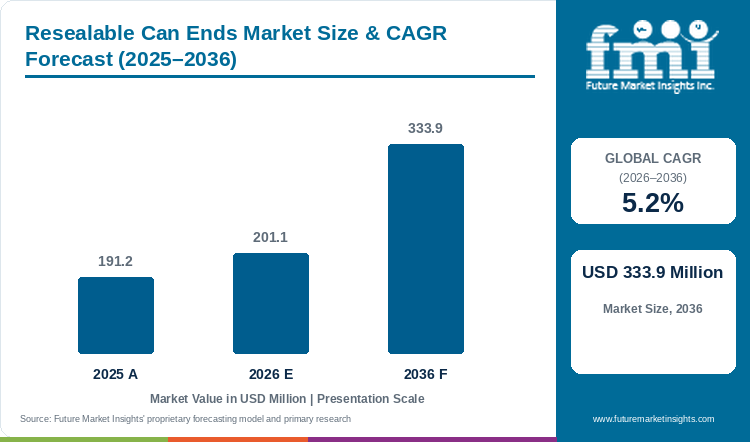
Having recorded a market size of USD 191.2 million in 2025 and moving to USD 201.1 million in 2026, the global resealable can ends market is projected to scale up to USD 333.9 million by the end of 2036, maintaining a 5.2% CAGR.
Beverage and food marketers replacing single-use plastic bottles with recyclable aluminum cans face a stubborn functional drawback, because once a consumer pops a standard stay-on-tab lid, a 473 ml or 500 ml can cannot be closed between sips or stored in a bag without spilling. Resealable can ends solve this portion-control problem and allow aluminum cans to compete head-on against screw-cap PET bottles, yet historical adoption was held back by slow closure assembly speeds and high unit tooling costs. To solve this production bottleneck at the K 2025 trade fair in October 2025, closure developer Xolution in Germany partnered with injection-molding machinery makers Engel and Hack plus automation supplier Ilsemann to run an automated high-cavitation cell for mass-producing XO resealable beverage can ends [1]. Lower per-unit manufacturing costs from automated molding cells lift the global resealable can ends market from a 2025 valuation of USD 191.2 million to a 2026 market size of USD 201.1 million, advancing at a 5.2% CAGR to reach USD 333.9 million by 2036 (USD 132.8 million in net growth). In 2026, standard drop-in formats have a forecast 46.4% share within the format type segment where energy drink co-packers upgrade standard beverage can ends without modifying existing filling turrets.
Key Market Trends & Insights
- By format type: Compatibility with existing 202 and 206 can-filling turrets gives standard drop-in formats a forecast 46.4% share in 2026.
- By material: Precision polyolefin slide seals retain gas pressure between sips, giving aluminum shells with polymer sliders an expected 52.6% share in 2026.
- By capacity: Multi-serving 473 ml and 500 ml energy drink cans resealed on the move give 250-750 ml containers an estimated 58.3% share in 2026.
- By end use: Carbonated energy drink and ready-to-drink coffee portioning puts beverage applications in the lead at a projected 61.5% in 2026.
- By sales channel: Mandatory filling-line seamer trials and migration qualification protocols give direct brand contracts an anticipated 64.2% share in 2026.
Regional Highlights
- North American and Central European leadership: Energy drink can conversions lift the USA by 5.9% CAGR to 2036 above Germany with 5.5% growth, reinforced by domestic closure tooling investment.
- Asian and Middle Eastern progression: Convenience beverage launches push South Korea up 5.3% yearly over the UK (5.1%) and the UAE (4.9%), leaving Saudi Arabia (4.7%) and France (4.5%) above Japan (4.1%).
Market Size & Forecast
Table 1: Market Size and Forecast for the Resealable Can Ends Market (USD million and CAGR percentage), 2025 to 2036
| Metric | Value |
|---|---|
| 2025 Market Size | USD 191.2 million |
| Estimated Market Size in 2026 | USD 201.1 million |
| Projected Market Size by 2036 | USD 333.9 million |
| CAGR, 2026 to 2036 | 5.2% |
| Added Revenue, 2026 to 2036 | USD 132.8 million |
Packaging Extended Producer Responsibility rules in Europe are forcing closure engineers to rethink how polymer sliders and metal shells are joined together. Under older waste rules, attaching a mixed-plastic slider or secondary snap-cap to a metal can carried minimal regulatory penalty, but new design-for-recycling laws penalize composite closures that contaminate metal recovery streams. As a matter of fact, the European Union published Regulation (EU) 2025/40 on packaging and packaging waste (PPWR) in January 2025, establishing binding recyclability performance grades that restrict non-separable mixed-material packaging components by 2030 [2]. Because brand owners want to avoid higher eco-modulated packaging fees, manufacturers supplying caps and closures are accelerating mono-material aluminum reclosure tabs and low-density polyolefin sliders that separate cleanly during furnace remelting.
Reclosable End Shipment Volume and Seaming Line Sizing
Table 2: Reclosable End Shipment Volume and Seaming Line Sizing for the Resealable Can Ends Market (USD million and operational ranges), 2025 to 2036
| Metric | 2025 | 2026 | 2036 |
|---|---|---|---|
| Market size (USD million) | 191.2 | 201.1 | 333.9 |
| Commercial resealable can ends shipped (billion units) | 3.1 to 3.5 | 3.3 to 3.7 | 5.3 to 6.0 |
| Qualified high-speed seaming lines globally (lines) | 165 to 190 | 175 to 205 | 310 to 355 |
| Average wholesale price per 1,000 resealable ends (USD) | 54.0 to 62.0 | 54.5 to 62.5 | 56.0 to 64.0 |
Operational note: Unit shipment and wholesale price ranges reconcile 202/206 beverage reclosure assemblies and 73mm/99mm mono-material steel food ends against standard stay-on-tab end baselines spanning USD 14 to USD 18 per thousand closures.
Scaling global unit shipments from 3.3-3.7 billion ends in 2026 to 5.3-6.0 billion ends by 2036 depends on qualifying more than 150 additional high-speed seaming lines. Modern beverage filling halls run rotary seamers at 60,000 to 90,000 cans per hour, where even a fraction of a millimeter in slider protrusion can jam spiral down-stackers and halt an entire canning line. Because filling downtime costs beverage co-packers thousands of dollars per minute, plant engineers reject bulky reclosure caps that require custom feed chutes. Closure toolmakers therefore recessed polyolefin sliders flush within standard curl profiles used on commercial metal cans so sleeves feed smoothly through existing seamers.
Per Capita & Beverage Filler Line Sizing
Table 3: Per Capita and Filler Line Valuation Indicators for the Resealable Can Ends Market (USD), 2025 to 2036
| Metric | 2025 | 2026 | 2036 |
|---|---|---|---|
| World population (billion) | 8.2 | 8.3 | 9.0 |
| Market value per 1,000 people (USD) | 23.3 | 24.2 | 37.1 |
| Annual reclosable-end spend per qualified filler line (USD million) | 1.0 to 1.2 | 1.0 to 1.2 | 1.0 to 1.1 |
| Mono-material & EPR-optimized end share of shipments (%) | 21.0% to 24.5% | 22.5% to 26.0% | 34.0% to 39.0% |
Table 4: Material & End-Use Allocation Indicators for the Resealable Can Ends Market (USD and percentages), 2026
| Metric | Value | Institutional Reference Basis |
|---|---|---|
| Market size, 2026 | USD 201.1 million | 2026 global reclosable can-end valuation baseline |
| Qualified beverage & food can seamers globally | 190 lines | Global co-packing & brand filling-line registry |
| Aluminum shell with polymer slider share, 2026 | 52.6% (USD 105.8 million allocation) | 52.6% material segment allocation |
| Beverage end-use share, 2026 | 61.5% (USD 123.7 million allocation) | 61.5% end-use segment allocation |
Although beverage fillers account for 61.5% (USD 123.7 million) of 2026 demand, food and pet-food canners are driving mono-material and EPR-optimized end share from 22.5%-26.0% in 2026 up to a 2036 share of 34.0%-39.0%. Three-piece steel tins for wet pet food and powdered nutrition traditionally relied on a peelable foil membrane covered by a separate low-density polyethylene snap-lid that adds secondary plastic weight and triggers higher waste fees. Substitution of that two-part assembly with a single direct-to-metal reclosable steel end eliminates the plastic overcap entirely. To make these all-metal lids viable in canned foods, closure plants pair reclosable steel shells with food can coatings that survive 121-degree-Celsius retort sterilization without gasket failure.
Analyst Perspective
"Patented reclosure geometry only converts into recurring commercial orders when the end runs at full speed on existing 202 and 206 seamers and passes EU PPWR recyclability audits. Suppliers that combine drop-in seaming compatibility with verified carbonation retention hold the clear commercial edge."
- Nandini Roy Choudhury, Principal Consultant, Future Market Insights.
How is the resealable can ends market segmented?
The resealable can ends market is segmented by format type, material, capacity, end use, and sales channel. In 2026, standard drop-in formats are projected at 46.4%, aluminum shell with polymer slider at 52.6%, 250-750 ml at 58.3%, beverage at 61.5%, and direct brand contracts at 64.2%.
By format type: Standard drop-in formats, recyclable mono-material lids, child-resistant & tamper-evident closures, and custom wide-aperture ends.
By material: Aluminum shell with polymer slider (PP / PE / PET), all-metal aluminum/steel assemblies, tinplate & ECCS composite closures, and post-consumer recycled hybrid ends.
By capacity: 250-750 ml cans, below 250 ml mini formats, 750 ml-2 L containers, and above 2 L bulk tins.
By end use: Beverage brands, culinary food tins, wet & dry pet nutrition, and pharmaceutical & industrial aerosols.
By sales channel: Direct brand contracts, packaging distributors & co-packers, and digital B2B portals.
What keeps Standard Drop-In Formats central to the format type segment?
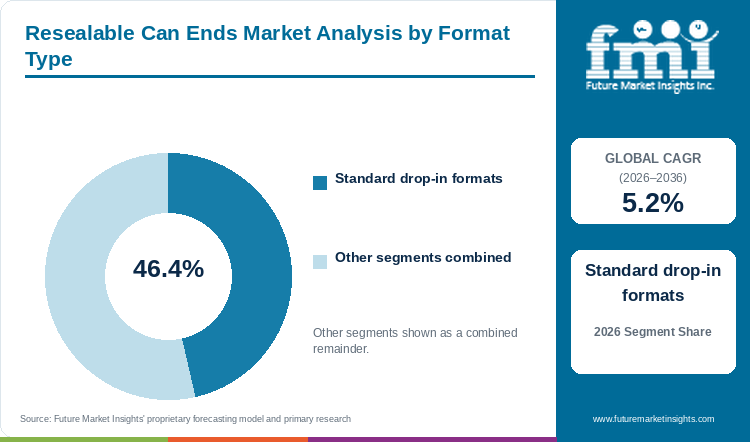
Existing 202 and 206 seamer chuck compatibility gives standard drop-in formats a forecast 46.4% share of the format type segment in 2026.
Table 5: Format Type Share for the Resealable Can Ends Market (percentage share), 2026
| Format Type | Share (2026) |
|---|---|
| Standard drop-in formats | 46.4% |
| Other Segments Combined* | 53.6% |
| Total | 100.0% |
*Calculated as the balance remaining after deducting the leading segment's reported share from 100.0%.
Table 6: Format Type Leadership and Market Growth for the Resealable Can Ends Market (segment and CAGR percentage), 2026 to 2036
| Metric | Value |
|---|---|
| Global CAGR (2026 to 2036) | 5.2% |
| Leading Segment | Standard drop-in formats |
Capital expenditure and line-changeover downtime are the biggest hurdles stopping beverage brands from adopting specialty closures. If a reclosable lid requires a contract packager to replace seaming turrets or slow filling speeds by 30%, the co-packing fee quickly wipes out the brand's retail price premium. Standard drop-in resealable formats overcome this barrier by matching the exact countersink depth and curl geometry of conventional 202 B64 and 206 CDL shells, letting beverage fillers run reclosable batches on the same lines used for beverage metal cans with only minor chuck adjustments.
- In 2026, standard drop-in formats are forecast to hold 46.4% of the format type segment because contract beverage packagers avoid capital expenditure on new seaming turrets.
- For instance, January 2026 technical specifications from Gamer Packaging for XO Resealable Can Ends confirm drop-in compatibility across standard 202 B64 and 206 CDL+ aluminum beverage can bodies with integrated tamper-evident bands [3].
Why does Aluminum Shell with Polymer Slider lead the material segment?
Within the material segment, aluminum shells with polymer sliders are expected to account for 52.6% of 2026 volume because polyolefin slide seals hold carbonation pressure.
Resealing a carbonated energy drink or sparkling water can is mechanically harder than closing a dry food tin because internal gas pressure reaches 3.5 to 4.5 bar and pushes outward against the seal. All-metal rotating tabs and threadless steel lids work well on low-pressure or dry containers, but metal-on-metal contact alone struggles to prevent micro-leaks of carbon dioxide once opened and jostled inside a backpack. Integration of a stamped 5182-alloy aluminum shell with an injection-molded polyolefin slider creates a tight elastomeric seal that holds fizz between sips while integrating with aluminum cap and closure recycling furnaces.
- Because polyolefin sliders maintain gas-tight pressure after opening, aluminum shells with polymer sliders are expected to make up 52.6% of material shipments in 2026.
- To support high-speed shell stamping across beverage lines, Ball Corporation's January 2026 Beverage Ends & Tabs portfolio supplies custom-engineered aluminum can ends with colored coatings and laser-etched tabs built for rotary seamers [4].
How does the 250-750 ml sub-segment shape capacity demand?
In 2026, the 250-750 ml sub-segment is estimated to account for 58.3% of the capacity segment where multi-serve portable beverage cans require spill-proof reclosure.
Unit economics explain why resealable ends cluster heavily in the 250 ml to 750 ml container range rather than mini cans or bulk institutional tins. Consumers finish 150 ml and 200 ml single-serve cans in a few sips, so brand managers cannot justify adding 3.5 to 4.5 cents of reclosable lid cost onto a low-priced mini can. By contrast, 330 ml sleek cans and 473 ml to 500 ml tall cans carry two to three servings consumed during commuting or gym sessions where spill-proof reclosure supports a higher retail price point on specialty tin cans.
- Within the capacity segment, the 250-750 ml sub-segment is estimated to hold 58.3% in 2026 on strong volume in 16-ounce energy drinks and 500 ml functional cans.
- To serve this multi-serve portable window, engineering specialist can2close GmbH in Germany documented in March 2025 that its 180-degree rotatable tamper-evident lever closure fits standard beverage cans to allow portioned drinking while blocking insects and dust [5].
Why does Beverage remain the primary end use segment leader?
Beverage applications are projected to command 61.5% of the end use segment in 2026 as carbonated energy and RTD drink brands replace PET bottles.
High retail gross margins in functional energy drinks and cold-brew coffees as well as state-regulated hemp beverages allow drink marketers to absorb the cost of a resealable end far more easily than canned vegetable or soup packers. Beverage brands also face intense pressure from grocery retailers to cut single-use plastic bottle share without losing on-the-go resealability. While wet pet food and culinary brands are beginning to adopt mono-material reclosable steel ends across food tins and drink cans, beverage launches remain the primary volume engine through 2036.
- Beverage applications are projected to generate 61.5% of end use demand in 2026 as energy and functional drink brands differentiate through resealable cans.
- For instance, January 2026 operational disclosures from Ardagh Metal Packaging show that the company runs 11 production facilities across the Americas supplying 8 oz Sleek to 24 oz beverage cans and specialized H!GHEND end and tab designs for energy and sparkling beverage brands [6].
Why do Direct Brand Contracts lead the sales channel segment?
In 2026, direct brand contracts are anticipated to account for 64.2% of the sales channel segment since filling plants require joint seaming-line qualification.
Conversion of a beverage or food SKU to a resealable end is not a simple catalog purchase because the closure supplier's field engineers must calibrate seamer chuck pressure and double-seam overlap as well as tunnel pasteurization temperatures directly on the customer's filling line. Because multi-million-unit beverage brands require guaranteed line speeds and custom color-matched sliders, they sign multi-year direct supply agreements with closure manufacturers. At the same time, regional craft drink brands and co-packers ordering smaller pallet quantities rely on specialized packaging distributors that stock pre-qualified ends.
- Direct brand contracts are anticipated to represent 64.2% of sales channel revenue in 2026 through customized seamer chuck validation and volume-linked tooling amortization.
- To serve mid-sized North American beverage brands beyond direct contracts, Xolution Germany GmbH and Gamer Packaging established a strategic distribution partnership in May 2025 offering multi-warehouse stocking and financing with technical quality assurance for XO resealable ends [7].
What are the drivers, restraints, and opportunities in the resealable can ends market?
On-the-go portioning convenience and PET-to-aluminum substitution drive reclosable end trials, whereas 3x-to-4x unit cost premiums and EPR composite penalties restrain mass conversion and mono-material metal reclosures create circular packaging opportunities.
- Driver: Beverage and food brands use resealable can ends to replace single-use PET bottles and eliminate secondary plastic overcaps on multi-serve cans.
- Restraint: Incremental closure cost premiums and strict EU PPWR recyclability rules on polymer-metal composite ends slow adoption in low-margin sodas.
- Opportunity: All-metal and mono-material reclosable can ends enable plastic-free resealability across retort food and carbonated beverage cans.
Growth Analysis and Future Potential: Plastic-to-Metal Substitution and Portion Control
Major retail chains and consumer packaged goods companies are shifting shelf space away from single-use plastic bottles and composite tubs toward metal cans that enter established recycling streams. Across multi-serve energy drinks and family-size food tins, adding a reclosable end allows metal packaging to match the resealing convenience of screw-top plastic containers while meeting child-resistant state rules for functional beverages. Reflecting the scale of corporate investment in metal food and closure platforms, Sonoco Products Company reported in July 2026 that its second-quarter 2026 net sales jumped 49% year-on-year to USD 1,885 million as its Consumer Packaging division reached USD 1,242 million across metal cans and closures in 37 countries [8]. Brand owners are therefore pairing reclosable ends with metal containers to capture plastic-replacement volume.
Risk Assessment of the Resealable Can Ends Market: Tooling Economics and EPR Modulated Fees
Two commercial barriers restrain mass conversion of mainstream carbonated soft drinks and economy beer multipacks to resealable ends: a 3x-to-4x unit cost premium and tightening Extended Producer Responsibility fee modulation. While a standard stay-on-tab aluminum end costs USD 14 to USD 18 per thousand units, a multi-piece resealable lid with an injection-molded slider costs USD 54 to USD 62 per thousand ends. In addition to this three-to-four-cent per-can surcharge, environmental regulators now penalize composite packaging structures. For instance, the UK Department for Environment Food and Rural Affairs published its 2025 illustrative base fees for packaging Extended Producer Responsibility in June 2025, assigning obligated producers separate per-tonne disposal fees across metal and plastic packaging weights [9]. Closure makers must therefore prove that polymer sliders delaminate and pyrolysis-clear during aluminum remelting.
Commercial Opportunity Analysis: Mono-Material Metal Reclosure and High-Speed Scaling
Reduction of the cost and regulatory friction of multi-resin closures is opening a major commercial avenue for high-speed automated assembly cells and 100% mono-material metal reclosures. On the high-speed beverage front, Xolution Germany GmbH in Dachau documented in January 2026 that its automated lines reach 200 million XO ends in annual capacity on standard B64 and SuperEnd shells, integrating a biaxially-oriented polypropylene tamper-proof band and self-sealing internal relock disc [10]. At the same time, threadless all-metal systems such as Canovation's CanReseal design licensed with CANPACK allow food and beverage packers to achieve airtight reclosure using 100% metal construction alongside tinplate packaging and aluminum cans.
Resealable Can Ends Market by Country (2026 to 2036)
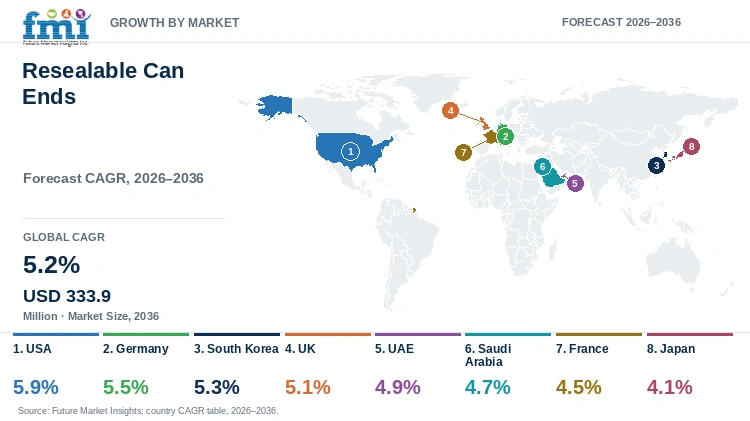
Co-packer line conversions and national recycling mandates place the USA first with 5.9% yearly expansion over 2026 to 2036 above Germany (5.5%) and South Korea (5.3%), whereas Japan posts a 4.1% compound rate. National growth dispersion stems from differences in 16-ounce energy drink consumption and compulsory deposit-return schemes across regional beverage markets.
Table 7: Country CAGR and Primary Growth Levers for the Resealable Can Ends Market (CAGR percentage and operational drivers), 2026 to 2036
| Country | CAGR (2026 to 2036) | Primary Growth Lever |
|---|---|---|
| USA | 5.9% | Dominant 16 oz energy drink volume and child-resistant functional beverage cans |
| Germany | 5.5% | August 2026 PPWR & VerpackDG implementation and domestic XO closure engineering |
| South Korea | 5.3% | EPR recycling mandates (57.2% municipal recycling) and RTD beverage innovation |
| UK | 5.1% | PackUK and Defra EPR recyclability assessment methodology (RAM) compliance |
| UAE | 4.9% | UAE Circular Economy Policy sustainable manufacturing and on-the-go beverages |
| Saudi Arabia | 4.7% | Consumer willingness-to-pay for 100% recyclable labeled beverage and food packaging |
| France | 4.5% | Citeo / Alutrec / COTREM metal packaging recyclability assessment tables |
| Japan | 4.1% | 95%+ aluminum can recycling stream and EcoEnd low-carbon lid engineering |
Source: Future Market Insights analysis
USA Resealable Can Ends Market Outlook (2026 to 2036)
Reclosable closure shipments across the USA are projected to expand at a 5.9% compound annual pace from 2026 to 2036, driven by high per-capita consumption of 16-ounce (473 ml) energy drinks and state-regulated functional beverages. Unlike European markets where 250 ml slim cans dominate, beverage fillers in the USA package energy and hemp-infused drinks in 16-ounce cans requiring child-resistant resealability. In addition, U.S. Environmental Protection Agency packaging data updated in October 2026 show that aluminum can recycling in the USA reached 50.4% (670,000 tons recycled) while steel packaging hit 73.8%, encouraging brands to replace plastic bottles with cans [11]. Domestic stocking of 202 and 206 XO ends by Gamer Packaging lets regional co-packers run reclosable batches without turret rebuilds.
Key takeaway: In the USA, strong 16-ounce energy drink demand and child-resistant functional beverage regulations are projected to anchor a 5.9% CAGR.
Germany Resealable Can Ends Market Outlook (2026 to 2036)
Germany functions as Europe's primary engineering and regulatory testing ground for reclosable metal packaging because strict deposit-return and dual-system rules govern every closure component. Demand for engineered resealable can ends across beverage and food fillers in Germany is estimated to advance at a 5.5% yearly clip through 2036, supported by domestic closure tooling and dual-system recycling compliance. As a matter of fact, guidance from the Zentrale Stelle Verpackungsregister (ZSVR) confirms that the European Union PPWR and the Packaging Law Implementation Act in Germany (VerpackDG) took effect on 12 August 2026, enforcing LUCID registration and strict recyclability conformity across packaged goods [12]. Domestic innovators in Germany including Xolution in Dachau and can2close in Purgen therefore engineer low-profile sliders and mono-material lids.
Key takeaway: In Germany, August 2026 VerpackDG packaging conformity rules and domestic closure manufacturing investments are estimated to produce a 5.5% CAGR through 2036.
South Korea Resealable Can Ends Market Outlook (2026 to 2036)
Rapid product launches across convenience-store ready-to-drink coffee and sparkling tonics in South Korea are matched by some of Asia's toughest household waste-sorting mandates. According to a June 2026 urban resource recovery study in Applied Sciences, South Korea's Extended Producer Responsibility framework and compulsory household separation and cleaning of metal cans and beverage containers lifted municipal recycling to 57.2% while aluminum prices exceeded USD 3,500 per tonne in Q1 2026 [13]. Co-packer procurement of resealable can ends across South Korea is forecast to rise at a 5.3% annual rate between 2026 and 2036 because beverage fillers substitute recyclable aluminum cans for single-use plastic bottles. However, higher EPR fees on composite closures push brands in South Korea toward mono-material aluminum designs.
Key takeaway: In South Korea, EPR recycling rules and convenience RTD beverage innovation are forecast to deliver a 5.3% CAGR.
UK Resealable Can Ends Market Outlook (2026 to 2036)
In the UK, packaging procurement is being reshaped by the rollout of modulated Extended Producer Responsibility fees that penalize secondary plastic snap-lids on metal tins and composite beverage closures. Under PackUK statutory guidance updated in October 2026 for packaging producer responsibility obligations, large producers in the UK must report packaging weights every six months and grade each container under the Recyclability Assessment Methodology (RAM) [14]. To avoid red RAM recyclability penalties, wet pet-food packers and drink brands in the UK are trialing mono-material steel reclosable lids and 202 aluminum ends. Brand expenditure on resealable can ends across the UK is anticipated to advance 5.1% annually through 2036, owing to plastic overcap elimination across supermarket chains.
Key takeaway: In the UK, PackUK RAM recyclability assessments and plastic overcap elimination are anticipated to guide 5.1% annual growth through 2036.
UAE Resealable Can Ends Market Outlook (2026 to 2036)
Beverage and food filler adoption of resealable can ends across the UAE is expected to post a 4.9% CAGR over the 2026 to 2036 forecast period, enabled by high on-the-go consumption of chilled energy drinks and sparkling fruit juices in Dubai and Abu Dhabi. What differentiates buyer demand in the UAE is the need for tamper-evident reclosable lids that block sand and dust during outdoor leisure occasions. Supporting aluminum can adoption over plastic bottles, the UAE Cabinet's UAE Circular Economy Policy updated in May 2025 prioritizes sustainable industrial manufacturing and circular packaging recovery across private-sector beverage fillers [15]. Regional co-packers in the UAE also require slider polymers rated for 45-degree-Celsius warehouse storage.
Key takeaway: In the UAE, outdoor on-the-go beverage consumption and federal circular-packaging initiatives are expected to generate a 4.9% CAGR through 2036.
Saudi Arabia Resealable Can Ends Market Outlook (2026 to 2036)
Young urban shoppers in Saudi Arabia are shifting beverage and food purchases toward cans that combine on-the-go resealability with clear environmental labeling. As a matter of fact, an August 2025 discrete choice valuation study of 424 urban consumers across Riyadh and Jeddah as well as Dammam published in Sustainability demonstrated a strong buyer preference for packages bearing explicit 100% recyclable labeling and an average willingness-to-pay premium of SAR 5.23 in Saudi Arabia [16]. Canning plant orders for resealable can ends across Saudi Arabia are predicted to grow 4.7% per annum from 2026 through 2036, attributable to aluminum can substitution over plastic bottles in malt beverages and juices. Domestic fillers in Riyadh and Jeddah still require polymer migration certificates before qualifying new ends.
Key takeaway: In Saudi Arabia, consumer preference for recyclable metal packaging and canning line upgrades are predicted to sustain a 4.7% yearly expansion pace.
France Resealable Can Ends Market Outlook (2026 to 2036)
Household packaging eco-modulation rules in France place strict material-compatibility limits on hybrid metal-and-polymer can closures, directly shaping which reclosable designs win brand contracts. Across France, resealable can ends demand is projected to log a 4.5% CAGR over 2026 to 2036, reinforced by mono-material metal packaging conversions in beverage and canned-food aisles. Under the March 2025 Recyclability Tables validated by Citeo and COTREM for the TREE assessment tool in France, rigid aluminum and steel closures containing plastic inserts are tolerated only when non-chlorinated resins do not disrupt eddy-current or magnetic sorting and chlorinated elements stay below 8% of weight [17]. Beverage and food packers in France therefore favor all-metal reclosures and thin polyolefin sliders certified under Alutrec rules.
Key takeaway: In France, Citeo and Alutrec metal-packaging recyclability criteria are projected to govern a 4.5% annual growth rate.
Japan Resealable Can Ends Market Outlook (2026 to 2036)
Japan records a more measured growth rate for flat resealable can ends than Western markets due to widespread vending-machine use of screw-cap bottle-cans and strict furnace purity rules. According to November 2025 sustainability disclosures from UACJ Corporation, the national aluminum beverage can recycling rate in Japan exceeds 95%, with UACJ and Toyo Seikan Group Holdings jointly developing EcoEnd low-carbon lids for closed-loop recycling [18]. Because remelters in Japan penalize heavy foreign polymer attachments on flat 202 ends, closure suppliers focus on all-aluminum rotating tab designs and thin polyolefin seals. Filler orders for resealable can ends in Japan are slated to log a 4.1% CAGR between 2026 and 2036 since specialty drink co-packers adopt low-carbon reclosable lids.
Key takeaway: In Japan, 95%+ aluminum can recycling purity standards and EcoEnd low-carbon lid initiatives are slated to result in a 4.1% CAGR.
Full report country CAGRs cover: North America; Latin America; Western Europe; Eastern Europe; East Asia; South Asia and Pacific; Middle East and Africa.
Who are the notable companies in the resealable can ends market?
Ball Corporation, Ardagh Group, CANPACK, Sonoco Products Company, Crown Holdings, Xolution Germany GmbH, Alpla, and Silgan Holdings are the notable companies in the resealable can ends market.
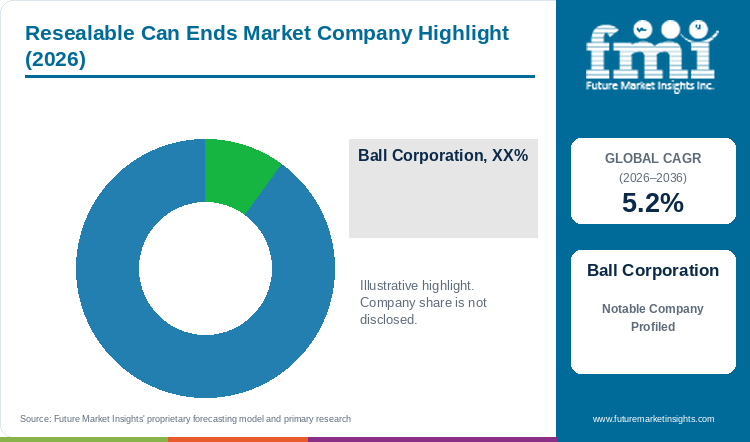
Commercial participation in the resealable can ends industry spans multinational metal can-end manufacturers and precision injection-molding closure groups. Global beverage can producers operate high-speed shell stamping presses and specialty tab platforms, whereas specialist engineering developers and polymer molding partners supply drop-in slider assemblies and mono-material steel reclosable food ends.
- Global Beverage Can & Metal End Platforms: Ball Corporation and Ardagh Group as well as CANPACK and Crown Holdings operate high-speed aluminum and steel end stamping plants supported by specialty beverage-end and mono-material reclosure technologies.
- Dedicated Reclosable Can-End & Mono-Material Innovators: Xolution Germany GmbH and Sonoco Products Company commercialize drop-in XO slider beverage ends and mono-material reclosable steel food cans.
- Precision Polymer Closure & Metal Container Specialists: Alpla and Silgan Holdings supply high-cavitation injection-molded closure components and sanitary easy-open metal food ends.
Competitive Benchmarking: Resealable Can Ends Market
Table 8: Competitive Benchmarking for the Resealable Can Ends Market (qualitative capability ratings), 2026
| Company | Reclosable-End IP & SKU Evidence | High-Speed Seamer Compatibility | Polymer / Mono-Material Engineering | Geographic Reach |
|---|---|---|---|---|
| Ball Corporation | High | High | High | High |
| Ardagh Group | High | High | Medium | High |
| CANPACK | High | High | High | High |
| Sonoco Products Company | High | High | High | High |
| Crown Holdings | Medium | High | Medium | High |
| Xolution Germany GmbH | High | High | High | Medium |
| Alpla | Medium | Medium | High | High |
| Silgan Holdings | Medium | High | High | High |
Scoring basis: Capability tiers evaluate commercialized reclosable and specialty can-end deployments coupled with drop-in compatibility on 202/206 beverage and sanitary food seamers. Engineering and geographic ratings reflect verified polymer slider or mono-material metal precision and multi-region manufacturing reach.
Key Developments in the Resealable Can Ends Market
- Silgan Holdings announced a strategic portfolio acceleration in October 2026 to acquire Trivium Packaging for USD 3.4 billion, creating a USD 7.3 billion global Metal Containers and Closures platform while establishing Silgan Dispensing Solutions as a dedicated precision closure business [19].
- Ball Corporation signed definitive agreements in December 2025 to acquire an 80% stake in European aluminum beverage can producer Benepack across two manufacturing facilities in Belgium and Hungary for EUR 184 million [20].
- CANPACK and Canovation formalized a collaboration in June 2026 supported by Stolle Machinery Company to advance CanReseal resealable aluminum can-end technology toward pilot-line implementation and commercial launch [21].
Key Players in the Resealable Can Ends Market
Global Beverage Can and Metal End Platforms
- Ball Corporation
- Ardagh Group
- CANPACK
- Crown Holdings
Dedicated Reclosable Can-End and Mono-Material Innovators
- Xolution Germany GmbH
- Sonoco Products Company
Precision Polymer Closure and Metal Container Specialists
- Alpla
- Silgan Holdings
Resealable Can Ends Market - Report Scope
Table 9: Report Scope for the Resealable Can Ends Market (coverage fields and definitions), 2026 to 2036
| Coverage field | Report scope |
|---|---|
| Market breakdown | Format Type; Material; Capacity; End Use; Sales Channel |
| Quantitative Units | USD Million |
| Market Definition | Commercial manufacturer revenue from complete resealable or reclosable can-end assemblies (including aluminum shells with integrated polymer sliders, rotatable stay-on-tab reclosures, and mono-material reclosable steel/aluminum ends) supplied for beverage, food, pet food, and specialty cans. Category Scope Note: Excludes the retail value of packaged beverages or foods, conventional non-resealable stay-on-tab ends, standalone PET bottle screw caps, and filling/seaming machinery. |
| Regions Covered | North America; Latin America; Western Europe; Eastern Europe; East Asia; South Asia and Pacific; Middle East and Africa |
| Countries Covered | USA, Germany, South Korea, UK, UAE, Saudi Arabia, France, Japan, and additional countries in the full report |
| Key Companies Covered | Ball Corporation, Ardagh Group, CANPACK, Sonoco Products Company, Crown Holdings, Xolution Germany GmbH, Alpla, Silgan Holdings |
| Forecast Period | 2026 to 2036 |
| Approach | Primary and secondary research with top-down and bottom-up market triangulation. |
Resealable Can Ends Market - Research Methodology
Table 10: Research Methodology for the Resealable Can Ends Market (research methods and approach), 2026 edition
| Method | Approach |
|---|---|
| Primary Research | Structured interviews with metal can-end tooling engineers, beverage co-packing line managers, injection-molding closure specialists, and EPR packaging compliance officers across North America, Europe, and Asia. |
| Secondary Research | Review of EU Regulation 2025/40 (PPWR), ZSVR VerpackDG rules in Germany, UK Defra 2025 EPR base fees, US EPA recycling tables, Citeo recyclability matrices, and technical specifications from Xolution, Ball, Crown, Sonoco, and CANPACK. |
| Market Sizing and Forecasting | Bottom-up unit-shipment and per-thousand-end pricing models across qualified beverage and food seaming lines reconciled against global metal can-end expenditure from 2025 to 2036. |
| Country Forecasting Model | Econometric country models weight 250-750 ml energy and functional beverage can volumes, deposit-return system collection rules, EPR composite fee penalties, and food-contact standards across eight national markets. |
| Operational Benchmark Traceability | Unit shipments, seaming line counts, and wholesale per-thousand pricing in Tables 2, 3, and 4 trace to commercial closure catalogs, K 2025 production cell disclosures, and co-packer tooling audits. |
| Data Triangulation and Validation | Revenue estimates are cross-checked against high-cavitation slider molding capacity and can-end stamping throughput while excluding standard non-resealable ends and unfilled can bodies to prevent double counting. |
Resealable Can Ends Market by Segments
Resealable Can Ends Market segmented by Format Type:
- Standard drop-in formats
- Recyclable mono-material formats
- Child-resistant & tamper-evident formats
- Custom-engineered wide-aperture formats
Resealable Can Ends Market segmented by Material:
- Aluminum shell with polymer slider (PP / PE / PET)
- All-metal & mono-material aluminum/steel
- Tinplate & ECCS composite ends
- Post-consumer recycled (rPET / rPP) hybrid ends
Resealable Can Ends Market segmented by Capacity:
- 250-750 ml
- Below 250 ml
- 750 ml-2 L
- Above 2 L
Resealable Can Ends Market segmented by End Use:
- Beverage
- Food
- Pet food & nutrition
- Pharma & industrial
Resealable Can Ends Market segmented by Sales Channel:
- Direct brand contracts
- Distributors & packaging integrators
- Online B2B
Resealable Can Ends Market by Region
- North America
- USA
- Canada
- Latin America
- Brazil
- Mexico
- Argentina
- Chile
- Western Europe
- Germany
- France
- UK
- Italy
- Spain
- Benelux
- Nordics
- Eastern Europe
- Poland
- Czech Republic
- Romania
- Hungary
- East Asia
- China
- Japan
- South Korea
- South Asia and Pacific
- India
- ASEAN
- Australia and New Zealand
- Middle East and Africa
- GCC Countries
- South Africa
- Türkiye
- Israel
Research Sources and Bibliography
- [1] Xolution Germany GmbH. (2025, October 6). Xolution Germany GmbH revolutionizes beverage cans. Xolution K 2025 Industrial Partnership Release.
- [2] European Union. (2025, January 22). Regulation - EU - 2025/40 - EN - PPWR - EUR-Lex. Official Journal of the European Union.
- [3] Gamer Packaging, Inc. (2026, January 12). XO Resealable Can Ends - Gamer Packaging. Gamer Packaging Technical Catalog.
- [4] Ball Corporation. (2026, January 15). Beverage Ends & Tabs - Ball. Ball Corporation Beverage Packaging Division.
- [5] can2close GmbH. (2025, March 15). Relaunch - Solution | can2close. can2close GmbH Technical Documentation.
- [6] Ardagh Metal Packaging S.A. (2026, January 18). Our Markets | Metal Beverage Packaging Manufacturers Americas | Ardagh Metal Packaging. Ardagh Metal Packaging North America.
- [7] Gamer Packaging, Inc. & Xolution Germany GmbH. (2025, May 14). Xolution and Gamer Packaging Announce Strategic Distribution Partnership - Gamer Packaging. Gamer Packaging Corporate News.
- [8] Sonoco Products Company. (2026, July 22). Sonoco Products Company - Sonoco Reports Second Quarter 2026 Results. Sonoco Products Company Official Investor Relations.
- [9] UK Department for Environment, Food & Rural Affairs. (2025, June 30). Extended producer responsibility for packaging: 2025 base fees - GOV.UK. GOV.UK Department for Environment, Food & Rural Affairs.
- [10] Xolution Germany GmbH. (2026, January 20). Xolution - XO Can to Go - German-based Relock System. Xolution Technical & Production Documentation (Dachau).
- [11] U.S. Environmental Protection Agency. (2026, October 19). Containers and Packaging: Product-Specific Data | US EPA. U.S. Environmental Protection Agency.
- [12] Zentrale Stelle Verpackungsregister (ZSVR). (2026, August 12). PPWR & VerpackDG: This has been in force since 12 August 2026. Zentrale Stelle Verpackungsregister (LUCID).
- [13] Tsai, C.-H., & Tsai, W.-T. (2026, June 9). Overview of E-Waste Mining from Urban Waste in the Developed East Asian Region and Major Achievements in Taiwan. Applied Sciences, 16(12), 5883 (MDPI).
- [14] UK Department for Environment, Food & Rural Affairs & PackUK. (2026, October 8). Extended producer responsibility for packaging - GOV.UK. GOV.UK Statutory Guidance Collection.
- [15] UAE Government. (2025, May 6). UAE Circular Economy Policy | The Official Portal of the UAE Government. Government of the UAE (U.ae).
- [16] Alenazi, S. A. (2025, August 11). Sustainability Awareness, Price Sensitivity, and Willingness to Pay for Eco-Friendly Packaging: A Discrete Choice and Valuation Study in the Saudi Retail Sector. Sustainability, 17(16), 7287 (MDPI).
- [17] Citeo, Alutrec & COTREM. (2025, March 10). Recyclability tables. Citeo Household Packaging Recyclability Assessment (TREE).
- [18] UACJ Corporation. (2025, November 12). UACJ's Vision for Building an Aluminum Circular Society | Sustainability | UACJ Corporation. UACJ Group Sustainability & Aluminum Can Recycling.
- [19] Silgan Holdings Inc. (2026, October 19). Silgan Holdings Inc. - Silgan Announces Strategic Portfolio Acceleration; Establishes Partnership to Acquire Trivium. Silgan Holdings Inc. Official Investor Relations.
- [20] Ball Corporation. (2025, December 11). Ball to Acquire Majority Stake in European Beverage Can Manufacturer Benepack - Ball. Ball Corporation Official Newsroom.
- [21] CANPACK Group, Inc. & Canovation LLC. (2026, June 2). Canovation and CANPACK Formalize Collaboration to Accelerate CanReseal® Toward Commercial Launch - CANPACK. CANPACK Corporate Newsroom.
- [22] Crown Holdings, Inc. (2026, January 14). Beverage Ends | Crown. Crown Beverage Packaging Products.
This bibliography is provided for reader reference and is not exhaustive. The full report contains the complete reference list and detailed citations.
This Report Answers
- What is the global resealable can ends market valuation in 2026 and the projection for 2036?
- How do carbonation retention and high-speed double-seamer compatibility govern end selection?
- Why do standard drop-in formats lead the format type segment?
- Why do aluminum shells with polymer sliders capture the largest material segment share?
- How do country CAGRs compare across the USA, Germany, South Korea, and the UK?
- Which packaging manufacturers supply reclosable can-end technologies and tooling?
- How do EU PPWR recyclability grades and UK EPR fees impact composite end designs?
- What pressure-retention and seaming trials should beverage brands complete before ordering?
Frequently Asked Questions
How big is the resealable can ends market in 2026, and what is forecast for 2036?
Global resealable can ends industry valuation stands at USD 191.2 million in 2025 and USD 201.1 million in 2026, reaching USD 333.9 million by 2036.
What is the CAGR for the resealable can ends market from 2026 to 2036?
Closure shipments globally are projected to advance at a 5.2% CAGR between 2026 and 2036, adding USD 132.8 million in net reclosable end sales.
Which format type leads the resealable can ends market?
Because 202 and 206 shell compatibility avoids filling-line seamer modifications, standard drop-in formats are forecast to hold 46.4% of the format type segment in 2026.
Which material segment holds the largest share in the resealable can ends market?
Within the material segment, aluminum shells with polymer sliders are expected to account for 52.6% of 2026 demand through gas-tight polyolefin slide seals on carbonated beverage cans.
Which countries post the highest growth rates for resealable can ends?
North American energy drink packaging puts the USA ahead at a 5.9% CAGR through 2036, trailed by Germany at 5.5%, South Korea at 5.3%, and the UK at 5.1%.
Which companies are active in the resealable can ends market?
Ball Corporation, Ardagh Group, CANPACK, Sonoco Products Company, Crown Holdings, Xolution Germany GmbH, Alpla, and Silgan Holdings lead reclosable can-end engineering and supply.
Preview the report firsthand - request a free sample
Get SampleGet the brochure for pricing and purchase details.
Get PDFTable of Content
- Key Takeaways
- Market Size and CAGR
- Top Growth Driver
- Fastest Growing Segment
- Leading Region
- Key Companies
- Emerging Opportunities
- Executive Summary
- Global Market Outlook
- Demand-side Trends
- Supply-side Trends
- Technology Roadmap Analysis
- Analysis and Recommendations
- Analyst Perspective (What is happening? Why now? What should investors know?)
- Key Questions Answered
- How large is the market?
- What is the CAGR?
- What are key trends?
- Which region dominates?
- Who are the leaders?
- Market Overview
- Market Coverage / Taxonomy
- Market Definition / Scope / Limitations
- Research Methodology
- Chapter Orientation
- Analytical Lens and Working Hypotheses
- Market Structure, Signals, and Trend Drivers
- Benchmarking and Cross-market Comparability
- Market Sizing, Forecasting, and Opportunity Mapping
- Research Design and Evidence Framework
- Desk Research Programme (Secondary Evidence)
- Expert Input and Fieldwork (Primary Evidence)
- Tooling, Models, and Reference Databases
- Data Engineering and Model Build
- Quality Assurance and Audit Trail
- Market Background
- Market Dynamics (Drivers, Restraints, Opportunity, Trends)
- Scenario Forecast (Optimistic, Likely, Conservative)
- Impact Analysis
- AI Impact
- Sustainability Impact
- Regulatory Impact
- Technology Impact
- Consumer / Buyer Analysis
- Purchase Drivers
- Adoption Barriers
- Buyer Journey
- Opportunity Map Analysis
- Product Life Cycle Analysis
- Supply Chain Analysis
- Investment Feasibility Matrix
- Value Chain Analysis
- PESTLE and Porter's Analysis
- Regulatory Landscape
- Regional Parent Market Outlook
- Production and Consumption Statistics
- Import and Export Statistics
- Global Market Analysis and Forecast, 2021 to 2036
- Historical Market Size Value (USD Million) Analysis, 2021 to 2025
- Current and Future Market Size Value (USD Million) Projections, 2026 to 2036
- Y-o-Y Growth Trend Analysis
- Absolute $ Opportunity Analysis
- Global Market Pricing Analysis, 2021 to 2036
- Global Market Analysis and Forecast, By Format Type, 2021 to 2036
- Introduction / Key Findings
- Historical Market Size Value (USD Million) Analysis By Format Type, 2021 to 2025
- Current and Future Market Size Value (USD Million) Analysis and Forecast By Format Type, 2026 to 2036
- Standard drop-in formats
- Recyclable mono-material formats
- Child-resistant & tamper-evident formats
- Custom-engineered wide-aperture formats
- Y-o-Y Growth Trend Analysis By Format Type, 2021 to 2025
- Absolute $ Opportunity Analysis By Format Type, 2026 to 2036
- Global Market Analysis and Forecast, By Material, 2021 to 2036
- Introduction / Key Findings
- Historical Market Size Value (USD Million) Analysis By Material, 2021 to 2025
- Current and Future Market Size Value (USD Million) Analysis and Forecast By Material, 2026 to 2036
- Aluminum shell with polymer slider (PP / PE / PET)
- All-metal & mono-material aluminum/steel
- Tinplate & ECCS composite ends
- Post-consumer recycled (rPET / rPP) hybrid ends
- Y-o-Y Growth Trend Analysis By Material, 2021 to 2025
- Absolute $ Opportunity Analysis By Material, 2026 to 2036
- Global Market Analysis and Forecast, By Capacity, 2021 to 2036
- Introduction / Key Findings
- Historical Market Size Value (USD Million) Analysis By Capacity, 2021 to 2025
- Current and Future Market Size Value (USD Million) Analysis and Forecast By Capacity, 2026 to 2036
- 250-750 ml
- Below 250 ml
- 750 ml-2 L
- Above 2 L
- Y-o-Y Growth Trend Analysis By Capacity, 2021 to 2025
- Absolute $ Opportunity Analysis By Capacity, 2026 to 2036
- Global Market Analysis and Forecast, By End Use, 2021 to 2036
- Introduction / Key Findings
- Historical Market Size Value (USD Million) Analysis By End Use, 2021 to 2025
- Current and Future Market Size Value (USD Million) Analysis and Forecast By End Use, 2026 to 2036
- Beverage
- Food
- Pet food & nutrition
- Pharma & industrial
- Y-o-Y Growth Trend Analysis By End Use, 2021 to 2025
- Absolute $ Opportunity Analysis By End Use, 2026 to 2036
- Global Market Analysis and Forecast, By Sales Channel, 2021 to 2036
- Introduction / Key Findings
- Historical Market Size Value (USD Million) Analysis By Sales Channel, 2021 to 2025
- Current and Future Market Size Value (USD Million) Analysis and Forecast By Sales Channel, 2026 to 2036
- Direct brand contracts
- Distributors & packaging integrators
- Online B2B
- Y-o-Y Growth Trend Analysis By Sales Channel, 2021 to 2025
- Absolute $ Opportunity Analysis By Sales Channel, 2026 to 2036
- Global Market Analysis and Forecast, By Region, 2021 to 2036
- Introduction
- Historical Market Size Value (USD Million) Analysis By Region, 2021 to 2025
- Current Market Size Value (USD Million) Analysis and Forecast By Region, 2026 to 2036
- North America
- Latin America
- Western Europe
- Eastern Europe
- East Asia
- South Asia and Pacific
- Middle East and Africa
- Market Attractiveness Analysis By Region
- North America Market Analysis and Forecast, By Country, 2021 to 2036
- Historical Market Size Value (USD Million) Trend Analysis By Market Taxonomy, 2021 to 2025
- Market Size Value (USD Million) Forecast By Market Taxonomy, 2026 to 2036
- By Country
- USA
- Canada
- By Format Type
- By Material
- By Capacity
- By End Use
- By Sales Channel
- By Country
- Market Attractiveness Analysis
- By Country
- By Format Type
- By Material
- By Capacity
- By End Use
- By Sales Channel
- Key Takeaways
- Latin America Market Analysis and Forecast, By Country
- Historical Market Size Value (USD Million) Trend Analysis By Market Taxonomy, 2021 to 2025
- Market Size Value (USD Million) Forecast By Market Taxonomy, 2026 to 2036
- By Country
- Brazil
- Mexico
- Argentina
- Chile
- By Format Type
- By Material
- By Capacity
- By End Use
- By Sales Channel
- By Country
- Market Attractiveness Analysis
- By Country
- By Format Type
- By Material
- By Capacity
- By End Use
- By Sales Channel
- Key Takeaways
- Western Europe Market Analysis and Forecast, By Country
- Historical Market Size Value (USD Million) Trend Analysis By Market Taxonomy, 2021 to 2025
- Market Size Value (USD Million) Forecast By Market Taxonomy, 2026 to 2036
- By Country
- Germany
- France
- UK
- Italy
- Spain
- Benelux
- Nordics
- By Format Type
- By Material
- By Capacity
- By End Use
- By Sales Channel
- By Country
- Market Attractiveness Analysis
- By Country
- By Format Type
- By Material
- By Capacity
- By End Use
- By Sales Channel
- Key Takeaways
- Eastern Europe Market Analysis and Forecast, By Country
- Historical Market Size Value (USD Million) Trend Analysis By Market Taxonomy, 2021 to 2025
- Market Size Value (USD Million) Forecast By Market Taxonomy, 2026 to 2036
- By Country
- Poland
- Czech Republic
- Romania
- Hungary
- By Format Type
- By Material
- By Capacity
- By End Use
- By Sales Channel
- By Country
- Market Attractiveness Analysis
- By Country
- By Format Type
- By Material
- By Capacity
- By End Use
- By Sales Channel
- Key Takeaways
- East Asia Market Analysis and Forecast, By Country
- Historical Market Size Value (USD Million) Trend Analysis By Market Taxonomy, 2021 to 2025
- Market Size Value (USD Million) Forecast By Market Taxonomy, 2026 to 2036
- By Country
- China
- Japan
- South Korea
- By Format Type
- By Material
- By Capacity
- By End Use
- By Sales Channel
- By Country
- Market Attractiveness Analysis
- By Country
- By Format Type
- By Material
- By Capacity
- By End Use
- By Sales Channel
- Key Takeaways
- South Asia and Pacific Market Analysis and Forecast, By Country
- Historical Market Size Value (USD Million) Trend Analysis By Market Taxonomy, 2021 to 2025
- Market Size Value (USD Million) Forecast By Market Taxonomy, 2026 to 2036
- By Country
- India
- ASEAN
- Australia and New Zealand
- By Format Type
- By Material
- By Capacity
- By End Use
- By Sales Channel
- By Country
- Market Attractiveness Analysis
- By Country
- By Format Type
- By Material
- By Capacity
- By End Use
- By Sales Channel
- Key Takeaways
- Middle East and Africa Market Analysis and Forecast, By Country
- Historical Market Size Value (USD Million) Trend Analysis By Market Taxonomy, 2021 to 2025
- Market Size Value (USD Million) Forecast By Market Taxonomy, 2026 to 2036
- By Country
- GCC Countries
- South Africa
- Türkiye
- Israel
- By Format Type
- By Material
- By Capacity
- By End Use
- By Sales Channel
- By Country
- Market Attractiveness Analysis
- By Country
- By Format Type
- By Material
- By Capacity
- By End Use
- By Sales Channel
- Key Takeaways
- Key Countries Market Analysis
- USA
- Pricing Analysis
- Market Share Analysis, 2025
- By Format Type
- By Material
- By Capacity
- By End Use
- By Sales Channel
- Canada
- Pricing Analysis
- Market Share Analysis, 2025
- By Format Type
- By Material
- By Capacity
- By End Use
- By Sales Channel
- Mexico
- Pricing Analysis
- Market Share Analysis, 2025
- By Format Type
- By Material
- By Capacity
- By End Use
- By Sales Channel
- Brazil
- Pricing Analysis
- Market Share Analysis, 2025
- By Format Type
- By Material
- By Capacity
- By End Use
- By Sales Channel
- Chile
- Pricing Analysis
- Market Share Analysis, 2025
- By Format Type
- By Material
- By Capacity
- By End Use
- By Sales Channel
- Germany
- Pricing Analysis
- Market Share Analysis, 2025
- By Format Type
- By Material
- By Capacity
- By End Use
- By Sales Channel
- UK
- Pricing Analysis
- Market Share Analysis, 2025
- By Format Type
- By Material
- By Capacity
- By End Use
- By Sales Channel
- Italy
- Pricing Analysis
- Market Share Analysis, 2025
- By Format Type
- By Material
- By Capacity
- By End Use
- By Sales Channel
- Spain
- Pricing Analysis
- Market Share Analysis, 2025
- By Format Type
- By Material
- By Capacity
- By End Use
- By Sales Channel
- France
- Pricing Analysis
- Market Share Analysis, 2025
- By Format Type
- By Material
- By Capacity
- By End Use
- By Sales Channel
- India
- Pricing Analysis
- Market Share Analysis, 2025
- By Format Type
- By Material
- By Capacity
- By End Use
- By Sales Channel
- ASEAN
- Pricing Analysis
- Market Share Analysis, 2025
- By Format Type
- By Material
- By Capacity
- By End Use
- By Sales Channel
- Australia and New Zealand
- Pricing Analysis
- Market Share Analysis, 2025
- By Format Type
- By Material
- By Capacity
- By End Use
- By Sales Channel
- China
- Pricing Analysis
- Market Share Analysis, 2025
- By Format Type
- By Material
- By Capacity
- By End Use
- By Sales Channel
- Japan
- Pricing Analysis
- Market Share Analysis, 2025
- By Format Type
- By Material
- By Capacity
- By End Use
- By Sales Channel
- South Korea
- Pricing Analysis
- Market Share Analysis, 2025
- By Format Type
- By Material
- By Capacity
- By End Use
- By Sales Channel
- Poland
- Pricing Analysis
- Market Share Analysis, 2025
- By Format Type
- By Material
- By Capacity
- By End Use
- By Sales Channel
- Hungary
- Pricing Analysis
- Market Share Analysis, 2025
- By Format Type
- By Material
- By Capacity
- By End Use
- By Sales Channel
- Türkiye
- Pricing Analysis
- Market Share Analysis, 2025
- By Format Type
- By Material
- By Capacity
- By End Use
- By Sales Channel
- South Africa
- Pricing Analysis
- Market Share Analysis, 2025
- By Format Type
- By Material
- By Capacity
- By End Use
- By Sales Channel
- UAE
- Pricing Analysis
- Market Share Analysis, 2025
- By Format Type
- By Material
- By Capacity
- By End Use
- By Sales Channel
- Saudi Arabia
- Pricing Analysis
- Market Share Analysis, 2025
- By Format Type
- By Material
- By Capacity
- By End Use
- By Sales Channel
- USA
- Market Structure Analysis
- Competition Dashboard
- Competition Benchmarking
- Market Share Analysis of Top Players
- By Regional
- By Format Type
- By Material
- By Capacity
- By End Use
- By Sales Channel
- Emerging Startups
- Innovation Benchmarking
- Competition Analysis
- Competition Deep Dive
- Ball Corporation
- Overview
- Product Portfolio
- Profitability by Market Segments
- Sales Footprint
- Strategy Overview
- Marketing Strategy
- Product Strategy
- Channel Strategy
- Ardagh Group
- CANPACK
- Sonoco Products Company
- Crown Holdings
- Xolution Germany GmbH
- Alpla
- Silgan Holdings
- Ball Corporation
- Case Studies
- Success Stories
- Recent Developments
- Competition Deep Dive
- Assumptions & Acronyms Used


