

- Market Size (2026)
- USD 240.7 Mn
- Forecast (2036)
- USD 419.0 Mn
- CAGR (2026 to 2036)
- 5.7%
How big is Resin Spray Nozzles Market in 2026?
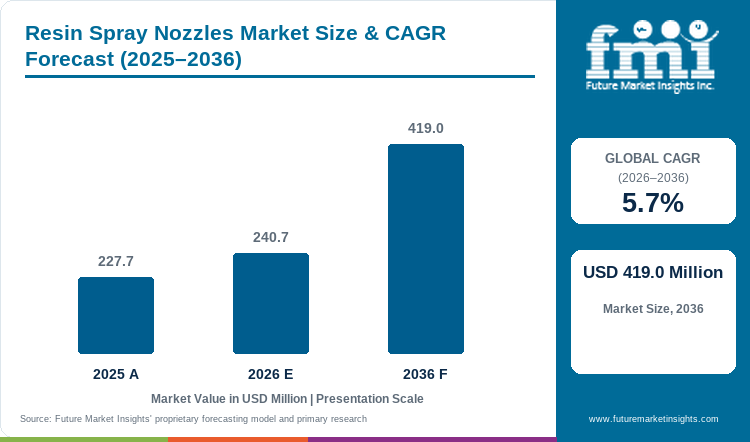
The resin spray nozzles market is valued at USD 240.7 million in 2026 and is projected to reach USD 419.0 million by 2036, expanding at a CAGR of 5.7% over the 2026-2036 period.
Sales of resin spray nozzles are estimated to rise at 5.7% CAGR through 2036. Market valuation increases from USD 227.7 million in 2025 to USD 240.7 million in 2026 and is estimated to reach USD 419.0 million by 2036. Plants are replacing worn tips because small opening changes are altering flow, fan shape, resin use, and finish quality. Buyers are looking for replacements that restore the tested spray pattern without changing the gun, pump, or resin recipe. Resin chemistry is the main switching challenge because fillers and catalyst settings are changing pressure and cure behavior. Plants are testing each new tip against the current resin and spray settings before regular use. In May 2025, the Georgia Air Protection Branch described gelcoat spraying followed by filled polyester resin at a reinforced-plastics facility. The permit describes nozzle use as part of a controlled production step. Fit, flow, and finish quality are shaping replacement decisions throughout that process.
Italy and the USA are creating demand through different production and service needs. Italian boatyards are working to fixed export schedules, so gelcoat finish and nearby parts support are affecting production decisions. Boat plants, composite repair crews, and wind-service teams are generating U.S. demand across many installed systems. In September 2026, the U.S. Energy Information Administrationlisted national wind capacity at 159 GW for 2025. The large wind fleet is keeping blade inspection and repair work active across many sites. Buyers in both countries are choosing tips that match existing guns and resin settings. Export deadlines are shaping Italian purchases, while dispersed service work is shaping U.S. replacement needs. Suppliers are keeping tested sizes near users to shorten service delays without forcing plants to approve a new spray system.
Key Takeaways
- FRP plants are replacing worn resin spray nozzles because wear is changing flow, resin use, and finish quality.
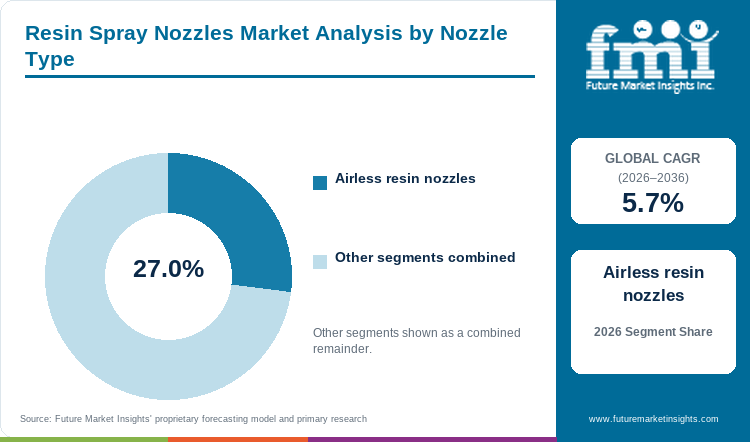
- Airless resin nozzles are set to lead nozzle type demand with 27.0% share in 2026, supported by pump pressure and replaceable tips.
- Polyester resin is projected to hold 31.0% of resin type demand in 2026 because many FRP lines already use familiar catalyst settings.
- FRP molding is forecast to represent 32.0% of application demand in 2026 because molded parts need regular resin wet-out and surface spraying.
- Resin chemistry and filler load are slowing supplier changes because plants are testing every new tip before regular production.
- Key players include Graco, Binks, Magnum Venus Products, Nordson, Sames, WAGNER, GAMA, and Spraying Systems Co.
Analyst Perspective
"The clearest replacement opportunity is emerging before a worn tip causes visible finish problems or extra resin use. Suppliers are helping plants track fan drift and are supporting approval with resin settings, wear data, and nearby stock."
- Nikhil Kaitwade, Principal Consultant, Future Market Insights
How is the resin spray nozzles market segmented?
The resin spray nozzles market is segmented six ways: by Nozzle Type, Resin Type, Application, Material, Sales Channel, and Region. Airless resin nozzles lead the Nozzle Type category with 27.0% of 2026 demand, polyester resin leads the Resin Type category with 31.0% of 2026 demand, and FRP molding leads the Application category with 32.0% of 2026 demand.
Resin spray nozzles are segmented by nozzle type, resin type, application, material, sales channel, and region. Nozzle type covers airless, air-assisted, mixing, chopper-gun, and gelcoat designs. Resin type covers polyester, epoxy, vinyl ester, PU resin, and gelcoat. Applications include FRP molding, marine composites, automotive composites, wind blade repair, and construction panels. Materials include stainless steel, tungsten carbide, ceramic, and hardened alloy. Sales channels include composite equipment dealers, direct OEM supply from equipment makers, aftermarket consumables, and system integrators that build complete automated cells.
What makes airless resin nozzles central to the nozzle type category?
Airless nozzles are using pump pressure to form the spray fan without added air. Filled composite resin systems are wearing small tip openings faster and can block them during long production runs. A worn opening is changing resin flow even while the gun and pump remain usable. Crews are replacing the tip and keeping the tested gun and pump setup in service.
- Based on nozzle type, airless resin nozzles are projected to account for 27.0% in 2026. Plants are favoring them because replaceable tips let crews service the spray point without changing the gun.
- In June 2025, Magnum Venus Products showed AirTex for filled materials that can block airless equipment. Filler load is shaping spray nozzle architecture because thicker materials are harder to spray through small openings.
Why does polyester resin hold 31.0% of resin type demand?
Plants are using polyester resin across fiberglass spray-up and gelcoat work because they already know its catalyst settings. Crews are working with familiar cure behavior and mixing hardware. In June 2025, Magnum Venus Products showed its ACE system with mix control for polyester resin and MEKP catalyst. Plants are keeping the same mixing setup for later batches once cure and spray checks confirm the process.
- By resin type, polyester resin is estimated to hold 31.0% in 2026. Plants are keeping it on catalyst settings and spray hardware already tested for routine FRP production.
- Crews are keeping the same spray settings once cure and flow checks confirm each resin batch. Those settings are giving crews a known baseline for checking and approving later tip changes.
How does FRP molding shape demand within the application category?
Structural composite molding is relying on nozzles for resin wet-out and surface work on molded parts. Flow changes are affecting cure timing and are increasing rework on molded parts. Plants are setting resin ratio and pressure for each mold cell, then keeping those settings through the production run. Nozzle wear is disturbing that tested setup even while the pump continues to work.
- In 2026, FRP molding is expected to lead application demand with 32.0% share. Mold cells are using nozzles during wet-out and surface work, keeping tip performance tied to molded composite production.
- In May 2025, Magnum Venus Products reported that BlueWind used fixed mix ratios and pressure controls for automated resin injection. Those controls are linking nozzle testing with the approved production setup. Plants are requiring replacement tips to work with the same mix and pressure settings.
What supports stainless steel within the material category?
Plants are using stainless steel in parts that carry resin and cleaning fluid because the material resists rust. Crews are choosing it as a durable base across several resin systems. In February 2025, WAGNER launched a modular liquid-control block with valve choices for abrasive fluids and automated lines. Hard inserts are protecting small high-wear points, while stainless steel is keeping the main fluid path easier to clean and service.
- By material, stainless steel is forecast to represent 34.0% in 2026. Crews are using it across resin-contact paths for rust protection, while harder inserts are protecting smaller wear points.
- Service crews are placing hard inserts at the points that wear fastest instead of using costly material across every wetted part. Using harder material only at wear points is controlling cost without reducing protection.
What supports composite equipment dealers within the sales channel category?
Composite equipment dealers are helping plants match each replacement tip with the installed gun and resin. Dealers are keeping common wear parts near production sites and are helping crews trace spray problems without replacing the full system. Plants with fixed lines are buying direct from equipment manufacturers, while system integrators are building and supporting more complex automated cells. Nearby stock and product guidance are reducing delays during planned or urgent service work.
- Composite equipment dealers are likely to capture 36.0% share of sales channel demand in 2026. Dealers are keeping tested tip sizes near plants and are matching replacements with installed guns during service.
- In April 2025, Magnum Venus Products named Composites One its authorized distributor in Mexico and expanded local support. The dealer route is giving plants another source for replacement parts and technical help during service work.
What are the drivers, restraints and opportunities in the Resin Spray Nozzles Market?
In the resin spray nozzles market, the key driver is worn tips that change spray shape and raise resin use, the key restraint is resin chemistry and filler load changes that require plants to test new tips before approval, and the key opportunity is pressure and flow records that help crews identify tip wear early and plan service.
- Driver: Worn tips are changing spray shape and raising resin use, turning nozzle wear into a clear plant cost.
- Restraint: Resin chemistry and filler load are changing flow, so plants are testing new tips before approving them for production.
- Opportunity: Pressure and flow records are helping crews spot tip wear early and plan service before finish quality changes.
Nozzle wear makes material cost visible
Resin cost is making nozzle wear more visible in plant budgets because worn tips can use more material. Operators are comparing fan shape and flow with the tested setup during scheduled service checks. In May 2025, Magnum Venus Products reported a 15% to 30% gelcoat-use reduction with Nitrotherm under listed settings. The reported result connects lower material use with stable spray conditions rather than full delivery-system replacement. Partial blockage is reducing those savings while the pump and gun remain usable. Planned tip checks are helping crews catch small flow changes before they affect finish quality. Scheduled replacements are protecting resin use and rework costs without forcing plants to change the complete spray system.
Line tests slow changes to new tip designs
Resin changes are turning simple tip replacements into plant tests. Fillers and catalyst settings are changing pressure, fan shape, and cure behavior on molded parts. In May 2025, an Oklahoma permit memo recorded atomized gelcoat and resin use under plant compliance checks. Plants are using those checks to keep sprayed resin and gelcoat inside approved process limits. Crews are testing new tip families before using them in regular production. Long test cycles are favoring familiar tip shapes during urgent service because teams are avoiding wider process changes. Vendors are able to shorten the review by giving plants resin-specific settings, wear data, and clear setup records.
Flow records help crews plan tip changes
Robot cells are relying on steady fluid flow because fixed paths cannot correct a poor spray pattern. In September 2025, Magnum Venus Products presented digital checks and closed-loop feedback for composite dispensing systems at CAMX. Closed-loop feedback is using sensor data to help the system hold the set flow and pressure. Pressure and flow records are helping crews connect each nozzle change with the exact spray recipe and service date. Maintenance teams are staging the correct tip before output leaves the accepted range. Planned changes are reducing emergency fault work and are protecting production schedules during long automated runs. Nozzle vendors are supporting this work with gun-fit data and replacement stock. Stored settings are shortening restart tests and are helping automated cells return to approved production with less disruption.
Which country CAGRs are included in the Resin Spray Nozzles Market?
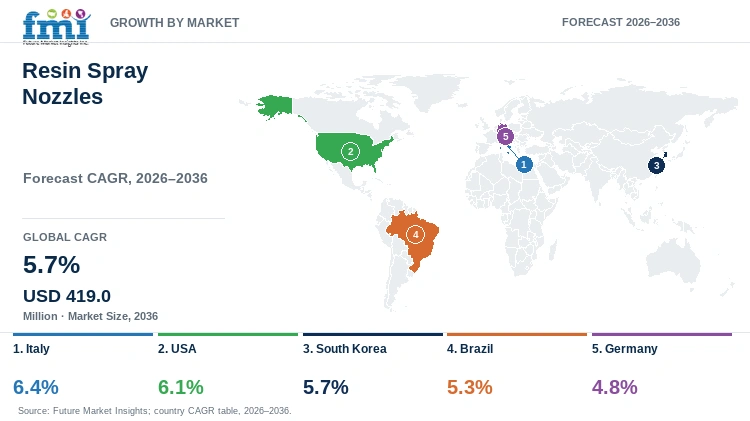
| Country | CAGR |
|---|---|
| Italy | 6.4% |
| USA | 6.1% |
| South Korea | 5.7% |
| Brazil | 5.3% |
| Germany | 4.8% |
How do country-level CAGRs compare in the Resin Spray Nozzles Market?
Italy is relying on export boatbuilding, while the USA is combining boat production with wind and field repair work. South Korea is placing more weight on formal part approval. Brazilian service work is relying on parts access across long travel routes. Germany is planning replacement work around existing equipment and scheduled maintenance.
- Italian boatyards favor nearby nozzle support because export schedules leave little room for gelcoat rework or service delays.
- Across the USA, boat plants and wind crews need broad parts coverage for installed FRP spray equipment.
- South Korean factories rely on formal part approval and need local test data for new nozzle families.
- Brazilian field crews rely on regional parts stock to cover wind sites across long service routes.
- Germany places emphasis on retrofit approval and planned service windows across mature automotive and wind equipment.
Local operating conditions are changing what buyers need from suppliers. Some buyers are seeking faster parts access, while others are requiring more test data or planned service support. The report covers all major regions used in the global assessment.
Country-wise Analysis
- Italian boatyards are using marine composite production for export programs that demand clean gelcoat finishes and short mold cycles. Italy's resin spray nozzle outlook is anticipated to advance at 6.4% CAGR over the assessment period. Export boatbuilding is supporting demand because finish quality and service timing are affecting fixed delivery schedules. In May 2026, Confindustria Nautica reported that export buyers took 90% of Italian boat output during 2025. Finish faults are adding rework and are putting ship dates at risk. Boatyards are testing each replacement tip for resin flow and fan shape before regular use. Nearby stock is shortening service delays, while dealer support is helping yards keep tested spray settings during planned maintenance.
- U.S. FRP demand is coming from boat plants, industrial sites, and crews that service wind turbine blades. In the USA, resin spray nozzle demand is predicted to advance at 6.1% CAGR through 2036. The broad service base is keeping replacement needs spread across installed guns and many work sites. In March 2026, the U.S. Energy Information Administrationreported 464,000 GWh of wind generation during 2025. Active wind generation is keeping blade inspection and maintenance work spread across the country. Plants are keeping approved resin and spray settings tied to each installed gun during service. Plants are testing each replacement tip before regular production. Broad dealer coverage is helping older spray equipment stay on planned service cycles across sites.
- South Korean factories are using formal part approval for high-performance composites and other advanced production work. The South Korea resin spray nozzle sector is projected to record 5.7% CAGR during the assessment period. Formal approval is slowing supplier changes because plants are requiring local test data and fixed pressure ranges. In October 2025, the industry ministry announced ten more industrial clusters for materials, parts, and equipment. The same plan included five AI projects for materials used in harsh conditions. These programs are expanding local engineering links, while plants are requiring each new tip to pass approval before normal use. Local service is helping engineers finish line tests and set new production cells with less delay.
- Brazilian service crews are covering wind and industrial sites across long routes between regions. Brazil is estimated to post 5.3% CAGR over the forecast period for resin spray nozzles. Regional parts access is supporting field maintenance by keeping tested nozzles closer to service crews. In June 2026, Empresa de Pesquisa Energética reported 34,707 MW of Brazilian wind capacity during 2025. The wind fleet is creating blade inspection and maintenance work across many regions. Missing nozzle sizes are delaying field work when correct parts are far from the site. Dealers are reducing that risk by holding service stock and training crews on resin-match checks. Regional parts coverage is keeping field work on schedule and supporting planned service.
- German FRP users are operating established automotive plants and wind-service networks with tested pressure ranges. Resin spray nozzle sales in Germany are forecast to expand at 4.8% CAGR by 2036. Replacement approval is slowing supplier changes because engineers are keeping proven spray parts until new ones pass fluid and wear tests. In January 2026, Bundesverband WindEnergie reported that 958 onshore turbines entered service during 2025. The report also recorded 5,232 MW of new onshore capacity. New sites are adding service work, while older equipment is creating maintenance needs. Local stock is helping plants change approved parts inside planned outages and fixed service windows. Local support is protecting production time during nozzle replacement.
Who are the notable companies in the Resin Spray Nozzles Market?
Notable companies in the resin spray nozzles market include Graco, Binks, Magnum Venus Products, Nordson, Sames, WAGNER, GAMA, and Spraying Systems Co.
FRP equipment makers are focusing on resin and gelcoat spray work. Other suppliers are focusing on automated fluid delivery for carbon fiber composites and industrial coating lines. Plants are checking resin match and spray shape before approving a new tip. Worn openings are disrupting tested spray setups, so nearby parts are reducing service risk. FRP specialists are supporting resin and gelcoat work with process knowledge, while fluid-delivery firms are supporting more automated lines. Buyers are comparing each supplier with the gun, resin, and service route already used at the plant. Good parts support is keeping tested lines running during planned maintenance.
- Graco, Binks, and Magnum Venus Products are supplying resin and gelcoat spray hardware for direct FRP production.
- Nordson, Sames, WAGNER, and Spraying Systems Co. are providing metering, automated liquid application, and engineered nozzle control for industrial lines.
- GAMA is focusing on two-part polyurethane and polyurea equipment for reactive materials within the PU resin segment.
Competitive Benchmarking: Resin Spray Nozzles Market
| Company | Composite Application Breadth | Mixing and Fluid Control | Automation Integration | Geographic Reach |
|---|---|---|---|---|
| Graco | High | High | High | Global |
| Binks | High | High | High | North America, Europe and Asia |
| Magnum Venus Products | High | High | High | North America and international distributors |
| Nordson | Medium | High | High | Global |
| Sames | Medium | High | High | Europe, Americas and Asia |
| WAGNER | Medium | High | High | Europe, Americas and Asia-Pacific |
| GAMA | Low | High | Medium | Europe and distributor markets worldwide |
| Spraying Systems Co. | Medium | Medium | High | Global |
The table uses High, Medium, and Low to compare what each company publicly documents. A High composite score requires several resin or FRP uses. Medium means one use with two-part fluids. Low marks the narrower PU resin role. A High fluid-control score needs both flow measurement and spray control. Medium needs one of those functions. A High automation score needs robots or automatic process feedback. Medium means connected equipment with fewer automated functions. Geographic reach records where products are sold or supported. These scores compare capability, not company size or market share.
Key Developments in the Resin Spray Nozzles Market
- In October 2025, Magnum Venus Products added air-operated double-diaphragm pumps to its composite equipment line. These pumps are moving low- and medium-viscosity fluids without using a rotating pump mechanism. The added option is giving plants another way to move composite fluids around spray systems.
- In June 2025, Spraying Systems Co. presented battery composite work at TechConnect. The program used supercritical fluid atomization. The method is creating a fine spray for placing material on structural battery parts.
- In April 2025, WAGNER documented a Tadano coating line using ACF 5000SP nozzles. The line used 39 high-pressure pumps and 39 guns to coat complex crane parts.
Key Players in the Resin Spray Nozzles Market
Direct composite application equipment
- Graco
- Binks
- Magnum Venus Products
Automated fluid application platforms
- Nordson
- Sames
- WAGNER
Specialized spray and two-component systems
- GAMA
- Spraying Systems Co.
Resin Spray Nozzles Market - Report Scope
| Coverage field | Report scope |
|---|---|
| Market breakdown | By nozzle type, resin type, application, material, sales channel and region. |
| Quantitative Units | USD million. |
| Market Definition | Revenue covers resin spray nozzles, spray tips, mixing nozzles and chopper or gelcoat nozzle components sold for resin application. Full spray guns, pumps, proportioners and automation packages are excluded unless the nozzle component is separately valued. |
| Regions Covered | North America, Latin America, Western Europe, Eastern Europe, East Asia, South Asia and Pacific, and Middle East and Africa. |
| Countries Covered | Italy, USA, South Korea, Brazil, Germany, and 20+ countries included in the full report. |
| Key Companies Profiled | Graco, Binks, Magnum Venus Products, Nordson, Sames, WAGNER, GAMA, Spraying Systems Co. |
| Forecast Period | 2026 to 2036. |
| Approach | Primary and secondary research with market triangulation. |
Resin Spray Nozzles Market - Research Methodology
| Method | Approach |
|---|---|
| Primary Research | FMI analysts gathered input from manufacturers, service providers, technology developers, distributors, end users, procurement teams, and subject-matter experts. Interviews examined purchasing decisions, product or service evaluation, adoption barriers, approval requirements, pricing considerations, and expectations for technical or commercial support. Respondents were also asked what evidence is required before a trial, pilot, or initial order develops into regular purchasing. |
| Desk Research | Desk research covered government statistics, regulatory publications, trade data, industry associations, technical literature, standards, company filings, product information, and official corporate announcements. Sources were reviewed for relevance, publication date, geographic coverage, and consistency with the defined market scope. Claims relating to performance, applications, approvals, capacity, investment, and commercial activity were retained only when supported by credible public evidence. |
| Market Sizing and Forecasting | The market model combined the baseline value with historical performance, segment structure, pricing and volume indicators, adoption levels, company participation, and country-level demand conditions. Forecast assumptions considered economic activity, investment trends, regulatory developments, technology adoption, purchasing cycles, supply availability, and barriers to wider market use. Segment and regional estimates were reconciled before the final market total was calculated. |
| Data Validation | Estimates were checked against multiple independent indicators, including public data, company activity, trade patterns, industry developments, and findings from primary interviews. Validation also tested whether products, services, applications, and company revenues fell within the defined market boundaries. Adjacent categories, unsupported claims, overlapping revenues, and activities without direct market relevance were excluded to reduce double counting and maintain consistency across segments and countries. |
Resin Spray Nozzles Market by Segments
Resin Spray Nozzles Market segmented by Nozzle Type:
- Airless resin nozzles
- Air-assisted nozzles
- Mixing spray tips
- Chopper gun nozzles
- Gelcoat spray nozzles
Resin Spray Nozzles Market segmented by Resin Type:
- Polyester resin
- Epoxy resin
- Vinyl ester resin
- PU resin
- Gelcoat
Resin Spray Nozzles Market segmented by Application:
- FRP molding
- Marine composites
- Automotive composites
- Wind blade repair
- Construction panels
Resin Spray Nozzles Market segmented by Material:
- Stainless steel
- Tungsten carbide
- Ceramic
- Hardened alloy
Resin Spray Nozzles Market segmented by Sales Channel:
- Composite equipment dealers
- Direct OEM
- Aftermarket consumables
- System integrators
Resin Spray Nozzles Market by Region:
- North America
- United States
- Canada
- Latin America
- Brazil
- Mexico
- Chile
- Rest of Latin America
- Western Europe
- Germany
- United Kingdom
- Italy
- Spain
- France
- Nordics
- Benelux
- Rest of Western Europe
- Eastern Europe
- Russia
- Poland
- Hungary
- Balkan and Baltic States
- Rest of Eastern Europe
- East Asia
- China
- Japan
- South Korea
- South Asia and Pacific
- India
- ASEAN
- Australia and New Zealand
- Rest of South Asia and Pacific
- Middle East and Africa
- Kingdom of Saudi Arabia
- Other GCC Countries
- Türkiye
- South Africa
- Other African Union Countries
- Rest of Middle East and Africa
Research Sources and Bibliography
- Georgia Air Protection Branch. (2025, May 28). Title V renewal application review: Jacuzzi Luxury Bath, TV-814633.
- Confindustria Nautica. (2026, May 12). The global boatbuilding market is projected to reach €33.3 billion by 2025.
- U.S. Energy Information Administration. (2026, September 9). Short-Term Energy Outlook: Electricity, coal, and renewables.
- U.S. Energy Information Administration. (2026, March 20). Wind and solar generated a record 17% of U.S. electricity in 2025.
- Magnum Venus Products. (2025, June 10). Explore the AirTex Spray System: Engineered for Granular Coatings and Highly Filled Materials.
- Magnum Venus Products. (2025, June 26). MVP Heads to AWFS with the ACE System in the Spotlight.
- Magnum Venus Products. (2025, May 21). BlueWind Turns Corner on Sustainable Productivity with MVP Flex Molding.
- WAGNER. (2025, February 3). Frequent color changes in liquid coating made easy.
- Magnum Venus Products. (2025, April 24). MVP and Composites One Grow Their Partnership into Mexico.
- Magnum Venus Products. (2025, May 28). Nitrotherm: A Game-Changing Technology For Gelcoaters.
- Oklahoma Department of Environmental Quality. (2025, May 13). Permit memorandum 2025-0286-C draft.
- Magnum Venus Products. (2025, September 2). Magnum Venus Products Highlights Scalable Automation Technologies at CAMX 2025.
- Ministry of Trade, Industry and Resources, Republic of Korea. (2025, October 24). Korea Announces New Basic Plan to Strengthen Materials, Parts, and Equipment Industry.
- Empresa de Pesquisa Energética. (2026, June 3). Brazilian Energy Balance 2026: Summary report, base year 2025.
- Bundesverband WindEnergie e.V. (2026, January 15). Onshore wind expansion in 2025: Sustain strong additions and secure resilience.
- Magnum Venus Products. (2025, October 31). MVP Expands Product Offering with Samoa Transfer Pumps.
- Spraying Systems Co. (2025, June 6). Spraying Systems Co to Highlight Innovations in Battery Composite Manufacturing at TechConnect.
- WAGNER. (2025, April 2). Efficient coating solution powers complex crane production.
- Graco Inc. (2025, November 17). Graco Inc. Acquires Radia Products, a Leading Manufacturer of Paint Mixing Equipment.
- Magnum Venus Products. (2026, September 9). MVP Showcasing Advanced Winding Capabilities at CAMX 2026.
- WAGNER. (2026, August 13). Greenfield Engineering: Raising the bar in powder coating.
- Sames. (2025, August 28). Elitfönster chooses Sames for a cleaner paint line.
- Spraying Systems Co. (2025, December). DAFNE installation: Precision spraying for living architecture.
- Graco Inc. (2025, July 31). Graco Inc. Has Completed Its Previously-Announced Acquisition of Color Service S.r.l.
- Binks. (2025, June 20). Introducing LUNA3 (Gravity/Fixed Pressure) Hand Spray Gun from Devilbiss.
- Magnum Venus Products. (2026, March 4). MVP to Spotlight New Proxxima Injection System at JEC World 2026.
- Nordson Corporation. (2025, November 12). Ready for Every Stretch: Nordson Introduces Presto Nozzle for Super-Fine Elastic Applications in Hygiene Production.
- WAGNER. (2026, April 23). WAGNER DP 1-40: Low-pulsation double diaphragm pump for efficient airspray coating.
- GlobalPur. (2025, October 15). GPRO 35H polyurea spray machine: Power, innovation and efficiency for professionals.
The full report contains the complete reference list and detailed citations for each section.
This Report Answers
- How large is the resin spray nozzles market in 2026 and 2036?
- Which production conditions make resin spray nozzle replacement important to material cost and production time?
- Why do airless resin nozzles account for 27.0% of nozzle type demand?
- How does polyester resin affect spray settings and mixing equipment on established FRP lines?
- Why does FRP molding account for 32.0% of application demand in 2026?
- How do qualification rules and service needs differ across the five countries?
- Which companies serve direct FRP application and broader fluid-control routes?
- Which checks matter when plants compare resin spray nozzle suppliers?
Frequently Asked Questions
How big is the resin spray nozzles market in 2026?
The resin spray nozzles market is valued at USD 240.7 million in 2026. It is projected to reach USD 419.0 million by 2036.
What is the CAGR of the resin spray nozzles market from 2026 to 2036?
The resin spray nozzles market is projected to grow at 5.7% CAGR from 2026 through 2036. Worn tips are supporting replacement demand because FRP lines need steady resin flow during service work.
Which nozzle type holds 27.0% of nozzle type demand in 2026?
Airless resin nozzles hold 27.0% of nozzle type demand in 2026. Pressure-fed designs are handling resin flow, and replaceable tips are letting crews service the spray point without changing the gun.
How much value will the resin spray nozzles market add between 2026 and 2036?
The resin spray nozzles market is expected to add USD 178.3 million between 2026 and 2036. Wear-part replacement and resin-use control support the projected value gain across installed FRP spray systems.
What restraint can slow resin spray nozzle switching?
Resin viscosity and filler load are changing nozzle flow during supplier changes. Catalyst settings are affecting cure behavior, so plants are testing each new tip before regular production.
What should plants check during resin spray nozzle selection?
Plants are comparing resin match, gun design, tip size, and fan width during selection. Plants are checking pressure range and wear material because cleaning needs and nearby stock are affecting service cost.
What limits payback from resin spray nozzle purchases?
Payback is falling when short tip life or poor resin match raises material use and rework. Long line tests and slow part changes are adding service cost. Plants are using wear data and nearby stock to reduce those extra costs.
Which companies are active in the resin spray nozzles market?
Key companies include Graco, Binks, Magnum Venus Products, Nordson, Sames, WAGNER, GAMA, and Spraying Systems Co. These suppliers are covering direct FRP spray equipment and broader fluid-delivery equipment across industrial applications.
Preview the report firsthand - request a free sample
Get SampleGet the brochure for pricing and purchase details.
Get PDFTable of Content
- Key Takeaways
- Market Size and CAGR
- Top Growth Driver
- Fastest Growing Segment
- Leading Region
- Key Companies
- Emerging Opportunities
- Executive Summary
- Global Market Outlook
- Demand-side Trends
- Supply-side Trends
- Technology Roadmap Analysis
- Analysis and Recommendations
- Analyst Perspective (What is happening? Why now? What should investors know?)
- Key Questions Answered
- How large is the market?
- What is the CAGR?
- What are key trends?
- Which region dominates?
- Who are the leaders?
- Market Overview
- Market Coverage / Taxonomy
- Market Definition / Scope / Limitations
- Research Methodology
- Chapter Orientation
- Analytical Lens and Working Hypotheses
- Market Structure, Signals, and Trend Drivers
- Benchmarking and Cross-market Comparability
- Market Sizing, Forecasting, and Opportunity Mapping
- Research Design and Evidence Framework
- Desk Research Programme (Secondary Evidence)
- Expert Input and Fieldwork (Primary Evidence)
- Tooling, Models, and Reference Databases
- Data Engineering and Model Build
- Quality Assurance and Audit Trail
- Market Background
- Market Dynamics (Drivers, Restraints, Opportunity, Trends)
- Scenario Forecast (Optimistic, Likely, Conservative)
- Impact Analysis
- AI Impact
- Sustainability Impact
- Regulatory Impact
- Technology Impact
- Consumer / Buyer Analysis
- Purchase Drivers
- Adoption Barriers
- Buyer Journey
- Opportunity Map Analysis
- Product Life Cycle Analysis
- Supply Chain Analysis
- Investment Feasibility Matrix
- Value Chain Analysis
- PESTLE and Porter's Analysis
- Regulatory Landscape
- Regional Parent Market Outlook
- Production and Consumption Statistics
- Import and Export Statistics
- Global Market Analysis and Forecast, 2021 to 2036
- Historical Market Size Value (USD Million) Analysis, 2021 to 2025
- Current and Future Market Size Value (USD Million) Projections, 2026 to 2036
- Y-o-Y Growth Trend Analysis
- Absolute $ Opportunity Analysis
- Global Market Pricing Analysis, 2021 to 2036
- Global Market Analysis and Forecast, By Nozzle Type, 2021 to 2036
- Introduction / Key Findings
- Historical Market Size Value (USD Million) Analysis By Nozzle Type, 2021 to 2025
- Current and Future Market Size Value (USD Million) Analysis and Forecast By Nozzle Type, 2026 to 2036
- Airless resin nozzles
- Air-assisted nozzles
- Mixing spray tips
- Chopper gun nozzles
- Gelcoat spray nozzles
- Y-o-Y Growth Trend Analysis By Nozzle Type, 2021 to 2025
- Absolute $ Opportunity Analysis By Nozzle Type, 2026 to 2036
- Global Market Analysis and Forecast, By Resin Type, 2021 to 2036
- Introduction / Key Findings
- Historical Market Size Value (USD Million) Analysis By Resin Type, 2021 to 2025
- Current and Future Market Size Value (USD Million) Analysis and Forecast By Resin Type, 2026 to 2036
- Polyester resin
- Epoxy resin
- Vinyl ester resin
- PU resin
- Gelcoat
- Y-o-Y Growth Trend Analysis By Resin Type, 2021 to 2025
- Absolute $ Opportunity Analysis By Resin Type, 2026 to 2036
- Global Market Analysis and Forecast, By Application, 2021 to 2036
- Introduction / Key Findings
- Historical Market Size Value (USD Million) Analysis By Application, 2021 to 2025
- Current and Future Market Size Value (USD Million) Analysis and Forecast By Application, 2026 to 2036
- FRP molding
- Marine composites
- Automotive composites
- Wind blade repair
- Construction panels
- Y-o-Y Growth Trend Analysis By Application, 2021 to 2025
- Absolute $ Opportunity Analysis By Application, 2026 to 2036
- Global Market Analysis and Forecast, By Material, 2021 to 2036
- Introduction / Key Findings
- Historical Market Size Value (USD Million) Analysis By Material, 2021 to 2025
- Current and Future Market Size Value (USD Million) Analysis and Forecast By Material, 2026 to 2036
- Stainless steel
- Tungsten carbide
- Ceramic
- Hardened alloy
- Y-o-Y Growth Trend Analysis By Material, 2021 to 2025
- Absolute $ Opportunity Analysis By Material, 2026 to 2036
- Global Market Analysis and Forecast, By Sales Channel, 2021 to 2036
- Introduction / Key Findings
- Historical Market Size Value (USD Million) Analysis By Sales Channel, 2021 to 2025
- Current and Future Market Size Value (USD Million) Analysis and Forecast By Sales Channel, 2026 to 2036
- Composite equipment dealers
- Direct OEM
- Aftermarket consumables
- System integrators
- Y-o-Y Growth Trend Analysis By Sales Channel, 2021 to 2025
- Absolute $ Opportunity Analysis By Sales Channel, 2026 to 2036
- Global Market Analysis and Forecast, By Region, 2021 to 2036
- Introduction
- Historical Market Size Value (USD Million) Analysis By Region, 2021 to 2025
- Current Market Size Value (USD Million) Analysis and Forecast By Region, 2026 to 2036
- North America
- Latin America
- Western Europe
- Eastern Europe
- East Asia
- South Asia and Pacific
- Middle East and Africa
- Market Attractiveness Analysis By Region
- North America Market Analysis and Forecast, By Country, 2021 to 2036
- Historical Market Size Value (USD Million) Trend Analysis By Market Taxonomy, 2021 to 2025
- Market Size Value (USD Million) Forecast By Market Taxonomy, 2026 to 2036
- By Country
- United States
- Canada
- By Nozzle Type
- By Resin Type
- By Application
- By Material
- By Sales Channel
- By Country
- Market Attractiveness Analysis
- By Country
- By Nozzle Type
- By Resin Type
- By Application
- By Material
- By Sales Channel
- Key Takeaways
- Latin America Market Analysis and Forecast, By Country
- Historical Market Size Value (USD Million) Trend Analysis By Market Taxonomy, 2021 to 2025
- Market Size Value (USD Million) Forecast By Market Taxonomy, 2026 to 2036
- By Country
- Brazil
- Mexico
- Chile
- Rest of Latin America
- By Nozzle Type
- By Resin Type
- By Application
- By Material
- By Sales Channel
- By Country
- Market Attractiveness Analysis
- By Country
- By Nozzle Type
- By Resin Type
- By Application
- By Material
- By Sales Channel
- Key Takeaways
- Western Europe Market Analysis and Forecast, By Country
- Historical Market Size Value (USD Million) Trend Analysis By Market Taxonomy, 2021 to 2025
- Market Size Value (USD Million) Forecast By Market Taxonomy, 2026 to 2036
- By Country
- Germany
- United Kingdom
- Italy
- Spain
- France
- Nordics
- Benelux
- Rest of Western Europe
- By Nozzle Type
- By Resin Type
- By Application
- By Material
- By Sales Channel
- By Country
- Market Attractiveness Analysis
- By Country
- By Nozzle Type
- By Resin Type
- By Application
- By Material
- By Sales Channel
- Key Takeaways
- Eastern Europe Market Analysis and Forecast, By Country
- Historical Market Size Value (USD Million) Trend Analysis By Market Taxonomy, 2021 to 2025
- Market Size Value (USD Million) Forecast By Market Taxonomy, 2026 to 2036
- By Country
- Russia
- Poland
- Hungary
- Balkan and Baltic States
- Rest of Eastern Europe
- By Nozzle Type
- By Resin Type
- By Application
- By Material
- By Sales Channel
- By Country
- Market Attractiveness Analysis
- By Country
- By Nozzle Type
- By Resin Type
- By Application
- By Material
- By Sales Channel
- Key Takeaways
- East Asia Market Analysis and Forecast, By Country
- Historical Market Size Value (USD Million) Trend Analysis By Market Taxonomy, 2021 to 2025
- Market Size Value (USD Million) Forecast By Market Taxonomy, 2026 to 2036
- By Country
- China
- Japan
- South Korea
- By Nozzle Type
- By Resin Type
- By Application
- By Material
- By Sales Channel
- By Country
- Market Attractiveness Analysis
- By Country
- By Nozzle Type
- By Resin Type
- By Application
- By Material
- By Sales Channel
- Key Takeaways
- South Asia and Pacific Market Analysis and Forecast, By Country
- Historical Market Size Value (USD Million) Trend Analysis By Market Taxonomy, 2021 to 2025
- Market Size Value (USD Million) Forecast By Market Taxonomy, 2026 to 2036
- By Country
- India
- ASEAN
- Australia and New Zealand
- Rest of South Asia and Pacific
- By Nozzle Type
- By Resin Type
- By Application
- By Material
- By Sales Channel
- By Country
- Market Attractiveness Analysis
- By Country
- By Nozzle Type
- By Resin Type
- By Application
- By Material
- By Sales Channel
- Key Takeaways
- Middle East and Africa Market Analysis and Forecast, By Country
- Historical Market Size Value (USD Million) Trend Analysis By Market Taxonomy, 2021 to 2025
- Market Size Value (USD Million) Forecast By Market Taxonomy, 2026 to 2036
- By Country
- Kingdom of Saudi Arabia
- Other GCC Countries
- Türkiye
- South Africa
- Other African Union Countries
- Rest of Middle East and Africa
- By Nozzle Type
- By Resin Type
- By Application
- By Material
- By Sales Channel
- By Country
- Market Attractiveness Analysis
- By Country
- By Nozzle Type
- By Resin Type
- By Application
- By Material
- By Sales Channel
- Key Takeaways
- Key Countries Market Analysis
- United States
- Pricing Analysis
- Market Share Analysis, 2025
- By Nozzle Type
- By Resin Type
- By Application
- By Material
- By Sales Channel
- Canada
- Pricing Analysis
- Market Share Analysis, 2025
- By Nozzle Type
- By Resin Type
- By Application
- By Material
- By Sales Channel
- Mexico
- Pricing Analysis
- Market Share Analysis, 2025
- By Nozzle Type
- By Resin Type
- By Application
- By Material
- By Sales Channel
- Brazil
- Pricing Analysis
- Market Share Analysis, 2025
- By Nozzle Type
- By Resin Type
- By Application
- By Material
- By Sales Channel
- Chile
- Pricing Analysis
- Market Share Analysis, 2025
- By Nozzle Type
- By Resin Type
- By Application
- By Material
- By Sales Channel
- Germany
- Pricing Analysis
- Market Share Analysis, 2025
- By Nozzle Type
- By Resin Type
- By Application
- By Material
- By Sales Channel
- United Kingdom
- Pricing Analysis
- Market Share Analysis, 2025
- By Nozzle Type
- By Resin Type
- By Application
- By Material
- By Sales Channel
- Italy
- Pricing Analysis
- Market Share Analysis, 2025
- By Nozzle Type
- By Resin Type
- By Application
- By Material
- By Sales Channel
- Spain
- Pricing Analysis
- Market Share Analysis, 2025
- By Nozzle Type
- By Resin Type
- By Application
- By Material
- By Sales Channel
- France
- Pricing Analysis
- Market Share Analysis, 2025
- By Nozzle Type
- By Resin Type
- By Application
- By Material
- By Sales Channel
- India
- Pricing Analysis
- Market Share Analysis, 2025
- By Nozzle Type
- By Resin Type
- By Application
- By Material
- By Sales Channel
- ASEAN
- Pricing Analysis
- Market Share Analysis, 2025
- By Nozzle Type
- By Resin Type
- By Application
- By Material
- By Sales Channel
- Australia and New Zealand
- Pricing Analysis
- Market Share Analysis, 2025
- By Nozzle Type
- By Resin Type
- By Application
- By Material
- By Sales Channel
- China
- Pricing Analysis
- Market Share Analysis, 2025
- By Nozzle Type
- By Resin Type
- By Application
- By Material
- By Sales Channel
- Japan
- Pricing Analysis
- Market Share Analysis, 2025
- By Nozzle Type
- By Resin Type
- By Application
- By Material
- By Sales Channel
- South Korea
- Pricing Analysis
- Market Share Analysis, 2025
- By Nozzle Type
- By Resin Type
- By Application
- By Material
- By Sales Channel
- Russia
- Pricing Analysis
- Market Share Analysis, 2025
- By Nozzle Type
- By Resin Type
- By Application
- By Material
- By Sales Channel
- Poland
- Pricing Analysis
- Market Share Analysis, 2025
- By Nozzle Type
- By Resin Type
- By Application
- By Material
- By Sales Channel
- Hungary
- Pricing Analysis
- Market Share Analysis, 2025
- By Nozzle Type
- By Resin Type
- By Application
- By Material
- By Sales Channel
- Kingdom of Saudi Arabia
- Pricing Analysis
- Market Share Analysis, 2025
- By Nozzle Type
- By Resin Type
- By Application
- By Material
- By Sales Channel
- Türkiye
- Pricing Analysis
- Market Share Analysis, 2025
- By Nozzle Type
- By Resin Type
- By Application
- By Material
- By Sales Channel
- South Africa
- Pricing Analysis
- Market Share Analysis, 2025
- By Nozzle Type
- By Resin Type
- By Application
- By Material
- By Sales Channel
- United States
- Market Structure Analysis
- Competition Dashboard
- Competition Benchmarking
- Market Share Analysis of Top Players
- By Regional
- By Nozzle Type
- By Resin Type
- By Application
- By Material
- By Sales Channel
- Emerging Startups
- Innovation Benchmarking
- Competition Analysis
- Competition Deep Dive
- Graco
- Overview
- Product Portfolio
- Profitability by Market Segments
- Sales Footprint
- Strategy Overview
- Marketing Strategy
- Product Strategy
- Channel Strategy
- Binks
- Magnum Venus Products
- Nordson
- Sames
- WAGNER
- GAMA
- Spraying Systems Co.
- Graco
- Case Studies
- Success Stories
- Recent Developments
- Competition Deep Dive
- Assumptions & Acronyms Used


