

- Industry Size (2026)
- USD 78.5 Mn
- Forecast (2036)
- USD 352.1 Mn
- CAGR (2026 to 2036)
- 16.2%
Sialyllactose Ingredients Market Size, Market Forecast and Outlook By FMI
The sialyllactose ingredients market was valued at USD 65.4 million in 2025. The industry is poised to cross USD 78.5 million in 2026 at a CAGR of 16.2% during the forecast period. Constantly increasing investment by major companies is raising the valuation to USD 352.1 million through 2036 as regulatory clearances across major consumer economies shift sialylated compounds from theoretical research targets to legally approved, commercial-scale nutritional additives.
Formulators in the pediatric nutrition sector are actively transitioning from evaluating whether to include sialylated compounds to determining how to secure stable, commercial-scale microbial fermentation supply without violating intellectual property. This transformation requires procurement directors to lock in multi-year offtake agreements with specialized biotechnology firms, bypassing traditional spot-market ingredient sourcing. Brands that delay this supply chain integration risk launching next-generation product lines without the crucial bio-equivalency claims that competitors are establishing as the new premium baseline. While the industry narrative heavily emphasizes infant nutrition, actual capacity constraints are increasingly driven by adult cognitive formulators quietly securing future supply allocations of human milk oligosaccharides for emerging healthy-aging portfolios.
Summary of Sialyllactose Ingredients Market
- Sialyllactose Ingredients Market Definition:
- The market comprises the industrial-scale synthesis and commercialization of 3'-SL and 6'-SL compounds. It is bounded by the intersection of precision fermentation capabilities and strict global regulatory approvals for novel nutritional additives.
- Demand Drivers in the Market:
- Maturing premiumization strategies compel product development teams at pediatric nutrition firms to match the complex oligosaccharide profile of human breast milk more closely.
- Expanding clinical literature regarding gut-brain axis communication pushes adult functional food formulators to seek scientifically validated cognitive support ingredients.
- Upgraded extraction and purification efficiencies allow biotechnology manufacturing directors to offer these compounds at price points viable for broader commercial application.
- Key Segments Analyzed in the FMI Report:
- 6'-Sialyllactose: 6'-Sialyllactose is poised to account for 62.4% share in 2026, driven by its naturally higher concentration in human breast milk during early lactation compared to alternative acidic oligosaccharides.
- Microbial Fermentation: Microbial Fermentation is projected to dominate through the forecast period, as it is currently the only scalable methodology capable of meeting commercial volume requirements economically.
- Infant Formula: Infant Formula is estimated to grab 78.1% share in 2026, representing the most immediate and heavily funded commercial pathway for bio-equivalent nutritional compounds.
- China: 19.2% compound growth, reflecting intense domestic brand competition utilizing ingredient innovation to capture share in a high-value consumer tier.
- Analyst Opinion at FMI:
- Nandini Roy Choudhury, Principal Analyst, Food and Beverage, at FMI, opines, "The general market assumption suggests that regulatory clearance is the final hurdle for sialyllactose commercialization. In reality, the critical bottleneck is downstream purification capacity. Achieving the required 90 percent plus purity for infant applications from a fermentation broth is exceptionally capital-intensive. Buyers who only verify a supplier's fermentation volume, without auditing their crystallization and spray-drying throughput, often face unexpected supply constraints just as they prepare for commercial product launches."
- Strategic Implications / Executive Takeaways:
- Chief Procurement Officers at global nutrition brands must establish early offtake agreements with fermentation facilities to secure supply before adult nutrition applications absorb available capacity.
- Biotechnology operations directors should prioritize scaling downstream purification processes to avoid bottlenecks that compromise compliance with strict pediatric safety standards.
- Regulatory affairs managers face the requirement to harmonize clinical safety dossiers across multiple jurisdictions to prevent delayed launches in key Asian and European growth regions.
- Methodology:
- Primary Research: Direct consultations with fermentation plant managers and pediatric formulation scientists.
- Desk Research: Aggregation of novel food dossier submissions and corporate capacity expansion announcements.
- Market-Sizing and Forecasting: Baseline driven by installed commercial fermentation volume capable of producing sialylated compounds.
- Data Validation and Update Cycle: Projections cross-validated against supply agreements announced by tier-1 consumer nutrition corporations.
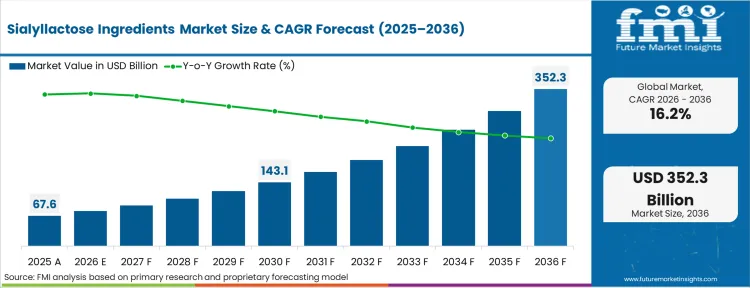
Growth becomes self-reinforcing once precision fermentation infrastructure crosses a specific volume threshold that drops the per-kilogram production cost below the premium margin ceiling of tier-1 consumer brands. Major biotechnology firms are currently scaling reactor capacities to trigger this exact inflection point. When this barrier clears, adoption moves rapidly from exclusive prescription-only medical foods into mainstream retail nutritional applications.
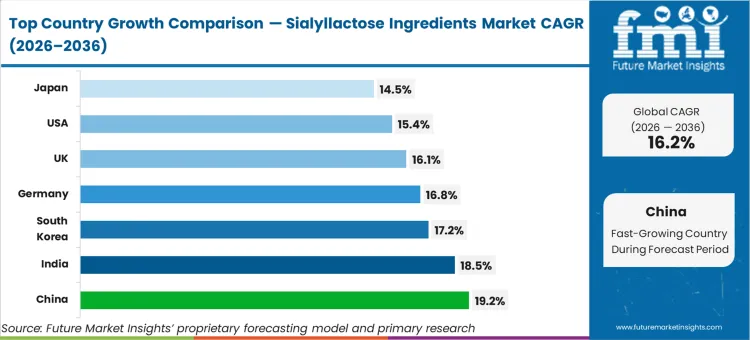
China tracks at 19.2% as domestic pediatric brands aggressively pursue premiumization strategies. India is estimated to advance at 18.5%, followed by South Korea at 17.2%, driven by rising investments in specialized biotechnology manufacturing hubs. Germany is projected to record a 16.8% expansion, slightly ahead of the United Kingdom at 16.1%, where novel food clearances dictate the pace of commercialization. The United States follows at 15.4%, and Japan is poised to garner 14.5% growth. The divergence across these geographies directly reflects the variance in how national food safety authorities classify and process novel biotechnological ingredients, rather than differences in underlying consumer demand.
Sialyllactose Ingredients Market Key Takeaways
| Metric | Details |
|---|---|
| Industry Size (2026) | USD 78.5 million |
| Industry Value (2036) | USD 352.1 million |
| CAGR (2026-2036) | 16.2% |
Source: Future Market Insights (FMI) analysis, based on proprietary forecasting model and primary research
Sialyllactose Ingredients Market Definition
The sialyllactose ingredients market encompasses the commercial production and supply of specific human milk oligosaccharides, primarily 3'-sialyllactose and 6'-sialyllactose, produced either via precision microbial fermentation or chemical synthesis. Analytically, this market is defined by the technical capability to produce these complex acidic oligosaccharides at commercial scale while meeting strict regulatory purity thresholds for inclusion in human nutritional products.
Sialyllactose Ingredients Market Inclusions
Scope includes purified 3'-sialyllactose and 6'-sialyllactose sodium salts, spray-dried sialyllactose powders, and liquid sialyllactose concentrates intended for human consumption. The market covers ingredients derived from genetically modified microbial strains, provided the final ingredient is entirely free from recombinant DNA, alongside enzymatically synthesized variants cleared for infant nutrition applications.
Sialyllactose Ingredients Market Exclusions
Bovine colostrum extracts and generalized dairy-derived sialic acid mixtures are strictly excluded because they lack the precise molecular structure and targeted bio-equivalency of synthesized or fermented human milk oligosaccharides. Fucosylated oligosaccharides, such as 2'-FL, are excluded as they represent a separate biochemical category governed by distinct production patents, pricing dynamics, and physiological functions.
Sialyllactose Ingredients Market Research Methodology
- Primary Research: FMI conducted interviews with Chief Technology Officers at precision fermentation firms, Head Formulators at tier-1 pediatric nutrition brands, and Regulatory Affairs Directors navigating novel food clearances.
- Desk Research: Analysts aggregated data from national food safety authority databases, publicly accessible Generally Recognized As Safe notices, and registered clinical trial repositories focusing on cognitive and immune endpoints.
- Market-Sizing and Forecasting: The baseline valuation anchors to disclosed production capacities of commercial-scale fermentation facilities and import volume data for high-value specialty nutritional additives.
- Data Validation and Update Cycle: Revenue forecasts were triangulated against capital expenditure announcements from major biotechnology ingredient suppliers and patent filing densities in the sialic acid biosynthesis domain.
Segmental Analysis
Sialyllactose Ingredients Market Analysis by Product Type
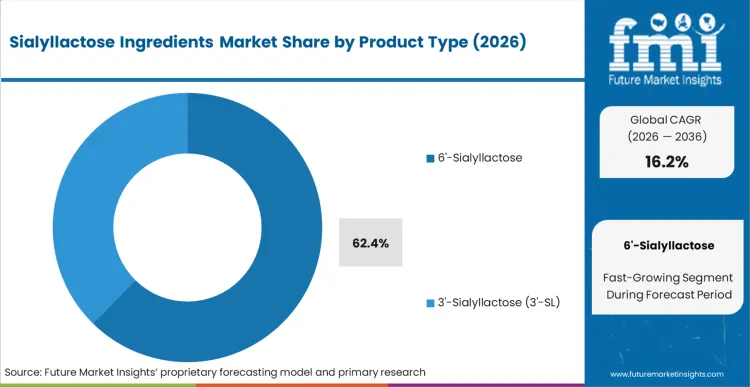
The reason 6'-Sialyllactose holds 62.4% of this market in 2026 stems directly from biological composition targets. Formulators are attempting to replicate the natural oligosaccharide ratio found in human breast milk, where 6'-SL is present in significantly higher concentrations than 3'-SL during early lactation stages. This biological reality forces procurement teams to index their purchasing heavily toward the 6'-isomer to support defensible bio-equivalency claims on packaging. According to FMI's estimates, this concentration differential dictates the capital allocation of biotechnology suppliers, who optimize their microbial strains primarily for 6'-SL yield. The operational consequence is a more robust, liquid supply chain for 6'-SL, allowing brands to plan large-scale rollouts with higher confidence. Nutritional brands that miscalculate this ratio and under-secure 6'-SL volumes face the commercial consequence of launching products that fail to meet the emerging analytical standards for premium infant formulations.
- Formulation threshold: 6'-SL provides the dominant sialic acid contribution required for cognitive development claims. Formulation scientists rely on this specific isomer to unlock premium pricing tiers in retail pediatric markets.
- Yield economics: Fermentation specialists currently achieve slightly better volumetric productivity with 6'-SL optimized strains. Production managers utilize this efficiency to lower the final cost-in-use for bulk purchasers.
- Clinical validation: The existing body of peer-reviewed evidence is heavily weighted toward the immune-modulating effects of the 6'-isomer. Medical marketing teams require this specific clinical backing to support physician detailing strategies.
Sialyllactose Ingredients Market Analysis by Source
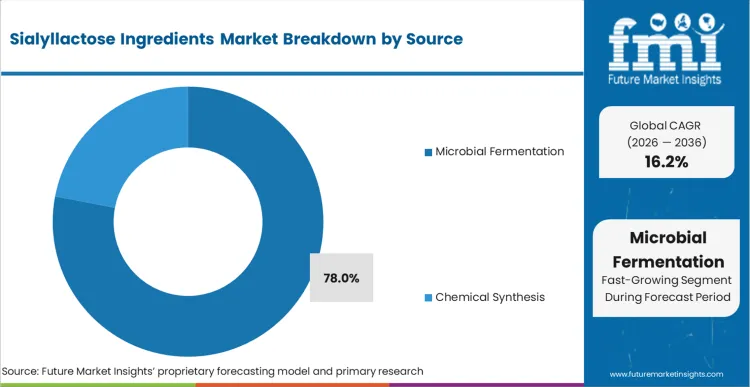
Legacy chemical synthesis pathways failed to deliver the cost architecture required for mass-market nutritional applications. This functional gap forced the industry toward Microbial Fermentation, which entirely displaces synthetic alternatives by utilizing genetically engineered microorganisms to produce complex carbohydrates from simple sugars. FMI analysts opine that this transition removes heavy metal catalyst risks and simplifies the safety dossier required by food safety authorities. Facility managers running precision fermentation platforms can scale production volumes linearly by adding reactor capacity, a flexibility impossible with rigid synthetic chemical routing. Buyers who rely on chemical synthesis for trial batches must inevitably confront severe margin degradation when attempting to transition those specific formulations to commercial-scale production runs.
- Process scalability: Fermentation platforms convert standard carbon sources into high-value oligosaccharides continuously. Operations directors capture significant margin improvements as batch sizes increase.
- Safety profile: Microbial pathways eliminate the need for harsh chemical solvents during synthesis. Quality assurance teams use this clean process profile to accelerate regulatory approvals for sensitive specialized dietary supplements.
- Strain ownership: Supplier advantage is entirely locked within proprietary, highly optimized microbial strains. Procurement teams must navigate complex intellectual property landscapes to ensure their chosen supply chain is patent-secure.
Sialyllactose Ingredients Market Analysis by Application
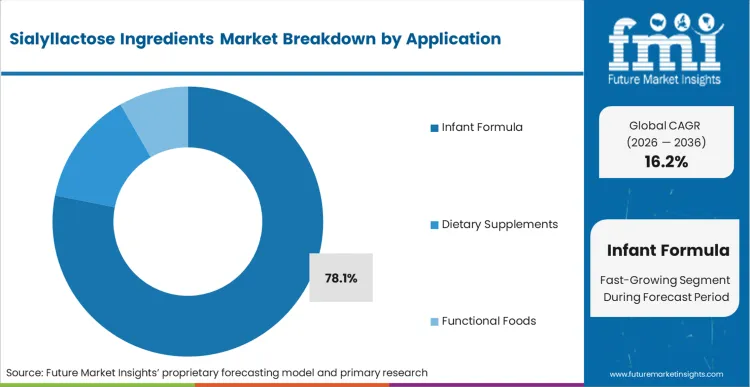
Through 2036, the application landscape transitions from exclusive reliance on pediatric nutrition toward targeted adult cognitive and immune formulations. Infant Formula currently dictates market architecture, commanding 78.1% share in 2026, because it presents the clearest commercial case for high-cost, low-volume specialty ingredients. As per FMI's projection, once fermentation yields improve and unit costs compress, formulators will rapidly deploy sialyllactose into medical foods and aging-support supplements. This shift forces ingredient suppliers to diversify their regulatory filings beyond pediatric safety thresholds to encompass general adult consumption. Ingredient manufacturers who fail to build clinical data supporting adult physiological benefits will find their growth artificially capped within the slowly expanding global infant formula demographic.
- Pediatric baseline: Inclusion in infant formulations serves as the primary revenue generator subsidizing overall industry capacity expansion. Brand managers utilize these early margins to fund ongoing clinical research.
- Cognitive expansion: Emerging data linking sialic acid to adult neural plasticity opens entirely new demographic targets. Product developers integrate these compounds into preventative cognitive health portfolios.
- Medical integration: Clinical nutrition pathways require highly purified, easily digestible immune modulators for compromised patients. Hospital procurement networks are beginning to specify these targeted clinical nutrition components for post-surgical recovery formulas.
Sialyllactose Ingredients Market Drivers, Restraints, and Opportunities
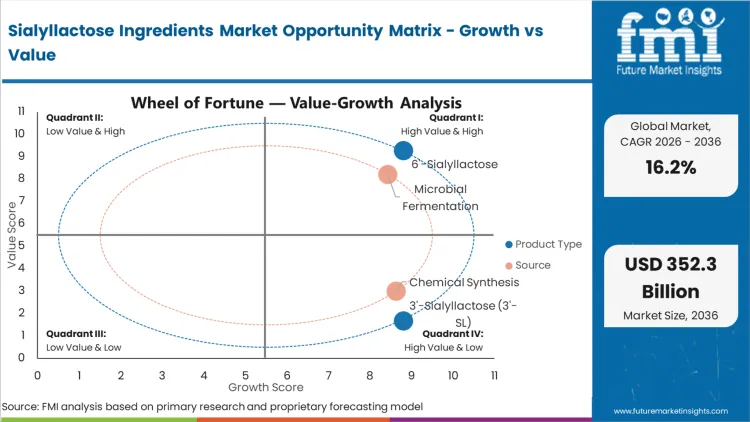
Deepening regulatory frameworks surrounding novel food ingredients compel formulation directors at global nutrition brands to standardize their global product portfolios. Rather than maintaining fragmented, region-specific formulations based on local approvals, tier-1 brands are moving to universal recipes utilizing legally cleared sialyllactose compounds. This pressure forces procurement departments to consolidate their purchasing with the few biotechnology suppliers capable of providing ingredients that meet both European and North American purity specifications simultaneously. Companies that delay this standardization lose the supply chain efficiencies necessary to compete in the increasingly consolidated premium nutrition sector.
The primary friction slowing broader adoption is the extreme complexity of downstream purification. Achieving the mandatory purity levels from raw fermentation broth requires sophisticated crystallization, simulated moving bed chromatography, and precise spray-drying protocols. This is not a temporary equipment shortage: it is a fundamental bioprocessing bottleneck that demands massive upfront capital expenditure. Contract manufacturing organizations are attempting to offer shared downstream services, but cross-contamination risks in pediatric supply chains limit their utility.
Opportunities in the Sialyllactose Ingredients Market
- Adult cognitive health: Maturing clinical data linking specific oligosaccharides to neural health enables targeted product launches. Functional food developers can capture early market share in the healthy-aging demographic before pediatric demand consumes all fermentation capacity.
- Synbiotic formulations: The compatibility of sialyllactose with specific beneficial bacterial strains creates new patentable combinations. Research and development teams design these probiotic synergy matrices to offer combined immune and digestive benefits.
- Process licensing: The immense capital barrier to building fermentation facilities creates a lucrative technology transfer market. IP-holding biotechnology startups can monetize their highly optimized microbial strains by licensing them to established agricultural processors possessing idle fermentation capacity.
Regional Analysis
Based on the regional analysis, the Sialyllactose Ingredients market is segmented into North America, Latin America, Western Europe, Eastern Europe, Asia Pacific, and Middle East & Africa across 40 plus countries.
.webp "Top Country Growth Comparison Sialyllactose Ingredients Market Cagr (2026 2036)")
| Country | CAGR (2026 to 2036) |
|---|---|
| China | 19.2% |
| India | 18.5% |
| South Korea | 17.2% |
| Germany | 16.8% |
| United Kingdom | 16.1% |
| United States | 15.4% |
| Japan | 14.5% |
Source: Future Market Insights (FMI) analysis, based on proprietary forecasting model and primary research
Asia Pacific Sialyllactose Ingredients Market Analysis
Buyer behavior and intense domestic brand competition shape the adoption trajectory across the Asia Pacific region. Pediatric nutrition companies in this market utilize ingredient innovation as the primary weapon to capture market share from established international competitors. Based on FMI's assessment, this dynamic accelerates the timeline for integrating novel compounds like sialyllactose, pushing regional procurement networks to secure supply agreements even before final local regulatory frameworks are fully implemented. The speed of formulation updates in this region forces biotechnology suppliers to maintain agile, highly responsive technical support teams locally.
- China: Aggressive domestic brand premiumization in the country forces formulation teams to adopt the latest human milk oligosaccharide profiles to remain competitive. Pediatric nutrition brands operating here must integrate these compounds swiftly to satisfy a highly informed, ingredient-conscious consumer base. The market for sialyllactose in China is forecast to register a CAGR of 19.2%. This rapid integration establishes a trajectory where Chinese formulation standards increasingly dictate the global baseline for complex nutritional additives.
- India: Regulatory modernization in India enables specialized nutrition brands to bypass legacy formulations and directly adopt advanced sialylated compounds. FMI estimates the sialyllactose market in India to expand at an annual growth rate of 18.5%. Formulation directors must balance these high-value ingredients against the extreme price sensitivity of the domestic retail environment. Brands that successfully optimize this cost-to-benefit ratio capture a massive, untapped commercial opportunity in the emerging middle-class pediatric sector.
- South Korea: South Korea is expected to see its sialyllactose market grow at a compound annual rate of 17.2%. South Korea's advanced domestic biotechnology infrastructure provides local brands with immediate access to precision fermentation capabilities. Supply chain managers operate without the heavy import tariffs and logistical delays that constrain buyers in adjacent markets. This domestic capability positions South Korean manufacturers to pivot rapidly from import substitution to becoming primary exporters of finished functional formulations across the broader region.
- Japan: Japan's highly rigorous functional food qualification standards require an exhaustive level of clinical documentation before sialyllactose can be marketed for specific health endpoints. Research directors must commit to multi-year clinical trials locally, regardless of safety data generated in Western markets. The Japanese landscape is set to achieve a CAGR of 14.5%. This creates a practitioner reality where the market expands slowly but with exceptionally high barriers to entry, locking in long-term stability for the few vendors who successfully navigate the approval matrix.
FMI's report includes expanding consumer hubs across Southeast Asia. These emerging markets demonstrate a clear pattern of regulatory shadowing, where local authorities rapidly adopt the safety dossiers and inclusion limits established by tier-1 global regulators, bypassing years of independent clinical review.
Europe Sialyllactose Ingredients Market Analysis
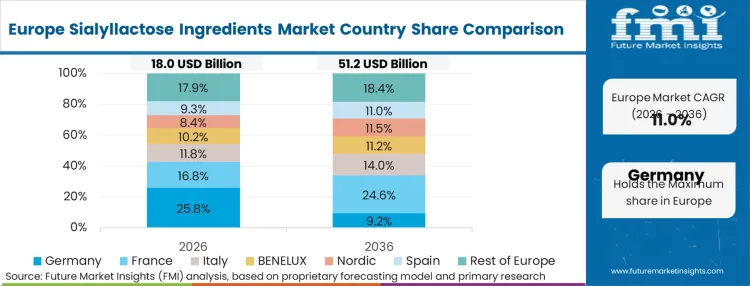
The regulatory environment, specifically the centralized novel food authorization process, dictates the pace and structure of market entry in Europe. This policy-led landscape forces ingredient manufacturers into a highly transparent, scientifically rigorous qualification cycle that favors well-capitalized biotechnology incumbents. In FMI's view, once clearance is granted, the unified market allows for rapid, cross-border commercialization, but the initial barrier filters out under-resourced challengers. Procurement teams in Europe operate with high confidence in ingredient safety but face supply limitations due to the small pool of authorized vendors.
- Germany: Germany's strict interpretation of clean-label requirements obligates functional food formulators to verify the complete absence of recombinant DNA in final fermented ingredients. Quality assurance teams must implement specialized testing protocols to validate every inbound shipment of sialyllactose. Over the forecast period, sialyllactose in Germany is set for a CAGR of 16.8%. Successfully navigating these purity standards results in a streamlined operational outcome where final products flow seamlessly into the highly lucrative organic and premium health retail channels.
- United Kingdom: Post-Brexit regulatory independence allows the United Kingdom to process novel food applications for advanced oligosaccharides on an independent timeline. Regulatory affairs managers must now allocate dedicated resources to manage simultaneous, parallel approval tracks for the European Union and the British market. The UK market for sialyllactose is likely to post a CAGR of 16.1%. Early navigation of this separate pathway provides agile ingredient suppliers a distinct competitive positioning advantage over vendors who wait for harmonized approvals.
FMI's report includes detailed assessments of the Nordic region. These countries exhibit a preference for sustainably produced, fermentation-derived ingredients, driven by overarching national mandates regarding supply chain decarbonization and advanced biotechnology integration.
North America Sialyllactose Ingredients Market Analysis
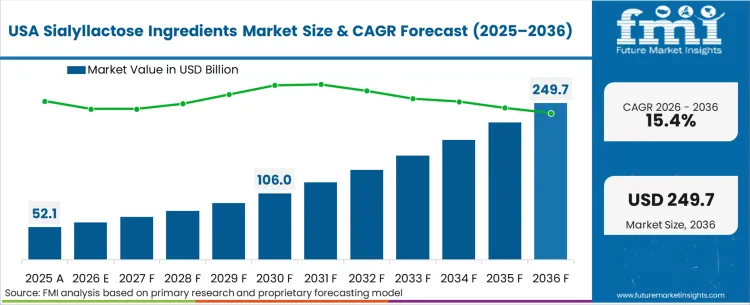
Capital availability and established precision fermentation infrastructure drive the North American market dynamics. The presence of massive contract manufacturing networks allows intellectual property holders to scale production rapidly without funding entire facilities independently. This economics-led environment forces procurement directors to evaluate vendors not just on current capacity, but on their financial runway and strategic partnerships. FMI analysts opine that the speed of commercialization here is heavily influenced by the aggressive investment posture of venture-backed biotechnology startups targeting adult recovery formulations and medical foods.
- United States: The United States' reliance on the Generally Recognized As Safe notification process allows ingredient developers to reach the commercialization phase faster than in markets requiring pre-market approval. Formulators in the US must independently verify the clinical efficacy of these compounds, as the regulatory framework primarily evaluates safety rather than functional claims. Demand for sialyllactose in the US is estimated to expand at a CAGR of 15.4%. Companies that successfully pair GRAS status with robust, independent clinical trials capture immediate commercial opportunity in the heavily funded sports nutrition and cognitive supplement sectors.
FMI's report includes analysis of the Canadian regulatory pathway. The Canadian framework requires a distinct novel food pre-market assessment, creating a delay that forces North American product launches into a staggered timeline rather than a unified continental rollout.
Competitive Aligners for Market Players
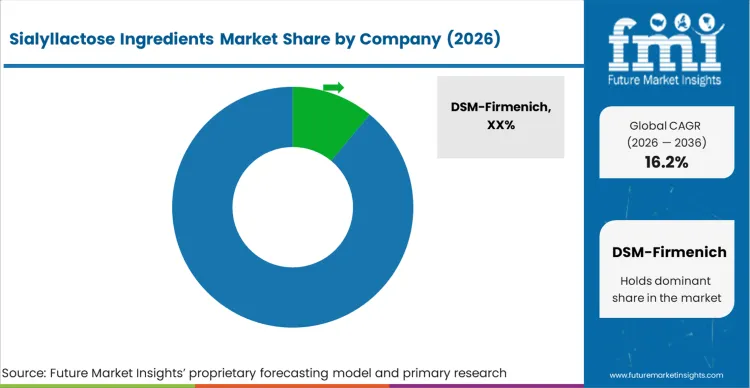
The competitive structure of the sialyllactose ingredients market is highly concentrated, dictated directly by the extreme capital requirements of precision fermentation and downstream purification. Global tier-1 nutrition brands, acting as the primary buyers, evaluate vendors strictly on their demonstrated ability to guarantee multi-ton commercial volumes without batch-to-batch variation. Companies like DSM-Firmenich and Novonesis hold dominant positions not simply because of their strain engineering, but because their vast, established manufacturing footprints derisk the supply chain for major pediatric formula clients.
To challenge these incumbents, emerging biotechnology firms must build or access pharmaceutical-grade crystallization and spray-drying capabilities. Having a high-yield microbial strain isinsufficient if the facility cannot extract the sialyllactose from the fermentation broth at 90 percent purity continuously. Challengers must demonstrate process engineering expertise that matches their genetic engineering capabilities. Successful entrants may attempt to achieve this by executing strategic joint ventures with legacy dairy processors, though converting idle filtration infrastructure requires massive retrofitting to meet strict pediatric cross-contamination standards.
Through 2036, the market will experience tension between the procurement preferences of global nutrition brands and the capacity limits of fermentation suppliers. Large buyers actively resist single-source lock-in, forcing them to cultivate secondary and tertiary suppliers even if it means tolerating slightly higher unit costs. However, the immense regulatory burden of filing new safety dossiers for every specific microbial strain naturally limits the vendor pool, keeping the market fundamentally consolidated despite buyer efforts to fragment it.
Key Players in Sialyllactose Ingredients Market
- DSM-Firmenich
- Novonesis
- Jennewein Biotechnologie GmbH
- BASF SE
- Kyowa Hakko Bio Co., Ltd.
- Royal FrieslandCampina N.V. (FrieslandCampina Ingredients)
- Nestlé Health Science
- Gnubiotics Sciences SA
- Elicityl SA
- Dextra Laboratories Ltd.
Scope of the Report
| Metric | Value |
|---|---|
| Quantitative Units | USD 78.5 million to USD 352.1 million, at a CAGR of 16.2% |
| Market Definition | The commercial production and supply ofexact 3'-sialyllactose and 6'-sialyllactose compounds, synthesized or fermented at scale for inclusion in strictly regulated human nutritional applications. |
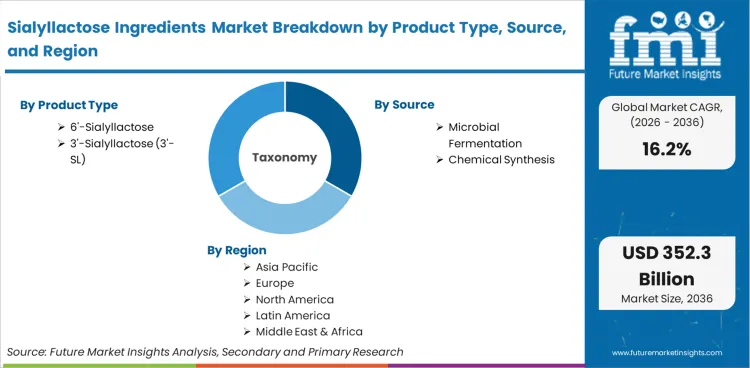
| Product Type Segmentation | 3'-Sialyllactose (3'-SL), 6'-Sialyllactose (6'-SL) |
| Source Segmentation | Microbial Fermentation, Chemical Synthesis |
| Application Segmentation | Infant Formula, Dietary Supplements, Functional Foods, Clinical Nutrition |
| Regions Covered | North America, Latin America, Western Europe, Eastern Europe, Asia Pacific, Middle East & Africa |
| Countries Covered | China, India, South Korea, Germany, United Kingdom, United States, Japan, and 40 plus countries |
| Key Companies Profiled | Novonesis, DSM-Firmenich (including Glycom A/S), Kyowa Hakko Bio Co., Ltd., FrieslandCampina Ingredients, and Advanced BioNutrition Corp |
| Forecast Period | 2026 to 2036 |
| Approach | Primary interviews targeted Chief Technology Officers at precision fermentation facilities and regulatory directors. The baseline data anchored to disclosed operational capacities of high-value specialty ingredient reactors. Projections were triangulated against capital expenditure tracking and registered clinical trial expansions. |
Source: Future Market Insights (FMI) analysis, based on proprietary forecasting model and primary research
Sialyllactose Ingredients Market Analysis by Segments
Product Type:
- 3'-Sialyllactose (3'-SL)
- 6'-Sialyllactose (6'-SL)
Source:
- Microbial Fermentation
- Chemical Synthesis
Application:
- Infant Formula
- Dietary Supplements
- Functional Foods
- Clinical Nutrition
Region:
- North America
- United States
- Canada
- Latin America
- Brazil
- Mexico
- Western Europe
- Germany
- United Kingdom
- France
- Italy
- Eastern Europe
- Poland
- Russia
- Asia Pacific
- China
- India
- Japan
- South Korea
- Australia
- Middle East & Africa
- GCC Countries
- South Africa
Bibliography
- Pressley, S. R., et al. (2024, March). Recent advances in the microbial production of human milk oligosaccharides. Frontiers in Bioengineering and Biotechnology.
- Urashima, T., et al. (2025, January). Recent advances in the science of human milk oligosaccharides. Current Research in Food Science.
- Amin, T., et al. (2025, July). Clinical evidence and mechanistic pathways of human milk oligosaccharides in gut health. Frontiers in Nutrition.
- Luo, G., et al. (2026, January). Building a microbial factory for human milk oligosaccharides: Efficient production of 3′-sialyllactosamine. Journal of Agricultural and Food Chemistry.
- NutraIngredients. (2026, February). China approves 3′-sialyllactose for use in infant formula.
- Food Standards Agency. (2025, March). Assessment of safety of 6′-sialyllactose sodium salt produced by microbial fermentation.
- dsm-firmenich. (2024, January). Approval of human milk oligosaccharide ingredients including 3′-sialyllactose and 6′-sialyllactose for infant nutrition.
This bibliography is provided for reader reference. The full FMI report contains the complete reference list with primary source documentation.
This Report Addresses
- Market intelligence to support strategic decision making across microbial fermentation outputs and synthetic specialty carbohydrate categories
- Market size estimation and 10-year revenue forecasts from 2026 to 2036, supported by disclosed production capacities of commercial-scale fermentation facilities
- Growth opportunity mapping across 3'-SL and 6'-SL product dimensions with emphasis on the downstream purification bottlenecks currently limiting supply
- Segment and regional revenue forecasts covering targeted clinical nutrition applications across markets governed by strict centralized novel food authorization processes
- Competition strategy assessment including specific intellectual property barriers, downstream processing capabilities, and joint venture structures within legacy dairy processors
- Technology development tracking including precision fermentation scale-up, simulated moving bed chromatography extraction, and safety dossier harmonization frameworks
- Market access analysis covering Generally Recognized As Safe notification pathways, European novel food requirements, and Chinese domestic pediatric formulation standards
- Market report delivery in PDF, Excel, PPT, and interactive dashboard formats for executive strategy, global pediatric nutrition formulation planning, and operational benchmarking use
Frequently Asked Questions
How large is the sialyllactose ingredients market in 2026?
The market reaches USD 78.5 million in 2026. This valuation reflects the immediate absorption of newly scaled microbial fermentation capacity by tier-1 pediatric nutrition brands securing their supply lines.
What will it be valued at by 2036?
Total valuation reaches USD 352.1 million by 2036. This scale assumes successful process engineering advancements that drop per-kilogram production costs, unlocking mainstream adult functional food applications.
What CAGR is projected?
The market expands at a 16.2% CAGR. This rapid pace is governed not by raw consumer demand, but by the sequential clearing of global regulatory hurdles and the activation of massive new bioprocessing facilities.
Which product type segment leads?
The 6'-Sialyllactose segment holds 62.4% share. It dominates because pediatric formulators require higher volumes of this specific isomer to accurately replicate the natural composition ratios found in human breast milk during early lactation.
Which Source segment leads?
Microbial fermentation controls the market architecture. Synthetic chemical pathways simply cannot achieve the cost reductions necessary to move sialyllactose out of the laboratory and into commercial food production.
Which application segment leads?
Infant formula captures 78.1% of the market. Pediatric nutrition provides the only current margin structure capable of absorbing the high initial costs of precision fermentation ingredients while funding ongoing clinical research.
What drives rapid growth?
Growth accelerates as major regulatory bodies finalize clear safety frameworks. This legal clarity forces procurement teams to transition sialyllactose from a research curiosity into a mandatory active ingredient for premium product tiers.
What is the primary restraint?
The downstream purification process creates a severe bottleneck. Extracting a 90 percent pure compound from complex fermentation broth requires capital-intensive chromatography and crystallization equipment that few suppliers possess at scale.
Which country grows fastest?
China expands at 19.2%, outpacing India's 18.5%. The difference lies in China's intense domestic brand competition, where companies use ingredient innovation aggressively to capture premium market share, forcing faster adoption cycles.
How do clean-label requirements impact formulation?
European purity standards force formulators to strictly verify the absence of recombinant DNA in the final product. This shifts purchasing power toward highly advanced biotechnology firms capable of guaranteeing completely isolated downstream processing.
Why is intellectual property a major constraint?
The efficient production of sialyllactose relies entirely on genetically engineered microbial strains. Brands must thoroughly audit their suppliers' patent positioning to avoid sudden supply disruptions caused by intellectual property litigation from dominant incumbents.
What allows incumbents to maintain their dominant market position?
Established players hold pharmaceutical-grade crystallization and spray-drying capabilities at scale. This downstream processing infrastructure derisks the supply chain for massive global brands, making it nearly impossible for small startups with good microbial strains to compete for major contracts.
How does South Korea's infrastructure shape its market trajectory?
South Korea possesses deep domestic precision fermentation capabilities, allowing local brands to bypass import logistics. This advantage allows formulation directors to rapidly prototype and scale new sialyllactose products for both domestic and export markets.
Why is 3'-Sialyllactose trailing in market share?
While clinically important, 3'-SL is present in lower concentrations in natural human milk during early lactation. Formulators prioritize securing the 6'-isomer first to hit their primary bio-equivalency targets before allocating budget to balance the complete oligosaccharide profile.
What prevents contract manufacturers from resolving the capacity bottleneck?
The extreme sensitivity of pediatric supply chains restricts the use of shared processing equipment. The risk of cross-contamination limits the utility of external contract manufacturing organizations, forcing primary ingredient suppliers to build dedicated, proprietary downstream lines.
How are adult nutrition brands approaching this market?
Cognitive and healthy-aging formulators are quietly establishing early offtake agreements. They are preparing to absorb excess capacity the moment production volumes push unit costs below the premium infant formula margin ceiling.
What does the Japanese regulatory environment mean for market entry?
Japan's requirement for extensive, locally generated clinical data creates a multi-year lag before commercialization. This locks out opportunistic suppliers and reserves the market for well-capitalized firms capable of funding long-term regional medical research.
Why are chemical synthesis pathways being phased out?
Chemical synthesis relies on harsh solvents and complex routing that scales poorly. Quality assurance directors increasingly reject these pathways to avoid the intense regulatory scrutiny associated with trace catalyst residues in specialized dietary supplements.
How do European brands manage the novel food authorization timeline?
Procurement directors in Western Europe build multi-year launch schedules precisely timed to anticipated EFSA clearances. They often initiate supply qualification audits with fermentation facilities a full 18 months before legal commercialization is permitted.
What role do legacy dairy processors play in the future market structure?
Legacy dairy companies hold massive, underutilized liquid filtration and drying infrastructure. We anticipate a surge in joint ventures where biotechnology firms provide the engineered microbial strains and dairy processors provide the downstream industrial scale, once cross-contamination retrofitting is addressed.
How does the US GRAS system alter supplier strategy?
The GRAS notification pathway allows ingredient developers to shift resources away from purely safety-focused pre-market approvals and directly into funding independent clinical trials that support lucrative, targeted functional claims.
What changes in this market by 2036?
By 2036, sialyllactose will transition from a niche, premium differentiator to a baseline nutritional requirement. The competitive axis will shift entirely from basic production capability to the formulation of highly stable, customized synbiotic matrices combining specific oligosaccharides with proprietary probiotic strains.
Preview the report firsthand - request a free sample
Get SampleGet the brochure for pricing and purchase details.
Get PDFTable of Content
- Executive Summary
- Global Market Outlook
- Demand-side Trends
- Supply-side Trends
- Technology Roadmap Analysis
- Analysis and Recommendations
- Market Overview
- Market Coverage / Taxonomy
- Market Definition / Scope / Limitations
- Research Methodology
- Chapter Orientation
- Analytical Lens and Working Hypotheses
- Market Structure, Signals, and Trend Drivers
- Benchmarking and Cross-market Comparability
- Market Sizing, Forecasting, and Opportunity Mapping
- Research Design and Evidence Framework
- Desk Research Programme (Secondary Evidence)
- Company Annual and Sustainability Reports
- Peer-reviewed Journals and Academic Literature
- Corporate Websites, Product Literature, and Technical Notes
- Earnings Decks and Investor Briefings
- Statutory Filings and Regulatory Disclosures
- Technical White Papers and Standards Notes
- Trade Journals, Industry Magazines, and Analyst Briefs
- Conference Proceedings, Webinars, and Seminar Materials
- Government Statistics Portals and Public Data Releases
- Press Releases and Reputable Media Coverage
- Specialist Newsletters and Curated Briefings
- Sector Databases and Reference Repositories
- FMI Internal Proprietary Databases and Historical Market Datasets
- Subscription Datasets and Paid Sources
- Social Channels, Communities, and Digital Listening Inputs
- Additional Desk Sources
- Expert Input and Fieldwork (Primary Evidence)
- Primary Modes
- Qualitative Interviews and Expert Elicitation
- Quantitative Surveys and Structured Data Capture
- Blended Approach
- Why Primary Evidence is Used
- Field Techniques
- Interviews
- Surveys
- Focus Groups
- Observational and In-context Research
- Social and Community Interactions
- Stakeholder Universe Engaged
- C-suite Leaders
- Board Members
- Presidents and Vice Presidents
- R&D and Innovation Heads
- Technical Specialists
- Domain Subject-matter Experts
- Scientists
- Physicians and Other Healthcare Professionals
- Governance, Ethics, and Data Stewardship
- Research Ethics
- Data Integrity and Handling
- Primary Modes
- Tooling, Models, and Reference Databases
- Desk Research Programme (Secondary Evidence)
- Data Engineering and Model Build
- Data Acquisition and Ingestion
- Cleaning, Normalisation, and Verification
- Synthesis, Triangulation, and Analysis
- Quality Assurance and Audit Trail
- Market Background
- Market Dynamics
- Drivers
- Restraints
- Opportunity
- Trends
- Scenario Forecast
- Demand in Optimistic Scenario
- Demand in Likely Scenario
- Demand in Conservative Scenario
- Opportunity Map Analysis
- Product Life Cycle Analysis
- Supply Chain Analysis
- Investment Feasibility Matrix
- Value Chain Analysis
- PESTLE and Porter’s Analysis
- Regulatory Landscape
- Regional Parent Market Outlook
- Production and Consumption Statistics
- Import and Export Statistics
- Market Dynamics
- Global Market Analysis 2021 to 2025 and Forecast, 2026 to 2036
- Historical Market Size Value (USD Million) Analysis, 2021 to 2025
- Current and Future Market Size Value (USD Million) Projections, 2026 to 2036
- Y-o-Y Growth Trend Analysis
- Absolute $ Opportunity Analysis
- Global Market Pricing Analysis 2021 to 2025 and Forecast 2026 to 2036
- Global Market Analysis 2021 to 2025 and Forecast 2026 to 2036, By Product Type
- Introduction / Key Findings
- Historical Market Size Value (USD Million) Analysis By Product Type , 2021 to 2025
- Current and Future Market Size Value (USD Million) Analysis and Forecast By Product Type , 2026 to 2036
- 6'-Sialyllactose
- 3'-Sialyllactose (3'-SL)
- 6'-Sialyllactose
- Y-o-Y Growth Trend Analysis By Product Type , 2021 to 2025
- Absolute $ Opportunity Analysis By Product Type , 2026 to 2036
- Global Market Analysis 2021 to 2025 and Forecast 2026 to 2036, By Source
- Introduction / Key Findings
- Historical Market Size Value (USD Million) Analysis By Source, 2021 to 2025
- Current and Future Market Size Value (USD Million) Analysis and Forecast By Source, 2026 to 2036
- Microbial Fermentation
- Chemical Synthesis
- Microbial Fermentation
- Y-o-Y Growth Trend Analysis By Source, 2021 to 2025
- Absolute $ Opportunity Analysis By Source, 2026 to 2036
- Global Market Analysis 2021 to 2025 and Forecast 2026 to 2036, By Application
- Introduction / Key Findings
- Historical Market Size Value (USD Million) Analysis By Application, 2021 to 2025
- Current and Future Market Size Value (USD Million) Analysis and Forecast By Application, 2026 to 2036
- Infant Formula
- Dietary Supplements
- Functional Foods
- Infant Formula
- Y-o-Y Growth Trend Analysis By Application, 2021 to 2025
- Absolute $ Opportunity Analysis By Application, 2026 to 2036
- Global Market Analysis 2021 to 2025 and Forecast 2026 to 2036, By Region
- Introduction
- Historical Market Size Value (USD Million) Analysis By Region, 2021 to 2025
- Current Market Size Value (USD Million) Analysis and Forecast By Region, 2026 to 2036
- North America
- Latin America
- Western Europe
- Eastern Europe
- East Asia
- South Asia and Pacific
- Middle East & Africa
- Market Attractiveness Analysis By Region
- North America Market Analysis 2021 to 2025 and Forecast 2026 to 2036, By Country
- Historical Market Size Value (USD Million) Trend Analysis By Market Taxonomy, 2021 to 2025
- Market Size Value (USD Million) Forecast By Market Taxonomy, 2026 to 2036
- By Country
- USA
- Canada
- Mexico
- By Product Type
- By Source
- By Application
- By Country
- Market Attractiveness Analysis
- By Country
- By Product Type
- By Source
- By Application
- Key Takeaways
- Latin America Market Analysis 2021 to 2025 and Forecast 2026 to 2036, By Country
- Historical Market Size Value (USD Million) Trend Analysis By Market Taxonomy, 2021 to 2025
- Market Size Value (USD Million) Forecast By Market Taxonomy, 2026 to 2036
- By Country
- Brazil
- Chile
- Rest of Latin America
- By Product Type
- By Source
- By Application
- By Country
- Market Attractiveness Analysis
- By Country
- By Product Type
- By Source
- By Application
- Key Takeaways
- Western Europe Market Analysis 2021 to 2025 and Forecast 2026 to 2036, By Country
- Historical Market Size Value (USD Million) Trend Analysis By Market Taxonomy, 2021 to 2025
- Market Size Value (USD Million) Forecast By Market Taxonomy, 2026 to 2036
- By Country
- Germany
- UK
- Italy
- Spain
- France
- Nordic
- BENELUX
- Rest of Western Europe
- By Product Type
- By Source
- By Application
- By Country
- Market Attractiveness Analysis
- By Country
- By Product Type
- By Source
- By Application
- Key Takeaways
- Eastern Europe Market Analysis 2021 to 2025 and Forecast 2026 to 2036, By Country
- Historical Market Size Value (USD Million) Trend Analysis By Market Taxonomy, 2021 to 2025
- Market Size Value (USD Million) Forecast By Market Taxonomy, 2026 to 2036
- By Country
- Russia
- Poland
- Hungary
- Balkan & Baltic
- Rest of Eastern Europe
- By Product Type
- By Source
- By Application
- By Country
- Market Attractiveness Analysis
- By Country
- By Product Type
- By Source
- By Application
- Key Takeaways
- East Asia Market Analysis 2021 to 2025 and Forecast 2026 to 2036, By Country
- Historical Market Size Value (USD Million) Trend Analysis By Market Taxonomy, 2021 to 2025
- Market Size Value (USD Million) Forecast By Market Taxonomy, 2026 to 2036
- By Country
- China
- Japan
- South Korea
- By Product Type
- By Source
- By Application
- By Country
- Market Attractiveness Analysis
- By Country
- By Product Type
- By Source
- By Application
- Key Takeaways
- South Asia and Pacific Market Analysis 2021 to 2025 and Forecast 2026 to 2036, By Country
- Historical Market Size Value (USD Million) Trend Analysis By Market Taxonomy, 2021 to 2025
- Market Size Value (USD Million) Forecast By Market Taxonomy, 2026 to 2036
- By Country
- India
- ASEAN
- Australia & New Zealand
- Rest of South Asia and Pacific
- By Product Type
- By Source
- By Application
- By Country
- Market Attractiveness Analysis
- By Country
- By Product Type
- By Source
- By Application
- Key Takeaways
- Middle East & Africa Market Analysis 2021 to 2025 and Forecast 2026 to 2036, By Country
- Historical Market Size Value (USD Million) Trend Analysis By Market Taxonomy, 2021 to 2025
- Market Size Value (USD Million) Forecast By Market Taxonomy, 2026 to 2036
- By Country
- Kingdom of Saudi Arabia
- Other GCC Countries
- Turkiye
- South Africa
- Other African Union
- Rest of Middle East & Africa
- By Product Type
- By Source
- By Application
- By Country
- Market Attractiveness Analysis
- By Country
- By Product Type
- By Source
- By Application
- Key Takeaways
- Key Countries Market Analysis
- USA
- Pricing Analysis
- Market Share Analysis, 2025
- By Product Type
- By Source
- By Application
- Canada
- Pricing Analysis
- Market Share Analysis, 2025
- By Product Type
- By Source
- By Application
- Mexico
- Pricing Analysis
- Market Share Analysis, 2025
- By Product Type
- By Source
- By Application
- Brazil
- Pricing Analysis
- Market Share Analysis, 2025
- By Product Type
- By Source
- By Application
- Chile
- Pricing Analysis
- Market Share Analysis, 2025
- By Product Type
- By Source
- By Application
- Germany
- Pricing Analysis
- Market Share Analysis, 2025
- By Product Type
- By Source
- By Application
- UK
- Pricing Analysis
- Market Share Analysis, 2025
- By Product Type
- By Source
- By Application
- Italy
- Pricing Analysis
- Market Share Analysis, 2025
- By Product Type
- By Source
- By Application
- Spain
- Pricing Analysis
- Market Share Analysis, 2025
- By Product Type
- By Source
- By Application
- France
- Pricing Analysis
- Market Share Analysis, 2025
- By Product Type
- By Source
- By Application
- India
- Pricing Analysis
- Market Share Analysis, 2025
- By Product Type
- By Source
- By Application
- ASEAN
- Pricing Analysis
- Market Share Analysis, 2025
- By Product Type
- By Source
- By Application
- Australia & New Zealand
- Pricing Analysis
- Market Share Analysis, 2025
- By Product Type
- By Source
- By Application
- China
- Pricing Analysis
- Market Share Analysis, 2025
- By Product Type
- By Source
- By Application
- Japan
- Pricing Analysis
- Market Share Analysis, 2025
- By Product Type
- By Source
- By Application
- South Korea
- Pricing Analysis
- Market Share Analysis, 2025
- By Product Type
- By Source
- By Application
- Russia
- Pricing Analysis
- Market Share Analysis, 2025
- By Product Type
- By Source
- By Application
- Poland
- Pricing Analysis
- Market Share Analysis, 2025
- By Product Type
- By Source
- By Application
- Hungary
- Pricing Analysis
- Market Share Analysis, 2025
- By Product Type
- By Source
- By Application
- Kingdom of Saudi Arabia
- Pricing Analysis
- Market Share Analysis, 2025
- By Product Type
- By Source
- By Application
- Turkiye
- Pricing Analysis
- Market Share Analysis, 2025
- By Product Type
- By Source
- By Application
- South Africa
- Pricing Analysis
- Market Share Analysis, 2025
- By Product Type
- By Source
- By Application
- USA
- Market Structure Analysis
- Competition Dashboard
- Competition Benchmarking
- Market Share Analysis of Top Players
- By Regional
- By Product Type
- By Source
- By Application
- Competition Analysis
- Competition Deep Dive
- DSM-Firmenich
- Overview
- Product Portfolio
- Profitability by Market Segments (Product/Age /Sales Channel/Region)
- Sales Footprint
- Strategy Overview
- Marketing Strategy
- Product Strategy
- Channel Strategy
- Novonesis
- Jennewein Biotechnologie GmbH
- BASF SE
- Kyowa Hakko Bio Co., Ltd.
- Royal FrieslandCampina N.V. (FrieslandCampina Ingredients)
- Nestlé Health Science
- DSM-Firmenich
- Competition Deep Dive
- Assumptions & Acronyms Used


