

- Market Size (2026)
- USD 674.6 Mn
- Forecast (2036)
- USD 1242.8 Mn
- CAGR (2026 to 2036)
- 6.3%
How big is SLS Refresh Powders Market in 2026?
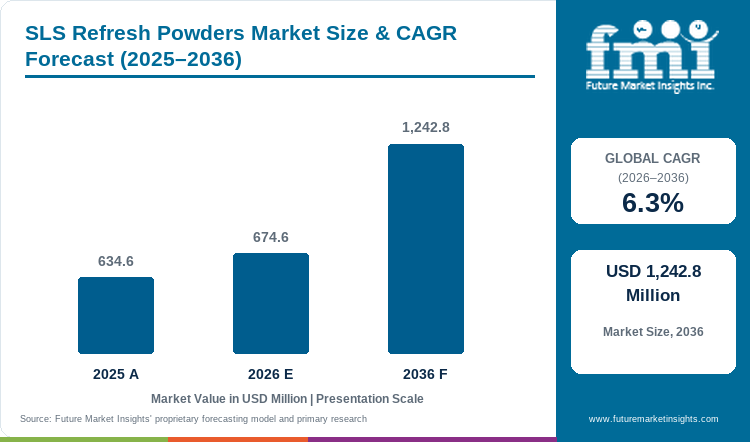
The SLS Refresh Powders market is valued at USD 674.6 million in 2026 and is projected to reach USD 1,242.8 million by 2036, expanding at a CAGR of 6.3% over the 2026-2036 period.
Sales of SLS refresh powders are estimated to rise at 6.3% CAGR through 2036. Market valuation increases from USD 634.6 million in 2025 to USD 674.6 million in 2026 and is estimated to reach USD 1,242.8 million by 2036. Plant teams are adding fresh powder because repeated heat cycles are changing used powder. Heat exposure is changing powder flow and narrowing the stable print window. Fresh powder is bringing each mix back inside approved machine settings. Teams are using the approved reuse ratio to set fresh-powder input for each build. HP introduced the MJF 1200 for small production teams in April 2026. The printer is expanding access to polymer powder-bed printing for smaller teams. Demand is expected to rise with printer use, while poor powder history is forcing higher refresh ratios or batch rejection.
Country demand is taking different paths because plants have different printer access, local service and approval rules. U.S. plants are using a broad network for training, testing and support. NIST reported 17 Manufacturing USA institutes in its March 2026 annual report. America Makes is providing an additive manufacturing hub for shared training and testing. German plants are using more written checks during powder approval. Japanese users are relying on detailed reviews and written standards for new reuse limits. Mexican and Dutch buyers are keeping stock nearby because smaller plants are running short or mixed jobs. These differences are changing how fast a powder trial becomes regular production.
Key Takeaways
- Higher printer use is raising fresh-powder orders because each reuse cycle needs a controlled mix of fresh and reclaimed material.
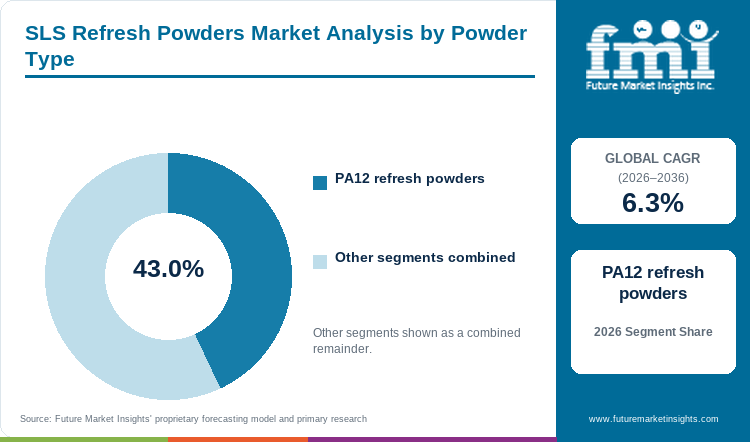
- PA12 refresh powders are estimated to hold 43.0% of powder type sales in 2026 because many powder-bed systems are already using the material.
- Industrial SLS is expected to lead printer platform sales at 42.0% in 2026 as production systems are using larger powder charges and more reuse cycles.
- Service bureaus are expected to represent 35.0% of end use sales in 2026 while pooled jobs are keeping powder handling frequent.
- Powder aging and weak batch records are slowing approval because heat exposure is changing reclaimed material between production builds.
- Key players include EOS, 3D Systems, HP, Evonik, Arkema, Forward AM, Sinterit, Formlabs, CRP Technology and LEHVOSS Group.
Analyst Perspective
“The next opportunity is opening as users move reclaimed powder into more polymers used for production. Suppliers are shortening approval work by publishing clear refresh limits and test data, while weak powder history is limiting wider adoption.”
- Nikhil Kaitwade, Principal Consultant, Future Market Insights
How is the SLS refresh powders market segmented?
The SLS Refresh Powders market is segmented six ways: by Powder Type, Printer Platform, End Use, Reuse Ratio, Sales Channel, and Region. PA12 refresh powders lead Powder Type with 43.0% of 2026 sales, Industrial SLS leads Printer Platform with 42.0%, and Service bureaus lead End Use with 35.0%.
The market is segmented by powder type, printer platform, end use, reuse ratio, sales channel and region. Powder type includes PA12, PA11, TPU, PP and specialty composite powders used in polymer production. Printer platform includes industrial SLS, MJF-compatible systems, desktop SLS and high-temperature SLS at different production scales. End use separates service bureaus, industrial prototyping, automotive parts, medical models and consumer goods. Reuse ratio covers medium, low and high refresh ratios plus virgin blend packages. Sales channel covers printer OEMs, material distributors, service bureau supply and direct powder producers.
What makes PA12 refresh powders central to the powder type category?
Plant teams are using PA12 across many polymer powder-bed systems for regular production. Polyamide materials such as PA12 are familiar to teams that check powder flow and mixing. EOS published a PA 2220 HighReuse material data sheet for EOS P3 NEXT in July 2026. The sheet sets a defined PA12 reuse route for that printer platform. Plant teams are comparing reclaimed powder with their own machine settings and part requirements. Buyers are using approved reuse limits to plan how much fresh powder each new build needs.
- Based on powder type, PA12 refresh powders are projected to account for 43.0% in 2026. Many polymer systems are already using PA12, so teams are applying familiar refresh steps.
- Plant teams are using known powder-mix limits to approve fresh material without rebuilding the full production plan.
Why does industrial SLS shape the printer platform category?
Production teams are using industrial SLS for larger builds and more reuse cycles. Industrial 3D printing relies on even powder layers during recoating, the step that spreads powder before each new layer. In June 2025, EOS reported that some dental firms operated several SLS systems. Some dental sites are producing tens of thousands of appliances each year, so their printers are running through many production cycles. Frequent machine use is making powder checks, reuse limits and refill planning part of daily production.
- In 2026, industrial SLS is expected to lead the printer platform category with 42.0% share. Production fleets are using larger powder charges and are completing more reuse cycles than compact systems.
- Known machine settings are reducing the risk of failed builds that waste powder and printer time.
How do service bureaus shape demand within the end use category?
Service bureaus are combining jobs from customers that do not own powder-bed printers. They are keeping 3D printing materials in stock so mixed customer jobs can run without long supply gaps. Formlabs added “Add to a Running Job” for Fuse printers in March 2025. The Fuse tool is letting users add parts to an SLS build that is already running. The feature is keeping printers productive and shortening the time before powder is sorted and mixed again.
- By end use, service bureaus are forecast to represent 35.0% in 2026. Mixed customer jobs are keeping bureaus sorting, recording and replenishing powder across different build schedules.
- Service bureaus are using smaller packs to keep lot records clear across shared customer jobs.
What supports the medium refresh ratio within the reuse ratio category?
Teams are mixing used powder with fresh powder for another production build. Additive manufacturing materials are changing through repeated heat cycles, which is affecting flow and recoating. Formlabs lowered the Nylon 12 Tough default refresh rate from 30% to 20% in April 2025. The firmware update is tying fresh-powder input to a tested material setting on Fuse printers. Plant teams are using that approved rate as the starting point for each new powder mix. Material-specific limits are helping buyers plan fresh powder without treating every used batch the same.
- By reuse ratio, the medium band is estimated to hold 39.0% in 2026. Plant teams are using medium ratios to restore flow while keeping more reclaimed material in the next build.
- Medium refresh ratios are reducing fresh-powder use while keeping reclaimed material inside approved process limits.
What drives printer OEMs within the sales channel category?
Printer OEMs are linking material rules with machine settings and local service. Printer makers are helping production users manage engineering plastics and recoating across repeated production runs. In July 2025, Sinterit named Burton Precision as its exclusive United States reseller. The agreement covers printers, materials, training and service for U.S. customers. Buyers are getting powder and machine support through one local route. Nearby stock and machine knowledge are helping teams solve mix problems before they delay approved production.
- Printer OEMs are set to lead the sales channel category with 36.0% share in 2026. OEM guidance is helping buyers match refresh limits with approved machine settings.
- Independent distributors are supporting mixed printer fleets with nearby stock and local service help.
What are the drivers, restraints and opportunities in the SLS Refresh Powders Market?
In the SLS Refresh Powders market, the key driver is regular production builds that raise fresh-powder demand because every reuse cycle needs another controlled mix of fresh and used powder, the key restraint is unknown heat history that makes powder flow and part quality harder to predict during approval of reclaimed material, and the key opportunity is qualified low-refresh mixes that let users reuse more specialty polymer while staying inside approved process limits.
- Driver: Regular production builds are raising fresh-powder demand because every reuse cycle needs another controlled mix of fresh and used powder.
- Restraint: Unknown heat history is making powder flow and part quality harder to predict during approval of reclaimed material.
- Opportunity: Qualified low-refresh mixes are letting users reuse more specialty polymer while staying inside approved process limits.
Production fleets are making refresh powder a planned production material
Plants using SLS every day are planning refresh powder with other production materials. In September 2025, Sinterit reported an order for more than 30 Lisa X and Suzy printers from FIT. FIT is using those systems for customer parts, so more active printers are creating more powder handling and reuse decisions. In automotive 3D printing, each powder-bed build leaves unused powder that teams are sorting and recording. Plant teams are setting the fresh-powder share from the approved reuse limit. More printer use is creating more refill decisions and more checks on used powder. Teams are using approved refresh powder because flow and part quality must stay inside approved limits. Nearby stock is helping plants refill approved grades without delaying scheduled builds.
Powder history is limiting how much material plants can reuse
Heat and handling are changing used powder during every reuse cycle. The changes are altering flow and making later builds less predictable. ASTM International opened a revision of its powder-reuse guide in March 2026. The guide covers powder-bed feedstock for medical parts made with polymer and metal powders. The revision is making clear reuse records more important for high performance polyamides and other approved grades. Plant teams are checking lot history before used powder returns to production. Weak records are forcing teams to add more fresh powder or reject the batch. Extra testing is adding approval time and reducing reuse savings. Age and mix records are helping plants keep each batch inside approved limits.
Specialty grades are creating more ways to reuse powder
Specialty grades are giving buyers more ways to reuse powder, but each material needs its own limit. HP made its halogen-free PA12 FR material available in April 2025. HP states that its approved process supports a 60% powder-reuse ratio for this grade. The release is giving plant teams a clear reuse plan for flame-retardant PA12. Users are setting separate reuse limits for TPU and PA11 on each approved machine. Users are checking the same machine records for polypropylene materials and selected composites. Nearby stock is reducing delays while teams compare powder cost with part yield. Approved specialty grades are expanding reuse without removing basic powder checks.
What are the country CAGRs in the SLS Refresh Powders Market?
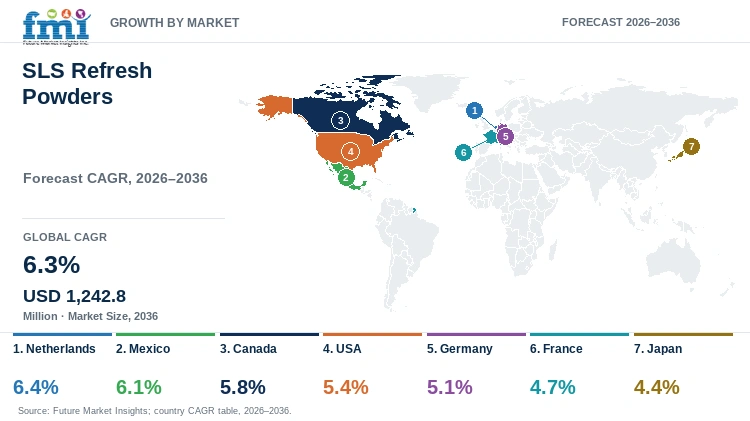
| Country | CAGR |
|---|---|
| Netherlands | 6.4% |
| Mexico | 6.1% |
| Canada | 5.8% |
| USA | 5.4% |
| Germany | 5.1% |
| France | 4.7% |
| Japan | 4.4% |
How do country-level CAGRs compare in the SLS Refresh Powders Market?
Country demand is following different paths because printer access, local service and approval practices are creating different buying conditions. Dutch 3D printing hubs are keeping trials close to machine help and powder stock. Mexican contract plants are using flexible pack sizes for short and changing jobs. Users in Canada and the United States are drawing on research and training networks. Germany, France and Japan are putting more weight on records that prove a new powder limit is safe for production.
- Dutch 3D printing hubs keep powder trials close to machine help and small powder stocks.
- Mexican contract plants need flexible powder packs as automotive and medical jobs shift between short runs.
- Canadian research programs support plastic powder tests, while smaller printer fleets favor flexible orders and nearby help.
- Across the USA, shared 3D printing networks give plant teams common training for powder checks and approval.
- German plants favor stable build records and batch certificates during approval of different plastic powder mixes.
- French factory programs support 3D printing trials and create demand for clear lot records during approval.
- Japanese users favor detailed build data and supplier records because engineering reviews lengthen approval for new powder limits.
Powder buying is changing by country because plants are using different printer fleets, service networks and approval routines. Country coverage includes North America, Latin America, Western Europe and Eastern Europe. It also includes East Asia, South Asia and Pacific, the Middle East and Africa.
Country-wise Analysis
- The Netherlands is projected to grow at 6.4% CAGR through 2036. Dutch users are ordering small powder lots and relying on nearby machine support for mixed jobs. In June 2025, the Dutch government named smart materials among five defense-industry focus areas. The policy covers advanced materials rather than SLS refresh powder sales. Users with open systems are testing more material options, so local support is helping with early powder trials. Clear records are letting teams reuse accepted mix settings on later customer jobs. Small packs are reducing stock costs for sites that change materials often. Nearby service is helping teams solve powder issues without holding large inventories. Dutch buyers are favoring flexible order sizes, clear records and machine support.
- Mexico is estimated to post 6.1% CAGR through 2036. Contract plants are buying flexible powder packs for short jobs in automotive, aerospace and electronics. Contract manufacturers are using medical 3D printing for short jobs that need clear powder records. In February 2026, the International Trade Administration listed 3D printing as an area for advanced factory work. The guide links 3D printing with plant upgrades and new ways to make parts. Imported powder can take longer to arrive, and printer service varies by area. Local distributors are keeping stock closer to users and giving support in Spanish. Flexible pack sizes fit changing schedules, while clear lot records are helping teams track powder across customer jobs.
- SLS refresh powder demand in Canada is forecast at 5.8% CAGR through 2036. National research is helping users test powder and printer settings. In July 2026, the National Research Council updated its Advanced Manufacturing program. The program includes polymer work, high-performance composites and 3D printing. Many Canadian users are running small printer fleets and avoiding large powder stocks. Small packs and nearby service are reducing money tied up in unused material. Clear reuse records are letting teams use one printer across jobs with different powder limits. Teams are keeping a separate powder history and approval rule for each job. Flexible order sizes are helping users move from research tests into regular plant work.
- Adoption of SLS refresh powder in the USA is estimated to expand at 5.4% CAGR through 2036. U.S. service bureaus and plant teams are using America Makes for training and shared production work. America Makes reported more than 750 people at its main events in December 2025. The institute added 33 members during the same reporting period. The figures track shared 3D printing work, not refresh powder sales. Plant teams are using approved mix limits before used powder enters regular production. Nearby stock and clear lot records are reducing refill delays across mixed printer fleets. Shared training is helping users apply common methods for production checks and customer reviews.
- SLS refresh powder sales in Germany are forecast to grow at 5.1% CAGR through 2036. German plants are using stable build results to approve each new polymer powder mix. VDMA reported more than 850 Formnext exhibitors in Frankfurt during November 2025. VDMA projected more than 32,000 visitors for the same additive manufacturing event. The figures track supplier activity rather than direct refresh powder sales. Germany’s supplier base is giving plant teams access to aerospace 3D printing knowledge and material support. Automotive plants are using batch certificates and clear mix rules to review powder changes. Machine support is reducing review work, while long approval cycles are delaying new grades and planned orders.
- In France, refresh powder demand is predicted to advance at 4.7% CAGR through 2036. Public factory programs are helping French firms test 3D printing methods for plant use. In July 2026, France’s Economy Ministry reported results from its robotics and smart-machines plan. The national program has supported close to 100 projects since 2023. The ministry says additive manufacturing has been part of the program since 2023. These programs are helping firms move new equipment from tests into regular factory use. Refresh powder suppliers are supporting polymer projects that reach steady plant production. Plant teams are using compliance checks and clear lot records during material trials. Set reuse limits and nearby stock are helping teams keep approved polymer runs supplied.
- Japan is projected to grow at 4.4% CAGR through 2036, limited by long plant reviews. Japanese users are favoring clear build records and local machine support during each powder review. In January 2026, METI’s Go-Tech database reported a faster powder-bed system for polymer 3D printing. The project is targeting finished goods and repair parts made on demand at Japanese plants. Faster printers are creating more build capacity without removing checks on used powder. Plant teams are tracking heat, flow and refresh data for each powder mix on an approved machine. Clear records are helping teams compare powder use across plant runs and tests. Small test orders are reducing stock risk, while local support is helping teams complete each new approval.
Who are the notable companies in the SLS Refresh Powders Market?
Notable companies in the SLS Refresh Powders market include EOS, 3D Systems, HP, Evonik, Arkema, Forward AM, Sinterit, Formlabs, CRP Technology, and LEHVOSS Group.
EOS, 3D Systems and HP are selling powders with their own printers and are publishing the settings users need. Evonik, Arkema, Forward AM and LEHVOSS Group are giving buyers more powder choices for open or partner machines. Sinterit and Formlabs are publishing refresh settings for compact printers used by smaller production teams. CRP Technology is pairing Windform powders with SLS part production for industrial uses. Closed systems are making approval easier because one supplier controls the printer and material settings. Open systems are giving buyers more choice, but each new powder requires more testing.
- EOS, 3D Systems and HP are pairing industrial printers with tested powders, machine settings and service support.
- Evonik, Arkema, Forward AM and LEHVOSS Group are supplying polymers for open or partner printing systems.
- Sinterit, Formlabs and CRP Technology are serving compact SLS systems and material-specific production uses.
Competitive Benchmarking: SLS Refresh Powders Market
| Company | Chemistry | Platform | Process | Reach |
|---|---|---|---|---|
| EOS | High | High | High | Global |
| 3D Systems | High | High | High | North America, Europe, Asia-Pacific |
| HP | High | High | High | Global |
| Evonik | High | High | High | Europe, North America, Asia-Pacific |
| Arkema | High | High | High | Europe, North America, Asia-Pacific |
| Forward AM | High | High | High | Europe, North America, Asia-Pacific |
| Sinterit | High | High | High | Europe, global resellers |
| Formlabs | High | High | High | North America, Europe, Asia-Pacific |
| CRP Technology | High | High | High | Europe, North America, exports |
| LEHVOSS Group | High | Medium | High | Europe, North America, Asia |
Chemistry scores High when a company offers at least three verified SLS material types. A company with two material types scores Medium, while one type scores Low. Platform scores High with several named printers or customer records and Medium with one. Process scores High with certificates, tested settings or other formal records. A Medium process score means the company has less public proof. Reach lists the regions where the company documents current SLS activity.
Key Developments in the SLS Refresh Powders Market
- In June 2026, Sinterit released its recycled PA12 ECO powder following beta tests. Sinterit says PA12 ECO can reduce printed-part cost by up to 60% under its stated conditions.
- In November 2025, Arkema presented Orgasol PA12 powder for powder-bed fusion production at Formnext. The recyclable grade is supporting controlled powder reuse across qualified industrial runs. Arkema says the grade can reduce powder costs by up to 50% under its stated conditions.
- In November 2025, Forward AM made its 3D-printing materials available on the iAM Marketplace. The marketplace is giving production users another way to buy polymer powders.
Key Players in the SLS Refresh Powders Market
Industrial SLS platforms
- EOS
- 3D Systems
- HP
Polymer powder suppliers
- Evonik
- Arkema
- Forward AM
- LEHVOSS Group
Compact SLS specialists
- Sinterit
- Formlabs
- CRP Technology
SLS Refresh Powders Market - Report Scope
| Coverage field | Report scope |
|---|---|
| Market breakdown | By powder type, printer platform, end use, reuse ratio, sales channel, and region. |
| Quantitative Units | USD million. |
| Market Definition | Commercial fresh powders and defined virgin blend packages used to replenish or condition reclaimed material in SLS and MJF-compatible powder-bed workflows are included. Printer revenue, powder-handling equipment, and downstream printed-part revenue are excluded. |
| Regions Covered | North America, Latin America, Western Europe, Eastern Europe, East Asia, South Asia and Pacific, and Middle East and Africa. |
| Countries Covered | Netherlands, Mexico, Canada, USA, Germany, France, Japan, and 20+ countries included in the full report. |
| Key Companies | EOS, 3D Systems, HP, Evonik, Arkema, Forward AM, Sinterit, Formlabs, CRP Technology, LEHVOSS Group. |
| Forecast Period | 2026 to 2036. |
| Approach | Primary and secondary research with market triangulation. |
SLS Refresh Powders Market - Research Methodology
| Method | Approach |
|---|---|
| Primary Research | FMI analysts gathered input from manufacturers, service providers, technology developers, distributors, end users, procurement teams, and subject-matter experts. Interviews examined purchasing decisions, product or service evaluation, adoption barriers, approval requirements, pricing considerations, and expectations for technical or commercial support. Respondents were also asked what evidence is required before a trial, pilot, or initial order develops into regular purchasing. |
| Desk Research | Desk research covered government statistics, regulatory publications, trade data, industry associations, technical literature, standards, company filings, product information, and official corporate announcements. Sources were reviewed for relevance, publication date, geographic coverage, and consistency with the defined market scope. Claims relating to performance, applications, approvals, capacity, investment, and commercial activity were retained only when supported by credible public evidence. |
| Market Sizing and Forecasting | The market model combined the baseline value with historical performance, segment structure, pricing and volume indicators, adoption levels, company participation, and country-level demand conditions. Forecast assumptions considered economic activity, investment trends, regulatory developments, technology adoption, purchasing cycles, supply availability, and barriers to wider market use. Segment and regional estimates were reconciled before the final market total was calculated. |
| Data Validation | Estimates were checked against multiple independent indicators, including public data, company activity, trade patterns, industry developments, and findings from primary interviews. Validation also tested whether products, services, applications, and company revenues fell within the defined market boundaries. Adjacent categories, unsupported claims, overlapping revenues, and activities without direct market relevance were excluded to reduce double counting and maintain consistency across segments and countries. |
SLS Refresh Powders Market by Segments
SLS Refresh Powders Market segmented by Powder Type:
- PA12 refresh powders
- PA11 refresh powders
- TPU refresh powders
- PP refresh powders
- Specialty composite powders
SLS Refresh Powders Market segmented by Printer Platform:
- Industrial SLS
- MJF-compatible refresh
- Desktop SLS
- High-temperature SLS
SLS Refresh Powders Market segmented by End Use:
- Service bureaus
- Industrial prototyping
- Automotive parts
- Medical models
- Consumer goods
SLS Refresh Powders Market segmented by Reuse Ratio:
- Medium refresh ratio
- Low refresh ratio
- High refresh ratio
- Virgin blend packages
SLS Refresh Powders Market segmented by Sales Channel:
- Printer OEMs
- Material distributors
- Service bureau supply
- Direct powder producers
SLS Refresh Powders Market by Region:
- North America
- United States
- Canada
- Latin America
- Brazil
- Mexico
- Chile
- Rest of Latin America
- Western Europe
- Germany
- United Kingdom
- Italy
- Spain
- France
- Nordics
- Benelux
- Rest of Western Europe
- Eastern Europe
- Russia
- Poland
- Hungary
- Balkan and Baltic States
- Rest of Eastern Europe
- East Asia
- China
- Japan
- South Korea
- South Asia and Pacific
- India
- ASEAN
- Australia and New Zealand
- Rest of South Asia and Pacific
- Middle East and Africa
- Kingdom of Saudi Arabia
- Other GCC Countries
- Türkiye
- South Africa
- Other African Union Countries
- Rest of Middle East and Africa
Research Sources and Bibliography
- HP Inc. (2026, April 14). HP marks a decade of additive manufacturing innovation by introducing the new HP MJF 1200 3D printer at RAPID+TCT.
- National Institute of Standards and Technology. (2026, March 17). Manufacturing USA 2025 Annual Report.
- National Institute of Standards and Technology. (2025, October 6). Powder spreading and flow characterization in additive manufacturing: Insights from the NIST powder spreading test bed.
- EOS GmbH. (2025, June 2). Why polymer SLS leads in dental appliance manufacturing.
- Formlabs. (2025, March 24). New software and firmware updates streamline efficiency.
- National Institute of Standards and Technology. (2025, September 24). Understanding the effects of metal powder feedstock heterogeneity on the laser powder bed fusion process.
- Sinterit. (2025, July 9). Burton Precision named exclusive U.S. reseller for Sinterit.
- BMW Group. (2026, July 15). Additive manufacturing at the BMW Group: How 3D printing is becoming a key industrial technology.
- ASTM International. (2026, March 23). Revision of F3456-22 standard guide for powder reuse schema in powder bed fusion processes for medical applications.
- HP Inc. (2025, April 8). HP continues to advance additive manufacturing with new innovations and collaborations at RAPID + TCT 2025.
- Government of the Netherlands. (2025, June 16). Defence Strategy for Industry and Innovation 2025-2029.
- U.S. Department of Commerce, International Trade Administration. (2026, February 10). Mexico - Advanced manufacturing.
- National Research Council Canada. (2026, July 28). Advanced Manufacturing program.
- America Makes. (2025, December 10). America Makes highlights successes from 2025.
- VDMA. (2025, November). Additive manufacturing: Formnext 2025.
- Ministry of Economy, Finance and Industrial and Digital Sovereignty, France. (2026, July 10). France 2030 launches the “Flagship Challenge” call for projects supporting robotics, drones, intelligent equipment, and additive manufacturing.
- New Energy and Industrial Technology Development Organization. (2025, May 9). Implementation structure selected for advanced metal additive manufacturing system technology development and demonstration.
- Sinterit. (2026, June 11). Introducing PA12 ECO: A new recycled PA12 powder with up to 60% lower cost per part.
- Formlabs. (2026, June 9). Formlabs unveils Fuse X1: Industrial large-format SLS 3D printing at a fraction of the cost.
- Forward AM. (2025, May 16). Forward AM joins Stratasys: A new chapter begins.
- Sinterit. (2025, September 16). We finalized major order and secure fresh financing amid industry challenges.
- EOS GmbH. (2026, January). Service provider spotlight: Creallo.
- 3D Systems. (2025, January 23). 3D Systems and Daimler Truck | Daimler Buses innovations maximize vehicle uptime by decentralizing spare part production.
- HP Inc. (2025, November 18). HP drives additive manufacturing adoption through portfolio expansion, new material innovations and global collaborations at Formnext 2025.
- Evonik Industries AG. (2025, March 27). Evonik partners with 3DChimera to distribute 3D-printing powders in the US.
- Arkema. (2025, November 5). Arkema at Formnext 2025: Accelerating sustainable innovation in additive manufacturing.
- Forward AM. (2025, November). Forward AM products now available on iAM Marketplace.
- Sinterit. (2026, June 3). Sinterit introduces BIANCO2: Compact SLS 3D printer without material limitations.
- CRP Technology. (2025, June 3). ISO 14001:2015 environmental management certification for SLS powder and part production.
- LEHVOSS Group. (2025, September 10). K 2025 - LEHVOSS Compounds opens new business areas and presents innovative solutions.
- EOS GmbH. (2026, January 5). Why Lifestyle Additive Replaced Injection Molding With SLS for Faster, Smarter Production.
- Formlabs. (2025, August 26). SLS 3D Printing Streamlines Single Piece Flow Manufacturing at Eaton.
- Formlabs. (2025, April 8). One-Man Plastics Factory: Getting New Products to Market With the Fuse 1+ 30W.
- EOS GmbH. (2026, July 7). PA 2220 HighReuse: Material data sheet.
- Formlabs. (2025, April 24). Firmware downloads and release notes.
- Formlabs. (2025, December 1). SOLIZE PARTNERS expand SLA and SLS 3D printer reach across Japan as Formlabs’ first certified development and manufacturing partner.
- Small and Medium Enterprise Agency, Ministry of Economy, Trade and Industry. (2026, January 21). High-speed powder-bed fusion 3D printer system for end-product and maintenance-part production.
The bibliography lists key sources used in this article. The full report contains the complete source list and detailed citations.
This Report Answers
- What is the SLS refresh powders market size in 2026 and 2036?
- What supports regular refresh-powder demand?
- Why does PA12 lead powder type share?
- How does industrial SLS affect powder turnover?
- Why do service bureaus need replenishment?
- How do reuse ratios change powder economics?
- What explains the 4.4% to 6.4% country range?
- Which companies pair SLS platforms with qualified powders?
- What limits reclaimed-powder use?
- How can specialty polymers expand refresh use?
Frequently Asked Questions
How big is the SLS refresh powders market in 2026?
The SLS refresh powders market is worth USD 674.6 million in 2026. Market value is projected to reach USD 1,242.8 million by 2036 as refresh plans guide reclaimed powder use.
What is the SLS refresh powders market CAGR from 2026 to 2036?
The SLS refresh powders market is projected to grow at a CAGR of 6.3% from 2026 to 2036 as production builds increase. Approved mixes are reducing fresh-powder use while keeping scrap and production checks inside set limits.
Which powder type leads the SLS refresh powders market?
The SLS refresh powders market uses PA12 refresh powders, which are expected to hold 43.0% of powder type revenue in 2026. Many plants are using familiar PA12 settings to balance powder cost and part yield inside approved limits.
What restraint affects SLS refresh powders?
Powder aging is changing flow, melt behavior and part quality across repeated production builds. Weak heat records are raising rejection risk, so teams are testing batches or adding more fresh powder.
What share does industrial SLS hold by printer platform?
Industrial SLS is projected at 42.0% of printer platform revenue in 2026. Large powder charges are making the refresh ratio, lot history and storage important for each order.
What are the Netherlands, Mexico and Canada CAGRs?
The Netherlands is projected at 6.4% CAGR, Mexico at 6.1% and Canada at 5.8% through 2036. Local networks, plant activity and research programs are helping teams test powder and manage smaller orders.
Which companies compete in SLS refresh powders?
Key companies include EOS, 3D Systems, HP, Evonik, Arkema, Forward AM and LEHVOSS Group. Sinterit and Formlabs are focusing on compact systems, while CRP Technology is serving industrial parts with special powders.
Preview the report firsthand - request a free sample
Get SampleGet the brochure for pricing and purchase details.
Get PDFTable of Content
- Key Takeaways
- Market Size and CAGR
- Top Growth Driver
- Fastest Growing Segment
- Leading Region
- Key Companies
- Emerging Opportunities
- Executive Summary
- Global Market Outlook
- Demand-side Trends
- Supply-side Trends
- Technology Roadmap Analysis
- Analysis and Recommendations
- Analyst Perspective (What is happening? Why now? What should investors know?)
- Key Questions Answered
- How large is the market?
- What is the CAGR?
- What are key trends?
- Which region dominates?
- Who are the leaders?
- Market Overview
- Market Coverage / Taxonomy
- Market Definition / Scope / Limitations
- Research Methodology
- Chapter Orientation
- Analytical Lens and Working Hypotheses
- Market Structure, Signals, and Trend Drivers
- Benchmarking and Cross-market Comparability
- Market Sizing, Forecasting, and Opportunity Mapping
- Research Design and Evidence Framework
- Desk Research Programme (Secondary Evidence)
- Expert Input and Fieldwork (Primary Evidence)
- Tooling, Models, and Reference Databases
- Data Engineering and Model Build
- Quality Assurance and Audit Trail
- Market Background
- Market Dynamics (Drivers, Restraints, Opportunity, Trends)
- Scenario Forecast (Optimistic, Likely, Conservative)
- Impact Analysis
- AI Impact
- Sustainability Impact
- Regulatory Impact
- Technology Impact
- Consumer / Buyer Analysis
- Purchase Drivers
- Adoption Barriers
- Buyer Journey
- Opportunity Map Analysis
- Product Life Cycle Analysis
- Supply Chain Analysis
- Investment Feasibility Matrix
- Value Chain Analysis
- PESTLE and Porter's Analysis
- Regulatory Landscape
- Regional Parent Market Outlook
- Production and Consumption Statistics
- Import and Export Statistics
- Global Market Analysis and Forecast, 2021 to 2036
- Historical Market Size Value (USD Million) Analysis, 2021 to 2025
- Current and Future Market Size Value (USD Million) Projections, 2026 to 2036
- Y-o-Y Growth Trend Analysis
- Absolute $ Opportunity Analysis
- Global Market Pricing Analysis, 2021 to 2036
- Global Market Analysis and Forecast, By Powder Type, 2021 to 2036
- Introduction / Key Findings
- Historical Market Size Value (USD Million) Analysis By Powder Type, 2021 to 2025
- Current and Future Market Size Value (USD Million) Analysis and Forecast By Powder Type, 2026 to 2036
- PA12 refresh powders
- PA11 refresh powders
- TPU refresh powders
- PP refresh powders
- Specialty composite powders
- Y-o-Y Growth Trend Analysis By Powder Type, 2021 to 2025
- Absolute $ Opportunity Analysis By Powder Type, 2026 to 2036
- Global Market Analysis and Forecast, By Printer Platform, 2021 to 2036
- Introduction / Key Findings
- Historical Market Size Value (USD Million) Analysis By Printer Platform, 2021 to 2025
- Current and Future Market Size Value (USD Million) Analysis and Forecast By Printer Platform, 2026 to 2036
- Industrial SLS
- MJF-compatible refresh
- Desktop SLS
- High-temperature SLS
- Y-o-Y Growth Trend Analysis By Printer Platform, 2021 to 2025
- Absolute $ Opportunity Analysis By Printer Platform, 2026 to 2036
- Global Market Analysis and Forecast, By End Use, 2021 to 2036
- Introduction / Key Findings
- Historical Market Size Value (USD Million) Analysis By End Use, 2021 to 2025
- Current and Future Market Size Value (USD Million) Analysis and Forecast By End Use, 2026 to 2036
- Service bureaus
- Industrial prototyping
- Automotive parts
- Medical models
- Consumer goods
- Y-o-Y Growth Trend Analysis By End Use, 2021 to 2025
- Absolute $ Opportunity Analysis By End Use, 2026 to 2036
- Global Market Analysis and Forecast, By Reuse Ratio, 2021 to 2036
- Introduction / Key Findings
- Historical Market Size Value (USD Million) Analysis By Reuse Ratio, 2021 to 2025
- Current and Future Market Size Value (USD Million) Analysis and Forecast By Reuse Ratio, 2026 to 2036
- Medium refresh ratio
- Low refresh ratio
- High refresh ratio
- Virgin blend packages
- Y-o-Y Growth Trend Analysis By Reuse Ratio, 2021 to 2025
- Absolute $ Opportunity Analysis By Reuse Ratio, 2026 to 2036
- Global Market Analysis and Forecast, By Sales Channel, 2021 to 2036
- Introduction / Key Findings
- Historical Market Size Value (USD Million) Analysis By Sales Channel, 2021 to 2025
- Current and Future Market Size Value (USD Million) Analysis and Forecast By Sales Channel, 2026 to 2036
- Printer OEMs
- Material distributors
- Service bureau supply
- Direct powder producers
- Y-o-Y Growth Trend Analysis By Sales Channel, 2021 to 2025
- Absolute $ Opportunity Analysis By Sales Channel, 2026 to 2036
- Global Market Analysis and Forecast, By Region, 2021 to 2036
- Introduction
- Historical Market Size Value (USD Million) Analysis By Region, 2021 to 2025
- Current Market Size Value (USD Million) Analysis and Forecast By Region, 2026 to 2036
- North America
- Latin America
- Western Europe
- Eastern Europe
- East Asia
- South Asia and Pacific
- Middle East and Africa
- Market Attractiveness Analysis By Region
- North America Market Analysis and Forecast, By Country, 2021 to 2036
- Historical Market Size Value (USD Million) Trend Analysis By Market Taxonomy, 2021 to 2025
- Market Size Value (USD Million) Forecast By Market Taxonomy, 2026 to 2036
- By Country
- United States
- Canada
- By Powder Type
- By Printer Platform
- By End Use
- By Reuse Ratio
- By Sales Channel
- By Country
- Market Attractiveness Analysis
- By Country
- By Powder Type
- By Printer Platform
- By End Use
- By Reuse Ratio
- By Sales Channel
- Key Takeaways
- Latin America Market Analysis and Forecast, By Country
- Historical Market Size Value (USD Million) Trend Analysis By Market Taxonomy, 2021 to 2025
- Market Size Value (USD Million) Forecast By Market Taxonomy, 2026 to 2036
- By Country
- Brazil
- Mexico
- Chile
- Rest of Latin America
- By Powder Type
- By Printer Platform
- By End Use
- By Reuse Ratio
- By Sales Channel
- By Country
- Market Attractiveness Analysis
- By Country
- By Powder Type
- By Printer Platform
- By End Use
- By Reuse Ratio
- By Sales Channel
- Key Takeaways
- Western Europe Market Analysis and Forecast, By Country
- Historical Market Size Value (USD Million) Trend Analysis By Market Taxonomy, 2021 to 2025
- Market Size Value (USD Million) Forecast By Market Taxonomy, 2026 to 2036
- By Country
- Germany
- United Kingdom
- Italy
- Spain
- France
- Nordics
- Benelux
- Rest of Western Europe
- By Powder Type
- By Printer Platform
- By End Use
- By Reuse Ratio
- By Sales Channel
- By Country
- Market Attractiveness Analysis
- By Country
- By Powder Type
- By Printer Platform
- By End Use
- By Reuse Ratio
- By Sales Channel
- Key Takeaways
- Eastern Europe Market Analysis and Forecast, By Country
- Historical Market Size Value (USD Million) Trend Analysis By Market Taxonomy, 2021 to 2025
- Market Size Value (USD Million) Forecast By Market Taxonomy, 2026 to 2036
- By Country
- Russia
- Poland
- Hungary
- Balkan and Baltic States
- Rest of Eastern Europe
- By Powder Type
- By Printer Platform
- By End Use
- By Reuse Ratio
- By Sales Channel
- By Country
- Market Attractiveness Analysis
- By Country
- By Powder Type
- By Printer Platform
- By End Use
- By Reuse Ratio
- By Sales Channel
- Key Takeaways
- East Asia Market Analysis and Forecast, By Country
- Historical Market Size Value (USD Million) Trend Analysis By Market Taxonomy, 2021 to 2025
- Market Size Value (USD Million) Forecast By Market Taxonomy, 2026 to 2036
- By Country
- China
- Japan
- South Korea
- By Powder Type
- By Printer Platform
- By End Use
- By Reuse Ratio
- By Sales Channel
- By Country
- Market Attractiveness Analysis
- By Country
- By Powder Type
- By Printer Platform
- By End Use
- By Reuse Ratio
- By Sales Channel
- Key Takeaways
- South Asia and Pacific Market Analysis and Forecast, By Country
- Historical Market Size Value (USD Million) Trend Analysis By Market Taxonomy, 2021 to 2025
- Market Size Value (USD Million) Forecast By Market Taxonomy, 2026 to 2036
- By Country
- India
- ASEAN
- Australia and New Zealand
- Rest of South Asia and Pacific
- By Powder Type
- By Printer Platform
- By End Use
- By Reuse Ratio
- By Sales Channel
- By Country
- Market Attractiveness Analysis
- By Country
- By Powder Type
- By Printer Platform
- By End Use
- By Reuse Ratio
- By Sales Channel
- Key Takeaways
- Middle East and Africa Market Analysis and Forecast, By Country
- Historical Market Size Value (USD Million) Trend Analysis By Market Taxonomy, 2021 to 2025
- Market Size Value (USD Million) Forecast By Market Taxonomy, 2026 to 2036
- By Country
- Kingdom of Saudi Arabia
- Other GCC Countries
- Türkiye
- South Africa
- Other African Union Countries
- Rest of Middle East and Africa
- By Powder Type
- By Printer Platform
- By End Use
- By Reuse Ratio
- By Sales Channel
- By Country
- Market Attractiveness Analysis
- By Country
- By Powder Type
- By Printer Platform
- By End Use
- By Reuse Ratio
- By Sales Channel
- Key Takeaways
- Key Countries Market Analysis
- United States
- Pricing Analysis
- Market Share Analysis, 2025
- By Powder Type
- By Printer Platform
- By End Use
- By Reuse Ratio
- By Sales Channel
- Canada
- Pricing Analysis
- Market Share Analysis, 2025
- By Powder Type
- By Printer Platform
- By End Use
- By Reuse Ratio
- By Sales Channel
- Mexico
- Pricing Analysis
- Market Share Analysis, 2025
- By Powder Type
- By Printer Platform
- By End Use
- By Reuse Ratio
- By Sales Channel
- Brazil
- Pricing Analysis
- Market Share Analysis, 2025
- By Powder Type
- By Printer Platform
- By End Use
- By Reuse Ratio
- By Sales Channel
- Chile
- Pricing Analysis
- Market Share Analysis, 2025
- By Powder Type
- By Printer Platform
- By End Use
- By Reuse Ratio
- By Sales Channel
- Germany
- Pricing Analysis
- Market Share Analysis, 2025
- By Powder Type
- By Printer Platform
- By End Use
- By Reuse Ratio
- By Sales Channel
- United Kingdom
- Pricing Analysis
- Market Share Analysis, 2025
- By Powder Type
- By Printer Platform
- By End Use
- By Reuse Ratio
- By Sales Channel
- Italy
- Pricing Analysis
- Market Share Analysis, 2025
- By Powder Type
- By Printer Platform
- By End Use
- By Reuse Ratio
- By Sales Channel
- Spain
- Pricing Analysis
- Market Share Analysis, 2025
- By Powder Type
- By Printer Platform
- By End Use
- By Reuse Ratio
- By Sales Channel
- France
- Pricing Analysis
- Market Share Analysis, 2025
- By Powder Type
- By Printer Platform
- By End Use
- By Reuse Ratio
- By Sales Channel
- India
- Pricing Analysis
- Market Share Analysis, 2025
- By Powder Type
- By Printer Platform
- By End Use
- By Reuse Ratio
- By Sales Channel
- ASEAN
- Pricing Analysis
- Market Share Analysis, 2025
- By Powder Type
- By Printer Platform
- By End Use
- By Reuse Ratio
- By Sales Channel
- Australia and New Zealand
- Pricing Analysis
- Market Share Analysis, 2025
- By Powder Type
- By Printer Platform
- By End Use
- By Reuse Ratio
- By Sales Channel
- China
- Pricing Analysis
- Market Share Analysis, 2025
- By Powder Type
- By Printer Platform
- By End Use
- By Reuse Ratio
- By Sales Channel
- Japan
- Pricing Analysis
- Market Share Analysis, 2025
- By Powder Type
- By Printer Platform
- By End Use
- By Reuse Ratio
- By Sales Channel
- South Korea
- Pricing Analysis
- Market Share Analysis, 2025
- By Powder Type
- By Printer Platform
- By End Use
- By Reuse Ratio
- By Sales Channel
- Russia
- Pricing Analysis
- Market Share Analysis, 2025
- By Powder Type
- By Printer Platform
- By End Use
- By Reuse Ratio
- By Sales Channel
- Poland
- Pricing Analysis
- Market Share Analysis, 2025
- By Powder Type
- By Printer Platform
- By End Use
- By Reuse Ratio
- By Sales Channel
- Hungary
- Pricing Analysis
- Market Share Analysis, 2025
- By Powder Type
- By Printer Platform
- By End Use
- By Reuse Ratio
- By Sales Channel
- Kingdom of Saudi Arabia
- Pricing Analysis
- Market Share Analysis, 2025
- By Powder Type
- By Printer Platform
- By End Use
- By Reuse Ratio
- By Sales Channel
- Türkiye
- Pricing Analysis
- Market Share Analysis, 2025
- By Powder Type
- By Printer Platform
- By End Use
- By Reuse Ratio
- By Sales Channel
- South Africa
- Pricing Analysis
- Market Share Analysis, 2025
- By Powder Type
- By Printer Platform
- By End Use
- By Reuse Ratio
- By Sales Channel
- Netherlands
- Pricing Analysis
- Market Share Analysis, 2025
- By Powder Type
- By Printer Platform
- By End Use
- By Reuse Ratio
- By Sales Channel
- United States
- Market Structure Analysis
- Competition Dashboard
- Competition Benchmarking
- Market Share Analysis of Top Players
- By Regional
- By Powder Type
- By Printer Platform
- By End Use
- By Reuse Ratio
- By Sales Channel
- Emerging Startups
- Innovation Benchmarking
- Competition Analysis
- Competition Deep Dive
- EOS
- Overview
- Product Portfolio
- Profitability by Market Segments
- Sales Footprint
- Strategy Overview
- Marketing Strategy
- Product Strategy
- Channel Strategy
- 3D Systems
- HP
- Evonik
- Arkema
- Forward AM
- Sinterit
- Formlabs
- CRP Technology
- LEHVOSS Group
- EOS
- Case Studies
- Success Stories
- Recent Developments
- Competition Deep Dive
- Assumptions & Acronyms Used


