

- Industry Size (2026)
- USD 1.0 Bn
- Forecast (2036)
- USD 1.5 Bn
- CAGR (2026 to 2036)
- 4.1%
Mold Powders and Casting Fluxes Market Size, Market Forecast and Outlook By FMI
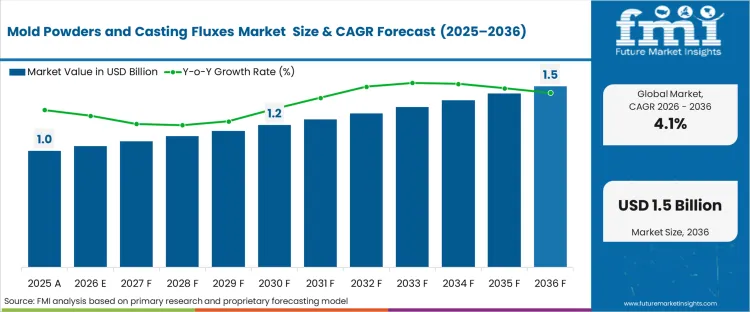
The mold powders and casting fluxes market was valued at USD 0.9 billion in 2025. The market is projected to reach USD 1.0 billion in 2026 and USD 1.5 billion by 2036, expanding at a CAGR of 4.1% during the forecast period. Mold powders are expected to lead product type with a 48.1% share in 2026. Slab casting is projected to remain the leading workflow with a 44.7% share in 2026. Integrated steel plants are expected to lead end-user demand with a 57.9% share in 2026. The market stays closely tied to continuous casting volumes. Demand also rises with steel-grade complexity, since higher-performance steels require tighter control inside the mold. That keeps these materials important even when mills delay broader capex decisions.
Summary of Mold Powders and Casting Fluxes Market
- Key Drivers
- Continuous casting keeps demand steady because mold powders and casting fluxes are consumed during normal steel production. Mills need them for lubrication, insulation, and heat-transfer control.
- Steel-grade complexity is another driver. Peritectic steels, ultra-low carbon steels, and other demanding grades need more precise powder behavior. That pushes mills toward tailored formulations with stronger technical support.
- Raw material pressure is also shaping procurement. Inputs such as fluorspar face supply concentration and price swings. As a result, steelmakers give more weight to reliable suppliers with stable sourcing and local service.
- Key Segments Analyzed in the Report
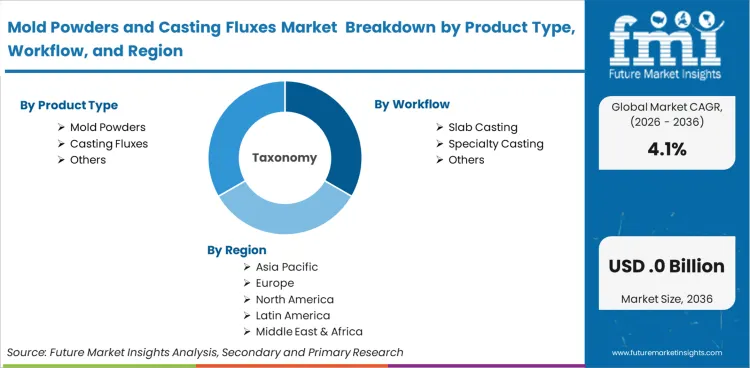
- Product type: mold powders, casting fluxes, starting powders, and tundish covering compounds
- Workflow: slab casting, billet and bloom casting, thin slab and beam blank casting, and specialty casting
- End user: integrated steel plants, mini mills and EAF producers, specialty steelmakers, and foundries
- Region: North America, Latin America, Western Europe, Eastern Europe, East Asia, South Asia and Pacific, and Middle East and Africa
- Analyst Opinion
- Nikhil Kaitwade, Principal Consultant at FMI says, suppliers do not win this market on tonnage alone. They win when a powder performs consistently on a given caster, supports surface quality, and comes with technical help that the mill can actually use on the shop floor.
- Mold Powders and Casting Fluxes Market Definition
- The mold powders and casting fluxes market includes consumable mineral and synthetic formulations used in continuous casting and related steel casting operations. It covers mold powders, casting fluxes, starting powders, granular fluxes, and tundish covering compounds sold in powder or granulated form. These materials help control heat transfer, improve lubrication, protect the meniscus, and absorb non-metallic inclusions during billet, bloom, beam blank, thin slab, and slab casting.
- Mold Powders and Casting Fluxes Market Inclusions
- Revenues from mold powders, casting fluxes, starting powders, and tundish covering compounds used in continuous casting and closely related steel casting operations
- Manufacturer revenues from powder and granular consumables, including customized formulations developed for specific caster types and steel grades
- Sales across major steelmaking regions, including direct supply to integrated mills, EAF-based producers, and specialty steel operations
- Mold Powders and Casting Fluxes Market Exclusions
- Refractories, slide gates, submerged entry nozzles, sensors, and robotics, except where referenced as adjacent benchmarks
- Finished steel product sales or value addition from downstream rolling, coating, or fabrication
- General industrial minerals sold without steel-casting-specific formulation or technical support
- Mold Powders and Casting Fluxes Market Research Methodology
- This study evaluates the market across key segments and regions for the base year 2025 and the forecast period 2026 to 2036. All market values are presented in USD billion. The analysis is built on a review of regulatory references, company disclosures, product and technology developments, trade literature, and industry documentation relevant to the value chain. Market estimates are derived through triangulation of demand-side trends, supply-side positioning, pricing dynamics, application intensity, and regional adoption patterns to establish current market size and forecast potential.
Key Drivers, Restraints, and Trends in Mold Powders and Casting Fluxes Market
Drivers
The market benefits from the fact that continuous casting remains the main route for turning liquid steel into semi-finished products. That creates repeat demand because powders and fluxes are consumed every day in production. This is not a one-time equipment purchase. It is an operating need.
Slab casting contributes a large share of demand because flat steel production runs at high volumes and surface defects are costly. When mills push for better surface quality, stable heat transfer becomes more important. Powder performance then moves closer to the center of process control.
Steel-grade complexity is also raising value per ton. Higher-strength steels, automotive grades, and crack-sensitive grades need tighter formulation control. Mills often qualify such powders by caster and grade. Once that happens, the supplier relationship becomes stickier.
Restraints
Raw material volatility remains a pressure point. Fluorspar supply is concentrated, and that can affect cost planning for powder producers. Smaller mills feel this more sharply because they have less room to absorb input inflation.
Qualification cycles are another restraint. Steelmakers do not switch powders casually when caster geometry, steel grade, and defect tolerance are all linked to product performance. A new supplier may need time to prove itself, and that slows displacement.
Some older caster setups also limit the upside from premium formulations. A better powder helps, but gains may remain modest if feeder precision, automation, or mold-condition monitoring are weak.
Trends
The market is becoming more application-specific. Mills increasingly ask for powders matched to caster type, speed, and steel grade. In practice, that means the same plant may not use one standard product across all lines.
Suppliers are also staying closer to operating conditions inside the mill. Automatic feeders, formulation changes, and on-site technical support are increasingly bundled into the commercial offer. This gives buyers more process stability and gives suppliers a stronger foothold.
Regional presence matters more than before. Mills want quick troubleshooting, dependable supply, and shorter response times when a formulation needs adjustment. In this market, service speed can matter almost as much as chemistry.
Segmental Analysis
Mold Powders and Casting Fluxes Market Analysis by Product Type
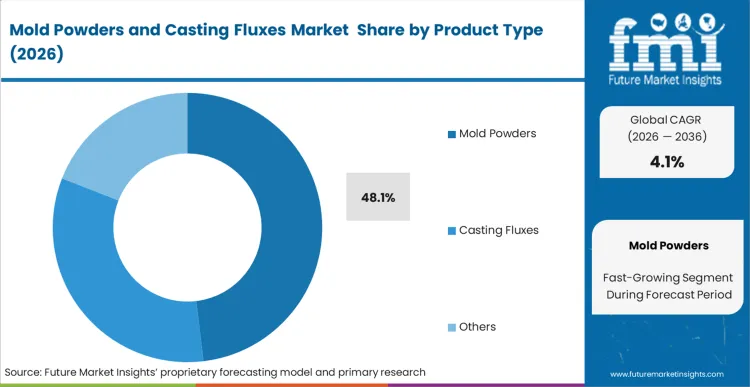
Mold powders are likely to account for the leading 48.1% share of the market in 2026. They lead because they are used directly in the mold during continuous casting and are consumed at high frequency. Their role is central to lubrication, insulation, and heat-transfer control. That makes them harder to substitute than some adjacent consumables.
Commercially, mold powders also carry more weight because their demand scales with throughput, sequence length, caster conditions, and steel grade. Slower steel markets can soften volumes, but the underlying need does not disappear.
Mold Powders and Casting Fluxes Market Analysis by Workflow
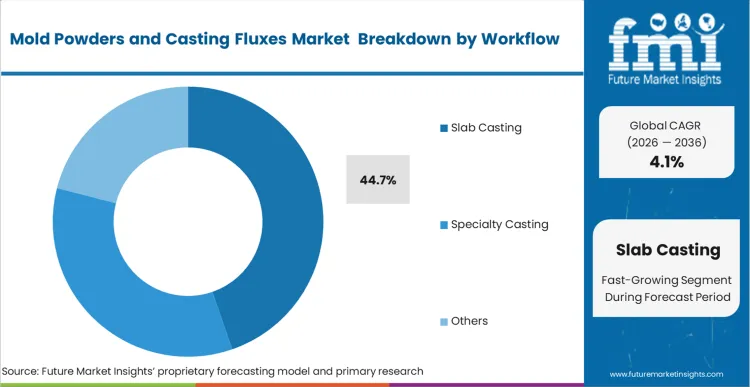
Slab casting are set to hold 44.7% share in 2026. The reason is straightforward. Slab lines support large flat-steel volumes, and flat products are highly exposed to surface-quality requirements. Poor mold performance can create visible and costly defects downstream.
This gives slab casters a higher dependence on stable powder behavior. Heat transfer has to be managed carefully. Lubrication must remain consistent. When mills run demanding grades at higher speeds, powder selection becomes even more sensitive.
Competitive Aligners for Market Players
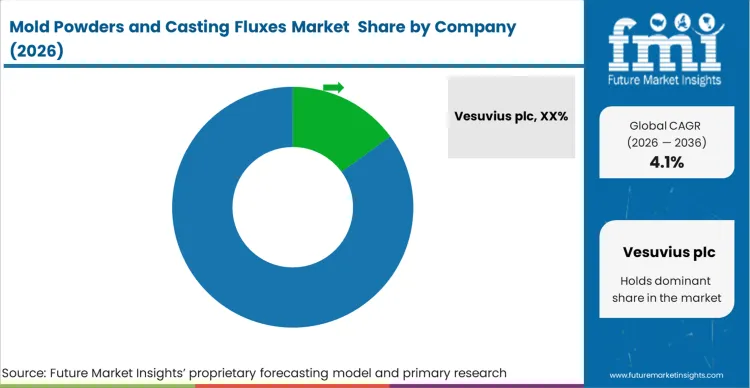
Suppliers gain ground when they solve plant-level casting issues reliably. A broad catalog helps, but mills care more about whether a product works on their caster, with their grades, under their operating conditions. That is why technical support matters so much. The stronger companies do more than ship bags of powder. They help tune feeder performance, respond to surface-quality issues, and refine formulations when grade mix changes. This also explains why adjacent capabilities matter. Companies with links to flow control, robotics, and wider steel-process consumables can stay embedded in the customer account for longer. Their position is harder to dislodge because they are part of day-to-day process stability, not just procurement.
Key Players in Mold Powders and Casting Fluxes Market
- Vesuvius plc
- Calderys
- RHI Magnesita
- Shinagawa Refractories Co., Ltd.
- Krosaki Harima Corporation
- Puyang Refractories Group Co., Ltd.
- Resco Products, Inc.
- Saint-Gobain SEFPRO
- IFGL Refractories Ltd.
- Dalmia Bharat Refractories
Strategic Outlook by FMI on Mold Powders and Casting Fluxes Market
The market is expected to grow steadily, but the value story is not purely about volume expansion. Growth will come from better product mix, tighter application matching, and stronger technical service around the caster.
Suppliers that stay close to mill operations should have an advantage. Local support, consistent sourcing, and the ability to adapt formulations quickly will matter. So will links to feeders, flow-control systems, and broader continuous-casting support. In a market like this, trust is earned on the shop floor.
Scope of the Report
| Metric | Value |
|---|---|
| Market Value | USD 0.9 billion in 2025 to USD 1.5 billion by 2036 |
| CAGR | 4.1% from 2026 to 2036 |
| Base Year | 2025 |
| Forecast Period | 2026 to 2036 |
| Product Type Segmentation | mold powders, casting fluxes, starting powders, tundish covering compounds |
| Workflow Segmentation | slab casting, billet and bloom casting, thin slab and beam blank casting, specialty casting |
| End User Segmentation | integrated steel plants, mini mills and EAF producers, specialty steelmakers, foundries |
| Regions Covered | North America, Latin America, Western Europe, Eastern Europe, East Asia, South Asia and Pacific, Middle East and Africa |
Bibliography
- World Steel Association. 2025. World Steel in Figures 2025.
- USA Geological Survey. 2025. Mineral Commodity Summaries 2025 (ver. 1.2, March 2025).
- Vesuvius plc. 2025. Annual Report and Financial Statements 2024.
- Vesuvius plc. 2025. Half Year 2025 Results Presentation.
- Calderys. Continuous casting. Accessed March 18, 2026.
- Calderys. Steel casting fluxes. Accessed March 18, 2026.
- RHI Magnesita. 2025. Investor Presentation | November 2025.
Frequently Asked Questions
What is the current size of the mold powders and casting fluxes market?
The mold powders and casting fluxes market was valued at USD 0.9 billion in 2025.
What is the expected market value of the mold powders and casting fluxes market in 2026?
The market is projected to reach USD 1.0 billion in 2026.
What will be the mold powders and casting fluxes market value by 2036?
The market is forecast to reach USD 1.5 billion by 2036.
What is the projected CAGR of the mold powders and casting fluxes market?
The market is projected to expand at a CAGR of 4.1% from 2026 to 2036.
Which product type leads the mold powders and casting fluxes market in 2026?
Mold powders are expected to lead the market with a 48.1% share in 2026.
Which workflow leads the mold powders and casting fluxes market in 2026?
Slab casting is projected to remain the leading workflow with a 44.7% share in 2026.
Which end-user segment leads the mold powders and casting fluxes market in 2026?
Integrated steel plants are expected to lead end-user demand with a 57.9% share in 2026.
Preview the report firsthand - request a free sample
Get SampleGet the brochure for pricing and purchase details.
Get PDFTable of Content
- Executive Summary
- Global Market Outlook
- Demand-side Trends
- Supply-side Trends
- Technology Roadmap Analysis
- Analysis and Recommendations
- Market Overview
- Market Coverage / Taxonomy
- Market Definition / Scope / Limitations
- Research Methodology
- Chapter Orientation
- Analytical Lens and Working Hypotheses
- Market Structure, Signals, and Trend Drivers
- Benchmarking and Cross-market Comparability
- Market Sizing, Forecasting, and Opportunity Mapping
- Research Design and Evidence Framework
- Desk Research Programme (Secondary Evidence)
- Company Annual and Sustainability Reports
- Peer-reviewed Journals and Academic Literature
- Corporate Websites, Product Literature, and Technical Notes
- Earnings Decks and Investor Briefings
- Statutory Filings and Regulatory Disclosures
- Technical White Papers and Standards Notes
- Trade Journals, Industry Magazines, and Analyst Briefs
- Conference Proceedings, Webinars, and Seminar Materials
- Government Statistics Portals and Public Data Releases
- Press Releases and Reputable Media Coverage
- Specialist Newsletters and Curated Briefings
- Sector Databases and Reference Repositories
- FMI Internal Proprietary Databases and Historical Market Datasets
- Subscription Datasets and Paid Sources
- Social Channels, Communities, and Digital Listening Inputs
- Additional Desk Sources
- Expert Input and Fieldwork (Primary Evidence)
- Primary Modes
- Qualitative Interviews and Expert Elicitation
- Quantitative Surveys and Structured Data Capture
- Blended Approach
- Why Primary Evidence is Used
- Field Techniques
- Interviews
- Surveys
- Focus Groups
- Observational and In-context Research
- Social and Community Interactions
- Stakeholder Universe Engaged
- C-suite Leaders
- Board Members
- Presidents and Vice Presidents
- R&D and Innovation Heads
- Technical Specialists
- Domain Subject-matter Experts
- Scientists
- Physicians and Other Healthcare Professionals
- Governance, Ethics, and Data Stewardship
- Research Ethics
- Data Integrity and Handling
- Primary Modes
- Tooling, Models, and Reference Databases
- Desk Research Programme (Secondary Evidence)
- Data Engineering and Model Build
- Data Acquisition and Ingestion
- Cleaning, Normalisation, and Verification
- Synthesis, Triangulation, and Analysis
- Quality Assurance and Audit Trail
- Market Background
- Market Dynamics
- Drivers
- Restraints
- Opportunity
- Trends
- Scenario Forecast
- Demand in Optimistic Scenario
- Demand in Likely Scenario
- Demand in Conservative Scenario
- Opportunity Map Analysis
- Product Life Cycle Analysis
- Supply Chain Analysis
- Investment Feasibility Matrix
- Value Chain Analysis
- PESTLE and Porter’s Analysis
- Regulatory Landscape
- Regional Parent Market Outlook
- Production and Consumption Statistics
- Import and Export Statistics
- Market Dynamics
- Global Market Analysis 2021 to 2025 and Forecast, 2026 to 2036
- Historical Market Size Value (USD Million) Analysis, 2021 to 2025
- Current and Future Market Size Value (USD Million) Projections, 2026 to 2036
- Y-o-Y Growth Trend Analysis
- Absolute $ Opportunity Analysis
- Global Market Pricing Analysis 2021 to 2025 and Forecast 2026 to 2036
- Global Market Analysis 2021 to 2025 and Forecast 2026 to 2036, By Product Type
- Introduction / Key Findings
- Historical Market Size Value (USD Million) Analysis By Product Type , 2021 to 2025
- Current and Future Market Size Value (USD Million) Analysis and Forecast By Product Type , 2026 to 2036
- Mold Powders
- Casting Fluxes
- Others
- Mold Powders
- Y-o-Y Growth Trend Analysis By Product Type , 2021 to 2025
- Absolute $ Opportunity Analysis By Product Type , 2026 to 2036
- Global Market Analysis 2021 to 2025 and Forecast 2026 to 2036, By Workflow
- Introduction / Key Findings
- Historical Market Size Value (USD Million) Analysis By Workflow, 2021 to 2025
- Current and Future Market Size Value (USD Million) Analysis and Forecast By Workflow, 2026 to 2036
- Slab Casting
- Specialty Casting
- Others
- Slab Casting
- Y-o-Y Growth Trend Analysis By Workflow, 2021 to 2025
- Absolute $ Opportunity Analysis By Workflow, 2026 to 2036
- Global Market Analysis 2021 to 2025 and Forecast 2026 to 2036, By Region
- Introduction
- Historical Market Size Value (USD Million) Analysis By Region, 2021 to 2025
- Current Market Size Value (USD Million) Analysis and Forecast By Region, 2026 to 2036
- North America
- Latin America
- Western Europe
- Eastern Europe
- East Asia
- South Asia and Pacific
- Middle East & Africa
- Market Attractiveness Analysis By Region
- North America Market Analysis 2021 to 2025 and Forecast 2026 to 2036, By Country
- Historical Market Size Value (USD Million) Trend Analysis By Market Taxonomy, 2021 to 2025
- Market Size Value (USD Million) Forecast By Market Taxonomy, 2026 to 2036
- By Country
- USA
- Canada
- Mexico
- By Product Type
- By Workflow
- By Country
- Market Attractiveness Analysis
- By Country
- By Product Type
- By Workflow
- Key Takeaways
- Latin America Market Analysis 2021 to 2025 and Forecast 2026 to 2036, By Country
- Historical Market Size Value (USD Million) Trend Analysis By Market Taxonomy, 2021 to 2025
- Market Size Value (USD Million) Forecast By Market Taxonomy, 2026 to 2036
- By Country
- Brazil
- Chile
- Rest of Latin America
- By Product Type
- By Workflow
- By Country
- Market Attractiveness Analysis
- By Country
- By Product Type
- By Workflow
- Key Takeaways
- Western Europe Market Analysis 2021 to 2025 and Forecast 2026 to 2036, By Country
- Historical Market Size Value (USD Million) Trend Analysis By Market Taxonomy, 2021 to 2025
- Market Size Value (USD Million) Forecast By Market Taxonomy, 2026 to 2036
- By Country
- Germany
- UK
- Italy
- Spain
- France
- Nordic
- BENELUX
- Rest of Western Europe
- By Product Type
- By Workflow
- By Country
- Market Attractiveness Analysis
- By Country
- By Product Type
- By Workflow
- Key Takeaways
- Eastern Europe Market Analysis 2021 to 2025 and Forecast 2026 to 2036, By Country
- Historical Market Size Value (USD Million) Trend Analysis By Market Taxonomy, 2021 to 2025
- Market Size Value (USD Million) Forecast By Market Taxonomy, 2026 to 2036
- By Country
- Russia
- Poland
- Hungary
- Balkan & Baltic
- Rest of Eastern Europe
- By Product Type
- By Workflow
- By Country
- Market Attractiveness Analysis
- By Country
- By Product Type
- By Workflow
- Key Takeaways
- East Asia Market Analysis 2021 to 2025 and Forecast 2026 to 2036, By Country
- Historical Market Size Value (USD Million) Trend Analysis By Market Taxonomy, 2021 to 2025
- Market Size Value (USD Million) Forecast By Market Taxonomy, 2026 to 2036
- By Country
- China
- Japan
- South Korea
- By Product Type
- By Workflow
- By Country
- Market Attractiveness Analysis
- By Country
- By Product Type
- By Workflow
- Key Takeaways
- South Asia and Pacific Market Analysis 2021 to 2025 and Forecast 2026 to 2036, By Country
- Historical Market Size Value (USD Million) Trend Analysis By Market Taxonomy, 2021 to 2025
- Market Size Value (USD Million) Forecast By Market Taxonomy, 2026 to 2036
- By Country
- India
- ASEAN
- Australia & New Zealand
- Rest of South Asia and Pacific
- By Product Type
- By Workflow
- By Country
- Market Attractiveness Analysis
- By Country
- By Product Type
- By Workflow
- Key Takeaways
- Middle East & Africa Market Analysis 2021 to 2025 and Forecast 2026 to 2036, By Country
- Historical Market Size Value (USD Million) Trend Analysis By Market Taxonomy, 2021 to 2025
- Market Size Value (USD Million) Forecast By Market Taxonomy, 2026 to 2036
- By Country
- Kingdom of Saudi Arabia
- Other GCC Countries
- Turkiye
- South Africa
- Other African Union
- Rest of Middle East & Africa
- By Product Type
- By Workflow
- By Country
- Market Attractiveness Analysis
- By Country
- By Product Type
- By Workflow
- Key Takeaways
- Key Countries Market Analysis
- USA
- Pricing Analysis
- Market Share Analysis, 2025
- By Product Type
- By Workflow
- Canada
- Pricing Analysis
- Market Share Analysis, 2025
- By Product Type
- By Workflow
- Mexico
- Pricing Analysis
- Market Share Analysis, 2025
- By Product Type
- By Workflow
- Brazil
- Pricing Analysis
- Market Share Analysis, 2025
- By Product Type
- By Workflow
- Chile
- Pricing Analysis
- Market Share Analysis, 2025
- By Product Type
- By Workflow
- Germany
- Pricing Analysis
- Market Share Analysis, 2025
- By Product Type
- By Workflow
- UK
- Pricing Analysis
- Market Share Analysis, 2025
- By Product Type
- By Workflow
- Italy
- Pricing Analysis
- Market Share Analysis, 2025
- By Product Type
- By Workflow
- Spain
- Pricing Analysis
- Market Share Analysis, 2025
- By Product Type
- By Workflow
- France
- Pricing Analysis
- Market Share Analysis, 2025
- By Product Type
- By Workflow
- India
- Pricing Analysis
- Market Share Analysis, 2025
- By Product Type
- By Workflow
- ASEAN
- Pricing Analysis
- Market Share Analysis, 2025
- By Product Type
- By Workflow
- Australia & New Zealand
- Pricing Analysis
- Market Share Analysis, 2025
- By Product Type
- By Workflow
- China
- Pricing Analysis
- Market Share Analysis, 2025
- By Product Type
- By Workflow
- Japan
- Pricing Analysis
- Market Share Analysis, 2025
- By Product Type
- By Workflow
- South Korea
- Pricing Analysis
- Market Share Analysis, 2025
- By Product Type
- By Workflow
- Russia
- Pricing Analysis
- Market Share Analysis, 2025
- By Product Type
- By Workflow
- Poland
- Pricing Analysis
- Market Share Analysis, 2025
- By Product Type
- By Workflow
- Hungary
- Pricing Analysis
- Market Share Analysis, 2025
- By Product Type
- By Workflow
- Kingdom of Saudi Arabia
- Pricing Analysis
- Market Share Analysis, 2025
- By Product Type
- By Workflow
- Turkiye
- Pricing Analysis
- Market Share Analysis, 2025
- By Product Type
- By Workflow
- South Africa
- Pricing Analysis
- Market Share Analysis, 2025
- By Product Type
- By Workflow
- USA
- Market Structure Analysis
- Competition Dashboard
- Competition Benchmarking
- Market Share Analysis of Top Players
- By Regional
- By Product Type
- By Workflow
- Competition Analysis
- Competition Deep Dive
- Vesuvius plc
- Overview
- Product Portfolio
- Profitability by Market Segments (Product/Age /Sales Channel/Region)
- Sales Footprint
- Strategy Overview
- Marketing Strategy
- Product Strategy
- Channel Strategy
- Calderys
- RHI Magnesita
- Shinagawa Refractories Co., Ltd.
- Krosaki Harima Corporation
- Puyang Refractories Group Co., Ltd.
- Resco Products, Inc.
- Vesuvius plc
- Competition Deep Dive
- Assumptions & Acronyms Used


