

- Industry Size (2026)
- USD 197.5 Mn
- Forecast (2036)
- USD 617.1 Mn
- CAGR (2026 to 2036)
- 12.1%
Demand for Small Satellite in South Korea Forecast and Outlook 2026 to 2036
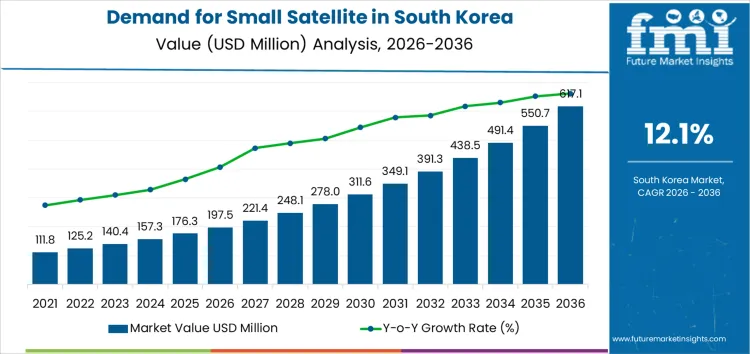
The demand for small satellites in South Korea is expected to reach USD 617.1 million by 2036, growing at a CAGR of 12.1% from USD 197.5 million in 2026. The quality of demand in this market is driven by long-term, stable contracts with both government and commercial buyers. Repeat usage is prevalent, particularly in sectors like communications, Earth observation, and scientific research, where small satellites are integral to ongoing operations. The high level of buyer commitment reflects the critical nature of these systems, with customers often locked into multi-year service agreements or long-term mission goals. Despite this stability, the industry also faces occasional shifts in demand tied to technological advancements, regulatory changes, and geopolitical factors. However, overall demand remains resilient, with strategic investments in small satellite capabilities continuing to grow in importance as countries and companies push for enhanced data collection and connectivity.
Quick Stats for the Demand for Small Satellite in South Korea
- Small Satellite in South Korea Value (2026): USD 197.5 million
- Small Satellite in South Korea Forecast Value (2036): USD 617.1 million
- Small Satellite in South Korea Forecast CAGR (2026 to 2036): 12.1%
- Small Satellite in South Korea Leading Segment: Low Earth Orbit (LEO) (83.8%)
- Key Growth Regions of Small Satellite in South Korea: Jeju (leading CAGR ~14.5%)
- Top Players of Small Satellite in South Korea: Airbus S.A.S., CASIC, OHB SE, Lockheed Martin Corporation, Boeing
What is the Growth Forecast for the Small Satellite Market in South Korea through 2036?
The small satellite market in South Korea is projected to experience rapid growth from 2026 to 2036. Starting at USD 197.5 million in 2026, the industry is expected to rise to USD 221.4 million in 2027. By 2028, the industry value will reach USD 248.1 million, followed by USD 278.0 million in 2029. The industry will continue its strong upward trajectory, with a projected value of USD 311.6 million in 2030 and USD 349.1 million in 2031.
As South Korea continues to invest in space technology and satellite services, the industry will expand further, reaching USD 391.3 million in 2032 and USD 438.5 million in 2033. By 2034, the industry value is expected to reach USD 491.4 million, growing to USD 550.7 million in 2035. By 2036, the industry is projected to reach USD 617.1 million. The industry growth curve shape analysis indicates an accelerating growth phase in the early years, followed by a steady increase as the industry matures. The rapid early growth reflects South Korea’s strategic focus on developing and expanding its space and satellite capabilities, with increasing adoption across government and commercial sectors.
Key Takeaways for Demand for Small Satellite in South Korea
| Metric | Value |
|---|---|
| Industry Sales Value (2026) | USD 197.5 million |
| Industry Forecast Value (2036) | USD 617.1 million |
| Industry Forecast CAGR (2026 to 2036) | 12.1% |
Why is the Demand for Small Satellites Growing in South Korea?
Demand for small satellites in South Korea has grown as national priorities shift toward space technology applications that require rapid, cost effective access to orbit. Small satellites, including nanosatellites and microsatellites, enable a range of services such as earth observation, communications, and scientific research without the high costs and long lead times associated with large spacecraft. South Korea’s aerospace sector has expanded capacity in satellite design, manufacturing, and launch support, driven by government initiatives and private sector engagement. Public research agencies and universities have incorporated small satellite programs to develop indigenous engineering skills and data capabilities.
Commercial and defence users value small satellites for tasks such as environmental monitoring, maritime surveillance, and connectivity services in remote areas. These platforms support higher revisit rates for imaging and enable scalable constellations that can be deployed incrementally, reducing financial exposure for project sponsors. Procurement decision makers in satellite integrators increasingly prioritise modular platforms and standardized bus architectures, which help shorten development cycles and improve interoperability with ground systems.
Looking ahead, demand for small satellites in South Korea is expected to advance further as commercial and institutional actors pursue new space applications. Companies able to deliver turnkey solutions, from payload integration to launch coordination and ground segment support, will find opportunities in both domestic and export markets. Suppliers of miniaturised subsystems such as onboard processors, power systems, and attitude control units can benefit from rising production volumes as constellation deployments become more common.
Service offerings that combine satellite hardware with data analytics, application software, and post launch operations support are likely to attract customers seeking comprehensive solutions rather than standalone components. Partnerships between Korean firms and international launch providers can reduce barriers to space access, enabling faster orbit insertion and reducing time to revenue. As satellite data usage grows across sectors like agriculture, logistics, and urban planning, small satellite adoption will remain a strategic area for technology investment and supply chain development in South Korea.
What Are the Key Segments in Demand for Small Satellites in South Korea?
The demand for small satellites in South Korea is shaped by satellite type and orbit type. Key satellite types include minisatellites, picosatellites, microsatellites, CubeSats, and femtosatellites, with minisatellites leading the industry at 26.6%. In terms of orbit types, low Earth orbit (LEO) dominates the industry, accounting for 83.8%, followed by medium Earth orbit (MEO) and geosynchronous orbit (GEO). As South Korea continues to invest in space technologies and satellite communications, the demand for small satellites is expected to grow, driven by both commercial and governmental needs.
How Does Satellite Type Influence Demand for Small Satellites in South Korea?
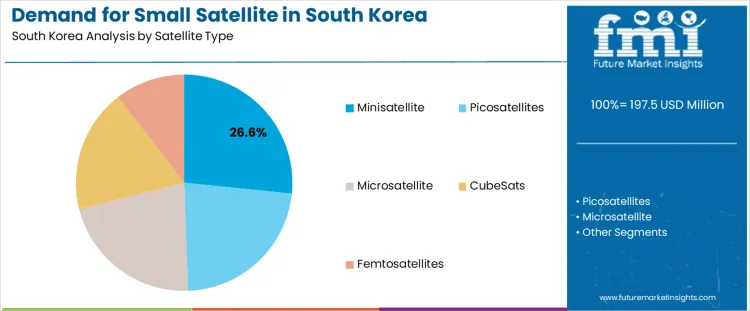
The demand for small satellites in South Korea is significantly influenced by the type of satellite being deployed, with minisatellites accounting for 26.6% of the industry share. Minisatellites, typically weighing between 100 kg and 500 kg, are highly sought after for their ability to carry larger payloads and perform more complex missions compared to smaller satellite types. They are used in a wide range of applications, including Earth observation, communications, and scientific research, making them a versatile choice for commercial and governmental missions in South Korea. Picosatellites and femtosatellites, though smaller in size and payload capacity, are gaining popularity for their cost-effectiveness and compact design, making them ideal for specific niche applications such as technology testing, research, and communications in remote areas.
Picosatellites, in particular, are used for missions that require rapid deployment or testing of new technologies, as their smaller size allows for more affordable launches. Microsatellites, larger than picosatellites but smaller than minisatellites, offer a balance between size, cost, and payload capacity, making them suitable for commercial communication services, Earth observation, and environmental monitoring. CubeSats, which are often launched in constellations, are also popular due to their modular nature and low launch cost, providing opportunities for a range of sectors, including education, research, and commercial ventures. As South Korea continues to expand its space exploration capabilities, the demand for each type of small satellite will vary based on mission requirements, payload capacity, and cost considerations.
What Is the Demand for Small Satellites in South Korea by Orbit Type?
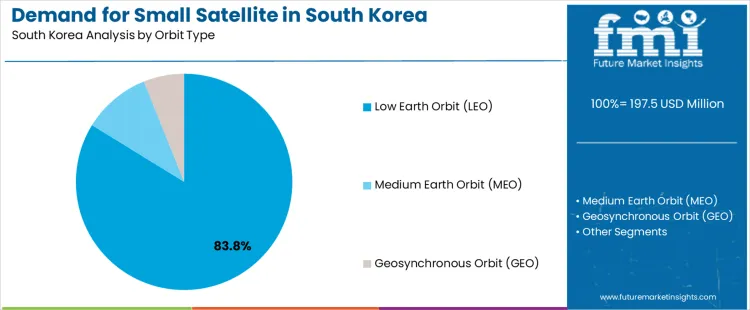
In South Korea, the demand for small satellites is predominantly driven by low Earth orbit (LEO), which accounts for 83.8% of the industry. LEO is the most common orbit for small satellites due to its proximity to Earth, which allows for faster data transmission, lower launch costs, and more frequent passes over target areas. LEO satellites are widely used for applications such as Earth observation, telecommunications, remote sensing, and scientific research. Their relatively low altitude (ranging from 160 to 2,000 kilometers) enables them to capture high-resolution images and data, making them ideal for commercial applications such as environmental monitoring and disaster response. Medium Earth orbit (MEO) and geosynchronous orbit (GEO) satellites, though representing a smaller share of the industry, serve critical functions in the satellite industry.
MEO satellites, typically used for navigation systems like GPS, have a higher altitude than LEO satellites and provide broader coverage but with slightly longer data transmission times. GEO satellites, positioned at about 35,786 kilometers above Earth, are used for communications and weather monitoring due to their ability to remain stationary relative to a fixed point on Earth, making them ideal for broadcast services. As South Korea continues to invest in satellite communications, defense, and space exploration, the demand for satellites in LEO will remain dominant, though MEO and GEO applications will continue to grow in importance for specific, high-demand services.
What are the Key Dynamics in the Demand for Small Satellites in South Korea?
Demand for small satellites in South Korea is influenced by national space policy, private sector investment, and strategic needs in earth observation, communication, and scientific research. South Korea’s space agenda prioritizes development of indigenous launch and satellite capabilities, creating demand for small satellite platforms and associated subsystems. Commercial use cases in remote sensing, agricultural monitoring, urban planning, and logistics tracking expand the customer base beyond government programs. Satellite manufacturers, subsystem suppliers, and ground segment vendors engage with institutional and corporate buyers to supply integrated solutions. As small satellites require shorter development cycles and lower unit costs than large spacecraft, firms with agile engineering teams find opportunities in design, fabrication, and integration services.
What are the Drivers of Demand for Small Satellites in South Korea?
A core driver is the country’s strategic objective to enhance space autonomy, reducing dependence on foreign satellite data and services. Government funding for space technology research and launch infrastructure stimulates procurement of small satellites tailored to national priorities. Commercial interest in geospatial intelligence, including precision agriculture, disaster risk management, and coastal surveillance, drives industry adoption. Private ventures and start ups leveraging low Earth orbit (LEO) constellations for Internet of Things (IoT) connectivity and broadband services contribute to expanding demand. Technological advances in miniaturization, standardized bus architectures, and off the shelf components reduce development risk and cost, making small satellites attractive to new entrants and established aerospace firms alike.
What are the Restraints on Demand for Small Satellites in South Korea?
Restraints include high entry barriers related to certification, spectrum licensing, and launch access, which can delay project schedules and increase upfront investment. Complex regulatory frameworks governing frequency allocation and space debris mitigation require specialist compliance capabilities that may not be mature in all firms. Limited domestic launch capacity creates reliance on international launch service providers, tying project timelines to foreign schedules and pricing. Demand from commercial users may evolve more slowly where data pricing and service models remain under refinement. Competition from established global small satellite manufacturers and constellation operators can pressure margins and require South Korean firms to differentiate through niche capabilities or service bundles.
What Key Trends Affect Demand for Small Satellites in South Korea?
A notable trend is the integration of small satellite platforms with advanced payloads such as synthetic aperture radar (SAR), hyperspectral imagers, and high throughput communication modules. Industry players are developing modular bus systems that support rapid payload swaps and mission reconfiguration, appealing to both government and enterprise clients. Collaborative ventures between Korean academic institutions and aerospace companies are advancing prototype testing and workforce expertise. Domestic supply chains for components and materials are strengthening, reducing reliance on imports and shortening lead times. Data analytics services that transform raw satellite outputs into actionable insights create recurring revenue streams for platform providers. Cross border partnerships for constellation deployment and data sharing further expand market potential and operational scope for suppliers.
What is the Regional Demand Outlook for Small Satellites in South Korea?
The demand for small satellites in South Korea is rapidly increasing across different regions, driven by advancements in satellite technology, growing investments in space exploration, and the rise of commercial space applications. South Gyeongsang, with a projected CAGR of 12.7%, leads the industry, driven by the region’s strong presence in the aerospace industry and increasing investment in space-related technologies. North Jeolla, with a growth rate of 9.7%, is seeing moderate demand, as the region develops its space technology infrastructure. South Jeolla, with a projected CAGR of 11.5%, is experiencing steady demand, as the region continues to expand its capabilities in satellite technology and space applications. Jeju, with the highest demand growth rate of 14.5%, is emerging as a key region for small satellites, driven by the region’s focus on advanced technology and growing commercial space opportunities. These regional trends highlight the significant market potential for suppliers of small satellite technologies.
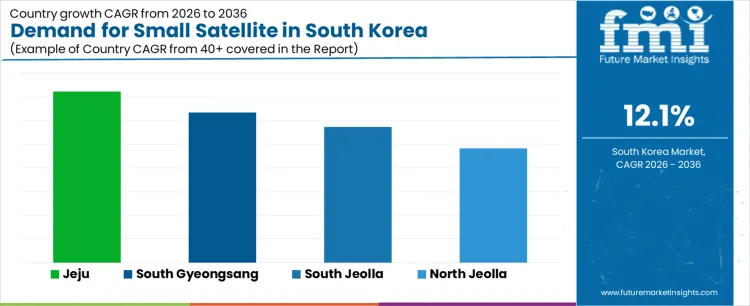
| Region | CAGR (2026 to 2036) |
|---|---|
| South Gyeongsang | 12.7% |
| North Jeolla | 9.7% |
| South Jeolla | 11.5% |
| Jeju | 14.5% |
How Can Satellite Manufacturers Leverage South Gyeongsang’s Growing Market?
South Gyeongsang, with a projected CAGR of 12.7%, offers significant growth opportunities for manufacturers of small satellites. The region’s strong aerospace industry, coupled with increasing investments in space technology and satellite applications, makes it an ideal market for satellite providers. Manufacturers should focus on offering cutting-edge, cost-effective small satellite solutions tailored to the region's space programs and commercial enterprises. By collaborating with local space agencies, research institutions, and commercial enterprises, suppliers can increase visibility and establish themselves as key players in the region’s space industry. As South Gyeongsang continues to expand its satellite capabilities, demand for innovative small satellite technologies is expected to rise, presenting long-term opportunities for suppliers.
What Drives Demand for Small Satellites in North Jeolla?
North Jeolla, with a CAGR of 9.7%, is witnessing growing demand for small satellites as the region develops its space technology infrastructure. While not as established as South Gyeongsang, North Jeolla is increasingly focusing on aerospace and satellite research, spurred by government initiatives and investment in space technology. Manufacturers targeting North Jeolla should focus on providing affordable, versatile small satellite solutions that can cater to the region’s growing need for satellite communication, Earth observation, and scientific research. As the region continues to invest in space-related technology, demand for small satellites is expected to grow, creating opportunities for suppliers to expand their reach in North Jeolla’s emerging satellite market.
What is the Growth Outlook for Small Satellites in South Jeolla?
South Jeolla, with a projected CAGR of 11.5%, presents steady demand for small satellites, fueled by the region’s ongoing investments in satellite technologies and space infrastructure. As South Jeolla expands its space capabilities, small satellites will be increasingly relied upon for communication, Earth observation, and other commercial applications. Manufacturers looking to enter the South Jeolla market should focus on providing high-quality, cost-effective satellite solutions that cater to both governmental and commercial sectors. Strategic partnerships with local aerospace companies and research institutions can help companies gain a competitive edge in this growing market. As demand for small satellites continues to rise, South Jeolla’s market offers significant opportunities for growth.
Why is Jeju Leading the Demand for Small Satellites?
Jeju, with the highest projected CAGR of 14.5%, is emerging as a key market for small satellites in South Korea. The region’s growing focus on technological advancements and commercial space applications is contributing to the increasing demand for small satellite solutions. Jeju’s emphasis on space exploration and its growing commercial space ecosystem make it an attractive market for satellite manufacturers. To capture this demand, companies should focus on providing innovative, flexible satellite systems that align with Jeju’s goals of advancing space technology and attracting investment in commercial satellite services. As Jeju continues to strengthen its role in the space sector, the demand for small satellites is expected to grow rapidly, presenting valuable opportunities for suppliers and manufacturers.
What is the Competitive Landscape for Small Satellite Demand in South Korea?
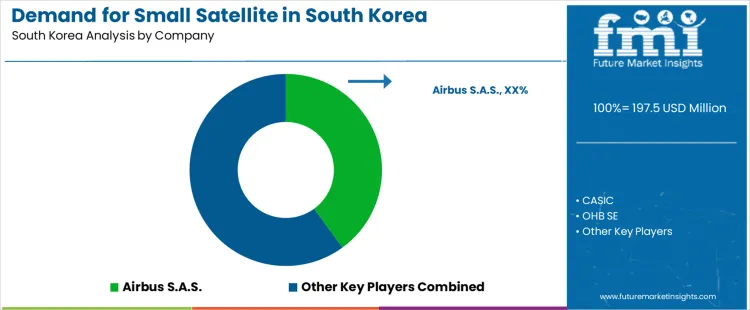
Demand for small satellites in South Korea is shaped by national space initiatives, university programmes, and commercial launch campaigns that prioritise low cost access to orbit and rapid technology iteration. Satellite integrators, systems buyers, and launch service partners evaluate payload performance, platform modularity, and delivery timelines when specifying small satellite solutions. Requirements for Earth observation, communication payloads, and scientific experimentation drive procurement criteria, with emphasis on mass efficiency, subsystem interoperability, and compliance with Korean space agency standards. Defence and telecommunication entities are investing in constellations that support resilient services, leading to demand for scalable bus architectures and responsive production cycles.
Data downlink performance and ground station compatibility are factors in purchasing specifications. System integrators in South Korea are also focused on supply chain transparency, test documentation, and risk mitigation for deployment schedules. As domestic small satellite projects expand, emphasis on quality control, certification traceability, and technical support responsiveness has increased among institutional and private sector buyers.
Competition among key suppliers in the small satellite domain in South Korea is guided by platform capability, technical documentation, and ecosystem support. Airbus S.A.S. is positioned as a leading provider, with product briefs that detail configurable satellite buses, payload interfaces, and performance margins useful to engineering procurement teams. CASIC materials present compact satellite platforms with specification data on mass budgets, power systems, and thermal control relevant to mission planners. OHB SE documentation outlines modular small satellite systems with focus on adaptability for Earth observation and communication missions, including subsystem performance tables and integration guidelines.
Lockheed Martin Corporation literature describes advanced small satellite architectures with detailed metrics on avionics performance, radiation tolerance, and mission support services that assist programme managers in evaluations. Boeing brochures highlight heritage platform variants and payload accommodation options, accompanied by technical summaries on structural loads, attitude control performance, and compatibility with common launch vehicles. These brochures typically include interface specifications, environmental qualification criteria, and test protocols that help South Korean space agencies, prime contractors, and aerospace integrators assess supplier offerings against mission risk profiles and operational requirements.
Key Players of the Demand for Small Satellite in South Korea
- Airbus S.A.S.
- CASIC
- OHB SE
- Lockheed Martin Corporation
- Boeing
Scope of the Report
| Items | Values |
|---|---|
| Quantitative Units (2026) | USD Million |
| Satellite Type | Minisatellite, Picosatellites, Microsatellite, CubeSats, Femtosatellites |
| Orbit Type | Low Earth Orbit (LEO), Medium Earth Orbit (MEO), Geosynchronous Orbit (GEO) |
| Application | Military Intelligence, Communication and Navigation, Earth Observation, Remote Sensing, Scientific Research & Exploration |
| Companies | Airbus S.A.S., CASIC, OHB SE, Lockheed Martin Corporation, Boeing |
| Region Covered | South Korea |
| Provinces Covered | South Gyeongsang, North Jeolla, South Jeolla, Jeju |
| Additional Attributes | Dollar sales by satellite type, orbit type, and application. Demand is driven by South Korea’s growing interest in defense surveillance, Earth monitoring missions, and scientific exploration, with LEO deployments dominating small satellite programs. |
Key Segments of Demand for Small Satellite in South Korea
Satellite Type
- Minisatellite
- Picosatellites
- Microsatellite
- CubeSats
- Femtosatellites
- Other
Orbit Type
- Low Earth Orbit (LEO)
- Medium Earth Orbit (MEO)
- Geosynchronous Orbit (GEO)
- Other
Application
- Military Intelligence
- Communication and Navigation
- Earth Observation
- Remote Sensing
- Scientific Research & Exploration
- Other
Provinces
- South Gyeongsang
- North Jeolla
- South Jeolla
- Jeju
Bibliography
- Korea AeroSpace Administration. (2025, January 22). KASA announces 2025 R&D implementation plan. Korea AeroSpace Administration.
- World Meteorological Organization. (2024). CAS500-1: Satellite instrument calibration and validation guidance. World Meteorological Organization.
- United Nations Office for Outer Space Affairs. (2024). Online index of objects launched into outer space. United Nations Office for Outer Space Affairs.
- Korea Legislation Research Institute. (2024). Space Development Promotion Act (Consolidated and amended). Korea Legislation Research Institute.
- Satellite Technology Research Center (SaTReC), KAIST. (2024). NEXTSat-1 mission overview and operational status. Korea Advanced Institute of Science and Technology.
Frequently Asked Questions
How big is the demand for small satellite in south korea in 2026?
The demand for small satellite in south korea is estimated to be valued at USD 197.5 million in 2026.
What will be the size of small satellite in south korea in 2036?
The market size for the small satellite in south korea is projected to reach USD 617.1 million by 2036.
How much will be the demand for small satellite in south korea growth between 2026 and 2036?
The demand for small satellite in south korea is expected to grow at a 12.1% CAGR between 2026 and 2036.
What are the key product types in the small satellite in south korea?
The key product types in small satellite in south korea are minisatellite, picosatellites, microsatellite, cubesats and femtosatellites.
Which orbit type segment is expected to contribute significant share in the small satellite in south korea in 2026?
In terms of orbit type, low earth orbit (leo) segment is expected to command 83.8% share in the small satellite in south korea in 2026.
Preview the report firsthand - request a free sample
Get SampleGet the brochure for pricing and purchase details.
Get PDFTable of Content
- Executive Summary
- South Korea Market Outlook
- Demand-side Trends
- Supply-side Trends
- Technology Roadmap Analysis
- Analysis and Recommendations
- Market Overview
- Market Coverage / Taxonomy
- Market Definition / Scope / Limitations
- Market Background
- Market Dynamics
- Drivers
- Restraints
- Opportunity
- Trends
- Scenario Forecast
- Demand in Optimistic Scenario
- Demand in Likely Scenario
- Demand in Conservative Scenario
- Opportunity Map Analysis
- Product Life Cycle Analysis
- Supply Chain Analysis
- Investment Feasibility Matrix
- Value Chain Analysis
- PESTLE and Porter’s Analysis
- Regulatory Landscape
- Regional Parent Market Outlook
- Production and Consumption Statistics
- Import and Export Statistics
- Market Dynamics
- South Korea Market Analysis 2021 to 2025 and Forecast, 2026 to 2036
- Historical Market Size Value (USD Million) Analysis, 2021 to 2025
- Current and Future Market Size Value (USD Million) Projections, 2026 to 2036
- Y-o-Y Growth Trend Analysis
- Absolute $ Opportunity Analysis
- South Korea Market Pricing Analysis 2021 to 2025 and Forecast 2026 to 2036
- South Korea Market Analysis 2021 to 2025 and Forecast 2026 to 2036, By Satellite Type
- Introduction / Key Findings
- Historical Market Size Value (USD Million) Analysis By Satellite Type, 2021 to 2025
- Current and Future Market Size Value (USD Million) Analysis and Forecast By Satellite Type, 2026 to 2036
- Minisatellite
- Picosatellites
- Microsatellite
- CubeSats
- Femtosatellites
- Minisatellite
- Y-o-Y Growth Trend Analysis By Satellite Type, 2021 to 2025
- Absolute $ Opportunity Analysis By Satellite Type, 2026 to 2036
- South Korea Market Analysis 2021 to 2025 and Forecast 2026 to 2036, By Orbit Type
- Introduction / Key Findings
- Historical Market Size Value (USD Million) Analysis By Orbit Type, 2021 to 2025
- Current and Future Market Size Value (USD Million) Analysis and Forecast By Orbit Type, 2026 to 2036
- Low Earth Orbit (LEO)
- Medium Earth Orbit (MEO)
- Geosynchronous Orbit (GEO)
- Low Earth Orbit (LEO)
- Y-o-Y Growth Trend Analysis By Orbit Type, 2021 to 2025
- Absolute $ Opportunity Analysis By Orbit Type, 2026 to 2036
- South Korea Market Analysis 2021 to 2025 and Forecast 2026 to 2036, By Application
- Introduction / Key Findings
- Historical Market Size Value (USD Million) Analysis By Application, 2021 to 2025
- Current and Future Market Size Value (USD Million) Analysis and Forecast By Application, 2026 to 2036
- Military Intelligence
- Communication and Navigation
- Earth Observation
- Remote Sensing
- Scientific Research & Exploration
- Military Intelligence
- Y-o-Y Growth Trend Analysis By Application, 2021 to 2025
- Absolute $ Opportunity Analysis By Application, 2026 to 2036
- Market Structure Analysis
- Competition Dashboard
- Competition Benchmarking
- Market Share Analysis of Top Players
- By Regional
- By Satellite Type
- By Orbit Type
- By Application
- Competition Analysis
- Competition Deep Dive
- Airbus S.A.S.
- Overview
- Product Portfolio
- Profitability by Market Segments (Product/Age /Sales Channel/Region)
- Sales Footprint
- Strategy Overview
- Marketing Strategy
- Product Strategy
- Channel Strategy
- CASIC
- OHB SE
- Lockheed Martin Corporation
- Boeing
- Airbus S.A.S.
- Competition Deep Dive
- Assumptions & Acronyms Used
- Research Methodology


