

- Market Size (2026)
- USD 3.3 Bn
- Forecast (2036)
- USD 5.4 Bn
- CAGR (2026 to 2036)
- 5.0%
How Big is the Spectral Densitometers Market in 2026?
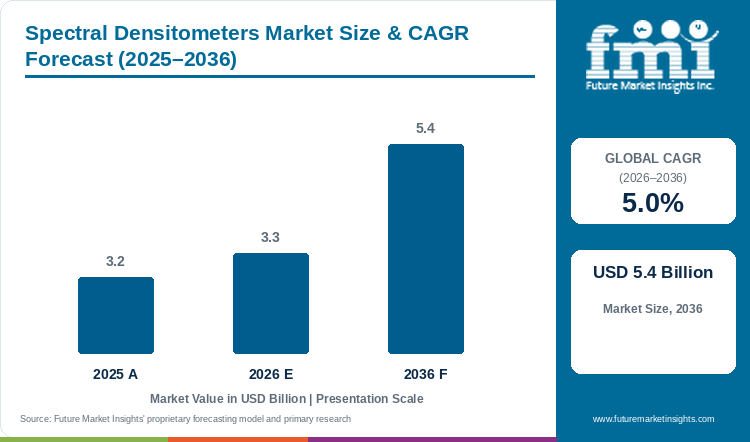
Printers, converters and industrial quality teams will spend USD 3.3 Billion on spectral densitometers in 2026, up from USD 3.2 Billion in 2025. A 5.0% CAGR will take the market to USD 5.4 Billion by 2036.
Sales of spectral densitometers are expected to grow at 5.0% CAGR between 2026 and 2036, based on FMI's analysis. Industry value is estimated to increase from USD 3.2 Billion in 2025 to USD 3.3 Billion in 2026 and to reach USD 5.4 Billion by 2036, adding USD 2.1 Billion during the forecast period.
Replacement of older handheld fleets is supporting the demand for spectral densitometers, though tight capital budgets at commercial printers are delaying part of this spending. Half of the PRINTING United Alliance research panel canceled or delayed capital investments in 2026, according to Alliance chief economist Andy Paparozzi [1]. Due to this, commercial printers are keeping older units in service for longer, and a share of 2026 and 2027 purchases will move later into the forecast period. Packaging printing is expected to hold 32% of demand by end use in 2026, and direct instrument suppliers are projected to handle 39% of sales.
Demand for replacement units will account for most new sales through 2036, and deferred orders are expected to return in clusters as supplier support windows close. X-Rite stopped selling first-generation eXact devices on 1 September 2026 and will support units with serial numbers below 30000 through 31 December 2028, with later units covered until 31 December 2031 [2]. Packaging converters are likely to buy ahead of commercial printers as these deadlines approach. Demand for spectral densitometers is also developing unevenly across countries, as South Korea is projected at 6.3% CAGR on factory automation spending and France is forecast at 4.3% with a shrinking base of small printers. However, mature print bases in Germany, Italy and France will continue to buy mainly for replacement.
Adjacent measurement and print markets are also opening faster-growing sales routes for the same instrument suppliers. Demand for inline color monitoring systems is projected to increase from USD 720.7 Million in 2026 to USD 1,769.8 Million by 2036 at 9.4% CAGR, an opportunity of USD 1,049.1 Million. Sales in the color sensors market are expected to expand from USD 1.9 Billion to USD 3.6 Billion at 6.6%. Revenue from pre-press and packaging graphics services is estimated to rise from USD 5.3 Billion in 2026 to USD 11.2 Billion by 2036 at 7.8% CAGR, and each new artwork version will need a measured color target before press approval.
By 2036, packaging pressrooms are expected to run mixed fleets of connected handheld units and inline systems, and FMI expects densitometer sales to keep a steady rise as a result. Trade-in credit, fleet calibration contracts and software support will decide which suppliers receive the larger part of the USD 2.1 Billion addition.
Key Takeaways
- Notable companies in the spectral densitometers market include X-Rite / Pantone, Konica Minolta, Datacolor, Techkon, BYK-Gardner, HunterLab, Barbieri Electronic and ColorLite.
- By device type, handheld spectral densitometers are projected to account for 34% in 2026, owing to press-side checks during make-ready and color correction.
- Based on technology, reflectance measurement is estimated to hold 36% in 2026, as most printed and packaging substrates are opaque, and packaging printing is expected at 32% by end use.
- South Korea is projected at 6.3% CAGR through 2036, followed by Japan at 5.9%, as factory automation spending and planned fleet replacement keep instrument orders moving.
Analyst Perspective
“Replacement of first-generation handheld fleets ahead of the 2028 and 2031 eXact support deadlines will open the nearest opportunity in packaging and commercial pressrooms. Suppliers bundling trade-in credit, fleet calibration and spectral workflow software will receive the larger share of these replacement orders.”
- Nikhil Kaitwade, Principal Consultant, Future Market Insights
How is the Spectral Densitometers Market Segmented?
The spectral densitometers market is segmented into device type, technology, end use, sales channel, application and region.
As per FMI, the market is segmented by device type into handheld spectral densitometers, benchtop densitometers, inline spectral systems, portable color measurement devices and multi-angle measurement systems. By technology, the market is segmented into reflectance measurement, transmission measurement, spectrophotometric measurement and camera-based measurement. By end use, the market is segmented into packaging printing, commercial printing, textile printing, paint and coatings QC, and photo and imaging. By sales channel, the market is segmented into direct instrument suppliers, printing distributors, press OEM integration and online or catalog sales. By application, the market is segmented into color quality control, ink density measurement, process calibration and brand color matching. The regional analysis covers seven regions and more than 25 countries.
Why Do Handheld Spectral Densitometers Lead the Spectral Densitometers Market by Device Type?
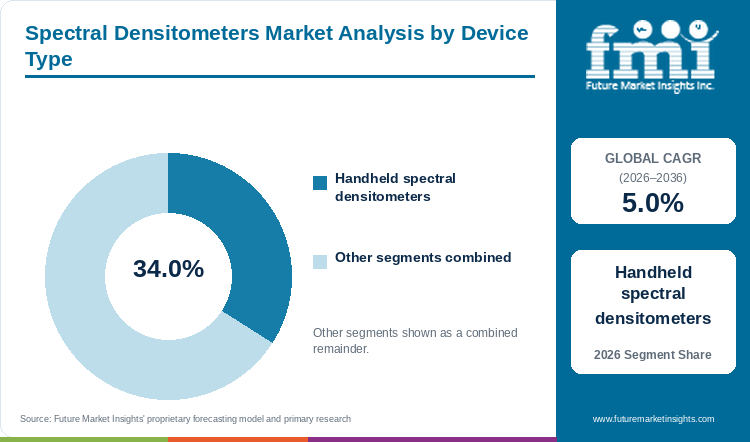
By device type, handheld spectral densitometers will account for 34% of market share in 2026.
Frequent color correction during make-ready is supporting the demand for spectral densitometers in handheld formats. Pressroom staff carry one device from machine to machine, to ink mixing and to incoming paper inspection, due to which print shops avoid laboratory trips and approve sheets faster. Portable color measurement devices and multi-angle measurement systems find wider use in general industrial and effect-coating checks, a field also tracked in the colorimeter market, and provide fewer density readings for routine pressroom tasks. Benchtop densitometers are growing at a slower pace, as each fixed station adds waiting time for crews on the floor. Inline spectral systems call for integration with the press and a separate capital sign-off, so many plants are delaying such projects. However, end of vendor service for older handheld models will decide the timing of replacement orders.
- Handheld spectral densitometers are projected to account for 34% of demand by device type in 2026, owing to press-side checks during make-ready and color correction.
- In August 2026, X-Rite Pantone launched the eXact 2 Basic, a handheld unit combining density and L*a*b* measurement for press operators moving beyond density-only workflows [3].
Why Does Reflectance Measurement Lead the Spectral Densitometers Market by Technology?
Based on technology, reflectance measurement will account for 36% of market share in 2026.
Reflectance measurement is widely used on paper, board, label stock and painted surfaces that block light. Graphic arts color standards are written around reflected-light readings for these jobs, due to which printers and converters buy reflectance instruments for everyday color sign-off. Transmission measurement is growing at a slower pace, as orders come mainly from film and transparent media. Laboratory spectrophotometric measurement supports ink formulation, and each plant needs only a few such units. Camera-based measurement extends targeting and inspection across the sheet, and buyers mostly add camera systems next to reflectance devices. However, proof of matching results against reflectance data will decide brand owner approval for camera-based readings.
- Reflectance measurement is estimated to hold 36% of demand by technology in 2026, supported by opaque print and packaging substrates measured under reflected light.
- Increasing use of software converting legacy density targets into spectral targets is expected to support reflectance instruments for brand colors.
Why Does Packaging Printing Lead the Spectral Densitometers Market by End Use?
In 2026, packaging printing will account for 32% of market share by end use.
Increasing production of folding cartons, labels and flexible packs for branded goods is supporting the demand for spectral densitometers in packaging printing. Brand owners approve packaging color against a fixed standard, and a color error on a long carton or label run wastes board, ink and machine time before the batch is delivered, due to which packaging converters are investing more in measured color control at the press. Commercial printing is growing at a slower pace, as shorter runs and tighter capital budgets are delaying instrument replacement. Textile printing mostly measures color on fabric with dye-house instruments linked to the digital textile printing market, and paint and coatings QC relies on multi-angle and laboratory spectrophotometers. Photo and imaging users buy fewer units, mainly for calibration work. However, the speed of instrument replacement and the cost of software integration will decide spending by smaller converters.
- Packaging printing is projected to account for 32% of demand by end use in 2026, owing to strict brand color approval on long carton and label runs.
- In September 2025, X-Rite and Esko showed connected color tools at Labelexpo Europe in Barcelona, pairing the eXact 2 handheld with Print Clone color matching software to cut packaging lead times from months to weeks [4].
Why Do Direct Instrument Suppliers Lead the Spectral Densitometers Market by Sales Channel?
By sales channel, direct instrument suppliers will account for 39% of market share in 2026.
Large printing groups replacing whole instrument fleets are supporting the demand for spectral densitometers through direct instrument suppliers. Such buyers expect calibration service, trade-in value and software installation in a single negotiated deal, due to which purchasing teams prefer contact with the manufacturer. Online or catalog sales cover simple repeat purchases and give little calibration help to buyers running several sites. Press OEM integration is growing at a slower pace, as orders follow new machine installations covered in the industrial printer market on longer capital cycles. Printing distributors mainly supply small shops from local stock and offer nearby repair support. However, bundled service offers from distribution partners will decide part of the channel split during fleet renewal.
- Direct instrument suppliers are projected to hold 39% of demand by sales channel in 2026, supported by fleet replacement contracts tied to support deadlines.
- X-Rite advised commercial printers to plan eXact Gen 1 upgrades before devices fail and noted that bundled upgrade promotions may be available through sales partners [2].
Why Does Color Quality Control Lead the Spectral Densitometers Market by Application?
Based on application, color quality control will account for 37% of market share in 2026.
Color approval at several stages of production is supporting the demand for spectral densitometers in color quality control. Incoming material, first press sheets and finished goods are all approved against one numeric target, due to which quality teams take the most readings in a plant. Brand color matching is expanding with label and packaging versions in the digital label printing and print-on-demand market, and every matched job still goes through a final quality check on press. Ink density measurement covers a narrower pressroom job and is growing at a slower pace. Process calibration happens on a fixed schedule and needs few readings per shift. However, operator training and consistent readings across devices will decide repeat spending on quality control fleets.
- Color quality control is estimated to account for 37% of demand by application in 2026, owing to measured acceptance at several points of production.
- In April 2026, ColorLite presented an ultramobile pocket-format color tester for quality checks on matte to gloss surfaces from incoming goods through production to outgoing goods [5].
What are the Drivers, Restraints, and Opportunities in the Spectral Densitometers Market?
According to FMI, fleet replacement in pressrooms is driving demand, delayed capital budgets are slowing purchases, and inline measurement on packaging lines will open the largest new revenue pool through 2036.
- Driver: Support deadlines for older handheld fleets and stricter brand-color requirements are encouraging pressrooms to move toward newer spectral instruments.
- Restraint: Commercial printers are delaying capital budgets, due to which instrument replacement is moving later into the forecast period.
- Opportunity: Inline and connected measurement can help converters move color checks from periodic sampling into running production.
Increasing shift from density-only control to spectral color data is supporting sales of spectral densitometers. X-Rite Pantone positioned the eXact 2 Basic for press operators relying on visual inspection and density-only workflows, combining density and L*a*b* readings in one handheld instrument [3]. Supplier platform changes are also encouraging upgrades, as first-generation eXact devices came off the X-Rite sales list on 1 September 2026 and the company is steering users toward the eXact 2 family [2].
Key challenges in the spectral densitometers market come from tight printer budgets and a shrinking commercial print base in Europe. The German print production index declined 4.8% in 2025, according to the BVDM annual report [6]. French printed volume fell about 30% between 2010 and 2023, as INSEE reported in July 2026 [7]. Due to this, commercial printers are keeping older instruments in service for longer, and packaging converters and inline projects are expected to carry a larger part of new orders through 2036.
Which Country CAGRs are Profiled in the Spectral Densitometers Market?
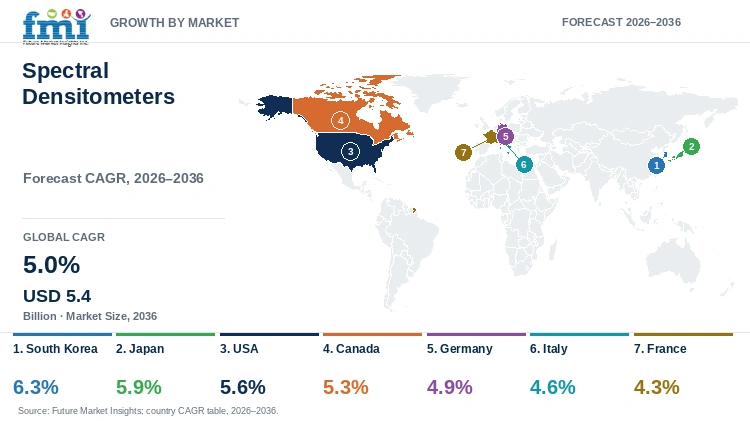
| Country | CAGR, 2026 to 2036 |
|---|---|
| South Korea | 6.3% |
| Japan | 5.9% |
| USA | 5.6% |
| Canada | 5.3% |
| Germany | 4.9% |
| Italy | 4.6% |
| France | 4.3% |
How do Country-level CAGRs Compare in the Spectral Densitometers Market?
Demand for spectral densitometers in the seven profiled countries is spread across three growth bands, according to FMI's analysis. South Korea, Japan and the USA are projected at 5.6% or above, Canada and Germany at 5.3% and 4.9%, and Italy and France at 4.6% and 4.3%. Growth pace is following replacement timing and automation spending, and mature print bases in the slower bands will continue to generate large replacement revenue through 2036.
- South Korea leads at 6.3% as AI-driven factory programs widen the demand for inline measurement.
- Japan follows at 5.9%, with instrument agreement across plants guiding replacement choices.
- Growth of 5.6% in the USA will follow delayed capital budgets returning to market.
- Canada will expand at 5.3% as smaller print teams adopt simpler handheld units.
- Germany grows at 4.9% under low press utilization and replacement-led buying.
- Demand for spectral densitometers in Italy will rise at 4.6% on packaging and converting quality requirements.
- France grows slowest at 4.3%, shaped by a shrinking base of small printers.
The full report extends CAGR estimates beyond these seven markets to more than 25 countries across seven regions.
Country Outlook
- Factory automation spending will set the pace in South Korea, the fastest market in the profiled group at a 6.3% CAGR through 2036. The government planned KRW 700 billion for the AI transformation of manufacturing in 2026, including support for AI factory development [8]. Inline spectral sensors feeding automated quality systems will gain the most from that program, with handheld units kept for line setup and audits.
- Japan is projected at 5.9% CAGR, and instrument-to-instrument agreement across plants and production areas is guiding supplier choice. Japanese converters replace fleets in planned batches, due to which calibration records and domestic service coverage carry high weight in each tender.
- Demand for spectral densitometers in the USA is projected at 5.6% CAGR, though the near-term path runs through deferred budgets. Half of the PRINTING United Alliance research panel canceled or delayed capital investments in 2026 [1]. Replacement orders are expected to cluster as support deadlines for older handheld fleets approach, with packaging converters buying ahead of commercial printers.
- Smaller print teams and limited specialist staff shape Canadian buying, and demand will grow at a 5.3% CAGR till 2036. Portable units with guided software and access to recertification services will gain the most listings outside large plants.
- German printers are buying under low utilization, with demand expanding on a 4.9% CAGR. Average capacity utilization in the German print industry fell to 74.9% in 2025, the lowest level since the series began [6]. Instrument spending will follow replacement and waste reduction needs, with standards compliance acting as a gate for every supplier.
- Packaging and converting work keeps color control central in Italy, a market expanding at a 4.6% CAGR. Substrate variation across export-oriented packaging runs will keep demand steady for handheld and inline units linked to brand-owner color targets.
- France grows slowest at 4.3%, and the base of buying firms is shrinking. INSEE counted about 16,000 printing companies with 38,000 full-time-equivalent workers in 2023, with no large enterprises in the sector [7]. Suppliers will sell on waste reduction and faster setup to small firms replacing one or two units at a time.
Who are the Notable Companies in the Spectral Densitometers Market?
X-Rite / Pantone, Konica Minolta, Datacolor, Techkon, BYK-Gardner, Barbieri Electronic, ColorLite, Nix Sensor, HunterLab and Sakurai Graphic Systems are among the notable companies profiled by FMI in this market.
Supply of press-side spectral densitometers is concentrated among a few print workflow specialists such as X-Rite / Pantone and Techkon, and industrial color measurement is spread across several platform suppliers. Pressrooms rarely change suppliers, as software, color libraries and calibration records are linked to one brand, due to which a switch requires requalification of density standards and fresh operator training. X-Rite / Pantone is using the eXact Gen 1 sales end on 1 September 2026 to move users onto the eXact 2 family [2]. Connected workflows are making entry harder for new suppliers, as X-Rite paired eXact 2 with Esko color matching software at Labelexpo Europe 2025 [4]. Consolidation is also increasing, and Techkon is already part of Datacolor. Owing to this, pricing power is expected to stay with suppliers controlling both the instrument and the color data workflow. However, each retiring fleet will open a new tender through 2036, and competition is expected to increase around these replacement deadlines.
- Print and Packaging Workflow Specialists: X-Rite / Pantone, Techkon, Nix Sensor and Sakurai Graphic Systems compete closest to press-side measurement, density control and press integration.
- Broad Industrial Color Measurement Platforms: Konica Minolta, Datacolor, BYK-Gardner and HunterLab serve wider production and laboratory color control with portable and benchtop spectral instruments.
- Automated and Inline Measurement Specialists: Barbieri Electronic and ColorLite offer automated, inline, transmission and mobile measurement configurations for production environments.
Competitive Benchmarking
| Company | Print-Process Densitometry | Portable / Press-Side Fit | Inline / Connected Workflow | Geographic Reach |
|---|---|---|---|---|
| X-Rite / Pantone | High | High | High | Global, with strong Americas, Europe and Asia coverage |
| Konica Minolta | Medium | High | Medium | Global industrial sensing and service footprint |
| Techkon | High | High | High | Germany, USA, Japan and distributor markets |
| Barbieri Electronic | Medium | Medium | High | Europe-based with global digital-print channels |
| Datacolor | Medium | Medium | High | Sales and support in 100+ countries |
| BYK-Gardner | Low | High | Medium | Global industrial color and appearance channels |
| ColorLite | High | High | High | Germany-based with international dealer coverage |
| Nix Sensor | High | High | Medium | Canada-based with international direct and partner sales |
| HunterLab | Low | Low | Low | Global industrial and laboratory color measurement presence |
| Sakurai Graphic Systems | Medium | Low | Medium | Japan with USA and European press-market support |
Scoring basis: Print-Process Densitometry is High for documented density and spectral control in printing workflows and Medium for related production use. Portable / Press-Side Fit is High for documented handheld or operator-side instruments and Medium for narrower portable ranges. Inline / Connected Workflow is High for documented software, network, scanning, robotic or closed-loop links and Medium for narrower connectivity. A Low rating marks limited public documentation for the criterion, and Geographic Reach describes documented sales or support presence.
Key Developments
- In September 2025, X-Rite and Esko showed connected color tools at Labelexpo Europe in Barcelona, pairing the eXact 2 handheld with AI-based Print Clone software to shorten packaging lead times [4].
- In April 2026, ColorLite introduced an ultramobile pocket-format color tester for quality checks on matte to gloss surfaces across incoming goods, production and outgoing goods [5].
- In August 2026, X-Rite Pantone launched the eXact 2 Basic, a handheld spectrophotometer combining density and L*a*b* measurement for commercial printers and converters [3].
- In September 2026, X-Rite discontinued sales of first-generation eXact devices, with service support running to the end of 2028 or 2031 depending on serial number range [2].
Key Players
Print and Packaging Workflow Specialists
- X-Rite / Pantone
- Techkon
- Nix Sensor
- Sakurai Graphic Systems
Broad Industrial Color Measurement Platforms
- Konica Minolta
- Datacolor
- BYK-Gardner
- HunterLab
Automated and Inline Measurement Specialists
- Barbieri Electronic
- ColorLite
Report Scope and Methodology
| Coverage field | Report scope |
|---|---|
| Market breakdown | 5 categories plus region: Device Type (Handheld spectral densitometers, Benchtop densitometers, Inline spectral systems, Portable color measurement devices, Multi-angle measurement systems), Technology (Reflectance, Transmission, Spectrophotometric, Camera-based measurement), End Use (Packaging printing, Commercial printing, Textile printing, Paint/coatings QC, Photo/imaging), Sales Channel (Direct instrument suppliers, Printing distributors, Press OEM integration, Online/catalog), Application (Color quality control, Ink density measurement, Process calibration, Brand color matching), and Region |
| Quantitative units | USD Billion |
| Market definition | Revenue from spectral densitometers and closely integrated spectral color measurement instruments sold within the stated device, technology, end-use, channel and application segments. Downstream finished-product revenue and adjacent or substitute product revenue are excluded. |
| Regions covered | North America, Latin America, Western Europe, Eastern Europe, East Asia, South Asia and Pacific, Middle East and Africa |
| Countries covered | More than 25 countries, with South Korea, Japan, the USA, Canada, Germany, Italy and France profiled in detail |
| Key companies profiled | X-Rite / Pantone, Konica Minolta, Techkon, Barbieri Electronic, Datacolor, BYK-Gardner, ColorLite, Nix Sensor, HunterLab and Sakurai Graphic Systems, selected from a wider field of color measurement suppliers |
| Forecast period | 2026 to 2036 |
| Approach | Supplier revenue, shipment and price checks, installed-base replacement timing and demand by application triangulated by FMI from primary and desk research. |
Research Methodology
| Method | Approach |
|---|---|
| Primary research | Interviews with instrument manufacturers, distributors, press OEMs, color management specialists, packaging and commercial printers, textile users, coatings QC teams and procurement staff test purchase triggers, replacement timing, calibration needs, workflow integration and channel structure. |
| Desk research | The analysis reviews standards bodies, national statistics, ministries, industry associations, company filings, product documentation and dated company announcements. Evidence is screened for relevance to spectral densitometers, the defined end uses, buyer workflows and country operating conditions. |
| Market sizing and forecasting | The sizing framework combines supplier and channel revenue with shipment and pricing checks, installed-base replacement, demand for print and industrial quality control, application mix, automation intensity, service conditions and country-level adoption across the 2026 to 2036 forecast period. |
| Data validation | Findings are cross-checked across company product evidence, official statistics, standards and buyer workflow information. Validation removes double counting, downstream finished-product revenue, unsupported claims and adjacent instruments outside the defined spectral or density measurement function. |
Spectral Densitometers Market by Segments
Spectral Densitometers Market Segmented by Device Type
- Handheld spectral densitometers
- Benchtop densitometers
- Inline spectral systems
- Portable color measurement devices
- Multi-angle measurement systems
Spectral Densitometers Market Segmented by Technology
- Reflectance measurement
- Transmission measurement
- Spectrophotometric measurement
- Camera-based measurement
Spectral Densitometers Market Segmented by End Use
- Packaging printing
- Commercial printing
- Textile printing
- Paint/coatings QC
- Photo/imaging
Spectral Densitometers Market Segmented by Sales Channel
- Direct instrument suppliers
- Printing distributors
- Press OEM integration
- Online/catalog
Spectral Densitometers Market Segmented by Application
- Color quality control
- Ink density measurement
- Process calibration
- Brand color matching
Spectral Densitometers Market Segmented by Region
- North America
- Latin America
- Western Europe
- Eastern Europe
- East Asia
- South Asia and Pacific
- Middle East and Africa
Research Sources and Bibliography
- [1] Advertising Specialty Institute (2026, September 24). PRINTING United Expo 2026: Breaking Down the Trends Facing the Print Industry.
- [2] X-Rite (2026, August 20). eXact Gen 1 End of Life: Upgrade Your Commercial Print Color Measurement.
- [3] X-Rite Pantone (2026, August 17). X-Rite Pantone Launches eXact 2 Basic Spectrophotometer Ahead of LOUPE Americas and PRINTING United Expo 2026.
- [4] X-Rite (2025, September). X-Rite Joins Forces with Esko at Labelexpo Europe to Accelerate Packaging Lead Times from Months to Weeks.
- [5] ColorLite GmbH (2026, April 2). Ultramobile color quality test in pocket format for applications from matt to gloss.
- [6] Bundesverband Druck und Medien (2026, June). BVDM Jahresbericht 2025+2026.
- [7] INSEE (2026, July 28). Les entreprises de l’imprimerie depuis 2010 : la production recule, les usages se modifient.
- [8] The Korea Times (2025, December 24). Gov't to funnel $478 mil. into AI transformation of manufacturing sector in 2026.
This bibliography is provided for reader reference and is not exhaustive. The full report contains the complete reference list and detailed citations.
This Report Answers
- What will spectral densitometers generate in 2026, and what market value will the industry reach by 2036?
- What effect will support deadlines for older handheld fleets have on demand for replacement units in print and packaging pressrooms?
- Why will handheld spectral densitometers hold the largest device type share in 2026?
- Why will reflectance measurement keep the lead in technology as camera-based and inline methods spread?
- Why will packaging printing remain the largest end use for spectral color measurement?
- Which growth gap will separate South Korea, Japan and the USA from Canada, Germany, Italy and France through 2036?
- What effect will delayed capital budgets at commercial printers have on the timing of instrument purchases?
- Which calibration, software and trade-in terms will buyers ask suppliers to offer before a fleet upgrade?
Frequently Asked Questions
How Big Is the Spectral Densitometers Market Expected to Be in 2026?
Spectral densitometer sales will reach USD 3.3 Billion in 2026, up from USD 3.2 Billion in 2025, as FMI estimates show. By 2036, market value will rise to USD 5.4 Billion as pressrooms and converting plants renew measurement fleets.
What Is the CAGR of the Spectral Densitometers Market from 2026 to 2036?
The market will grow at a 5% CAGR over the 2026 to 2036 period. Replacement of older handheld units and new inline projects on packaging lines will carry most of that growth.
Which Device Type Holds the Largest Share of the Spectral Densitometers Market?
Handheld spectral densitometers will lead with 34% of market share by device type in 2026. Press operators will keep using portable units for make-ready checks, ink room work and goods-in inspection.
Which End Use Leads the Spectral Densitometers Market?
Packaging printing will lead with 32% of market share by end use in 2026. Long carton, label and flexible pack runs will raise the cost of a color error and justify spending on measurement.
Which Country Is Expected to Grow Fastest in the Spectral Densitometers Market?
South Korea will post the fastest growth at a 6.3% CAGR till 2036, with Japan next at 5.9% and the USA third at 5.6%, according to FMI. France, at 4.3%, will post the slowest rate of the seven profiled countries.
What Notable Restraint Affects the Spectral Densitometers Market?
Key challenges will include delayed capital budgets at commercial printers and the cost of calibration and service across mixed fleets. Smaller print shops with low measurement frequency will keep older instruments in service for longer.
Which Are the Key Companies in the Spectral Densitometers Market?
The profiled suppliers are X-Rite / Pantone, Konica Minolta, Techkon, Barbieri Electronic, Datacolor, BYK-Gardner, ColorLite, Nix Sensor, HunterLab and Sakurai Graphic Systems. The companies fall into three groups covering print workflow specialists, broad industrial color platforms and automated measurement suppliers.
Preview the report firsthand - request a free sample
Get SampleGet the brochure for pricing and purchase details.
Get PDFTable of Content
- Key Takeaways
- Market Size and CAGR
- Top Growth Driver
- Fastest Growing Segment
- Leading Region
- Key Companies
- Emerging Opportunities
- Executive Summary
- Global Market Outlook
- Demand-side Trends
- Supply-side Trends
- Technology Roadmap Analysis
- Analysis and Recommendations
- Analyst Perspective (What is happening? Why now? What should investors know?)
- Key Questions Answered
- How large is the market?
- What is the CAGR?
- What are key trends?
- Which region dominates?
- Who are the leaders?
- Market Overview
- Market Coverage / Taxonomy
- Market Definition / Scope / Limitations
- Research Methodology
- Chapter Orientation
- Analytical Lens and Working Hypotheses
- Market Structure, Signals, and Trend Drivers
- Benchmarking and Cross-market Comparability
- Market Sizing, Forecasting, and Opportunity Mapping
- Research Design and Evidence Framework
- Desk Research Programme (Secondary Evidence)
- Expert Input and Fieldwork (Primary Evidence)
- Tooling, Models, and Reference Databases
- Data Engineering and Model Build
- Quality Assurance and Audit Trail
- Market Background
- Market Dynamics (Drivers, Restraints, Opportunity, Trends)
- Scenario Forecast (Optimistic, Likely, Conservative)
- Impact Analysis
- AI Impact
- Sustainability Impact
- Regulatory Impact
- Technology Impact
- Consumer / Buyer Analysis
- Purchase Drivers
- Adoption Barriers
- Buyer Journey
- Opportunity Map Analysis
- Product Life Cycle Analysis
- Supply Chain Analysis
- Investment Feasibility Matrix
- Value Chain Analysis
- PESTLE and Porter's Analysis
- Regulatory Landscape
- Regional Parent Market Outlook
- Production and Consumption Statistics
- Import and Export Statistics
- Global Market Analysis and Forecast, 2021 to 2036
- Historical Market Size Value (USD Billion) Analysis, 2021 to 2025
- Current and Future Market Size Value (USD Billion) Projections, 2026 to 2036
- Y-o-Y Growth Trend Analysis
- Absolute $ Opportunity Analysis
- Global Market Pricing Analysis, 2021 to 2036
- Global Market Analysis and Forecast, By Device Type, 2021 to 2036
- Introduction / Key Findings
- Historical Market Size Value (USD Billion) Analysis By Device Type, 2021 to 2025
- Current and Future Market Size Value (USD Billion) Analysis and Forecast By Device Type, 2026 to 2036
- Handheld spectral densitometers
- Benchtop densitometers
- Inline spectral systems
- Portable color measurement devices
- Multi-angle measurement systems
- Y-o-Y Growth Trend Analysis By Device Type, 2021 to 2025
- Absolute $ Opportunity Analysis By Device Type, 2026 to 2036
- Global Market Analysis and Forecast, By Technology, 2021 to 2036
- Introduction / Key Findings
- Historical Market Size Value (USD Billion) Analysis By Technology, 2021 to 2025
- Current and Future Market Size Value (USD Billion) Analysis and Forecast By Technology, 2026 to 2036
- Reflectance measurement
- Transmission measurement
- Spectrophotometric measurement
- Camera-based measurement
- Y-o-Y Growth Trend Analysis By Technology, 2021 to 2025
- Absolute $ Opportunity Analysis By Technology, 2026 to 2036
- Global Market Analysis and Forecast, By End Use, 2021 to 2036
- Introduction / Key Findings
- Historical Market Size Value (USD Billion) Analysis By End Use, 2021 to 2025
- Current and Future Market Size Value (USD Billion) Analysis and Forecast By End Use, 2026 to 2036
- Packaging printing
- Commercial printing
- Textile printing
- Paint/coatings QC
- Photo/imaging
- Y-o-Y Growth Trend Analysis By End Use, 2021 to 2025
- Absolute $ Opportunity Analysis By End Use, 2026 to 2036
- Global Market Analysis and Forecast, By Sales Channel, 2021 to 2036
- Introduction / Key Findings
- Historical Market Size Value (USD Billion) Analysis By Sales Channel, 2021 to 2025
- Current and Future Market Size Value (USD Billion) Analysis and Forecast By Sales Channel, 2026 to 2036
- Direct instrument suppliers
- Printing distributors
- Press OEM integration
- Online/catalog
- Y-o-Y Growth Trend Analysis By Sales Channel, 2021 to 2025
- Absolute $ Opportunity Analysis By Sales Channel, 2026 to 2036
- Global Market Analysis and Forecast, By Application, 2021 to 2036
- Introduction / Key Findings
- Historical Market Size Value (USD Billion) Analysis By Application, 2021 to 2025
- Current and Future Market Size Value (USD Billion) Analysis and Forecast By Application, 2026 to 2036
- Color quality control
- Ink density measurement
- Process calibration
- Brand color matching
- Y-o-Y Growth Trend Analysis By Application, 2021 to 2025
- Absolute $ Opportunity Analysis By Application, 2026 to 2036
- Global Market Analysis and Forecast, By Region, 2021 to 2036
- Introduction
- Historical Market Size Value (USD Billion) Analysis By Region, 2021 to 2025
- Current Market Size Value (USD Billion) Analysis and Forecast By Region, 2026 to 2036
- North America
- Latin America
- Western Europe
- Eastern Europe
- East Asia
- South Asia and Pacific
- Middle East and Africa
- Market Attractiveness Analysis By Region
- North America Market Analysis and Forecast, By Country, 2021 to 2036
- Historical Market Size Value (USD Billion) Trend Analysis By Market Taxonomy, 2021 to 2025
- Market Size Value (USD Billion) Forecast By Market Taxonomy, 2026 to 2036
- By Country
- By Device Type
- By Technology
- By End Use
- By Sales Channel
- By Application
- Market Attractiveness Analysis
- By Country
- By Device Type
- By Technology
- By End Use
- By Sales Channel
- By Application
- Key Takeaways
- Latin America Market Analysis and Forecast, By Country
- Historical Market Size Value (USD Billion) Trend Analysis By Market Taxonomy, 2021 to 2025
- Market Size Value (USD Billion) Forecast By Market Taxonomy, 2026 to 2036
- By Country
- By Device Type
- By Technology
- By End Use
- By Sales Channel
- By Application
- Market Attractiveness Analysis
- By Country
- By Device Type
- By Technology
- By End Use
- By Sales Channel
- By Application
- Key Takeaways
- Western Europe Market Analysis and Forecast, By Country
- Historical Market Size Value (USD Billion) Trend Analysis By Market Taxonomy, 2021 to 2025
- Market Size Value (USD Billion) Forecast By Market Taxonomy, 2026 to 2036
- By Country
- By Device Type
- By Technology
- By End Use
- By Sales Channel
- By Application
- Market Attractiveness Analysis
- By Country
- By Device Type
- By Technology
- By End Use
- By Sales Channel
- By Application
- Key Takeaways
- Eastern Europe Market Analysis and Forecast, By Country
- Historical Market Size Value (USD Billion) Trend Analysis By Market Taxonomy, 2021 to 2025
- Market Size Value (USD Billion) Forecast By Market Taxonomy, 2026 to 2036
- By Country
- By Device Type
- By Technology
- By End Use
- By Sales Channel
- By Application
- Market Attractiveness Analysis
- By Country
- By Device Type
- By Technology
- By End Use
- By Sales Channel
- By Application
- Key Takeaways
- East Asia Market Analysis and Forecast, By Country
- Historical Market Size Value (USD Billion) Trend Analysis By Market Taxonomy, 2021 to 2025
- Market Size Value (USD Billion) Forecast By Market Taxonomy, 2026 to 2036
- By Country
- By Device Type
- By Technology
- By End Use
- By Sales Channel
- By Application
- Market Attractiveness Analysis
- By Country
- By Device Type
- By Technology
- By End Use
- By Sales Channel
- By Application
- Key Takeaways
- South Asia and Pacific Market Analysis and Forecast, By Country
- Historical Market Size Value (USD Billion) Trend Analysis By Market Taxonomy, 2021 to 2025
- Market Size Value (USD Billion) Forecast By Market Taxonomy, 2026 to 2036
- By Country
- By Device Type
- By Technology
- By End Use
- By Sales Channel
- By Application
- Market Attractiveness Analysis
- By Country
- By Device Type
- By Technology
- By End Use
- By Sales Channel
- By Application
- Key Takeaways
- Middle East and Africa Market Analysis and Forecast, By Country
- Historical Market Size Value (USD Billion) Trend Analysis By Market Taxonomy, 2021 to 2025
- Market Size Value (USD Billion) Forecast By Market Taxonomy, 2026 to 2036
- By Country
- By Device Type
- By Technology
- By End Use
- By Sales Channel
- By Application
- Market Attractiveness Analysis
- By Country
- By Device Type
- By Technology
- By End Use
- By Sales Channel
- By Application
- Key Takeaways
- Key Countries Market Analysis
- South Korea
- Pricing Analysis
- Market Share Analysis, 2025
- By Device Type
- By Technology
- By End Use
- By Sales Channel
- By Application
- Japan
- Pricing Analysis
- Market Share Analysis, 2025
- By Device Type
- By Technology
- By End Use
- By Sales Channel
- By Application
- USA
- Pricing Analysis
- Market Share Analysis, 2025
- By Device Type
- By Technology
- By End Use
- By Sales Channel
- By Application
- Canada
- Pricing Analysis
- Market Share Analysis, 2025
- By Device Type
- By Technology
- By End Use
- By Sales Channel
- By Application
- Germany
- Pricing Analysis
- Market Share Analysis, 2025
- By Device Type
- By Technology
- By End Use
- By Sales Channel
- By Application
- Italy
- Pricing Analysis
- Market Share Analysis, 2025
- By Device Type
- By Technology
- By End Use
- By Sales Channel
- By Application
- France
- Pricing Analysis
- Market Share Analysis, 2025
- By Device Type
- By Technology
- By End Use
- By Sales Channel
- By Application
- South Korea
- Market Structure Analysis
- Competition Dashboard
- Competition Benchmarking
- Market Share Analysis of Top Players
- By Regional
- By Device Type
- By Technology
- By End Use
- By Sales Channel
- By Application
- Emerging Startups
- Innovation Benchmarking
- Competition Analysis
- Competition Deep Dive
- X-Rite / Pantone
- Overview
- Product Portfolio
- Profitability by Market Segments
- Sales Footprint
- Strategy Overview
- Marketing Strategy
- Product Strategy
- Channel Strategy
- Konica Minolta
- Techkon
- Barbieri Electronic
- Datacolor
- BYK-Gardner
- ColorLite
- Nix Sensor
- HunterLab
- Sakurai Graphic Systems
- X-Rite / Pantone
- Case Studies
- Success Stories
- Recent Developments
- Competition Deep Dive
- Assumptions & Acronyms Used


