

- Market Size (2026)
- USD 380.6 Mn
- Forecast (2036)
- USD 656.3 Mn
- CAGR (2026 to 2036)
- 5.6%
How big is Speed Log Testers Market in 2026?
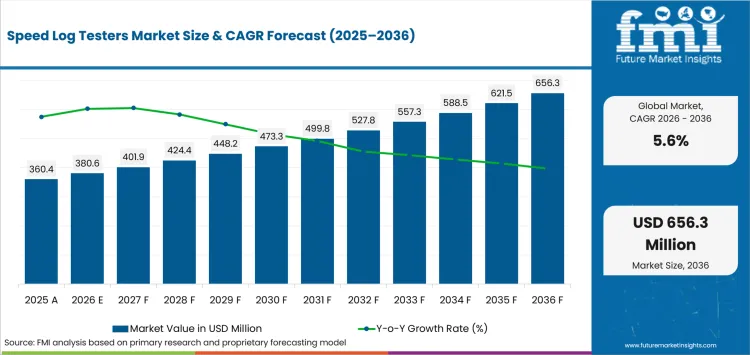
USD 380.6 million in 2026 and USD 656.3 million by 2036 at a 5.6% CAGR.
Demand for speed log testers is projected to expand at 5.6% CAGR between 2026 and 2036, lifting valuation from USD 380.6 million to USD 656.3 million. Commissioning and repair work ties marine electronics tester purchases to installed fleets as technicians verify speed data throughout service lives. UN Trade and Development reported in June 2026 that about 116,000 merchant vessels operated at the year start. That installed fleet gives technicians verification work during vessel maintenance and commissioning.
Country demand varies with service intensity among maritime economies with similar growth patterns. German port workloads give ship repair services recurring access to vessels needing bridge checks during scheduled calls. Destatis reported in March 2026 that German seaports handled 284.4 million tonnes of goods during 2025, sustaining repair demand around established yards. Singapore operates with shorter service windows, while Japan and Norway impose different qualification conditions that change portable tester order timing.
Key Takeaways of Speed Log Testers Market
- Recurring commissioning and maintenance work raises demand for testers that verify speed data without extending vessel downtime during scheduled service visits.
- Based on tester type, Doppler speed log testers are projected to account for 29.0% in 2026 due to acoustic transducer verification requirements.
- In 2026, calibration verification is expected to lead test function with 31.0% share because repaired SDME units require repeatable acceptance checks.
- The vessel type category is forecast to be led by commercial ships at 44.0% share in 2026 due to recurring surveys and long service lives.
- Mixed sensor principles and bridge interfaces raise training plus adapter requirements when one portable kit cannot cover an installed fleet.
- Kongsberg Maritime ASA, Furuno Electric Co., Ltd., Japan Radio Co., Ltd., Sperry Marine B.V., Consilium Safety Group AB, AMI Marine Limited, Jotron SKIPPER AS and Anschütz GmbH comprise the profiled company set.
Analyst Perspective
"Speed log tester selection should start with the vessel’s installed sensor principle and the data interfaces technicians must prove during one attendance. Commercial value comes from covering those signal paths with traceable records without forcing a second sea trial or another service visit."
- Nikhil Kaitwade, Principal Consultant, Future Market Insights
How is the Speed Log Testers Market segmented?
Segmentation covers tester type, test function, vessel type, application, sales channel and region.
Tester type includes Doppler, electromagnetic and pitot or pressure log testers plus GPS-referenced and signal simulation testers. Test function covers calibration verification, signal simulation, transducer health check, sea trial validation and interface or NMEA testing. Vessels include commercial ships, naval vessels, offshore vessels and workboats or ferries. Application covers navigation system testing, dry dock maintenance, commissioning and annual survey support. Channels include marine electronics distributors, direct OEM and service or calibration providers. Within the sales channel category, marine electronics distributors are estimated to account for 39.0% in 2026 because they provide local equipment access and technical support for vessel operators.
What supports navigation system testing within the application category?
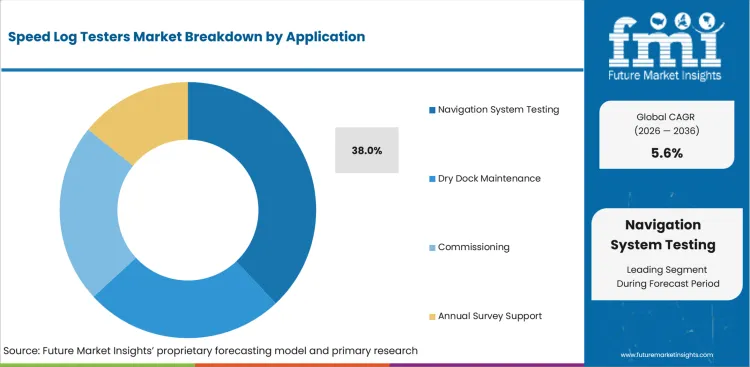
Navigation system testing starts with a passed speed-sensor check and continues into the bridge data path. Marine radar and integrated bridge functions can expose interface faults that a sensor-only check misses. Sperry Marine reported in September 2025 that two Samskip vessels would receive integrated bridge systems with open interfaces and remote diagnostics.
- The application category is forecast to be led by navigation system testing at 38.0% share in 2026 due to downstream interface validation needs.
- Service teams gain more from testers that confirm source accuracy and data delivery across commissioning faults beyond the speed-log display.
What makes doppler speed log testers central to the tester type category?
Doppler speed logs separate acoustic sensing from the display and bridge interface, so technicians must locate the fault without replacing equipment. Marine electronics technicians need tools that check transducer behavior and downstream output during vessel attendance.
- Based on tester type, Doppler speed log testers are projected to account for 29.0% in 2026 due to acoustic transducer verification requirements.
- Portable Doppler testers earn field use when they separate sensor faults from processing faults without sending a vessel back to sea for diagnosis.
Why does calibration verification lead the test function category?
Calibration verification turns a repaired or installed speed log into a documented navigation input that service teams can accept. Technicians compare controlled references with indicated results so test and measurement sensors remain traceable across repeated service work.
- By test function, calibration verification is estimated to hold 31.0% in 2026 owing to repeatable acceptance checks following SDME adjustment. DNV reported in August 2025 that updated MED rules introduced revised testing standards for speed and distance measuring equipment.
- Controlled dockside checks reduce reliance on extended sea trials and give technicians a traceable record before the vessel returns to normal service.
How do commercial ships shape demand within the vessel type category?
Commercial fleet maintenance puts testers into repeated service as one operator may manage marine vessels carrying several generations of speed-log equipment and bridge interfaces. Dry-dock teams therefore value portable instruments that can follow technicians between vessels without rebuilding the test setup.
- By vessel type, commercial ships are forecast to represent 44.0% in 2026 driven by recurring dry-dock and bridge maintenance across long service lives.
- Scheduled fleet maintenance keeps portable testers in repeated use across vessels with different speed-log generations and interfaces. UN Trade and Development reported in September 2025 that the world fleet counted 112,500 vessels at the year start.
What are the drivers, restraints and opportunities in the Speed Log Testers Market?
Connected navigation expands verification demand while reference uncertainty raises diagnostic effort and remote records extend service value.
- Driver: Flag-state approval and commissioning requirements keep speed-log verification tied to installed interfaces and formal acceptance work.
- Restraint: GNSS interference and mixed sensor architectures increase diagnostic time when external references cannot be treated as independently reliable.
- Opportunity: Exportable diagnostic records let shore specialists review onboard measurements and reduce repeat attendance for faults that can be assessed remotely.
Speed-Log Approval Sustains Verification Work
Flag-state approval keeps speed-log verification tied to formal vessel acceptance instead of discretionary troubleshooting during service work. AMI Marine reported in April 2026 that Panama approved its SMIDS Pro GNSS speed-log option for non-portable piloting aids. Approved equipment then requires commissioning against installed vessel interfaces, making portable references necessary for speed and distance checks during final vessel acceptance.
Reference Uncertainty Raises Diagnostic Work
Satellite interference raises diagnostic effort because a GNSS reference can fail alongside onboard speed or positioning equipment. IMO joined ICAO and ITU in March 2025 to warn that jamming and spoofing incidents were increasing across satellite navigation signals. Service engineers therefore need independent references and clear maritime cybersecurity procedures to avoid replacing hardware that is functioning correctly.
Remote Diagnostics Extend Service Value
Remote fault visibility extends tester value by letting shore specialists review consistent logs to decide whether another vessel attendance is required. Portable instruments become more useful as their records travel with the fault history across maritime satellite communication links. Japan Radio Co., Ltd. added GNSS jamming and spoofing detection to Smart Ship Viewer in April 2026 so shore teams can separate external interference from onboard equipment faults.
Which country CAGRs are profiled in the Speed Log Testers Market?
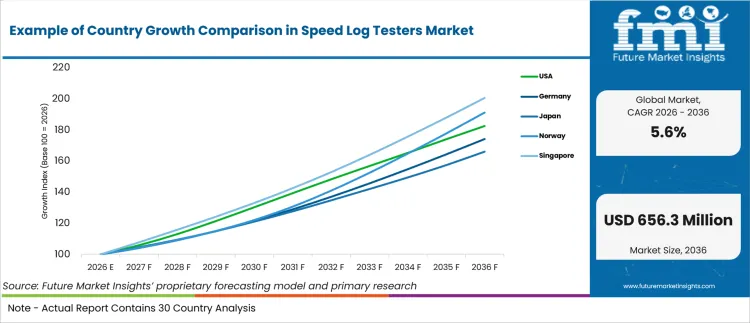
| Country | CAGR |
|---|---|
| Singapore | 5.6% |
| Norway | 5.3% |
| USA | 4.8% |
| Germany | 4.4% |
| Japan | 4.1% |
How do country-level CAGRs compare in the Speed Log Testers Market?
The five profiled markets span 1.5 percentage points and separate into two distinct service patterns. Singapore and Norway form the upper group because dense port work or dispersed coastal operations reward portable verification. The United States occupies the middle position as Germany and Japan progress more slowly under mature-fleet refit and qualification demands.
- Singapore’s record vessel traffic compresses diagnostic work into short service windows.
- Norway’s offshore routes favor rugged tools backed by reachable coastal support.
- United States yard diversity favors multi-interface kits across mixed vessel generations.
- Germany’s refits reward traceable calibration across legacy and digital bridge equipment.
- Japan’s controlled commissioning raises qualification demands for unfamiliar third-party service tools.
Similar growth rates therefore mask different service, qualification and channel conditions across these maritime economies. The full report provides country-level CAGR analysis across North America, Latin America, Europe, East Asia, South Asia, Oceania and the Middle East and Africa.
Country-wise Analysis
- Singapore marine technicians work inside short port calls that require speed-log faults to be isolated ahead of departure across commercial vessels carrying different bridge interfaces, sensor layouts and service histories during busy port rotations. Speed log tester sales in Singapore are forecast to expand at 5.6% CAGR by 2036 as MPA’s January 2026 release recorded 3.22 billion GT of vessel arrivals during 2025 across the port. Dense technical coverage puts verification tools into regular service yet tight sailing windows penalize failed first visits and favor portable kits with broad interfaces, downloadable records and fast shore-team handover during one routine attendance.
- Statistics Norway reported in January 2026 that the Norwegian merchant fleet contained 1,498 vessels in 2025 across a country whose coastal service network supports exposed routes plus offshore traffic and smaller ports. Norway is estimated to post 5.3% CAGR over the forecast period as recurring offshore maintenance sustains tester use, although weather exposure and specialized vessel configurations increase adapter and technician training requirements during scheduled visits. Regional service arrangements matter as much as rugged hardware because technicians need calibrated equipment plus replacement leads within reach of remote coastal work, offshore maintenance schedules and dispersed operating areas during urgent calls.
- United States ship repair activity spans large and smaller private yards that handle commercial vessels with different bridge generations, producing a broad service pattern across coastal repair programs and scheduled dry-dock maintenance work. The United States speed log testers sector is projected to record 4.8% CAGR during the assessment period, shaped by recurring repair cycles and portable kits that technicians can carry between varied yard facilities. Compatibility remains the main friction as MARAD’s May 2025 survey covered major private shipbuilding and repair facilities with different capabilities, favoring traceable calibration plus locally available replacement leads and technical support near major yards.
- Germany’s federal transport ministry ordered four replacement ships in December 2025, including two BSH survey vessels with modern hydrographic systems that place navigation equipment inside tightly documented public commissioning and acceptance projects. Adoption of speed log testers in Germany is estimated to expand at 4.4% CAGR through 2036 as refit work adds newer digital bridge functions, although legacy interfaces increase integration and testing effort during retrofits. Formal documentation requirements make interface knowledge and traceable calibration central to acceptance, so entrants need IEC data support plus service partners familiar with northern German yards and established refit histories across installed bridge equipment.
- Japanese shipyards use tightly controlled commissioning routines that raise the qualification burden for unfamiliar third-party testers, despite local engineering teams being able to evaluate technically capable instruments during planned maintenance and acceptance work. Speed log tester demand in Japan is forecast to rise at 4.1% CAGR over the forecast period as MLIT reported the country’s first inspected ship carrying an autonomous navigation system in December 2025. Manufacturers need detailed Japanese documentation and dependable local technical support as shipyard teams require proven compatibility across routine maintenance, established domestic marine-electronics networks and tightly controlled acceptance programs covering commercial fleets nationwide during maintenance.
Who are the notable companies in the Speed Log Testers Market?
Kongsberg Maritime ASA, Furuno Electric Co., Ltd., Japan Radio Co., Ltd., Sperry Marine B.V., Consilium Safety Group AB, AMI Marine Limited, Jotron SKIPPER AS and Anschütz GmbH.
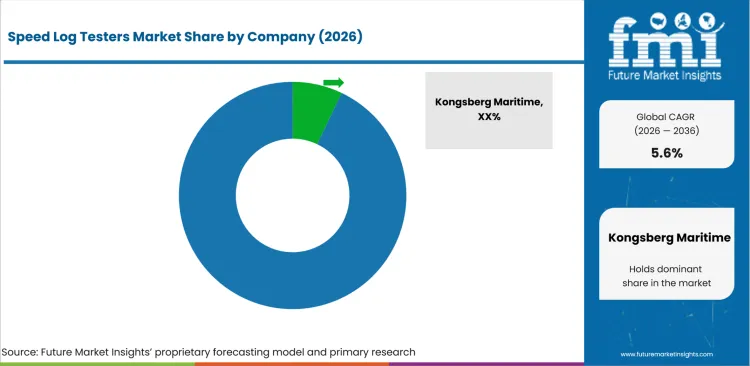
Competition separates direct speed-log OEMs from field-service organizations and navigation integration specialists across a fragmented installed base. Entry depends on verified signal compatibility and nearby technical support during short commercial port calls and scheduled yard visits.
- Furuno Electric Co., Ltd. and Jotron SKIPPER AS supply speed-log equipment used across commercial marine navigation. Japan Radio Co., Ltd. and Sperry Marine B.V. supply broader navigation systems that technicians encounter during integrated verification work.
- AMI Marine Limited combines GNSS speed-log coverage with NMEA diagnostics, while Consilium Safety Group AB focuses on marine field service.
- Kongsberg Maritime ASA covers integrated maritime systems, while Anschütz GmbH focuses on bridge platforms that shape downstream speed-data checks.
Competitive Benchmarking: Speed Log Testers Market
| Company | Speed-Log Exposure | Diagnostic Support | Bridge Integration | Geographic Reach |
|---|---|---|---|---|
| Kongsberg Maritime ASA | Medium | Medium | Medium | Global |
| Furuno Electric Co., Ltd. | High | Medium | High | Global |
| Japan Radio Co., Ltd. | Medium | Medium | High | Global |
| Sperry Marine B.V. | Medium | Medium | High | Europe, Americas and Asia |
| Consilium Safety Group AB | Medium | Medium | Medium | Global service network |
| AMI Marine Limited | High | High | Medium | United Kingdom and overseas |
| Jotron SKIPPER AS | High | Medium | Medium | Norway and global partners |
| Anschütz GmbH | Medium | Medium | High | Europe and international projects |
Key Developments in the Speed Log Testers Market
- In November 2025, Sperry Marine B.V. completed the first VisionMaster bridge installation for SAL Heavy Lift Orca-class vessels with NAVISTAR satellite-compass integration.
- In June 2025, Consilium Safety Group AB acquired Ares Marine in Türkiye and added local marine electronics service near more than 70 shipyards.
- In January 2025, Japan Radio Co., Ltd. released the JLR-41 multi-GNSS compass with spoofing detection for safer heading and positioning checks.
Key Players in the Speed Log Testers Market
Direct Speed-Log Equipment
- Furuno Electric Co., Ltd.
- AMI Marine Limited
- Jotron SKIPPER AS
Integrated Navigation Systems
- Japan Radio Co., Ltd.
- Sperry Marine B.V.
- Kongsberg Maritime ASA
- Anschütz GmbH
Field Service and Marine Electronics
- Consilium Safety Group AB
Speed Log Testers Market - Report Scope
| Coverage field | Report scope |
|---|---|
| Market breakdown | By tester type, test function, vessel type, application, sales channel and region. |
| Quantitative Units | Revenue in USD million and CAGR in %. |
| Market Definition | Portable or service-bench equipment used to verify, simulate, calibrate or diagnose marine speed-log systems and their navigation-data interfaces. |
| Regions Covered | North America, Latin America, Europe, East Asia, South Asia and Pacific, and Middle East and Africa. |
| Countries Covered | Singapore, Norway, USA, Germany, Japan, and 20+ countries included in the full report. |
| Key Companies Profiled | Kongsberg Maritime ASA, Furuno Electric Co., Ltd., Japan Radio Co., Ltd., Sperry Marine B.V., Consilium Safety Group AB, AMI Marine Limited, Jotron SKIPPER AS, and Anschütz GmbH. |
| Forecast Period | 2026 to 2036. |
| Approach | Primary and secondary research with market triangulation. |
Speed Log Testers Market - Research Methodology
| Method | Approach |
|---|---|
| Primary Research | FMI analysts gathered input from manufacturers, service providers, technology developers, distributors, end users, procurement teams, and subject-matter experts. Interviews examined purchasing decisions, product or service evaluation, adoption barriers, approval requirements, pricing considerations, and expectations for technical or commercial support. Respondents were also asked what evidence is required before a trial, pilot, or initial order develops into regular purchasing. |
| Desk Research | Desk research covered government statistics, regulatory publications, trade data, industry associations, technical literature, standards, company filings, product information, and official corporate announcements. Sources were reviewed for relevance, publication date, geographic coverage, and consistency with the defined market scope. Claims relating to performance, applications, approvals, capacity, investment, and commercial activity were retained only when supported by credible public evidence. |
| Market Sizing and Forecasting | The market model combined the baseline value with historical performance, segment structure, pricing and volume indicators, adoption levels, company participation, and country-level demand conditions. Forecast assumptions considered economic activity, investment trends, regulatory developments, technology adoption, purchasing cycles, supply availability, and barriers to wider market use. Segment and regional estimates were reconciled before the final market total was calculated. |
| Data Validation | Estimates were checked against multiple independent indicators, including public data, company activity, trade patterns, industry developments, and findings from primary interviews. Validation also tested whether products, services, applications, and company revenues fell within the defined market boundaries. Adjacent categories, unsupported claims, overlapping revenues, and activities without direct market relevance were excluded to reduce double counting and maintain consistency across segments and countries. |
Speed Log Testers Market by Segments
Speed Log Testers Market segmented by Tester Type:
- Doppler Speed Log Testers
- Electromagnetic Log Testers
- Pitot / Pressure Log Testers
- GPS-referenced Test Kits
- Signal Simulation Testers
Speed Log Testers Market segmented by Test Function:
- Calibration Verification
- Signal Simulation
- Transducer Health Check
- Sea Trial Validation
- Interface / NMEA Testing
Speed Log Testers Market segmented by Vessel Type:
- Commercial Ships
- Naval Vessels
- Offshore Vessels
- Workboats / Ferries
Speed Log Testers Market segmented by Application:
- Navigation System Testing
- Dry Dock Maintenance
- Commissioning
- Annual Survey Support
Speed Log Testers Market segmented by Sales Channel:
- Marine Electronics Distributors
- Direct OEM
- Service / Calibration Providers
Speed Log Testers Market by Region:
- North America
- United States
- Canada
- Latin America
- Brazil
- Mexico
- Chile
- Rest of Latin America
- Western Europe
- Germany
- United Kingdom
- Italy
- Spain
- France
- Nordics
- Benelux
- Rest of Western Europe
- Eastern Europe
- Russia
- Poland
- Hungary
- Balkan and Baltic States
- Rest of Eastern Europe
- East Asia
- China
- Japan
- South Korea
- South Asia and Pacific
- India
- ASEAN
- Australia and New Zealand
- Rest of South Asia and Pacific
- Middle East and Africa
- Kingdom of Saudi Arabia
- Other GCC Countries
- Türkiye
- South Africa
- Other African Union Countries
- Rest of Middle East and Africa
Research Sources and Bibliography
- UN Trade and Development (UNCTAD). (2026, June 18). Maritime and other transport.
- Federal Statistical Office of Germany (Destatis). (2026, March 10). Seeverkehr 2025: Güterumschlag steigt um 3,8 % gegenüber dem Vorjahr.
- Jotron. (2026, June 15). Jotron x AD Navigation: What has happened since the aqcuisition?
- DNV. (2025, August 28). Updated Implementing Regulation (EU) 2025/1533 amending the MED in force from 23 September 2025.
- UN Trade and Development (UNCTAD). (2025, September 24). Review of Maritime Transport 2025: Staying the course in turbulent waters.
- Sperry Marine B.V. (2025, September 22). Sperry Marine to deliver Integrated Bridge Systems for hydrogen-powered, autonomous-ready Samskip ships.
- AMI Marine Limited. (2026, April 15). AMI Marine Achieves Panama Approvals for SMIDS Pro GNSS Speed Log.
- International Maritime Organization. (2025, March 25). Protect satellite navigation from interference, UN agencies urge.
- Japan Radio Co., Ltd. (2026, April 16). GNSS Jamming & Spoofing Countermeasure Information Display Function Added to SSV.
- Maritime and Port Authority of Singapore. (2026, January 13). Singapore Posts Record Port Performance in 2025 and Develops Future Readiness through Industry Collaborations for 2026.
- Statistics Norway. (2026, January 23). The Norwegian Merchant Fleet.
- USA Maritime Administration. (2025, May 20). Report on Survey of USA Shipbuilding and Repair Facilities - 2025.
- Federal Ministry of Transport, Germany. (2025, December 10). Bund gibt vier neue Schiffe in Auftrag.
- Ministry of Land, Infrastructure, Transport and Tourism, Japan. (2025, December 10).
- Furuno Electric Co., Ltd. (2026, January 8). Furuno achieves IACS UR E27 certification from multiple classification societies.
- AMI Marine Limited. (2026, April 2). The Marine Engineering Collection.
- Kongsberg Maritime. (2026, February 6). Presentations of Kongsberg Maritime and KONGSBERG.
- Kongsberg Maritime ASA. (2026, April 22). Kongsberg Maritime ASA Completion of the demerger of Kongsberg Gruppen ASA.
- Anschütz GmbH. (2025, November 12). Anschütz establishes new US subsidiary to strengthen local presence.
- Sperry Marine B.V. (2025, November 3). Sperry Marine sets new benchmark for heavy lift ship performance.
- Consilium Safety Group AB. (2025, June 30). Consilium expands into Türkiye’s shipbuilding hub through the acquisition of Ares Marine.
- Japan Radio Co., Ltd. (2025, January 16). Release of GNSS Compass JLR-41, Which Supports Multi-GNSS and Realizes High-accuracy Heading Measurement and Positioning.
This bibliography is provided for reader reference and is not exhaustive. The full report contains the complete reference list and detailed citations
This Report Answers
- How large is the speed log testers market in 2026 and what is projected for 2036?
- Which service conditions generate recurring demand for dedicated speed log testing equipment?
- Why do Doppler speed log testers lead the tester type category during 2026?
- How does calibration verification support documented acceptance after marine electronics repair?
- Why do commercial ships account for the largest current vessel-type share?
- How do service conditions differ across the five profiled maritime countries?
- Which reference and interface conditions raise portable tester diagnostic costs?
- How do equipment companies and service organizations shape competitive access?
- What should marine service companies compare before selecting mixed-interface testers?
Frequently Asked Questions
What is the CAGR of the Speed Log Testers Market from 2026 to 2036?
The Speed Log Testers Market is projected to grow at a CAGR of 5.6% between 2026 and 2036. Demand is supported by navigation-system verification and connected marine-electronics maintenance.
Which tester type leads the Speed Log Testers Market?
Doppler speed log testers are projected to account for 29.0% of the Speed Log Testers Market in 2026. Service teams use them to verify acoustic transducers and diagnose vessel speed-measurement systems.
Which test function leads the Speed Log Testers Market?
Calibration verification is projected to account for 31.0% of the Speed Log Testers Market in 2026. Repeatable acceptance checks support documented performance validation after installation or repair.
Which vessel type holds the largest share of the Speed Log Testers Market?
Commercial ships are projected to account for 44.0% of the Speed Log Testers Market in 2026. Their maintenance cycles, inspections and long operating lifecycles create recurring tester demand.
Which application leads the Speed Log Testers Market?
Navigation system testing is projected to account for 38.0% of the Speed Log Testers Market in 2026. Technicians must verify sensor accuracy and data transfer across integrated bridge systems.
Which countries are projected to record the highest growth in the Speed Log Testers Market?
Singapore is projected to grow at a CAGR of 5.6%, followed by Norway at 5.3% and the USA at 4.8% through 2036. Maritime service networks and vessel-maintenance activity support growth in these markets.
Which companies are active in the Speed Log Testers Market?
Key companies include Kongsberg Maritime ASA, Furuno Electric Co., Ltd., Japan Radio Co., Ltd., Sperry Marine B.V., Consilium Safety Group AB, AMI Marine Limited, Jotron SKIPPER AS and Anschütz GmbH. They compete through equipment, diagnostics and marine-service support.
Preview the report firsthand - request a free sample
Get SampleGet the brochure for pricing and purchase details.
Get PDFTable of Content
- Key Takeaways
- Market Size and CAGR
- Top Growth Driver
- Fastest Growing Segment
- Leading Region
- Key Companies
- Emerging Opportunities
- Executive Summary
- Global Market Outlook
- Demand-side Trends
- Supply-side Trends
- Technology Roadmap Analysis
- Analysis and Recommendations
- Analyst Perspective (What is happening? Why now? What should investors know?)
- Key Questions Answered
- How large is the market?
- What is the CAGR?
- What are key trends?
- Which region dominates?
- Who are the leaders?
- Market Overview
- Market Coverage / Taxonomy
- Market Definition / Scope / Limitations
- Research Methodology
- Chapter Orientation
- Analytical Lens and Working Hypotheses
- Market Structure, Signals, and Trend Drivers
- Benchmarking and Cross-market Comparability
- Market Sizing, Forecasting, and Opportunity Mapping
- Research Design and Evidence Framework
- Desk Research Programme (Secondary Evidence)
- Expert Input and Fieldwork (Primary Evidence)
- Tooling, Models, and Reference Databases
- Data Engineering and Model Build
- Quality Assurance and Audit Trail
- Market Background
- Market Dynamics (Drivers, Restraints, Opportunity, Trends)
- Scenario Forecast (Optimistic, Likely, Conservative)
- Impact Analysis
- AI Impact
- Sustainability Impact
- Regulatory Impact
- Technology Impact
- Consumer / Buyer Analysis
- Purchase Drivers
- Adoption Barriers
- Buyer Journey
- Opportunity Map Analysis
- Product Life Cycle Analysis
- Supply Chain Analysis
- Investment Feasibility Matrix
- Value Chain Analysis
- PESTLE and Porter's Analysis
- Regulatory Landscape
- Regional Parent Market Outlook
- Production and Consumption Statistics
- Import and Export Statistics
- Global Market Analysis and Forecast, 2021 to 2036
- Historical Market Size Value (USD Million) Analysis, 2021 to 2025
- Current and Future Market Size Value (USD Million) Projections, 2026 to 2036
- Y-o-Y Growth Trend Analysis
- Absolute $ Opportunity Analysis
- Global Market Pricing Analysis, 2021 to 2036
- Global Market Analysis and Forecast, By Tester Type, 2021 to 2036
- Introduction / Key Findings
- Historical Market Size Value (USD Million) Analysis By Tester Type, 2021 to 2025
- Current and Future Market Size Value (USD Million) Analysis and Forecast By Tester Type, 2026 to 2036
- Doppler Speed Log Testers
- Electromagnetic Log Testers
- Pitot / Pressure Log Testers
- GPS-referenced Test Kits
- Signal Simulation Testers
- Doppler Speed Log Testers
- Y-o-Y Growth Trend Analysis By Tester Type, 2021 to 2025
- Absolute $ Opportunity Analysis By Tester Type, 2026 to 2036
- Global Market Analysis and Forecast, By Test Function, 2021 to 2036
- Introduction / Key Findings
- Historical Market Size Value (USD Million) Analysis By Test Function, 2021 to 2025
- Current and Future Market Size Value (USD Million) Analysis and Forecast By Test Function, 2026 to 2036
- Calibration Verification
- Signal Simulation
- Transducer Health Check
- Sea Trial Validation
- Interface / NMEA Testing
- Calibration Verification
- Y-o-Y Growth Trend Analysis By Test Function, 2021 to 2025
- Absolute $ Opportunity Analysis By Test Function, 2026 to 2036
- Global Market Analysis and Forecast, By Vessel Type, 2021 to 2036
- Introduction / Key Findings
- Historical Market Size Value (USD Million) Analysis By Vessel Type, 2021 to 2025
- Current and Future Market Size Value (USD Million) Analysis and Forecast By Vessel Type, 2026 to 2036
- Commercial Ships
- Naval Vessels
- Offshore Vessels
- Workboats / Ferries
- Commercial Ships
- Y-o-Y Growth Trend Analysis By Vessel Type, 2021 to 2025
- Absolute $ Opportunity Analysis By Vessel Type, 2026 to 2036
- Global Market Analysis and Forecast, By Application, 2021 to 2036
- Introduction / Key Findings
- Historical Market Size Value (USD Million) Analysis By Application, 2021 to 2025
- Current and Future Market Size Value (USD Million) Analysis and Forecast By Application, 2026 to 2036
- Navigation System Testing
- Dry Dock Maintenance
- Commissioning
- Annual Survey Support
- Navigation System Testing
- Y-o-Y Growth Trend Analysis By Application, 2021 to 2025
- Absolute $ Opportunity Analysis By Application, 2026 to 2036
- Global Market Analysis and Forecast, By Sales Channel, 2021 to 2036
- Introduction / Key Findings
- Historical Market Size Value (USD Million) Analysis By Sales Channel, 2021 to 2025
- Current and Future Market Size Value (USD Million) Analysis and Forecast By Sales Channel, 2026 to 2036
- Marine Electronics Distributors
- Direct OEM
- Service / Calibration Providers
- Marine Electronics Distributors
- Y-o-Y Growth Trend Analysis By Sales Channel, 2021 to 2025
- Absolute $ Opportunity Analysis By Sales Channel, 2026 to 2036
- Global Market Analysis and Forecast, By Region, 2021 to 2036
- Introduction
- Historical Market Size Value (USD Million) Analysis By Region, 2021 to 2025
- Current Market Size Value (USD Million) Analysis and Forecast By Region, 2026 to 2036
- North America
- Latin America
- Western Europe
- Eastern Europe
- East Asia
- South Asia and Pacific
- Middle East & Africa
- Market Attractiveness Analysis By Region
- North America Market Analysis and Forecast, By Country, 2021 to 2036
- Historical Market Size Value (USD Million) Trend Analysis By Market Taxonomy, 2021 to 2025
- Market Size Value (USD Million) Forecast By Market Taxonomy, 2026 to 2036
- By Country
- USA
- Canada
- By Tester Type
- By Test Function
- By Vessel Type
- By Application
- By Sales Channel
- By Country
- Market Attractiveness Analysis
- By Country
- By Tester Type
- By Test Function
- By Vessel Type
- By Application
- By Sales Channel
- Key Takeaways
- Latin America Market Analysis and Forecast, By Country
- Historical Market Size Value (USD Million) Trend Analysis By Market Taxonomy, 2021 to 2025
- Market Size Value (USD Million) Forecast By Market Taxonomy, 2026 to 2036
- By Country
- Brazil
- Mexico
- Chile
- Rest of Latin America
- By Tester Type
- By Test Function
- By Vessel Type
- By Application
- By Sales Channel
- By Country
- Market Attractiveness Analysis
- By Country
- By Tester Type
- By Test Function
- By Vessel Type
- By Application
- By Sales Channel
- Key Takeaways
- Western Europe Market Analysis and Forecast, By Country
- Historical Market Size Value (USD Million) Trend Analysis By Market Taxonomy, 2021 to 2025
- Market Size Value (USD Million) Forecast By Market Taxonomy, 2026 to 2036
- By Country
- Germany
- UK
- Italy
- Spain
- France
- Nordic
- BENELUX
- Rest of Western Europe
- By Tester Type
- By Test Function
- By Vessel Type
- By Application
- By Sales Channel
- By Country
- Market Attractiveness Analysis
- By Country
- By Tester Type
- By Test Function
- By Vessel Type
- By Application
- By Sales Channel
- Key Takeaways
- Eastern Europe Market Analysis and Forecast, By Country
- Historical Market Size Value (USD Million) Trend Analysis By Market Taxonomy, 2021 to 2025
- Market Size Value (USD Million) Forecast By Market Taxonomy, 2026 to 2036
- By Country
- Russia
- Poland
- Hungary
- Balkan & Baltic
- Rest of Eastern Europe
- By Tester Type
- By Test Function
- By Vessel Type
- By Application
- By Sales Channel
- By Country
- Market Attractiveness Analysis
- By Country
- By Tester Type
- By Test Function
- By Vessel Type
- By Application
- By Sales Channel
- Key Takeaways
- East Asia Market Analysis and Forecast, By Country
- Historical Market Size Value (USD Million) Trend Analysis By Market Taxonomy, 2021 to 2025
- Market Size Value (USD Million) Forecast By Market Taxonomy, 2026 to 2036
- By Country
- China
- Japan
- South Korea
- By Tester Type
- By Test Function
- By Vessel Type
- By Application
- By Sales Channel
- By Country
- Market Attractiveness Analysis
- By Country
- By Tester Type
- By Test Function
- By Vessel Type
- By Application
- By Sales Channel
- Key Takeaways
- South Asia and Pacific Market Analysis and Forecast, By Country
- Historical Market Size Value (USD Million) Trend Analysis By Market Taxonomy, 2021 to 2025
- Market Size Value (USD Million) Forecast By Market Taxonomy, 2026 to 2036
- By Country
- India
- ASEAN
- Australia & New Zealand
- Rest of South Asia and Pacific
- By Tester Type
- By Test Function
- By Vessel Type
- By Application
- By Sales Channel
- By Country
- Market Attractiveness Analysis
- By Country
- By Tester Type
- By Test Function
- By Vessel Type
- By Application
- By Sales Channel
- Key Takeaways
- Middle East & Africa Market Analysis and Forecast, By Country
- Historical Market Size Value (USD Million) Trend Analysis By Market Taxonomy, 2021 to 2025
- Market Size Value (USD Million) Forecast By Market Taxonomy, 2026 to 2036
- By Country
- Kingdom of Saudi Arabia
- Other GCC Countries
- Türkiye
- South Africa
- Other African Union
- Rest of Middle East & Africa
- By Tester Type
- By Test Function
- By Vessel Type
- By Application
- By Sales Channel
- By Country
- Market Attractiveness Analysis
- By Country
- By Tester Type
- By Test Function
- By Vessel Type
- By Application
- By Sales Channel
- Key Takeaways
- Key Countries Market Analysis
- USA
- Pricing Analysis
- Market Share Analysis, 2025
- By Tester Type
- By Test Function
- By Vessel Type
- By Application
- By Sales Channel
- Canada
- Pricing Analysis
- Market Share Analysis, 2025
- By Tester Type
- By Test Function
- By Vessel Type
- By Application
- By Sales Channel
- Mexico
- Pricing Analysis
- Market Share Analysis, 2025
- By Tester Type
- By Test Function
- By Vessel Type
- By Application
- By Sales Channel
- Brazil
- Pricing Analysis
- Market Share Analysis, 2025
- By Tester Type
- By Test Function
- By Vessel Type
- By Application
- By Sales Channel
- Chile
- Pricing Analysis
- Market Share Analysis, 2025
- By Tester Type
- By Test Function
- By Vessel Type
- By Application
- By Sales Channel
- Germany
- Pricing Analysis
- Market Share Analysis, 2025
- By Tester Type
- By Test Function
- By Vessel Type
- By Application
- By Sales Channel
- UK
- Pricing Analysis
- Market Share Analysis, 2025
- By Tester Type
- By Test Function
- By Vessel Type
- By Application
- By Sales Channel
- Italy
- Pricing Analysis
- Market Share Analysis, 2025
- By Tester Type
- By Test Function
- By Vessel Type
- By Application
- By Sales Channel
- Spain
- Pricing Analysis
- Market Share Analysis, 2025
- By Tester Type
- By Test Function
- By Vessel Type
- By Application
- By Sales Channel
- France
- Pricing Analysis
- Market Share Analysis, 2025
- By Tester Type
- By Test Function
- By Vessel Type
- By Application
- By Sales Channel
- India
- Pricing Analysis
- Market Share Analysis, 2025
- By Tester Type
- By Test Function
- By Vessel Type
- By Application
- By Sales Channel
- ASEAN
- Pricing Analysis
- Market Share Analysis, 2025
- By Tester Type
- By Test Function
- By Vessel Type
- By Application
- By Sales Channel
- Australia & New Zealand
- Pricing Analysis
- Market Share Analysis, 2025
- By Tester Type
- By Test Function
- By Vessel Type
- By Application
- By Sales Channel
- China
- Pricing Analysis
- Market Share Analysis, 2025
- By Tester Type
- By Test Function
- By Vessel Type
- By Application
- By Sales Channel
- Japan
- Pricing Analysis
- Market Share Analysis, 2025
- By Tester Type
- By Test Function
- By Vessel Type
- By Application
- By Sales Channel
- South Korea
- Pricing Analysis
- Market Share Analysis, 2025
- By Tester Type
- By Test Function
- By Vessel Type
- By Application
- By Sales Channel
- Russia
- Pricing Analysis
- Market Share Analysis, 2025
- By Tester Type
- By Test Function
- By Vessel Type
- By Application
- By Sales Channel
- Poland
- Pricing Analysis
- Market Share Analysis, 2025
- By Tester Type
- By Test Function
- By Vessel Type
- By Application
- By Sales Channel
- Hungary
- Pricing Analysis
- Market Share Analysis, 2025
- By Tester Type
- By Test Function
- By Vessel Type
- By Application
- By Sales Channel
- Kingdom of Saudi Arabia
- Pricing Analysis
- Market Share Analysis, 2025
- By Tester Type
- By Test Function
- By Vessel Type
- By Application
- By Sales Channel
- Türkiye
- Pricing Analysis
- Market Share Analysis, 2025
- By Tester Type
- By Test Function
- By Vessel Type
- By Application
- By Sales Channel
- South Africa
- Pricing Analysis
- Market Share Analysis, 2025
- By Tester Type
- By Test Function
- By Vessel Type
- By Application
- By Sales Channel
- USA
- Market Structure Analysis
- Competition Dashboard
- Competition Benchmarking
- Market Share Analysis of Top Players
- By Regional
- By Tester Type
- By Test Function
- By Vessel Type
- By Application
- By Sales Channel
- Emerging Startups
- Innovation Benchmarking
- Competition Analysis
- Competition Deep Dive
- Kongsberg Maritime
- Overview
- Product Portfolio
- Profitability by Market Segments
- Sales Footprint
- Strategy Overview
- Marketing Strategy
- Product Strategy
- Channel Strategy
- Furuno
- Wärtsilä
- Raytheon Anschütz
- JRC
- Sperry Marine
- Consilium
- AMI Marine
- Skipper Electronics
- Navitron Systems
- Kongsberg Maritime
- Case Studies
- Success Stories
- Recent Developments
- Competition Deep Dive
- Assumptions & Acronyms Used


