

- Industry Size (2026)
- USD 560.0 Mn
- Forecast (2036)
- USD 805.3 Mn
- CAGR (2026 to 2036)
- 3.7%
Stationary Water Screen Market Forecast and Outlook 2026 to 2036
The stationary water screen market is set to reach USD 560.0 million in 2026 and is forecasted to reach USD 805.3 million by 2036 at a CAGR of 3.7%. Value behavior is determined by fixed intake protection requirements across power generation municipal supply and industrial abstraction systems. Stationary screens function as permanent infrastructure assets rather than configurable equipment, anchoring demand to intake count hydraulic load and debris exposure. Specification decisions are governed by structural integrity corrosion resistance and bar spacing tolerance aligned with site hydrology. Capital allocation favors long service life and mechanical simplicity, limiting substitution once installed. Demand formation remains insulated from short term utilization changes because intake protection is mandatory for continuous operation and regulatory compliance.
Revenue progression reflects incremental infrastructure expansion refurbishment of aging intakes and compliance driven retrofits rather than technology replacement cycles. Environmental regulation introduces constraints through entrainment limits and flow velocity requirements that increase engineering specificity and restrict standardization. Fouling risk sediment variability and biofilm accumulation elevate maintenance planning importance and influence material choice.
Quick Stats for Stationary Water Screen Market
- Stationary Water Screen Market Value (2026): USD 560.0 million
- Stationary Water Screen Market Forecast Value (2036): USD 805.3 million
- Stationary Water Screen Market Forecast CAGR 2026 to 2036: 3.7%
- Leading Screen Type by Demand Share: Fixed Bar Screens
- Fastest-Growing Countries: India, China, Indonesia, Brazil, Mexico
- Top Players in Global Demand: Huber SE, Aqseptence Group, WesTech Engineering, ANDRITZ, Xylem, Veolia, Parkson (Xylem), Jash Engineering, Ovivo, SUEZ
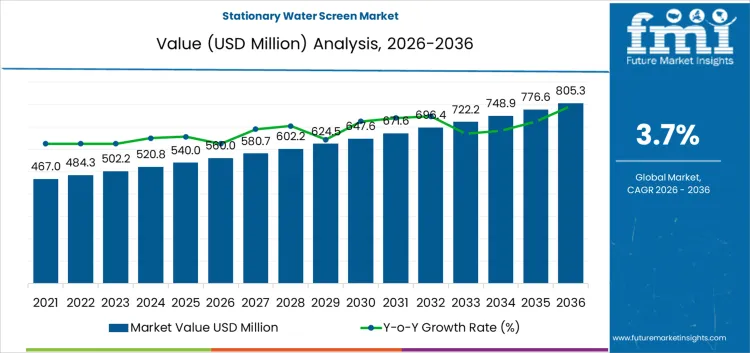
Public procurement cycles and EPC driven project structures moderate spending cadence and compress pricing flexibility. Replacement demand emerges from corrosion fatigue structural deformation and capacity mismatch under changing flow conditions. Procurement emphasis remains on durability predictable headloss and maintenance accessibility, sustaining stable growth shaped by lifecycle servicing and infrastructure persistence rather than discretionary investment patterns.
Stationary Water Screen Market Key Takeaways
| Metric | Value |
|---|---|
| Market Value (2026) | USD 560.0 million |
| Market Forecast Value (2036) | USD 805.3 million |
| Forecast CAGR 2026 to 2036 | 3.7% |
Why is the Demand for Stationary Water Screen Growing?
Demand for stationary water screens is rising as water intake systems in power generation, municipal supply, and industrial processing require dependable filtration of debris and solids before pumps and treatment stages. Stationary screens provide a fixed barrier that removes floating vegetation, sediment, and coarse particulate, reducing wear on downstream equipment and supporting uninterrupted flow. Engineers specify screens with adequate structural strength, corrosion resistance, and hydraulic capacity to match site conditions and intake volumes. Procurement teams evaluate material standards, fabrication quality, and serviceability to ensure components align with project specifications and lifecycle expectations.
Regulatory requirements for water abstraction and intake protection influence selection of stationary screens that balance environmental protection with operational needs, including minimizing harm to aquatic organisms while maintaining target flow rates. Expansion of infrastructure for water supply, energy production, and industrial cooling systems reinforces uptake of stationary water screens that integrate with automatic raking or cleaning mechanisms to reduce manual maintenance. Facility planners align screen installation with pump sizing, sediment load profiles, and access for inspection to support planned upkeep. Coordination with engineering, operations, and maintenance teams enhances performance verification and reduces risk of blockage or unplanned downtime. These technical and operational drivers support sustained demand for stationary water screens in evolving water management frameworks.
How Are the Segments Classified in the Stationary Water Screen Market?
Demand for stationary water screens is shaped by intake protection requirements, regulatory compliance for debris exclusion, and continuous flow reliability. Infrastructure operators require passive screening solutions that operate without moving parts and maintain hydraulic stability. Adoption aligns with raw water abstraction, wastewater pretreatment, and industrial process protection needs. Screen selection prioritizes structural strength, clogging resistance, and low maintenance operation. Segment classification reflects differentiation by screen construction, operational application, and material selection. Structure highlights how debris interception role, intake function, and corrosion exposure influence specification priorities and deployment patterns across fixed water screening installations.
Which Screen Type Represents the Largest Share of Demand?
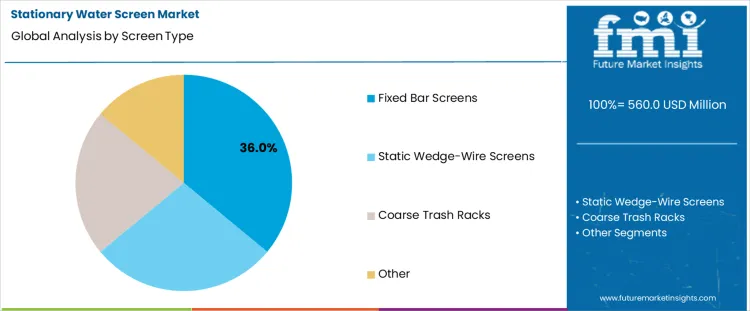
Fixed bar screens hold 36.0%, representing the largest share among screen types due to structural simplicity and reliability. These screens intercept large debris at intake points using rigid bar spacing configurations. Passive operation without mechanical movement reduces failure risk and maintenance dependency. Suitability for high-flow and variable debris conditions supports widespread use. Static wedge-wire screens provide finer separation with higher fabrication precision. Coarse trash racks address heavy debris loads with wider spacing. Screen type segmentation reflects preference for durable, low-complexity designs supporting long service life in continuously operating intake systems.
Key Points
- Fixed bar screens offer passive and reliable debris interception.
- Simple construction reduces maintenance and operational risk.
- Other screen types address finer separation or heavy debris loads.
Which Application Accounts for the Highest Share of Demand?
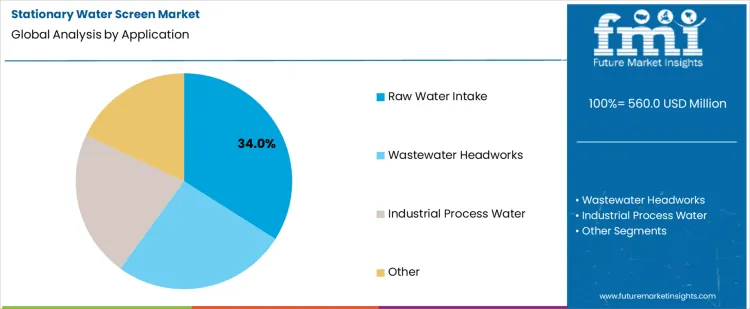
Raw water intake applications hold 34.0%, representing the largest share among application areas due to upstream protection requirements. These intakes supply untreated water to treatment plants and industrial systems. Effective screening prevents debris damage to pumps and downstream equipment. Continuous operation demands stable hydraulic performance with minimal blockage risk. Wastewater headworks apply stationary screens for preliminary solids removal under different load profiles. Industrial process water systems use screens for equipment protection. Application segmentation reflects concentration of stationary screen deployment at initial intake points where debris exclusion remains critical.
Key Points
- Raw water intakes require consistent upstream debris protection.
- Equipment reliability depends on stable screening performance.
- Other applications support pretreatment and process safeguarding.
Which Material Accounts for the Highest Share of Demand?
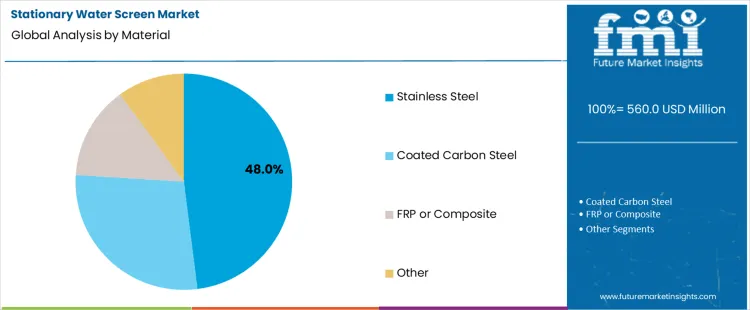
Stainless steel holds 48.0%, representing the largest share among materials used for stationary water screens. Corrosion resistance supports long-term exposure to water, chemicals, and biological growth. Mechanical strength maintains structural integrity under debris impact and hydraulic pressure. Fabrication versatility enables precise bar spacing and customized screen geometry. Coated carbon steel offers cost efficiency with moderate corrosion protection. FRP and composite materials provide lightweight alternatives with lower structural capacity. Material segmentation reflects preference for durable metals where longevity, strength, and corrosion resistance remain essential for fixed screening installations.
Key Points
- Stainless steel provides corrosion resistance for continuous water exposure.
- High strength supports debris impact and flow pressure conditions.
- Other materials balance cost, weight, and structural requirements.
What are the Key Dynamics in the Stationary Water Screen Market?
Demand for stationary water screens reflects fixed intake protection requirements for continuous water abstraction systems. Adoption spans power plants, municipal water intakes, industrial process water systems, irrigation canals, and desalination facilities. Global scope aligns with infrastructure reliability, debris exclusion needs, and environmental intake compliance. Usage centers on static screening structures installed at intake points to block solids, vegetation, and aquatic organisms from entering downstream systems.
How do intake protection need and operational continuity requirements shape adoption?
Stationary water screens protect pumps, heat exchangers, and conveyance systems from debris-induced damage and flow disruption. Demand increases where uninterrupted water intake remains critical for power generation cooling, industrial processing, and potable water supply. Fixed screens provide constant protection without reliance on moving parts, reducing mechanical failure risk. Facilities operating in debris-heavy rivers, canals, or coastal zones rely on stationary designs to manage seasonal load variation. Screen aperture selection balances debris exclusion with acceptable head loss. Simplicity of design supports long service life under continuous immersion. Adoption reflects operational preference for robust, low-complexity intake protection supporting stable flow conditions.
How do environmental compliance, fouling risk, and site constraints influence market scalability?
Stationary screens must comply with environmental regulations governing aquatic life protection and intake velocity limits. Demand sensitivity rises where stricter entrainment rules require finer screen openings, increasing clogging risk. Biofouling and sediment accumulation elevate cleaning frequency and maintenance cost. Site-specific hydrology and intake geometry limit standardization across projects. Retrofit installation challenges increase cost in existing facilities. Material selection must address corrosion and abrasion, raising capital expenditure. Manual cleaning dependence affects labor requirements. Capital budget constraints in public infrastructure projects constrain rapid scaling across multiple intake locations.
How Is Demand for Stationary Water Screens Evolving Globally?
Demand for stationary water screens is expanding globally due to protection needs for pumps, cooling systems, and treatment assets operating under continuous flow conditions. Usage aligns with debris exclusion, biofouling control, and intake reliability across municipal, industrial, and power applications. Asset operators prioritize screens offering stable hydraulics, low head loss, and predictable maintenance intervals. Replacement demand contributes where legacy intakes undergo refurbishment. Growth rates in India at 4.8%, China at 4.4%, Indonesia at 4.3%, Brazil at 4.0%, and Mexico at 3.7% indicate steady expansion driven by infrastructure utilization intensity, environmental load management, and lifecycle servicing.
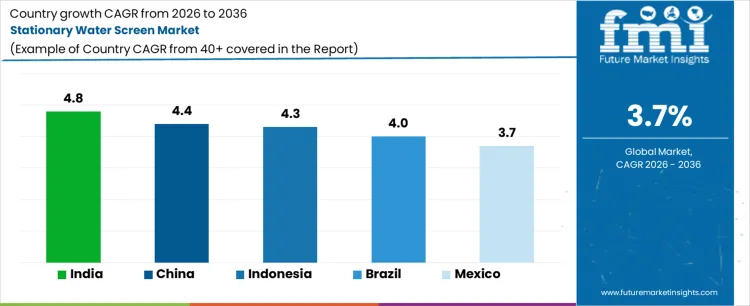
| Country | CAGR (%) |
|---|---|
| India | 4.8% |
| China | 4.4% |
| Indonesia | 4.3% |
| Brazil | 4.0% |
| Mexico | 3.7% |
What Is Driving Stationary Water Screen Demand Growth in India?
India is growing at a CAGR of 4.8%, supported by expansion of riverine and canal-based water abstraction. Municipal supply systems rely on fixed screens to manage seasonal debris and sediment loads. Thermal power stations require continuous intake protection to maintain cooling reliability. Variable monsoon flows increase screening performance requirements and structural robustness. Public investment in water and energy infrastructure sustains new installations and replacements. Demand growth reflects operating reliability needs under fluctuating hydraulic conditions rather than adoption of movable screening technologies.
- Expansion of municipal and irrigation water intakes
- Continuous cooling water protection for power plants
- Monsoon-driven debris and sediment variability
- Public infrastructure investment supporting installations
Why Is China Sustaining Demand for Stationary Water Screens?
Stationary water screen demand in China is expanding at a CAGR of 4.4%, driven by industrial water intake protection and infrastructure modernization. Power generation and heavy industry require fixed screens to manage high-volume cooling flows. Urban water treatment facilities upgrade intake structures to reduce pump fouling and downtime. Standardized designs support deployment across industrial zones and utilities. Domestic manufacturing enables scale production and material customization. Demand growth reflects operational reliability requirements across large fixed-intake assets rather than short-term construction cycles.
- High-volume industrial and power cooling intakes
- Urban water utility intake modernization
- Standardized screen deployment across facilities
- Strong domestic manufacturing capability
How Is Indonesia Influencing Growth of Stationary Water Screen Demand?
Stationary water screen demand in Indonesia is growing at a CAGR of 4.3%, shaped by hydropower development and industrial water usage. River intakes face high organic debris loads due to rainfall and vegetation. Fixed screens provide cost-effective protection for continuous operations. Industrial estates require reliable intake screening to prevent equipment damage. Infrastructure development supports both new installations and maintenance replacement. Demand growth reflects environmental exposure and steady industrial expansion rather than regulatory-driven change.
- High organic debris loads from river systems
- Hydropower intake protection requirements
- Industrial estate water abstraction needs
- Ongoing infrastructure development activity
What Factors Are Supporting Stationary Water Screen Demand in Brazil?
Brazil is expanding at a CAGR of 4.0%, supported by hydropower reliance and municipal water abstraction. Fixed screens manage sediment and vegetation in river-based intakes. Power facilities prioritize intake reliability to maintain generation efficiency. Urban utilities invest in intake refurbishment to reduce maintenance disruptions. Seasonal flow variability influences screen sizing and material selection. Growth reflects operational maintenance and incremental upgrades rather than large-scale intake capacity expansion.
- Hydropower dependence on protected river intakes
- Sediment and vegetation management needs
- Municipal intake refurbishment programs
- Seasonal variability influencing design requirements
Why Is Mexico Showing Measured Growth in Stationary Water Screens?
Stationary water screen demand in Mexico is growing at a CAGR of 3.7%, influenced by industrial water use and utility maintenance programs. Power and manufacturing facilities rely on fixed screens for continuous cooling and process water intake. Aging infrastructure requires replacement of corroded or undersized screens. Standardized specifications support predictable procurement. Demand remains measured, reflecting stable industrial activity and lifecycle replacement rather than rapid infrastructure expansion.
- Continuous cooling and process water intake needs
- Replacement of aging intake screen infrastructure
- Standardized specifications supporting procurement
- Stable industrial and utility operating conditions
What is the competitive landscape of demand for the stationary water screen market globally?
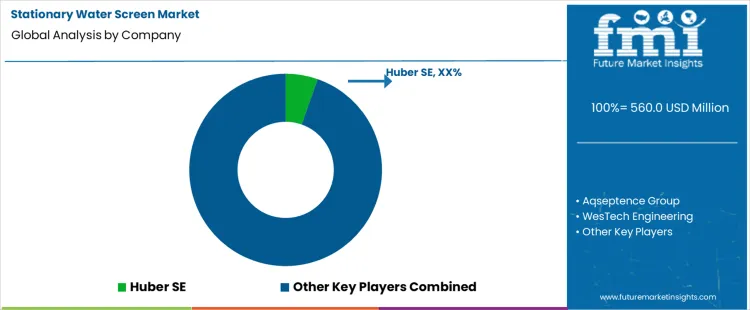
Demand for stationary water screens is driven by growing investments in water and wastewater infrastructure, regulatory requirements for solids removal at intake and treatment facilities, and the need to protect downstream equipment and processes. Stationary screens are installed at raw water intakes, wastewater treatment plants, and industrial facilities to capture debris, rags, and coarse solids. Buyers evaluate screen type, bar spacing, flow capacity, material durability, corrosion resistance, and ease of maintenance or automated cleaning integration. Procurement teams prioritize suppliers with engineered screening solutions that meet hydraulic performance, global quality standards, and strong service and spare parts support across project lifecycles. Trend in the global market reflects increasing focus on automation, low-maintenance designs, and compliance with environmental and discharge standards.
Huber SE holds leading positioning through a comprehensive range of stationary water screens and solids separation equipment designed for municipal and industrial applications with proven performance and service networks. Aqseptence Group supports demand with engineered stationary screens and cleaning technologies tailored for various flow regimes and solids loads. WesTech Engineering contributes screening solutions integrated into broader water and wastewater process lines with emphasis on reliability and ease of operation. ANDRITZ supplies robust stationary screens and inlet systems used in treatment facilities and industrial water intake structures. Xylem participates with stationary screen products including Parkson-branded solutions and associated support services for water and wastewater systems. Competitive differentiation depends on screening efficiency, durability in corrosive environments, adaptability to site conditions, and ability to support long-term operational objectives.
Key Players in the Stationary Water Screen Market
- Huber SE
- Aqseptence Group
- WesTech Engineering
- ANDRITZ
- Xylem
- Veolia
- Parkson (Xylem)
- Jash Engineering
- Ovivo
- SUEZ (Veolia)
Scope of the Report
| Items | Values |
|---|---|
| Quantitative Units | USD million |
| Screen Type | Fixed Bar Screens; Static Wedge-Wire Screens; Coarse Trash Racks; Other |
| Application | Raw Water Intake; Wastewater Headworks; Industrial Process Water; Other |
| Material | Stainless Steel; Coated Carbon Steel; FRP or Composite; Other |
| Sales Channel | Municipal Tenders; Industrial Direct Sales; EPC Contracts; Other |
| Regions Covered | Asia Pacific, Europe, North America, Latin America, Middle East & Africa |
| Countries Covered | India, China, Indonesia, Brazil, Mexico, and 40+ countries |
| Key Companies Profiled | Huber SE; Aqseptence Group; WesTech Engineering; ANDRITZ; Xylem; Veolia; Parkson; Jash Engineering; Ovivo; SUEZ |
| Additional Attributes | Dollar sales by screen type and application; adoption trends for static wedge-wire and fixed bar screens in raw water and headworks installations; hydraulic loading capacity, headloss, and capture efficiency performance metrics; material durability, corrosion resistance, and fouling control considerations; suitability for continuous-duty municipal and industrial operations; procurement dynamics across municipal tenders, EPC contracts, and direct industrial sales; maintenance frequency, manual versus automated raking options, and lifecycle cost considerations; compliance with intake protection norms, wastewater screening standards, and site-specific utility specifications influencing stationary water screen selection. |
Stationary Water Screen Market by Segment
Screen Type:
- Fixed Bar Screens
- Static Wedge-Wire Screens
- Coarse Trash Racks
- Other
Application:
- Raw Water Intake
- Wastewater Headworks
- Industrial Process Water
- Other
Material:
- Stainless Steel
- Coated Carbon Steel
- FRP or Composite
- Other
Sales Channel:
- Municipal Tenders
- Industrial Direct Sales
- EPC Contracts
- Other
Region:
- Asia Pacific
- China
- Japan
- South Korea
- India
- Australia & New Zealand
- ASEAN
- Rest of Asia Pacific
- Europe
- Germany
- United Kingdom
- France
- Italy
- Spain
- Nordic
- BENELUX
- Rest of Europe
- North America
- United States
- Canada
- Mexico
- Latin America
- Brazil
- Chile
- Rest of Latin America
- Middle East & Africa
- Kingdom of Saudi Arabia
- Other GCC Countries
- Turkey
- South Africa
- Other African Union
- Rest of Middle East & Africa
Bibliography
- European Commission. (2023). Directive (EU) 2020/2184 on the quality of water intended for human consumption, including abstraction, intake protection, and infrastructure reliability requirements, as amended and applied during 2023. Official Journal of the European Union.
- European Commission. (2024). Commission Delegated Regulation (EU) 2023/2427 supplementing Directive (EU) 2020/2184 with technical specifications for water intake protection, debris exclusion, and operational performance, applicable from 2024. Official Journal of the European Union.
- United States Environmental Protection Agency. (2023). Clean Water Act Section 316(b): Cooling water intake structure requirements and best technology available standards for debris and organism exclusion, current regulatory framework applied during 2023. USA Environmental Protection Agency.
- International Organization for Standardization. (2023). ISO 29461: Water intake screens-Structural integrity, hydraulic performance, and debris interception requirements (current edition applied to stationary and passive screening systems). International Organization for Standardization.
- International Organization for Standardization. (2024). ISO 9227: Corrosion tests in artificial atmospheres-Salt spray tests, latest edition used for durability assessment of intake screen materials and coatings. International Organization for Standardization.
Frequently Asked Questions
How big is the stationary water screen market in 2026?
The global stationary water screen market is estimated to be valued at USD 560.0 million in 2026.
What will be the size of stationary water screen market in 2036?
The market size for the stationary water screen market is projected to reach USD 805.3 million by 2036.
How much will be the stationary water screen market growth between 2026 and 2036?
The stationary water screen market is expected to grow at a 3.7% CAGR between 2026 and 2036.
What are the key product types in the stationary water screen market?
The key product types in stationary water screen market are fixed bar screens, static wedge-wire screens, coarse trash racks and other.
Which application segment to contribute significant share in the stationary water screen market in 2026?
In terms of application, raw water intake segment to command 34.0% share in the stationary water screen market in 2026.
Preview the report firsthand - request a free sample
Get SampleGet the brochure for pricing and purchase details.
Get PDFTable of Content
- Executive Summary
- Global Market Outlook
- Demand-side Trends
- Supply-side Trends
- Technology Roadmap Analysis
- Analysis and Recommendations
- Market Overview
- Market Coverage / Taxonomy
- Market Definition / Scope / Limitations
- Market Background
- Market Dynamics
- Drivers
- Restraints
- Opportunity
- Trends
- Scenario Forecast
- Demand in Optimistic Scenario
- Demand in Likely Scenario
- Demand in Conservative Scenario
- Opportunity Map Analysis
- Product Life Cycle Analysis
- Supply Chain Analysis
- Investment Feasibility Matrix
- Value Chain Analysis
- PESTLE and Porter’s Analysis
- Regulatory Landscape
- Regional Parent Market Outlook
- Production and Consumption Statistics
- Import and Export Statistics
- Market Dynamics
- Global Market Analysis 2021 to 2025 and Forecast, 2026 to 2036
- Historical Market Size Value (USD Million) Analysis, 2021 to 2025
- Current and Future Market Size Value (USD Million) Projections, 2026 to 2036
- Y-o-Y Growth Trend Analysis
- Absolute $ Opportunity Analysis
- Global Market Pricing Analysis 2021 to 2025 and Forecast 2026 to 2036
- Global Market Analysis 2021 to 2025 and Forecast 2026 to 2036, By Screen Type
- Introduction / Key Findings
- Historical Market Size Value (USD Million) Analysis By Screen Type , 2021 to 2025
- Current and Future Market Size Value (USD Million) Analysis and Forecast By Screen Type , 2026 to 2036
- Fixed Bar Screens
- Static Wedge-Wire Screens
- Coarse Trash Racks
- Other
- Fixed Bar Screens
- Y-o-Y Growth Trend Analysis By Screen Type , 2021 to 2025
- Absolute $ Opportunity Analysis By Screen Type , 2026 to 2036
- Global Market Analysis 2021 to 2025 and Forecast 2026 to 2036, By Application
- Introduction / Key Findings
- Historical Market Size Value (USD Million) Analysis By Application, 2021 to 2025
- Current and Future Market Size Value (USD Million) Analysis and Forecast By Application, 2026 to 2036
- Raw Water Intake
- Wastewater Headworks
- Industrial Process Water
- Other
- Raw Water Intake
- Y-o-Y Growth Trend Analysis By Application, 2021 to 2025
- Absolute $ Opportunity Analysis By Application, 2026 to 2036
- Global Market Analysis 2021 to 2025 and Forecast 2026 to 2036, By Material
- Introduction / Key Findings
- Historical Market Size Value (USD Million) Analysis By Material, 2021 to 2025
- Current and Future Market Size Value (USD Million) Analysis and Forecast By Material, 2026 to 2036
- Stainless Steel
- Coated Carbon Steel
- FRP or Composite
- Other
- Stainless Steel
- Y-o-Y Growth Trend Analysis By Material, 2021 to 2025
- Absolute $ Opportunity Analysis By Material, 2026 to 2036
- Global Market Analysis 2021 to 2025 and Forecast 2026 to 2036, By Sales Channel
- Introduction / Key Findings
- Historical Market Size Value (USD Million) Analysis By Sales Channel, 2021 to 2025
- Current and Future Market Size Value (USD Million) Analysis and Forecast By Sales Channel, 2026 to 2036
- Municipal Tenders
- Industrial Direct Sales
- EPC Contracts
- Other
- Municipal Tenders
- Y-o-Y Growth Trend Analysis By Sales Channel, 2021 to 2025
- Absolute $ Opportunity Analysis By Sales Channel, 2026 to 2036
- Global Market Analysis 2021 to 2025 and Forecast 2026 to 2036, By Region
- Introduction
- Historical Market Size Value (USD Million) Analysis By Region, 2021 to 2025
- Current Market Size Value (USD Million) Analysis and Forecast By Region, 2026 to 2036
- North America
- Latin America
- Western Europe
- Eastern Europe
- East Asia
- South Asia and Pacific
- Middle East & Africa
- Market Attractiveness Analysis By Region
- North America Market Analysis 2021 to 2025 and Forecast 2026 to 2036, By Country
- Historical Market Size Value (USD Million) Trend Analysis By Market Taxonomy, 2021 to 2025
- Market Size Value (USD Million) Forecast By Market Taxonomy, 2026 to 2036
- By Country
- USA
- Canada
- Mexico
- By Screen Type
- By Application
- By Material
- By Sales Channel
- By Country
- Market Attractiveness Analysis
- By Country
- By Screen Type
- By Application
- By Material
- By Sales Channel
- Key Takeaways
- Latin America Market Analysis 2021 to 2025 and Forecast 2026 to 2036, By Country
- Historical Market Size Value (USD Million) Trend Analysis By Market Taxonomy, 2021 to 2025
- Market Size Value (USD Million) Forecast By Market Taxonomy, 2026 to 2036
- By Country
- Brazil
- Chile
- Rest of Latin America
- By Screen Type
- By Application
- By Material
- By Sales Channel
- By Country
- Market Attractiveness Analysis
- By Country
- By Screen Type
- By Application
- By Material
- By Sales Channel
- Key Takeaways
- Western Europe Market Analysis 2021 to 2025 and Forecast 2026 to 2036, By Country
- Historical Market Size Value (USD Million) Trend Analysis By Market Taxonomy, 2021 to 2025
- Market Size Value (USD Million) Forecast By Market Taxonomy, 2026 to 2036
- By Country
- Germany
- UK
- Italy
- Spain
- France
- Nordic
- BENELUX
- Rest of Western Europe
- By Screen Type
- By Application
- By Material
- By Sales Channel
- By Country
- Market Attractiveness Analysis
- By Country
- By Screen Type
- By Application
- By Material
- By Sales Channel
- Key Takeaways
- Eastern Europe Market Analysis 2021 to 2025 and Forecast 2026 to 2036, By Country
- Historical Market Size Value (USD Million) Trend Analysis By Market Taxonomy, 2021 to 2025
- Market Size Value (USD Million) Forecast By Market Taxonomy, 2026 to 2036
- By Country
- Russia
- Poland
- Hungary
- Balkan & Baltic
- Rest of Eastern Europe
- By Screen Type
- By Application
- By Material
- By Sales Channel
- By Country
- Market Attractiveness Analysis
- By Country
- By Screen Type
- By Application
- By Material
- By Sales Channel
- Key Takeaways
- East Asia Market Analysis 2021 to 2025 and Forecast 2026 to 2036, By Country
- Historical Market Size Value (USD Million) Trend Analysis By Market Taxonomy, 2021 to 2025
- Market Size Value (USD Million) Forecast By Market Taxonomy, 2026 to 2036
- By Country
- China
- Japan
- South Korea
- By Screen Type
- By Application
- By Material
- By Sales Channel
- By Country
- Market Attractiveness Analysis
- By Country
- By Screen Type
- By Application
- By Material
- By Sales Channel
- Key Takeaways
- South Asia and Pacific Market Analysis 2021 to 2025 and Forecast 2026 to 2036, By Country
- Historical Market Size Value (USD Million) Trend Analysis By Market Taxonomy, 2021 to 2025
- Market Size Value (USD Million) Forecast By Market Taxonomy, 2026 to 2036
- By Country
- India
- ASEAN
- Australia & New Zealand
- Rest of South Asia and Pacific
- By Screen Type
- By Application
- By Material
- By Sales Channel
- By Country
- Market Attractiveness Analysis
- By Country
- By Screen Type
- By Application
- By Material
- By Sales Channel
- Key Takeaways
- Middle East & Africa Market Analysis 2021 to 2025 and Forecast 2026 to 2036, By Country
- Historical Market Size Value (USD Million) Trend Analysis By Market Taxonomy, 2021 to 2025
- Market Size Value (USD Million) Forecast By Market Taxonomy, 2026 to 2036
- By Country
- Kingdom of Saudi Arabia
- Other GCC Countries
- Turkiye
- South Africa
- Other African Union
- Rest of Middle East & Africa
- By Screen Type
- By Application
- By Material
- By Sales Channel
- By Country
- Market Attractiveness Analysis
- By Country
- By Screen Type
- By Application
- By Material
- By Sales Channel
- Key Takeaways
- Key Countries Market Analysis
- USA
- Pricing Analysis
- Market Share Analysis, 2025
- By Screen Type
- By Application
- By Material
- By Sales Channel
- Canada
- Pricing Analysis
- Market Share Analysis, 2025
- By Screen Type
- By Application
- By Material
- By Sales Channel
- Mexico
- Pricing Analysis
- Market Share Analysis, 2025
- By Screen Type
- By Application
- By Material
- By Sales Channel
- Brazil
- Pricing Analysis
- Market Share Analysis, 2025
- By Screen Type
- By Application
- By Material
- By Sales Channel
- Chile
- Pricing Analysis
- Market Share Analysis, 2025
- By Screen Type
- By Application
- By Material
- By Sales Channel
- Germany
- Pricing Analysis
- Market Share Analysis, 2025
- By Screen Type
- By Application
- By Material
- By Sales Channel
- UK
- Pricing Analysis
- Market Share Analysis, 2025
- By Screen Type
- By Application
- By Material
- By Sales Channel
- Italy
- Pricing Analysis
- Market Share Analysis, 2025
- By Screen Type
- By Application
- By Material
- By Sales Channel
- Spain
- Pricing Analysis
- Market Share Analysis, 2025
- By Screen Type
- By Application
- By Material
- By Sales Channel
- France
- Pricing Analysis
- Market Share Analysis, 2025
- By Screen Type
- By Application
- By Material
- By Sales Channel
- India
- Pricing Analysis
- Market Share Analysis, 2025
- By Screen Type
- By Application
- By Material
- By Sales Channel
- ASEAN
- Pricing Analysis
- Market Share Analysis, 2025
- By Screen Type
- By Application
- By Material
- By Sales Channel
- Australia & New Zealand
- Pricing Analysis
- Market Share Analysis, 2025
- By Screen Type
- By Application
- By Material
- By Sales Channel
- China
- Pricing Analysis
- Market Share Analysis, 2025
- By Screen Type
- By Application
- By Material
- By Sales Channel
- Japan
- Pricing Analysis
- Market Share Analysis, 2025
- By Screen Type
- By Application
- By Material
- By Sales Channel
- South Korea
- Pricing Analysis
- Market Share Analysis, 2025
- By Screen Type
- By Application
- By Material
- By Sales Channel
- Russia
- Pricing Analysis
- Market Share Analysis, 2025
- By Screen Type
- By Application
- By Material
- By Sales Channel
- Poland
- Pricing Analysis
- Market Share Analysis, 2025
- By Screen Type
- By Application
- By Material
- By Sales Channel
- Hungary
- Pricing Analysis
- Market Share Analysis, 2025
- By Screen Type
- By Application
- By Material
- By Sales Channel
- Kingdom of Saudi Arabia
- Pricing Analysis
- Market Share Analysis, 2025
- By Screen Type
- By Application
- By Material
- By Sales Channel
- Turkiye
- Pricing Analysis
- Market Share Analysis, 2025
- By Screen Type
- By Application
- By Material
- By Sales Channel
- South Africa
- Pricing Analysis
- Market Share Analysis, 2025
- By Screen Type
- By Application
- By Material
- By Sales Channel
- USA
- Market Structure Analysis
- Competition Dashboard
- Competition Benchmarking
- Market Share Analysis of Top Players
- By Regional
- By Screen Type
- By Application
- By Material
- By Sales Channel
- Competition Analysis
- Competition Deep Dive
- Huber SE
- Overview
- Product Portfolio
- Profitability by Market Segments (Product/Age /Sales Channel/Region)
- Sales Footprint
- Strategy Overview
- Marketing Strategy
- Product Strategy
- Channel Strategy
- Aqseptence Group
- WesTech Engineering
- ANDRITZ
- Xylem
- Veolia
- Parkson (Xylem)
- Jash Engineering
- Ovivo
- Huber SE
- Competition Deep Dive
- Assumptions & Acronyms Used
- Research Methodology


