

- Market Size (2026)
- USD 52.0 Mn
- Forecast (2036)
- USD 158.6 Mn
- CAGR (2026 to 2036)
- 11.8%
How big is Suberin Waterproof Coatings Market in 2026?
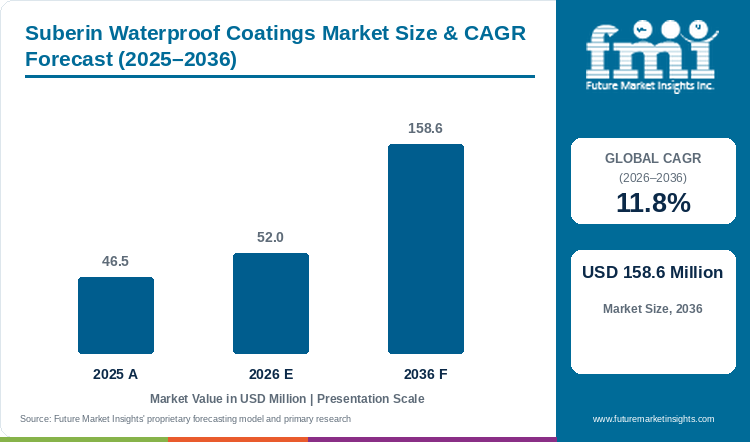
Global suberin waterproof coatings turnover is projected to expand at an 11.8% CAGR between 2026 and 2036, advancing after a 2025 baseline of USD 46.5 million to an estimated 2026 size of USD 52.0 million and a forecast 2036 target of USD 158.6 million.
In July 2026, the Confederation of European Paper Industries reported that total European paper and board production across CEPI member countries reached 77.4 million tonnes in 2025 with packaging-grade output holding stable as mills prioritize fossil-free aqueous barrier dispersions to replace extruded polyethylene cupstock [1]. After posting USD 46.5 million across 2025, worldwide suberin waterproof coatings sales are estimated at USD 52.0 million throughout 2026 and are forecast to touch USD 158.6 million come 2036 via a projected 11.8% CAGR that adds USD 106.6 million in annual revenue between 2026 and 2036. Cleaving the aliphatic polyester-polyaromatic network of outer tree bark liberates long-chain omega-hydroxyfatty and alpha,omega-dicarboxylic suberinic acids that cure into ultra-hydrophobic paperboard packaging barriers achieving 60-second Cobb water-absorption values below 5 grams per square meter with 95-degree-Celsius coffee while disintegrating cleanly inside municipal hydropulpers. Nordic Silver & Downy Birch Outer Bark (Betula pendula) is predicted to represent 61.4% of 2026 bark feedstock origin sales across paperboard biorefineries because Swedish and Finnish debarking drums supply homogeneous white outer periderm.
Key Market Trends & Insights
- By bark feedstock origin: Nordic Silver & Downy Birch Outer Bark (Betula pendula) (61.4% predicted share in 2026) leads feedstock supply because white outer birch bark contains 40% to 50% suberin plus betulin triterpenes and separates cleanly via flotation from inner phloem.
- By depolymerization chemistry: Alkaline Hydrolysis Suberinic Acid Monomer/Oligomer Dispersions (56.8% anticipated in 2026) anchor chemical processing since potassium or sodium hydroxide saponification in water-ethanol media avoids costly ionic-liquid solvent recycling.
- By barrier performance target: Boiling Water & Hot-Coffee Cup Repulpable Barrier (Cobb60 <5 g/m²) (53.2% forecast in 2026) captures the majority of specification spending as coffee chains replace 15 gsm low-density polyethylene cup liners.
- By packaging format: Single-Use Hot & Cold Paper Beverage Cups (47.6% expected in 2026) represent the foremost converting application owing to high-speed rotary cup-forming heat-sealability and European single-use plastic tax exemptions.
Regional Highlights
- Fastest European converting corridor: Poland is projected to pace major paperboard-converting nations with a 12.9% compound annual expansion through 2036 as pan-European cup and folding-carton plants scale dispersion-coated board capacity.
- High-volume industrial adopters: German converter demand is forecast to climb 12.5% annually while United States revenue is predicted to gain 12.3% per year through 2036 on supermarket recyclability scorecards and quick-service beverage cup conversions.
- Primary bark biorefinery hubs: Swedish (predicted 11.4% CAGR) and Finnish (estimated 11.1% CAGR) biorefineries together with Portuguese (foreseen at 10.8% CAGR) cork processors supply upstream bark monomers for integrated paperboard mill coating trials.
Market Size & Forecast
Table 1: Market Size and Forecast for the Suberin Waterproof Coatings Market (USD million and CAGR percentage), 2025 to 2036
| Metric | Value |
|---|---|
| 2025 Market Size | USD 46.5 million |
| Estimated Market Size in 2026 | USD 52.0 million |
| Projected Market Size by 2036 | USD 158.6 million |
| CAGR, 2026 to 2036 | 11.8% |
| Added Revenue, 2026 to 2036 | USD 106.6 million |
Harmonized European Union polymer-weight limits on fiber packaging and Nordic pulp-mill side-stream valorization govern commercial suberin waterproof coating deployment through 2036. Under the European Union's Packaging and Packaging Waste Regulation (Regulation (EU) 2025/40) summarized by EUR-Lex for 2026 implementation, composite paper cups and cartons that fail strict design-for-recycling grades face escalating Extended Producer Responsibility fee penalties [2]. Rather than combusting debarking residues in mill recovery boilers for low-margin steam, Nordic and Iberian forest-product groups now extract betulin-free suberinic acid oligomers to coat liquid carton packaging and hot beverage cupstock. Central European and North American converters purchase these concentrated aqueous dispersions to achieve plastic-free repulpability without slowing blade or curtain coating lines.
Pulp-Mill Bark Valorization and Suberinic Acid Yield Sizing
Table 2: Bark Side-Stream Valorization and Suberin Dispersion Output Indicators for the Suberin Waterproof Coatings Market (USD million, metric tons, and USD per kg), mixed historical and forecast years from 2025 to 2036
| Metric | 2025 | 2026 | 2036 |
|---|---|---|---|
| Market size (USD million) | 46.5 | 52.0 | 158.6 |
| Refined suberin coating solids output (metric tons) | 4,150 to 4,600 | 4,680 to 5,200 | 15,400 to 17,200 |
| Processed dry birch & cork outer bark (metric tons) | 16,600 to 18,400 | 18,700 to 20,800 | 61,600 to 68,800 |
| Average realized suberin dispersion price (USD per kg solids) | 10.10 to 11.20 | 10.00 to 11.10 | 9.20 to 10.30 |
Operational note: Bark mass-balance calculations assume a 24% to 28% net yield of depolymerized suberinic acid from float-separated silver birch outer bark and cork stripping powder after triterpene removal.
Diverting outer birch bark from pulp-mill hog-fuel boilers into alkaline hydrolysis reactors multiplies the economic value of debarking residues tenfold while leaving inner bark and lignin fractions available for bioenergy. Separating hydrophobic white outer bark from hydrophilic inner bast fibers via water flotation prevents condensed tannins and sugars from contaminating the depolymerized suberinic acid melt. In January 2025, biorefinery researchers at the Latvian State Institute of Wood Chemistry demonstrated in the Journal of Renewable Materials that potassium-hydroxide depolymerized outer birch bark yields 45% to 49% suberinic acid fractions that form water-repellent surface barriers and achieve 83.8% leaching fixation [3]. Integrated forest-product companies consequently pair bark biorefineries with fiber based packaging mills to lock in captive feedstock security.
Cupstock & Carton Coating Coverage and Mill Line Sizing
Table 3: Coated Cupstock Area and Mill Line Indicators for the Suberin Waterproof Coatings Market (million square meters, gsm, and USD), mixed historical and forecast years from 2025 to 2036
| Metric | 2025 | 2026 | 2036 |
|---|---|---|---|
| Global suberin-coated board area (million sq. meters) | 890 to 980 | 1,020 to 1,130 | 3,350 to 3,720 |
| Typical dry barrier coat weight (grams per sq. meter) | 4.2 to 5.5 | 4.0 to 5.2 | 3.5 to 4.6 |
| Annual spend per integrated board coating line (USD thousand) | 380 to 440 | 410 to 475 | 820 to 950 |
| Boiling-water Cobb60 absorption performance (g/m²) | 3.2 to 4.8 | 3.0 to 4.5 | 2.4 to 3.8 |
Table 4: Segment Revenue and Operational Benchmark Traceability for the Suberin Waterproof Coatings Market (USD million and percentages), 2026
| Metric | Value | Basis |
|---|---|---|
| Market size, 2026 | USD 52.0 million | Report value |
| Nordic silver & downy birch outer bark revenue, 2026 | USD 31.9 million | 61.4% feedstock share |
| Boiling water & hot-coffee cup barrier revenue, 2026 | USD 27.7 million | 53.2% barrier-target share |
| Single-use hot & cold paper beverage cups revenue, 2026 | USD 24.8 million | 47.6% format share |
Replacing a 15 gsm extruded polyethylene cup liner with a 4.5 gsm suberin dispersion topcoat cuts polymer weight below 3% of total cup mass and guarantees >95% fiber recovery in EN 13430 repulping tests. Because depolymerized suberinic acids retain thermoplastic ester and hydroxyl groups, coated cup blanks heat-seal directly along side seams and bottom curls on standard high-speed cup-forming turrets. Converters supplying paper packaging and foodservice chains avoid both municipal plastic-cup levies and ultrasonic-sealing tooling retrofits.
Analyst Perspective
"Depolymerized birch and cork suberin dispersions give cupstock and frozen-carton mills a boiling-water barrier below 5 g/m² Cobb60 that repulps cleanly in standard wastepaper streams. Commercial scale-up depends on automated wet-flotation bark sorting at Nordic pulp mills to strip inner phloem tannins before alkaline saponification."
- Nikhil Kaitwade, Principal Consultant, Future Market Insights.
How is the suberin waterproof coatings market segmented?
The suberin waterproof coatings market is segmented by bark feedstock origin, depolymerization chemistry, barrier performance target, packaging format, and region. In 2026, Nordic Silver & Downy Birch Outer Bark (Betula pendula) is projected at 61.4%, Alkaline Hydrolysis Suberinic Acid Monomer/Oligomer Dispersions at 56.8%, Boiling Water & Hot-Coffee Cup Repulpable Barrier (Cobb60 <5 g/m²) at 53.2%, and Single-Use Hot & Cold Paper Beverage Cups at 47.6%.
By bark feedstock origin: Nordic Silver & Downy Birch Outer Bark (Betula pendula), Mediterranean Cork Oak Stripping Waste (Quercus suber), and Aspen & Eucalyptus Pulp-Mill Bark Side-Streams.
By depolymerization chemistry: Alkaline Hydrolysis Suberinic Acid Monomer/Oligomer Dispersions, Ionic-Liquid & Deep-Eutectic Cleaved Suberin Esters, and Epoxidized & Maleated Crosslinkable Suberin Polyols.
By barrier performance target: Boiling Water & Hot-Coffee Cup Repulpable Barrier (Cobb60 <5 g/m²), Grease & Mineral-Oil Vapor Barrier (Kit Level 12), and Antimicrobial Wood & Fiberboard Weathering Seal.
By packaging format: Single-Use Hot & Cold Paper Beverage Cups, Frozen Food & Chilled Fish Folding Cartons, and E-Commerce Water-Resistant Kraft Mailers.
Why Does Nordic Silver & Downy Birch Outer Bark (Betula pendula) Dominate Bark Feedstock Origins?
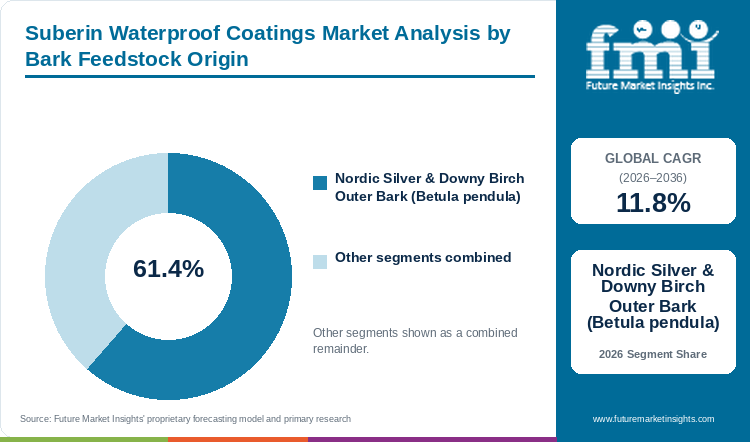
Nordic Silver & Downy Birch Outer Bark (Betula pendula) is predicted to claim 61.4% of bark feedstock origin in 2026, enabled by automated mill debarking.
Table 5: Bark Feedstock Origin Share for the Suberin Waterproof Coatings Market (percentage share), 2026
| Bark Feedstock Origin | Share (2026) |
|---|---|
| Nordic Silver & Downy Birch Outer Bark (Betula pendula) | 61.4% |
| Mediterranean Cork Oak Stripping Waste (Quercus suber) | 23.1% |
| Aspen & Eucalyptus Pulp-Mill Bark Side-Streams | 15.5%* |
| Total | 100.0% |
*Note: Combined share of remaining bark feedstock origin categories totaling 100.0% of 2026 market demand.
Table 6: Bark Feedstock Origin Leadership and Market Growth for the Suberin Waterproof Coatings Market (segment and CAGR percentage), 2026 to 2036
| Metric | Value |
|---|---|
| Global CAGR (2026 to 2036) | 11.8% |
| Leading Segment | Nordic Silver & Downy Birch Outer Bark (Betula pendula) |
Centralized drum debarking at Swedish and Finnish hardwood kraft pulp mills generates hundreds of thousands of tonnes of uniform silver and downy birch bark annually, positioning Nordic Silver & Downy Birch Outer Bark (Betula pendula) as the foundational industry feedstock. Outer birch periderm contains 450 milligrams per gram of aliphatic suberin polyesters alongside extractable betulin, which is more than double the suberin density found in aspen or eucalyptus bark. Whereas Mediterranean cork oak stripping occurs on nine-year silvicultural cycles with high demand from wine-stopper manufacturers, birch bark is continuously co-produced alongside boxboard packaging wood-pulp furnish. Co-extracting high-value cosmetic betulin triterpenes in the first solvent stage cross-subsidizes the cost of the remaining suberinic acid barrier fraction.
- Continuous pulp-mill debarking and 45% outer-periderm suberin content are predicted to yield Nordic Silver & Downy Birch Outer Bark (Betula pendula) 61.4% of 2026 feedstock revenue.
- In February 2025, Finnish birch-bark biorefinery specialist Innomost Oy documented commercial validation of birch suberin dispersions for moisture-resistant and adhesive industrial applications [4].
How Do Alkaline Hydrolysis Suberinic Acid Monomer/Oligomer Dispersions Lead Depolymerization Chemistry?
Alkaline Hydrolysis Suberinic Acid Monomer/Oligomer Dispersions are anticipated to generate 56.8% of depolymerization chemistry in 2026, backed by solvent-free aqueous stability.
Refluxing debittered outer bark in aqueous potassium or sodium hydroxide cleaves ester linkages cleanly without degrading C18 and C22 omega-hydroxyfatty acid chains, putting Alkaline Hydrolysis Suberinic Acid Monomer/Oligomer Dispersions ahead of competing chemistries. Partial saponification preserves a controlled ratio of amphiphilic suberinic acid salts and oligomeric esters that self-emulsify in warm water at 25% to 40% solids content without synthetic surfactants. In contrast, cholinium-hexanoate ionic liquids and deep-eutectic solvents require complex membrane diafiltration before the resin can be applied to food-contact packaging coating webs. Acidifying or thermally curing the alkaline dispersion on the paperboard dryer section regenerates a cross-linked hydrophobic polyester network.
- Surfactant-free self-emulsification and low reagent costs are anticipated to bring Alkaline Hydrolysis Suberinic Acid Monomer/Oligomer Dispersions to 56.8% of 2026 chemistry turnover.
- In August 2025, Stora Enso Oyj inaugurated its EUR 1.1 billion Oulu consumer packaging board line in Finland, expanding integrated Nordic birch-pulp and barrier-board infrastructure [5].
What Places Boiling Water & Hot-Coffee Cup Repulpable Barrier (Cobb60 <5 g/m²) First in Performance Targets?
Boiling Water & Hot-Coffee Cup Repulpable Barrier (Cobb60 <5 g/m²) is forecast to reach 53.2% of barrier performance target in 2026, stemming from cup mandates.
Withstanding 90-to-98-degree-Celsius brewed coffee and tea without edge wicking or seam leakage is the hardest technical requirement for aqueous dispersion coatings, which is forecast to lift Boiling Water & Hot-Coffee Cup Repulpable Barrier (Cobb60 <5 g/m²) to 53.2% of segment demand. Conventional styrene-acrylate and polyhydroxyalkanoate latexes often soften or blister when filled with boiling water unless applied at heavy 10 to 14 gsm coat weights. Because suberin's C18-to-C22 aliphatic chains pack into dense crystalline domains bridged by aromatic ferulic units, a 4.5 gsm suberin layer on corrugated and folding carton packaging or cupboard holds Cobb60 water absorption below 5 g/m². Furthermore, natural phenolic moieties inside suberin impart intrinsic fungal and bacterial resistance for wood and fiberboard weathering seals.
- Superior hot-liquid holdout at low coat weights is forecast to assign Boiling Water & Hot-Coffee Cup Repulpable Barrier (Cobb60 <5 g/m²) 53.2% of 2026 performance-target revenue.
- In October 2025, Metsä Board Corporation completed a EUR 60 million modernization at its Simpele mill in Finland, installing curtain-coating technology for next-generation barrier foodboards [6].
Why Do Single-Use Hot & Cold Paper Beverage Cups Lead Packaging Format Demand?
Single-Use Hot & Cold Paper Beverage Cups are expected to constitute 47.6% of packaging format in 2026, aided by municipal hydropulper recovery rules.
Billions of takeaway coffee and cold soft-drink cups consumed annually within European and American coffee-shop chains make Single-Use Hot & Cold Paper Beverage Cups the largest converting outlet for suberin coatings. Polyethylene-lined paper cups require specialized high-attrition detrasping mills, causing most municipal recycling facilities to landfill or incinerate post-consumer cup waste. Coating virgin cupboard and moulded paperboard lids with suberinic acid dispersions allows used cups to repulp in standard EN 13430 residential paper streams while preserving rim stiffness. Frozen fish cartons and water-resistant e-commerce kraft mailers represent rapidly expanding secondary formats as retailers eliminate poly-coated mailers.
- High-volume takeaway beverage turnover and plastic-free cup recycling rules are expected to grant Single-Use Hot & Cold Paper Beverage Cups 47.6% of 2026 packaging format sales.
- In September 2025, Billerud AB launched its recyclable CrownBoard Carry and CrownBoard Light paperboard grades engineered for high strength and moisture resistance [7].
What are the drivers, restraints, and opportunities in the suberin waterproof coatings market?
European PPWR composite-packaging restrictions and abundant Nordic birch-bark mill side-streams are projected to drive suberin waterproof coatings demand through 2036, whereas natural phenolic amber tinting restricts unbleached or backside board applications unless decolorized.
- Driver:European Union single-use plastic cup taxes and mandatory paper-repulpability thresholds compel board mills to replace extruded polyethylene with bark-derived suberin barriers.
- Restraint:Co-extracted polyphenolic chromophores impart a light amber-to-tan hue that requires peroxide bleaching or backside-only application on bright white graphic boxboard.
- Opportunity:Formulating hybrid suberin-cellulose nanofibril (CNF) and maleated suberin polyol coatings enables ultra-low 3 gsm single-pass curtain application on e-commerce kraft mailers and frozen food cartons.
Growth Analysis and Future Potential: Qualitative Demand Catalysts
Statutory fee modulation under Extended Producer Responsibility schemes across the European Union and North America has turned polyethylene-lined paperboard into a direct tax liability for beverage and frozen-food brands. Brussels regulators issued implementation guidance IP/26/664 in March 2026 for the Packaging and Packaging Waste Regulation (PPWR), establishing strict recyclability performance grades and composite-material thresholds across the Single Market [8]. Integrated Nordic paperboard producers already debark millions of tonnes of birch pulpwood each year, giving them captive access to outer-bark suberin without competing for agricultural food crops. Upgrading mill coaters to apply suberin dispersions onto solid board and cupstock allows converters to certify 100% wood-derived packaging.
Risk Assessment of the Suberin Waterproof Coatings Market: Operational and Formulation Friction
Managing natural color variation and curing kinetics on 600-meter-per-minute board machines remains the chief technical obstacle facing suberin dispersion formulators. Alkaline cleavage of birch and cork bark co-extracts ferulic acid esters and condensed phenolic oligomers that oxidize into a warm brownish-amber film during infrared drying. While amber tinting blends naturally with unbleached kraft mailers and the interior food-contact surface of coffee cups, luxury cosmetic and pharmaceutical carton buyers demand CIE whiteness above 85% on exterior print surfaces. In March 2025, Kemira Oyj and IFF formed a commercial joint venture to scale biobased paper and board barrier polymers, noting that new biopolymers must match existing mill runnability and optical standards [9]. Formulators serving mailer packaging and bleached boxboard lines must therefore add selective decolorization or restrict unbleached suberin to inner barrier plies.
Commercial Opportunity Analysis: Formulation Differentiation and Value-Add Formats
Blending suberinic acid dispersions with microfibrillated cellulose or biodegradable polyhydroxyalkanoates creates dual-barrier coatings that block both boiling water and mineral-oil vapor at coat weights below 4 gsm. Pure suberin films excel in hydrophobicity because of their long aliphatic chains, whereas pairing them with nanocellulose closes pinholes and boosts oxygen and grease holdout to Kit Level 12. In June 2025, Kemira Oyj announced an exclusive partnership with Bluepha to commercialize 100% biobased barrier coatings for recyclable paper and board packaging across Asia-Pacific and global converting corridors [10]. Coating suppliers that offer pre-formulated suberin-biopolymer blends for bioplastics packaging and frozen seafood cartons capture premium pricing over commodity styrene-butadiene latex.
Suberin Waterproof Coatings Market by Country (2026 to 2036)
Polish paper-cup and folding-carton converting hubs are projected to top major paperboard-converting nations with a 12.9% compound annual growth rate between 2026 and 2036, ahead of anticipated German (12.5%) and expected United States (12.3%) converting corridors. Upstream bark-biorefinery leaders Sweden (predicted 11.4% CAGR) and Finland (estimated 11.1% CAGR) alongside Portugal (foreseen at 10.8% CAGR) supply the core birch and cork monomer streams that feed these international board-coating lines.
Table 7: Country CAGR and Primary Growth Levers for the Suberin Waterproof Coatings Market (CAGR percentage and operational drivers), 2026 to 2036
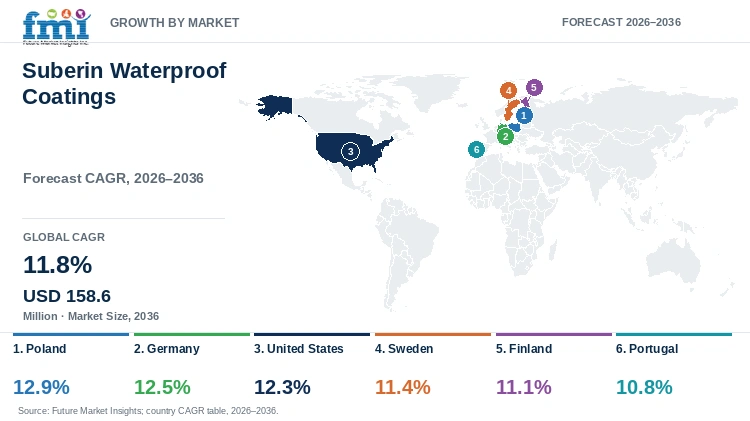
| Country | CAGR (2026 to 2036) | Primary Growth Lever |
|---|---|---|
| Poland | 12.9% | Rapidly expanding export cup and frozen-carton converting plants adopting Nordic barrier boards |
| Germany | 12.5% | VerpackG recyclability fee modulation and reusable/recyclable takeaway beverage cup mandates |
| United States | 12.3% | Quick-service restaurant fiber-cup transitions and Maine/California EPR recyclability rules |
| Sweden | 11.4% | 84.6-million-m³ commercial forest fellings and integrated kraft-mill birch bark biorefining |
| Finland | 11.1% | Commercial birch log debarking side-streams and VTT/Innomost suberin dispersion scale-up |
| Portugal | 10.8% | Cork oak stripping waste valorization and Amorim industrial cork-suberin extraction |
Source: Future Market Insights analysis
Sweden Suberin Waterproof Coatings Market Outlook (2026 to 2036)
World-scale integrated pulp and paperboard mills across Värmland and Norrland set Sweden apart from non-integrated converting markets by co-locating birch debarking drums and inline curtain coaters inside single coastal complexes. In September 2026, the Swedish Forest Agency (Skogsstyrelsen) forecasted 2026 national gross forest felling at 84.6 million cubic meters of standing volume, supplying vast debarking side-streams to domestic kraft mills [11]. Swedish suberin waterproof coatings turnover is predicted to progress at an 11.4% yearly rate through 2036 as Stora Enso and Holmen alongside Billerud commercialize fossil-free barrier cupstocks and liquid boards. However, tighter winter roundwood harvesting limits and competition from biomass district-heating plants for mill bark residues require Swedish biorefineries to return suberin-depleted inner bark directly to mill boilers.
Key takeaway: In Sweden, 84.6 million cubic meters of annual timber fellings and integrated board-mill coaters are predicted to sustain an 11.4% yearly expansion in birch-suberin coatings.
Finland Suberin Waterproof Coatings Market Outlook (2026 to 2036)
Finland distinguishes itself from other forestry economies through joint pilot-to-industrial chemical scale-up led by VTT Technical Research Centre of Finland and Innomost Oy alongside paper-chemistry formulator Kemira Oyj. In June 2026, Kemira Oyj and IFF announced the transition of their EUR 130 million Alpha Bio joint-venture biobased packaging materials plant to Hanko in Southern Finland to scale renewable paper and board barrier polymers [12]. Backed by recent curtain-coating upgrades at Oulu and Simpele paperboard mills, Finnish suberin waterproof coatings sales are slated to rise at an estimated 11.1% CAGR until 2036. Even so, high domestic electricity transmission charges and capital depreciation on newly built extraction reactors compel Finnish producers to export concentrated suberin dispersions across continental Europe.
Key takeaway: In Finland, integrated birch-pulp debarking streams and commercial curtain-coating lines at Oulu and Simpele are estimated to drive an 11.1% annual growth trajectory.
Portugal Suberin Waterproof Coatings Market Outlook (2026 to 2036)
Unlike Northern European markets that process birch pulpwood bark, Portugal leads global cork production and accounts for roughly half of worldwide cork processing across its Alentejo and Ribatejo Quercus suber montado woodlands, yielding betulin-free suberin from stopper-punching dust. In June 2026, Corticeira Amorim received international sustainability and decarbonisation recognition from World Finance for electrifying cork processing and extending circular oak-bark side-stream applications across Portugal [13]. Upcycling unutilized cork granules into depolymerized suberinic acid waterproof dispersions is foreseen to lift Portuguese market turnover by 10.8% annually between 2026 and 2036. Nonetheless, nine-year statutory intervals between tree strippings and summer wildfire risks across Iberian forests limit spot feedstock elasticity, prompting domestic extractors to prioritize high-margin specialty packaging.
Key takeaway: In Portugal, upcycling cork-stopper grinding dust across 720,000 hectares of montado oak forests is foreseen to anchor a 10.8% yearly expansion in cork-suberin coatings.
Germany Suberin Waterproof Coatings Market Outlook (2026 to 2036)
Rather than extracting domestic tree bark, Germany operates as Europe's largest demand-pull converting market where folding-carton and cup plants procure Nordic birch-suberin and Iberian cork-suberin dispersions to avoid municipal plastic taxes. In April 2025, the European Environment Agency published its updated municipal and packaging waste management country profiles confirming that Germany's strict packaging recovery quotas penalize non-repulpable plastic-lined paperboard [14]. German suberin waterproof coatings expenditure is anticipated to expand by 12.5% each year through 2036 as bakery chains and frozen-fish processors alongside e-commerce fulfillment centers switch to mono-material fiber mailers and cups. However, rigorous German Federal Institute for Risk Assessment (BfR) Recommendation XXXVI migration testing on novel bark extracts lengthens supplier qualification cycles for direct hot-beverage contact.
Key takeaway: In Germany, strict VerpackG repulpability standards and large-scale cup and mailer converting are anticipated to drive suberin coating demand at a 12.5% annual clip.
Poland Suberin Waterproof Coatings Market Outlook (2026 to 2036)
Poland differs from Western European markets by functioning as Central Europe's high-speed export converting hub, where paper beverage cup and frozen-food carton plants around Poznań and Warsaw coat imported Nordic board at lower unit labor costs. In October 2025, Eurostat packaging waste records highlighted Poland's rising industrial paper and cardboard converting throughput serving Western European retail chains under harmonized EU recyclability mandates [15]. Polish converters importing pre-coated Nordic boxboard reels and formulating inline suberin barrier topcoats are projected to push national revenue up at a market-leading 12.9% compound annual pace from 2026 to 2036. Still, limited domestic birch-bark extraction capacity and elevated coal-to-gas industrial energy transition costs force Polish carton plants to rely on imported Finnish and Swedish suberin dispersion concentrates.
Key takeaway: In Poland, pan-European paper-cup and frozen-food carton converting hubs are expected to generate a Europe-topping 12.9% compound annual growth rate through 2036.
United States Suberin Waterproof Coatings Market Outlook (2026 to 2036)
In contrast to Europe's centralized PPWR framework, the United States market is shaped by state-level Extended Producer Responsibility laws in California and Maine alongside quick-service restaurant pledges to retire poly-lined hot cups. Paper mills across the Great Lakes and Pacific Northwest process substantial birch and aspen pulpwood volumes whose debarking side-streams can be diverted from hog-fuel boilers into alkaline suberin extraction. During September 2026, retail food analysts at the USDA Economic Research Service reported sustained U.S. foodservice and packaged food distribution activity, supporting commercial trials of plastic-free hot and cold beverage cups [16]. Consequently, U.S. suberin waterproof coatings turnover is expected to gain 12.3% per annum through 2036, tempered only by FDA Food Contact Notification dossier timelines for novel bark-derived monomers.
Key takeaway: In the United States, state EPR paper-cup recyclability rules and Great Lakes hardwood mill integration are predicted to back a 12.3% yearly expansion through 2036.
Full report country CAGRs cover: North America; Latin America; Western Europe; Eastern Europe; East Asia; South Asia and Pacific; Middle East and Africa.
Who are the notable companies in the suberin waterproof coatings market?
Stora Enso Oyj, Holmen AB, Corticeira Amorim, S.G.P.S., S.A., Metsä Board Corporation, Billerud AB, Kemira Oyj, VTT Technical Research Centre of Finland Ltd, and Innomost Oy are the notable companies in the suberin waterproof coatings market.
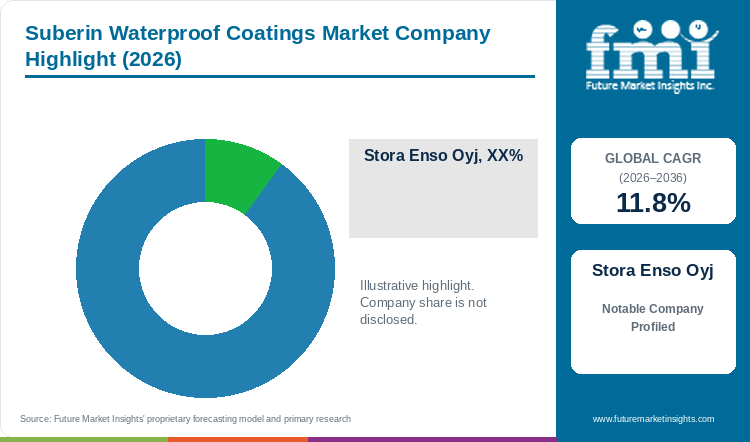
Competitive positioning in the suberin waterproof coatings sector links Nordic and Iberian forest-resource owners with specialized bark-extraction biorefineries and paper-chemistry formulators. Integrated Nordic forestry and paperboard groups including Stora Enso Oyj and Holmen AB alongside Metsä Board Corporation and Billerud AB control vast birch pulpwood debarking streams and wide curtain-coated cupboard and boxboard machines. Dedicated bark biorefineries led by Corticeira Amorim (processing Mediterranean cork stripping waste) and Finnish birch-bark upcycler Innomost Oy isolate purified suberinic acid oligomers and triterpene co-products. Meanwhile, paper-chemistry leader Kemira Oyj and VTT Technical Research Centre of Finland Ltd engineer surfactant-free aqueous suberin dispersions and hybrid nanocellulose-suberin barrier formulations for global board mills.
- Integrated Nordic Forestry & Birch Biorefinery Groups: Stora Enso Oyj and Holmen AB alongside Metsä Board Corporation and Billerud AB integrate captive birch debarking with high-speed barrier paperboard manufacturing.
- Bark Extraction & Suberin Dispersion Specialists: Corticeira Amorim and Innomost Oy upcycle cork-stopper dust and white birch outer bark into commercial suberinic acid concentrates.
- Paperboard Barrier Chemistry & Spin-Out Innovators: Kemira Oyj and VTT Technical Research Centre of Finland Ltd formulate inline-curable suberin-biopolymer dispersions for cupstock and kraft mailers.
Competitive Benchmarking: Suberin Waterproof Coatings Market
Table 8: Competitive Benchmarking for the Suberin Waterproof Coatings Market (qualitative capability ratings), 2026
| Company | Captive Bark Supply | Suberin Cleavage IP | Mill Coater Integration | Geographic Reach |
|---|---|---|---|---|
| Stora Enso Oyj | High | High | High | High |
| Holmen AB | High | Medium | High | Medium |
| Corticeira Amorim, S.G.P.S., S.A. | High | High | Medium | High |
| Metsä Board Corporation | High | Medium | High | High |
| Billerud AB | High | Medium | High | High |
| Kemira Oyj | Medium | High | High | High |
| VTT Technical Research Centre of Finland Ltd | Medium | High | Medium | Medium |
| Innomost Oy | Medium | High | Medium | Medium |
Scoring basis: Captive Bark Supply is rated High for companies owning integrated pulpwood debarking drums or cork-stripping processing mills and Medium for formulators sourcing external bark fractions. Suberin Cleavage IP reflects patented alkaline or deep-eutectic depolymerization processes yielding low-color suberinic acid monomers and oligomers. Mill Coater Integration assesses commercial deployment on industrial rod and curtain coaters producing repulpable cupstock and folding boxboard.
Key Developments in the Suberin Waterproof Coatings Market
- In March 2026, Metsä Board Corporation introduced its MetsäBoard Pro FBB Go fast-delivery barrier and folding boxboard service concept for European consumer brands [17].
- In September 2025, Stora Enso Oyj integrated three acquired Junnikkala Oy sawmills with its Oulu consumer packaging board mill in Northern Finland to secure long-term wood and forestry side-stream supply [18].
- In February 2025, Metsä Board Corporation initiated pre-engineering at its Husum integrated mill in Sweden to convert BM2 paper machine capacity toward high-performance foodservice barrier paperboards [19].
Key Players in the Suberin Waterproof Coatings Market
Integrated Nordic Forestry & Birch Biorefinery Groups
- Stora Enso Oyj
- Holmen AB
- Metsä Board Corporation
- Billerud AB
Bark Extraction & Suberin Dispersion Specialists
- Corticeira Amorim, S.G.P.S., S.A.
- Innomost Oy
Paperboard Barrier Chemistry & Spin-Out Innovators
- Kemira Oyj
- VTT Technical Research Centre of Finland Ltd
Suberin Waterproof Coatings Market - Report Scope
Table 9: Report Scope for the Suberin Waterproof Coatings Market (coverage fields and definitions), 2026 to 2036
| Coverage field | Report scope |
|---|---|
| Market breakdown | Bark Feedstock Origin; Depolymerization Chemistry; Barrier Performance Target; Packaging Format; Region |
| Quantitative Units | USD Million |
| Market Definition | Includes B2B revenue from extracted birch, cork, aspen, and eucalyptus bark suberin monomers/oligomers, alkaline-hydrolyzed suberinic acid aqueous dispersions, and crosslinkable suberin polyol coatings sold for waterproof and greaseproof paperboard, cupstock, mailer, and wood/fiberboard barrier applications. Category Scope Note: Excludes raw unextracted bark burned as hog fuel, solid cork wine stoppers, cosmetic-grade betulin triterpene powders, and downstream converted paper cup or carton sales. |
| Regions Covered | North America; Latin America; Western Europe; Eastern Europe; East Asia; South Asia and Pacific; Middle East and Africa |
| Countries Covered | Sweden, Finland, Portugal, Germany, Poland, United States, and additional countries in the full report |
| Key Companies Covered | Stora Enso Oyj, Holmen AB, Corticeira Amorim, S.G.P.S., S.A., Metsä Board Corporation, Billerud AB, Kemira Oyj, VTT Technical Research Centre of Finland Ltd, Innomost Oy |
| Forecast Period | 2026 to 2036 |
| Approach | Primary and secondary research with rigorous market triangulation. |
Suberin Waterproof Coatings Market - Research Methodology
Table 10: Research Methodology for the Suberin Waterproof Coatings Market (research methods and approach), 2026 edition
| Method | Approach |
|---|---|
| Primary Research | Primary interviews were conducted with Nordic kraft pulp-mill biorefinery directors, cork-waste valorization engineers, paperboard dispersion-coating chemists, cupstock converters, and EPR compliance specialists to validate bark yields, Cobb60 water holdout, and coater runnability. |
| Secondary Research | Secondary research covered Skogsstyrelsen felling statistics, European Commission PPWR regulations, Cepi paperboard statistics, EEA and Eurostat packaging waste reports, peer-reviewed wood-chemistry literature, and corporate releases from Stora Enso, Metsä Board, Billerud, Kemira, Corticeira Amorim, Holmen, and Innomost. |
| Market Sizing and Forecasting | Market sizing and forecasting from 2026 to 2036 combined bottom-up bark extraction mass balances and suberin dispersion pricing (USD/kg solids) with top-down substitution of polyethylene-lined cupstock and frozen-food folding cartons. |
| Data Triangulation and Validation | Estimates were triangulated against Nordic birch pulpwood consumption, Iberian cork stripping tonnages, and curtain-coater capacity additions to prevent double counting with cosmetic betulin extracts or synthetic styrene-butadiene dispersions. |
| Country Forecasting Model | Country CAGRs (spanning 10.8% in Portugal to 12.9% in Poland around the 11.8% global CAGR) are modeled from national birch/cork bark availability, paper-cup and folding-carton converting capacity, and statutory EPR composite-packaging penalties. |
| Operational Benchmark Traceability | Operational benchmarks in Tables 2, 3, and 4 (isolated suberinic acid yield, coated board square-meter coverage, 3.5-5.5 gsm coat weight, and Cobb60 <5 g/m² performance) trace to Nordic biorefinery mass balances, TAPPI/ISO Cobb60 and Kit 12 test protocols, and industrial curtain-coater specifications. |
Suberin Waterproof Coatings Market by Segments
Suberin Waterproof Coatings Market segmented by Bark Feedstock Origin:
- Nordic Silver & Downy Birch Outer Bark (Betula pendula)
- Mediterranean Cork Oak Stripping Waste (Quercus suber)
- Aspen & Eucalyptus Pulp-Mill Bark Side-Streams
Suberin Waterproof Coatings Market segmented by Depolymerization Chemistry:
- Alkaline Hydrolysis Suberinic Acid Monomer/Oligomer Dispersions
- Ionic-Liquid & Deep-Eutectic Cleaved Suberin Esters
- Epoxidized & Maleated Crosslinkable Suberin Polyols
Suberin Waterproof Coatings Market segmented by Barrier Performance Target:
- Boiling Water & Hot-Coffee Cup Repulpable Barrier (Cobb60 <5 g/m²)
- Grease & Mineral-Oil Vapor Barrier (Kit Level 12)
- Antimicrobial Wood & Fiberboard Weathering Seal
Suberin Waterproof Coatings Market segmented by Packaging Format:
- Single-Use Hot & Cold Paper Beverage Cups
- Frozen Food & Chilled Fish Folding Cartons
- E-Commerce Water-Resistant Kraft Mailers
Suberin Waterproof Coatings Market by Region
- North America
- United States
- Canada
- Latin America
- Brazil
- Mexico
- Argentina
- Chile
- Western Europe
- Germany
- France
- United Kingdom
- Italy
- Spain
- Benelux
- Nordics
- Eastern Europe
- Poland
- Czech Republic
- Romania
- Hungary
- East Asia
- China
- Japan
- South Korea
- South Asia and Pacific
- India
- ASEAN
- Australia and New Zealand
- Middle East and Africa
- GCC Countries
- South Africa
- Türkiye
- Israel
Research Sources and Bibliography
- [1] Confederation of European Paper Industries (Cepi). (2026, July 02). Press release: A Slow Drift, New Statistics Report Shows Why Europe’s Paper Industry Needs Attention Now. Confederation of European Paper Industries (Cepi).
- [2] Publications Office of the European Union. (2025, September 26). Packaging and packaging waste (from 2026). EUR-Lex Summaries of EU Legislation.
- [3] Godina, D., Sosins, G., Paze, A., Rizikovs, J., Makars, R., & Treu, A. (2025, January 20). Evaluating the Potential of Birch Bark Suberinic Acids for Solid Wood Impregnation. Journal of Renewable Materials, 13(1), 147-161.
- [4] Innomost Oy. (2025, February 06). Suberin offers superior adhesion and moisture resistance for various applications. Innomost News.
- [5] Stora Enso Oyj. (2025, August 18). Stora Enso's billion-euro investment in renewable packaging – Europe's most modern consumer board production line inaugurated in Finland. Stora Enso Newsroom.
- [6] Metsä Board Corporation. (2025, October 17). Metsä Board completes EUR 60 million modernisation at Simpele mill – Launches enhanced MetsäBoard Classic FBB. Metsä Group News and Publications.
- [7] Billerud AB. (2025, September 08). Billerud launches recyclable cartonboards built for strength and moisture resistance. Billerud Press & News.
- [8] European Commission. (2026, March 29). Commission publishes guidance to support implementation of new packaging rules, for a more sustainable and competitive EU packaging sector. European Commission Press Corner (IP/26/664).
- [9] Kemira Oyj. (2025, March 27). Kemira and IFF Form Joint Venture To Produce Biobased Materials at Scale. Kemira Newsroom.
- [10] Kemira Oyj. (2025, June 25). Kemira and Bluepha Announce Exclusive Partnership to Commercialize Fully Biobased Barrier Coatings in APAC. Kemira Newsroom.
- [11] Swedish Forest Agency (Skogsstyrelsen). (2026, September 22). The felling is expected to decrease in 2026. Skogsstyrelsen Official Statistics.
- [12] Kemira Oyj. (2026, June 18). Kemira and IFF joint venture relocates planned biobased materials manufacturing site to Hanko, Finland. Kemira Newsroom.
- [13] Corticeira Amorim, S.G.P.S., S.A. (2026, June 22). Corticeira Amorim internationally recognised for sustainability and decarbonisation performance. Corticeira Amorim Media News.
- [14] European Environment Agency (EEA). (2025, April 23). Country profiles on municipal and packaging waste management - 2025. European Environment Agency.
- [15] Eurostat. (2025, October 10). Packaging waste statistics. Eurostat Statistics Explained.
- [16] U.S. Department of Agriculture, Economic Research Service (ERS). (2026, September 25). Food Price Outlook - Summary Findings. USDA Economic Research Service.
- [17] Metsä Board Corporation. (2026, March 03). Metsä Board introduces a new product and service concept for fast moving brand packaging in Europe. Metsä Group News and Publications.
- [18] Stora Enso Oyj. (2025, September 17). Stora Enso Oulu - Prime location and seamless wood supply. Stora Enso Newsroom.
- [19] Metsä Board Corporation. (2025, February 06). A pre-engineering starts at the Husum mill integrate to change the production of BM2. Metsä Group Investor News.
- [20] Holmen AB. (2026, March 09). Annual Report 2025 including sustainability report. Holmen Financial Reports.
This bibliography is provided for reader reference and is not exhaustive. The full report contains the complete reference list and detailed citations.
This Report Answers
- How large is the suberin waterproof coatings market in 2026 and what is forecast for 2036?
- How do depolymerized suberinic acid dispersions achieve Cobb60 <5 g/m² boiling-water resistance?
- Why does Nordic Silver & Downy Birch Outer Bark (Betula pendula) lead bark feedstock origins?
- Why do alkaline hydrolysis suberin dispersions lead over ionic-liquid extraction chemistries?
- How do growth rates compare across Poland, Germany, the United States, Sweden, Finland, and Portugal?
- Which Nordic forestry groups, cork processors, and chemical companies supply suberin coatings?
- How do formulators manage natural phenolic amber tinting on bleached packaging boards?
- What repulpability and heat-sealing benchmarks should cupstock buyers verify before switching from PE?
Frequently Asked Questions
How big is the suberin waterproof coatings market in 2026, and what is forecast for 2036?
Counting USD 46.5 million during 2025, global suberin waterproof coatings demand is forecast at USD 52.0 million in 2026 before climbing toward a projected USD 158.6 million by 2036 as paper-cup and frozen-carton mills replace extruded polyethylene liners with bark-derived suberin dispersions.
What is the CAGR for the suberin waterproof coatings market from 2026 to 2036?
According to FMI, global turnover is anticipated to expand at an 11.8% CAGR between 2026 and 2036, generating USD 106.6 million in expected incremental revenue under European PPWR repulpability rules.
Which bark feedstock origin segment leads the suberin waterproof coatings market?
Nordic Silver & Downy Birch Outer Bark (Betula pendula) is predicted to capture 61.4% of 2026 bark feedstock revenue because centralized debarking drums at Swedish and Finnish kraft pulp mills supply uniform outer bark containing 45% extractable suberin.
Which depolymerization chemistry segment leads the market in 2026?
Alkaline Hydrolysis Suberinic Acid Monomer/Oligomer Dispersions are expected to account for 56.8% of 2026 chemistry turnover owing to surfactant-free aqueous self-emulsification and low-cost potassium or sodium hydroxide saponification.
Which country posts the fastest growth in the suberin waterproof coatings market?
FMI estimates that Poland is projected to lead major paperboard-converting nations at a 12.9% CAGR from 2026 to 2036, driven by export-oriented paper cup and frozen-food folding carton converting plants adopting Nordic barrier boards.
Who are the notable companies in the suberin waterproof coatings market?
Leading participants include Stora Enso Oyj, Holmen AB, Corticeira Amorim, S.G.P.S., S.A., Metsä Board Corporation, Billerud AB, Kemira Oyj, VTT Technical Research Centre of Finland Ltd, and Innomost Oy, spanning birch/cork bark biorefining and inline dispersion-coated cupboards.
Preview the report firsthand - request a free sample
Get SampleGet the brochure for pricing and purchase details.
Get PDFTable of Content
- Key Takeaways
- Market Size and CAGR
- Top Growth Driver
- Fastest Growing Segment
- Leading Region
- Key Companies
- Emerging Opportunities
- Executive Summary
- Global Market Outlook
- Demand-side Trends
- Supply-side Trends
- Technology Roadmap Analysis
- Analysis and Recommendations
- Analyst Perspective (What is happening? Why now? What should investors know?)
- Key Questions Answered
- How large is the market?
- What is the CAGR?
- What are key trends?
- Which region dominates?
- Who are the leaders?
- Market Overview
- Market Coverage / Taxonomy
- Market Definition / Scope / Limitations
- Research Methodology
- Chapter Orientation
- Analytical Lens and Working Hypotheses
- Market Structure, Signals, and Trend Drivers
- Benchmarking and Cross-market Comparability
- Market Sizing, Forecasting, and Opportunity Mapping
- Research Design and Evidence Framework
- Desk Research Programme (Secondary Evidence)
- Expert Input and Fieldwork (Primary Evidence)
- Tooling, Models, and Reference Databases
- Data Engineering and Model Build
- Quality Assurance and Audit Trail
- Market Background
- Market Dynamics (Drivers, Restraints, Opportunity, Trends)
- Scenario Forecast (Optimistic, Likely, Conservative)
- Impact Analysis
- AI Impact
- Sustainability Impact
- Regulatory Impact
- Technology Impact
- Consumer / Buyer Analysis
- Purchase Drivers
- Adoption Barriers
- Buyer Journey
- Opportunity Map Analysis
- Product Life Cycle Analysis
- Supply Chain Analysis
- Investment Feasibility Matrix
- Value Chain Analysis
- PESTLE and Porter's Analysis
- Regulatory Landscape
- Regional Parent Market Outlook
- Production and Consumption Statistics
- Import and Export Statistics
- Global Market Analysis and Forecast, 2021 to 2036
- Historical Market Size Value (USD Million) Analysis, 2021 to 2025
- Current and Future Market Size Value (USD Million) Projections, 2026 to 2036
- Y-o-Y Growth Trend Analysis
- Absolute $ Opportunity Analysis
- Global Market Pricing Analysis, 2021 to 2036
- Global Market Analysis and Forecast, By Bark Feedstock Origin, 2021 to 2036
- Introduction / Key Findings
- Historical Market Size Value (USD Million) Analysis By Bark Feedstock Origin, 2021 to 2025
- Current and Future Market Size Value (USD Million) Analysis and Forecast By Bark Feedstock Origin, 2026 to 2036
- Nordic Silver & Downy Birch Outer Bark (Betula pendula)
- Mediterranean Cork Oak Stripping Waste (Quercus suber)
- Aspen & Eucalyptus Pulp-Mill Bark Side-Streams
- Y-o-Y Growth Trend Analysis By Bark Feedstock Origin, 2021 to 2025
- Absolute $ Opportunity Analysis By Bark Feedstock Origin, 2026 to 2036
- Global Market Analysis and Forecast, By Depolymerization Chemistry, 2021 to 2036
- Introduction / Key Findings
- Historical Market Size Value (USD Million) Analysis By Depolymerization Chemistry, 2021 to 2025
- Current and Future Market Size Value (USD Million) Analysis and Forecast By Depolymerization Chemistry, 2026 to 2036
- Alkaline Hydrolysis Suberinic Acid Monomer/Oligomer Dispersions
- Ionic-Liquid & Deep-Eutectic Cleaved Suberin Esters
- Epoxidized & Maleated Crosslinkable Suberin Polyols
- Y-o-Y Growth Trend Analysis By Depolymerization Chemistry, 2021 to 2025
- Absolute $ Opportunity Analysis By Depolymerization Chemistry, 2026 to 2036
- Global Market Analysis and Forecast, By Barrier Performance Target, 2021 to 2036
- Introduction / Key Findings
- Historical Market Size Value (USD Million) Analysis By Barrier Performance Target, 2021 to 2025
- Current and Future Market Size Value (USD Million) Analysis and Forecast By Barrier Performance Target, 2026 to 2036
- Boiling Water & Hot-Coffee Cup Repulpable Barrier (Cobb60 <5 g/m²)
- Grease & Mineral-Oil Vapor Barrier (Kit Level 12)
- Antimicrobial Wood & Fiberboard Weathering Seal
- Y-o-Y Growth Trend Analysis By Barrier Performance Target, 2021 to 2025
- Absolute $ Opportunity Analysis By Barrier Performance Target, 2026 to 2036
- Global Market Analysis and Forecast, By Packaging Format, 2021 to 2036
- Introduction / Key Findings
- Historical Market Size Value (USD Million) Analysis By Packaging Format, 2021 to 2025
- Current and Future Market Size Value (USD Million) Analysis and Forecast By Packaging Format, 2026 to 2036
- Single-Use Hot & Cold Paper Beverage Cups
- Frozen Food & Chilled Fish Folding Cartons
- E-Commerce Water-Resistant Kraft Mailers
- Y-o-Y Growth Trend Analysis By Packaging Format, 2021 to 2025
- Absolute $ Opportunity Analysis By Packaging Format, 2026 to 2036
- Global Market Analysis and Forecast, By Region, 2021 to 2036
- Introduction
- Historical Market Size Value (USD Million) Analysis By Region, 2021 to 2025
- Current Market Size Value (USD Million) Analysis and Forecast By Region, 2026 to 2036
- North America
- Latin America
- Western Europe
- Eastern Europe
- East Asia
- South Asia and Pacific
- Middle East and Africa
- Market Attractiveness Analysis By Region
- North America Market Analysis and Forecast, By Country, 2021 to 2036
- Historical Market Size Value (USD Million) Trend Analysis By Market Taxonomy, 2021 to 2025
- Market Size Value (USD Million) Forecast By Market Taxonomy, 2026 to 2036
- By Country
- United States
- Canada
- By Bark Feedstock Origin
- By Depolymerization Chemistry
- By Barrier Performance Target
- By Packaging Format
- By Country
- Market Attractiveness Analysis
- By Country
- By Bark Feedstock Origin
- By Depolymerization Chemistry
- By Barrier Performance Target
- By Packaging Format
- Key Takeaways
- Latin America Market Analysis and Forecast, By Country
- Historical Market Size Value (USD Million) Trend Analysis By Market Taxonomy, 2021 to 2025
- Market Size Value (USD Million) Forecast By Market Taxonomy, 2026 to 2036
- By Country
- Brazil
- Mexico
- Argentina
- Chile
- By Bark Feedstock Origin
- By Depolymerization Chemistry
- By Barrier Performance Target
- By Packaging Format
- By Country
- Market Attractiveness Analysis
- By Country
- By Bark Feedstock Origin
- By Depolymerization Chemistry
- By Barrier Performance Target
- By Packaging Format
- Key Takeaways
- Western Europe Market Analysis and Forecast, By Country
- Historical Market Size Value (USD Million) Trend Analysis By Market Taxonomy, 2021 to 2025
- Market Size Value (USD Million) Forecast By Market Taxonomy, 2026 to 2036
- By Country
- Germany
- France
- United Kingdom
- Italy
- Spain
- Benelux
- Nordics
- By Bark Feedstock Origin
- By Depolymerization Chemistry
- By Barrier Performance Target
- By Packaging Format
- By Country
- Market Attractiveness Analysis
- By Country
- By Bark Feedstock Origin
- By Depolymerization Chemistry
- By Barrier Performance Target
- By Packaging Format
- Key Takeaways
- Eastern Europe Market Analysis and Forecast, By Country
- Historical Market Size Value (USD Million) Trend Analysis By Market Taxonomy, 2021 to 2025
- Market Size Value (USD Million) Forecast By Market Taxonomy, 2026 to 2036
- By Country
- Poland
- Czech Republic
- Romania
- Hungary
- By Bark Feedstock Origin
- By Depolymerization Chemistry
- By Barrier Performance Target
- By Packaging Format
- By Country
- Market Attractiveness Analysis
- By Country
- By Bark Feedstock Origin
- By Depolymerization Chemistry
- By Barrier Performance Target
- By Packaging Format
- Key Takeaways
- East Asia Market Analysis and Forecast, By Country
- Historical Market Size Value (USD Million) Trend Analysis By Market Taxonomy, 2021 to 2025
- Market Size Value (USD Million) Forecast By Market Taxonomy, 2026 to 2036
- By Country
- China
- Japan
- South Korea
- By Bark Feedstock Origin
- By Depolymerization Chemistry
- By Barrier Performance Target
- By Packaging Format
- By Country
- Market Attractiveness Analysis
- By Country
- By Bark Feedstock Origin
- By Depolymerization Chemistry
- By Barrier Performance Target
- By Packaging Format
- Key Takeaways
- South Asia and Pacific Market Analysis and Forecast, By Country
- Historical Market Size Value (USD Million) Trend Analysis By Market Taxonomy, 2021 to 2025
- Market Size Value (USD Million) Forecast By Market Taxonomy, 2026 to 2036
- By Country
- India
- ASEAN
- Australia and New Zealand
- By Bark Feedstock Origin
- By Depolymerization Chemistry
- By Barrier Performance Target
- By Packaging Format
- By Country
- Market Attractiveness Analysis
- By Country
- By Bark Feedstock Origin
- By Depolymerization Chemistry
- By Barrier Performance Target
- By Packaging Format
- Key Takeaways
- Middle East and Africa Market Analysis and Forecast, By Country
- Historical Market Size Value (USD Million) Trend Analysis By Market Taxonomy, 2021 to 2025
- Market Size Value (USD Million) Forecast By Market Taxonomy, 2026 to 2036
- By Country
- GCC Countries
- South Africa
- Türkiye
- Israel
- By Bark Feedstock Origin
- By Depolymerization Chemistry
- By Barrier Performance Target
- By Packaging Format
- By Country
- Market Attractiveness Analysis
- By Country
- By Bark Feedstock Origin
- By Depolymerization Chemistry
- By Barrier Performance Target
- By Packaging Format
- Key Takeaways
- Key Countries Market Analysis
- United States
- Pricing Analysis
- Market Share Analysis, 2025
- By Bark Feedstock Origin
- By Depolymerization Chemistry
- By Barrier Performance Target
- By Packaging Format
- Canada
- Pricing Analysis
- Market Share Analysis, 2025
- By Bark Feedstock Origin
- By Depolymerization Chemistry
- By Barrier Performance Target
- By Packaging Format
- Mexico
- Pricing Analysis
- Market Share Analysis, 2025
- By Bark Feedstock Origin
- By Depolymerization Chemistry
- By Barrier Performance Target
- By Packaging Format
- Brazil
- Pricing Analysis
- Market Share Analysis, 2025
- By Bark Feedstock Origin
- By Depolymerization Chemistry
- By Barrier Performance Target
- By Packaging Format
- Chile
- Pricing Analysis
- Market Share Analysis, 2025
- By Bark Feedstock Origin
- By Depolymerization Chemistry
- By Barrier Performance Target
- By Packaging Format
- Germany
- Pricing Analysis
- Market Share Analysis, 2025
- By Bark Feedstock Origin
- By Depolymerization Chemistry
- By Barrier Performance Target
- By Packaging Format
- United Kingdom
- Pricing Analysis
- Market Share Analysis, 2025
- By Bark Feedstock Origin
- By Depolymerization Chemistry
- By Barrier Performance Target
- By Packaging Format
- Italy
- Pricing Analysis
- Market Share Analysis, 2025
- By Bark Feedstock Origin
- By Depolymerization Chemistry
- By Barrier Performance Target
- By Packaging Format
- Spain
- Pricing Analysis
- Market Share Analysis, 2025
- By Bark Feedstock Origin
- By Depolymerization Chemistry
- By Barrier Performance Target
- By Packaging Format
- France
- Pricing Analysis
- Market Share Analysis, 2025
- By Bark Feedstock Origin
- By Depolymerization Chemistry
- By Barrier Performance Target
- By Packaging Format
- India
- Pricing Analysis
- Market Share Analysis, 2025
- By Bark Feedstock Origin
- By Depolymerization Chemistry
- By Barrier Performance Target
- By Packaging Format
- ASEAN
- Pricing Analysis
- Market Share Analysis, 2025
- By Bark Feedstock Origin
- By Depolymerization Chemistry
- By Barrier Performance Target
- By Packaging Format
- Australia and New Zealand
- Pricing Analysis
- Market Share Analysis, 2025
- By Bark Feedstock Origin
- By Depolymerization Chemistry
- By Barrier Performance Target
- By Packaging Format
- China
- Pricing Analysis
- Market Share Analysis, 2025
- By Bark Feedstock Origin
- By Depolymerization Chemistry
- By Barrier Performance Target
- By Packaging Format
- Japan
- Pricing Analysis
- Market Share Analysis, 2025
- By Bark Feedstock Origin
- By Depolymerization Chemistry
- By Barrier Performance Target
- By Packaging Format
- South Korea
- Pricing Analysis
- Market Share Analysis, 2025
- By Bark Feedstock Origin
- By Depolymerization Chemistry
- By Barrier Performance Target
- By Packaging Format
- Poland
- Pricing Analysis
- Market Share Analysis, 2025
- By Bark Feedstock Origin
- By Depolymerization Chemistry
- By Barrier Performance Target
- By Packaging Format
- Hungary
- Pricing Analysis
- Market Share Analysis, 2025
- By Bark Feedstock Origin
- By Depolymerization Chemistry
- By Barrier Performance Target
- By Packaging Format
- Türkiye
- Pricing Analysis
- Market Share Analysis, 2025
- By Bark Feedstock Origin
- By Depolymerization Chemistry
- By Barrier Performance Target
- By Packaging Format
- South Africa
- Pricing Analysis
- Market Share Analysis, 2025
- By Bark Feedstock Origin
- By Depolymerization Chemistry
- By Barrier Performance Target
- By Packaging Format
- Sweden
- Pricing Analysis
- Market Share Analysis, 2025
- By Bark Feedstock Origin
- By Depolymerization Chemistry
- By Barrier Performance Target
- By Packaging Format
- Finland
- Pricing Analysis
- Market Share Analysis, 2025
- By Bark Feedstock Origin
- By Depolymerization Chemistry
- By Barrier Performance Target
- By Packaging Format
- Portugal
- Pricing Analysis
- Market Share Analysis, 2025
- By Bark Feedstock Origin
- By Depolymerization Chemistry
- By Barrier Performance Target
- By Packaging Format
- United States
- Market Structure Analysis
- Competition Dashboard
- Competition Benchmarking
- Market Share Analysis of Top Players
- By Regional
- By Bark Feedstock Origin
- By Depolymerization Chemistry
- By Barrier Performance Target
- By Packaging Format
- Emerging Startups
- Innovation Benchmarking
- Competition Analysis
- Competition Deep Dive
- Stora Enso Oyj
- Overview
- Product Portfolio
- Profitability by Market Segments
- Sales Footprint
- Strategy Overview
- Marketing Strategy
- Product Strategy
- Channel Strategy
- Holmen AB
- Corticeira Amorim, S.G.P.S., S.A.
- Metsä Board Corporation
- Billerud AB
- Kemira Oyj
- VTT Technical Research Centre of Finland Ltd
- Innomost Oy
- Stora Enso Oyj
- Case Studies
- Success Stories
- Recent Developments
- Competition Deep Dive
- Assumptions & Acronyms Used


