

- Market Size (2026)
- USD 188.6 Mn
- Forecast (2036)
- USD 507.2 Mn
- CAGR (2026 to 2036)
- 10.4%
How big is Sulfur Release Granules Market in 2026?
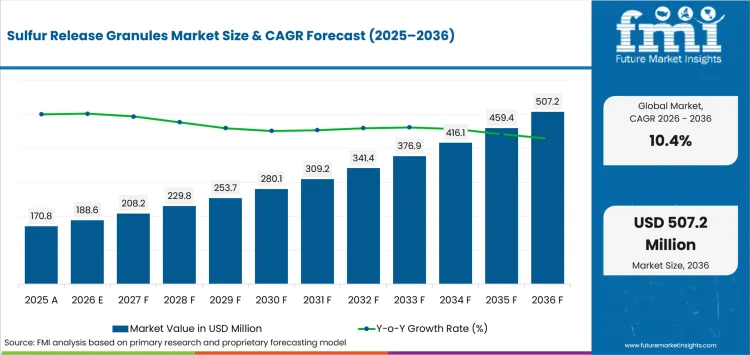
USD 188.6 million in 2026 and USD 507.2 million by 2036 at a 10.4% CAGR.
Demand for sulfur release granules is projected to expand at 10.4% CAGR between 2026 and 2036, lifting valuation from USD 188.6 million to USD 507.2 million. Commercial value depends on whether granulation improves elemental sulfur handling and keeps nutrient release inside the crop response window. USDA Agricultural Research Service began a slow-release elemental sulfur soybean project in April 2026 using three sulfur rates. The project tests yield and seed quality under field conditions, placing controlled-release fertilizers inside an agronomic evaluation instead of a laboratory-only formulation claim.
The USA is projected to expand at a 10.0% CAGR which exceeds the UK's 9.0% CAGR during the forecast period. British commercialization starts from widespread sulfur use in crop programs. Defra's July 2026 fertiliser survey recorded sulfur dressings on 60% of crops in Great Britain during 2025. Existing crop use shortens the technical education needed for specialty sulfur products entering agronomist evaluation. A premium granule still requires field evidence that better handling or release timing can justify its price against familiar sulfur sources.
Key Takeaways of Sulfur Release Granules Market
- Growers pay for formulated sulfur if the granule improves dispersion or release behavior inside an existing crop nutrition or crop-protection program.
- Based on product type, surfactant-based formulations are projected to account for 38.9% in 2026 due to wetting chemistry that addresses elemental sulfur handling directly.
- The efficacy enhancement segment is likely to capture 49.8% share in 2026 attributable to applications that must prove an agronomic gain to secure repeat purchase.
- Cereals & grains are set to lead the crop type category with 37.1% share in 2026 due to scheduled nutrient decisions on broad acreage.
- Variable crop response and application compatibility can slow repeat purchasing unless formulators identify the field conditions in which the release profile improves performance.
- Some of the key players in this market include WinField United, BRANDT, Nouryon, Rovensa Next, Croda, Clariant, Stepan Company, and Evonik.
Analyst Perspective
"Release control earns a premium if the granule disperses cleanly and changes sulfur availability under the intended application program. Evaluation should start with crop-response evidence and tank or spreader behavior ahead of unit price in the purchase decision."
- Nikhil Kaitwade, Principal Consultant, Future Market Insights
How is the Sulfur Release Granules Market segmented?
The sulfur release granules market is segmented by product type, function, crop type, application method, sales channel, and region.
Product type covers surfactant-based, oil-based, polymer-based, mineral / carrier-based, and other formulations. Function includes efficacy enhancement, loss & drift reduction, handling & compatibility, and others. Crop type covers cereals & grains, fruits & vegetables, oilseeds & pulses, turf & ornamentals, and others. Application method includes foliar tank-mix, granule / dry blend, fertigation, and others. Sales channel includes agri-input distributors, cooperatives, agri-retail chains, online / direct-to-farm, and others.
What supports Foliar Tank-Mix in the Application Method category?
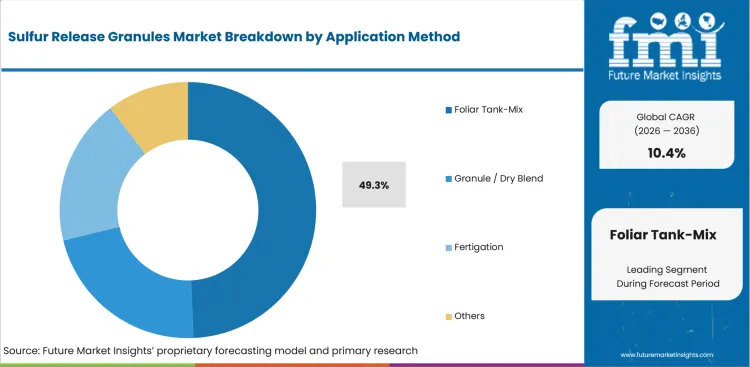
Foliar tank-mix use exposes settling or foam during mixing and spraying, so compatibility problems interrupt application immediately. Commercial adoption therefore depends on stable dispersion inside normal spray equipment and carrier volumes during a full commercial application window locally.
- Foliar tank-mix is set to lead the application method category with 49.3% share in 2026 owing to existing spray passes and immediate compatibility checks.
- Evonik announced in March 2025 that ISAA 2025 would feature new adjuvant and silica technologies for agricultural formulations. The application focus places agricultural adjuvants under handling and spray-performance scrutiny ahead of wider field use.
What makes Surfactant-Based central to the Product Type category?
Elemental sulfur needs dependable wetting so fine particles disperse evenly in liquid application systems under normal tank concentrations. Formulators screen agricultural surfactants for suspension stability before moving a candidate into commercial field testing at commercial carrier volumes.
- Based on product type, surfactant-based formulations are projected to account for 38.9% in 2026 due to wetting chemistry that lowers agglomeration and uneven placement risk.
- BRANDT announced a proprietary adjuvant portfolio in April 2025 for production at its Nebraska formulation plant. The investment gives formulators a current route for testing surfactant chemistry under production conditions ahead of wider crop-input use.
Why does Efficacy Enhancement lead the Function category?
Efficacy enhancement captures spending once a sulfur treatment produces a crop response that remains credible under local field conditions. Repeat purchase depends on whether the response survives changes in soil status and seasonal weather.
- The efficacy enhancement segment is likely to capture 49.8% share in 2026 attributable to the need for repeatable agronomic performance for premium pricing to hold.
- USDA Agricultural Research Service published July 2025 soybean results in which soil sulfur raised seed protein in one of two test environments. The uneven response makes location-specific field evidence more useful for specialty fertilizers than a higher sulfur loading during repeat commercial use.
How do Cereals & Grains anchor the Crop Type category?
Cereal acreage gives sulfur programs repeated application windows and a distributor base that already schedules seasonal nutrient decisions. Large field areas also expose handling problems quickly during commercial use at retailer and applicator scale.
- In 2026, cereals & grains are expected to lead crop type with 37.1% share owing to broad acreage that supports scheduled sulfur decisions each season.
- Defra confirmed in January 2026 that the 2025 UK wheat harvest reached 12 million tonnes and increased 7.3% from 2024. That crop base gives fertilizer additives a large field platform for targeted sulfur qualification ahead of distributor rollout locally.
What are the drivers, restraints and opportunities in the Sulfur Release Granules Market?
Targeted sulfur management raises demand, variable field response limits blanket adoption, and integrated formulation testing can shorten qualification for specialty granules.
- Driver: Agronomists increase sulfur spending if soil and crop evidence identifies a credible response window for another nutrient input.
- Restraint: Field response and spray-use requirements can reduce the economic case for a premium granule in poorly matched conditions.
- Opportunity: One coordinated formulation and field-testing program can shorten the route from prototype to distributor recommendation.
Sulfur spending rises most reliably once agronomists identify fields likely to respond to another nutrient input. USDA Agricultural Research Service published a May 2025 twelve-year Iowa corn study in which sulfur increased grain yield in two study years. The result limits the commercial case for sulphur-coated urea and other timed formats to fields supported by local diagnosis and repeatable response evidence.
Crop-protection positioning introduces a separate constraint: application instructions must fit current mitigation measures and locally approved labels. EPA released the Pesticide App for Label Mitigations in August 2025 so applicators could calculate runoff and spray-drift measures from current strategies. Formulators therefore need agrochemical additives that change droplet behavior and stay compatible with mitigation choices written into pesticide labels.
Qualification can shorten once one technical program coordinates formulation design, field testing and regulatory work under the same timetable. Stepan Company partnered with SynTech Research Group in August 2025 to extend those services for agricultural products in North America. The shared program gives activator adjuvants and sulfur formulations a clearer distributor-review route with stability data and field results from one timetable.
Which country CAGRs are profiled in the Sulfur Release Granules Market?
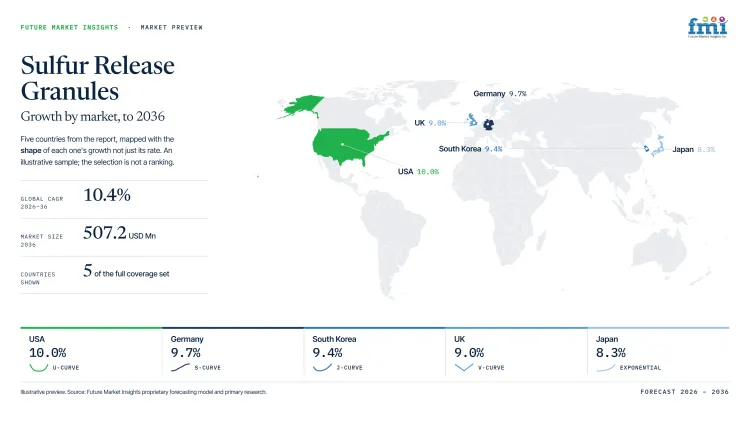
| Country | CAGR |
|---|---|
| USA | 10.0% |
| Germany | 9.7% |
| South Korea | 9.4% |
| UK | 9.0% |
| Japan | 8.3% |
How do country-level CAGRs compare in the Sulfur Release Granules Market?
The 1.7 percentage-point range separates an upper group of the USA, Germany and South Korea from the UK and Japan. The spread is narrow enough that qualification cost can outweigh CAGR ranking. Commercial priority therefore depends on how fast field evidence moves through each country's technical sales channel locally.
- USA cooperatives can translate validated sulfur evidence into recommendations through broad-acre nutrient programs.
- German cereal accounts reward technical coverage but require clear claim separation during listing.
- South Korean greenhouse clusters make equipment trials useful ahead of wider field adoption.
- UK advisers compare specialty granules directly with familiar sulfur programs at farm level.
- Japanese distributors prioritize crop-specific mixing instructions over broad specialty sulfur inventories locally.
Comparable growth rates therefore conceal materially different costs for qualification, training and distributor acceptance. The full report provides country-level CAGR analysis across North America, Latin America, Europe, East Asia, South Asia, Oceania and the Middle East and Africa.
Country-wise Analysis
- US specialty sulfur orders pass through retail agronomists and cooperatives that compare a first-season response with cheaper sulfate or elemental sources. The USA is estimated to post 10.0% CAGR through 2036 owing to broad-acre nutrient programs, while USDA NASS put 2025 winter wheat seedings at 34.1 million acres. Multi-location trials give those channels a practical basis for recommending a premium release profile to growers. Variable sulfur response is the main friction, so repeat orders depend on site-specific timing evidence that survives normal field variation. Companies with regional trial data can earn retailer attention faster than formulations supported mainly by generalized sulfur nutrition claims.
- German distributors serve cereal farms whose crop-protection sulfur programs bring authorization duties that do not apply to ordinary nutrient positioning today. Destatis estimated cereals on 6.03 million hectares in May 2026, with winter wheat representing 48% and giving specialty formulations a large technical-sales base. Sulfur release granule demand in Germany is forecast to rise at 9.7% CAGR because professional agronomy gives differentiated products a defined evaluation route for large cereal accounts. Local listing can slow if nutrient claims and regulated plant-protection uses blur together, which favors companies able to provide German instructions and application evidence plus seasonal retailer training support.
- South Korean greenhouse and field programs increasingly use labor-saving equipment, making equipment compatibility part of distributor screening for unfamiliar inputs. MAFRA's February 2025 plan targets smart technology on 35% of 55,000 greenhouse hectares and 20% of major field-crop areas. Formal verification programs give compatible granules a structured route into equipment trials and adviser training. South Korea is projected to record 9.4% CAGR through 2036 given investment in smart-farming systems that can document application performance. A shortage of specialized companies and technical personnel remains the local constraint, so repeat use depends heavily on distributor training and mixing guidance locally.
- UK sulfur purchasing follows agronomist recommendations and fertiliser channels that already schedule sulfur inside cereal nutrition plans, reducing the need to explain basic crop demand. Defra recorded a 9.1% increase in UK wheat area to 1.7 million hectares during 2025, giving specialty sulfur products a concentrated cereal customer base. Formulators face direct price comparison with conventional sulfur sources, so better handling or timing must remain visible under commercial field conditions and normal retailer margins locally. The UK sulfur release granules market is forecast to expand at 9.0% CAGR aided by adviser-led nutrient management and routine sulfur use in crop plans.
- Japanese distributors evaluate specialty sulfur through crop-specific application routines in which low-volume mixing and equipment fit determine whether a product reaches repeat field use. Japan is anticipated to expand at 8.3% CAGR through 2036 shaped by demand for efficient crop-input use in smaller cereal programs. MAFF reported in November 2025 that wheat covered 229,500 hectares while production reached 1.022 million tonnes and both measures were 1% below the prior year. Limited broad-acre volume restricts inventory-led selling for specialty sulfur granules in many distributor programs. Companies with exact mixing directions and local application validation can compete more effectively than firms relying on broad portfolio coverage alone.
Who are the notable companies in the Sulfur Release Granules Market?
WinField United, BRANDT, Nouryon, Rovensa Next, Croda, Clariant, Stepan Company, and Evonik are the notable companies serving this market.
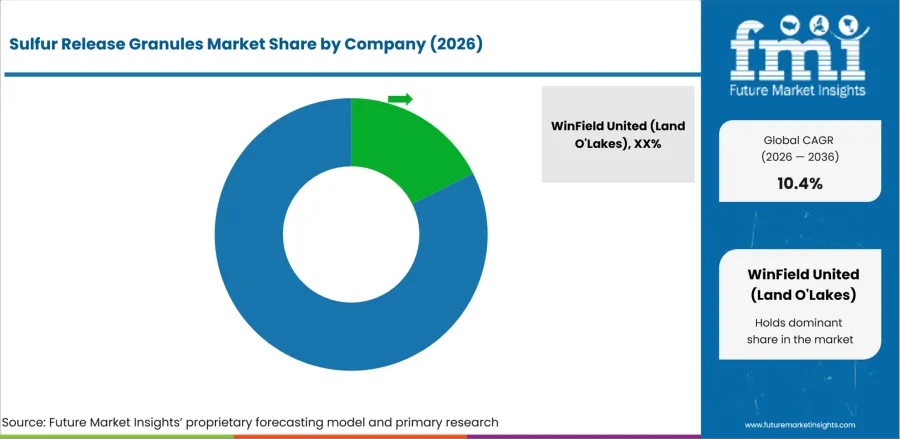
Farm-facing adjuvant brands compete closest to application decisions while ingredient companies compete on wetting, dispersion and formulation service. Distributor acceptance raises the entry bar because a sulfur formulation needs application evidence and a technical route for resolving compatibility problems.
- WinField United, BRANDT and Rovensa Next compete closest to application decisions through adjuvant portfolios, agronomy support and retail or distributor access.
- Nouryon, Croda, Clariant, Stepan Company and Evonik compete upstream through surfactants, dispersants, formulation support and crop-protection ingredient technologies.
Competitive Benchmarking: Sulfur Release Granules Market
| Company | Wetting & Dispersion Breadth | Spray-Control Breadth | Validation & Formulation Support | Geographic Reach |
|---|---|---|---|---|
| WinField United | High | High | High | North America |
| BRANDT | High | High | Medium | North America and international markets |
| Nouryon | High | High | High | Global |
| Rovensa Next | High | High | High | Europe, Americas, MENA and Asia-Pacific |
| Croda | High | Medium | High | Global |
| Clariant | High | High | High | Global |
| Stepan Company | High | Medium | High | Americas, Europe and Asia |
| Evonik | High | High | High | Global |
Scoring basis: High wetting and dispersion breadth requires at least three documented formulation functions, Medium requires two and Low identifies one. High spray-control breadth requires three documented spray functions, Medium requires two and Low identifies one. High validation support requires a dedicated testing network, Medium requires one defined technical service and Low identifies one documented support route. Geographic reach records verified operating coverage.
Key Developments in the Sulfur Release Granules Market
- In March 2026, Croda opened a greenfield manufacturing facility at its Dahej site in India to support Life Sciences and crop-enhancing formulation supply for Asian customers.
- In December 2025, Stepan Company established an agriculture laboratory in Piracicaba for crop-protection formulation and performance testing in Brazil.
- In May 2025, Rovensa Next launched Biostimulation 360° for global plant nutrition and biostimulant programs with adjuvant support inside its biosolutions portfolio.
Key Players in the Sulfur Release Granules Market
Farm-Facing Adjuvant and Crop-Input Platforms
- WinField United
- BRANDT
- Rovensa Next
Formulation Chemistry and Ingredient Platforms
- Nouryon
- Croda
- Clariant
- Stepan Company
- Evonik
Sulfur Release Granules Market - Report Scope
| Coverage field | Report scope |
|---|---|
| Market breakdown | By product type, function, crop type, application method, sales channel and region. |
| Quantitative Units | USD million. |
| Market Definition | Commercial granulated or dispersible sulfur systems designed to manage release, wetting, dispersion, deposition, handling or application performance in crop nutrition and crop-protection programs. |
| Regions Covered | North America, Latin America, Europe, East Asia, South Asia and Pacific, and Middle East and Africa. |
| Countries Covered | USA, Germany, South Korea, UK, Japan, and 20+ countries included in the full report. |
| Key Companies Profiled | WinField United, BRANDT, Nouryon, Rovensa Next, Croda, Clariant, Stepan Company, and Evonik. |
| Forecast Period | 2026 to 2036. |
| Approach | Primary and secondary research with market triangulation. |
Sulfur Release Granules Market - Research Methodology
| Method | Approach |
|---|---|
| Primary Research | FMI analysts gathered input from manufacturers, service providers, technology developers, distributors, end users, procurement teams, and subject-matter experts. Interviews examined purchasing decisions, product or service evaluation, adoption barriers, approval requirements, pricing considerations, and expectations for technical or commercial support. Respondents were also asked what evidence is required before a trial, pilot, or initial order develops into regular purchasing. |
| Desk Research | Desk research covered government statistics, regulatory publications, trade data, industry associations, technical literature, standards, company filings, product information, and official corporate announcements. Sources were reviewed for relevance, publication date, geographic coverage, and consistency with the defined market scope. Claims relating to performance, applications, approvals, capacity, investment, and commercial activity were retained only when supported by credible public evidence. |
| Market Sizing and Forecasting | The market model combined the baseline value with historical performance, segment structure, pricing and volume indicators, adoption levels, company participation, and country-level demand conditions. Forecast assumptions considered economic activity, investment trends, regulatory developments, technology adoption, purchasing cycles, supply availability, and barriers to wider market use. Segment and regional estimates were reconciled before the final market total was calculated. |
| Data Validation | Estimates were checked against multiple independent indicators, including public data, company activity, trade patterns, industry developments, and findings from primary interviews. Validation also tested whether products, services, applications, and company revenues fell within the defined market boundaries. Adjacent categories, unsupported claims, overlapping revenues, and activities without direct market relevance were excluded to reduce double counting and maintain consistency across segments and countries. |
Sulfur Release Granules Market by Segments
Sulfur Release Granules Market segmented by Product Type:
- Surfactant-Based
- Oil-Based
- Polymer-Based
- Mineral / Carrier-Based
- Others
Sulfur Release Granules Market segmented by Function:
- Efficacy Enhancement
- Loss & Drift Reduction
- Handling & Compatibility
- Others
Sulfur Release Granules Market segmented by Crop Type:
- Cereals & Grains
- Fruits & Vegetables
- Oilseeds & Pulses
- Turf & Ornamentals
- Others
Sulfur Release Granules Market segmented by Application Method:
- Foliar Tank-Mix
- Granule / Dry Blend
- Fertigation
- Others
Sulfur Release Granules Market segmented by Sales Channel:
- Agri-Input Distributors
- Cooperatives
- Agri-Retail Chains
- Online / Direct-to-Farm
- Others
Sulfur Release Granules Market by Region:
- North America
- United States
- Canada
- Latin America
- Brazil
- Mexico
- Argentina
- Chile
- Western Europe
- Germany
- France
- United Kingdom
- Italy
- Spain
- Benelux
- Nordics
- Eastern Europe
- Poland
- Czech Republic
- Romania
- Hungary
- East Asia
- China
- Japan
- South Korea
- South Asia and Pacific
- India
- ASEAN
- Australia and New Zealand
- Middle East and Africa
- GCC Countries
- South Africa
- Türkiye
- Israel
Research Sources and Bibliography
- USA Department of Agriculture, Agricultural Research Service. (2026, April 1). Effects of Slow-release Elemental Sulfur Fertilization on Soybean Growth, Yield, and Seed Quality.
- Department for Environment, Food & Rural Affairs. (2026, July 16). British Survey of Fertiliser Practice 2025 - annual report.
- BRANDT. (2025, April 15). BRANDT Grows Product Management Team.
- USA Department of Agriculture, Agricultural Research Service. (2025, July 6). Sulfur fertilization alters soybean seed protein in one of two test environments in the Southeast USA
- Department for Environment, Food & Rural Affairs. (2026, January 20). Cereal and oilseed production in the United Kingdom 2025.
- Evonik Industries. (2025, March 19). Evonik will participate in ISAA 2025 with sustainable solutions and innovations for the agricultural sector.
- USA Department of Agriculture, Agricultural Research Service. (2025, May 19). Long-term field study on corn response to sulfur fertilization in Iowa, USA.
- USA Environmental Protection Agency. (2025, August 14). EPA Releases New Mobile Tool to Help Farmers Implement Recommended Ecological Pesticide Mitigation Measures.
- Stepan Company. (2025, August 28). Stepan Expands AFS Through Partnership with SynTech Research Group.
- USA Department of Agriculture, National Agricultural Statistics Service. (2025, January 10). Winter Wheat and Canola Seedings.
- Statistisches Bundesamt. (2026, May 19). Getreideanbaufläche 2026 hat sich nach Tiefststand von 2024 weiter stabilisiert.
- Ministry of Agriculture, Food and Rural Affairs. (2025, February 27). S. Korea’s First Master Plan for Promotion of the Growth of the Smart-Farming Industry for the Years 2025-2029.
- Department for Environment, Food & Rural Affairs. (2025, December 17). Agricultural Land Use in United Kingdom at 1 June 2025.
- Ministry of Agriculture, Forestry and Fisheries. (2025, November 28).
- WinField United. (2025, March 25). Adjuvant Research That Proves Itself in the Tank.
- BRANDT. (2025, May 20). How Adjuvants Improve Foliar Herbicide Performance.
- Nouryon. (2025, April 7). Nouryon launches Adsee Flex 960, an advanced tank mix adjuvant for enhanced crop performance.
- Rovensa Next. (2026, March 17). VINTRE Named Most Widely Applied Adjuvant in California in 2025.
- Croda International Plc. (2026, February 24). Life Sciences business review.
- Clariant. (2026, February 27). Clariant publishes Integrated Report 2025.
- Stepan Company. (2025, December 2). Stepan expands agricultural footprint in Brazil with strategic investments.
- Croda International Plc. (2026, March 19). Croda opens new manufacturing facility in Dahej, India to support growth and sustainable innovation.
- Rovensa Next. (2025, May 12). Rovensa Next launches “Biostimulation 360º”.
- Lamberti Group. (2025, June 3). Lamberti Opens New Branch in Australia.
- Clariant. (2025, March 13). Clariant’s novel solutions for enhancing crop health and biological formulations at CAC 2025.
- Borregaard ASA. (2025, June 24). EU support for bio-based pest control in food production.
- Syensqo. (2026, March 10). Syensqo launches Geropon D2566, the next-generation dispersant for complex suspension concentrate formulations.
- BASF SE. (2025, April 7). BASF launches Sokalan CP 301: a readily biodegradable dispersant with optimal performance for stable agricultural formulations.
- Precision Laboratories. (2025, January 20). The Mix Tank App Expands Functionality To Streamline Spraying Practices.
- Stepan Company. (2025, October 15). Stepan and Staphyt Announce Strategic Collaboration Agreement to Accelerate Agricultural Innovation in Europe.
- Rizobacter. (2025, April 29). Rizobacter lanza RIZOSPRAY PRO MANÍ: el primer adyuvante funcional del mercado.
This bibliography is provided for reader reference and is not exhaustive. The full report contains the complete reference list and detailed citations
This Report Answers
- How large is the sulfur release granules market in 2026 and what value is projected for 2036?
- Which formulation characteristics explain the 10.4% forecast CAGR through 2036?
- Why do surfactant-based products hold the largest stated product type share?
- Why does efficacy enhancement account for the largest stated function share?
- How do cereal acreage and scheduled nutrient programs influence sulfur granule demand?
- What limits repeat purchasing when sulfur response varies between locations?
- How do the five profiled country growth rates differ from 2026 to 2036?
- Which companies compete closest to farm application and which operate upstream in formulation chemistry?
- Which recent company actions are changing formulation support and regional availability?
Frequently Asked Questions
How big is the sulfur release granules market in 2026?
The sulfur release granules market is valued at USD 188.6 million in 2026 and is projected to reach USD 507.2 million by 2036. Growth comes from formulations that improve sulfur handling or release performance inside existing crop-input programs.
What is the CAGR of the sulfur release granules market from 2026 to 2036?
The sulfur release granules market is projected to grow at a CAGR of 10.4% between 2026 and 2036. Expansion depends on targeted sulfur management and field evidence that specialty formulations justify their premium under commercial conditions.
Which product type leads the sulfur release granules market?
The surfactant-based segment is expected to hold 38.9% of the sulfur release granules market in 2026, attributable to wetting chemistry that improves particle dispersion. Better wetting reduces settling risk during liquid application and commercial spray preparation.
Which function leads the sulfur release granules market?
The efficacy enhancement segment is estimated to hold 49.8% of the sulfur release granules market in 2026, supported by demand for measurable agronomic performance. Variable field response keeps location-specific validation central to premium positioning and repeat purchase.
Which companies are active in the sulfur release granules market?
Key companies operating in the sulfur release granules market include WinField United, BRANDT, Nouryon, Rovensa Next, Croda, Clariant, Stepan Company, and Evonik. Their positions span farm-facing adjuvants, formulation chemistry, technical testing and crop-input distribution support.
Preview the report firsthand - request a free sample
Get SampleGet the brochure for pricing and purchase details.
Get PDFTable of Content
- Key Takeaways
- Market Size and CAGR
- Top Growth Driver
- Fastest Growing Segment
- Leading Region
- Key Companies
- Emerging Opportunities
- Executive Summary
- Global Market Outlook
- Demand-side Trends
- Supply-side Trends
- Technology Roadmap Analysis
- Analysis and Recommendations
- Analyst Perspective (What is happening? Why now? What should investors know?)
- Key Questions Answered
- How large is the market?
- What is the CAGR?
- What are key trends?
- Which region dominates?
- Who are the leaders?
- Market Overview
- Market Coverage / Taxonomy
- Market Definition / Scope / Limitations
- Research Methodology
- Chapter Orientation
- Analytical Lens and Working Hypotheses
- Market Structure, Signals, and Trend Drivers
- Benchmarking and Cross-market Comparability
- Market Sizing, Forecasting, and Opportunity Mapping
- Research Design and Evidence Framework
- Desk Research Programme (Secondary Evidence)
- Expert Input and Fieldwork (Primary Evidence)
- Tooling, Models, and Reference Databases
- Data Engineering and Model Build
- Quality Assurance and Audit Trail
- Market Background
- Market Dynamics (Drivers, Restraints, Opportunity, Trends)
- Scenario Forecast (Optimistic, Likely, Conservative)
- Impact Analysis
- AI Impact
- Sustainability Impact
- Regulatory Impact
- Technology Impact
- Consumer / Buyer Analysis
- Purchase Drivers
- Adoption Barriers
- Buyer Journey
- Opportunity Map Analysis
- Product Life Cycle Analysis
- Supply Chain Analysis
- Investment Feasibility Matrix
- Value Chain Analysis
- PESTLE and Porter's Analysis
- Regulatory Landscape
- Regional Parent Market Outlook
- Production and Consumption Statistics
- Import and Export Statistics
- Global Market Analysis and Forecast, 2021 to 2036
- Historical Market Size Value (USD Million) Analysis, 2021 to 2025
- Current and Future Market Size Value (USD Million) Projections, 2026 to 2036
- Y-o-Y Growth Trend Analysis
- Absolute $ Opportunity Analysis
- Global Market Pricing Analysis, 2021 to 2036
- Global Market Analysis and Forecast, By Product Type, 2021 to 2036
- Introduction / Key Findings
- Historical Market Size Value (USD Million) Analysis By Product Type, 2021 to 2025
- Current and Future Market Size Value (USD Million) Analysis and Forecast By Product Type, 2026 to 2036
- Surfactant-Based
- Oil-Based
- Polymer-Based
- Mineral / Carrier-Based
- Others
- Surfactant-Based
- Y-o-Y Growth Trend Analysis By Product Type, 2021 to 2025
- Absolute $ Opportunity Analysis By Product Type, 2026 to 2036
- Global Market Analysis and Forecast, By Function, 2021 to 2036
- Introduction / Key Findings
- Historical Market Size Value (USD Million) Analysis By Function, 2021 to 2025
- Current and Future Market Size Value (USD Million) Analysis and Forecast By Function, 2026 to 2036
- Efficacy Enhancement
- Loss & Drift Reduction
- Handling & Compatibility
- Others
- Efficacy Enhancement
- Y-o-Y Growth Trend Analysis By Function, 2021 to 2025
- Absolute $ Opportunity Analysis By Function, 2026 to 2036
- Global Market Analysis and Forecast, By Crop Type, 2021 to 2036
- Introduction / Key Findings
- Historical Market Size Value (USD Million) Analysis By Crop Type, 2021 to 2025
- Current and Future Market Size Value (USD Million) Analysis and Forecast By Crop Type, 2026 to 2036
- Cereals & Grains
- Fruits & Vegetables
- Oilseeds & Pulses
- Turf & Ornamentals
- Others
- Cereals & Grains
- Y-o-Y Growth Trend Analysis By Crop Type, 2021 to 2025
- Absolute $ Opportunity Analysis By Crop Type, 2026 to 2036
- Global Market Analysis and Forecast, By Application Method, 2021 to 2036
- Introduction / Key Findings
- Historical Market Size Value (USD Million) Analysis By Application Method, 2021 to 2025
- Current and Future Market Size Value (USD Million) Analysis and Forecast By Application Method, 2026 to 2036
- Foliar Tank-Mix
- Granule / Dry Blend
- Fertigation
- Others
- Foliar Tank-Mix
- Y-o-Y Growth Trend Analysis By Application Method, 2021 to 2025
- Absolute $ Opportunity Analysis By Application Method, 2026 to 2036
- Global Market Analysis and Forecast, By Sales Channel, 2021 to 2036
- Introduction / Key Findings
- Historical Market Size Value (USD Million) Analysis By Sales Channel, 2021 to 2025
- Current and Future Market Size Value (USD Million) Analysis and Forecast By Sales Channel, 2026 to 2036
- Agri-Input Distributors
- Cooperatives
- Agri-Retail Chains
- Online / Direct-to-Farm
- Others
- Agri-Input Distributors
- Y-o-Y Growth Trend Analysis By Sales Channel, 2021 to 2025
- Absolute $ Opportunity Analysis By Sales Channel, 2026 to 2036
- Global Market Analysis and Forecast, By Region, 2021 to 2036
- Introduction
- Historical Market Size Value (USD Million) Analysis By Region, 2021 to 2025
- Current Market Size Value (USD Million) Analysis and Forecast By Region, 2026 to 2036
- North America
- Latin America
- Western Europe
- Eastern Europe
- East Asia
- South Asia and Pacific
- Middle East & Africa
- Market Attractiveness Analysis By Region
- North America Market Analysis and Forecast, By Country, 2021 to 2036
- Historical Market Size Value (USD Million) Trend Analysis By Market Taxonomy, 2021 to 2025
- Market Size Value (USD Million) Forecast By Market Taxonomy, 2026 to 2036
- By Country
- USA
- Canada
- By Product Type
- By Function
- By Crop Type
- By Application Method
- By Sales Channel
- By Country
- Market Attractiveness Analysis
- By Country
- By Product Type
- By Function
- By Crop Type
- By Application Method
- By Sales Channel
- Key Takeaways
- Latin America Market Analysis and Forecast, By Country
- Historical Market Size Value (USD Million) Trend Analysis By Market Taxonomy, 2021 to 2025
- Market Size Value (USD Million) Forecast By Market Taxonomy, 2026 to 2036
- By Country
- Brazil
- Mexico
- Chile
- Rest of Latin America
- By Product Type
- By Function
- By Crop Type
- By Application Method
- By Sales Channel
- By Country
- Market Attractiveness Analysis
- By Country
- By Product Type
- By Function
- By Crop Type
- By Application Method
- By Sales Channel
- Key Takeaways
- Western Europe Market Analysis and Forecast, By Country
- Historical Market Size Value (USD Million) Trend Analysis By Market Taxonomy, 2021 to 2025
- Market Size Value (USD Million) Forecast By Market Taxonomy, 2026 to 2036
- By Country
- Germany
- UK
- Italy
- Spain
- France
- Nordic
- BENELUX
- Rest of Western Europe
- By Product Type
- By Function
- By Crop Type
- By Application Method
- By Sales Channel
- By Country
- Market Attractiveness Analysis
- By Country
- By Product Type
- By Function
- By Crop Type
- By Application Method
- By Sales Channel
- Key Takeaways
- Eastern Europe Market Analysis and Forecast, By Country
- Historical Market Size Value (USD Million) Trend Analysis By Market Taxonomy, 2021 to 2025
- Market Size Value (USD Million) Forecast By Market Taxonomy, 2026 to 2036
- By Country
- Russia
- Poland
- Hungary
- Balkan & Baltic
- Rest of Eastern Europe
- By Product Type
- By Function
- By Crop Type
- By Application Method
- By Sales Channel
- By Country
- Market Attractiveness Analysis
- By Country
- By Product Type
- By Function
- By Crop Type
- By Application Method
- By Sales Channel
- Key Takeaways
- East Asia Market Analysis and Forecast, By Country
- Historical Market Size Value (USD Million) Trend Analysis By Market Taxonomy, 2021 to 2025
- Market Size Value (USD Million) Forecast By Market Taxonomy, 2026 to 2036
- By Country
- China
- Japan
- South Korea
- By Product Type
- By Function
- By Crop Type
- By Application Method
- By Sales Channel
- By Country
- Market Attractiveness Analysis
- By Country
- By Product Type
- By Function
- By Crop Type
- By Application Method
- By Sales Channel
- Key Takeaways
- South Asia and Pacific Market Analysis and Forecast, By Country
- Historical Market Size Value (USD Million) Trend Analysis By Market Taxonomy, 2021 to 2025
- Market Size Value (USD Million) Forecast By Market Taxonomy, 2026 to 2036
- By Country
- India
- ASEAN
- Australia & New Zealand
- Rest of South Asia and Pacific
- By Product Type
- By Function
- By Crop Type
- By Application Method
- By Sales Channel
- By Country
- Market Attractiveness Analysis
- By Country
- By Product Type
- By Function
- By Crop Type
- By Application Method
- By Sales Channel
- Key Takeaways
- Middle East & Africa Market Analysis and Forecast, By Country
- Historical Market Size Value (USD Million) Trend Analysis By Market Taxonomy, 2021 to 2025
- Market Size Value (USD Million) Forecast By Market Taxonomy, 2026 to 2036
- By Country
- Kingdom of Saudi Arabia
- Other GCC Countries
- Türkiye
- South Africa
- Other African Union
- Rest of Middle East & Africa
- By Product Type
- By Function
- By Crop Type
- By Application Method
- By Sales Channel
- By Country
- Market Attractiveness Analysis
- By Country
- By Product Type
- By Function
- By Crop Type
- By Application Method
- By Sales Channel
- Key Takeaways
- Key Countries Market Analysis
- USA
- Pricing Analysis
- Market Share Analysis, 2025
- By Product Type
- By Function
- By Crop Type
- By Application Method
- By Sales Channel
- Canada
- Pricing Analysis
- Market Share Analysis, 2025
- By Product Type
- By Function
- By Crop Type
- By Application Method
- By Sales Channel
- Mexico
- Pricing Analysis
- Market Share Analysis, 2025
- By Product Type
- By Function
- By Crop Type
- By Application Method
- By Sales Channel
- Brazil
- Pricing Analysis
- Market Share Analysis, 2025
- By Product Type
- By Function
- By Crop Type
- By Application Method
- By Sales Channel
- Chile
- Pricing Analysis
- Market Share Analysis, 2025
- By Product Type
- By Function
- By Crop Type
- By Application Method
- By Sales Channel
- Germany
- Pricing Analysis
- Market Share Analysis, 2025
- By Product Type
- By Function
- By Crop Type
- By Application Method
- By Sales Channel
- UK
- Pricing Analysis
- Market Share Analysis, 2025
- By Product Type
- By Function
- By Crop Type
- By Application Method
- By Sales Channel
- Italy
- Pricing Analysis
- Market Share Analysis, 2025
- By Product Type
- By Function
- By Crop Type
- By Application Method
- By Sales Channel
- Spain
- Pricing Analysis
- Market Share Analysis, 2025
- By Product Type
- By Function
- By Crop Type
- By Application Method
- By Sales Channel
- France
- Pricing Analysis
- Market Share Analysis, 2025
- By Product Type
- By Function
- By Crop Type
- By Application Method
- By Sales Channel
- India
- Pricing Analysis
- Market Share Analysis, 2025
- By Product Type
- By Function
- By Crop Type
- By Application Method
- By Sales Channel
- ASEAN
- Pricing Analysis
- Market Share Analysis, 2025
- By Product Type
- By Function
- By Crop Type
- By Application Method
- By Sales Channel
- Australia & New Zealand
- Pricing Analysis
- Market Share Analysis, 2025
- By Product Type
- By Function
- By Crop Type
- By Application Method
- By Sales Channel
- China
- Pricing Analysis
- Market Share Analysis, 2025
- By Product Type
- By Function
- By Crop Type
- By Application Method
- By Sales Channel
- Japan
- Pricing Analysis
- Market Share Analysis, 2025
- By Product Type
- By Function
- By Crop Type
- By Application Method
- By Sales Channel
- South Korea
- Pricing Analysis
- Market Share Analysis, 2025
- By Product Type
- By Function
- By Crop Type
- By Application Method
- By Sales Channel
- Russia
- Pricing Analysis
- Market Share Analysis, 2025
- By Product Type
- By Function
- By Crop Type
- By Application Method
- By Sales Channel
- Poland
- Pricing Analysis
- Market Share Analysis, 2025
- By Product Type
- By Function
- By Crop Type
- By Application Method
- By Sales Channel
- Hungary
- Pricing Analysis
- Market Share Analysis, 2025
- By Product Type
- By Function
- By Crop Type
- By Application Method
- By Sales Channel
- Kingdom of Saudi Arabia
- Pricing Analysis
- Market Share Analysis, 2025
- By Product Type
- By Function
- By Crop Type
- By Application Method
- By Sales Channel
- Türkiye
- Pricing Analysis
- Market Share Analysis, 2025
- By Product Type
- By Function
- By Crop Type
- By Application Method
- By Sales Channel
- South Africa
- Pricing Analysis
- Market Share Analysis, 2025
- By Product Type
- By Function
- By Crop Type
- By Application Method
- By Sales Channel
- USA
- Market Structure Analysis
- Competition Dashboard
- Competition Benchmarking
- Market Share Analysis of Top Players
- By Regional
- By Product Type
- By Function
- By Crop Type
- By Application Method
- By Sales Channel
- Emerging Startups
- Innovation Benchmarking
- Competition Analysis
- Competition Deep Dive
- WinField United (Land O'Lakes)
- Overview
- Product Portfolio
- Profitability by Market Segments
- Sales Footprint
- Strategy Overview
- Marketing Strategy
- Product Strategy
- Channel Strategy
- Brandt
- Loveland Products (Nutrien)
- Oro Agri (Rovensa)
- Croda
- Clariant
- Stepan Company
- Evonik
- WinField United (Land O'Lakes)
- Case Studies
- Success Stories
- Recent Developments
- Competition Deep Dive
- Assumptions & Acronyms Used


