

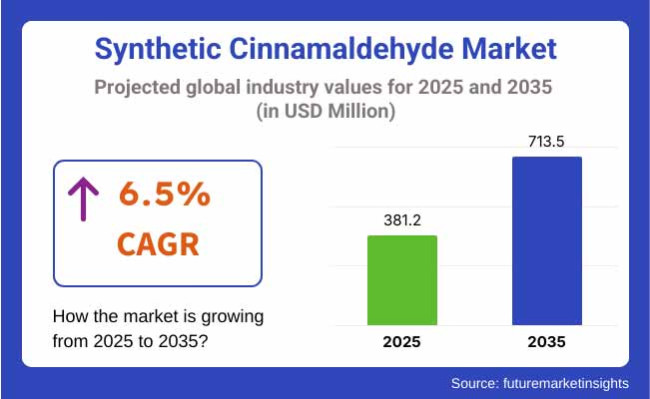
- Industry Size (2025)
- USD 381.2 Mn
- Forecast (2035)
- USD 713.5 Mn
- CAGR (2025 to 2035)
- 6.5%
Synthetic Cinnamaldehyde Market Outlook 2025 to 2035
Synthetic Cinnamaldehyde Market is likely to see astronomical growth from 2025 to 2035 since all these markets require more in view of higher applications in such markets like food and beverages, pharma, agro, and personal care. The market would be approximately USD 381.2 million in 2025 and may also be approximately USD 713.5 million in 2035 with a compound annual growth rate (CAGR) of 6.5% over the forecast period.
The market itself is changing dramatically due to some of the most powerful drivers. Growth in the flavour and fragrance industry, which is largely based on cinnamaldehyde, produced by converting geranial into one of the large constituents, is one of the strongest growth drivers.
Its use is in beverages and foods, whereby it assists in imparting a strong flavour or aroma of cinnamon to a product such as chewing gum, cake, and to food and beverage itself. Pharmacology is pending because it is opening its activity to an anti-inflammatory and to an antimicrobial. Regulatory issues pertaining to artificial flavouring additives and the shift to naturally occurring compounds are in jeopardy, and manufacturers try multiple routes of synthesis in accordance with policy of safety and sustainability.
Synthetic cinnamaldehyde is categorized on the basis of application and routes of synthesis. Synthetic cinnamaldehyde is employed as a food and beverage flavouring, a highly critical perfume and cosmetic raw material, and an active ingredient in agrochemicals.
Cinnamaldehyde naturally exists in insecticides as a way of repelling insects, which can repel insects without leaving residues of toxic chemicals. Synthetic cinnamaldehyde is used by the pharmaceutical industry as an ingredient of antifungal and antibacterial drugs. Organic food additive and environmentally friendly pesticide demand also includes synthetic cinnamaldehyde demand.
Regional Market Trends
North America
The North American market is a large share market for synthetic cinnamaldehyde due to the fact that it has developed mature food and beverage, pharma, and cosmetic markets. United States is among the largest consumers, where cinnamaldehyde is utilized as a food flavour ingredient in foods and drinks, chewing gum, and pharmaceuticals.
Conducive regulatory food additive climate being crafted in the region has also been responsible for development of the technology and innovation in form processing to address security requirements. Requirement of extremely pure synthetic cinnamaldehyde also comes on the heels of requirement for natural antimicrobial and preservative compounds like natural and plant antimicrobials.
North American pharmaceuticals are also interested in cinnamaldehyde's antimicrobial activity for the development of natural alternatives to synthetic antibiotics. In America and Canada, personal care and fragrance markets are also utilizing cinnamaldehyde increasingly to be incorporated into prestige fragrances and skincare for regional market growth.
Europe
Synthetic cinnamaldehyde is Europe's dominant market in imports from neighbouring nations including Germany, France, and Italy. European soft drinks, dairy products, and sweets are attached to the incorporation of synthetic cinnamaldehyde. Synthetics' regulation of additives in the European Union has been characterized by investments in cleaner production plants.
Pharmaceuticals and agrochemicals in the European market employ cinnamaldehyde because of its insect-repelling as well as antifungal properties. Provided that the trend among consumers to use clean-label commodities persists, European firms will launch green raw materials and green processing technology according to prevailing regulatory conditions.
Asia-Pacific
Asia-Pacific will also be growing at a faster rate with the use of synthetic cinnamaldehyde with higher growth in food processing units, pharma R&D, and personal care applications. India, China, Japan, and South Korea are the largest producers and consumers and among all these countries, the largest one is China as it has the largest size of flavour and perfumery market.
India's new pharmaceutical industry has experienced increasing demand for cinnamaldehyde as a bioactive ayurvedic and herbal medicine ingredient. Biopesticides produced from cinnamaldehyde are increasingly being adopted by Indian and Chinese agro-industries to manage insects infesting food crops with less toxic chemical synthetics. Environmental effects of chemical synthesis have, however, prompted authorities to impose stricter production conditions.
Challenges and Opportunities
Challenge
Regulatory and Consumer Concerns
The market for cinnamaldehyde is complemented by the demand of consumers for natural additives. There is regulatory control in Europe and North America on food additive production, and artificial flavour addition is thus outlawed in foods. The companies thus require research and development expenditures in an effort to reach levels of formulation amongst consumers as well as regulation formulation levels. In addition, petrochemical-based syntheses of cinnamaldehyde are also green issues that must be resolved, and there is an incentive to use greener synthesis processes.
Opportunity
Advancements in Green Chemistry and Bio-Based Production
Green chemistry technology presents a beneficial opportunity to the synthetic cinnamaldehyde industry. The firms strive to establish low-environment-footprint bio-based production processes without any compromise in the product quality. Biotechnology advancements allow it to obtain cinnamaldehyde from renewable biomass feedstocks through fermentation technologies and reduced petrochemical synthesis needs.
Besides this, higher use of synthetic cinnamaldehyde in agricultural insecticides is one of the new horizons of growth. It is being researched as an organic pesticide, and it will be a wonderful alternative as an effective yet safe pesticide instead of the usual chemical insecticides. They are all part of global trends going green on agriculture and safe food.
Shifts in the Synthetic Cinnamaldehyde Market from 2020 to 2024 and Future Trends 2025 to 2035
During 2020 to 2024, the total market for synthetic cinnamaldehyde grew with increasing demand in food, pharma, and personal care. Demand was fuelled by increasing demand owing to increased consumption of processed food, increasing demand for herbal medicine, and increasing sustainable agriculture. Due to artificial additive limitations, however, and consumer demand for clean-label food, the companies did have incentive to use bio-based synthesis as well as natural flavour.
In 2025 to 2035, the company will be supported in transformation through green production technology, R&D of bio-based cinnamaldehyde, and R&D of application of others in other business fields. Natural and renewable ingredients will lead business in the future across the industry since companies are forced to reduce the scale of business activities and create new grounds for clean-label and high-end level green ingredients.
Market Shifts: A Comparative Analysis 2020 to 2024 vs. 2025 to 2035
| Market Shift | 2020 to 2024 |
|---|---|
| Regulatory Landscape | Regulatory regulation was directed to acceptable levels of synthetic cinnamaldehyde in foodstuffs and cosmetics with regional difference in safety level. |
| Technological Advancements | Advancements in organic synthesis maximized productivity efficiency, with decreased costs and enhanced scalability. |
| Flavour & Fragrance Industry Trends | The food processing and beverage business experienced global utilization in bakery items, confections, and fizzy soft beverages owing to the cinnamon-like odour. |
| Pharmaceutical Applications | Science underscored its anti-inflammatory as well as antimicrobial activities to prompt enhanced usage in oral formulations and topical solutions. |
| Agrochemical Innovations | Synthetic cinnamaldehyde was used as an insect repellent and antimicrobial agent in crop protection. |
| Cosmetic and Personal Care | As a main fragrance note in perfumes, lotions, and soap; slight reformulation was practiced as a result of synthetic chemical problems. |
| Environmental Sustainability | Practical recovery of solvents during manufacture was common in waste treatment policies. |
| Production & Supply Chain Dynamics | Price instability of raw materials and supply chain disruption influenced the production cost, especially in petrochemical-derived cinnamaldehyde. |
| Market Shift | 2025 to 2035 |
|---|---|
| Regulatory Landscape | Regulatory bodies across global food and flavour use impose more stringent purity levels, requiring greater demand for low-residual solvents, high-purity synthetic cinnamaldehyde. |
| Technological Advancements | Bio-based synthesis and precision fermentation become increasingly accepted, ending dependence on petrochemical feedstock without being cost-inferior. |
| Flavour & Fragrance Industry Trends | Natural and sustainable ingredients shift consumer preferences, propelling demand for bioengineered cinnamaldehyde, with specialty uses occurring in plant-derived meat substitutes as a flavour ingredient. |
| Pharmaceutical Applications | Pharmaceutical uses include drug development, where cinnamaldehyde derivatives are used in antifungal and metabolic disorder medications. |
| Agrochemical Innovations | Environmentally friendly biopesticides produced using cinnamaldehyde are regulation-approved, replacing invasive chemical pesticides as they enhance agricultural production and soil fertility. |
| Cosmetic and Personal Care | Clean beauty consumerism drives demand for naturally occurring synthetic substitutes for cinnamaldehyde, driving investment in green chemistry solutions applied in skincare and haircare products. |
| Environmental Sustainability | Circular economy initiatives encourage closed-loop production, pushing for renewable raw materials and decreasing the carbon footprint while manufacturing synthetic cinnamaldehyde. |
| Production & Supply Chain Dynamics | Investment in supply chain diversification and biotech production stabilizes supply, decreasing reliance on the conventional petroleum sources. |
| Market Growth Drivers | Sustainable product innovation-driven growth, compliance with regulations, and the increasing consumer demand for functional ingredients in various sectors. |
Country-Wise Outlook
United States
The USA market for cinnamaldehyde continues to be in growth demand by end use in food and beverage, and flavour and fragrance. Natural-identical food and beverage flavouring is growing highest. Cinnamaldehyde also presents market demand opportunity with pharmaceutical and oral care end uses.
During the following decade, the USA market will be led by innovative and petrochemical-free bio-based synthesis technology. Environmentally-friendly insecticides and bio-friendly food additives will lead market growth too. Clean-label trend in cosmetics and FDA policy regulations regarding fragrance chemicals also mold the market ecosystem.
| Country | CAGR (2025 to 2035) |
|---|---|
| USA | 6.4% |
United Kingdom
UK demand for synthetic cinnamaldehyde is in a stable state of growth thanks to regulatory pressure for food safety and industry demand from the cosmetics and personal care industries. Use with REACH-compliant solutions of cinnamaldehyde is driving market trends towards sustainability and clean labels.
Increasing uses of herbal medicines and plant-based food products will drive demand for cinnamaldehyde synthetics. Additionally, awareness of consumers about non-toxic insecticides will drive consumption of bio-based derivatives of cinnamaldehyde in the agricultural sector.
| Country | CAGR (2025 to 2035) |
|---|---|
| UK | 6.5% |
European Union
Europe has the biggest market for synthetic cinnamaldehyde and is exploited by food, cosmetic, and perfume industries. Bioengineered and sustainable flavouring chemicals are mainly produced by Germany, Italy, and France, and others follow according to EU food security and chemical sustainability regulations.
Usage in cinnamaldehyde bio-synthesized, especially in luxury perfumes and organic-certified foods, is widespread. Additionally, R&D on European bioactive molecules is also persuasive innovation towards medicinally and nutraceutically valuable utilization of cinnamaldehyde. Green chemistry paradigms in the newly developing industries will also further speed up market growth.
| Region | CAGR (2025 to 2035) |
|---|---|
| European Union | 6.2% |
Japan
Japan demand for synthetic cinnamaldehyde is due to the demand in Japan to innovate food and drug use. Increased demand for traditional medicine preparation and health supplement functional food is increasing consumption of cinnamaldehyde.
Japanese cosmetics market is shifting towards bio-origin and natural-identical fragrances with the market growth being led by consumer demand for green cosmetics. Market growth is, however, led by innovation in controlled-release cinnamaldehyde in insect repellents. The Japanese market is interested in precision fermentation technologies for the manufacture of high-purity and low-toxicity cinnamaldehyde.
| Country | CAGR (2025 to 2035) |
|---|---|
| Japan | 6.3% |
South Korea
South Korean synthetic cinnamaldehyde has a busy market due to escalating demand for food processing, fragrance and flavour, and cosmetics. South Korea's domestic as well as foreign production of cinnamaldehyde-based bioactive compounds has been dominated.
Government-backed sustainability initiatives of the chemical and food sectors create market demand for sustainable versions of cinnamaldehyde derivatives like diminished market size for traditional synthetic cinnamaldehyde. Uses of cinnamaldehyde in antimicrobial additives and bioplastics also offer the market increased space to expand. Regulation compliance and clean-label ingredient attention in South Korea will be skewed towards incremental market growth in the subsequent few years.
| Country | CAGR (2025 to 2035) |
|---|---|
| South Korea | 6.2% |
Segmentation Forecast - Synthetic Cinnamaldehyde Market
Flavour Agents Rule the Market Owing to Their Widespread Use in Foods and Beverages
The most widespread in synthetic cinnamaldehyde are flavour ingredients because they have broad use in food and drinks. Synthetic cinnamaldehyde is a major food item for cinnamon-flavoured food, bakery product, confectionery, and chewing gum. Its pungent, hot, and robust flavour has widespread use for soft drink flavouring, milk products, and confectionaries.
Apart from the traditional uses, synthetically cinnamaldehyde is also found to be used more frequently in plant-based meat substitutes, acting character value in that it replicates the natural taste of the spice. Its use with bittering agents, also used twice in pharmaceuticals and mouthwashes, is another reason for its market dominance. Its growing use due to the demand for imitated natural flavour profiles since their artificial equivalents are affordable drives demand in this industry.
Antimicrobial Agents Become More Popular as Natural Preservatives Gain Demand
Synthetic cinnamaldehyde is also used widely as an antimicrobial due to its fungicidal and bactericidal activities. Synthetic cinnamaldehyde is used in the food processing industry with its preservative action to impart shelf life and inhibit the growth of spoilage microorganisms in processed foods, ready-to-eat foods, and sauces. Due to the current trend for natural preservatives and clean labelling, synthetic cinnamaldehyde provides a safer alternative to synthetic chemical preservatives such as sodium benzoate and sorbic acid.
Synthetic cinnamaldehyde also finds applications in antimicrobial product applications and drug coating of medical devices in the pharmaceutical industry. Its application is even being researched as an anti-dote to fight resistant bacteria, which further establishes it in medicine. Non-toxic and safe antimicrobial products for application in medicine and food safety are leading demand in this segment.
Aroma Agents Feel the Heat in Personal Care and Household Products
Aroma chemicals are the largest use of synthetic cinnamaldehyde, and the majority of it is perfumery and personal care. Due to the familiar sweet-spicy smell of the compound, it is a familiar fragrance raw material that is used in perfumes, scented candles, air fresheners, and also in personal care products like shampoos and body lotions.
Synthetic cinnamaldehyde is applied in household products whose scent dominates pungent chemical smells applied in cleaning products. Its use in detergents, disinfectants, and softeners helps them achieve their respective fragrance benefits. Its use in air conditioners as an insecticide and in insect-control sprays is another propellant. Rising demand for nature-based fragrances that have improved shelf life propels this sector.
Pesticide & Insecticide Applications Expand as Eco-Friendly Alternatives Gain Popularity
Synthetic cinnamaldehyde is gaining increased use for wider use in agriculture as an insecticide and a pesticide due to its natural repellent action. Synthetic cinnamaldehyde efficiently controls most of the crop pests such as mites, aphids, and fungal infection and thus has extremely wide usage in organic cultivation.
As compared to chemical pesticides, cinnamaldehyde products offer a more environmentally friendly and biodegradable option with lower environmental footprint. The farmers are employing these products for confronting strict agri-regulations, consumers' demand for pesticide-free food items, mosquito repellents, killing of fleas infesting animals, and domestic-use insecticides. All these factors are driving the expansion of agricultural and consumer markets.
Food & Beverage Industry Largest User of Synthetic Cinnamaldehyde
Food and beverages industry is the largest consumer of synthetic cinnamaldehyde and employs it as milk, drinks, baked foods, and confectioneries. Besides flavouring agent application, it is employed as preservative and antimicrobial to prolong the shelf lives of short-life products.
Synthetic cinnamaldehyde is applied by the food and beverage sector in flavour spirits, liqueurs, and cinnamon-flavoured beverages. Demand is stimulated by its application in vegetable foods and functional beverages. Growing focus on ethnic and exotic flavours in the global food market guarantees industry expansion to be in a positive streak.
Synthetic Cinnamaldehyde is Applied by the Healthcare Industry in Therapeutic Uses
Synthetic cinnamaldehyde has also been considered in the pharmaceutical industry as a therapeutic agent of application in treating inflammatory diseases, microbial infections, and metabolic syndrome. Its antimicrobial properties and antioxidant activity make it an excellent active pharmaceutical ingredient in drug products, particularly oral products such as toothpaste and mouthwashes.
Its value in cancer, for which it is at present being considered as an anticancer drug inhibitor of tumour cell proliferation, is similarly more forward. Expanded curiosity about characterizing natural and bioactive substance in drugs and nourishment enhancements opens up open doors for broadened utilization of artificially created cinnamaldehyde in medicinal benefits.
Condensation of Acetaldehyde and Benzaldehyde Emerges the Preferred Synthesis Process
Out of the many synthesis paths, the most common path for the synthesis of cinnamaldehyde is condensation of sodium hydroxide solution of benzaldehyde and acetaldehyde. The reaction is favoured because it is economical, offers high yield, and can yield very pure cinnamaldehyde, which is applied in food, drugs, and fragrances.
Cinnamyl alcohol oxidation is also the most commonly employed process, especially in industrial syntheses where purity is not a requirement. Hydrolysis of cinnamyl dichloride and (1-chloroally) benzene treatment are less favoured due to a greater level of complexity combined with reduced efficiency with yield. Increased demand in highly regulated industries such as health and food for cinnamaldehyde of growing purity further confirms the superiority of benzaldehyde-acetaldehyde condensation as the superior synthesis.
Competitive Landscape
Synthetic cinnamaldehyde is a highly competitive market with local as well as international players dominating the market, with international players dominating in terms of innovation and operational efficiency. Key players focus on high-purity synthesis, eco-friendly production, and wider application in food & beverages, pharma, flavour, and agriculture sectors.
There are existing competitors and emerging competitors in the industry, and the existing competitors plus emerging competitors are all collaborating towards the development of innovations in manufacturing process, acceptability in the regulatory aspect, and functional enhancements in synthetic cinnamaldehyde.
Market Share Analysis by Company
| Company Name | Estimated Market Share (%) |
|---|---|
| Emerald Kalama Chemical | 15-20% |
| Kao Corporation | 10-14% |
| Prasol Chemicals Pvt. Ltd. | 8-12% |
| Merck KGaA | 6-10% |
| LANXESS | 4-8% |
| Other Companies (combined) | 40-50% |
Key Company Offerings and Activities
| Company Name | Key Offerings/Activities |
|---|---|
| Emerald Kalama Chemical | Develops high-purity synthetic cinnamaldehyde for food flavouring, personal care, and industrial applications. Focuses on sustainable and eco-friendly production processes. |
| Kao Corporation | Specializes in cinnamaldehyde derivatives for fragrances, cosmetics, and antimicrobial applications. Invests in innovative synthesis techniques for enhanced product stability. |
| Prasol Chemicals Pvt. Ltd. | Manufactures synthetic cinnamaldehyde for pharmaceutical and agrochemical applications. Focuses on cost-effective production and global supply chain expansion. |
| Merck KGaA | Supplies high-grade synthetic cinnamaldehyde for research, specialty chemicals, and biotech industries. Develops customized solutions for niche applications. |
| LANXESS | Produces synthetic cinnamaldehyde for industrial and preservative applications. Emphasizes regulatory compliance and green chemistry initiatives. |
Key Company Insights
Emerald Kalama Chemical (15-20%)
Emerald Kalama Chemical dominates the market of synthetic cinnamaldehyde through a total variety of food flavour, personal care, and industrial uses. It is an environmentally friendly business dedicated to using green production techniques without emitting or producing wastes. Its global marketing network supplies products to various markets because of increasing demands for natural and synthetic aromatic chemicals.
Kao Corporation (10-14%)
Kao Corporation is a specialty fragrance and cosmetic producer of high-quality cinnamaldehyde for regional, personal care, and fragrance applications. Kao is aggressively involved in developing advanced synthesis technology to improve product stability and fragrance life. Kao technology, R&D oriented, enables it to create innovative formulating products as per consumer demand and regulatory standards.
Prasol Chemicals Pvt. Ltd. (8-12%)
Prasol Chemicals is the biggest manufacturer of synthetic cinnamaldehyde used by pharma and agrochemical industries. It specializes in low-cost production with no compromise on purity and regulatory requirements. With increasing international exposure, Prasol wishes to make its supply chain more efficient and provide tailor-made solutions to the industrial base.
Merck KGaA (6-10%)
Merck KGaA provides top-grade synthetic cinnamaldehyde for specialty chemicals such as research and biotech markets. Merck trades in precise production and tailored solutions, which are designed to fit specific needs of pharmaceutical and analysis businesses. Merck's innovation strategy helps in delivering top-grade compounds for tailored application.
LANXESS (4-8%)
LANXESS industrially synthetically manufactures cinnamaldehyde for industrial, preservative, and antimicrobial use. It is committed to regulation and sustainability and operates at a global level of safety. LANXESS remains committed to its production productivity and greener alternatives over conventional synthesis alternatives.
Other Key Players (40-50% Combined)
Other companies corner the synthetic cinnamaldehyde market through innovations, cost-cutting, and specialty solutions. These include:
- Symrise AG
- Vigon International
- BASF SE
- Jayant Agro-Organics Ltd.
- Sigma-Aldrich
Synthetic Cinnamaldehyde Market Segmentation
By Type of Product:
- Flavor agent
- Antimicrobial agent
- Aroma agent
- Pesticide & Insecticide
By Application:
- Food & Beverages
- Household & Personal Care
- Agriculture
- Healthcare
- Industrial
By Synthesis Process:
- Oxidation of cinnamyl alcohol
- Condensation of Benzaldehyde and Acetaldehyde in presence of sodium hydroxide
- Hydrolysis of cinnamyl dichloride by cold water
- Condensation of styrene with formylmethylaniline in presence of phosphorus oxychloride
- Treatment of (1-chloroally) benzene with phosphorus pentachloride and conversion of (2,3,3-trichloropropyl) benzene to cinnamaldehyde
By Region:
- North America
- Latin America
- Western Europe
- Eastern Europe
- East Asia
- South Asia Pacific
- Middle East and Africa
Frequently Asked Questions
What was the overall size of the synthetic cinnamaldehyde market in 2025?
The overall market size for synthetic cinnamaldehyde was USD 324.93 million in 2025.
How big is the synthetic cinnamaldehyde market expected to be in 2035?
The synthetic cinnamaldehyde market is expected to reach USD 713.5 million by 2035.
What will drive the demand for the synthetic cinnamaldehyde market during the forecast period?
The increasing adoption in industrial and chemical processes, rising demand in the food and beverage industry, and growing applications in the pharmaceutical industry are expected to drive the synthetic cinnamaldehyde market during the forecast period.
List the top 5 regions contributing to the synthetic cinnamaldehyde market.
The top 5 regions driving the development of the synthetic cinnamaldehyde market are North America, Europe, Asia-Pacific, Latin America, and the Middle East & Africa.
Which is the leading application segment in the synthetic cinnamaldehyde market?
Based on application, the flavouring agent segment is projected to be the leading segment in the synthetic cinnamaldehyde market over the forecast period.
Preview the report firsthand - request a free sample
Get SampleGet the brochure for pricing and purchase details.
Get PDFTable of Content
- Executive Summary
- Industry Introduction, including Taxonomy and Market Definition
- Market Trends and Success Factors, including Macro-economic Factors, Market Dynamics, and Recent Industry Developments
- Global Market Demand Analysis 2020 to 2024 and Forecast 2025 to 2035, including Historical Analysis and Future Projections
- Global Market Analysis 2020 to 2024 and Forecast 2025 to 2035
- Type of Product
- Application
- Synthesis Process
- Global Market Analysis 2020 to 2024 and Forecast 2025 to 2035, By Type of Product
- Flavor agent
- Antimicrobial agent
- Aroma agent
- Pesticide & Insecticide
- Global Market Analysis 2020 to 2024 and Forecast 2025 to 2035, By Application
- Food & Beverages
- Household & Personal Care
- Agriculture
- Healthcare
- Industrial
- Global Market Analysis 2020 to 2024 and Forecast 2025 to 2035, By Synthesis Process
- Oxidation of cinnamyl alcohol
- Condensation of Benzaldehyde and Acetaldehyde in presence of sodium hydroxide
- Hydrolysis of cinnamyl dichloride by cold water
- Condensation of styrene with formylmethylaniline in presence of phosphorus oxychloride
- Treatment of (1-chloroally) benzene with phosphorus pentachloride and conversion of (2,3,3-trichloropropyl) benzene to cinnamaldehyde
- Global Market Analysis 2020 to 2024 and Forecast 2025 to 2035, By Region
- North America
- Latin America
- Western Europe
- Eastern Europe
- East Asia
- South Asia Pacific
- Middle East and Africa
- North America Sales Analysis 2020 to 2024 and Forecast 2025 to 2035, by Key Segments and Countries
- Latin America Sales Analysis 2020 to 2024 and Forecast 2025 to 2035, by Key Segments and Countries
- Western Europe Sales Analysis 2020 to 2024 and Forecast 2025 to 2035, by Key Segments and Countries
- Eastern Europe Sales Analysis 2020 to 2024 and Forecast 2025 to 2035, by Key Segments and Countries
- East Asia Sales Analysis 2020 to 2024 and Forecast 2025 to 2035, by Key Segments and Countries
- South Asia Pacific Sales Analysis 2020 to 2024 and Forecast 2025 to 2035, by Key Segments and Countries
- Middle East and Africa Sales Analysis 2020 to 2024 and Forecast 2025 to 2035, by Key Segments and Countries
- Sales Forecast 2025 to 2035 by Type of Product, Application, and Synthesis Process for 30 Countries
- Competition Outlook, including Market Structure Analysis, Company Share Analysis by Key Players, and Competition Dashboard
- Company Profile
- Symrise
- Chem-Fleur, Inc. / Firmenich SA
- Chemical Dynamics, Inc.
- Givaudan
- Penta Manufacturing Company, LLC.
- BERJÉ INC
- Merck KGaA
- ABI Chem
- TimTec LLC
- NIPPON A&L INC.


