

- Industry Size (2026)
- USD 338.2 Bn
- Forecast (2036)
- USD 697.0 Bn
- CAGR (2026 to 2036)
- 7.5%
Telecom Mounting Hardware Market Size, Market Forecast and Outlook By FMI
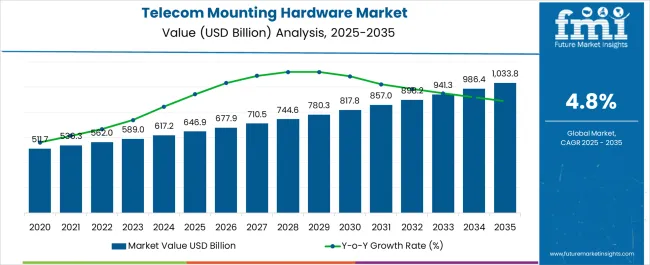
In 2025, the telecom mounting hardware market was valued at USD 338.2 billion. Based on Future Market Insights’ analysis, demand for telecom mounting hardware is estimated to grow to USD 363.6 billion in 2026 and USD 697.0 billion by 2036. FMI projects a CAGR of 7.5% during the forecast period.
Industry is currently witnessing a "Compliance or Collapse" shift in urban centers, where stagnant macro-tower volumes are yielding to high-margin, aesthetic street-level infrastructure. This transition is not merely about adding more steel; it is about "invisible" densification. Municipalities are rejecting traditional industrial masts in favor of concealed mounting solutions that integrate 5G radios into lamp posts and utility poles. This forces hardware vendors to engineer mounts that manage thermal dissipation and wind load while remaining visually unobtrusive, effectively turning commodity brackets into high-value architectural components.
Despite the volatility in global capex cycles, major telecom network infrastructure providers are noting a return to predictable demand patterns as inventory corrections conclude. As AVNER M. APPLBAUM, President & Chief Executive Officer, Valmont noted regarding the sector's recovery, "In Infrastructure, we saw growth in Utility, driven by ongoing demand strength, and stabilization in the Telecommunications market as carrier spending increased." [1] This stabilization suggests that the market has absorbed the post-pandemic inventory glut and is now entering a phase of steady, specification-driven growth focused on network densification and grid hardening.
Summary of Telecom Mounting Hardware Market
- Telecom Mounting Hardware Market Definition
- The industry covers the specialized structural hardware required to mount and secure active network equipment across macro and street-level sites.
- Demand Drivers in the Market
- Global 5G Standalone (SA) rollouts require massive densification of mid-band sites.
- Rural connectivity mandates in emerging economies drive demand for ruggedized, off-grid mounting kits.
- Urban aesthetic regulations force a shift toward concealed and integrated smart pole solutions.
- Key Segments Analyzed in the FMI Report
- Component: Hardware dominates with 51.7% share due to heavy steel and composite volume.
- Technology: 5G accounts for 46.2% of value as carriers prioritize mid-band deployment.
- Geography: Asia Pacific leads in volume growth while Europe drives innovation in concealment.
- Analyst Opinion at FMI
- VP for Technology and Media at Future Market Insights, opines, "The hardware market is bifurcating between high-volume, standardized mounts for rural coverage and high-value, aesthetic solutions for urban densification. My research team’s findings indicate that vendors who can integrate renewable power and compute capabilities directly into their mounting platforms will capture the highest margins in the coming decade."
- Strategic Implications/Executive Takeaways
- Shift product portfolios from passive steel to active site enablement kits.
- Prioritize partnerships with municipal lighting and utility providers to access street-level real estate.
- Invest in lightweight, composite materials to reduce logistics costs for remote deployments.
- Methodology
- Validated through first-hand corporate production and capacity data.
- Zero reliance on speculative third-party market research reports.
- Based on verifiable industrial benchmarks and verified sources.
Regional growth variance is heavily skewed toward Asia Pacific, with China leading the forecast with a 10.1% CAGR, followed closely by India at 9.4%, driven by aggressive state-led 5G and FWA mandates. Mature Western markets display steadier replacement-driven growth, with Germany projected at 8.6%, France at 7.9%, and the United Kingdom at 7.1%, reflecting the shift toward aesthetic urban concealment and densification rather than greenfield macro-tower expansion.
Telecom Mounting Hardware Market Definition
The telecom mounting hardware market refers to the global ecosystem of physical support structures and accessories designed to secure telecommunications equipment to towers, rooftops, utility poles, and street furniture.
Telecom Mounting Hardware Market Inclusions
The report includes a comprehensive analysis of structural components such as brackets, mounts, masts, monopoles, and camouflaged concealment solutions used for wireless and wired network deployment. It covers hardware essential for macro towers, small cells, distributed antenna systems (DAS), and fixed wireless access (FWA) points, along with associated installation and maintenance services.
Telecom Mounting Hardware Market Exclusions
The scope excludes the active electronic equipment itself, such as radios, antennas, and baseband processing units, unless sold as a fully integrated "smart pole" unit where the hardware value is inseparable. It also omits general-purpose construction materials not specifically engineered for telecommunications load-bearing standards, as well as non-telecom utility infrastructure.
Telecom Mounting Hardware Market Research Methodology
- Primary Research: Interviews were conducted with tower company executives, hardware OEMs, municipal planners, and regulatory bodies to gauge infrastructure rollout timelines.
- Desk Research: Production data from steel fabricators, regulatory filings from telecom operators, and funding announcements from infrastructure startups supported volume benchmarking.
- Market-Sizing and Forecasting: A hybrid top-down and bottom-up model was developed, reconstructing demand from base station deployment targets and tower operational capex.
- Data Validation and Update Cycle: Outputs undergo anomaly screening, variance checks against operator capital expenditure guidance, and structured peer review prior to release.
Segmental Analysis
Telecom Mounting Hardware Market Analysis by Technology
The transition to 5G technology is fundamentally reshaping the physical requirements of network sites, driving 46.2% of total market value in 2026. Unlike previous generations, 5G mid-band and millimeter-wave frequencies require a significantly denser grid of antennas, necessitating a shift from few large macro towers to thousands of street-level mounting points. Ericsson forecasts that global 5G subscriptions will reach 6.3 billion by 2030, creating sustained pressure on operators to densify their networks to handle the associated data traffic [2]. This densification forces hardware vendors to design compact, lightweight mounts that can be deployed on lamp posts and building facades without structural retrofitting.
- 5G: Demand is accelerating as carriers move to Standalone (SA) architectures that require dedicated new infrastructure rather than just upgrades to existing LTE sites.
- 4G/LTE: Volume remains significant in developing regions where operators are expanding coverage to underserved rural areas using standard telecom tower configurations.
- 2G & 3G: This segment is in structural decline, with hardware demand limited to maintenance and replacement of legacy sites in specific late-adopter markets.
Telecom Mounting Hardware Market Analysis by Component
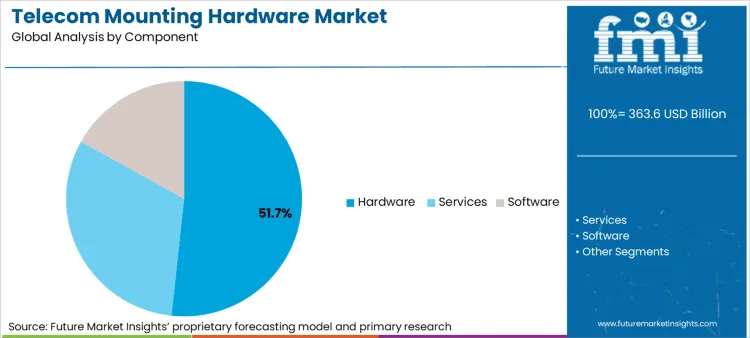
Hardware components represent the backbone of the market, holding a 51.7% share, as physical steel and composite structures remain non-negotiable for network integrity. However, the definition of "hardware" is evolving from simple brackets to complex, wind-load engineered systems capable of supporting heavier massive MIMO active antenna units. American Tower Corporation reported total capital expenditures of approximately USD 1.6 billion in 2024, highlighting the immense continued investment in the physical structural layer of the network [3]. This capex flows directly into the procurement of reinforced mounts, monopoles, and tower strengthening kits required to support the additional weight and windage of modern 5G equipment.
- Hardware: Growth is driven by the physical necessity of mounting heavier base station antenna units on existing towers, requiring reinforced structural steel kits.
- Services: Installation, site acquisition, and structural analysis services are growing as operators outsource the complexity of deploying small cell network sites in difficult urban zoning environments.
- Software: Emerging demand for digital twin modeling of tower loads allows operators to optimize mounting locations remotely before dispatching crews.
Telecom Mounting Hardware Market Drivers, Restraints, and Opportunities
The primary engine propelling the market is the imperative for "Mid-Band Densification," which is physically transforming the urban landscape. Although 5G population coverage is growing globally, 5G mid-band is only deployed in around 30 percent of all sites globally outside of mainland China [4]. This gap represents a massive physical infrastructure deficit. To close it, operators cannot rely on existing macro towers; they must deploy thousands of new mounting points on street furniture, utility poles, and building facades. This creates a sustained wave of procurement for specialized side-arm mounts, canister shrouds, and rooftop sleds that can support active antenna units without penetrating building envelopes.
The "Power and Permit" bottleneck acts as a significant restraint. In many jurisdictions, acquiring the permit to mount a small cell takes longer than the installation itself, stalling hardware orders. Furthermore, in emerging markets, the lack of reliable grid power makes standard mounting solutions useless. This challenge, however, is opening a lucrative opportunity for "Energy-Integrated Infrastructure." Companies like Ryse Energy are capitalizing on this by deploying over 5,000 renewable energy systems, effectively bundling power generation with the mounting structure to create a resilient, off-grid site solution [5]. This signals a market evolution where the most valuable mounting hardware will be that which solves the energy problem.
- Mid-Band Densification: The massive gap in mid-band site deployment globally creates a long-term runway for street-level mounting hardware.
- Zoning Friction: Permitting delays for visible infrastructure in urban centers retard the speed of hardware deployment, favoring concealment solutions.
- Energy Integration: The lack of grid reliability in rural areas creates a premium market for mounting kits that integrate solar and wind power generation.
Regional Analysis
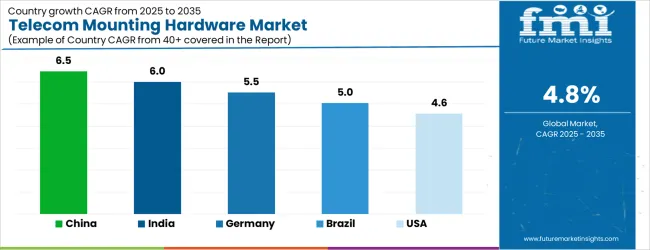
Based on the regional analysis, the telecom mounting hardware market is segmented into North America, Latin America, Europe, East Asia, South Asia, Oceania and Middle East & Africa across 40+ countries. The full report also offers market attractiveness analysis based on regional trends.
| Country | CAGR (2026 to 2036) |
|---|---|
| China | 10.1% |
| India | 9.4% |
| Germany | 8.6% |
| France | 7.9% |
| United Kingdom | 7.1% |
Source: Future Market Insights (FMI) analysis, based on proprietary forecasting model and primary research
Asia Pacific Telecom Mounting Hardware Market Analysis
Asia Pacific serves as the global volume engine, characterized by state-coordinated infrastructure mandates that prioritize rapid, nationwide coverage over incremental upgrades. The region's market dynamics are defined by centralized procurement from massive tower-mounted amplifier companies (TowerCos), which drives down unit costs for standardized hardware but creates immense volume requirements.
- China: The market trajectory in China, projected to expand at a 10.1% CAGR, is defined by state-level execution; the Ministry of Industry and Information Technology confirmed the deployment of 4.14 million 5G base stations by late 2024, creating a massive installed base that requires constant structural maintenance and upgrading [6].
- India: India's market expansion, estimated at a 9.4% CAGR, is being catalyzed by the surge in Fixed Wireless Access (FWA); with subscribers hitting 6.77 million by early 2025, there is a corresponding boom in demand for rooftop pole mounts and consumer-premise mounting kits [7].
FMI’s report includes a detailed analysis of growth in the Asia Pacific region, along with a country-wise assessment that includes China, India, Japan, South Korea, and Indonesia. Readers can also find regional trends, regulations, and market growth based on different segments and countries in Asia Pacific.
Europe Telecom Mounting Hardware Market Analysis
Europe acts as the global laboratory for "aesthetic integration," where strict urban planning laws and historic preservation mandates force innovation in concealment hardware. The value here lies not in the tonnage of steel, but in the engineering of mounts that can blend seamlessly into heritage architecture.
- Germany: In Germany, where demand is forecast to grow at an 8.6% CAGR, the focus has shifted to closing the final coverage gaps; with the Federal Network Agency reporting 95% surface area coverage for 5G, hardware spend is moving toward densification and capacity reinforcement in difficult-to-reach rural zones [8].
- France: French infrastructure investment, driving a 7.9% CAGR, is prioritizing 5G adoption, with 24.3 million SIM cards already active on 5G networks, driving a retrofit cycle for existing metropolitan rooftop sites to support heavier active antenna units [9].
- United Kingdom: The United Kingdom, anticipated to witness a 7.1% CAGR, is witnessing a surge in Standalone 5G deployment, which has reached 83% of premises, necessitating the widespread installation of new, specific mounting configurations that support advanced massive MIMO gear [10].
FMI’s report includes a detailed analysis of growth in the Europe region, along with a country-wise assessment that includes Germany, France, the United Kingdom, Italy, and Spain. Readers can also find regional trends, regulations, and market growth based on different segments and countries in Europe.
Competitive Aligners for Market Players
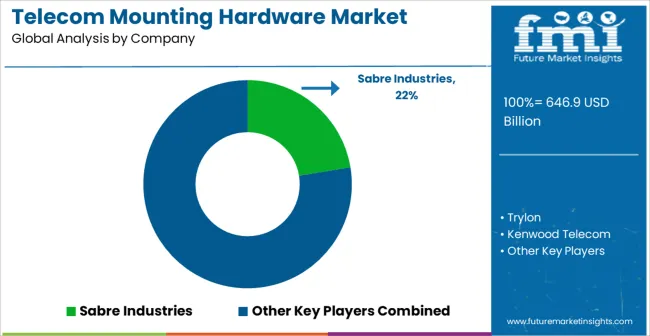
The competitive landscape is bifurcating into two distinct operational models: high-volume commodity manufacturing and high-value integrated solutions. Large steel fabricators rely on economies of scale to supply standard brackets and towers to national tower companies, competing primarily on price and raw material hedging strategies. However, to escape the "commodity trap," forward-thinking players are pivoting toward technology-infused hardware.
A key strategic aligner is the shift toward "Smart City Integration." Companies are differentiating themselves by offering "site-in-a-box" solutions that integrate power, cooling, and concealment into the mounting hardware itself. For instance, Ubicquia recently raised USD 70.6 million to accelerate its portfolio of street-level smart infrastructure, effectively transforming simple streetlights into intelligent mounting assets [11]. This strategy insulates vendors from steel price volatility and builds stickier relationships with municipalities. Additionally, the market is seeing consolidation among pure-play hardware vendors, as evidenced by CommScope’s agreement to divest its Outdoor Wireless Networks segment to Amphenol, allowing the acquirer to consolidate its grip on the antenna-mount interface ecosystem [12].
Recent Developments
The report includes full coverage of key trends from competitive benchmarking. Some of the recent developments covered in the reports:
- In October 2024, Nokia reported a net sales decline driven by the normalization of India's rapid 5G rollout, signaling a shift from peak deployment frenzy to a steady-state maintenance and fill-in phase for hardware suppliers [13].
- In February 2026, the UK Government (DSIT) launched a "Mobile Market Review" call for evidence to explore planning law changes, potentially reducing the regulatory barriers for deploying new mounting infrastructure [14].
Key Players in Telecom Mounting Hardware Market
- Huawei
- Nokia
- Ericsson
- Cisco
- ZTE
- CommScope
- Amphenol
- Valmont Industries
- American Tower Corporation
- Ubicquia
- Ryse Energy
Scope of the Report
| Metric | Value |
|---|---|
| Quantitative Units | USD 363.6 billion (2026) to USD 697.0 billion (2036), at a CAGR of 7.5% |
| Market Definition | The telecom mounting hardware market refers to the global ecosystem of physical support structures and accessories designed to secure telecommunications equipment to towers, rooftops, utility poles, and street furniture. |
| Component Segmentation | Hardware, Software, Services |
| Technology Segmentation | 5G, 4G/LTE, 2G & 3G |
| Application Coverage | Macro Towers, Small Cells, DAS, FWA |
| Regions Covered | Asia Pacific, Europe, North America, Latin America, Middle East & Africa |
| Countries Covered | China, India, Germany, France, United Kingdom, United States, Japan, South Korea, Indonesia, Australia & New Zealand, Italy, Spain, Benelux, Nordics, Brazil, Argentina, Saudi Arabia, UAE, South Africa |
| Key Companies Profiled | Huawei, Nokia, Ericsson, Cisco, ZTE, CommScope, Amphenol, Valmont Industries, American Tower Corporation, Ubicquia, Ryse Energy |
| Forecast Period | 2026 to 2036 |
| Approach | Hybrid top-down and bottom-up market modeling validated through primary interviews with resin producers and panel manufacturers, supported by trade data benchmarking and plant level capacity verification |
Telecom Mounting Hardware Market by Segments
Component
- Hardware
- Software
- Services
Technology
- 5G
- 4G/LTE
- 2G & 3G
Infrastructure
-
Wireless
- Wired
End Use
- Consumer Electronics
- BFSI
- Retail
- Media
Region
- Asia Pacific
- India
- China
- Japan
- South Korea
- Indonesia
- Australia & New Zealand
- ASEAN
- Rest of Asia Pacific
- Europe
- Germany
- Italy
- France
- United Kingdom
- Spain
- Benelux
- Nordics
- Central & Eastern Europe
- Rest of Europe
- North America
- United States
- Canada
- Mexico
- Latin America
- Brazil
- Argentina
- Chile
- Rest of Latin America
- Middle East & Africa
- Kingdom of Saudi Arabia
- United Arab Emirates
- South Africa
- Turkey
- Rest of Middle East & Africa
Bibliography
- [1] USA Securities and Exchange Commission. (2025). Valmont Industries, Inc. Annual Report (Form 10-K) for the fiscal year ended December 28, 2024 (2024 Annual Report & Form 10-K). SEC EDGAR
- [2] Ericsson. (2024). Ericsson Mobility Report: Global 5G subscriptions forecast to reach 6.3 billion by 2030. Corporate Report.
- [3] American Tower Corporation. (2024). Fourth Quarter and Full Year 2024 Financial Results. Corporate Filing.
- [4] Ericsson. (2024). Ericsson Mobility Report Update: Mid-band densification gap analysis. Industry Report.
- [5] Ryse Energy. (2024). Deployment of over 5,000 renewable energy systems for critical infrastructure. Corporate Update.
- [6] MIIT China. (2024). China achieves 14th Five-Year Plan 5G goals ahead of schedule with 4.14 million base stations. Government Statistics.
- [7] TRAI. (2025). Yearly Performance Indicators of Indian Telecom Sector 2024-25. Regulator Report.
- [8] Bundesnetzagentur. (2025). Mobile communications monitoring report confirms 95% 5G coverage in Germany. Regulator Press Release.
- [9] Arcep. (2025). French Telecoms Market Telconomics: 5G adoption reaches 24.3 million SIM cards. Regulator Statistics.
- [10] Ofcom. (2026). Mobile Market Review Call for Evidence. Government Publication.
- [11] Ubicquia. (2024). Ubicquia raises $70.6M in Series D funding led by Fuel Venture Capital. Company Press Release.
- [12] CommScope. (2024). CommScope Reports Third Quarter 2024 Results and Divestiture Announcement. Corporate Press Release.
- [13] Nokia. (2024). Interim Report Q3 2024: Net sales decline in India region. Corporate Filing.
- [14] UK Government (DSIT). (2026). Mobile Market Review: Call for Evidence on planning laws. Government Announcement.
This Report Addresses
- Market intelligence to enable structured strategic decision making across mature and emerging telecom infrastructure economies
- Market size estimation and 10 year revenue forecasts from 2026 to 2036, supported by validated tower count and capex benchmarks
- Growth opportunity mapping across macro towers, small cells, and smart poles with emphasis on 5G densification
- Segment and regional revenue forecasts covering wireless and wired infrastructure, hardware components, and installation services
- Competition strategy assessment including M&A consolidation models, cost survivability positioning, and smart city partnership benchmarking
- Product innovation tracking including wind-load engineered mounts, camouflaged concealment solutions, and renewable-integrated sites
- Regulatory impact analysis covering spectrum auction mandates, urban planning zoning laws, and infrastructure sharing policies
- Market report delivery in PDF, Excel, PPT, and interactive dashboard formats for executive and operational use
Frequently Asked Questions
How large is the demand for Telecom Mounting Hardware in the global market in 2026?
Demand for Telecom Mounting Hardware in the global market is estimated to be valued at USD 363.6 billion in 2026.
What will be the market size of Telecom Mounting Hardware in the global market by 2036?
Market size for Telecom Mounting Hardware is projected to reach USD 697.0 billion by 2036.
What is the expected demand growth for Telecom Mounting Hardware in the global market between 2026 and 2036?
Demand for Telecom Mounting Hardware in the global market is expected to grow at a CAGR of 7.5% between 2026 and 2036.
Which Component is poised to lead global sales by 2026?
Hardware is expected to be the dominant component, capturing approximately 51.7% of global market share in 2026 due to the physical requirements of network densification.
How significant is the role of Wireless Infrastructure in driving Telecom Mounting Hardware adoption in 2026?
Wireless infrastructure represents a critical segment, projected to hold a substantial 58.9% share of the total market in 2026 as 5G rollouts accelerate.
What is driving demand in China?
The market trajectory in China is defined by the government's rapid execution of the 14th Five-Year Plan, which has already resulted in 4.14 million 5G base stations [6].
What compliance standards or regulations are referenced for China?
The 14th Five-Year Plan targets for digital infrastructure construction are referenced as the key regulatory benchmark [6].
What is the China growth outlook in this report?
China is projected to grow at a CAGR of 10.1% during 2026 to 2036.
Why is Europe described as a priority region in this report?
Europe is a priority because mature markets are focusing on aesthetic integration and retrofitting existing sites to meet strict urban planning and coverage mandates.
What type of demand dominates in Europe?
Replacement driven demand for high-value, concealed, and integrated mounting solutions dominates regional consumption.
What is India growth outlook in this report?
India is projected to expand at a CAGR of 9.4% during 2026 to 2036.
Does the report cover Germany in its regional analysis?
Yes, Germany is included within Europe under the regional scope of analysis.
What are the sources referred to for analyzing Germany?
Official coverage data from the Bundesnetzagentur (Federal Network Agency) is cited as the primary reference source [8].
What is the main demand theme linked to Germany in its region coverage?
Demand is linked to achieving nationwide coverage targets, with 95% surface area coverage already reached [8].
Does the report cover the United Kingdom in its regional analysis?
Yes, the United Kingdom is included within Europe under the regional coverage framework.
What is the main United Kingdom related demand theme in its region coverage?
The main theme is the rollout of Standalone 5G, which has reached 83% of premises, driving demand for site upgrades [10].
Which product formats or configurations are strategically important for Asia Pacific supply chains?
Standardized steel macro tower components and ruggedized rural mounting kits are strategically important for the region's volume-driven rollout.
What is Telecom Mounting Hardware and what is it mainly used for?
Telecom mounting hardware consists of structural supports like brackets, poles, and masts used to secure antennas and radios to towers and buildings.
What does Telecom Mounting Hardware Market mean in this report?
It refers to the global industry for manufacturing and supplying the physical structural interface between network equipment and the site environment.
What is included in the scope of this Telecom Mounting Hardware report?
The scope covers hardware components, installation services, and software for planning, across wireless and wired infrastructure.
What is excluded from the scope of this report?
Active electronic components like radios and antennas are excluded unless they are inseparable parts of an integrated smart pole solution.
What does market forecast mean on this page?
Market forecast represents a model based projection built on defined assumptions for strategic planning purposes.
How does FMI build and validate the Telecom Mounting Hardware forecast?
The forecast is developed using hybrid top-down and bottom-up modeling validated through primary interviews and telecom network infrastructure benchmarks.
What does zero reliance on speculative third party market research mean here?
Primary interviews and verifiable public datasets are used instead of unverified syndicated market estimates.
Preview the report firsthand - request a free sample
Get SampleGet the brochure for pricing and purchase details.
Get PDFTable of Content
- Executive Summary
- Global Market Outlook
- Demand-side Trends
- Supply-side Trends
- Technology Roadmap Analysis
- Analysis and Recommendations
- Market Overview
- Market Coverage / Taxonomy
- Market Definition / Scope / Limitations
- Research Methodology
- Chapter Orientation
- Analytical Lens and Working Hypotheses
- Market Structure, Signals, and Trend Drivers
- Company Annual and Sustainability Reports
- Peer-reviewed Journals and Academic Literature
- Corporate Websites, Product Literature, and Technical Notes
- Earnings Decks and Investor Briefings
- Statutory Filings and Regulatory Disclosures
- Technical White Papers and Standards Notes
- Trade Journals, Industry Magazines, and Analyst Briefs
- Conference Proceedings, Webinars, and Seminar Materials
- Government Statistics Portals and Public Data Releases
- Press Releases and Reputable Media Coverage
- Specialist Newsletters and Curated Briefings
- Sector Databases and Reference Repositories
- FMI Internal Proprietary Databases and Historical Market Datasets
- Subscription Datasets and Paid Sources
- Social Channels, Communities, and Digital Listening Inputs
- Additional Desk Sources
- Expert Input and Fieldwork (Primary Evidence)
- Primary Modes
- Qualitative Interviews and Expert Elicitation
- Quantitative Surveys and Structured Data Capture
- Blended Approach
- Why Primary Evidence is Used
- Field Techniques
- Interviews
- Surveys
- Focus Groups
- Observational and In-context Research
- Social and Community Interactions
- Stakeholder Universe Engaged
- C-suite Leaders
- Board Members
- Presidents and Vice Presidents
- R&D and Innovation Heads
- Technical Specialists
- Domain Subject-matter Experts
- Scientists
- Physicians and Other Healthcare Professionals
- Governance, Ethics, and Data Stewardship
- Research Ethics
- Data Integrity and Handling
- Primary Modes
- Tooling, Models, and Reference Databases
- Data Engineering and Model Build
- Data Acquisition and Ingestion
- Cleaning, Normalisation, and Verification
- Synthesis, Triangulation, and Analysis
- Quality Assurance and Audit Trail
- Market Background
- Market Dynamics
- Drivers
- Restraints
- Opportunity
- Trends
- Scenario Forecast
- Demand in Optimistic Scenario
- Demand in Likely Scenario
- Demand in Conservative Scenario
- Opportunity Map Analysis
- Product Life Cycle Analysis
- Supply Chain Analysis
- Investment Feasibility Matrix
- Value Chain Analysis
- PESTLE and Porter’s Analysis
- Regulatory Landscape
- Regional Parent Market Outlook
- Production and Consumption Statistics
- Import and Export Statistics
- Market Dynamics
- Global Market Analysis 2021 to 2025 and Forecast, 2026 to 2036
- Historical Market Size Value (USD Million) Analysis, 2021 to 2025
- Current and Future Market Size Value (USD Million) Projections, 2026 to 2036
- Y-o-Y Growth Trend Analysis
- Absolute $ Opportunity Analysis
- Global Market Pricing Analysis 2021 to 2025 and Forecast 2026 to 2036
- Global Market Analysis 2021 to 2025 and Forecast 2026 to 2036, By Component
- Introduction / Key Findings
- Historical Market Size Value (USD Million) Analysis By Component , 2021 to 2025
- Current and Future Market Size Value (USD Million) Analysis and Forecast By Component , 2026 to 2036
- Hardware
- Services
- Software
- Hardware
- Y-o-Y Growth Trend Analysis By Component , 2021 to 2025
- Absolute $ Opportunity Analysis By Component , 2026 to 2036
- Global Market Analysis 2021 to 2025 and Forecast 2026 to 2036, By Technology
- Introduction / Key Findings
- Historical Market Size Value (USD Million) Analysis By Technology, 2021 to 2025
- Current and Future Market Size Value (USD Million) Analysis and Forecast By Technology, 2026 to 2036
- 5G
- 4G/LTE
- 2G & 3G
- 5G
- Y-o-Y Growth Trend Analysis By Technology, 2021 to 2025
- Absolute $ Opportunity Analysis By Technology, 2026 to 2036
- Global Market Analysis 2021 to 2025 and Forecast 2026 to 2036, By Region
- Introduction
- Historical Market Size Value (USD Million) Analysis By Region, 2021 to 2025
- Current Market Size Value (USD Million) Analysis and Forecast By Region, 2026 to 2036
- North America
- Latin America
- Western Europe
- Eastern Europe
- East Asia
- South Asia and Pacific
- Middle East & Africa
- Market Attractiveness Analysis By Region
- North America Market Analysis 2021 to 2025 and Forecast 2026 to 2036, By Country
- Historical Market Size Value (USD Million) Trend Analysis By Market Taxonomy, 2021 to 2025
- Market Size Value (USD Million) Forecast By Market Taxonomy, 2026 to 2036
- By Country
- USA
- Canada
- Mexico
- By Component
- By Technology
- By Country
- Market Attractiveness Analysis
- By Country
- By Component
- By Technology
- Key Takeaways
- Latin America Market Analysis 2021 to 2025 and Forecast 2026 to 2036, By Country
- Historical Market Size Value (USD Million) Trend Analysis By Market Taxonomy, 2021 to 2025
- Market Size Value (USD Million) Forecast By Market Taxonomy, 2026 to 2036
- By Country
- Brazil
- Chile
- Rest of Latin America
- By Component
- By Technology
- By Country
- Market Attractiveness Analysis
- By Country
- By Component
- By Technology
- Key Takeaways
- Western Europe Market Analysis 2021 to 2025 and Forecast 2026 to 2036, By Country
- Historical Market Size Value (USD Million) Trend Analysis By Market Taxonomy, 2021 to 2025
- Market Size Value (USD Million) Forecast By Market Taxonomy, 2026 to 2036
- By Country
- Germany
- UK
- Italy
- Spain
- France
- Nordic
- BENELUX
- Rest of Western Europe
- By Component
- By Technology
- By Country
- Market Attractiveness Analysis
- By Country
- By Component
- By Technology
- Key Takeaways
- Eastern Europe Market Analysis 2021 to 2025 and Forecast 2026 to 2036, By Country
- Historical Market Size Value (USD Million) Trend Analysis By Market Taxonomy, 2021 to 2025
- Market Size Value (USD Million) Forecast By Market Taxonomy, 2026 to 2036
- By Country
- Russia
- Poland
- Hungary
- Balkan & Baltic
- Rest of Eastern Europe
- By Component
- By Technology
- By Country
- Market Attractiveness Analysis
- By Country
- By Component
- By Technology
- Key Takeaways
- East Asia Market Analysis 2021 to 2025 and Forecast 2026 to 2036, By Country
- Historical Market Size Value (USD Million) Trend Analysis By Market Taxonomy, 2021 to 2025
- Market Size Value (USD Million) Forecast By Market Taxonomy, 2026 to 2036
- By Country
- China
- Japan
- South Korea
- By Component
- By Technology
- By Country
- Market Attractiveness Analysis
- By Country
- By Component
- By Technology
- Key Takeaways
- South Asia and Pacific Market Analysis 2021 to 2025 and Forecast 2026 to 2036, By Country
- Historical Market Size Value (USD Million) Trend Analysis By Market Taxonomy, 2021 to 2025
- Market Size Value (USD Million) Forecast By Market Taxonomy, 2026 to 2036
- By Country
- India
- ASEAN
- Australia & New Zealand
- Rest of South Asia and Pacific
- By Component
- By Technology
- By Country
- Market Attractiveness Analysis
- By Country
- By Component
- By Technology
- Key Takeaways
- Middle East & Africa Market Analysis 2021 to 2025 and Forecast 2026 to 2036, By Country
- Historical Market Size Value (USD Million) Trend Analysis By Market Taxonomy, 2021 to 2025
- Market Size Value (USD Million) Forecast By Market Taxonomy, 2026 to 2036
- By Country
- Kingdom of Saudi Arabia
- Other GCC Countries
- Turkiye
- South Africa
- Other African Union
- Rest of Middle East & Africa
- By Component
- By Technology
- By Country
- Market Attractiveness Analysis
- By Country
- By Component
- By Technology
- Key Takeaways
- Key Countries Market Analysis
- USA
- Pricing Analysis
- Market Share Analysis, 2025
- By Component
- By Technology
- Canada
- Pricing Analysis
- Market Share Analysis, 2025
- By Component
- By Technology
- Mexico
- Pricing Analysis
- Market Share Analysis, 2025
- By Component
- By Technology
- Brazil
- Pricing Analysis
- Market Share Analysis, 2025
- By Component
- By Technology
- Chile
- Pricing Analysis
- Market Share Analysis, 2025
- By Component
- By Technology
- Germany
- Pricing Analysis
- Market Share Analysis, 2025
- By Component
- By Technology
- UK
- Pricing Analysis
- Market Share Analysis, 2025
- By Component
- By Technology
- Italy
- Pricing Analysis
- Market Share Analysis, 2025
- By Component
- By Technology
- Spain
- Pricing Analysis
- Market Share Analysis, 2025
- By Component
- By Technology
- France
- Pricing Analysis
- Market Share Analysis, 2025
- By Component
- By Technology
- India
- Pricing Analysis
- Market Share Analysis, 2025
- By Component
- By Technology
- ASEAN
- Pricing Analysis
- Market Share Analysis, 2025
- By Component
- By Technology
- Australia & New Zealand
- Pricing Analysis
- Market Share Analysis, 2025
- By Component
- By Technology
- China
- Pricing Analysis
- Market Share Analysis, 2025
- By Component
- By Technology
- Japan
- Pricing Analysis
- Market Share Analysis, 2025
- By Component
- By Technology
- South Korea
- Pricing Analysis
- Market Share Analysis, 2025
- By Component
- By Technology
- Russia
- Pricing Analysis
- Market Share Analysis, 2025
- By Component
- By Technology
- Poland
- Pricing Analysis
- Market Share Analysis, 2025
- By Component
- By Technology
- Hungary
- Pricing Analysis
- Market Share Analysis, 2025
- By Component
- By Technology
- Kingdom of Saudi Arabia
- Pricing Analysis
- Market Share Analysis, 2025
- By Component
- By Technology
- Turkiye
- Pricing Analysis
- Market Share Analysis, 2025
- By Component
- By Technology
- South Africa
- Pricing Analysis
- Market Share Analysis, 2025
- By Component
- By Technology
- USA
- Market Structure Analysis
- Competition Dashboard
- Competition Benchmarking
- Market Share Analysis of Top Players
- By Regional
- By Component
- By Technology
- Competition Analysis
- Competition Deep Dive
- Huawei
- Overview
- Product Portfolio
- Profitability by Market Segments (Product/Age /Sales Channel/Region)
- Sales Footprint
- Strategy Overview
- Marketing Strategy
- Product Strategy
- Channel Strategy
- Nokia
- Ericsson
- Cisco
- ZTE
- CommScope
- Amphenol
- Huawei
- Competition Deep Dive
- Assumptions & Acronyms Used


