

- Market Size (2026)
- USD 215.4 Mn
- Forecast (2036)
- USD 770.9 Mn
- CAGR (2026 to 2036)
- 13.6%
How big is Telehealth-Linked Nutrition Product Market in 2026?
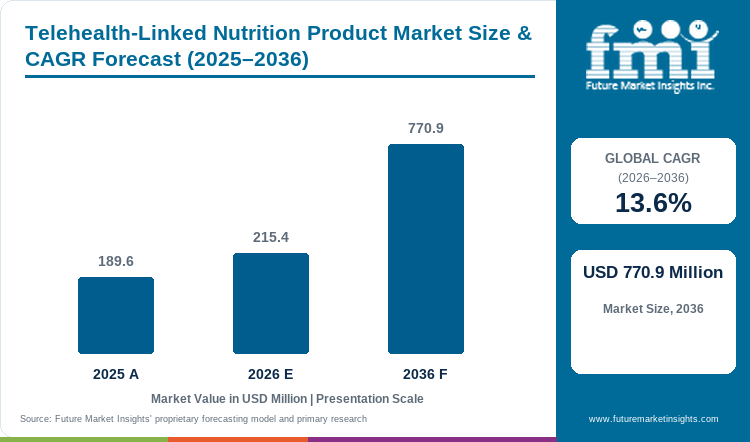
USD 215.4 million in 2026 and USD 770.9 million by 2036, expanding at 13.6% CAGR.
Demand for telehealth-linked nutrition products is projected to expand at 13.6% CAGR between 2026 and 2036, growing from USD 189.6 million in 2025 to USD 215.4 million in 2026, and escalating to USD 770.9 million by 2036. Nourish reported in February 2026 that it served 500,000 patients during 2025 and expanded its registered dietitian network beyond 6,000 clinicians. Those figures establish the scale of virtual nutrition care that can feed product-linked programs after an eligible remote consultation. The commercial link appears when an eligible dietitian pathway can trigger meals, groceries or specialized nutrition and support repeated fulfillment after the remote visit.
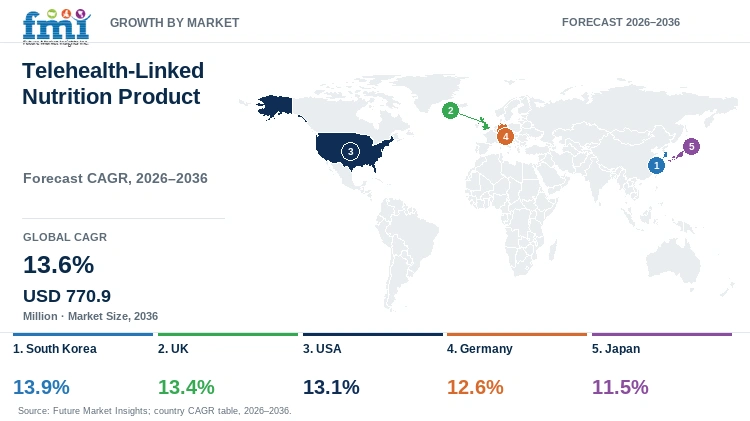
National rules determine whether a remote encounter can become the first step in a product-bearing care sequence. South Korea is projected at 13.9% CAGR compared with Japan at 11.5% during the forecast period. In December 2025, the Republic of Korea established a permanent legal basis for telemedicine centered on follow-up patients and clinic-level care. A clearer remote-care route can shorten referral uncertainty, but nutrition suppliers still need benefit coverage and a local fulfillment arrangement before virtual care produces a physical order.
Key Takeaways
- Health-plan and chronic-care programs expand demand when remote nutrition guidance can authorize a covered physical product and repeated home fulfillment.
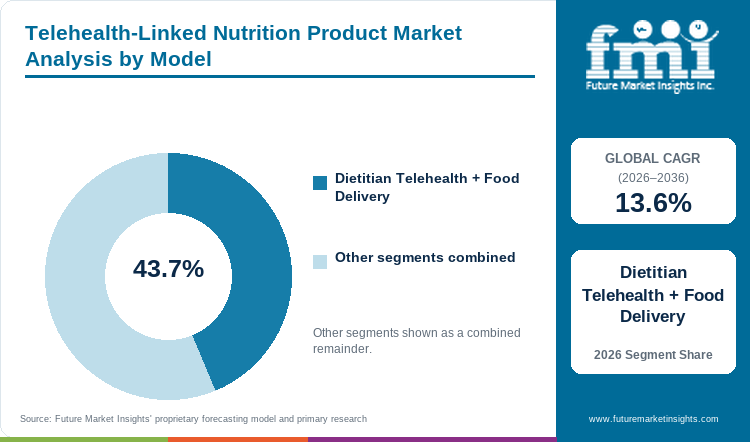
- By model, dietitian telehealth + food delivery is estimated to hold 43.7% in 2026 because one care relationship can guide product selection and replenishment.
- In 2026, diabetes & metabolic programs are projected to represent 38.2% of condition program demand because ongoing management supports repeated dietitian contact.
- Insurance-covered programs are anticipated to account for 43.3% of payer demand in 2026 because benefit eligibility reduces the immediate member payment barrier.
- Separate payment rules for virtual clinical services and physical nutrition benefits can delay contracting even after remote care has been approved.
- Some of the key players in this market include Season Health (OpenLoop Health), Foodsmart, Nourish, Kate Farms (Danone), Abbott, Nestlé (medical nutrition), ModifyHealth, and Mom's Meals (PurFoods).
Analyst Perspective
"Health-plan buyers will favor programs that can prove member eligibility and identify the nutrition product that follows each remote encounter. Product suppliers gain repeated volume only when coverage rules and home fulfillment stay connected after the dietitian visit."
- Anurag Sharma, Principal Consultant, Future Market Insights
How is the telehealth-linked nutrition product market segmented?
The market is segmented by Model, Condition Program, Payer, Fulfillment, Sales Channel and Region.
The telehealth-linked nutrition product market is segmented by model, condition program, payer, fulfillment, sales channel and region. Model covers dietitian telehealth + food delivery, prescription-linked product fulfillment, chronic-care program bundles and others. Condition program includes diabetes & metabolic, renal, cardiac, oncology and other condition-specific nutrition programs. Payer distinguishes insurance-covered programs, employer benefits, out-of-pocket payment and other funding arrangements used for linked nutrition products. Fulfillment includes fresh - frozen meal delivery, grocery benefit integration, ONS & supplement shipping and others. Sales channel includes telehealth platforms, online - DTC routes, health-plan referrals and other purchase-entry channels used by eligible members.
What operating condition supports dietitian telehealth + food delivery within the model category?
Dietitian telehealth + food delivery ties a clinical nutrition decision to a household order that can continue without a separate shopping workflow. Foodsmart reported in March 2026 that members using telenutrition with medically tailored groceries showed stronger sustained weight-loss results than telenutrition-only participants, linking remote counseling with a product-bearing program in which food access remains part of the care route after each appointment. The same operating model can sit beside home healthcare services for members managing chronic conditions outside institutional settings. Health plans still need benefit rules and dependable delivery before clinical guidance can become a repeated household order.
- By model, dietitian telehealth + food delivery is projected to account for 43.7% in 2026 because product access follows the same remote nutrition interaction.
- Health plans can convert a referral into repeated meal or grocery use when one workflow manages counseling and the handoff to fulfillment.
How does diabetes & metabolic demand shape the condition program category?
Diabetes and metabolic programs require repeated dietary adjustments because glucose control and weight goals continue between medical visits. NHS England requires its Type 2 Diabetes Path to Remission providers to supply total diet replacement products and supports a one-to-one digital delivery model. Condition-specific diabetic food access therefore matters where a payer or provider wants the nutrition intervention to continue between clinical reviews. Program operators still need reliable product availability and adherence support before repeated counseling can produce repeated fulfillment.
- Within condition program, diabetes & metabolic is expected to represent 38.2% in 2026 because ongoing management supports repeated dietitian and product touchpoints.
- Program operators can adjust nutrition instructions as clinical goals change without rebuilding the member relationship before every replenishment order.
How do insurance-covered programs shape demand within the payer category?
Insurance coverage changes the purchase decision because a health plan can identify eligible members before nutrition-product fulfillment begins. Nourish reported in April 2025 that its insurance-covered virtual care model served patients in all fifty states and connected dietitians with national commercial plans plus Medicare and Medicaid pathways. That scale places clinical nutrition decisions closer to an authorized benefit instead of leaving each member to arrange a separate consumer purchase. The payer route also gives program operators a documented referral point before home delivery starts. Product coverage still needs separate terms when counseling and physical nutrition benefits fall under different plan rules.
- Insurance-covered programs are set to account for 43.3% of payer demand in 2026 because contracted benefits reduce immediate member costs and define eligibility.
- Program operators still need to reconcile counseling coverage with separate terms governing meals or specialized nutrition products after each remote visit.
What makes fresh - frozen meal delivery important within the fulfillment category?
Prepared meals reduce the execution burden after a remote consultation because the member receives a defined portion and menu instead of broad food guidance. Mom's Meals and Agilix Health launched a June 2026 collaboration that integrates virtual nutrition-led care with medically tailored meals for high-risk Medicare Advantage members. The program gives a remote care team a direct physical fulfillment step that can continue after the clinical encounter. The mechanism resembles meal replacement products because both routes translate a nutrition plan into repeat delivery with controlled composition. Health plans still need condition rules and delivery continuity before prepared meals can support repeat covered use.
- Fresh - frozen meal delivery is forecast to represent 44.3% of fulfillment demand in 2026 because prepared formats reduce shopping and preparation work.
- Health plans can specify condition-aligned menus and confirm that product delivery continues after the remote clinical interaction has ended.
How does the telehealth platform shape selection within the sales channel category?
A telehealth platform can place enrollment and dietitian interaction before product selection so members enter the nutrition benefit from one digital route. Nourish introduced an outcomes model in June 2026 that links partner fees to patient results inside its dietitian-led metabolic-care system. That model gives the virtual channel responsibility for what happens after the appointment instead of treating consultation volume as the endpoint. Diet nutrition apps become commercially useful in this setting when digital engagement produces a documented clinical action tied to product selection or replenishment. Health plans still need benefit logic and fulfillment partners before the platform can turn that action into a physical order.
- The telehealth platform category is anticipated to retain 44.2% of sales channel demand in 2026 because remote care can start enrollment and product routing.
- Health plans gain a measurable referral entry point when platform records connect member eligibility with clinician follow-up and the next nutrition action.
What are the drivers, restraints and opportunities in the Telehealth-Linked Nutrition Product Market?
Covered chronic-care nutrition expands demand, separate service and product benefits slow conversion, and integrated payer-food programs improve repeated fulfillment.
- Driver: Health plans are extending remote chronic-care programs toward dietitian services that can influence repeated nutrition-product use.
- Restraint: Virtual-care reimbursement does not automatically finance meals or specialized nutrition products recommended after an eligible encounter.
- Opportunity: Payer-food partnerships can connect clinical guidance with product access and remove a second search or purchase step for members.
Covered Remote Chronic Care Expands Product Entry Points
Remote chronic-care coverage increases the number of eligible encounters that can start a nutrition pathway. CMS finalized 2026 Medicare Diabetes Prevention Program changes allowing distance-learning and asynchronous online delivery through December 2029, including enrollment by virtual-only suppliers. The policy covers prevention services and does not itself reimburse the food products that members may use. Its market relevance lies in the reimbursable remote touchpoint that can identify eligible people and support continuing dietary management for chronic disease. Nutrition suppliers capture product revenue only after a health plan or provider adds a separate meal, grocery or specialized-nutrition benefit to that clinical route.
Separate Benefit Rules Delay Product Conversion
Coverage friction appears when a payer authorizes a digital clinical service but treats related physical components under different payment rules. BfArM states in its 2026 DiGA fast-track guide that optional additional functions are not considered in statutory reimbursement and may create user-paid costs. The guide covers reimbursed digital health applications and shows that optional paid components can remain outside the insured service boundary. A telehealth nutrition program can face a comparable contracting split when counseling is reimbursed but meals or supplements require another benefit. The split can delay a product order even after the virtual clinical service has received reimbursement. Suppliers must solve both coverage paths before a virtual recommendation becomes a repeat order.
Integrated Payer-Food Programs Support Repeat Fulfillment
Integrated payer-food programs give suppliers a practical route to convert virtual guidance into repeated product use. Highmark Health Options West Virginia and Foodsmart announced a June 2026 program that combines one-on-one virtual nutrition counseling with meal planning and access to dietitian-recommended groceries and meals. The program launches from an existing Medicaid member relationship instead of asking each participant to build a separate food-purchasing path. Product companies can enter similar arrangements by fitting approved nutrition formats to the program’s condition rules and fulfillment process. Revenue depends on maintaining that connection after enrollment so each eligible member can continue receiving the recommended nutrition product.
Which country CAGRs are profiled in the Telehealth-Linked Nutrition Product Market?
| Country | CAGR |
|---|---|
| South Korea | 13.9% |
| UK | 13.4% |
| USA | 13.1% |
| Germany | 12.6% |
| Japan | 11.5% |
How do country-level CAGRs compare in the Telehealth-Linked Nutrition Product Market?
The five country forecasts occupy a 2.4 percentage-point range from 13.9% to 11.5%. South Korea, UK and USA form a tighter upper group while Germany and Japan advance at somewhat lower rates. The distribution describes forecast pace and does not measure current country revenue, so similar growth rates can still produce different commercial entry conditions.
- South Korea is moving from pilot-based telemedicine toward a permanent statutory route that gives clinic-linked nutrition services clearer operating rules.
- UK commissioning can join a defined nutrition protocol with supplied products and remote support inside one contracted service pathway.
- USA health-plan contracting can connect virtual dietitian care with benefit-funded food access when eligibility and fulfillment are designed together.
- Germany separates reimbursed digital care from many associated physical inputs which places greater weight on explicit product-benefit arrangements.
- Japan keeps physician oversight central to online care which makes local clinical integration an important condition before product routing begins.
The full report provides country-level CAGR analysis across North America, Latin America, Western Europe, Eastern Europe, East Asia, South Asia and Pacific, and the Middle East and Africa.
Country-wise Analysis
- South Korea is replacing a long-running telemedicine pilot with a permanent legal structure centered on repeat patients and clinic-level medical care. The country is projected to expand at 13.9% CAGR through 2036 with permanent rules replacing pilot-only telemedicine governance. The Ministry of Health and Welfare reported in August 2025 that about 4.92 million people had used the national pilot and roughly 23,000 institutions had participated. That national scale gives digital health operators a substantial clinical base, but nutrition products still require a separate benefit and fulfillment route.
- UK commissioning can place product supply inside a defined clinical nutrition protocol instead of leaving participants to source every item independently. The UK is forecast to grow at 13.4% CAGR between 2026 and 2036 with commissioned pathways combining remote support and supplied nutrition. NHS England reported in November 2025 that more than 13,000 people enrolled in its Type 2 Diabetes Path to Remission Programme during 2024-25. That national program gives medical food suppliers a documented route into condition-specific nutrition demand under a commissioned service. Eligibility remains narrow, so commercial participation depends on meeting service specifications and maintaining reliable product supply for the full intervention.
- USA health plans can use remote nutrition care as a covered entry point before a member receives food or specialized nutrition support. The USA is anticipated to record 13.1% CAGR through 2036 with payer contracts linking remote nutrition eligibility to separate food or nutrition benefits. CMS stated in July 2026 that virtual-only organizations can enroll as Medicare Diabetes Prevention Program suppliers under the 2026 rule changes, expanding virtual prevention access and complements functional foods programs outside Medicare. Product suppliers still need plan-specific coverage and fulfillment agreements because the federal program does not itself pay for food products.
- Germany is widening routine digital health use while keeping the payment boundary for physical nutrition products distinct from many digital services. Germany is expected to maintain 12.6% CAGR from 2026 to 2036 with digital care integration increasing remote clinical touchpoints under separate product-payment rules. The Federal Ministry of Health stated in February 2026 that its updated digital strategy seeks stronger integration of digital innovations into routine care and more digitally supported primary care. Digitally supported primary care also creates referral points that can connect home care services with remote nutrition follow-up. Nutrition companies still need payer or provider contracts that expressly cover the physical product after the digital encounter.
- Japan regulates online medical care as an extension of physician-led practice instead of an independent consumer channel. Japan is predicted to expand at 11.5% CAGR through 2036 with remote encounters remaining tied to physician oversight and national operating requirements. The Ministry of Health, Labour and Welfare stated that online-care provisions under the revised Medical Care Act took effect on April 1, 2026. The rules strengthen a formal route for remote medicine and can support adjacent enteral nutrition planning where clinicians manage continuing nutrition needs.
Who are the notable companies in the Telehealth-Linked Nutrition Product Market?
Season Health (OpenLoop Health), Foodsmart, Nourish, Kate Farms (Danone), Abbott, Nestlé (medical nutrition), ModifyHealth, and Mom's Meals (PurFoods).
Competition separates companies that manage virtual nutrition and payer access from manufacturers and meal operators that control the physical product. Entry becomes harder when a buyer expects one partner to coordinate clinical eligibility with condition-specific nutrition and benefit administration plus dependable home delivery. The eight companies therefore occupy different commercial roles and should not be read as interchangeable substitutes.
- Virtual nutrition and benefit operators include Season Health (OpenLoop Health), Foodsmart and Nourish with documented remote dietitian or metabolic-care workflows.
- Specialized nutrition manufacturers include Kate Farms (Danone), Abbott and Nestlé (medical nutrition) with condition-oriented drink or medical-nutrition capabilities.
- Home-delivered meal integration is represented by ModifyHealth and Mom's Meals (PurFoods) which combine nutrition products with clinical or payer channels.
Competitive Benchmarking: Telehealth-Linked Nutrition Product Market
| Company | Virtual Nutrition Integration | Product / Fulfillment Control | Payer Benefit Integration | Geographic Reach |
|---|---|---|---|---|
| Season Health (OpenLoop Health) | High | Medium | High | United States |
| Foodsmart | High | Medium | High | United States |
| Nourish | High | Low | High | United States |
| Kate Farms (Danone) | Low | High | Low | United States |
| Abbott | Low | High | Low | Global |
| Nestlé (medical nutrition) | Low | High | Low | Global |
| ModifyHealth | High | High | High | United States |
| Mom's Meals (PurFoods) | Medium | High | High | United States |
Scoring basis: High virtual integration requires a directly operated remote nutrition workflow, Medium reflects documented partner-mediated virtual care and Low reflects no documented direct workflow. High product control requires direct specialized nutrition manufacturing or home fulfillment, Medium reflects curated or partner fulfillment and Low reflects no direct control. High payer integration requires documented health-plan or government-benefit operations, Medium reflects a narrower payer route and Low reflects no documented direct payer integration.
Key Developments in the Telehealth-Linked Nutrition Product Market
- In May 2026, Nourish raised a Series C round to expand its dietitian-led metabolic clinic and deepen relationships with health plans and health systems.
- In July 2025, Kate Farms launched its High Protein Nutrition Shake with plant-based protein and fiber for adults managing muscle health or weight-related nutrition needs.
- In July 2025, ModifyHealth and Monash University expanded their Low-FODMAP partnership by connecting certified meal delivery and dietitian support with Monash resources.
Key Players in the Telehealth-Linked Nutrition Product Market
Virtual Nutrition and Benefit Platforms
- Season Health (OpenLoop Health)
- Foodsmart
- Nourish
Specialized Nutrition Product Suppliers
- Kate Farms (Danone)
- Abbott
- Nestlé (medical nutrition)
Meal Fulfillment and Care Integrators
- ModifyHealth
- Mom's Meals (PurFoods)
Telehealth-Linked Nutrition Product Market - Report Scope
| Coverage field | Report scope |
|---|---|
| Market breakdown | By model, condition program, payer, fulfillment, sales channel and region. |
| Quantitative Units | USD million. |
| Market Definition | Revenue from nutrition products and bundled product fulfillment when ordering, coverage or replenishment is tied to remote dietitian, clinician, health-plan or chronic-care management. Stand-alone telehealth fees and unrelated retail nutrition are excluded. |
| Regions Covered | North America, Latin America, Western Europe, Eastern Europe, East Asia, South Asia and Pacific, and Middle East and Africa. |
| Countries Covered | South Korea, UK, USA, Germany, Japan, and 20+ countries included in the full report. |
| Key Companies Profiled | Season Health (OpenLoop Health), Foodsmart, Nourish, Kate Farms (Danone), Abbott, Nestlé (medical nutrition), ModifyHealth, and Mom's Meals (PurFoods). |
| Forecast Period | 2026 to 2036. |
| Approach | Primary and secondary research with market triangulation. |
Telehealth-Linked Nutrition Product Market - Research Methodology
| Method | Approach |
|---|---|
| Primary Research | FMI analysts gathered input from manufacturers, service providers, technology developers, distributors, end users, procurement teams, and subject-matter experts. Interviews examined purchasing decisions, product or service evaluation, adoption barriers, approval requirements, pricing considerations, and expectations for technical or commercial support. Respondents were also asked what evidence is required before a trial, pilot, or initial order develops into regular purchasing. |
| Desk Research | Desk research covered government statistics, regulatory publications, trade data, industry associations, technical literature, standards, company filings, product information, and official corporate announcements. Sources were reviewed for relevance, publication date, geographic coverage, and consistency with the defined market scope. Claims relating to performance, applications, approvals, capacity, investment, and commercial activity were retained only when supported by credible public evidence. |
| Market Sizing and Forecasting | The market model combined the baseline value with historical performance, segment structure, pricing and volume indicators, adoption levels, company participation, and country-level demand conditions. Forecast assumptions considered economic activity, investment trends, regulatory developments, technology adoption, purchasing cycles, supply availability, and barriers to wider market use. Segment and regional estimates were reconciled before the final market total was calculated. |
| Data Validation | Estimates were checked against multiple independent indicators, including public data, company activity, trade patterns, industry developments, and findings from primary interviews. Validation also tested whether products, services, applications, and company revenues fell within the defined market boundaries. Adjacent categories, unsupported claims, overlapping revenues, and activities without direct market relevance were excluded to reduce double counting and maintain consistency across segments and countries. |
Telehealth-Linked Nutrition Product Market by Segments
Telehealth-Linked Nutrition Product Market segmented by Model:
- Dietitian Telehealth + Food Delivery
- Prescription-Linked Product Fulfillment
- Chronic-Care Program Bundles
- Others
Telehealth-Linked Nutrition Product Market segmented by Condition Program:
- Diabetes & Metabolic
- Renal
- Cardiac
- Oncology
- Others
Telehealth-Linked Nutrition Product Market segmented by Payer:
- Insurance-Covered Programs
- Employer Benefits
- Out-of-Pocket
- Others
Telehealth-Linked Nutrition Product Market segmented by Fulfillment:
- Fresh - Frozen Meal Delivery
- Grocery Benefit Integration
- ONS & Supplement Shipping
- Others
Telehealth-Linked Nutrition Product Market segmented by Sales Channel:
- Telehealth Platform
- Online - DTC
- Health Plan Referral
- Others
Telehealth-Linked Nutrition Product Market by Region:
- North America
- United States
- Canada
- Latin America
- Brazil
- Mexico
- Argentina
- Chile
- Western Europe
- Germany
- France
- United Kingdom
- Italy
- Spain
- Benelux
- Nordics
- Eastern Europe
- Poland
- Czech Republic
- Romania
- Hungary
- East Asia
- China
- Japan
- South Korea
- South Asia and Pacific
- India
- ASEAN
- Australia and New Zealand
- Middle East and Africa
- GCC Countries
- South Africa
- Türkiye
- Israel
Research Sources and Bibliography
- Nourish. (2026, February 4). Nourish Publishes First Annual Impact Report (2025).
- Government of the Republic of Korea. (2025, December 3). ‘비대면진료 제도화’ 15년 만에 확정…의료법 개정안 통과.
- Foodsmart. (2026, March). Foodsmart Clinical Research Dossier - Economic & Clinical ROI.
- NHS England. (2024, February 5; updated 2026, February 17). NHS Type 2 Diabetes Path to Remission Programme service specification (2023).
- Nourish. (2025, April 23). Nourish Raises $70M Series B to Tackle Chronic Disease with AI-Powered Nutrition Care.
- Mom's Meals. (2026, June 18). Mom’s Meals and Agilix Health Collaborate to Advance Food as Medicine.
- Nourish. (2026, June 30). Nourish Announces Clinical Outcomes Model, Tying Fees to Performance in the First Outcomes-Based Approach for Dietitian-Led Metabolic Care.
- Centers for Medicare & Medicaid Services. (2026). Calendar Year (CY) 2026 Medicare Physician Fee Schedule (PFS) Changes to the Medicare Diabetes Prevention Program (MDPP).
- Federal Institute for Drugs and Medical Devices. (2026). The Fast-Track Process for Digital Health Applications (DiGA) according to Section 139e SGB V: A Guide for Manufacturers, Service Providers and Users.
- Highmark Health Options West Virginia & Foodsmart. (2026, June 30). Foodsmart and Highmark Health Options introduce program to improve member nutrition care and health outcomes.
- Ministry of Health and Welfare, Republic of Korea. (2025, August 14). 비대면진료 시범사업 평가·제도화 논의.
- NHS England. (2025, November 8). Record numbers of people with type 2 diabetes benefit from NHS ‘soups and shakes’.
- Centers for Medicare & Medicaid Services. (2026, July 8). Medicare Diabetes Prevention Program (MDPP) Expanded Model: Supplier Resources.
- Federal Ministry of Health, Germany. (2026, February 11). “Digitale Innovationen noch stärker in den Versorgungsalltag integrieren”.
- Ministry of Health, Labour and Welfare, Japan. (2026, March 27). 医療法等の一部を改正する法律の一部の施行等について(オンライン診療関係).
- OpenLoop Health. (2026, June 17). OpenLoop Health Closes First Half of 2026 with Strategic Acquisition, New Partnerships, and Growing Industry Presence.
- The MolinaCares Accord. (2026, March 24). Molina Healthcare of Illinois and Foodsmart Celebrate National Nutrition Month with Joint Effort to Improve Nutrition Among New Mothers.
- Nourish. (2026, May 19). Nourish Raises $100M Series C to Reverse Chronic Disease with AI-Native Metabolic Clinic.
- ModifyHealth. (2025, July 1). ModifyHealth and Monash University Expand Partnership to Advance Low-FODMAP Diet Awareness in the USA
- Kate Farms. (2025, July 8). Kate Farms unveils new High Protein Nutrition Shake: Protein with purpose, built for real change.
- Season Health. (2026). Health plans: Drive clinical outcomes with a fully-integrated food-as-medicine platform. Retrieved September 16, 2026.
- Danone. (2026). Universal registration document 2025.
- Kate Farms. (2026, July 28). Kate Farms Expands High Protein Nutrition Shake Into Walmart and CVS as Retail Distribution Grows Sevenfold.
- Abbott. (2025, November 13). Abbott launches new and advanced Ensure Diabetes Care, a clinically proven formula to help manage blood sugar.
- Nestlé. (2026, September 3). Nestlé invests CHF 310 million in Brazil to grow its presence in nutrition and health.
- ModifyHealth. (2025, September 4). ModifyHealth Expands Its In-Network Coverage, Strengthening Its Position as One of the Nation’s Largest Providers of Insurance-Covered Virtual Dietitian Support.
- Mom's Meals. (2026, May 19). New spring meals 2026.
- Abbott. (2026, May 13). Abbott launches Ensure Strength Pro in India to support healthy ageing.
- Nestlé. (2026, February 16). New Nestlé Vital nutritional drink targets the rising demand for healthy-aging solutions.
- Kate Farms. (2025, March 12). Kate Farms Kids Nutrition Launches at Target: A New Standard for Kids Nutrition.
- Nourish. (2026, June 2). Nourish Shows Patients Completing 6+ Dietitian Appointments Achieve 2.3x Greater Weight Loss.
- Nestlé. (2026, March 23). 2025 Operating segments and information by products restated.
- Dudlicek, J. (2025, October 8). Forty Acres Fresh Market, Foodsmart Launch 'Nutrition Corner'.
- Abbott. (2026, June). 2025 Global Sustainability Report.
- Mom's Meals. (2026, September 10). Food Safety at Mom's Meals®: Delivering confidence with every meal.
This bibliography is provided for reader reference and is not exhaustive. The full report contains the complete reference list and detailed citations
This Report Answers
- How large is this market in 2026 and by 2036?
- Which care models convert remote nutrition guidance into physical product orders?
- Why does diabetes and metabolic care support repeated product fulfillment?
- How do insurance benefits change member payment and referral pathways?
- Which fulfillment formats fit recurring home nutrition programs with direct product control?
- How do national country rules alter telehealth-linked nutrition product commercialization?
- Which companies combine virtual care, specialized nutrition and home fulfillment?
- What payment boundary delays conversion from counseling to physical product orders?
Frequently Asked Questions
How big is the Telehealth-Linked Nutrition Product Market in 2026?
The telehealth-linked nutrition product market is valued at USD 215.4 million in 2026 and is projected to reach USD 770.9 million by 2036. Covered remote nutrition pathways support growth when they can activate a physical product and repeated home fulfillment.
What is the CAGR of the Telehealth-Linked Nutrition Product Market?
The telehealth-linked nutrition product market is projected to grow at 13.6% CAGR between 2026 and 2036. Growth depends on health-plan programs that connect eligible remote nutrition care with product access and continuing delivery.
Which model category accounts for the authorized 43.7% share in 2026?
The dietitian telehealth + food delivery segment is expected to hold 43.7% of model demand in 2026. Its position reflects one workflow that can connect dietitian guidance with meals or groceries delivered to the member.
Which condition program accounts for the authorized 38.2% share in 2026?
The diabetes & metabolic segment is projected to represent 38.2% of condition program demand in 2026. Repeated dietary management gives remote dietitian care a continuing role between medical visits and product replenishment.
Which payer category accounts for the authorized 43.3% share in 2026?
The insurance-covered programs segment is anticipated to account for 43.3% of payer demand in 2026. Contracted benefits reduce immediate member payment friction and give health plans a defined referral route into nutrition care.
Which companies are active in the Telehealth-Linked Nutrition Product Market?
Key companies include Season Health (OpenLoop Health), Foodsmart, Nourish, Kate Farms (Danone), Abbott, Nestlé (medical nutrition), ModifyHealth and Mom's Meals (PurFoods). Their roles span virtual nutrition care, specialized nutrition products and home meal fulfillment programs for covered members.
Preview the report firsthand - request a free sample
Get SampleGet the brochure for pricing and purchase details.
Get PDFTable of Content
- Key Takeaways
- Market Size and CAGR
- Top Growth Driver
- Fastest Growing Segment
- Leading Region
- Key Companies
- Emerging Opportunities
- Executive Summary
- Global Market Outlook
- Demand-side Trends
- Supply-side Trends
- Technology Roadmap Analysis
- Analysis and Recommendations
- Analyst Perspective (What is happening? Why now? What should investors know?)
- Key Questions Answered
- How large is the market?
- What is the CAGR?
- What are key trends?
- Which region dominates?
- Who are the leaders?
- Market Overview
- Market Coverage / Taxonomy
- Market Definition / Scope / Limitations
- Research Methodology
- Chapter Orientation
- Analytical Lens and Working Hypotheses
- Market Structure, Signals, and Trend Drivers
- Benchmarking and Cross-market Comparability
- Market Sizing, Forecasting, and Opportunity Mapping
- Research Design and Evidence Framework
- Desk Research Programme (Secondary Evidence)
- Expert Input and Fieldwork (Primary Evidence)
- Tooling, Models, and Reference Databases
- Data Engineering and Model Build
- Quality Assurance and Audit Trail
- Market Background
- Market Dynamics (Drivers, Restraints, Opportunity, Trends)
- Scenario Forecast (Optimistic, Likely, Conservative)
- Impact Analysis
- AI Impact
- Sustainability Impact
- Regulatory Impact
- Technology Impact
- Consumer / Buyer Analysis
- Purchase Drivers
- Adoption Barriers
- Buyer Journey
- Opportunity Map Analysis
- Product Life Cycle Analysis
- Supply Chain Analysis
- Investment Feasibility Matrix
- Value Chain Analysis
- PESTLE and Porter's Analysis
- Regulatory Landscape
- Regional Parent Market Outlook
- Production and Consumption Statistics
- Import and Export Statistics
- Global Market Analysis and Forecast, 2021 to 2036
- Historical Market Size Value (USD Million) Analysis, 2021 to 2025
- Current and Future Market Size Value (USD Million) Projections, 2026 to 2036
- Y-o-Y Growth Trend Analysis
- Absolute $ Opportunity Analysis
- Global Market Pricing Analysis, 2021 to 2036
- Global Market Analysis and Forecast, By Model, 2021 to 2036
- Introduction / Key Findings
- Historical Market Size Value (USD Million) Analysis By Model, 2021 to 2025
- Current and Future Market Size Value (USD Million) Analysis and Forecast By Model, 2026 to 2036
- Dietitian Telehealth + Food Delivery
- Prescription-Linked Product Fulfillment
- Chronic-Care Program Bundles
- Others
- Y-o-Y Growth Trend Analysis By Model, 2021 to 2025
- Absolute $ Opportunity Analysis By Model, 2026 to 2036
- Global Market Analysis and Forecast, By Condition Program, 2021 to 2036
- Introduction / Key Findings
- Historical Market Size Value (USD Million) Analysis By Condition Program, 2021 to 2025
- Current and Future Market Size Value (USD Million) Analysis and Forecast By Condition Program, 2026 to 2036
- Diabetes & Metabolic
- Renal
- Cardiac
- Oncology
- Others
- Y-o-Y Growth Trend Analysis By Condition Program, 2021 to 2025
- Absolute $ Opportunity Analysis By Condition Program, 2026 to 2036
- Global Market Analysis and Forecast, By Payer, 2021 to 2036
- Introduction / Key Findings
- Historical Market Size Value (USD Million) Analysis By Payer, 2021 to 2025
- Current and Future Market Size Value (USD Million) Analysis and Forecast By Payer, 2026 to 2036
- Insurance-Covered Programs
- Employer Benefits
- Out-of-Pocket
- Others
- Y-o-Y Growth Trend Analysis By Payer, 2021 to 2025
- Absolute $ Opportunity Analysis By Payer, 2026 to 2036
- Global Market Analysis and Forecast, By Fulfillment, 2021 to 2036
- Introduction / Key Findings
- Historical Market Size Value (USD Million) Analysis By Fulfillment, 2021 to 2025
- Current and Future Market Size Value (USD Million) Analysis and Forecast By Fulfillment, 2026 to 2036
- Fresh - Frozen Meal Delivery
- Grocery Benefit Integration
- ONS & Supplement Shipping
- Others
- Y-o-Y Growth Trend Analysis By Fulfillment, 2021 to 2025
- Absolute $ Opportunity Analysis By Fulfillment, 2026 to 2036
- Global Market Analysis and Forecast, By Sales Channel, 2021 to 2036
- Introduction / Key Findings
- Historical Market Size Value (USD Million) Analysis By Sales Channel, 2021 to 2025
- Current and Future Market Size Value (USD Million) Analysis and Forecast By Sales Channel, 2026 to 2036
- Telehealth Platform
- Online - DTC
- Health Plan Referral
- Others
- Y-o-Y Growth Trend Analysis By Sales Channel, 2021 to 2025
- Absolute $ Opportunity Analysis By Sales Channel, 2026 to 2036
- Global Market Analysis and Forecast, By Region, 2021 to 2036
- Introduction
- Historical Market Size Value (USD Million) Analysis By Region, 2021 to 2025
- Current Market Size Value (USD Million) Analysis and Forecast By Region, 2026 to 2036
- North America
- Latin America
- Western Europe
- Eastern Europe
- East Asia
- South Asia and Pacific
- Middle East and Africa
- Market Attractiveness Analysis By Region
- North America Market Analysis and Forecast, By Country, 2021 to 2036
- Historical Market Size Value (USD Million) Trend Analysis By Market Taxonomy, 2021 to 2025
- Market Size Value (USD Million) Forecast By Market Taxonomy, 2026 to 2036
- By Country
- United States
- Canada
- By Model
- By Condition Program
- By Payer
- By Fulfillment
- By Sales Channel
- By Country
- Market Attractiveness Analysis
- By Country
- By Model
- By Condition Program
- By Payer
- By Fulfillment
- By Sales Channel
- Key Takeaways
- Latin America Market Analysis and Forecast, By Country
- Historical Market Size Value (USD Million) Trend Analysis By Market Taxonomy, 2021 to 2025
- Market Size Value (USD Million) Forecast By Market Taxonomy, 2026 to 2036
- By Country
- Brazil
- Mexico
- Argentina
- Chile
- By Model
- By Condition Program
- By Payer
- By Fulfillment
- By Sales Channel
- By Country
- Market Attractiveness Analysis
- By Country
- By Model
- By Condition Program
- By Payer
- By Fulfillment
- By Sales Channel
- Key Takeaways
- Western Europe Market Analysis and Forecast, By Country
- Historical Market Size Value (USD Million) Trend Analysis By Market Taxonomy, 2021 to 2025
- Market Size Value (USD Million) Forecast By Market Taxonomy, 2026 to 2036
- By Country
- Germany
- France
- United Kingdom
- Italy
- Spain
- Benelux
- Nordics
- By Model
- By Condition Program
- By Payer
- By Fulfillment
- By Sales Channel
- By Country
- Market Attractiveness Analysis
- By Country
- By Model
- By Condition Program
- By Payer
- By Fulfillment
- By Sales Channel
- Key Takeaways
- Eastern Europe Market Analysis and Forecast, By Country
- Historical Market Size Value (USD Million) Trend Analysis By Market Taxonomy, 2021 to 2025
- Market Size Value (USD Million) Forecast By Market Taxonomy, 2026 to 2036
- By Country
- Poland
- Czech Republic
- Romania
- Hungary
- By Model
- By Condition Program
- By Payer
- By Fulfillment
- By Sales Channel
- By Country
- Market Attractiveness Analysis
- By Country
- By Model
- By Condition Program
- By Payer
- By Fulfillment
- By Sales Channel
- Key Takeaways
- East Asia Market Analysis and Forecast, By Country
- Historical Market Size Value (USD Million) Trend Analysis By Market Taxonomy, 2021 to 2025
- Market Size Value (USD Million) Forecast By Market Taxonomy, 2026 to 2036
- By Country
- China
- Japan
- South Korea
- By Model
- By Condition Program
- By Payer
- By Fulfillment
- By Sales Channel
- By Country
- Market Attractiveness Analysis
- By Country
- By Model
- By Condition Program
- By Payer
- By Fulfillment
- By Sales Channel
- Key Takeaways
- South Asia and Pacific Market Analysis and Forecast, By Country
- Historical Market Size Value (USD Million) Trend Analysis By Market Taxonomy, 2021 to 2025
- Market Size Value (USD Million) Forecast By Market Taxonomy, 2026 to 2036
- By Country
- India
- ASEAN
- Australia and New Zealand
- By Model
- By Condition Program
- By Payer
- By Fulfillment
- By Sales Channel
- By Country
- Market Attractiveness Analysis
- By Country
- By Model
- By Condition Program
- By Payer
- By Fulfillment
- By Sales Channel
- Key Takeaways
- Middle East and Africa Market Analysis and Forecast, By Country
- Historical Market Size Value (USD Million) Trend Analysis By Market Taxonomy, 2021 to 2025
- Market Size Value (USD Million) Forecast By Market Taxonomy, 2026 to 2036
- By Country
- GCC Countries
- South Africa
- Türkiye
- Israel
- By Model
- By Condition Program
- By Payer
- By Fulfillment
- By Sales Channel
- By Country
- Market Attractiveness Analysis
- By Country
- By Model
- By Condition Program
- By Payer
- By Fulfillment
- By Sales Channel
- Key Takeaways
- Key Countries Market Analysis
- United States
- Pricing Analysis
- Market Share Analysis, 2025
- By Model
- By Condition Program
- By Payer
- By Fulfillment
- By Sales Channel
- Canada
- Pricing Analysis
- Market Share Analysis, 2025
- By Model
- By Condition Program
- By Payer
- By Fulfillment
- By Sales Channel
- Mexico
- Pricing Analysis
- Market Share Analysis, 2025
- By Model
- By Condition Program
- By Payer
- By Fulfillment
- By Sales Channel
- Brazil
- Pricing Analysis
- Market Share Analysis, 2025
- By Model
- By Condition Program
- By Payer
- By Fulfillment
- By Sales Channel
- Chile
- Pricing Analysis
- Market Share Analysis, 2025
- By Model
- By Condition Program
- By Payer
- By Fulfillment
- By Sales Channel
- Germany
- Pricing Analysis
- Market Share Analysis, 2025
- By Model
- By Condition Program
- By Payer
- By Fulfillment
- By Sales Channel
- United Kingdom
- Pricing Analysis
- Market Share Analysis, 2025
- By Model
- By Condition Program
- By Payer
- By Fulfillment
- By Sales Channel
- Italy
- Pricing Analysis
- Market Share Analysis, 2025
- By Model
- By Condition Program
- By Payer
- By Fulfillment
- By Sales Channel
- Spain
- Pricing Analysis
- Market Share Analysis, 2025
- By Model
- By Condition Program
- By Payer
- By Fulfillment
- By Sales Channel
- France
- Pricing Analysis
- Market Share Analysis, 2025
- By Model
- By Condition Program
- By Payer
- By Fulfillment
- By Sales Channel
- India
- Pricing Analysis
- Market Share Analysis, 2025
- By Model
- By Condition Program
- By Payer
- By Fulfillment
- By Sales Channel
- ASEAN
- Pricing Analysis
- Market Share Analysis, 2025
- By Model
- By Condition Program
- By Payer
- By Fulfillment
- By Sales Channel
- Australia and New Zealand
- Pricing Analysis
- Market Share Analysis, 2025
- By Model
- By Condition Program
- By Payer
- By Fulfillment
- By Sales Channel
- China
- Pricing Analysis
- Market Share Analysis, 2025
- By Model
- By Condition Program
- By Payer
- By Fulfillment
- By Sales Channel
- Japan
- Pricing Analysis
- Market Share Analysis, 2025
- By Model
- By Condition Program
- By Payer
- By Fulfillment
- By Sales Channel
- South Korea
- Pricing Analysis
- Market Share Analysis, 2025
- By Model
- By Condition Program
- By Payer
- By Fulfillment
- By Sales Channel
- Poland
- Pricing Analysis
- Market Share Analysis, 2025
- By Model
- By Condition Program
- By Payer
- By Fulfillment
- By Sales Channel
- Hungary
- Pricing Analysis
- Market Share Analysis, 2025
- By Model
- By Condition Program
- By Payer
- By Fulfillment
- By Sales Channel
- Türkiye
- Pricing Analysis
- Market Share Analysis, 2025
- By Model
- By Condition Program
- By Payer
- By Fulfillment
- By Sales Channel
- South Africa
- Pricing Analysis
- Market Share Analysis, 2025
- By Model
- By Condition Program
- By Payer
- By Fulfillment
- By Sales Channel
- United States
- Market Structure Analysis
- Competition Dashboard
- Competition Benchmarking
- Market Share Analysis of Top Players
- By Regional
- By Model
- By Condition Program
- By Payer
- By Fulfillment
- By Sales Channel
- Emerging Startups
- Innovation Benchmarking
- Competition Analysis
- Competition Deep Dive
- Season Health (OpenLoop Health)
- Overview
- Product Portfolio
- Profitability by Market Segments
- Sales Footprint
- Strategy Overview
- Marketing Strategy
- Product Strategy
- Channel Strategy
- Foodsmart
- Nourish
- Kate Farms (Danone)
- Abbott
- Nestlé (medical nutrition)
- ModifyHealth
- Mom's Meals (PurFoods)
- Season Health (OpenLoop Health)
- Case Studies
- Success Stories
- Recent Developments
- Competition Deep Dive
- Assumptions & Acronyms Used


