

- Market Size (2026)
- USD 1263.6 Mn
- Forecast (2036)
- USD 2038.8 Mn
- CAGR (2026 to 2036)
- 4.9%
How big is Transmission Oil Pans Market in 2026?
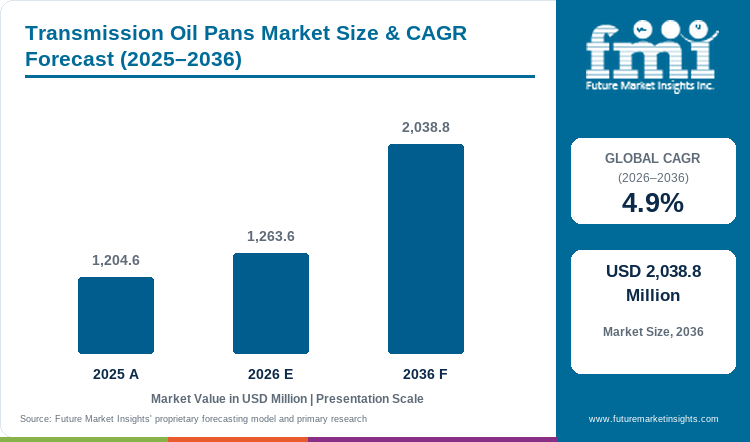
USD 1,263.6 million in 2026 and USD 2,038.8 million by 2036 at a 4.9% CAGR.
Sales of transmission oil pans are estimated to rise at 4.9% CAGR through 2036, increasing valuation from USD 1,204.6 million in 2025 to USD 1,263.6 million in 2026, and reaching USD 2,038.8 million by 2036. Transmission oil pans are tied to the transmission architecture selected at the beginning of a vehicle program because reservoir geometry and service-access requirements rarely change once the gearbox enters production. ZF and BMW signed a long-term 8HP automatic-transmission agreement in February 2026 covering future passenger-vehicle programs. The agreement extends the transmission family into the late 2030s and keeps associated component interfaces aligned with a defined gearbox platform. Long production commitments therefore help preserve demand for validated pan designs because manufacturers typically avoid redesigning lubrication hardware after release.
France is projected to grow at 6.0% CAGR compared with 3.9% for Japan through 2036. SDES reported 1.665 million new passenger-car registrations in France during 2025 and non-plug gasoline hybrids represented 42.5% of new registrations. The powertrain mix is changing the transmission programs that suppliers must support across the forecast period. Hybrid-compatible architectures can preserve separate fluid reservoirs even as conventional gasoline programs lose share. Japan's moderate rate is consistent with a more mature replacement setting and longer vehicle holding periods discussed later in the country analysis.
Key Takeaways
- Automatic and hybrid transmission programs preserve demand for pans that manage fluid containment and service access inside qualified gearbox packages.
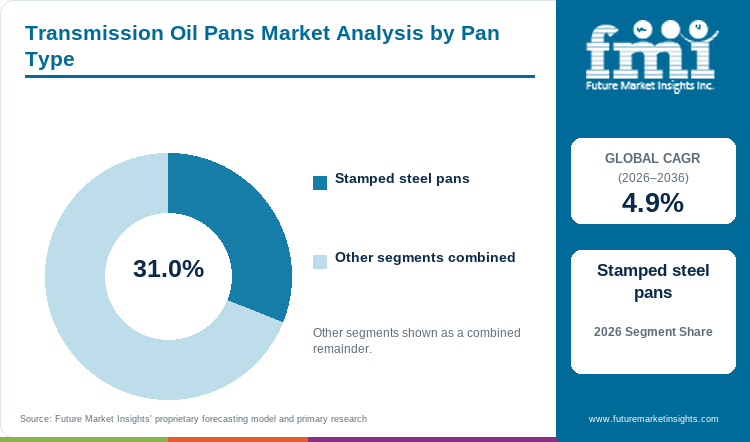
- Based on pan type, stamped steel pans are projected to account for 31.0% in 2026, supported by mature high-volume forming economics.
- By transmission type, automatic transmissions are estimated to hold 41.0% in 2026, influenced by their installed base and fluid-service requirements.
- In 2026, passenger cars are expected to lead vehicle type with 32.0% share, supported by repeated platform sourcing and fitment breadth.
- Dedicated tooling and repeated leak or impact validation raise switching costs before an alternative pan can enter a released transmission program.
- Some of the key players in this market include ZF Friedrichshafen AG and MANN+HUMMEL. The selected set also includes MAHLE GmbH and Ferdinand Bilstein GmbH + Co. KG. MEYLE AG and POLYTEC Holding AG add direct pan or oil-service relevance. AISIN Corporation and Magna International Inc. contribute transmission or hybrid-drive programs. Schaeffler AG and JATCO Ltd. complete the selected company set.
Analyst Perspective
"Transmission oil pans earn program value only after sealing performance and service access survive material or filter-integration changes. Engineers should compare total system cost after validation because a lighter pan can lose its advantage if tooling or service complexity rises."
- Nikhil Kaitwade, Principal Consultant, Future Market Insights
How is the Transmission Oil Pans Market segmented?
The transmission oil pans market is segmented by Pan Type, Transmission Type, Vehicle Type, Sales Channel, Function, and Region.
The transmission oil pans market is segmented by pan type, transmission type, vehicle type, sales channel, function, and region. Pan type covers stamped steel, aluminum, composite plastic, integrated filter, and deep sump pans. Transmission type covers automatic, DCT, CVT, hybrid, and heavy-duty transmissions. Vehicle type covers passenger cars, SUVs/crossovers, light commercial vehicles, pickup trucks, and heavy trucks. Sales channel covers OEM direct, transmission Tier-1s, aftermarket replacement, and performance aftermarket. Function covers oil containment, filter integration, cooling support, and structural/NVH support.
How does stamped steel shape demand within the pan type category?
Stamped steel remains practical for high-volume programs because press forming controls geometry through established tooling. The material also tolerates impact exposure without requiring thicker sections that can erase cost advantages in some alternatives. Program engineers compare steel against automotive lightweight materials when vehicle mass targets justify a different forming route. Any material change affects flange stiffness and sealing behavior across the released transmission interface. Tooling changes can trigger fresh dimensional and leak validation before production approval begins on a revised design. Stamped steel therefore retains value in platforms that prioritize repeatable forming and established repair practices. Alternative materials gain attention when integration or weight savings can absorb the additional qualification work.
- Based on pan type, stamped steel pans are projected to account for 31.0% in 2026, supported by mature forming routes and impact tolerance.
- A March 2026 Ford service bulletin lists transmission fluid pan gaskets for 10R80 and 10R80 MHT applications, showing how pan interfaces remain transmission-specific service items.
What supports automatic transmissions within the transmission type category?
Automatic gearboxes retain dedicated fluid-service work because automatic transmission systems use defined oil volumes and application-specific filters. Service teams must confirm the gearbox family before ordering pans or filter assemblies because fitment errors can interrupt maintenance work. Automatic architectures also keep hydraulic fluid management central to shift quality and component protection. Model-specific reservoirs must maintain the required fluid volume across operating conditions and scheduled service intervals.
- By transmission type, automatic transmissions are estimated to hold 41.0% in 2026, influenced by their installed base and recurring fluid-service exposure.
- JATCO presented automatic transmissions and CVTs at the May 2026 Automotive Engineering Exposition, confirming continuing engineering activity in fluid-lubricated gearbox architectures.
How do passenger-car applications shape the vehicle type category?
Passenger-car programs create repeated sourcing cycles because automotive transmission programs must fit tight platform packaging and service requirements. Reservoir geometry is established alongside the transmission housing before full series production begins at the assembly plant. A pan supplier must maintain dimensional consistency across the vehicle program rather than treating the component as a universal enclosure. Passenger cars also span automatic and hybrid architectures with different service access and packaging limits.
- In 2026, passenger cars are expected to lead vehicle type with 32.0% share, supported by broad volumes and diverse transmission architectures.
- AISIN began contract manufacturing Mazda six-speed automatic transmissions in Indiana during April 2026, expanding localized capacity for a passenger-vehicle transmission program.
What supports OEM direct sourcing within the sales channel category?
OEM direct sourcing starts before series production because pan geometry and automotive seals and gaskets must match the released transmission housing. Engineering teams define flange dimensions and fastener patterns before the vehicle reaches full production release. A supplier entering later must reproduce those interfaces without disturbing leak performance or service access. Tooling approval and validation become part of the sourcing decision rather than a separate aftermarket step. OEM awards can secure recurring production volume across the life of a transmission program. The same early integration raises switching costs once the complete assembly has passed release validation. Direct sourcing remains strongest when program timing and interface control matter more than late price competition.
- By sales channel, OEM direct is forecast to represent 50.0% in 2026, attributable to early design lock-in and program-specific validation requirements.
- ZF announced PowerLine selection for Capacity Trucks in May 2026, illustrating how transmission hardware enters service only after an OEM program award and integration process.
What role does oil containment play within the function category?
Oil containment remains the primary function because every separate-pan architecture must preserve reservoir volume and leak control. Transmission oil filters and cooling features add service value only after the enclosure maintains the required fluid boundary. Flange stiffness and sealing surfaces must remain stable through operating temperatures and road exposure. Drain access also affects scheduled maintenance procedures for vehicles that remain active in service fleets.
- Oil containment is projected to hold 38.0% share in 2026, driven by the reservoir and sealing function required by every applicable pan design.
- In February 2026, ZF Aftermarket expanded model-specific transmission oil-change kits with measured fluid quantities and required service parts. The range covers automatic and dual-clutch transmissions plus CVT applications. Model-specific fluid quantities reinforce the need to preserve correct reservoir capacity during service.
What are the drivers, restraints and opportunities in the Transmission Oil Pans Market?
Automatic and hybrid transmission programs sustain oil-pan demand, model-specific qualification slows supplier switching, and service integration can raise assembly value.
- Driver: Long-running automatic and hybrid transmission programs preserve demand for sealed reservoirs and service interfaces in released vehicle platforms.
- Restraint: Gearbox-specific sealing geometry and service procedures increase the cost and time required to substitute a pan or related interface.
- Opportunity: Complete oil-service kits can reduce workshop preparation time when the correct filter package and sealing hardware match the exact transmission application.
Production commitments keep pan demand tied to transmission families that remain in service for years. Transmission fluid requires controlled containment inside those gearboxes even as hybrid systems add electrical content. Allison signed a June 2026 contract to supply 4040 MX transmissions for BAE Systems Hägglunds CV90 MkIV vehicles. The award establishes a new production base for a fluid-lubricated transmission family rather than a short replacement cycle. Each released gearbox still needs a reservoir interface that survives production and later maintenance. Pan suppliers therefore benefit when transmission programs receive long production commitments and stable service requirements. The commercial effect appears through repeat program demand rather than through a broad assumption about total vehicle production.
Application specificity limits switching because workshops and vehicle programs cannot treat every reservoir interface as interchangeable hardware. Transmission filter systems vary with gearbox design and the maintenance procedure specified for each application. ZF Aftermarket expanded 8HP Gen4 oil-change kit coverage in July 2026 and emphasized model-specific fluid quantities and maintenance requirements. Those requirements keep service parts tied to exact transmission families even when competing products offer similar functions. A replacement pan must match flange geometry and sealing hardware before price becomes a decisive factor. The qualification burden raises the cost of substitution across both production and aftermarket routes. Suppliers without precise fitment data face a slower path from catalog availability to repeat orders.
Workshop service offers a direct route to additional pan-related revenue because complete kits reduce missing-parts risk. MEYLE surveyed 388 independent workshop employees across seven markets during June 2026 and found nearly 60% saw potential for three to ten additional automatic-transmission oil changes each month. Kit completeness ranked ahead of price in the same survey and availability remained a major selection factor. Complete oil-change packages can convert that service potential only if filters and sealing parts match the transmission code. Pan suppliers can support the route through application-specific assemblies that reduce workshop preparation time. The opportunity depends on accurate fitment coverage and dependable availability rather than generic maintenance promotion.
Which country CAGRs are profiled in the Transmission Oil Pans Market?
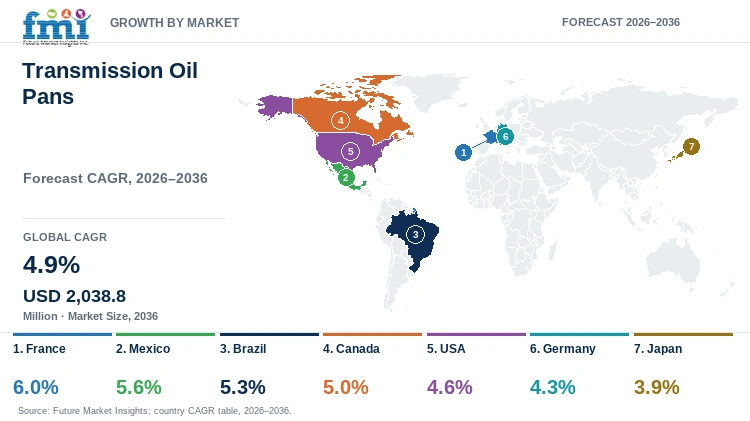
| Country | CAGR |
|---|---|
| France | 6.0% |
| Mexico | 5.6% |
| Brazil | 5.3% |
| Canada | 5.0% |
| USA | 4.6% |
| Germany | 4.3% |
| Japan | 3.9% |
How do country-level CAGRs compare in the Transmission Oil Pans Market?
The country CAGRs span 2.1 percentage points. France and Mexico occupy the upper range with Brazil close behind. Canada falls in the middle of the displayed range. The USA and Germany remain major production bases. Japan records the lowest displayed CAGR.
- France faces faster powertrain-mix turnover, so suppliers must choose hybrid-compatible programs without overcommitting capacity to declining legacy applications.
- Mexico rewards launch support near export-oriented plants because concentrated light-truck programs make timing and OEM award access commercially important.
- Brazil places more weight on local manufacturing economics because passenger and commercial production require durable designs at tightly controlled component cost.
- Canada presents a wider fitment challenge because multipurpose vehicles and pickups spread replacement demand within several North American transmission families.
- The USA combines truck-heavy production with a large service fleet, making part-number breadth and workshop availability important outside new-vehicle programs.
- Germany puts engineering release discipline ahead of rapid supplier switching because transmission components enter tightly managed vehicle-platform validation processes.
- Japan favors repeatable precision and compact packaging because mature supplier relationships raise the threshold for replacing an existing qualified transmission component source.
Comparable CAGRs can therefore produce different entry conditions because platform concentration and service intensity vary between countries. The full report provides country-level CAGR analysis across North America, Latin America, Western Europe, Eastern Europe, East Asia, South Asia and Pacific, and the Middle East and Africa.
Country-wise Analysis
- U.S. demand combines a truck-heavy new-vehicle mix with a large replacement base for automatic transmissions. Transmission oil pan demand in the USA is forecast to rise at 4.6% CAGR over the forecast period, supported by transmission service requirements in pickups and SUVs. EPA reported that trucks represented 66% of model-year 2024 new light-duty vehicles and truck SUVs accounted for half of production. Automatic transmission torque converters and pan assemblies require application-specific sealing coverage before broad aftermarket stocking becomes economic. The vehicle mix widens part-number requirements because pickup and SUV platforms use several North American transmission families. Aftermarket stocking becomes more efficient when application volume supports the correct pan and sealing combination.
- German programs require tight engineering validation as automakers change powertrain content inside large passenger-car manufacturing operations. By 2036, Germany is projected to grow at 4.3% CAGR. Continuing automotive production and hybrid platform work shape the national transmission outlook. Destatis reported automotive output rose 3.6% month on month in June 2026 following seasonal and calendar adjustment. Large production volumes keep launch support important even when platform changes remain relatively incremental. Program changes can require fresh dimensional checks across seals and housing interfaces before final production approval. Suppliers must preserve launch timing and dimensional consistency because replacing a released pan design can trigger repeated interface validation. Local competition therefore depends on disciplined release performance as much as component cost control.
- Japanese vehicle programs combine long supplier relationships with compact packaging and an aging installed passenger-car base. Japan is estimated to post 3.9% CAGR over the forecast period, influenced by replacement needs inside mature automatic and continuously variable transmissions. JAMA reported a 71.9% household passenger-car ownership rate and a 7.2-year average holding period in its 2025 fiscal-year survey. Long holding periods keep mature gearboxes in service and extend demand for application-specific replacement parts. Compact packaging leaves little tolerance for dimensional variation around the reservoir and surrounding transmission hardware. Suppliers protect repeat business through stable sealing geometry and controlled fitment expansion across mature vehicle applications.
- Brazilian demand spans passenger and commercial production because component cost must remain balanced against durability. Transmission oil pan demand in Brazil is forecast to rise at 5.3% CAGR over the forecast period, supported by continuing domestic vehicle production. OICA recorded 1.990 million cars and 654 thousand commercial vehicles produced in Brazil during 2025. The production mix shows a broad vehicle base rather than one dominant route for component sourcing. Local sourcing favors advanced automotive materials when designs balance material cost with durability. A lighter pan gains volume when tooling economics and service fit remain competitive against established steel or aluminum content.
- Canadian demand is weighted toward multipurpose vehicles and pickups that share North American transmission families under broad duty-cycle requirements. Adoption of transmission oil pans in Canada is estimated to expand at 5.0% CAGR through 2036, linked to a vehicle mix that keeps SUV and hybrid fitment relevant. Statistics Canada reported multipurpose vehicles represented 63.2% of 2025 new registrations and hybrid registrations rose 36.1%. That mix keeps North American fitment breadth central to transmission service coverage across the country. Hybrid growth also changes which transmission families remain relevant to replacement inventories over longer service periods. Aftermarket suppliers need enough part depth to support common applications without accumulating excessive slow-moving variants.
- French passenger-car registrations are shifting toward non-plug hybrids as conventional petrol demand continues to decline. Transmission oil pan sales in France are forecast to expand at 6.0% CAGR by 2036, reinforced by the changing mix of transmissions that retain separate oil containment. ACEA reported French hybrid-electric registrations rose 21.6% in 2025 and battery-electric registrations increased 12.5%. Hybrid growth changes the mix of transmission programs without preserving pans on every electrified architecture. Suppliers need to separate hybrid platforms with fluid-lubricated gearboxes from battery-electric programs that omit conventional transmission pans. Tooling allocation therefore depends on verified drivetrain architecture rather than registration growth across the wider vehicle market.
- Mexican sourcing is concentrated in export-oriented light-vehicle plants because launch timing and local support affect program access. In Mexico, transmission oil pan demand is predicted to advance at 5.6% CAGR through 2036. High light-truck production supports the outlook through pickup and SUV transmission architectures. INEGI reported 3.953 million light vehicles produced in 2025 and light trucks represented 77.2% of output. Concentrated light-truck output raises the value of local launch support because a delayed release can affect large export programs. Once a pan enters a high-volume transmission family its supply record becomes part of the program relationship. Stable availability and fast engineering response help protect the awarded program through continuing series production.
Who are the notable companies in the Transmission Oil Pans Market?
ZF Friedrichshafen AG, MANN+HUMMEL, MAHLE GmbH, Ferdinand Bilstein GmbH + Co. KG, MEYLE AG, POLYTEC Holding AG, AISIN Corporation, Magna International Inc., Schaeffler AG, and JATCO Ltd. are active within the defined transmission oil-pan and transmission-interface scope.
Direct pan or transmission-oil service evidence is documented by six companies in the selected set. Four additional groups contribute transmission programs that establish fluid-routing and packaging requirements without direct pan claims.
- Direct pan and oil-service interfaces include ZF Friedrichshafen AG and MANN+HUMMEL. MAHLE GmbH and Ferdinand Bilstein GmbH + Co. KG also document pan-related or transmission-oil service activity. MEYLE AG and POLYTEC Holding AG complete the direct-interface group.
- Transmission-program control includes AISIN Corporation and Magna International Inc. Schaeffler AG and JATCO Ltd. document current transmission or hybrid-drive programs that set gearbox fluid and packaging requirements.
Competitive Benchmarking: Transmission Oil Pans Market
| Company | Pan / Oil-Service Evidence | Transmission Program Depth | Aftermarket / Service Reach | Geographic Reach |
|---|---|---|---|---|
| ZF Friedrichshafen AG | High | High | High | Global |
| MANN+HUMMEL | High | Low | High | Global |
| MAHLE GmbH | Medium | Low | High | Global |
| Ferdinand Bilstein GmbH + Co. KG | High | Low | High | Europe and international aftermarket |
| MEYLE AG | High | Low | High | Europe and international aftermarket |
| POLYTEC Holding AG | High | Low | Low | Europe with international automotive programs |
| AISIN Corporation | Low | High | Low | Japan, North America, Europe and Asia |
| Magna International Inc. | Low | High | Low | Global automotive operations |
| Schaeffler AG | Low | High | Low | Global automotive operations |
| JATCO Ltd. | Low | High | Low | Japan, Mexico, China, Thailand and United Kingdom |
Scoring basis: High pan or oil-service evidence requires direct public documentation of a transmission pan or an application-specific service kit. Medium identifies direct service equipment without a pan or parts kit. Low identifies a current transmission program without direct pan evidence. High transmission depth requires current gearbox manufacturing or a production program. High aftermarket reach requires workshop parts or service products in multiple markets.
Key Developments in the Transmission Oil Pans Market
- In August 2026, MANN+HUMMEL introduced fully equipped transmission oil-filter service kits for European passenger-car applications with filters and application-dependent service accessories.
- In July 2026, MAHLE moved UK workshop-equipment sales into its direct aftermarket organization and included transmission oil-service equipment within the integrated offering.
- In March 2026, Magna International Inc. introduced the DHD REX dedicated hybrid drive with a compact single-motor architecture for range-extended electric vehicles.
Key Players in the Transmission Oil Pans Market
Direct pan and transmission-oil service interfaces
- ZF Friedrichshafen AG
- MANN+HUMMEL
- MAHLE GmbH
- Ferdinand Bilstein GmbH + Co. KG
- MEYLE AG
- POLYTEC Holding AG
Transmission and hybrid-drive program control
- AISIN Corporation
- Magna International Inc.
- Schaeffler AG
- JATCO Ltd.
Transmission Oil Pans Market - Report Scope
| Coverage field | Report scope |
|---|---|
| Market breakdown | By pan type, transmission type, vehicle type, sales channel, function, and region. |
| Quantitative Units | USD million. |
| Market Definition | Revenue from transmission oil pans used with automatic, DCT, CVT, hybrid, and heavy-duty transmissions is included. Complete transmissions, engine oil pans, stand-alone fluids, and unrelated housings are excluded. |
| Regions Covered | North America, Latin America, Western Europe, Eastern Europe, East Asia, South Asia and Pacific, and Middle East and Africa. |
| Countries Covered | France, Mexico, Brazil, Canada, USA, Germany, Japan, and 20+ countries included in the full report. |
| Key Companies Profiled | ZF Friedrichshafen AG, MANN+HUMMEL, MAHLE GmbH, Ferdinand Bilstein GmbH + Co. KG, MEYLE AG, POLYTEC Holding AG, AISIN Corporation, Magna International Inc., Schaeffler AG, JATCO Ltd. |
| Forecast Period | 2026 to 2036. |
| Approach | Primary and secondary research with market triangulation. |
Transmission Oil Pans Market - Research Methodology
| Method | Approach |
|---|---|
| Primary Research | FMI analysts gathered input from manufacturers, service providers, technology developers, distributors, end users, procurement teams, and subject-matter experts. Interviews examined purchasing decisions, product or service evaluation, adoption barriers, approval requirements, pricing considerations, and expectations for technical or commercial support. Respondents were also asked what evidence is required before a trial, pilot, or initial order develops into regular purchasing. |
| Desk Research | Desk research covered government statistics, regulatory publications, trade data, industry associations, technical literature, standards, company filings, product information, and official corporate announcements. Sources were reviewed for relevance, publication date, geographic coverage, and consistency with the defined market scope. Claims relating to performance, applications, approvals, capacity, investment, and commercial activity were retained only when supported by credible public evidence. |
| Market Sizing and Forecasting | The market model combined the baseline value with historical performance, segment structure, pricing and volume indicators, adoption levels, company participation, and country-level demand conditions. Forecast assumptions considered economic activity, investment trends, regulatory developments, technology adoption, purchasing cycles, supply availability, and barriers to wider market use. Segment and regional estimates were reconciled before the final market total was calculated. |
| Data Validation | Estimates were checked against multiple independent indicators, including public data, company activity, trade patterns, industry developments, and findings from primary interviews. Validation also tested whether products, services, applications, and company revenues fell within the defined market boundaries. Adjacent categories, unsupported claims, overlapping revenues, and activities without direct market relevance were excluded to reduce double counting and maintain consistency across segments and countries. |
Transmission Oil Pans Market by Segments
Transmission Oil Pans Market segmented by Pan Type:
- Stamped steel pans
- Aluminum pans
- Composite plastic pans
- Integrated filter pans
- Deep sump pans
Transmission Oil Pans Market segmented by Transmission Type:
- Automatic transmissions
- DCT
- CVT
- Hybrid transmissions
- Heavy-duty transmissions
Transmission Oil Pans Market segmented by Vehicle Type:
- Passenger cars
- SUVs/crossovers
- Light commercial vehicles
- Pickup trucks
- Heavy trucks
Transmission Oil Pans Market segmented by Sales Channel:
- OEM direct
- Transmission Tier-1s
- Aftermarket replacement
- Performance aftermarket
Transmission Oil Pans Market segmented by Function:
- Oil containment
- Filter integration
- Cooling support
- Structural/NVH support
Transmission Oil Pans Market by Region:
- North America
- United States
- Canada
- Latin America
- Brazil
- Mexico
- Chile
- Rest of Latin America
- Western Europe
- Germany
- United Kingdom
- Italy
- Spain
- France
- Nordics
- Benelux
- Rest of Western Europe
- Eastern Europe
- Russia
- Poland
- Hungary
- Balkan and Baltic States
- Rest of Eastern Europe
- East Asia
- China
- Japan
- South Korea
- South Asia and Pacific
- India
- ASEAN
- Australia and New Zealand
- Rest of South Asia and Pacific
- Middle East and Africa
- Kingdom of Saudi Arabia
- Other GCC Countries
- Türkiye
- South Africa
- Other African Union Countries
- Rest of Middle East and Africa
Research Sources and Bibliography
- ZF Friedrichshafen AG. (2026, February 6). ZF and BMW Sign Agreement for Future-Oriented Drive Technologies.
- Service des données et études statistiques. (2026, February 11). Immatriculations de voitures en 2025 : le marché du neuf baisse, celui de l’occasion résiste.
- National Highway Traffic Safety Administration. (2026, March 19). Technical Service Bulletin 26-2112: No Upshift Past Second Gear, Unable To Achieve Third Gear Ratio, And/Or Illuminated MIL With DTCs P0757 And P2701.
- JATCO Ltd. (2026, May 11). JATCO to Exhibit at Automotive Engineering Exposition 2026 YOKOHAMA.
- AISIN Corporation. (2026, April 21). AISIN Begins Contract Manufacturing Mazda’s Six-speed Automatic Transmission in the United States.
- ZF Friedrichshafen AG. (2026, May 4). ZF 8-speed PowerLine Transmission Selected for Capacity Trucks Terminal Tractor Platform.
- Allison Transmission. (2026, June 16). Allison Transmission to supply 4040 MX transmissions for BAE Systems Hägglunds CV90 MkIV vehicles.
- ZF Friedrichshafen AG. (2026, July 30). ZF Aftermarket Maximizes Vehicle Uptime with Maintain - Repair - Replace Strategy.
- MEYLE AG. (2026, September 8). Lifetime maintenance-free? A myth with consequences for workshops.
- U.S. Environmental Protection Agency. (2026, February 19). Highlights of the Automotive Trends Report.
- Federal Statistical Office of Germany. (2026, August 7). Production in June 2026: +0.2% on the previous month.
- Japan Automobile Manufacturers Association. (2026, April 14). 2025 fiscal-year passenger car market trend survey.
- International Organization of Motor Vehicle Manufacturers. (2026). World Motor Vehicle - Production - 2025. Retrieved September 18, 2026.
- Statistics Canada. (2026, March 12). New motor vehicle registrations, fourth quarter 2025.
- European Automobile Manufacturers’ Association. (2026, January 27). New car registrations: +1.8% in 2025; battery-electric 17.4% market share.
- Instituto Nacional de Estadística y Geografía. (2026, January 9). Registro administrativo de la industria automotriz de vehículos ligeros. Diciembre de 2025.
- MANN+HUMMEL. (2026, August 26). New transmission oil filter kits from MANN-FILTER.
- MAHLE Aftermarket. (2026, July 7). MAHLE strengthens UK aftermarket presence.
- Magna International Inc. (2026, March 24). Magna Unveils DHD REX Hybrid Drive for Enhanced EV Range.
- POLYTEC Holding AG. (2025). Annual Report 2024. Retrieved September 18, 2026.
- BorgWarner Inc. (2026, May 6). BorgWarner Wins Two Conquest Awards in Asia for Combustion and Hybrid Powertrain Programs.
- BorgWarner Inc. (2026, April 30). BorgWarner Secures Three Electric Motor Awards in China and South Korea.
- ZF Friedrichshafen AG. (2026, September 8). ZF Aftermarket Announces New EV Repair Kits and Expanded Portfolio for a More Diverse Vehicle Parc.
- MANN+HUMMEL. (2026, September 8). MANN-FILTER presents filters for e-axles.
- MAHLE. (2026, July 21). MAHLE develops an ecosystem for the workshop business of the future.
- Ferdinand Bilstein GmbH + Co. KG. (2026, August 5). Un entretien souvent négligé, désormais simplifié grâce à febi.
- POLYTEC Holding AG. (2026, April 30). Annual Report 2025.
- AISIN Corporation. (2026, August 27). Newly Developed Two-Motor Hybrid Drive Module Adopted for STELLANTIS New Jeep Cherokee.
- Magna International Inc. (2026, July 28). Magna Secures 800V eDrive Program Award with Chery.
- Schaeffler AG. (2026, April 27). Not just a bridging technology: Schaeffler offers extensive range from components to systems for all hybrid powertrains.
- JATCO Ltd. (2026, June 24). JATCO Expands Adoption of its X-in-1 series.
- ZF Friedrichshafen AG. (2026, February 19). ZF's transmission oil change kit range continues to grow with numerous new additions in the combustion engine, electric, and hybrid sectors.
- MEYLE AG. (2026, March 30). Transmission oil change kit - in detail.
This bibliography is provided for reader reference and is not exhaustive. The full report contains the complete reference list and detailed citations.
This Report Answers
- How large is the transmission oil pans market in 2026 and 2036?
- Which transmission programs sustain demand for dedicated oil-containment and service interfaces?
- Why do stamped steel pans retain the largest estimated share within pan type?
- How do automatic transmissions affect pan systems and oil-service requirements?
- Why does OEM direct sourcing hold half of the sales channel category?
- How do country CAGRs compare across France, Mexico and other profiled markets?
- Which companies provide direct oil-service evidence or control transmission programs?
- How do application-specific sealing and validation requirements limit supplier switching?
- How can complete transmission oil-service kits add aftermarket revenue without increasing fitment risk?
Frequently Asked Questions
How big is the transmission oil pans market in 2026?
The transmission oil pans market is valued at USD 1,263.6 million in 2026 and is projected to reach USD 2,038.8 million by 2036. Automatic and hybrid transmission programs keep oil containment tied to released gearbox platforms.
What is the CAGR of the transmission oil pans market from 2026 to 2036?
The transmission oil pans market is projected to grow at a CAGR of 4.9% between 2026 and 2036. Continuing transmission production and replacement activity require application-specific fluid containment.
Which pan type leads the transmission oil pans market?
Stamped steel pans are projected to account for 31.0% of pan type revenue in 2026, supported by mature forming economics and impact durability. Aluminum and composite alternatives need enough mass or integration benefit to justify different tooling.
Which transmission type holds the largest current share in the transmission oil pans market?
The automatic transmissions segment is estimated to hold 41.0% of transmission type revenue in 2026, influenced by its broad installed base and fluid-service requirements. Application-specific filters and sealing interfaces keep fitment discipline central to workshop replacement work and scheduled transmission service.
Which sales channel leads the transmission oil pans market?
OEM direct is forecast to represent 50.0% of sales channel revenue in 2026, attributable to early geometry release and program validation. Suppliers usually secure series-production business before launch because later substitution can require renewed sealing and tooling approval.
Which countries record the faster profiled growth in the transmission oil pans market?
France is projected at 6.0% CAGR followed by Mexico at 5.6% and Brazil at 5.3% through 2036. Their commercial conditions differ because powertrain mix and manufacturing concentration change how quickly qualified designs convert into orders.
Which companies are active in the transmission oil pans market?
Key companies within the direct oil-service scope include ZF Friedrichshafen AG and MANN+HUMMEL. MAHLE GmbH and Ferdinand Bilstein GmbH + Co. KG also provide relevant service interfaces. MEYLE AG and POLYTEC Holding AG add aftermarket or pan-engineering coverage. AISIN Corporation and Magna International Inc. contribute transmission or hybrid-drive programs. Schaeffler AG and JATCO Ltd. complete the selected set. Their roles span production interfaces and aftermarket maintenance.
Preview the report firsthand - request a free sample
Get SampleGet the brochure for pricing and purchase details.
Get PDFTable of Content
- Key Takeaways
- Market Size and CAGR
- Top Growth Driver
- Fastest Growing Segment
- Leading Region
- Key Companies
- Emerging Opportunities
- Executive Summary
- Global Market Outlook
- Demand-side Trends
- Supply-side Trends
- Technology Roadmap Analysis
- Analysis and Recommendations
- Analyst Perspective (What is happening? Why now? What should investors know?)
- Key Questions Answered
- How large is the market?
- What is the CAGR?
- What are key trends?
- Which region dominates?
- Who are the leaders?
- Market Overview
- Market Coverage / Taxonomy
- Market Definition / Scope / Limitations
- Research Methodology
- Chapter Orientation
- Analytical Lens and Working Hypotheses
- Market Structure, Signals, and Trend Drivers
- Benchmarking and Cross-market Comparability
- Market Sizing, Forecasting, and Opportunity Mapping
- Research Design and Evidence Framework
- Desk Research Programme (Secondary Evidence)
- Expert Input and Fieldwork (Primary Evidence)
- Tooling, Models, and Reference Databases
- Data Engineering and Model Build
- Quality Assurance and Audit Trail
- Market Background
- Market Dynamics (Drivers, Restraints, Opportunity, Trends)
- Scenario Forecast (Optimistic, Likely, Conservative)
- Impact Analysis
- AI Impact
- Sustainability Impact
- Regulatory Impact
- Technology Impact
- Consumer / Buyer Analysis
- Purchase Drivers
- Adoption Barriers
- Buyer Journey
- Opportunity Map Analysis
- Product Life Cycle Analysis
- Supply Chain Analysis
- Investment Feasibility Matrix
- Value Chain Analysis
- PESTLE and Porter's Analysis
- Regulatory Landscape
- Regional Parent Market Outlook
- Production and Consumption Statistics
- Import and Export Statistics
- Global Market Analysis and Forecast, 2021 to 2036
- Historical Market Size Value (USD Million) Analysis, 2021 to 2025
- Current and Future Market Size Value (USD Million) Projections, 2026 to 2036
- Y-o-Y Growth Trend Analysis
- Absolute $ Opportunity Analysis
- Global Market Pricing Analysis, 2021 to 2036
- Global Market Analysis and Forecast, By Pan Type, 2021 to 2036
- Introduction / Key Findings
- Historical Market Size Value (USD Million) Analysis By Pan Type, 2021 to 2025
- Current and Future Market Size Value (USD Million) Analysis and Forecast By Pan Type, 2026 to 2036
- Stamped steel pans
- Aluminum pans
- Composite plastic pans
- Integrated filter pans
- Deep sump pans
- Y-o-Y Growth Trend Analysis By Pan Type, 2021 to 2025
- Absolute $ Opportunity Analysis By Pan Type, 2026 to 2036
- Global Market Analysis and Forecast, By Transmission Type, 2021 to 2036
- Introduction / Key Findings
- Historical Market Size Value (USD Million) Analysis By Transmission Type, 2021 to 2025
- Current and Future Market Size Value (USD Million) Analysis and Forecast By Transmission Type, 2026 to 2036
- Automatic transmissions
- DCT
- CVT
- Hybrid transmissions
- Heavy-duty transmissions
- Y-o-Y Growth Trend Analysis By Transmission Type, 2021 to 2025
- Absolute $ Opportunity Analysis By Transmission Type, 2026 to 2036
- Global Market Analysis and Forecast, By Vehicle Type, 2021 to 2036
- Introduction / Key Findings
- Historical Market Size Value (USD Million) Analysis By Vehicle Type, 2021 to 2025
- Current and Future Market Size Value (USD Million) Analysis and Forecast By Vehicle Type, 2026 to 2036
- Passenger cars
- SUVs/crossovers
- Light commercial vehicles
- Pickup trucks
- Heavy trucks
- Y-o-Y Growth Trend Analysis By Vehicle Type, 2021 to 2025
- Absolute $ Opportunity Analysis By Vehicle Type, 2026 to 2036
- Global Market Analysis and Forecast, By Sales Channel, 2021 to 2036
- Introduction / Key Findings
- Historical Market Size Value (USD Million) Analysis By Sales Channel, 2021 to 2025
- Current and Future Market Size Value (USD Million) Analysis and Forecast By Sales Channel, 2026 to 2036
- OEM direct
- Transmission Tier-1s
- Aftermarket replacement
- Performance aftermarket
- Y-o-Y Growth Trend Analysis By Sales Channel, 2021 to 2025
- Absolute $ Opportunity Analysis By Sales Channel, 2026 to 2036
- Global Market Analysis and Forecast, By Function, 2021 to 2036
- Introduction / Key Findings
- Historical Market Size Value (USD Million) Analysis By Function, 2021 to 2025
- Current and Future Market Size Value (USD Million) Analysis and Forecast By Function, 2026 to 2036
- Oil containment
- Filter integration
- Cooling support
- Structural/NVH support
- Y-o-Y Growth Trend Analysis By Function, 2021 to 2025
- Absolute $ Opportunity Analysis By Function, 2026 to 2036
- Global Market Analysis and Forecast, By Region, 2021 to 2036
- Introduction
- Historical Market Size Value (USD Million) Analysis By Region, 2021 to 2025
- Current Market Size Value (USD Million) Analysis and Forecast By Region, 2026 to 2036
- North America
- Latin America
- Western Europe
- Eastern Europe
- East Asia
- South Asia and Pacific
- Middle East and Africa
- Market Attractiveness Analysis By Region
- North America Market Analysis and Forecast, By Country, 2021 to 2036
- Historical Market Size Value (USD Million) Trend Analysis By Market Taxonomy, 2021 to 2025
- Market Size Value (USD Million) Forecast By Market Taxonomy, 2026 to 2036
- By Country
- United States
- Canada
- By Pan Type
- By Transmission Type
- By Vehicle Type
- By Sales Channel
- By Function
- By Country
- Market Attractiveness Analysis
- By Country
- By Pan Type
- By Transmission Type
- By Vehicle Type
- By Sales Channel
- By Function
- Key Takeaways
- Latin America Market Analysis and Forecast, By Country
- Historical Market Size Value (USD Million) Trend Analysis By Market Taxonomy, 2021 to 2025
- Market Size Value (USD Million) Forecast By Market Taxonomy, 2026 to 2036
- By Country
- Brazil
- Mexico
- Chile
- Rest of Latin America
- By Pan Type
- By Transmission Type
- By Vehicle Type
- By Sales Channel
- By Function
- By Country
- Market Attractiveness Analysis
- By Country
- By Pan Type
- By Transmission Type
- By Vehicle Type
- By Sales Channel
- By Function
- Key Takeaways
- Western Europe Market Analysis and Forecast, By Country
- Historical Market Size Value (USD Million) Trend Analysis By Market Taxonomy, 2021 to 2025
- Market Size Value (USD Million) Forecast By Market Taxonomy, 2026 to 2036
- By Country
- Germany
- United Kingdom
- Italy
- Spain
- France
- Nordics
- Benelux
- Rest of Western Europe
- By Pan Type
- By Transmission Type
- By Vehicle Type
- By Sales Channel
- By Function
- By Country
- Market Attractiveness Analysis
- By Country
- By Pan Type
- By Transmission Type
- By Vehicle Type
- By Sales Channel
- By Function
- Key Takeaways
- Eastern Europe Market Analysis and Forecast, By Country
- Historical Market Size Value (USD Million) Trend Analysis By Market Taxonomy, 2021 to 2025
- Market Size Value (USD Million) Forecast By Market Taxonomy, 2026 to 2036
- By Country
- Russia
- Poland
- Hungary
- Balkan and Baltic States
- Rest of Eastern Europe
- By Pan Type
- By Transmission Type
- By Vehicle Type
- By Sales Channel
- By Function
- By Country
- Market Attractiveness Analysis
- By Country
- By Pan Type
- By Transmission Type
- By Vehicle Type
- By Sales Channel
- By Function
- Key Takeaways
- East Asia Market Analysis and Forecast, By Country
- Historical Market Size Value (USD Million) Trend Analysis By Market Taxonomy, 2021 to 2025
- Market Size Value (USD Million) Forecast By Market Taxonomy, 2026 to 2036
- By Country
- China
- Japan
- South Korea
- By Pan Type
- By Transmission Type
- By Vehicle Type
- By Sales Channel
- By Function
- By Country
- Market Attractiveness Analysis
- By Country
- By Pan Type
- By Transmission Type
- By Vehicle Type
- By Sales Channel
- By Function
- Key Takeaways
- South Asia and Pacific Market Analysis and Forecast, By Country
- Historical Market Size Value (USD Million) Trend Analysis By Market Taxonomy, 2021 to 2025
- Market Size Value (USD Million) Forecast By Market Taxonomy, 2026 to 2036
- By Country
- India
- ASEAN
- Australia and New Zealand
- Rest of South Asia and Pacific
- By Pan Type
- By Transmission Type
- By Vehicle Type
- By Sales Channel
- By Function
- By Country
- Market Attractiveness Analysis
- By Country
- By Pan Type
- By Transmission Type
- By Vehicle Type
- By Sales Channel
- By Function
- Key Takeaways
- Middle East and Africa Market Analysis and Forecast, By Country
- Historical Market Size Value (USD Million) Trend Analysis By Market Taxonomy, 2021 to 2025
- Market Size Value (USD Million) Forecast By Market Taxonomy, 2026 to 2036
- By Country
- Kingdom of Saudi Arabia
- Other GCC Countries
- Türkiye
- South Africa
- Other African Union Countries
- Rest of Middle East and Africa
- By Pan Type
- By Transmission Type
- By Vehicle Type
- By Sales Channel
- By Function
- By Country
- Market Attractiveness Analysis
- By Country
- By Pan Type
- By Transmission Type
- By Vehicle Type
- By Sales Channel
- By Function
- Key Takeaways
- Key Countries Market Analysis
- United States
- Pricing Analysis
- Market Share Analysis, 2025
- By Pan Type
- By Transmission Type
- By Vehicle Type
- By Sales Channel
- By Function
- Canada
- Pricing Analysis
- Market Share Analysis, 2025
- By Pan Type
- By Transmission Type
- By Vehicle Type
- By Sales Channel
- By Function
- Mexico
- Pricing Analysis
- Market Share Analysis, 2025
- By Pan Type
- By Transmission Type
- By Vehicle Type
- By Sales Channel
- By Function
- Brazil
- Pricing Analysis
- Market Share Analysis, 2025
- By Pan Type
- By Transmission Type
- By Vehicle Type
- By Sales Channel
- By Function
- Chile
- Pricing Analysis
- Market Share Analysis, 2025
- By Pan Type
- By Transmission Type
- By Vehicle Type
- By Sales Channel
- By Function
- Germany
- Pricing Analysis
- Market Share Analysis, 2025
- By Pan Type
- By Transmission Type
- By Vehicle Type
- By Sales Channel
- By Function
- United Kingdom
- Pricing Analysis
- Market Share Analysis, 2025
- By Pan Type
- By Transmission Type
- By Vehicle Type
- By Sales Channel
- By Function
- Italy
- Pricing Analysis
- Market Share Analysis, 2025
- By Pan Type
- By Transmission Type
- By Vehicle Type
- By Sales Channel
- By Function
- Spain
- Pricing Analysis
- Market Share Analysis, 2025
- By Pan Type
- By Transmission Type
- By Vehicle Type
- By Sales Channel
- By Function
- France
- Pricing Analysis
- Market Share Analysis, 2025
- By Pan Type
- By Transmission Type
- By Vehicle Type
- By Sales Channel
- By Function
- India
- Pricing Analysis
- Market Share Analysis, 2025
- By Pan Type
- By Transmission Type
- By Vehicle Type
- By Sales Channel
- By Function
- ASEAN
- Pricing Analysis
- Market Share Analysis, 2025
- By Pan Type
- By Transmission Type
- By Vehicle Type
- By Sales Channel
- By Function
- Australia and New Zealand
- Pricing Analysis
- Market Share Analysis, 2025
- By Pan Type
- By Transmission Type
- By Vehicle Type
- By Sales Channel
- By Function
- China
- Pricing Analysis
- Market Share Analysis, 2025
- By Pan Type
- By Transmission Type
- By Vehicle Type
- By Sales Channel
- By Function
- Japan
- Pricing Analysis
- Market Share Analysis, 2025
- By Pan Type
- By Transmission Type
- By Vehicle Type
- By Sales Channel
- By Function
- South Korea
- Pricing Analysis
- Market Share Analysis, 2025
- By Pan Type
- By Transmission Type
- By Vehicle Type
- By Sales Channel
- By Function
- Russia
- Pricing Analysis
- Market Share Analysis, 2025
- By Pan Type
- By Transmission Type
- By Vehicle Type
- By Sales Channel
- By Function
- Poland
- Pricing Analysis
- Market Share Analysis, 2025
- By Pan Type
- By Transmission Type
- By Vehicle Type
- By Sales Channel
- By Function
- Hungary
- Pricing Analysis
- Market Share Analysis, 2025
- By Pan Type
- By Transmission Type
- By Vehicle Type
- By Sales Channel
- By Function
- Kingdom of Saudi Arabia
- Pricing Analysis
- Market Share Analysis, 2025
- By Pan Type
- By Transmission Type
- By Vehicle Type
- By Sales Channel
- By Function
- Türkiye
- Pricing Analysis
- Market Share Analysis, 2025
- By Pan Type
- By Transmission Type
- By Vehicle Type
- By Sales Channel
- By Function
- South Africa
- Pricing Analysis
- Market Share Analysis, 2025
- By Pan Type
- By Transmission Type
- By Vehicle Type
- By Sales Channel
- By Function
- United States
- Market Structure Analysis
- Competition Dashboard
- Competition Benchmarking
- Market Share Analysis of Top Players
- By Regional
- By Pan Type
- By Transmission Type
- By Vehicle Type
- By Sales Channel
- By Function
- Emerging Startups
- Innovation Benchmarking
- Competition Analysis
- Competition Deep Dive
- ZF Friedrichshafen AG
- Overview
- Product Portfolio
- Profitability by Market Segments
- Sales Footprint
- Strategy Overview
- Marketing Strategy
- Product Strategy
- Channel Strategy
- MANN+HUMMEL
- MAHLE GmbH
- Ferdinand Bilstein GmbH + Co. KG
- MEYLE AG
- POLYTEC Holding AG
- AISIN Corporation
- Magna International Inc.
- Schaeffler AG
- JATCO Ltd.
- ZF Friedrichshafen AG
- Case Studies
- Success Stories
- Recent Developments
- Competition Deep Dive
- Assumptions & Acronyms Used


