

- Market Size (2026)
- USD 12.8 Mn
- Forecast (2036)
- USD 60.0 Mn
- CAGR (2026 to 2036)
- 16.7%
How big is Twistocaloric Elastomer Coolers Market in 2026?
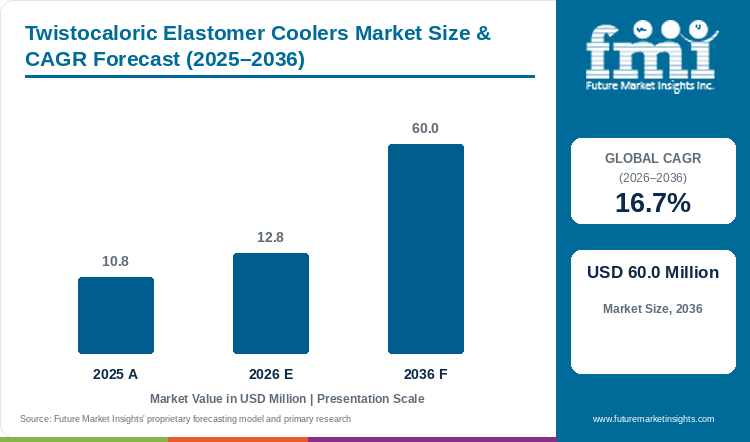
Valued at USD 10.8 million throughout 2025, the twistocaloric elastomer coolers sector is estimated to register USD 12.8 million during 2026 while progressing at a projected 16.7% CAGR until reaching an anticipated USD 60.0 million by 2036-end.
Uniaxial elastocaloric cooling frames require long linear hydraulic actuators that cannot fit inside wearable exosuits or 1U server blades, whereas twisting supercoiled elastomer plies converts low-torque rotary stepper motion into reversible strain crystallization and positions Coiled & Supercoiled Natural Rubber / EPDM Elastomer Plies for a projected 53.6% share of twisted fiber material demand in 2026. Measured at USD 10.8 million throughout 2025, global twistocaloric elastomer coolers 2026 turnover is estimated at a USD 12.8 million baseline while progressing at an expected 16.7% CAGR until hitting a predicted USD 60.0 million by 2036-end for an anticipated expansion of USD 47.2 million. Confirming how combining torsional twist with uniaxial stretching amplifies elastocaloric entropy changes in natural rubber over low-COP Peltier elements across thermoelectric cooling modules replacement duties, researchers in the TWISTER project at the Universitat de Barcelona filed European patent application EP25382371 in April 2025 for a natural-rubber twistocaloric liquid-cooling prototype with mechanical energy recovery while noting that scaling laboratory prototypes to commercial maturity remains ongoing [1].
Key Market Trends & Insights
- By twisted fiber material: Coiled & Supercoiled Natural Rubber / EPDM Elastomer Plies are envisioned to hold 53.6% of 2026 material revenue because hyperelastic polymer chains crystallize exothermically when twisted and absorb heat upon untwisting at low rotary torque.
- By heat transfer medium: Direct Microfluidic Water/Glycol Channel Exchange is foreseen to represent 62.8% of 2026 heat-transfer turnover since laminar micro-channels surrounding coiled fiber bundles extract heat five times faster than static air.
- By application: Wearable Exosuit & Micro-Electronic Spot Cooling is slated to capture 48.4% of 2026 end-use demand as robotics and edge-computing builders seek lightweight, orientation-independent spot coolers.
Regional Highlights
- Highest national growth rate: South Korea is envisioned to lead regional adoption with a 17.9% compound annual pace from 2026 to 2036 on wearable robotics and automotive seat thermal R&D.
- Fast-growing semiconductor and aerospace hubs: Taiwanese demand is foreseen to advance 17.4% annually while French installations are expected to expand by 17.0% on polymer composite and chip-cooling innovation.
- Core medical wire and elastomer markets: United States shipments are expected to rise 16.5% annually while Japan is foreseen to post 16.4% while Germany is estimated to post 16.2%.
Market Size & Forecast
Table 1: Market Size and Forecast for the Twistocaloric Elastomer Coolers Market (USD million and CAGR percentage), 2025 to 2036
| Metric | Value |
|---|---|
| 2025 Market Size | USD 10.8 million |
| Estimated Market Size in 2026 | USD 12.8 million |
| Projected Market Size by 2036 | USD 60.0 million |
| CAGR, 2026 to 2036 | 16.7% |
| Added Revenue, 2026 to 2036 | USD 47.2 million |
Transitioning solid-state caloric cooling from laboratory tensile frames into commercial wearable and automotive devices requires replacing meter-long linear stretching actuators with compact rotary torsion cartridges. Updated AIM Act hydrofluorocarbon phasedown guidance from EPA offices in September 2026 confirmed that the 85% phasedown through 2036 avoids 4.6 billion metric tons of CO2e while renewing application-specific allowances for defense and semiconductor cooling through 2030 [2]. Unlike Peltier thermoelectric modules that suffer low coefficients of performance and Joule back-heating, supercoiled natural rubber and nickel-titanium twistocaloric cartridges convert rotary servo torque into high-COP cooling alongside shape memory alloy wires medical manufacturing lines. Device builders that encapsulate multi-ply elastomer braids inside flexible microfluidic sleeves achieve silent spot cooling without refrigerant tubing.
Rotary Actuator Cartridge Volume and Specific Cooling Power Sizing
Table 2: Twistocaloric Cartridge Shipment Volume and Specific Cooling Power for the Twistocaloric Elastomer Coolers Market (USD million, thousand units, and watts per gram), 2025 to 2036
| Metric | 2025 | 2026 | 2036 |
|---|---|---|---|
| Market size (USD million) | 10.8 | 12.8 | 60.0 |
| Rotary twistocaloric cartridges shipped (thousand units) | 68.0 to 78.0 | 82.0 to 94.0 | 440.0 to 510.0 |
| Specific cooling power (watts per gram of fiber) | 5.2 to 7.5 | 6.0 to 8.4 | 11.5 to 15.8 |
| Average cartridge unit price (USD per unit) | 138 to 158 | 136 to 156 | 118 to 136 |
Operational note: Cartridge shipment counts and specific cooling power ranges reflect rotary torsion cooler assemblies rated from 15 to 250 watts of thermal output running at 1.0 to 4.0 cycles per second.
Supercoiling pre-stretched elastomer plies or multi-strand shape-memory wires amplifies the entropy change per turn of rotary twist while reducing actuator length by more than 65% compared with linear elastocaloric ribbons. In May 2026, Confluent Medical Technologies announced a 26000-square-foot ISO 13485 Nitinol Wire Center of Excellence in Hyderabad in India that doubles its precision superelastic wire capacity across 0.004-inch to 0.100-inch diameters [3]. Pairing high-purity nickel-titanium strands with performance elastomer compounds allows cartridge designers to tailor transition temperatures from 5 degrees Celsius for insulin coolers up to 35 degrees Celsius for chip spot cooling. Automated multi-spindle braiding machines lower per-cartridge assembly costs as production scales beyond 80000 units in 2026.
Torsional Fatigue Life and Microfluidic Heat-Transfer Benchmarks
Table 3: Torsional Fatigue Durability andAdiabatic Temperature-Span Indicators for the Twistocaloric Elastomer Coolers Market (kelvin, cycles, and COP), 2025 to 2036
| Metric | 2025 | 2026 | 2036 |
|---|---|---|---|
| Adiabatic cooling span per untwist stroke (K) | 8.5 to 14.0 | 9.5 to 15.5 | 14.0 to 21.0 |
| Torsional fatigue life (million twist cycles) | 0.8 to 1.5 | 1.2 to 2.2 | 4.5 to 8.0 |
| Material-level coefficient of performance (COP) | 4.5 to 6.8 | 5.0 to 7.4 | 7.2 to 10.5 |
| Rotary actuator torque recovery efficiency (%) | 62.0 to 70.0 | 65.0 to 74.0 | 78.0 to 86.0 |
Table 4: Institutional and Corporate Reference Benchmarks for the Twistocaloric Elastomer Coolers Market (metrics, values, and reference bodies), 2026
| Benchmark Indicator | Reported / Modeled Value | Institutional Reference Basis |
|---|---|---|
| Market size, 2026 | USD 12.8 million | FMI baseline valuation |
| Natural Rubber / EPDM Plies share, 2026 | 53.6% (USD 6.9 million) | Twisted fiber material segment |
| Dyneema UHMWPE tensile strength | 15x stronger than steel (weight basis) | Avient Corporation technical specification |
| Medical insulin cold-chain storage band | 2 deg C to 8 deg C target window | World Health Organization / FDA storage standard |
Preventing torsional crack nucleation at the clamped ends of twisted rubber plies and metal wires is essential for commercializing multi-year twistocaloric cooling modules. By embedding gradient-stiffness ferrules and circulating de-oxygenated glycol through microfluidics cooling channels, engineers suppress oxidative surface cracking and extend elastomer life past two million cycles. Coupling twin counter-rotating fiber bundles onto a single brushless DC motor shaft also cancels reactionary torque so the cooler operates smoothly inside handheld medical cases and wearable garments.
Analyst Perspective
"Twistocaloric coolers solve the packaging bottleneck of elastocaloric refrigeration by converting long linear tensile strokes into compact rotary torsion cartridges. Suppliers that extend supercoiled EPDM and Nitinol wire fatigue life past five million cycles will displace low-efficiency Peltier modules in portable cooling."
- Nikhil Kaitwade, Principal Consultant, Future Market Insights.
How is the twistocaloric elastomer coolers market segmented?
The twistocaloric elastomer coolers market is segmented by twisted fiber material, heat transfer medium, and application. In 2026, Coiled & Supercoiled Natural Rubber / EPDM Elastomer Plies are projected to lead at 53.6%, Direct Microfluidic Water/Glycol Channel Exchange at 62.8%, and Wearable Exosuit & Micro-Electronic Spot Cooling at 48.4%.
By twisted fiber material: Coiled & Supercoiled Natural Rubber / EPDM Elastomer Plies, Twisted Nickel-Titanium (NiTi) Shape-Memory Wire Bundles, and UHMWPE (Dyneema) & Nylon-6,6 Coiled Polymer Yarns.
By heat transfer medium: Direct Microfluidic Water/Glycol Channel Exchange and Solid-Contact Thermal Interface Switching.
By application: Wearable Exosuit & Micro-Electronic Spot Cooling, Compact Portable Medical Insulin & Vaccine Coolers, and Zero-Refrigerant Automotive Zonal Seat Coolers.
Why Do Coiled & Supercoiled Natural Rubber / EPDM Elastomer Plies Lead Twisted Fiber Materials?
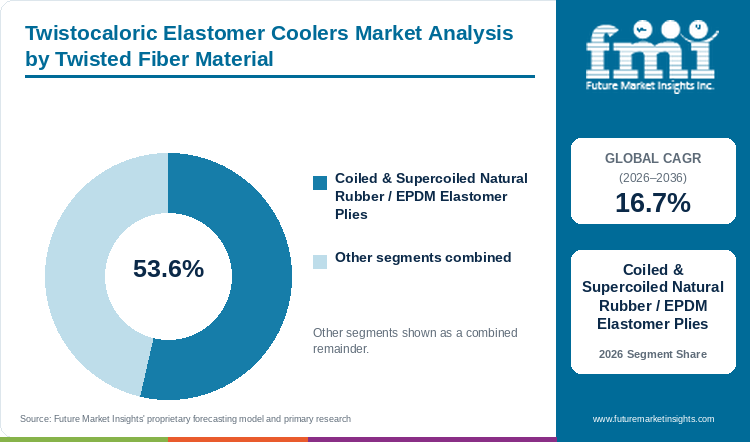
Coiled & Supercoiled Natural Rubber / EPDM Elastomer Plies are projected at 53.6% of twisted fibers in 2026, backed by low torque.
Table 5: Twisted Fiber Material Share for the Twistocaloric Elastomer Coolers Market (percentage share), 2026
| Twisted Fiber Material Segment | Share (2026) |
|---|---|
| Coiled & Supercoiled Natural Rubber / EPDM Elastomer Plies | 53.6% |
| Twisted Nickel-Titanium (NiTi) Shape-Memory Wire Bundles | 28.9% |
| UHMWPE (Dyneema) & Nylon-6,6 Coiled Polymer Yarns | 17.5% |
| Total | 100.0% |
*Note: Combined share of remaining twisted fiber material categories totaling 100.0% of 2026 market demand.
Table 6: Twisted Fiber Material Leadership and Market Growth for the Twistocaloric Elastomer Coolers Market (segment and CAGR percentage), 2026 to 2036
| Metric | Value |
|---|---|
| Global CAGR (2026 to 2036) | 16.7% |
| Leading Segment | Coiled & Supercoiled Natural Rubber / EPDM Elastomer Plies |
Twisting pre-stretched natural cis-1,4-polyisoprene and ethylene-propylene-diene monomer (EPDM) plies into double-helical supercoils concentrates reversible strain crystallization within a low-modulus elastomer that requires minimal motor torque. When compared with metallic shape-memory wires that demand high-torque gearboxes, elastomer plies sourced from natural rubber feedstocks and synthetic EPDM plants cut actuator weight and material cost by more than 70%. Twisted Nickel-Titanium (NiTi) Shape-Memory Wire Bundles (projected at 28.9%) and UHMWPE (Dyneema) & Nylon-6,6 Coiled Polymer Yarns (envisioned at 17.5%) are foreseen to supply the 46.4% balance of 2026 fiber demand.
- Coiled & Supercoiled Natural Rubber / EPDM Elastomer Plies are envisioned to capture 53.6% of 2026 fiber revenue because low torsional stiffness allows direct actuation by miniature brushless stepper motors.
- In January 2026, Michelin announced agreements to acquire Cooley Group and Tex Tech Industries to expand its Polymer Composite Solutions business by roughly 20% or USD 280 million in specialty coated fabrics and technical elastomers [4].
What Gives Direct Microfluidic Water/Glycol Channel Exchange the Majority Share of Heat Transfer Media?
Direct Microfluidic Water/Glycol Channel Exchange is estimated to constitute 62.8% of heat transfer medium in 2026, stemming from rapid heat extraction.
Synchronizing bidirectional water-glycol micro-pumps with the twist and untwist strokes of a supercoiled fiber bundle flushes exothermic heat to the ambient sink and delivers chilled fluid to the cold plate at cycle rates above 2 hertz. Convective microfluidic sleeves overcome the thermal boundary resistance that slows dry contact switching, making liquid-coupled twistocaloric cartridges ideal for direct to chip liquid cooling cold plates and liquid-cooled garments. Solid-Contact Thermal Interface Switching is anticipated to hold 37.2% of 2026 heat-transfer turnover in pocket insulin coolers where fluid pumps are omitted.
- Direct Microfluidic Water/Glycol Channel Exchange is estimated to claim 62.8% of 2026 heat-transfer revenue by enabling regenerator temperature spans exceeding 18 kelvin across multi-stage cascades.
- In March 2026, Furukawa Electric approved fixed-asset capital expenditure to expand production capacity for high-density data center heat-dissipation and liquid-cooling products [5].
How Does Wearable Exosuit & Micro-Electronic Spot Cooling Anchor End-Use Applications?
Wearable Exosuit & Micro-Electronic Spot Cooling is projected to attain 48.4% of application demand in 2026, aided by compact actuator packaging.
Powered industrial exoskeletons alongside military micro-climate vests and edge-AI processor modules require orientation-independent spot coolers that operate without heavy compressors or gravity-sensitive vapor condensers. Because twistocaloric elastomer and polymer-yarn cartridges weigh only tens of grams and tolerate shock and vibration, defense and electronics OEMs integrate them directly into backpack hydration loops and liquid-cooled edge data centers chassis. Compact Portable Medical Insulin & Vaccine Coolers (projected at 31.2%) and Zero-Refrigerant Automotive Zonal Seat Coolers (foreseen at 20.4%) are expected to contribute the other 51.6% of 2026 application revenue.
- Wearable Exosuit & Micro-Electronic Spot Cooling is foreseen to deliver 48.4% of 2026 application turnover by providing high-COP cooling per gram in mobile and space-constrained electronics.
- In April 2026, Avient Corporation announced that it would present Dyneema ultra-high-molecular-weight polyethylene fibers and Fiber-Line precision twisting and coating processes for extreme-condition wearables at Techtextil 2026 in Frankfurt [6].
What are the drivers, restraints, and opportunities in the twistocaloric elastomer coolers market?
Demand for lightweight wearable and chip spot cooling drives twistocaloric elastomer coolers, while torsional polymer fatigue restrains continuous duty, and EV zonal seat cooling opens volume production.
- Driver: Rising heat flux in edge microelectronics and thermal stress in industrial and defense exosuits create strong demand for compressor-free, high-COP rotary spot coolers.
- Restraint: Mullin stress-softening and torsional fatigue in natural rubber plies alongside wire-clamp stress concentrations limit continuous multi-million-cycle service life.
- Opportunity: Embedding silent, zero-refrigerant twistocaloric cartridges inside electric-vehicle seats replaces central HVAC ducting and cuts cabin conditioning power.
Growth Analysis and Future Potential: Qualitative Demand Catalysts
Thermoelectric Peltier coolers used in portable insulin cases and wearable cooling vests alongside laser diodes suffer from low coefficients of performance below 1.0 that rapidly drain lithium-ion battery packs. In June 2026, solid-state caloric pioneer Exergyn opened a EUR 2 million shape-memory alloy engineering and prototyping center in Zdiby in the Czech Republic to scale refrigerant-free thermal systems under its Carrier Corporation collaboration [7]. By twisting supercoiled natural rubber plies or nickel-titanium wire bundles inside a regenerative microfluidic sleeve, twistocaloric coolers achieve material COPs above 5.0 while cutting battery weight in half for cold chain monitoring devices and field medical kits. Medical cold-chain distributors and defense procurement agencies increasingly fund rugged solid-state coolers that contain zero regulated fluorocarbons.
Risk Assessment of the Twistocaloric Elastomer Coolers Market: Operational and Formulation Friction
Repeatedly twisting and untwisting elastomer fibers at 100% to 300% shear strain induces Mullins stress relaxation and hysteresis heating alongside surface micro-cracking if polymer cross-link density is not precisely controlled. Natural cis-polyisoprene rubbers also degrade when exposed to dissolved oxygen or ozone in open air, while nickel-titanium wire bundles require tight impurity control below 500 parts per million oxygen to avoid brittle inclusion fracture. In May 2025, Fort Wayne Metals researchers Jenica Kolhoff and Dr. Jeremy Schaffer published rotary beam fatigue studies demonstrating that platinum-core Nitinol DFT composite wires survive 10 million cycles at 0.9% strain [8]. To prevent premature fiber snapping, cartridge manufacturers must seal elastomer plies inside oxygen-free glycol channels and source medical-grade alloy melts alongside cold chain logistics qualification protocols.
Commercial Opportunity Analysis: Formulation Differentiation and Value-Add Formats
Electric-vehicle interior designers are shifting from power-hungry whole-cabin air conditioning toward localized zonal micro-climate cooling built directly into seats and headrests as well as center consoles. In September 2026, Zeon Corporation detailed its Nipol IR2200 and IR2200L high-cis polyisoprene synthetic rubber grades and exhibited next-generation automotive elastomer compounds at Rubber Tech CHINA 2026 [9]. Integrating whisper-quiet twistocaloric EPDM or Dyneema cartridges into automotive seating systems cushions delivers chilled air or fluid directly to occupant contact points while saving up to 1.5 kilowatts of compressor load. Elastomer compounders that formulate peroxide-cured EPDM and stereoregular polyisoprene plies rated for five million twist cycles capture high-volume automotive tier-one supply contracts.
Twistocaloric Elastomer Coolers Market by Country (2026 to 2036)
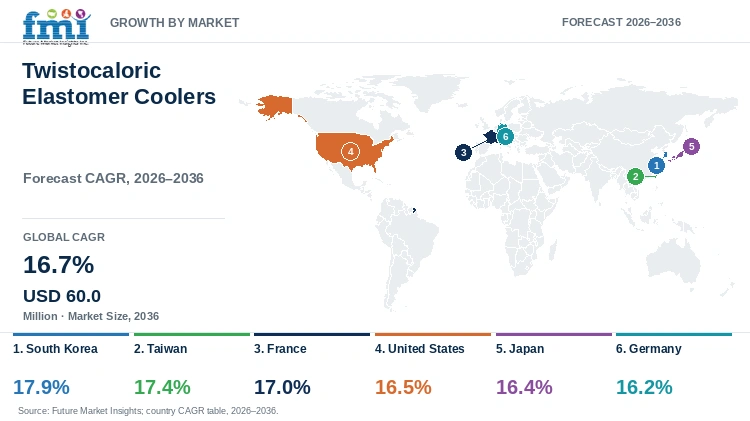
Global adoption of twistocaloric elastomer coolers is led by countries possessing advanced wearable robotics and semiconductor packaging alongside shape-memory alloy wire drawing and synthetic elastomer compounding industries. South Korea is envisioned to pace key regional markets at a 17.9% annual growth rate to 2036 while Taiwan is predicted to post 17.4% and France is slated to reach 17.0%. Meanwhile, the United States is expected to register 16.5% alongside Japan with a forecast 16.4% rate and Germany with an estimated 16.2% clip as medical and automotive spot-cooling programs scale.
Table 7: Country CAGR and Primary Growth Levers for the Twistocaloric Elastomer Coolers Market (CAGR percentage and operational drivers), 2026 to 2036
| Country | CAGR (2026 to 2036) | Primary Growth Lever |
|---|---|---|
| South Korea | 17.9% | Wearable industrial exosuits and EV zonal seat cooling integration |
| Taiwan | 17.4% | Edge-AI semiconductor spot cooling and microfluidic cold-plate assembly |
| France | 17.0% | Michelin polymer composite R&D and public heat-pump decarbonization |
| United States | 16.5% | Fort Wayne Metals and Confluent Nitinol wire capacity and defense wearables |
| Japan | 16.4% | Zeon polyisoprene elastomers and Furukawa Electric shape-memory alloys |
| Germany | 16.2% | ARLANXEO Keltan EPDM compounding and automotive seating thermal systems |
Source: Future Market Insights analysis
South Korea Twistocaloric Elastomer Coolers Market Outlook (2026 to 2036)
Whereas global twistocaloric demand is split across medical and electronics prototypes, South Korea's market is uniquely driven by high-volume factory exoskeleton deployments in shipyards and automotive assembly lines. Engineering benchmarks from the Fraunhofer Institute for Physical Measurement Techniques IPM in October 2026 highlighted active elastocaloric shape-memory systems paired with rapid latent-heat pipe transfer for compact industrial and automotive cooling [10]. South Korean twistocaloric elastomer cooler sales are projected to climb at a leading 17.9% annual pace between 2026 and 2036 as domestic robotics and automotive seating suppliers integrate rotary polymer-ply spot coolers. Strict battery-weight limits below 1.2 kilograms on wearable exosuit waist packs nevertheless constrain motor sizing, compelling Korean engineers to favor low-torque supercoiled polyisoprene plies.
Key takeaway: In South Korea, factory exosuit rollouts and EV zonal seating programs are projected to drive 17.9% annual growth for low-torque elastomer twistocaloric cartridges.
Taiwan Twistocaloric Elastomer Coolers Market Outlook (2026 to 2036)
Taiwan's Ministry of Economic Affairs released the 2025 National Electricity Supply and Demand Report in August 2026, projecting 2.5% annual power demand growth through 2035 from artificial-intelligence data centers and semiconductor fabs [11]. Unlike European and North American markets focused on wearable garments or medical cases, Taiwan's twistocaloric demand is uniquely concentrated in board-level spot cooling for edge-AI servers and gaming notebooks. Taiwanese revenues are foreseen to advance at a 17.4% annual clip over the 2026 to 2036 period as thermal module assemblers in Hsinchu and Taoyuan pair twisted nickel-titanium and UHMWPE yarn actuators with microfluidic cold plates. Tight height clearances inside 1U server chassis still restrict rotary cartridge diameters, prompting Taiwanese ODMs to develop flat multi-spindle braided elastomer cassettes.
Key takeaway: In Taiwan, rising AI hardware heat densities and microfluidic module assembly are anticipated to fuel 17.4% yearly growth for low-profile twistocaloric spot coolers.
France Twistocaloric Elastomer Coolers Market Outlook (2026 to 2036)
French market turnover is forecast to expand by 17.0% per annum between 2026 and 2036, reinforced by Michelin's investments in functional polymer composites and caloric elastomer testing in Clermont-Ferrand. France differs from Asian electronics-led markets because domestic activity centers on tire-grade natural rubber and synthetic elastomer compounding tailored for high-strain torsional crystallization. Supporting this European regulatory transition, the European Commission adopted Implementing Regulation (EU) 2026/286 in February 2026 and Implementing Decision (EU) 2026/1382 in June 2026 tightening fluorinated-gas quota allocations and stationary chiller exemptions [12]. Lengthy aerospace and automotive tier-one qualification cycles for new elastomer compounds remain a local hurdle, leading French suppliers to target portable medical vaccine coolers for immediate revenue.
Key takeaway: In France, polymer composite innovation led by Michelin and European F-gas restrictions are slated to back 17.0% annual expansion across medical and mobility coolers.
United States Twistocaloric Elastomer Coolers Market Outlook (2026 to 2036)
In contrast to elastomer-dominant Asian markets, the United States market is uniquely anchored by vacuum-arc-remelted medical Nitinol wire drawing and Department of Defense soldier micro-climate cooling programs. Official heat-pump deployment statistics published in June 2026 for the first quarter of 2026 confirmed rising demand for compact zero-GWP hydronic and localized thermal units across commercial and residential buildings [13]. United States demand is envisioned to advance by 16.5% annually over the decade from 2026 to 2036 with strong domestic supply from Fort Wayne Metals and Confluent Medical Technologies alongside Avient Corporation's Dyneema fiber division. High per-kilogram costs for medical-grade Nitinol wire still restrict consumer appliance adoption, so American device builders reserve NiTi twist bundles for defense vests and portable insulin cases.
Key takeaway: In the United States, domestic Nitinol wire leadership and defense wearable programs are expected to power 16.5% yearly growth for high-reliability twistocaloric modules.
Japan Twistocaloric Elastomer Coolers Market Outlook (2026 to 2036)
In October 2025, Exergyn highlighted its 3D metal printing research on Nitinol alloys with Fort Wayne Metals alongside its sister company Nexeryn targeting compact medical and automotive thermal actuators [14]. Japan stands apart from global competitors through its dual upstream mastery of ultra-high-cis synthetic polyisoprene rubbers and inclusion-free nickel-titanium shape-memory alloy wires. Japanese shipments are predicted to grow 16.4% per year from 2026 through 2036 as Zeon Corporation supplies specialty polyisoprene elastomers and Furukawa Electric advances alloy wire thermal actuators for compact robotics. Conservative reliability standards among Japanese electronics brands require multi-million-cycle fatigue proof before integration, pushing domestic suppliers to co-develop hybrid EPDM-wire cartridges with sealed glycol sleeves.
Key takeaway: In Japan, Zeon's synthetic polyisoprene elastomers and Furukawa Electric's alloy expertise are predicted to deliver 16.4% annual expansion for long-life rotary coolers.
Germany Twistocaloric Elastomer Coolers Market Outlook (2026 to 2036)
German demand is estimated to increase at a 16.2% annual clip from 2026 through 2036 as automotive seating suppliers evaluate zero-refrigerant zonal seat coolers compounded with ARLANXEO's Keltan EPDM elastomers in Dormagen. Whereas global demand leans toward wearable exosuits and portable medical coolers, Germany's market is uniquely driven by electric-vehicle interior zonal micro-climate seating engineered by domestic automotive OEMs and tier-one suppliers. Fort Wayne Metals expanded its vacuum-arc and plasma-arc Nitinol melting furnaces in December 2024 and early 2025 to reach 450 metric tons of annual alloy capacity for precision wire diameters down to 0.0127 millimeters [15]. Strict VDA automotive odor and volatile-organic-compound limits inside passenger cabins rule out sulfur-cured natural rubbers, requiring German compounders to formulate odorless peroxide-cured EPDM supercoils.
Key takeaway: In Germany, ARLANXEO EPDM compounding and EV zonal seat cooling trials are estimated to underpin 16.2% yearly growth for low-VOC peroxide-cured elastomer supercoils.
Full report country CAGRs cover: North America; Latin America; Western Europe; Eastern Europe; East Asia; South Asia and Pacific; Middle East and Africa.
Who are the notable companies in the twistocaloric elastomer coolers market?
Fort Wayne Metals Research Products Corp., Confluent Medical Technologies, Inc., Michelin, Zeon Corporation, Furukawa Electric Co., Ltd., Exergyn Ltd., Avient Corporation, and ARLANXEO are the notable companies in the twistocaloric elastomer coolers market.
Future Market Insights observes that competition across the twistocaloric elastomer coolers sector unites precision shape-memory wire drawers with specialty elastomer compounders and high-modulus polymer fiber producers. Nitinol wire and solid-state caloric specialists engineer fatigue-resistant nickel-titanium wire bundles and rotary torsion actuators for medical and electronics cooling. Global tire and synthetic rubber corporations formulate high-cis polyisoprene and EPDM elastomer plies tailored for strain-induced crystallization. Advanced polymer yarn manufacturers supply ultra-high-molecular-weight polyethylene (UHMWPE) and polyamide fibers for lightweight wearable cooling textiles.
- Nitinol Wire & Solid-State Caloric Actuator Specialists: Fort Wayne Metals Research Products Corp. and Confluent Medical Technologies alongside Furukawa Electric and Exergyn Ltd. supply fatigue-rated NiTi wires and caloric cooling cartridges.
- Elastomer Compound & Polymer Composite Innovators: Michelin and Zeon Corporation together with ARLANXEO formulate natural rubber and synthetic polyisoprene as well as EPDM plies for high-strain twistocaloric cycling.
- High-Modulus Coiled Polymer Yarn Producers: Avient Corporation supplies Dyneema UHMWPE and engineered polymer fibers for coiled textile and wearable cooling actuators.
Competitive Benchmarking: Twistocaloric Elastomer Coolers Market
Table 8: Competitive Benchmarking for the Twistocaloric Elastomer Coolers Market (qualitative capability ratings), 2026
| Company | Twisted Fiber & Elastomer IP | High-Cycle Fatigue Engineering | Wearable / Medical / Auto Access | Geographic Reach |
|---|---|---|---|---|
| Fort Wayne Metals Research Products Corp. | High | High | High | High |
| Confluent Medical Technologies, Inc. | High | High | High | High |
| Michelin | High | High | Medium | High |
| Zeon Corporation | High | Medium | Medium | High |
| Furukawa Electric Co., Ltd. | High | High | Medium | High |
| Exergyn Ltd. | High | High | Medium | Medium |
| Avient Corporation | High | Medium | High | High |
| ARLANXEO | High | Medium | Medium | High |
Scoring basis: Twisted Fiber & Elastomer IP is rated High across major category leaders holding proprietary Nitinol melting or high-cis polyisoprene/EPDM synthesis alongside UHMWPE fiber patents. High-Cycle Fatigue Engineering is High for companies with documented multi-million-cycle wire drawing and caloric actuator testing or tire-cord fatigue laboratories. Wearable / Medical / Auto Access and Geographic Reach reflect established OEM qualification channels across medical devices and defense textiles as well as automotive components.
Key Developments in the Twistocaloric Elastomer Coolers Market
- In February 2026, Michelin announced an agreement to acquire Houston-based Flexitallic with 17 manufacturing sites and USD 220 million in annual revenue to accelerate growth in its Polymer Composite Solutions division [16].
- In January 2026, Fort Wayne Metals updated its Nitinol actuator wire technical specifications for 0.0732-to-0.5842-millimeter filaments characterized at 150 megapascals per ASTM E3097 delivering 4% to 5% reversible stroke [17].
- In July 2026, Michelin detailed its flexible polymer and elastomer composite solutions across its Fenner and Flex Composite Group industrial brands for extreme mechanical and thermal environments [18].
Key Players in the Twistocaloric Elastomer Coolers Market
Nitinol Wire & Solid-State Caloric Actuator Specialists
- Fort Wayne Metals Research Products Corp.
- Confluent Medical Technologies, Inc.
- Furukawa Electric Co., Ltd.
- Exergyn Ltd.
Elastomer Compound & Polymer Composite Innovators
- Michelin
- Zeon Corporation
- ARLANXEO
High-Modulus Coiled Polymer Yarn Producers
- Avient Corporation
Twistocaloric Elastomer Coolers Market - Report Scope
Table 9: Report Scope for the Twistocaloric Elastomer Coolers Market (coverage fields and definitions), 2026 to 2036
| Coverage field | Report scope |
|---|---|
| Market breakdown | Twisted Fiber Material; Heat Transfer Medium; Application; Region |
| Quantitative Units | USD Million (2025, 2026, and 2036) |
| Market Definition | Covers revenues from rotary twistocaloric cooler cartridges, supercoiled natural rubber/EPDM, Nitinol wire, and UHMWPE/nylon caloric fiber bundles, and integrated microfluidic or solid-contact spot coolers. Category Scope Note: Excludes uniaxial linear-pull elastocaloric chillers, bulk automotive tires, medical stents, and thermoelectric Peltier modules. |
| Regions Covered | North America; Latin America; Western Europe; Eastern Europe; East Asia; South Asia and Pacific; Middle East and Africa |
| Countries Covered | South Korea, Taiwan, France, United States, Japan, Germany, and additional regional markets |
| Key Companies Covered | Fort Wayne Metals Research Products Corp., Confluent Medical Technologies, Inc., Michelin, Zeon Corporation, Furukawa Electric Co., Ltd., Exergyn Ltd., Avient Corporation, ARLANXEO |
| Forecast Period | 2026 to 2036 (Base Year: 2026; Historical Baseline: 2025) |
| Approach | Primary and secondary research triangulated with rotary cartridge shipment volumes and specific cooling power (W/g) models. |
Twistocaloric Elastomer Coolers Market - Research Methodology
Table 10: Research Methodology for the Twistocaloric Elastomer Coolers Market (research methods and approach), 2026 edition
| Method | Approach |
|---|---|
| Primary Research | Interviews with shape-memory alloy metallurgists, elastomer compounding engineers, wearable robotics thermal architects, and medical cold-chain device OEMs to validate torsional fatigue limits, specific cooling power, and cartridge pricing. |
| Secondary Research | Analysis of Universitat de Barcelona TWISTER and Fraunhofer IPM caloric publications, U.S. EPA AIM Act documents, corporate technical datasheets from Fort Wayne Metals, Michelin, Zeon, Avient, and ARLANXEO, and patent filings. |
| Market Sizing and Forecasting | Bottom-up modeling of rotary twistocaloric cartridge unit shipments (thousand units), active fiber mass per cartridge, and average unit selling prices across wearable, medical, and automotive seating applications. |
| Country Forecasting Model | Econometric country CAGRs (ranging from 16.2% in Germany to 17.9% in South Korea around the 16.7% global CAGR) calibrated against national robotics adoption, AI chip packaging volume, and domestic elastomer/alloy supply. |
| Operational Benchmark Traceability | Physical and operational benchmarks in Tables 2, 3, and 4 traced to Universitat de Barcelona TWISTER natural-rubber twistocaloric prototype data (EP25382371), Fraunhofer IPM caloric benchmarks, Avient Dyneema fiber specifications, and Fort Wayne Metals Nitinol fatigue data. |
| Data Triangulation and Validation | Reconciliation of specialty caloric fiber and wire shipments against downstream rotary spot-cooler module assemblies to exclude non-cooling medical wire and tire rubber revenues. |
Twistocaloric Elastomer Coolers Market by Segments
Twistocaloric Elastomer Coolers Market segmented by Twisted Fiber Material:
- Coiled & Supercoiled Natural Rubber / EPDM Elastomer Plies
- Twisted Nickel-Titanium (NiTi) Shape-Memory Wire Bundles
- UHMWPE (Dyneema) & Nylon-6,6 Coiled Polymer Yarns
Twistocaloric Elastomer Coolers Market segmented by Heat Transfer Medium:
- Direct Microfluidic Water/Glycol Channel Exchange
- Solid-Contact Thermal Interface Switching
Twistocaloric Elastomer Coolers Market segmented by Application:
- Wearable Exosuit & Micro-Electronic Spot Cooling
- Compact Portable Medical Insulin & Vaccine Coolers
- Zero-Refrigerant Automotive Zonal Seat Coolers
Twistocaloric Elastomer Coolers Market by Region
- North America
- United States
- Canada
- Latin America
- Brazil
- Mexico
- Argentina
- Chile
- Western Europe
- Germany
- France
- United Kingdom
- Italy
- Spain
- Benelux
- Nordics
- Eastern Europe
- Poland
- Czech Republic
- Romania
- Hungary
- East Asia
- China
- Japan
- South Korea
- South Asia and Pacific
- India
- ASEAN
- Australia and New Zealand
- Middle East and Africa
- GCC Countries
- South Africa
- Türkiye
- Israel
Research Sources and Bibliography
- [1] Universitat de Barcelona. (2025, April 9). PROD2023 TWISTER - Functional Materials and Phase Transitions. Universitat de Barcelona.
- [2] U.S. Environmental Protection Agency. (2026, September 14). Frequent Questions on the Phasedown of Hydrofluorocarbons. US EPA.
- [3] Confluent Medical Technologies, Inc. (2026, May 4). Confluent Medical Technologies Announces Nitinol Wire Center of Excellence. Confluent Medical Newsroom.
- [4] Michelin. (2026, January 5). Michelin announces two projects of acquisition, aiming at reinforcing its Polymer Composite Solutions business. Michelin Group Publications.
- [5] Furukawa Electric Co., Ltd. (2026, March 30). Notice Regarding Capital Expenditure (Acquisition of Fixed Assets) for Production of Heat-Dissipation/Cooling Products for Data Centers. Furukawa Electric News Release.
- [6] Avient Corporation. (2026, April 15). Techtextil 2026: Avient to Showcase Materials Enabling Next-Generation Performance for Demanding Applications and Extreme Conditions. Avient Newsroom.
- [7] Exergyn Ltd. (2026, June 17). Exergyn opens a center in Zdiby. Exergyn Corporate News.
- [8] Fort Wayne Metals Research Products Corp. (2025, May 16). Optimizing medical devices: The effect of platinum on Nitinol DFT® composite wire. Fort Wayne Metals Technical Blog.
- [9] Zeon Corporation. (2026, September 24). IR (Polyisoprene Rubber) | Synthetic Rubbers | Zeon Corporation. Zeon Corporation Products.
- [10] Fraunhofer Institute for Physical Measurement Techniques IPM. (2026, October 12). Elastocaloric materials & systems - Fraunhofer IPM. Fraunhofer-Gesellschaft.
- [11] Ministry of Economic Affairs. (2026, August 7). Ministry of Economic Affairs Releases the 2025 National Electricity Supply and Demand Report of Taiwan; Prudent Electricity Resource Planning Ensures Reliable Power Supply. MOEA Republic of China (Taiwan).
- [12] European Commission. (2026, February 11). Documentation - F-gas Legislation - Fluorinated Greenhouse Gases – Climate Action. Directorate-General for Climate Action.
- [13] Department for Energy Security and Net Zero. (2026, June 11). Heat pump deployment statistics: March 2026. GOV.UK.
- [14] Exergyn Ltd. (2025, October 3). Exergyn features on Irish Times – Breakthrough technology section (2 October 2025). Exergyn Corporate News.
- [15] Fort Wayne Metals Research Products Corp. (2024, December 11). Fort Wayne Metals Expands Nitinol Melting Capabilities to Meet Growing Medical Device Industry Demand. Fort Wayne Metals News.
- [16] Michelin. (2026, February 3). Michelin to acquire Flexitallic, accelerating growth in Polymer Composite Solutions. Michelin Group Publications.
- [17] Fort Wayne Metals Research Products Corp. (2026, January 15). Nitinol actuator technical information - Fort Wayne Metals. Fort Wayne Metals Resources.
- [18] Michelin. (2026, July 8). MICHELIN, an expert in composite solutions. Michelin Group Activities.
- [19] ARLANXEO. (2026, January 15). Keltan® Eco. ARLANXEO Customer Portal.
- [20] Huntsman Corporation. (2025, May 1). Huntsman Performance Products. Huntsman Corporation.
- [21] National Renewable Energy Laboratory. (2024, May 15). Thermal Energy Storage in Commercial Buildings. NREL Publications.
This bibliography is provided for reader reference and is not exhaustive. The full report contains the complete reference list and detailed citations.
This Report Answers
- How big is the twistocaloric elastomer coolers market in 2026 and what is projected for 2036?
- Why do Coiled & Supercoiled Natural Rubber / EPDM Elastomer Plies capture 53.6% of fiber demand?
- How does Direct Microfluidic Water/Glycol Channel Exchange achieve 62.8% of heat-transfer share?
- Why does Wearable Exosuit & Micro-Electronic Spot Cooling lead applications at 48.4%?
- How do rotary supercoiled torsion cartridges shrink actuator length compared with linear elastocaloric frames?
- Why do South Korea (17.9% CAGR), Taiwan (17.4%), and France (17.0%) lead national growth rates?
- What engineering measures prevent Mullins stress softening and wire-clamp fatigue in high-cycle cartridges?
- How are Fort Wayne Metals, Confluent Medical, Michelin, Zeon, Furukawa Electric, Exergyn, Avient, and ARLANXEO positioned?
Frequently Asked Questions
What is the 2026 market value and 2036 forecast for twistocaloric elastomer coolers?
Rotary twistocaloric cooler revenues are estimated to reach USD 12.8 million in 2026 compared with USD 10.8 million in 2025 based on Future Market Insights modeling. Annual market revenue is projected to increase by USD 47.2 million between 2026 and 2036 and lift the 2036 market to an anticipated USD 60.0 million. At what CAGR will the twistocaloric elastomer coolers market expand from 2026 to 2036? Global cartridge sales are projected to register a 16.7% compound annual growth rate from 2026 through 2036. Adoption is expected to be fueled by powered industrial exosuits alongside portable insulin coolers and edge-AI chip spot cooling.
Which twisted fiber material segment holds the leading share in 2026?
Coiled & Supercoiled Natural Rubber / EPDM Elastomer Plies are projected to lead at 53.6% of fiber revenue in 2026. Strain-induced crystallization in hyperelastic rubbers delivers high cooling COPs at low rotary stepper-motor torque.
Why does direct microfluidic water/glycol channel exchange lead heat transfer media?
Direct Microfluidic Water/Glycol Channel Exchange is estimated to account for 62.8% of 2026 heat-transfer turnover. Convective micro-channels surrounding twisted fiber bundles extract heat rapidly at multi-hertz cycling rates.
Which country records the fastest CAGR over the forecast period?
South Korea is projected to lead major national markets at a 17.9% annual growth clip through 2036 according to FMI. Industrial exosuit adoption across Korean factories and EV zonal seat cooling R&D support this expected trajectory.
Who are the leading companies in the twistocaloric elastomer coolers market?
Notable participants include Fort Wayne Metals Research Products Corp., Confluent Medical Technologies, Inc., Michelin, Zeon Corporation, Furukawa Electric Co., Ltd., Exergyn Ltd., Avient Corporation, and ARLANXEO.
Preview the report firsthand - request a free sample
Get SampleGet the brochure for pricing and purchase details.
Get PDFTable of Content
- Key Takeaways
- Market Size and CAGR
- Top Growth Driver
- Fastest Growing Segment
- Leading Region
- Key Companies
- Emerging Opportunities
- Executive Summary
- Global Market Outlook
- Demand-side Trends
- Supply-side Trends
- Technology Roadmap Analysis
- Analysis and Recommendations
- Analyst Perspective (What is happening? Why now? What should investors know?)
- Key Questions Answered
- How large is the market?
- What is the CAGR?
- What are key trends?
- Which region dominates?
- Who are the leaders?
- Market Overview
- Market Coverage / Taxonomy
- Market Definition / Scope / Limitations
- Research Methodology
- Chapter Orientation
- Analytical Lens and Working Hypotheses
- Market Structure, Signals, and Trend Drivers
- Benchmarking and Cross-market Comparability
- Market Sizing, Forecasting, and Opportunity Mapping
- Research Design and Evidence Framework
- Desk Research Programme (Secondary Evidence)
- Expert Input and Fieldwork (Primary Evidence)
- Tooling, Models, and Reference Databases
- Data Engineering and Model Build
- Quality Assurance and Audit Trail
- Market Background
- Market Dynamics (Drivers, Restraints, Opportunity, Trends)
- Scenario Forecast (Optimistic, Likely, Conservative)
- Impact Analysis
- AI Impact
- Sustainability Impact
- Regulatory Impact
- Technology Impact
- Consumer / Buyer Analysis
- Purchase Drivers
- Adoption Barriers
- Buyer Journey
- Opportunity Map Analysis
- Product Life Cycle Analysis
- Supply Chain Analysis
- Investment Feasibility Matrix
- Value Chain Analysis
- PESTLE and Porter's Analysis
- Regulatory Landscape
- Regional Parent Market Outlook
- Production and Consumption Statistics
- Import and Export Statistics
- Global Market Analysis and Forecast, 2021 to 2036
- Historical Market Size Value (USD Million) Analysis, 2021 to 2025
- Current and Future Market Size Value (USD Million) Projections, 2026 to 2036
- Y-o-Y Growth Trend Analysis
- Absolute $ Opportunity Analysis
- Global Market Pricing Analysis, 2021 to 2036
- Global Market Analysis and Forecast, By Twisted Fiber Material, 2021 to 2036
- Introduction / Key Findings
- Historical Market Size Value (USD Million) Analysis By Twisted Fiber Material, 2021 to 2025
- Current and Future Market Size Value (USD Million) Analysis and Forecast By Twisted Fiber Material, 2026 to 2036
- Coiled & Supercoiled Natural Rubber / EPDM Elastomer Plies
- Twisted Nickel-Titanium (NiTi) Shape-Memory Wire Bundles
- UHMWPE (Dyneema) & Nylon-6,6 Coiled Polymer Yarns
- Y-o-Y Growth Trend Analysis By Twisted Fiber Material, 2021 to 2025
- Absolute $ Opportunity Analysis By Twisted Fiber Material, 2026 to 2036
- Global Market Analysis and Forecast, By Heat Transfer Medium, 2021 to 2036
- Introduction / Key Findings
- Historical Market Size Value (USD Million) Analysis By Heat Transfer Medium, 2021 to 2025
- Current and Future Market Size Value (USD Million) Analysis and Forecast By Heat Transfer Medium, 2026 to 2036
- Direct Microfluidic Water/Glycol Channel Exchange
- Solid-Contact Thermal Interface Switching
- Y-o-Y Growth Trend Analysis By Heat Transfer Medium, 2021 to 2025
- Absolute $ Opportunity Analysis By Heat Transfer Medium, 2026 to 2036
- Global Market Analysis and Forecast, By Application, 2021 to 2036
- Introduction / Key Findings
- Historical Market Size Value (USD Million) Analysis By Application, 2021 to 2025
- Current and Future Market Size Value (USD Million) Analysis and Forecast By Application, 2026 to 2036
- Wearable Exosuit & Micro-Electronic Spot Cooling
- Compact Portable Medical Insulin & Vaccine Coolers
- Zero-Refrigerant Automotive Zonal Seat Coolers
- Y-o-Y Growth Trend Analysis By Application, 2021 to 2025
- Absolute $ Opportunity Analysis By Application, 2026 to 2036
- Global Market Analysis and Forecast, By Region, 2021 to 2036
- Introduction
- Historical Market Size Value (USD Million) Analysis By Region, 2021 to 2025
- Current Market Size Value (USD Million) Analysis and Forecast By Region, 2026 to 2036
- North America
- Latin America
- Western Europe
- Eastern Europe
- East Asia
- South Asia and Pacific
- Middle East and Africa
- Market Attractiveness Analysis By Region
- North America Market Analysis and Forecast, By Country, 2021 to 2036
- Historical Market Size Value (USD Million) Trend Analysis By Market Taxonomy, 2021 to 2025
- Market Size Value (USD Million) Forecast By Market Taxonomy, 2026 to 2036
- By Country
- United States
- Canada
- By Twisted Fiber Material
- By Heat Transfer Medium
- By Application
- By Country
- Market Attractiveness Analysis
- By Country
- By Twisted Fiber Material
- By Heat Transfer Medium
- By Application
- Key Takeaways
- Latin America Market Analysis and Forecast, By Country
- Historical Market Size Value (USD Million) Trend Analysis By Market Taxonomy, 2021 to 2025
- Market Size Value (USD Million) Forecast By Market Taxonomy, 2026 to 2036
- By Country
- Brazil
- Mexico
- Argentina
- Chile
- By Twisted Fiber Material
- By Heat Transfer Medium
- By Application
- By Country
- Market Attractiveness Analysis
- By Country
- By Twisted Fiber Material
- By Heat Transfer Medium
- By Application
- Key Takeaways
- Western Europe Market Analysis and Forecast, By Country
- Historical Market Size Value (USD Million) Trend Analysis By Market Taxonomy, 2021 to 2025
- Market Size Value (USD Million) Forecast By Market Taxonomy, 2026 to 2036
- By Country
- Germany
- France
- United Kingdom
- Italy
- Spain
- Benelux
- Nordics
- By Twisted Fiber Material
- By Heat Transfer Medium
- By Application
- By Country
- Market Attractiveness Analysis
- By Country
- By Twisted Fiber Material
- By Heat Transfer Medium
- By Application
- Key Takeaways
- Eastern Europe Market Analysis and Forecast, By Country
- Historical Market Size Value (USD Million) Trend Analysis By Market Taxonomy, 2021 to 2025
- Market Size Value (USD Million) Forecast By Market Taxonomy, 2026 to 2036
- By Country
- Poland
- Czech Republic
- Romania
- Hungary
- By Twisted Fiber Material
- By Heat Transfer Medium
- By Application
- By Country
- Market Attractiveness Analysis
- By Country
- By Twisted Fiber Material
- By Heat Transfer Medium
- By Application
- Key Takeaways
- East Asia Market Analysis and Forecast, By Country
- Historical Market Size Value (USD Million) Trend Analysis By Market Taxonomy, 2021 to 2025
- Market Size Value (USD Million) Forecast By Market Taxonomy, 2026 to 2036
- By Country
- China
- Japan
- South Korea
- By Twisted Fiber Material
- By Heat Transfer Medium
- By Application
- By Country
- Market Attractiveness Analysis
- By Country
- By Twisted Fiber Material
- By Heat Transfer Medium
- By Application
- Key Takeaways
- South Asia and Pacific Market Analysis and Forecast, By Country
- Historical Market Size Value (USD Million) Trend Analysis By Market Taxonomy, 2021 to 2025
- Market Size Value (USD Million) Forecast By Market Taxonomy, 2026 to 2036
- By Country
- India
- ASEAN
- Australia and New Zealand
- By Twisted Fiber Material
- By Heat Transfer Medium
- By Application
- By Country
- Market Attractiveness Analysis
- By Country
- By Twisted Fiber Material
- By Heat Transfer Medium
- By Application
- Key Takeaways
- Middle East and Africa Market Analysis and Forecast, By Country
- Historical Market Size Value (USD Million) Trend Analysis By Market Taxonomy, 2021 to 2025
- Market Size Value (USD Million) Forecast By Market Taxonomy, 2026 to 2036
- By Country
- GCC Countries
- South Africa
- Türkiye
- Israel
- By Twisted Fiber Material
- By Heat Transfer Medium
- By Application
- By Country
- Market Attractiveness Analysis
- By Country
- By Twisted Fiber Material
- By Heat Transfer Medium
- By Application
- Key Takeaways
- Key Countries Market Analysis
- United States
- Pricing Analysis
- Market Share Analysis, 2025
- By Twisted Fiber Material
- By Heat Transfer Medium
- By Application
- Canada
- Pricing Analysis
- Market Share Analysis, 2025
- By Twisted Fiber Material
- By Heat Transfer Medium
- By Application
- Mexico
- Pricing Analysis
- Market Share Analysis, 2025
- By Twisted Fiber Material
- By Heat Transfer Medium
- By Application
- Brazil
- Pricing Analysis
- Market Share Analysis, 2025
- By Twisted Fiber Material
- By Heat Transfer Medium
- By Application
- Chile
- Pricing Analysis
- Market Share Analysis, 2025
- By Twisted Fiber Material
- By Heat Transfer Medium
- By Application
- Germany
- Pricing Analysis
- Market Share Analysis, 2025
- By Twisted Fiber Material
- By Heat Transfer Medium
- By Application
- United Kingdom
- Pricing Analysis
- Market Share Analysis, 2025
- By Twisted Fiber Material
- By Heat Transfer Medium
- By Application
- Italy
- Pricing Analysis
- Market Share Analysis, 2025
- By Twisted Fiber Material
- By Heat Transfer Medium
- By Application
- Spain
- Pricing Analysis
- Market Share Analysis, 2025
- By Twisted Fiber Material
- By Heat Transfer Medium
- By Application
- France
- Pricing Analysis
- Market Share Analysis, 2025
- By Twisted Fiber Material
- By Heat Transfer Medium
- By Application
- India
- Pricing Analysis
- Market Share Analysis, 2025
- By Twisted Fiber Material
- By Heat Transfer Medium
- By Application
- ASEAN
- Pricing Analysis
- Market Share Analysis, 2025
- By Twisted Fiber Material
- By Heat Transfer Medium
- By Application
- Australia and New Zealand
- Pricing Analysis
- Market Share Analysis, 2025
- By Twisted Fiber Material
- By Heat Transfer Medium
- By Application
- China
- Pricing Analysis
- Market Share Analysis, 2025
- By Twisted Fiber Material
- By Heat Transfer Medium
- By Application
- Japan
- Pricing Analysis
- Market Share Analysis, 2025
- By Twisted Fiber Material
- By Heat Transfer Medium
- By Application
- South Korea
- Pricing Analysis
- Market Share Analysis, 2025
- By Twisted Fiber Material
- By Heat Transfer Medium
- By Application
- Poland
- Pricing Analysis
- Market Share Analysis, 2025
- By Twisted Fiber Material
- By Heat Transfer Medium
- By Application
- Hungary
- Pricing Analysis
- Market Share Analysis, 2025
- By Twisted Fiber Material
- By Heat Transfer Medium
- By Application
- Türkiye
- Pricing Analysis
- Market Share Analysis, 2025
- By Twisted Fiber Material
- By Heat Transfer Medium
- By Application
- South Africa
- Pricing Analysis
- Market Share Analysis, 2025
- By Twisted Fiber Material
- By Heat Transfer Medium
- By Application
- Taiwan
- Pricing Analysis
- Market Share Analysis, 2025
- By Twisted Fiber Material
- By Heat Transfer Medium
- By Application
- United States
- Market Structure Analysis
- Competition Dashboard
- Competition Benchmarking
- Market Share Analysis of Top Players
- By Regional
- By Twisted Fiber Material
- By Heat Transfer Medium
- By Application
- Emerging Startups
- Innovation Benchmarking
- Competition Analysis
- Competition Deep Dive
- Fort Wayne Metals Research Products Corp.
- Overview
- Product Portfolio
- Profitability by Market Segments
- Sales Footprint
- Strategy Overview
- Marketing Strategy
- Product Strategy
- Channel Strategy
- Confluent Medical Technologies, Inc.
- Michelin
- Zeon Corporation
- Furukawa Electric Co., Ltd.
- Exergyn Ltd.
- Avient Corporation
- ARLANXEO
- Fort Wayne Metals Research Products Corp.
- Case Studies
- Success Stories
- Recent Developments
- Competition Deep Dive
- Assumptions & Acronyms Used


