

- Market Size (2026)
- USD 252.2 Mn
- Forecast (2036)
- USD 580.8 Mn
- CAGR (2026 to 2036)
- 8.7%
How big is UK Scones Market in 2026?
USD 252.2 Million in 2026 and USD 580.8 Million by 2036 at an 8.7% CAGR.
The UK scones market is projected to expand from USD 252.2 million in 2026 to USD 580.8 million by 2036 at an 8.7% CAGR. Reliable national replenishment carries more weight in a concentrated grocery channel with four retailers holding 65.7% of grocery sales in May 2026 according to Defra. Manufacturers selling bakery products through that channel absorb the commercial cost of missed availability, damaged packs or inconsistent shelf life.
Digital ordering broadens access beyond store listings, although parcel distribution places more stress on brittle formats and protective packs. ONS data published in July 2026 show that internet sales represented 27.4% of UK retail sales during 2025. The 27.4% online share gives specialist products a viable discovery route, but food packaging must preserve texture and shape well enough for repeat orders to remain economical.
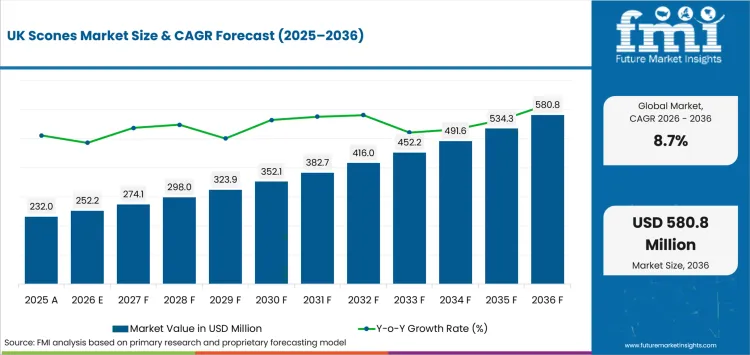
Key Takeaways of UK Scones Market
- Demand is rising as manufacturers serve grocery, foodservice and digital orders without sacrificing texture or pack integrity.
- Based on product type, rolled sugar cones are projected to account for 35.0% in 2026 due to thin rolled wafers fitting familiar dessert service.
- By Claim - Nature, conventional products are estimated to hold 59.0% in 2026 owing to standard formulations avoiding specialist segregation and claim-control requirements.
- In 2026, fresh formats are expected to lead format with 32.0% share because shorter dwell times reduce moisture exposure during handling.
- Breakage, moisture migration, allergen controls and packaging obligations raise the cost of maintaining repeatable quality through each sales route.
- Some of the key players in this market include Finsbury Food Group, Greggs, Premier Foods, The Compleat Food Group, Bells of Lazonby, St Pierre Groupe, Mademoiselle Desserts, and Warburtons.
Analyst Perspective
"A low unit price loses value quickly if cone breakage or moisture pickup increases waste after delivery. Retail scale rewards standard formats while lined or claim-specific variants require tighter ingredient control and moisture protection for wider distribution."
- Nandini Roy Choudhury, Principal Consultant, Future Market Insights
How is the UK Scones Market segmented?
The UK scones market is segmented by product type, Claim - Nature, format, packaging format, sales channel and region.
Product type covers rolled sugar cones, molded cake cones, waffle cones & bowls and chocolate-lined variants. Claim - Nature includes conventional, clean label, organic, gluten-free and high-protein / fortified products. Format spans fresh, frozen, ambient packaged, chilled and par-baked / thaw-and-serve supply. Packaging format includes multipack, single-serve, family / loaf pack and bulk foodservice. Sales channels comprise supermarkets & hypermarkets, artisan & specialty bakeries, convenience & forecourt, online & DTC and foodservice distributors.
What makes Rolled Sugar Cones central to the Product Type category?
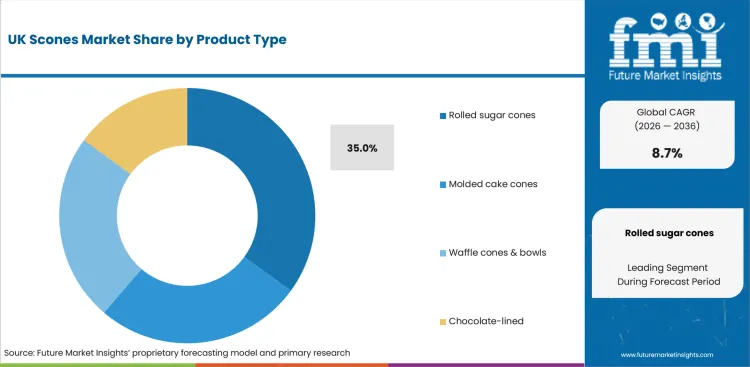
Rolled sugar cones use a thin baked wafer that is shaped while warm, so crispness and moisture resistance become central specification tests. Baking ingredients also affect forming behavior and the finished cone's bite during filling and service.
- Rolled sugar cones are projected to hold 35.0% share in 2026 due to thin walls and familiar geometry that fit filled dessert service.
- Impulse dessert outlets periodically refresh visible serving formats without changing the basic hand-held service model used for filled cones. In April 2026, Wafer Ltd announced its Tutti Frutti cone as a new addition to the company cone range for impulse dessert outlets.
Why does Conventional lead the Claim - Nature category?
Conventional products cover the broadest price range since standard formulas do not require the separate controls used for free-from production. Specialist ranges stay commercially relevant in retailers that can support clear labels and controlled handling for bakery ingredients used in claim-specific recipes.
- By claim - nature, conventional products are estimated to hold 59.0% in 2026 owing to standard formulations requiring fewer segregation and certification steps.
- The Food Standards Agency issued updated best-practice guidance in March 2025 covering written information for 14 regulated allergens in non-prepacked food. Claim-specific production therefore needs tighter ingredient records as gluten-free food reaches retail or foodservice customers.
What supports Multipack leadership in the Packaging Format category?
Multipacks protect fragile baked items while giving retailers fixed count economics for household stock-up purchases through grocery and convenience channels. UK packaging fees now price recyclability performance into material choices used for multipack commercial distribution.
- The multipack segment is likely to capture 31.0% share in 2026 attributable to stock-up economics and the protection brittle formats require.
- PackUK confirmed in June 2025 that household packaging receives red, amber or green recyclability ratings under the Recyclability Assessment Methodology. Multipack designers therefore reserve freshness-indicating packaging or extra barrier material for cases where the added layer measurably reduces breakage or moisture loss.
What drives Supermarkets & Hypermarkets within the Sales Channel category?
Large grocery chains offer national reach and repeatable shelf conditions, so manufacturers can spread listing and promotional costs over a broad store base. One execution failure can disrupt national availability and raise service penalties quickly for a listed bakery line.
- In 2026, supermarkets & hypermarkets are expected to lead sales channel with 39.0% share because standardized cases fit centralized grocery distribution.
- Defra recorded Tesco at 28.2% of UK grocery sales during the twelve weeks ending 17 May 2026. A national listing can therefore change volume quickly, while bakery mixes and finished formats must maintain consistent specifications under retailer service rules.
What are the drivers, restraints and opportunities in the UK Scones Market?
Channel breadth supports repeat ordering, while product protection and compliance raise execution costs. Specialist claims and direct digital access leave room for differentiated formats.
- Driver: Grocery, foodservice and digital routes give manufacturers several purchase occasions for the same baked format.
- Restraint: Moisture exposure, breakage and packaging obligations increase the cost of protecting texture through distribution.
- Opportunity: Claim-specific production and clearer online merchandising can make specialist bakery propositions easier to find and reorder.
One baked format can generate more reorder occasions if manufacturers can serve grocery and foodservice without changing core product quality. Defra recorded real consumer expenditure on eating out rising 2.3% in 2025 as households returned to out-of-home occasions. The 2.3% recovery gives frozen bakery formats and fresh lines another volume route if case size and replenishment frequency fit operator needs.
Packaging economics now depend directly on recyclability under the UK producer-responsibility regime for household materials entering the waste stream. PackUK states that red-rated household packaging carries a 1.2 modulation factor in 2026 to 2027 while amber material receives no modulation change. Manufacturers therefore need pack structures that reduce crushing or moisture loss enough to justify material choices under the fee system.
Specialist claims command a premium if foodservice customers can verify allergen information at the point of purchase during ordering. Food Standards Agency research published in 2025 found that 94% of surveyed foodservice businesses provided allergen information in writing. Clear written information gives allergen-free food and high-protein bakery mixes a cleaner purchase route if manufacturing controls support the stated claim during commercial ordering.
Who are the notable companies in the UK Scones Market?
Finsbury Food Group, Greggs, Premier Foods, The Compleat Food Group, Bells of Lazonby, St Pierre Groupe, Mademoiselle Desserts, and Warburtons.
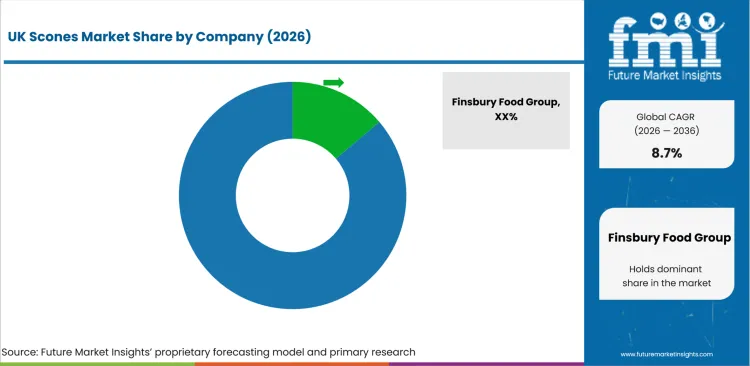
Competition is dispersed between national bakery brands, retail manufacturers, food-to-go operators and specialist free-from producers. Entry barriers come from retailer qualification and pack integrity plus the distribution discipline needed to keep brittle or short-life baked formats within specification.
- Finsbury Food Group, Premier Foods and Warburtons bring national retail relationships and large-scale bakery manufacturing to packaged formats.
- Greggs and The Compleat Food Group bring dense route-to-market or chilled prepared-food operations that strengthen service frequency and format flexibility.
- Bells of Lazonby, St Pierre Groupe and Mademoiselle Desserts differentiate their offers through specialist bakery production and premium sweet-bakery ranges.
Competitive Benchmarking: UK Scones Market
| Company | UK Channel Breadth | Specialist Bakery Capability | Manufacturing / Distribution Control | Geographic Reach |
|---|---|---|---|---|
| Finsbury Food Group | High | High | High | United Kingdom and Europe |
| Greggs | High | Medium | High | United Kingdom |
| Premier Foods | High | Medium | High | United Kingdom and international sales |
| The Compleat Food Group | High | High | High | United Kingdom |
| Bells of Lazonby | Medium | High | Medium | United Kingdom and export markets |
| St Pierre Groupe | High | Medium | Medium | UK, USA, Europe and Middle East |
| Mademoiselle Desserts | High | High | High | Europe, United Kingdom and United States |
| Warburtons | High | Medium | High | United Kingdom |
Scoring basis: High channel breadth requires verified access to at least three major routes while Medium requires two and Low identifies one documented route. High specialist capability requires at least three differentiated bakery or free-from formats while Medium requires two and Low identifies one verified format. High manufacturing or distribution control requires several owned sites or a national logistics platform while Medium covers one substantial route and Low one limited route.
Key Developments in the UK Scones Market
- In August 2026, Premier Foods expanded the Mr Kipling Signature home baking range with Salted Caramel & Belgian Milk Chocolate Cake Mix and a matching Fill & Glaze Icing.
- In March 2026, Mademoiselle Desserts became part of Emmi Desserts, bringing its UK operations under Emmi Group’s unified dessert business structure.
- In April 2026, Finsbury Food Group acquired 100% of Flower & White Ltd to extend its sweet-snacking platform through direct-to-consumer plus retail and foodservice channels.
Key Players in the UK Scones Market
National Retail and Branded Bakery Platforms
- Finsbury Food Group
- Premier Foods
- Warburtons
Food-to-Go and Prepared-Food Operators
- Greggs
- The Compleat Food Group
Specialist and Premium Bakery Producers
- Bells of Lazonby
- St Pierre Groupe
- Mademoiselle Desserts
UK Scones Market - Report Scope
| Coverage field | Report scope |
|---|---|
| Market breakdown | By product type, Claim - Nature, format, packaging format, sales channel and region. |
| Quantitative Units | USD Million. |
| Market Definition | Commercial baked cone and bowl products, including rolled, molded, waffle and lined formats, sold through UK retail, foodservice and direct channels. |
| Regions Covered | Europe |
| Countries Covered | United Kingdom |
| Key Companies Profiled | Finsbury Food Group, Greggs, Premier Foods, The Compleat Food Group, Bells of Lazonby, St Pierre Groupe, Mademoiselle Desserts, and Warburtons. |
| Forecast Period | 2026 to 2036. |
| Approach | Primary and secondary research with market triangulation. |
UK Scones Market - Research Methodology
| Method | Approach |
|---|---|
| Primary Research | FMI analysts gathered input from manufacturers, service providers, technology developers, distributors, end users, procurement teams, and subject-matter experts. Interviews examined purchasing decisions, product or service evaluation, adoption barriers, approval requirements, pricing considerations, and expectations for technical or commercial support. Respondents were also asked what evidence is required before a trial, pilot, or initial order develops into regular purchasing. |
| Desk Research | Desk research covered government statistics, regulatory publications, trade data, industry associations, technical literature, standards, company filings, product information, and official corporate announcements. Sources were reviewed for relevance, publication date, geographic coverage, and consistency with the defined market scope. Claims relating to performance, applications, approvals, capacity, investment, and commercial activity were retained only when supported by credible public evidence. |
| Market Sizing and Forecasting | The market model combined the baseline value with historical performance, segment structure, pricing and volume indicators, adoption levels, company participation, and country-level demand conditions. Forecast assumptions considered economic activity, investment trends, regulatory developments, technology adoption, purchasing cycles, supply availability, and barriers to wider market use. Segment and regional estimates were reconciled before the final market total was calculated. |
| Data Validation | Estimates were checked against multiple independent indicators, including public data, company activity, trade patterns, industry developments, and findings from primary interviews. Validation also tested whether products, services, applications, and company revenues fell within the defined market boundaries. Adjacent categories, unsupported claims, overlapping revenues, and activities without direct market relevance were excluded to reduce double counting and maintain consistency across segments and countries. |
UK Scones Market by Segments
UK Scones Market segmented by Product Type:
- Rolled sugar cones
- Molded cake cones
- Waffle cones & bowls
- Chocolate-lined
UK Scones Market segmented by Claim - Nature:
- Conventional
- Clean label
- Organic
- Gluten-free
- High-protein / fortified
UK Scones Market segmented by Format:
- Fresh
- Frozen
- Ambient packaged
- Chilled
- Par-baked / thaw-and-serve
UK Scones Market segmented by Packaging Format:
- Multipack
- Single-serve
- Family / loaf pack
- Bulk foodservice
UK Scones Market segmented by Sales Channel:
- Supermarkets & hypermarkets
- Artisan & specialty bakeries
- Convenience & forecourt
- Online & DTC
- Foodservice distributors
Research Sources and Bibliography
- Department for Environment, Food & Rural Affairs. (2026, July 29). Food statistics in your pocket.
- Office for National Statistics. (2026, July 24). Internet sales as a percentage of total retail sales.
- Food Standards Agency. (2025, March 5). Updated industry guidance issued for food allergen information in the out-of-home sector.
- Food Standards Agency, Ipsos UK, & Opinium. (2025). Allergen information for non-prepacked foods: Key findings from consumers and food service workers.
- PackUK. (2025, June 28; updated 2026, February 17). PackUK extended producer responsibility (EPR) for packaging: producer disposal fees modulation statement.
- Wafer Ltd. (2026, April 17). Introducing our New Tutti Frutti Cone - January 2026.
- Antonelli Bros Ltd. (2025, April 11). How Antonelli is preparing for a busy summer in 2025.
- Premier Foods. (2026, August 5). Mr Kipling expands its Signature home baking range.
- Greggs plc. (2026, July 29). A message from our Chief Executive: 2026 Interim Results.
- Finsbury Food Group. (2026, April 30). Finsbury Food Group Acquires Flower & White To Boost DTC And Healthy Snacking Growth.
- Bells of Lazonby. (2026). Home. Retrieved August 25, 2026.
- St Pierre Groupe. (2026). Home. Retrieved August 25, 2026.
- Mademoiselle Desserts. (2025, April 15). Our Spring 2025 Launches.
- Warburtons. (2026). Our operations. Retrieved August 25, 2026.
- The Compleat Food Group. (2025, July 14). The Compleat Food Group acquires Freshpak.
- Warburtons. (2026, March). Packaging redesign unveiled.
- Emmi Group. (2026). Annual report 2025: Acquisitions.
- Finsbury Food Group. (2026, June 26). First-ever Hello Kitty Celebration Cake hits Tesco shelves.
- Greggs plc. (2026, June). New Bitesize Greggs opens in London Bridge Station.
- Premier Foods. (2026, May 29). Mr Kipling unveils exceedingly good innovation.
- Wafer Ltd. (2026, April 17). Wafer Launches New Soft Serve Mix.
- The Compleat Food Group. (2025, March 11). The Compleat Food Group acquires The Real Yorkshire Pudding Co.
- Wafer Ltd. (2026, April 17). Wafer Expands Retail Pack Range for 2026.
- The Compleat Food Group. (2026, January 12). The Compleat Food Group acquires Greencore's sauces and soups business.
- Warburtons. (2025, August). Baked Baggage.
This bibliography is provided for reader reference and is not exhaustive. The full report contains the complete reference list and detailed citations
This Report Answers
- How large is the UK scones market in 2026 and what value is projected for 2036?
- Which operating conditions support the 8.7% forecast CAGR through 2036?
- Why do rolled sugar cones hold the largest product type share in 2026?
- How do conventional claims and specialist free-from controls alter production requirements?
- Why does multipack packaging require a balance between protection and recyclability cost?
- What makes supermarkets & hypermarkets the largest sales channel in 2026?
- Which execution frictions could prevent channel access from converting into repeat orders?
- Which companies are benchmarked for UK bakery reach, specialist capability and distribution control?
- How does the United Kingdom's 9.0% CAGR interact with grocery concentration and packaging economics?
Frequently Asked Questions
How big is the UK scones market in 2026?
The UK scones market is valued at USD 252.2 million in 2026 and is projected to reach USD 580.8 million by 2036. Growth depends on reliable grocery and foodservice distribution that preserves texture while digital ordering broadens access to specialist formats.
What is the CAGR of the UK scones market from 2026 to 2036?
The UK scones market is projected to grow at a CAGR of 8.7% between 2026 and 2036. Expansion depends on multi-channel availability and repeat purchasing supported by consistent packaging and shelf-life performance.
Which product type leads the UK scones market?
The rolled sugar cones segment is expected to hold 35.0% of the UK scones market in 2026, driven by familiar crisp geometry that suits filled dessert service. Moisture control protects the cone from softening during filling and distribution through final delivery to the customer.
Which Claim - Nature segment leads the UK scones market?
The conventional segment is expected to hold 59.0% of the UK scones market in 2026, attributable to fewer specialist formulation and segregation requirements. Free-from propositions require tighter allergen control and clearer claim management for consistent supply through commercial channels.
Which companies are active in the UK scones market?
Key companies operating in the market include Finsbury Food Group, Greggs, Premier Foods, The Compleat Food Group, Bells of Lazonby, St Pierre Groupe, Mademoiselle Desserts, and Warburtons. Their positions differ by bakery range, retail access, specialist production and distribution control within the article boundary.
Preview the report firsthand - request a free sample
Get SampleGet the brochure for pricing and purchase details.
Get PDFTable of Content
- Key Takeaways
- Market Size and CAGR
- Top Growth Driver
- Fastest Growing Segment
- Leading Region
- Key Companies
- Emerging Opportunities
- Executive Summary
- UK Market Outlook
- Demand-side Trends
- Supply-side Trends
- Technology Roadmap Analysis
- Analysis and Recommendations
- Analyst Perspective (What is happening? Why now? What should investors know?)
- Key Questions Answered
- How large is the market?
- What is the CAGR?
- What are key trends?
- Which region dominates?
- Who are the leaders?
- Market Overview
- Market Coverage / Taxonomy
- Market Definition / Scope / Limitations
- Research Methodology
- Chapter Orientation
- Analytical Lens and Working Hypotheses
- Market Structure, Signals, and Trend Drivers
- Benchmarking and Cross-market Comparability
- Market Sizing, Forecasting, and Opportunity Mapping
- Research Design and Evidence Framework
- Desk Research Programme (Secondary Evidence)
- Expert Input and Fieldwork (Primary Evidence)
- Tooling, Models, and Reference Databases
- Data Engineering and Model Build
- Quality Assurance and Audit Trail
- Market Background
- Market Dynamics (Drivers, Restraints, Opportunity, Trends)
- Scenario Forecast (Optimistic, Likely, Conservative)
- Impact Analysis
- AI Impact
- Sustainability Impact
- Regulatory Impact
- Technology Impact
- Consumer / Buyer Analysis
- Purchase Drivers
- Adoption Barriers
- Buyer Journey
- Opportunity Map Analysis
- Product Life Cycle Analysis
- Supply Chain Analysis
- Investment Feasibility Matrix
- Value Chain Analysis
- PESTLE and Porter's Analysis
- Regulatory Landscape
- Regional Parent Market Outlook
- Production and Consumption Statistics
- Import and Export Statistics
- UK Market Analysis and Forecast, 2021 to 2036
- Historical Market Size Value (USD Million) Analysis, 2021 to 2025
- Current and Future Market Size Value (USD Million) Projections, 2026 to 2036
- Y-o-Y Growth Trend Analysis
- Absolute $ Opportunity Analysis
- UK Market Pricing Analysis, 2021 to 2036
- UK Market Analysis and Forecast, By Product Type, 2021 to 2036
- Introduction / Key Findings
- Historical Market Size Value (USD Million) Analysis By Product Type, 2021 to 2025
- Current and Future Market Size Value (USD Million) Analysis and Forecast By Product Type, 2026 to 2036
- Rolled sugar cones
- Molded cake cones
- Waffle cones & bowls
- Chocolate-lined
- Rolled sugar cones
- Y-o-Y Growth Trend Analysis By Product Type, 2021 to 2025
- Absolute $ Opportunity Analysis By Product Type, 2026 to 2036
- UK Market Analysis and Forecast, By Claim / Nature, 2021 to 2036
- Introduction / Key Findings
- Historical Market Size Value (USD Million) Analysis By Claim / Nature, 2021 to 2025
- Current and Future Market Size Value (USD Million) Analysis and Forecast By Claim / Nature, 2026 to 2036
- Conventional
- Clean label
- Organic
- Gluten-free
- High-protein / fortified
- Conventional
- Y-o-Y Growth Trend Analysis By Claim / Nature, 2021 to 2025
- Absolute $ Opportunity Analysis By Claim / Nature, 2026 to 2036
- UK Market Analysis and Forecast, By Format, 2021 to 2036
- Introduction / Key Findings
- Historical Market Size Value (USD Million) Analysis By Format, 2021 to 2025
- Current and Future Market Size Value (USD Million) Analysis and Forecast By Format, 2026 to 2036
- Fresh
- Frozen
- Ambient packaged
- Chilled
- Par-baked / thaw-and-serve
- Fresh
- Y-o-Y Growth Trend Analysis By Format, 2021 to 2025
- Absolute $ Opportunity Analysis By Format, 2026 to 2036
- UK Market Analysis and Forecast, By Packaging Format, 2021 to 2036
- Introduction / Key Findings
- Historical Market Size Value (USD Million) Analysis By Packaging Format, 2021 to 2025
- Current and Future Market Size Value (USD Million) Analysis and Forecast By Packaging Format, 2026 to 2036
- Multipack
- Single-serve
- Family / loaf pack
- Bulk foodservice
- Multipack
- Y-o-Y Growth Trend Analysis By Packaging Format, 2021 to 2025
- Absolute $ Opportunity Analysis By Packaging Format, 2026 to 2036
- UK Market Analysis and Forecast, By Sales Channel, 2021 to 2036
- Introduction / Key Findings
- Historical Market Size Value (USD Million) Analysis By Sales Channel, 2021 to 2025
- Current and Future Market Size Value (USD Million) Analysis and Forecast By Sales Channel, 2026 to 2036
- Supermarkets & hypermarkets
- Artisan & specialty bakeries
- Convenience & forecourt
- Online & DTC
- Foodservice distributors
- Supermarkets & hypermarkets
- Y-o-Y Growth Trend Analysis By Sales Channel, 2021 to 2025
- Absolute $ Opportunity Analysis By Sales Channel, 2026 to 2036
- UK Market Analysis and Forecast, By Region, 2021 to 2036
- Introduction
- Historical Market Size Value (USD Million) Analysis By Region, 2021 to 2025
- Current Market Size Value (USD Million) Analysis and Forecast By Region, 2026 to 2036
- UK
- Market Attractiveness Analysis By Region
- UK Market Analysis and Forecast, By Country, 2021 to 2036
- Historical Market Size Value (USD Million) Trend Analysis By Market Taxonomy, 2021 to 2025
- Market Size Value (USD Million) Forecast By Market Taxonomy, 2026 to 2036
- By Country
- By Product Type
- By Claim / Nature
- By Format
- By Packaging Format
- By Sales Channel
- By Country
- Market Attractiveness Analysis
- By Country
- By Product Type
- By Claim / Nature
- By Format
- By Packaging Format
- By Sales Channel
- Key Takeaways
- Key Countries Market Analysis
- UK
- Pricing Analysis
- Market Share Analysis, 2025
- By Product Type
- By Claim / Nature
- By Format
- By Packaging Format
- By Sales Channel
- UK
- Market Structure Analysis
- Competition Dashboard
- Competition Benchmarking
- Market Share Analysis of Top Players
- By Regional
- By Product Type
- By Claim / Nature
- By Format
- By Packaging Format
- By Sales Channel
- Emerging Startups
- Innovation Benchmarking
- Competition Analysis
- Competition Deep Dive
- Finsbury Food Group
- Overview
- Product Portfolio
- Profitability by Market Segments
- Sales Footprint
- Strategy Overview
- Marketing Strategy
- Product Strategy
- Channel Strategy
- Greggs
- Premier Foods
- Samworth Brothers
- The Compleat Food Group
- Bells of Lazonby
- St Pierre Groupe
- Mademoiselle Desserts
- Frank Roberts & Sons
- Warburtons
- Finsbury Food Group
- Case Studies
- Success Stories
- Recent Developments
- Competition Deep Dive
- Assumptions & Acronyms Used


