

- Industry Size (2025)
- USD 268.2 Mn
- Forecast (2035)
- USD 501.5 Mn
- CAGR (2025 to 2035)
- 6.5%
Demand for Body Fat Measurement in USA Forecast and Outlook (2025 to 2035)
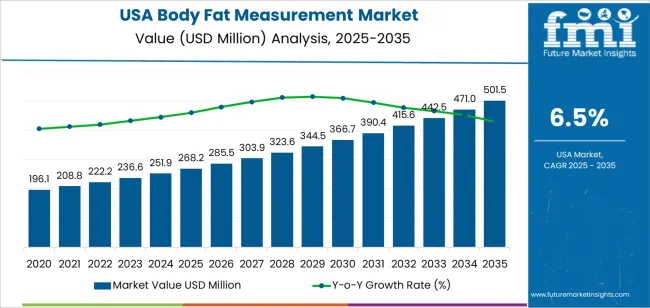
The demand for body fat measurement technology in the USA is expected to grow from USD 268.2 million in 2025 to USD 501.5 million by 2035, reflecting a compound annual growth rate (CAGR) of 6.5%. As health-conscious consumers continue to seek accurate and non-invasive methods to monitor and manage body composition, the demand for body fat measurement tools, such as bioelectrical impedance analysis (BIA), skinfold calipers, and dual-energy X-ray absorptiometry (DXA), is expected to rise. The increasing awareness of obesity-related health risks and the expanding fitness and wellness markets are key drivers of this growth.
The market will experience steady growth, with demand increasing from USD 268.2 million in 2025 to USD 285.5 million in 2026, USD 303.9 million in 2027, and USD 323.6 million in 2028. By 2029, the demand for body fat measurement technology will rise to USD 344.5 million, continuing its upward trajectory to USD 501.5 million by 2035, driven by growing health trends and an increasing emphasis on personalized fitness and health tracking.
Quick Stats of the Demand for Body Fat Measurement in USA
- Demand for Body Fat Measurement in USA Value (2025): USD 268.2 million
- Demand for Body Fat Measurement in USA Forecast Value (2035): USD 501.5 million
- Demand for Body Fat Measurement in USA Forecast CAGR (2025 to 2035): 6.5%
- Demand for Body Fat Measurement in USA Product Type: 63% BIA
- Demand for Body Fat Measurement in USA Key Growth Regions: West USA, South USA, Northeast USA, Midwest USA
- Demand for Body Fat Measurement in USA Key Players: GE Healthcare, OMRON Healthcare Co., Ltd., The Diagnostic Medical Systems (DMS) Group, Hologic Inc., Xiaomi
What is the Growth Forecast for the Body Fat Measurement Industry in USA through 2035?
The peak-to-trough analysis for the body fat measurement market reveals a steady, consistent growth pattern over the forecast period, with no significant peaks or troughs. Early years (2025–2029) will experience gradual annual increases in demand, with a relatively stable growth rate. The market will likely see moderate growth in the initial stages as the technology becomes more widely adopted in both fitness and medical settings.
In the later years of the forecast (2029–2035), the demand for body fat measurement tools is expected to continue expanding at a steady pace, reaching its peak value of USD 501.5 million in 2035. The analysis suggests that there will not be any major fluctuations or downturns in the market, indicating a smooth and predictable increase in demand. The growing focus on preventive healthcare, obesity management, and the increasing adoption of fitness tracking devices in mainstream health routines will support the continued demand for body fat measurement technologies, minimizing the likelihood of significant market downturns.
USA Amino Acids Industry Key Takeaways
| Metric | Value |
|---|---|
| Industry Sales Value (2025) | USD 268.2 million |
| Industry Forecast Value (2035) | USD 501.5 million |
| Industry Forecast CAGR (2025 to 2035) | 6.5% |
Why is the Demand for Body Fat Measurement in USA Growing?
Demand for body fat measurement in the USA is increasing due to growing awareness of health, fitness, and preventive care among general population. Rising rates of obesity and related metabolic disorders have increased interest in tracking not only weight but body composition - such as fat mass, muscle mass, and visceral fat. Individuals, fitness enthusiasts and health conscious consumers are using body fat measurement to monitor progress, maintain healthy body composition and manage risks linked to excess fat. The trend toward preventive health, wellness and lifestyle management supports greater adoption of body fat measurement as part of regular health monitoring.
Advances in technology and growing availability of affordable home use measurement tools support the rising demand. Devices such as bioelectrical impedance analysis (BIA) scales, body composition monitors and smart body fat analyzers have become more accessible and user friendly. These devices provide reasonably accurate estimates of body fat and overall composition for home, gym or clinical use. Growth of fitness centres, wellness programmes and corporate health initiatives also fuels demand for body fat measurement services and devices. As long as obesity remains a public health concern and more people adopt preventive health habits or fitness regimes, demand for body fat measurement in the USA is likely to grow steadily.
What Is the Current State of the Demand for Body Fat Measurement in the USA in Terms of Product and End User?
The demand for body fat measurement in the USA is primarily driven by product and end user. The leading product is BIA (Bioelectrical Impedance Analysis), which accounts for 63% of the market share, while hospitals and clinics are the dominant end-user segment, capturing 42% of the demand. As health and wellness awareness continues to grow, body fat measurement tools are becoming increasingly important in both clinical and fitness settings. The demand for accurate and non-invasive body composition analysis, particularly through BIA technology, is strong in the USA, driven by its application in health management and fitness optimization.
How Is BIA Leading the Demand for Body Fat Measurement in the USA?
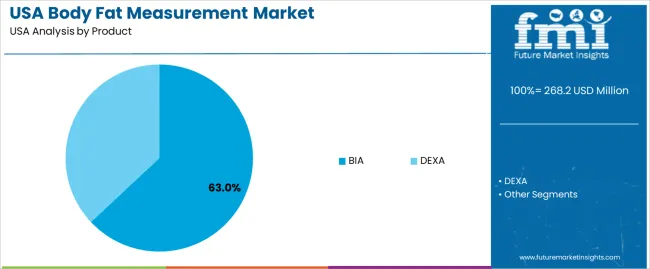
BIA (Bioelectrical Impedance Analysis) leads the demand for body fat measurement in the USA, holding 63% of the market share. BIA is a popular method for assessing body composition, including body fat percentage, muscle mass, and hydration levels. This method works by passing a small electrical current through the body and measuring the resistance to the flow of electricity, which varies between different tissue types. BIA is favored for its ease of use, speed, and non-invasive nature, making it suitable for both clinical and fitness applications.
The demand for BIA is driven by its accessibility and relatively low cost compared to other body fat measurement methods, such as DEXA (Dual-Energy X-ray Absorptiometry). BIA devices are commonly used in hospitals, clinics, gyms, and fitness centers to monitor body composition as part of overall health assessments. As consumers and healthcare professionals continue to focus on health management and disease prevention, BIA remains the preferred choice for routine body fat measurement in the USA due to its convenience, affordability, and efficiency.
How Are Hospitals & Clinics Leading the End-User Demand for Body Fat Measurement in the USA?
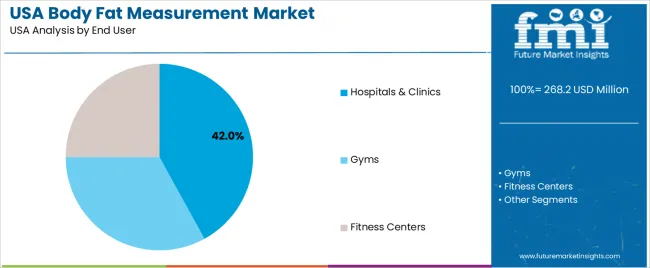
Hospitals and clinics lead the end-user demand for body fat measurement in the USA, capturing 42% of the market share. Body fat measurement is essential in healthcare settings for managing various conditions, such as obesity, metabolic disorders, and cardiovascular diseases. Hospitals and clinics use body fat measurement tools to assess patients' health status, guide treatment plans, and monitor progress in weight management and rehabilitation programs.
The demand from hospitals and clinics is driven by the increasing focus on preventative healthcare and the need for accurate body composition analysis. Medical professionals use body fat measurements to evaluate patients' risk for certain chronic diseases and provide personalized care. As the healthcare sector places more emphasis on managing obesity and related health conditions, the demand for reliable and accurate body fat measurement technologies, such as BIA, is expected to remain strong. Hospitals and clinics will continue to be the leading end-user segment for body fat measurement tools in the USA as they play a central role in patient care and health monitoring.
What is the Summary of Demand for Body Fat Measurement in the USA?
Demand for body fat measurement in the USA has been rising steadily in recent years. As more individuals, fitness centers, healthcare providers, and wellness programs prioritize body composition rather than just body weight, tools and services for body fat measurement have become more important. The market for body fat measurement devices and services is expanding, supported by growing awareness of obesity, metabolic health, and the value of tracking fat versus lean mass. Both at home scales and clinic grade body composition analyzers are in demand as consumers and professionals seek accurate, actionable health data.
What are the Drivers of Demand for Body Fat Measurement in the USA?
One key driver is increasing health awareness among Americans, especially the elevated concern about obesity, metabolic disorders, and chronic disease risk. As more people focus on preventive health, body fat measurement is valued as a tool to assess risk beyond simple body weight or BMI. Another driver is growth in the fitness and wellness industry, including gyms, personal trainers, and home workouts; many users rely on body fat measurements to track progress, monitor fat loss or muscle gain, and tailor nutrition or training plans. Advances in technology and accessibility - such as portable bioelectrical impedance devices, consumer friendly smart scales, and affordable measurement tools - make it easier for individuals to monitor body composition at home. Additionally, clinical and diagnostic use in healthcare settings for obesity management, metabolic testing, and preventive health assessments supports professional demand for accurate measurement tools.
What are the Restraints on Demand for Body Fat Measurement in the USA?
Despite growth, some factors restrain demand. One restraint is cost: high precision measurement devices (such as DEXA, Bod Pod, or advanced analyzers) remain relatively expensive, making them less accessible for price sensitive consumers or smaller clinics. Another restraint is variability in accuracy and consistency across different measurement methods; less accurate consumer level devices may produce unreliable results, discouraging reliance on them. Some individuals may distrust body fat measurement outcomes or feel that weight and general health markers suffice, limiting adoption of specialized measurement. Additionally, for occasional fitness users or those with modest health concerns, the perceived benefit may not justify the expense and effort of regular body fat measurement. Finally, regulatory, privacy, or data security concerns (for devices linked to apps or health platforms) might limit adoption in certain segments.
What are the Key Trends Influencing Demand for Body Fat Measurement in the USA?
One major trend is rising demand for home based body composition devices and smart scales as consumers seek convenience, privacy, and ongoing monitoring. Many users prefer at home tracking rather than visiting clinics. Another trend is integration of body fat measurement into broader health management and wellness platforms, including nutrition apps, fitness trackers, and telehealth services; this links body composition data with diet, exercise, and long term health tracking. There is also growing adoption of more accurate and non invasive measurement technologies (for example bioelectrical impedance, multi frequency analyzers, or portable devices) which balance precision and affordability. In addition, increasing demand from healthcare providers and wellness clinics for preventive health screening, obesity management, and metabolic monitoring supports institutional use of body fat measurement tools. Finally, growing public and clinical recognition that fat percentage and body composition provide better insight into health risks than BMI or weight alone is shaping long term adoption.
What is the Country-Wise Demand Outlook for Body Fat Measurement in the USA?
The demand for body fat measurement in the USA is expected to show strong growth across various regions. The West USA is projected to experience the highest CAGR of 7.4%, followed by the South USA at 6.7%, the Northeast USA at 5.9%, and the Midwest USA at 5.2%. These regional differences reflect variations in health trends, fitness participation, and increasing public awareness of the importance of body composition in relation to overall health. Key drivers include rising obesity rates, growing fitness culture, technological advances in measurement devices, and the increasing availability of body fat analysis in clinical and home settings.
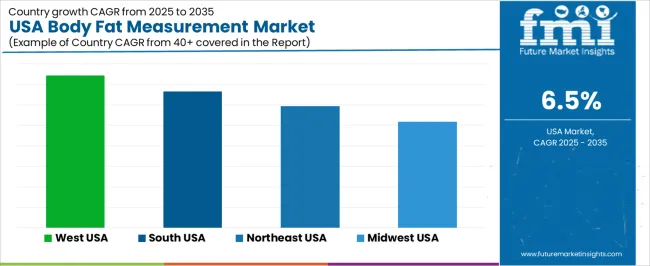
| Region | CAGR (%) |
|---|---|
| West USA | 7.4 |
| South USA | 6.7 |
| Northeast USA | 5.9 |
| Midwest USA | 5.2 |
What Factors Drive Demand for Body Fat Measurement in the West USA?
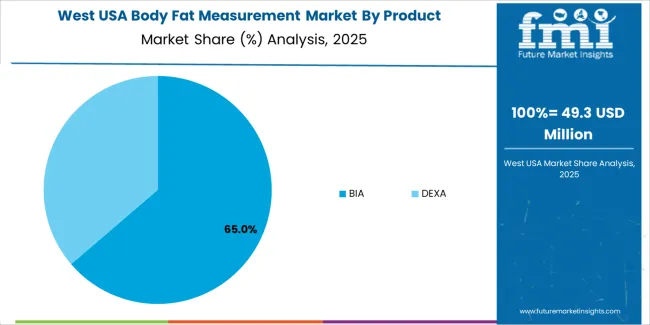
In the West USA, the projected 7.4% annual growth in demand for body fat measurement is driven by a combination of factors, including high levels of health awareness, fitness participation, and technological adoption. The West has a large population of health-conscious consumers who actively engage in physical activities such as triathlons, marathons, and fitness routines. This region has also witnessed a shift toward more advanced methods of health tracking, with individuals increasingly interested in precise measurements of body composition. Moreover, the popularity of wellness-focused trends such as mindfulness and biohacking further fuels interest in body fat measurement. These factors, along with a growing emphasis on preventive health care, are key drivers of growth in the body fat measurement market in the West USA.
Why is Demand for Body Fat Measurement Growing in the South USA?
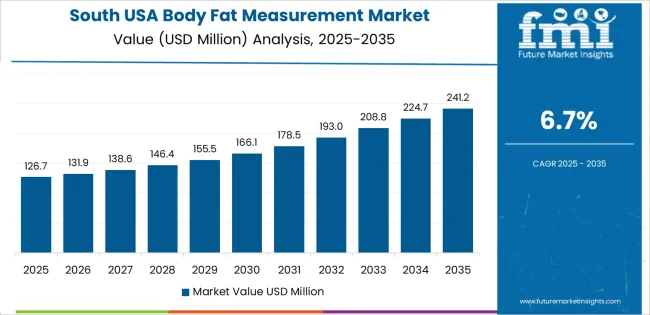
In the South USA, the demand for body fat measurement is expected to grow at a CAGR of 6.7%, reflecting the region's increasing focus on obesity prevention and overall health improvement. The South has historically had high obesity rates, which has led to a heightened awareness of the need to monitor and manage body composition. As healthcare providers and fitness centers in the region adopt more advanced body fat measurement technologies, more consumers are opting for accurate methods to track their health. Additionally, the South's expanding fitness culture and rising participation in sports such as running, cycling, and bodybuilding further fuel the demand for body fat measurement tools. Increasingly affordable at-home measurement devices have also contributed to wider consumer adoption, allowing individuals to monitor their body composition regularly and make informed health decisions.
What Supports Demand for Body Fat Measurement in the Northeast USA?
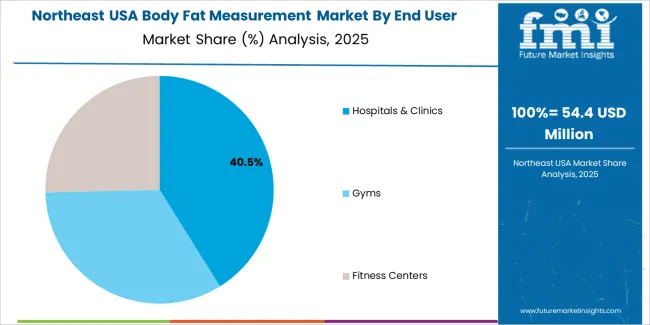
The Northeast USA, with a projected CAGR of 5.9%, is expected to see steady growth in the demand for body fat measurement. The region's high population density and a large number of healthcare institutions contribute to increasing access to advanced diagnostic and wellness services. There is a growing awareness among healthcare providers and the general public regarding the importance of body composition as a key metric of overall health, especially in relation to conditions such as heart disease, diabetes, and metabolic syndrome. In addition to clinical applications, fitness centers and personal trainers in the Northeast are increasingly adopting body fat measurement tools to track client progress and design personalized health and fitness programs. These trends are helping to drive demand for body fat measurement devices and services in the Northeast USA.
How is Demand for Body Fat Measurement Evolving in the Midwest USA?
In the Midwest USA, the projected CAGR of 5.2% for body fat measurement is reflective of gradual but steady growth. The Midwest, which has a large population of working class individuals and rural communities, is experiencing increasing awareness about the role of body composition in health and fitness. With rising obesity rates and growing concerns about chronic health conditions, more people in the Midwest are turning to body fat measurement as a tool for monitoring health and making informed lifestyle changes. Fitness centers, healthcare providers, and wellness clinics in the region are incorporating body fat measurement into their services. Furthermore, affordable, easy-to-use at-home body fat measurement devices are gaining popularity, making it easier for consumers in the Midwest to track their progress in managing body composition. As these factors continue to evolve, demand for body fat measurement services and devices is expected to grow steadily in the Midwest USA.
What is the Competitive Landscape for the Body Fat Measurement Market in the USA?
The body fat measurement market in the USA draws demand from rising health awareness, obesity prevalence and growth in fitness and preventive care adoption. The national body composition analyzers market was valued around USD 203.0 million in 2024 and is expected to grow at a compound annual rate of roughly 7.0% through 2033. Bio impedance (BIA) devices lead in USAge owing to affordability and ease of use. Dual energy X ray absorptiometry (DEXA) instruments are gaining traction for clinical and diagnostic precision. The market’s expansion reflects growing interest from hospitals, wellness centers, gyms and individual consumers aiming for accurate body composition tracking.
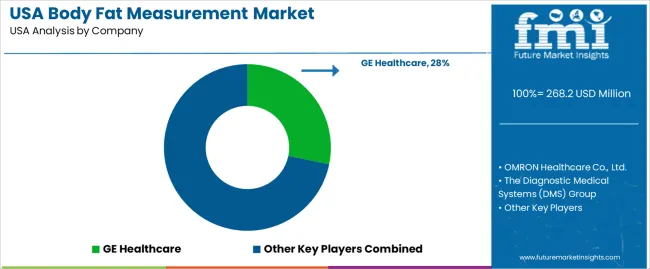
Competition among suppliers centres on technology accuracy, device portability, ease of use, data output and price. A leading company in this domain is GE Healthcare with about 28.2% market share. Other significant firms include OMRON Healthcare Co., Ltd., The Diagnostic Medical Systems (DMS) Group, Hologic Inc. and Xiaomi. Some providers emphasise clinical grade analyzers with high precision suitable for hospitals. Others target home users or fitness consumers with portable or smart BIA scales offering convenience, affordability and basic body fat estimates. Device-guides and brochures typically highlight factors like measurement speed, reproducibility, user comfort, data depth (fat, muscle, water, bone mass) and connectivity or integration with health apps. Market pressure continues as suppliers enhance features to meet diverse end user needs including clinical accuracy, home wellness monitoring and fitness tracking.
Key Players of the Body Fat Measurement Industry in USA
- GE Healthcare
- OMRON Healthcare Co., Ltd.
- The Diagnostic Medical Systems (DMS) Group
- Hologic Inc.
- Xiaomi
Scope of the Report
| Items | Details |
|---|---|
| Quantitative Units | USD Million |
| Regions Covered | USA |
| Product | BIA, DEXA |
| End-User | Hospitals & Clinics, Gyms, Fitness Centers |
| Key Companies Profiled | GE Healthcare, OMRON Healthcare Co., Ltd., The Diagnostic Medical Systems (DMS) Group, Hologic Inc., Xiaomi |
| Additional Attributes | Dollar sales by product type and end-user reveal strong demand for BIA (Bioelectrical Impedance Analysis) and DEXA (Dual-Energy X-ray Absorptiometry) for body fat measurement. Hospitals and clinics lead in USAge, followed by gyms and fitness centers, where fitness tracking is increasingly popular. Companies like OMRON and Hologic provide advanced, reliable measurement solutions. The market is expected to grow as demand for health tracking and obesity management increases, along with the rise in fitness awareness. |
Key Segments in the Demand for Body Fat Measurement in USA
Product:
- BIA
- DEXA
End User:
- Hospitals & Clinics
- Gyms
- Fitness Centers
Region:
- Northeast USA
- West USA
- Midwest USA
- South USA
Frequently Asked Questions
How big is the demand for body fat measurement in USA in 2025?
The demand for body fat measurement in USA is estimated to be valued at USD 268.2 million in 2025.
What will be the size of body fat measurement in USA in 2035?
The market size for the body fat measurement in USA is projected to reach USD 501.5 million by 2035.
How much will be the demand for body fat measurement in USA growth between 2025 and 2035?
The demand for body fat measurement in USA is expected to grow at a 6.5% CAGR between 2025 and 2035.
What are the key product types in the body fat measurement in USA?
The key product types in body fat measurement in USA are bia and dexa.
Which end user segment is expected to contribute significant share in the body fat measurement in USA in 2025?
In terms of end user, hospitals & clinics segment is expected to command 42.0% share in the body fat measurement in USA in 2025.
Preview the report firsthand - request a free sample
Get SampleGet the brochure for pricing and purchase details.
Get PDFTable of Content
- Executive Summary
- USA Market Outlook
- Demand-side Trends
- Supply-side Trends
- Technology Roadmap Analysis
- Analysis and Recommendations
- Market Overview
- Market Coverage / Taxonomy
- Market Definition / Scope / Limitations
- Market Background
- Market Dynamics
- Drivers
- Restraints
- Opportunity
- Trends
- Scenario Forecast
- Demand in Optimistic Scenario
- Demand in Likely Scenario
- Demand in Conservative Scenario
- Opportunity Map Analysis
- Product Life Cycle Analysis
- Supply Chain Analysis
- Investment Feasibility Matrix
- Value Chain Analysis
- PESTLE and Porter’s Analysis
- Regulatory Landscape
- Regional Parent Market Outlook
- Production and Consumption Statistics
- Import and Export Statistics
- Market Dynamics
- USA Market Analysis 2020 to 2024 and Forecast, 2025 to 2035
- Historical Market Size Value (USD Million) Analysis, 2020 to 2024
- Current and Future Market Size Value (USD Million) Projections, 2025 to 2035
- Y-o-Y Growth Trend Analysis
- Absolute $ Opportunity Analysis
- USA Market Pricing Analysis 2020 to 2024 and Forecast 2025 to 2035
- USA Market Analysis 2020 to 2024 and Forecast 2025 to 2035, By Product
- Introduction / Key Findings
- Historical Market Size Value (USD Million) Analysis By Product , 2020 to 2024
- Current and Future Market Size Value (USD Million) Analysis and Forecast By Product , 2025 to 2035
- BIA
- DEXA
- Y-o-Y Growth Trend Analysis By Product , 2020 to 2024
- Absolute $ Opportunity Analysis By Product , 2025 to 2035
- USA Market Analysis 2020 to 2024 and Forecast 2025 to 2035, By End User
- Introduction / Key Findings
- Historical Market Size Value (USD Million) Analysis By End User, 2020 to 2024
- Current and Future Market Size Value (USD Million) Analysis and Forecast By End User, 2025 to 2035
- Hospitals & Clinics
- Gyms
- Fitness Centers
- Y-o-Y Growth Trend Analysis By End User, 2020 to 2024
- Absolute $ Opportunity Analysis By End User, 2025 to 2035
- Market Structure Analysis
- Competition Dashboard
- Competition Benchmarking
- Market Share Analysis of Top Players
- By Regional
- By Product
- By End User
- Competition Analysis
- Competition Deep Dive
- GE Healthcare
- Overview
- Product Portfolio
- Profitability by Market Segments (Product/Age /Sales Channel/Region)
- Sales Footprint
- Strategy Overview
- Marketing Strategy
- Product Strategy
- Channel Strategy
- OMRON Healthcare Co., Ltd.
- The Diagnostic Medical Systems (DMS) Group
- Hologic Inc.
- Xiaomi
- GE Healthcare
- Competition Deep Dive
- Assumptions & Acronyms Used
- Research Methodology


