

- Market Size (2026)
- USD 5.5 Bn
- Forecast (2036)
- USD 11.7 Bn
- CAGR (2026 to 2036)
- 7.8%
How big is UV-Barrier Paper Packaging Market in 2026?
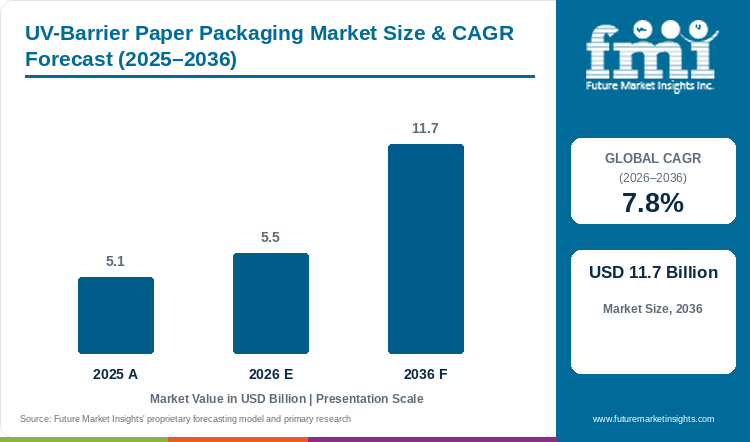
Demand for UV-barrier paper packaging is projected to expand at 7.8% CAGR between 2026 and 2036. Industry value grows from USD 5.1 billion in 2025 to USD 5.5 billion in 2026 and is projected to reach USD 11.7 billion by 2036.
Light-sensitive foods, beverages and personal care products requires packaging which can reduce the passage of UV and visible light. Due to this requirement, coated and multilayer paper is finding wider application in cartons, sachets, wraps and overwraps. The global UV-barrier paper packaging market was valued at USD 5.1 billion in 2025 and is estimated at USD 5.5 billion in 2026. Market value is projected to reach USD 11.7 billion by 2036, expanding at 7.8% CAGR during 2026 to 2036. Folding cartons represented 36.2% of packaging type revenue in 2026, owing to larger print area and rigid protection provided by paperboard packaging. Mondi reports 90% paper content and oxygen and water-vapour transmission below 0.5 for FunctionalBarrier Paper Ultimate.[1] Availability of functional paper grades and installed converting lines is anticipated to support sustainable packaging developments across consumer brands.
Key Market Trends & Insights
- By packaging type, folding cartons led with 36.2% share in 2026, supported by rigid protection and a wider printable surface.
- By barrier technology, metallized coatings accounted for 35.7% in 2026 as thin reflective layers reduce UV and visible-light transmission.
- By paper grade, bleached packaging paper represented 31.2% in 2026 owing to smooth coating coverage and clean printed graphics.
- By end user, food and beverage held 42.0% in 2026, while coffee, tea, spices, cereal bars and bouillon require aroma and light protection.
Regional Highlights
- Fastest-growing profiled country: Japan (8.3% CAGR, 2026 to 2036).
- By country: Finland (7.8%) and Germany (7.5%) follow, while the United States records the lowest profiled CAGR at 6.9%.
Market Size & Forecast
Table 1: Market Size and Forecast for the UV-Barrier Paper Packaging Market (USD billion and percentage), 2025 to 2036
| Metric | Value |
|---|---|
| 2025 Market Size | USD 5.1 billion |
| Estimated Market Size in 2026 | USD 5.5 billion |
| Projected Market Size by 2036 | USD 11.7 billion |
| CAGR, 2026 to 2036 | 7.8% |
| Added Revenue, 2026 to 2036 | USD 6.2 billion |
| Market Expansion Multiple | 2.13x |
Paper production provides the material base; however, every paper grade cannot be used for products requiring longer shelf life. The coating must protect aroma, color and product quality and should also remain suitable for recovery in the paper stream. Cepi reported 77.4 million tonnes of paper and board production in 2025, along with 45.3 million tonnes of paper for recycling utilization, with the European paper recycling rate remaining at 76.4%.[2] Finland reported a 96% recycling rate for fiber packaging in official packaging statistics.[3] These recovery rates are encouraging development of thinner coatings which can disperse or remain within accepted limits during recycling. Apart from recyclability, the paper must seal, fold and run on the intended packing line without loss of speed. Barrier papers meeting both product protection and fiber-recovery requirement are expected to receive higher preference during the forecast period.
Barrier Performance and Recycling Readiness
Barrier paper is used on a regular basis only when the same structure protects the packaged product and fits the intended recycling route. While oxygen and water-vapour transmission below 0.5 provides essential gas barrier performance, effective UV-barrier packaging specifically requires calibrated ultraviolet and visible light transmittance thresholds to prevent photo-oxidation in light-sensitive food and personal care products. Paper content of 90% also provides a higher fiber portion for recovery where suitable facilities are present. However, a high national recycling rate does not confirm that every coating on the finished pack will be accepted. Repulping, screening, sealing and packing-line performance requires separate testing for each structure. Development of thinner coatings having measured barrier and recovery performance is expected to create new avenues for UV-barrier paper packaging market.
Table 2: Barrier Performance and Recycling Readiness Indicators for the UV-Barrier Paper Packaging Market (paper content, transmission rates, production, and recycling percentages), mixed reporting years from 2023 to 2025
| Indicator | Data Point | Why It Matters | Source |
|---|---|---|---|
| FunctionalBarrier Paper Ultimate paper content | 90% paper | Supports paper-based design and recovery where facilities exist. | [1] |
| Oxygen and water-vapour barrier | Below 0.5 in stated test units | Supports aroma and shelf-life protection for demanding dry foods. | [1] |
| German packaging-paper production | 12.3 million tonnes; up 5% in 2024 | Provides a broad material base for coated cartons, wraps and sleeves. | [11] |
| European paper and board production | 77.4 million tonnes in 2025 | Shows the scale of paper production available to packaging and coating markets. | [2] |
| European paper recycling rate | 76.4% in 2025 | Increases the requirement for barrier coatings compatible with fiber recovery. | [2] |
| Finnish fiber-packaging recycling rate | 96% in 2023 | Shows recovery conditions supporting recyclable specialty paper development. | [3] |
| U.S. packaging-paper production | Up 1.7% in 2025 | Indicates continued output of paper grades used by packaging converters. | [16] |
Analyst Perspective
“Food brands will move first towards barrier papers which protect aroma without slowing the installed packing lines. Grades having recyclability evidence will receive regular orders, while untested papers will remain limited to selected trials.”
- Nandini Roy Choudhury, Principal Consultant, Future Market Insights.
How is the UV-barrier paper packaging market segmented?
UV-barrier paper packaging market is segmented by four primary commercial axes and region: packaging type, barrier technology, paper grade, end user, and region. In 2026, folding cartons are projected at 36.2%, metallized coatings at 35.7%, bleached packaging paper at 31.2%, and food and beverage at 42.0%.
By packaging type: pouches, sachets, wraps and overwraps, folding cartons, labels and sleeves, and other packaging types.
By barrier technology: metallized coatings, TiO2 and pigmented barriers, AlOx and SiOx, bio-based barriers, and hybrid and multilayer barriers.
By paper grade: kraft, bleached packaging paper, recycled paperboard, and specialty barrier paper.
By end user: food and beverage, cosmetics and personal care, pharma and nutraceuticals, industrial and chemical, and other end users.
By region: North America, Latin America, Western Europe, Eastern Europe, East Asia, South Asia and Pacific, and Middle East and Africa.
Why do folding cartons retain a notable packaging type share?
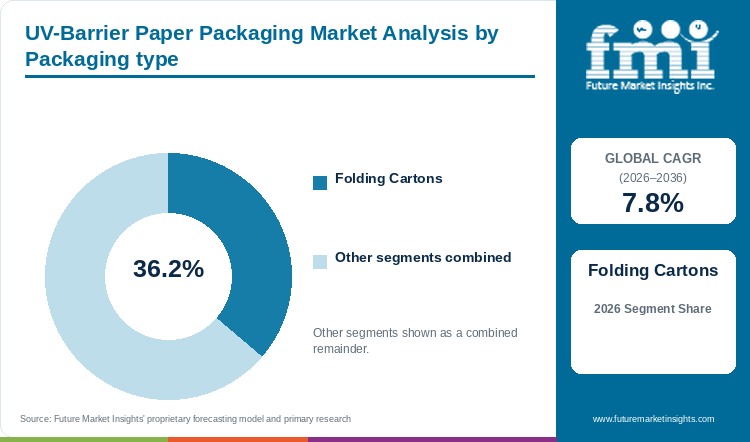
Folding cartons are projected to hold 36.2% of packaging type revenue in 2026, supported by printable, rigid light protection.
Table 3: Packaging Type Share for the UV-Barrier Paper Packaging Market (percentage share), 2026
| Packaging Type | Share (2026) |
|---|---|
| Folding Cartons | 36.2% |
| Other Segments Combined | 63.8%* |
| Total | 100.0% |
*Calculated as the balance remaining after deducting the leading segment's reported share from 100.0%.
Table 4: Packaging Type Leadership and Market Growth for the UV-Barrier Paper Packaging Market (segment and CAGR percentage), 2026 to 2036
| Metric | Value |
|---|---|
| Global CAGR (2026 to 2036) | 7.8% |
| Leading Segment | Folding Cartons |
Folding cartons are paperboard packages which can carry light-control coating on the inner or outer surface. The cartons provides rigid protection and larger printing area when compared with flexible packaging paper formats. Food, cosmetics and health-product manufacturers use coated cartons where the packed product remains under retail light for longer period. In November 2025, Smurfit WestRock opened a dedicated clinical packaging facility supporting printed cartons, traceability and regulated pharmaceutical packaging handling.[4] Presence of controlled carton-converting operations is expected to support the folding cartons segment over the forecast period.
- Folding cartons are projected to hold 36.2% of packaging type revenue in 2026, supported by rigid protection and a wider printable surface.
- Controlled carton converting and creasing performance determine whether food brands expand paperboard use.
What supports metallized coatings in the barrier technology category?
By barrier technology, metallized coatings are estimated to hold 35.7% in 2026, owing to efficient light reflection.
Metallized coatings are thin reflective layers applied on paper in order to reduce passage of UV and visible light. The coating is used in pouches, sachets, wraps and carton liners where high reflection is required with smaller material addition. Metallized paper also provides a compact structure when compared with thicker multilayer laminates. In August 2025, Mondi expanded FunctionalBarrier Paper Ultimate following investment in coating technology at the Solec plant.[5] Expansion of coating capability and demand for light-reflective polycoated paper packaging is expected to drive the metallized coatings segment growth.
- Metallized coatings are estimated to account for 35.7% of barrier technology demand in 2026, as thin reflective layers reduce light transmission.
- Adoption across barrier paper depends on coating adhesion, line speed, and repulpability during recycling.
How does bleached paper meet demanding packaging surface needs?
Bleached packaging paper is projected to hold 31.2% of paper grade demand in 2026, enabled by smooth coating coverage.
Bleached packaging paper is having smooth surface and uniform color, due to which pigments and barrier coatings can be applied at consistent coverage. Clean surface also supports printed graphics required in food, cosmetics and health-product packaging. Coating variation is lower on a uniform paper surface, which in turn reduces visible defects in cartons and wraps. In April 2026, Stora Enso presented development of moisture, grease and oxygen barriers along with thin dispersion coatings.[6] Wider demand for paper combining print quality and barrier performance is anticipated to support specialty paper converting across retail sectors.
- Bleached packaging paper is projected to hold 31.2% of paper grade demand in 2026, enabled by smooth coating coverage and uniform print quality.
- Surface consistency and fiber strength remain necessary to prevent coating pinholes during high-speed converting.
Why is food and beverage central to end-user demand?
Food and beverage is expected to command 42.0% of end-user revenue in 2026, driven by shelf-life and appearance needs.
Food and beverage products can lose color, aroma and vitamin quality when exposed to light during storage and retail display. UV-barrier paper packaging reduces this exposure and provides space for product information, branding and traceability. Coffee, tea, spices, cereal bars and bouillon are some of the products requiring aroma and light protection. In July 2025, the European Food Safety Authority updated safety guidelines on substances used in food-contact paper and board packaging.[7] Availability of coated paper for different food packaging formats is expected to propel the food and beverage segment growth.
- Food and beverage is expected to command 42.0% of end-user revenue in 2026, driven by shelf-life protection and aroma retention in dry products.
- Commercial uptake depends on barrier consistency across variable retail storage conditions and humidity levels.
What are the drivers, restraints, and opportunities in the UV-barrier paper packaging market?
In the UV-barrier paper packaging market, light-sensitive products drive adoption, coating-recycling trade-offs restrain qualification, and thin recyclable barriers create opportunity.
- Driver: Brands need fiber-based packs that reduce light exposure without losing print quality or packing-line speed.
- Restraint: Barrier layers can interfere with repulping, sealing, creasing, or food-contact compliance when structures are poorly matched.
- Opportunity: Ultra-thin, pigmented, mineral, and bio-based coatings can extend paper into applications still served by complex laminates.
Light Exposure Changes Product Quality
Exposure to UV and visible light can result in oxidation, pigment loss and nutrient degradation in sensitive packaged products. This is increasing the requirement for paper structures having measured light, oxygen and moisture protection. The U.S. Department of Agriculture noted in its 2025 food quality guidelines that barrier packaging prevents nutrient degradation in light-sensitive specialty crops.[8] According to FMI, product protection together with seal strength and food-contact performance is expected to increase paper use in longer shelf-life formats. Wider application in cartons, sachets and overwraps is likely to drive UV-barrier paper packaging market growth.
Recyclability Limits Coating Choices
Barrier coating adds material which must separate, disperse or remain within accepted limits during paper recycling. In its 2025 environmental performance review, Cepi highlighted that unrecyclable multi-material coatings increase reject rates at European paper mills.[9] Higher coating load can increase screen rejects and reduce the amount of fiber recovered from certain paper packaging structures. Lack of recognized repulpability and screening evidence can delay acceptance among converters and recyclers. These factors may hamper the growth of UV-barrier paper packaging market during the forecast period.
Thin Barriers Open New Formats
Barrier suppliers are reducing coating thickness while combining light, oxygen, moisture, aroma and grease protection in one paper structure. In March 2026, the Fraunhofer Institute for Process Engineering and Packaging demonstrated ultra-thin, recyclable barrier layers applied on paper without compromising repulpability.[10] As noted by FMI, packaging manufacturers are expected to prefer papers which can run on installed filling equipment without major line modification. Development of thinner and machine-compatible barrier coated paper is expected to create growth opportunities over the assessment period.
Which country CAGRs are profiled in the UV-barrier paper packaging market?
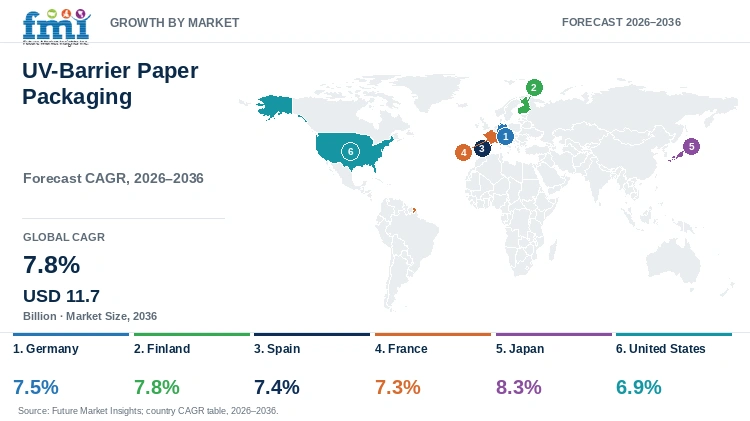
Table 5: Country CAGR Comparison for the UV-Barrier Paper Packaging Market (CAGR percentage), 2026 to 2036
| Country | CAGR |
|---|---|
| Germany | 7.5% |
| Finland | 7.8% |
| Spain | 7.4% |
| France | 7.3% |
| Japan | 8.3% |
| United States | 6.9% |
How do country-level CAGRs compare in the UV-barrier paper packaging market?
Commercial conditions differ across the profiled countries as Japan demand is attributed to compact and highly specified consumer packs, while Finland growth is supported by fiber supply and paper recovery. Germany, Spain and France also have established paper and food-packaging operations.
- Germany combines a large packaging-paper base with EU design-for-recycling requirements.
- Finland links forest-based material supply with established fiber-packaging recovery.
- Spain connects paper packaging demand with food exports and a high packaging-paper production share.
- France has strong food, cosmetics, and pharmaceutical channels that require print and product protection.
- Japan combines high packaging value with compact, carefully specified consumer formats.
- United States demand is supported by large paper capacity and growing specialty packaging shipments.
Full report country CAGRs cover: North America; Latin America; Western Europe; Eastern Europe; East Asia; South Asia and Pacific; Middle East and Africa.
Country-wise Analysis
- Germany's UV-barrier paper packaging outlook is anticipated to advance at 7.5% CAGR over the assessment period. Packaging-paper production increased by 5% in 2024 to 12.3 million tonnes, while total paper output increased by 3%.[11] Availability of packaging paper supports coated cartons, wraps and sleeves used by food and consumer-product companies. Germany also has established printing and converting operations which can apply light-control coatings on different paper grades. Demand for recyclable paper packaging is expected to support Germany market growth through 2036.
- Adoption of UV-barrier paper packaging in Finland is estimated to expand at 7.8% CAGR through 2036. The Finnish Forest Industries Federation reported that paperboard production in Finland increased by 13.3% in early 2025 to 1.0 million tonnes.[12] Finland has availability of kraft and specialty paper along with mills supplying paper grades across European countries. Established fiber-packaging production and recovery are encouraging manufacturers to introduce thinner coatings which can be processed in existing paper streams. Expansion of specialty papers and recyclable barrier coatings is anticipated to support Finland market revenue growth.
- UV-barrier paper packaging demand in Spain is forecast to rise at 7.4% CAGR over the forecast period. Spain produced 6.31 million tonnes of paper and board in 2025, of which packaging grades represented 68.9% of production.[13] Higher share of packaging paper provides material for cartons, sachets and wraps used by food exporters. Oils, confectionery, processed foods and beverages requires protection from prolonged light exposure. Application of coated paper in export food packaging is expected to support Spain market growth through 2036.
- France is estimated to post 7.3% CAGR over the forecast period, owing to demand from food, cosmetics and health-product packaging. Cepi reported that European paper industry supported 176,000 direct jobs in 2025 and represented 90% of regional production through member associations.[14] France has presence of food, fragrance, cosmetic and pharmaceutical manufacturers which require printed packaging and product protection. Growing demand for premium cosmetic packaging with decorative barrier finishes is expected to support France market revenue growth.
- By 2036, Japan is projected to grow at 8.3% CAGR, owing to high-value packaging and smaller consumer pack formats. Japan Packaging Institute estimated packaging-material shipments at 17.60 million tonnes in 2025, while packaging machinery production reached 257,373 units.[15] Sachets, cartons, sleeves and overwraps are used for tea, seasonings, cosmetics and supplements in the country. Availability of packaging machinery and requirement for narrow coating and seal tolerance is expected to create growth opportunities for UV-barrier paper in Japan.
- Sales of UV-barrier paper packaging in the United States are forecast to expand at 6.9% CAGR through 2036. American Forest & Paper Association reported 66.3 million tons of paper and paperboard production in 2025.[16] Packaging-paper production increased by 1.7%, whereas containerboard mills operated at 91.9%. Large paper capacity supports cartons, wraps and coated paper used by food, personal care and health-product brands. Expansion of specialty packaging paper is likely to support United States market growth during the assessment period.
Who are the notable companies in the UV-barrier paper packaging market?
Mondi, Smurfit WestRock, Nippon Paper Industries, International Paper, Stora Enso, UPM Specialty Papers, Ahlstrom, and Sappi are notable companies profiled in this market.
UV-barrier paper packaging market is moderately fragmented with presence of global paper manufacturers, specialty paper suppliers and packaging converters. Mondi and Stora Enso are focusing on paper substrates and functional barrier coatings. Smurfit WestRock and International Paper has wider carton and converting operations, whereas UPM Specialty Papers, Ahlstrom, Sappi and Nippon Paper Industries are supplying specialty grades for food and consumer packaging. Some of the prominent players are expanding coating technology and product portfolio in order to cater the growing demand for recyclable barrier paper.
- Integrated barrier-paper suppliers: Mondi and Stora Enso develop substrates and functional barrier structures.
- Packaging and converting groups: Smurfit WestRock and International Paper connect paper supply with carton and packaging conversion.
- Specialty paper suppliers: UPM Specialty Papers, Ahlstrom, Sappi, and Nippon Paper Industries provide grades, surfaces, or coating platforms for demanding uses.
Competitive Benchmarking: UV-Barrier Paper Packaging Market
Table 6: Competitive Benchmarking for the UV-Barrier Paper Packaging Market (qualitative capability ratings), 2026
| Company | Barrier capability | Converting depth | Current activity | Geographic reach |
|---|---|---|---|---|
| Mondi | High | High | High | High |
| Smurfit WestRock | Medium | High | High | High |
| Nippon Paper Industries | Medium | Medium | Medium | High |
| International Paper | Low | High | Medium | High |
| Stora Enso | High | High | High | High |
| UPM Specialty Papers | High | Medium | High | High |
| Ahlstrom | High | Medium | High | High |
| Sappi | Medium | Medium | Medium | High |
High indicates broad current evidence across the rated aspect. Medium indicates a narrower or regionally focused evidence base. Low indicates limited direct public evidence for UV-barrier paper packaging. Ratings do not indicate product quality, market share, or company rank.
Key Developments in the UV-Barrier Paper Packaging Market
- In September 2026, UPM Specialty Materials extended its barrier paper technology to label applications with the launch of UPM Asendo 80, providing PFAS-free grease resistance.[17]
- In September 2025, Sappi Europe introduced its Guard Pro OMH high-barrier paper, providing oxygen, water vapour, and grease protection for food packaging applications.[18]
- In March 2025, Ahlstrom expanded its LamiBak portfolio with the launch of LamiBak Flex, a base paper designed for barrier coating, metallization, and flexible food packaging.[19]
- In January 2025, Smurfit WestRock introduced a paper pallet wrap intended to replace plastic stretch film in selected transport uses.[20]
Key Players in the UV-Barrier Paper Packaging Market
Integrated Barrier-paper Platforms
- Mondi
- Stora Enso
- UPM Specialty Papers
- Nippon Paper Industries
Packaging and Converting Groups
- Smurfit WestRock
- International Paper
Specialty Functional Papers
- Ahlstrom
- Sappi
UV-Barrier Paper Packaging Market - Report Scope
Table 7: Report Scope for the UV-Barrier Paper Packaging Market (coverage fields and definitions), 2026 to 2036
| Coverage field | Report scope |
|---|---|
| Market breakdown | Packaging type; barrier technology; paper grade; end user; region |
| Quantitative units | USD billion |
| Market definition | First-sale revenue from paper and paperboard packaging designed to reduce ultraviolet or broader light transmission. Standalone inks, coating equipment, plastic-only films, and downstream filling services are excluded. |
| Regions covered | North America; Latin America; Western Europe; Eastern Europe; East Asia; South Asia and Pacific; Middle East and Africa |
| Countries covered | Germany; Finland; Spain; France; Japan; United States |
| Key companies profiled | Mondi, Smurfit WestRock, Nippon Paper Industries, International Paper, Stora Enso, UPM Specialty Papers, Ahlstrom, Sappi |
| Forecast period | 2026 to 2036 |
| Approach | Hybrid bottom-up and top-down sizing that reconciles coated-paper output, format demand, barrier use, company participation, and country adoption conditions. |
UV-Barrier Paper Packaging Market - Research Methodology
Table 8: Research Methodology for the UV-Barrier Paper Packaging Market (research methods and approach), 2026 edition
| Method | Approach |
|---|---|
| Primary Research | FMI analysts gathered input from manufacturers, service providers, technology developers, distributors, end users, procurement teams, and subject-matter experts. Interviews examined purchasing decisions, product or service evaluation, adoption barriers, approval requirements, pricing considerations, and expectations for technical or commercial support. Respondents were also asked what evidence is required before a trial, pilot, or initial order develops into regular purchasing. |
| Desk Research | Desk research covered government statistics, regulatory publications, trade data, industry associations, technical literature, standards, company filings, product information, and official corporate announcements. Sources were reviewed for relevance, publication date, geographic coverage, and consistency with the defined market scope. Claims relating to performance, applications, approvals, capacity, investment, and commercial activity were retained only when supported by credible public evidence. |
| Market Sizing and Forecasting | The market model combined the baseline value with historical performance, segment structure, pricing and volume indicators, adoption levels, company participation, and country-level demand conditions. Forecast assumptions considered economic activity, investment trends, regulatory developments, technology adoption, purchasing cycles, supply availability, and barriers to wider market use. Segment and regional estimates were reconciled before the final market total was calculated. |
| Data Validation | Estimates were checked against multiple independent indicators, including public data, company activity, trade patterns, industry developments, and findings from primary interviews. Validation also tested whether products, services, applications, and company revenues fell within the defined market boundaries. Adjacent categories, unsupported claims, overlapping revenues, and activities without direct market relevance were excluded to reduce double counting and maintain consistency across segments and countries. |
UV-Barrier Paper Packaging Market by Segments
UV-Barrier Paper Packaging Market segmented by Packaging type:
- Pouches
- Sachets
- Wraps and Overwraps
- Folding Cartons
- Labels and Sleeves
- Other Packaging Types
UV-Barrier Paper Packaging Market segmented by Barrier technology:
- Metallized Coatings
- TiO2 and Pigmented Barriers
- AlOx and SiOx
- Bio-based Barriers
- Hybrid and Multilayer Barriers
UV-Barrier Paper Packaging Market segmented by Paper grade:
- Kraft
- Bleached Packaging Paper
- Recycled Paperboard
- Specialty Barrier Paper
UV-Barrier Paper Packaging Market segmented by End user:
- Food and Beverage
- Cosmetics and Personal Care
- Pharma and Nutraceuticals
- Industrial and Chemical
- Other End Users
UV-Barrier Paper Packaging Market by Region
- North America
- United States
- Canada
- Latin America
- Brazil
- Mexico
- Argentina
- Chile
- Western Europe
- Germany
- France
- United Kingdom
- Italy
- Spain
- Benelux
- Nordics
- Eastern Europe
- Poland
- Czech Republic
- Romania
- Hungary
- East Asia
- Japan
- South Korea
- South Asia and Pacific
- ASEAN
- Australia and New Zealand
- Middle East and Africa
- GCC Countries
- South Africa
- Türkiye
- Israel
Research Sources and Bibliography
- [1] Mondi Group. (2025, August). FunctionalBarrier Paper Ultimate: High-barrier functional paper solutions.
- [2] Confederation of European Paper Industries. (2026, July). Key Statistics 2025: European pulp and paper industry.
- [3] Finnish Packaging Recycling RINKI Ltd. (2026). Packaging statistics: Fibre packaging recovery and recycling targets.
- [4] Smurfit WestRock. (2025, November 4). Smurfit WestRock unveils world’s first dedicated clinical packaging facility.
- [5] Mondi Group. (2025, August 14). Mondi ramps up FunctionalBarrier Paper Ultimate to meet growing demand.
- [6] Stora Enso Oyj. (2026, April 14). Advancing barrier performance in paper-based packaging.
- [7] European Food Safety Authority. (2025, July). Safety assessment of substances used in food contact paper and board.
- [8] U.S. Department of Agriculture. (2025, May). Food quality preservation and barrier packaging standards.
- [9] Confederation of European Paper Industries. (2025, November). Mill repulpability and fiber recovery performance report.
- [10] Fraunhofer Institute for Process Engineering and Packaging. (2026, March). Development of thin recyclable barrier coatings for paper packaging.
- [11] DIE PAPIERINDUSTRIE e.V. (2025). PAPIER 2025: Ein Leistungsbericht.
- [12] Finnish Forest Industries Federation (Metsäteollisuus ry). (2025, June). Forest industry production and exports report: Paper and paperboard output.
- [13] ASPAPEL. (2026, July). 2025 Spanish pulp and paper sector results.
- [14] Confederation of European Paper Industries. (2026, May). Employment and social performance in the European pulp and paper industry.
- [15] Japan Packaging Institute. (2026). Statistics on the scale of Japanese packaging industry in 2025.
- [16] American Forest & Paper Association. (2026, May 29). 66th Annual Paper Industry Capacity and Fiber Consumption Survey.
- [17] UPM Specialty Materials. (2026, September 15). UPM extends barrier paper technology to label applications.
- [18] Sappi Europe. (2025, July 14). Sappi celebrates future-proof paper packaging: Guard Pro barrier range launch.
- [19] Ahlstrom. (2025, March 17). Ahlstrom expands LamiBak portfolio with a new base paper for flexible food packaging.
- [20] Smurfit WestRock. (2025, January 9). Paper pallet wrap set to drive down supply chain emissions.
This bibliography is provided for reader reference. The full report contains the complete reference list and detailed citations.
This Report Answers
- How large is the UV-barrier paper packaging market during 2026?
- What market value is projected for the UV-barrier paper packaging market by 2036?
- Which packaging type holds a notable share of UV-barrier paper packaging demand?
- Which barrier technology holds a notable UV-barrier paper packaging share?
- Which countries show notable UV-barrier paper packaging growth through 2036?
- Which companies are notable in the UV-barrier paper packaging market?
Frequently Asked Questions
How large is the UV-barrier paper packaging market expected in 2026?
Future Market Insights estimates that the UV-barrier paper packaging market will be valued at USD 5.5 billion in 2026. The market is projected to reach USD 11.7 billion by 2036 owing to wider use in light-sensitive food and consumer products.
What CAGR is projected for UV-barrier paper packaging through 2036?
As per FMI, the UV-barrier paper packaging market is projected to expand at 7.8% CAGR from 2026 to 2036. Growth is supported by recyclable paper having measured light, oxygen and moisture protection.
Which packaging type holds a notable market share in 2026?
Folding cartons are projected to hold 36.2% of packaging type revenue in 2026. The segment benefits from rigid protection, wider print area and use in food and personal care packaging.
Which barrier technology holds a notable market share in 2026?
Metallized coatings are estimated to account for 35.7% of barrier technology revenue in 2026. Demand is supported by high light reflection at a low coating weight.
Which country has a notable expansion outlook through 2036?
Japan is projected to register 8.3% CAGR from 2026 to 2036. Growth is supported by compact consumer packs and established packaging machinery production.
Who are the notable companies in this market?
Notable companies include Mondi, Smurfit WestRock, Nippon Paper Industries, International Paper, Stora Enso, UPM Specialty Papers, Ahlstrom and Sappi. These companies are expanding barrier papers, coating platforms and packaging conversion capability.
Preview the report firsthand - request a free sample
Get SampleGet the brochure for pricing and purchase details.
Get PDFTable of Content
- Key Takeaways
- Market Size and CAGR
- Top Growth Driver
- Fastest Growing Segment
- Leading Region
- Key Companies
- Emerging Opportunities
- Executive Summary
- Global Market Outlook
- Demand-side Trends
- Supply-side Trends
- Technology Roadmap Analysis
- Analysis and Recommendations
- Analyst Perspective (What is happening? Why now? What should investors know?)
- Key Questions Answered
- How large is the market?
- What is the CAGR?
- What are key trends?
- Which region dominates?
- Who are the leaders?
- Market Overview
- Market Coverage / Taxonomy
- Market Definition / Scope / Limitations
- Research Methodology
- Chapter Orientation
- Analytical Lens and Working Hypotheses
- Market Structure, Signals, and Trend Drivers
- Benchmarking and Cross-market Comparability
- Market Sizing, Forecasting, and Opportunity Mapping
- Research Design and Evidence Framework
- Desk Research Programme (Secondary Evidence)
- Expert Input and Fieldwork (Primary Evidence)
- Tooling, Models, and Reference Databases
- Data Engineering and Model Build
- Quality Assurance and Audit Trail
- Market Background
- Market Dynamics (Drivers, Restraints, Opportunity, Trends)
- Scenario Forecast (Optimistic, Likely, Conservative)
- Impact Analysis
- AI Impact
- Sustainability Impact
- Regulatory Impact
- Technology Impact
- Consumer / Buyer Analysis
- Purchase Drivers
- Adoption Barriers
- Buyer Journey
- Opportunity Map Analysis
- Product Life Cycle Analysis
- Supply Chain Analysis
- Investment Feasibility Matrix
- Value Chain Analysis
- PESTLE and Porter's Analysis
- Regulatory Landscape
- Regional Parent Market Outlook
- Production and Consumption Statistics
- Import and Export Statistics
- Global Market Analysis and Forecast, 2021 to 2036
- Historical Market Size Value (USD Billion) Analysis, 2021 to 2025
- Current and Future Market Size Value (USD Billion) Projections, 2026 to 2036
- Y-o-Y Growth Trend Analysis
- Absolute $ Opportunity Analysis
- Global Market Pricing Analysis, 2021 to 2036
- Global Market Analysis and Forecast, By Packaging type, 2021 to 2036
- Introduction / Key Findings
- Historical Market Size Value (USD Billion) Analysis By Packaging type, 2021 to 2025
- Current and Future Market Size Value (USD Billion) Analysis and Forecast By Packaging type, 2026 to 2036
- Pouches
- Sachets
- Wraps and Overwraps
- Folding Cartons
- Labels and Sleeves
- Other Packaging Types
- Y-o-Y Growth Trend Analysis By Packaging type, 2021 to 2025
- Absolute $ Opportunity Analysis By Packaging type, 2026 to 2036
- Global Market Analysis and Forecast, By Barrier technology, 2021 to 2036
- Introduction / Key Findings
- Historical Market Size Value (USD Billion) Analysis By Barrier technology, 2021 to 2025
- Current and Future Market Size Value (USD Billion) Analysis and Forecast By Barrier technology, 2026 to 2036
- Metallized Coatings
- TiO2 and Pigmented Barriers
- AlOx and SiOx
- Bio-based Barriers
- Hybrid and Multilayer Barriers
- Y-o-Y Growth Trend Analysis By Barrier technology, 2021 to 2025
- Absolute $ Opportunity Analysis By Barrier technology, 2026 to 2036
- Global Market Analysis and Forecast, By Paper grade, 2021 to 2036
- Introduction / Key Findings
- Historical Market Size Value (USD Billion) Analysis By Paper grade, 2021 to 2025
- Current and Future Market Size Value (USD Billion) Analysis and Forecast By Paper grade, 2026 to 2036
- Kraft
- Bleached Packaging Paper
- Recycled Paperboard
- Specialty Barrier Paper
- Y-o-Y Growth Trend Analysis By Paper grade, 2021 to 2025
- Absolute $ Opportunity Analysis By Paper grade, 2026 to 2036
- Global Market Analysis and Forecast, By End user, 2021 to 2036
- Introduction / Key Findings
- Historical Market Size Value (USD Billion) Analysis By End user, 2021 to 2025
- Current and Future Market Size Value (USD Billion) Analysis and Forecast By End user, 2026 to 2036
- Food and Beverage
- Cosmetics and Personal Care
- Pharma and Nutraceuticals
- Industrial and Chemical
- Other End Users
- Y-o-Y Growth Trend Analysis By End user, 2021 to 2025
- Absolute $ Opportunity Analysis By End user, 2026 to 2036
- Global Market Analysis and Forecast, By Region, 2021 to 2036
- Introduction
- Historical Market Size Value (USD Billion) Analysis By Region, 2021 to 2025
- Current Market Size Value (USD Billion) Analysis and Forecast By Region, 2026 to 2036
- North America
- Latin America
- Western Europe
- Eastern Europe
- East Asia
- South Asia and Pacific
- Middle East and Africa
- Market Attractiveness Analysis By Region
- North America Market Analysis and Forecast, By Country, 2021 to 2036
- Historical Market Size Value (USD Billion) Trend Analysis By Market Taxonomy, 2021 to 2025
- Market Size Value (USD Billion) Forecast By Market Taxonomy, 2026 to 2036
- By Country
- United States
- Canada
- By Packaging type
- By Barrier technology
- By Paper grade
- By End user
- By Country
- Market Attractiveness Analysis
- By Country
- By Packaging type
- By Barrier technology
- By Paper grade
- By End user
- Key Takeaways
- Latin America Market Analysis and Forecast, By Country
- Historical Market Size Value (USD Billion) Trend Analysis By Market Taxonomy, 2021 to 2025
- Market Size Value (USD Billion) Forecast By Market Taxonomy, 2026 to 2036
- By Country
- Brazil
- Mexico
- Argentina
- Chile
- By Packaging type
- By Barrier technology
- By Paper grade
- By End user
- By Country
- Market Attractiveness Analysis
- By Country
- By Packaging type
- By Barrier technology
- By Paper grade
- By End user
- Key Takeaways
- Western Europe Market Analysis and Forecast, By Country
- Historical Market Size Value (USD Billion) Trend Analysis By Market Taxonomy, 2021 to 2025
- Market Size Value (USD Billion) Forecast By Market Taxonomy, 2026 to 2036
- By Country
- Germany
- France
- United Kingdom
- Italy
- Spain
- Benelux
- Nordics
- By Packaging type
- By Barrier technology
- By Paper grade
- By End user
- By Country
- Market Attractiveness Analysis
- By Country
- By Packaging type
- By Barrier technology
- By Paper grade
- By End user
- Key Takeaways
- Eastern Europe Market Analysis and Forecast, By Country
- Historical Market Size Value (USD Billion) Trend Analysis By Market Taxonomy, 2021 to 2025
- Market Size Value (USD Billion) Forecast By Market Taxonomy, 2026 to 2036
- By Country
- Poland
- Czech Republic
- Romania
- Hungary
- By Packaging type
- By Barrier technology
- By Paper grade
- By End user
- By Country
- Market Attractiveness Analysis
- By Country
- By Packaging type
- By Barrier technology
- By Paper grade
- By End user
- Key Takeaways
- East Asia Market Analysis and Forecast, By Country
- Historical Market Size Value (USD Billion) Trend Analysis By Market Taxonomy, 2021 to 2025
- Market Size Value (USD Billion) Forecast By Market Taxonomy, 2026 to 2036
- By Country
- Japan
- South Korea
- By Packaging type
- By Barrier technology
- By Paper grade
- By End user
- By Country
- Market Attractiveness Analysis
- By Country
- By Packaging type
- By Barrier technology
- By Paper grade
- By End user
- Key Takeaways
- South Asia and Pacific Market Analysis and Forecast, By Country
- Historical Market Size Value (USD Billion) Trend Analysis By Market Taxonomy, 2021 to 2025
- Market Size Value (USD Billion) Forecast By Market Taxonomy, 2026 to 2036
- By Country
- ASEAN
- Australia and New Zealand
- By Packaging type
- By Barrier technology
- By Paper grade
- By End user
- By Country
- Market Attractiveness Analysis
- By Country
- By Packaging type
- By Barrier technology
- By Paper grade
- By End user
- Key Takeaways
- Middle East and Africa Market Analysis and Forecast, By Country
- Historical Market Size Value (USD Billion) Trend Analysis By Market Taxonomy, 2021 to 2025
- Market Size Value (USD Billion) Forecast By Market Taxonomy, 2026 to 2036
- By Country
- GCC Countries
- South Africa
- Türkiye
- Israel
- By Packaging type
- By Barrier technology
- By Paper grade
- By End user
- By Country
- Market Attractiveness Analysis
- By Country
- By Packaging type
- By Barrier technology
- By Paper grade
- By End user
- Key Takeaways
- Key Countries Market Analysis
- United States
- Pricing Analysis
- Market Share Analysis, 2025
- By Packaging type
- By Barrier technology
- By Paper grade
- By End user
- Canada
- Pricing Analysis
- Market Share Analysis, 2025
- By Packaging type
- By Barrier technology
- By Paper grade
- By End user
- Mexico
- Pricing Analysis
- Market Share Analysis, 2025
- By Packaging type
- By Barrier technology
- By Paper grade
- By End user
- Brazil
- Pricing Analysis
- Market Share Analysis, 2025
- By Packaging type
- By Barrier technology
- By Paper grade
- By End user
- Chile
- Pricing Analysis
- Market Share Analysis, 2025
- By Packaging type
- By Barrier technology
- By Paper grade
- By End user
- Germany
- Pricing Analysis
- Market Share Analysis, 2025
- By Packaging type
- By Barrier technology
- By Paper grade
- By End user
- United Kingdom
- Pricing Analysis
- Market Share Analysis, 2025
- By Packaging type
- By Barrier technology
- By Paper grade
- By End user
- Italy
- Pricing Analysis
- Market Share Analysis, 2025
- By Packaging type
- By Barrier technology
- By Paper grade
- By End user
- Spain
- Pricing Analysis
- Market Share Analysis, 2025
- By Packaging type
- By Barrier technology
- By Paper grade
- By End user
- France
- Pricing Analysis
- Market Share Analysis, 2025
- By Packaging type
- By Barrier technology
- By Paper grade
- By End user
- ASEAN
- Pricing Analysis
- Market Share Analysis, 2025
- By Packaging type
- By Barrier technology
- By Paper grade
- By End user
- Australia and New Zealand
- Pricing Analysis
- Market Share Analysis, 2025
- By Packaging type
- By Barrier technology
- By Paper grade
- By End user
- Japan
- Pricing Analysis
- Market Share Analysis, 2025
- By Packaging type
- By Barrier technology
- By Paper grade
- By End user
- South Korea
- Pricing Analysis
- Market Share Analysis, 2025
- By Packaging type
- By Barrier technology
- By Paper grade
- By End user
- Poland
- Pricing Analysis
- Market Share Analysis, 2025
- By Packaging type
- By Barrier technology
- By Paper grade
- By End user
- Hungary
- Pricing Analysis
- Market Share Analysis, 2025
- By Packaging type
- By Barrier technology
- By Paper grade
- By End user
- Türkiye
- Pricing Analysis
- Market Share Analysis, 2025
- By Packaging type
- By Barrier technology
- By Paper grade
- By End user
- South Africa
- Pricing Analysis
- Market Share Analysis, 2025
- By Packaging type
- By Barrier technology
- By Paper grade
- By End user
- Finland
- Pricing Analysis
- Market Share Analysis, 2025
- By Packaging type
- By Barrier technology
- By Paper grade
- By End user
- United States
- Market Structure Analysis
- Competition Dashboard
- Competition Benchmarking
- Market Share Analysis of Top Players
- By Regional
- By Packaging type
- By Barrier technology
- By Paper grade
- By End user
- Emerging Startups
- Innovation Benchmarking
- Competition Analysis
- Competition Deep Dive
- Mondi
- Overview
- Product Portfolio
- Profitability by Market Segments
- Sales Footprint
- Strategy Overview
- Marketing Strategy
- Product Strategy
- Channel Strategy
- Smurfit WestRock
- Nippon Paper Industries
- International Paper
- Stora Enso
- UPM Specialty Papers
- Ahlstrom
- Sappi
- Mondi
- Case Studies
- Success Stories
- Recent Developments
- Competition Deep Dive
- Assumptions & Acronyms Used


