

- Market Size (2026)
- USD 0.8 Bn
- Forecast (2036)
- USD 2.1 Bn
- CAGR (2026 to 2036)
- 10.0%
How big is Vascular Disrupting Agents Market in 2026?
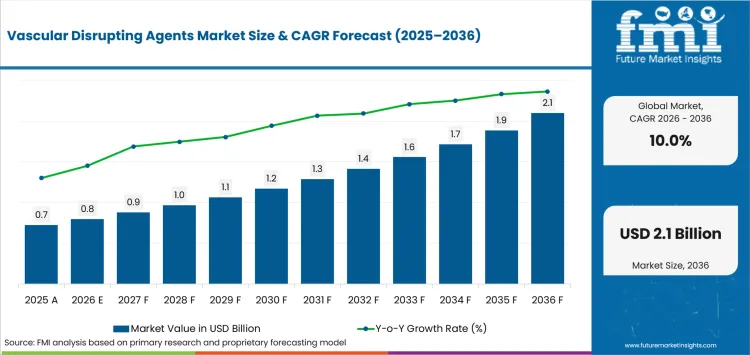
USD 0.8 billion in 2026 and USD 2.1 billion by 2036 at a 10.0% CAGR.
Demand for vascular disrupting agents is projected to expand at 10.0% CAGR between 2026 and 2036, increasing valuation from USD 0.8 billion in 2026 to USD 2.1 billion by 2036. The expansion Is supported by oncology drug development that links vascular shutdown with durable tumor control and repeat-dose safety.
Vascular-disruption programs rely on oncology trial infrastructure that can repeat imaging and safety assessments across dose cohorts. ClinicalTrials.gov reported in July 2026 that it listed 595,630 registered studies worldwide, including 454,529 interventional studies and 219,775 drug or biologic studies. The scale of registered interventional research supports recurring demand for monitored infusion, perfusion imaging and sequence-controlled combination protocols.
Key Takeaways of Vascular Disrupting Agents Market
- Solid-tumor programs sustain demand for agents that damage established vessels and support sequence-specific combination treatment across difficult lesions.
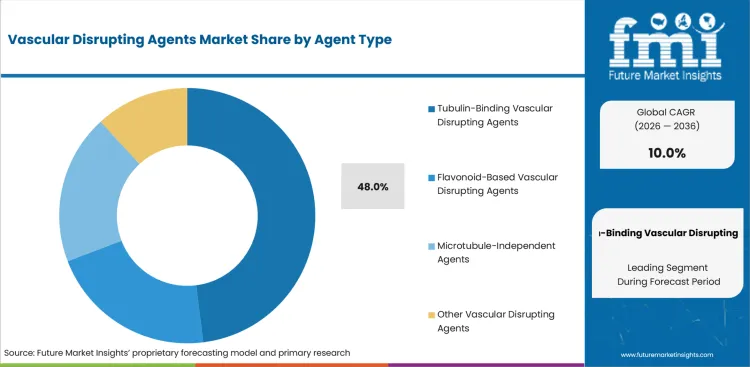
- Tubulin-binding agents are projected at 48.0% share in 2026, driven by direct vascular effects and established clinical development history.
- Microtubule disruption is estimated at 52.0% of mechanism demand owing to rapid endothelial structural failure across abnormal tumor vessels.
- Oncology applications are forecast at 78.0% share in 2026, attributable to direct evaluation across solid tumors and metastatic cancer programs.
- Viable peripheral tumor cells and systemic vascular effects can limit durable response despite an immediate reduction in tumor perfusion.
- Oncotelic Therapeutics, Inc., BeyondSpring Inc., Neuphoria Therapeutics Inc., Bristol Myers Squibb Company, AstraZeneca PLC, Novartis AG, Sanofi and Abbott Laboratories.
Analyst Perspective
“A vascular-disrupting agent earns a larger trial through durable rim control alongside an acceptable repeat-dose cardiovascular profile. Sponsors should set perfusion thresholds and partner-therapy timing before dose expansion, so weak biological effects stop without consuming late-stage capital.”
- Anurag Sharma, Principal Consultant for Healthcare, Future Market Insights
How is the Vascular Disrupting Agents Market segmented?
The vascular disrupting agents industry is segmented by agent type, mechanism of action, application, route of administration, end user and region.
Agent type covers tubulin-binding, flavonoid-based, microtubule-independent, and other investigational agents across distinct chemical or platform families. Mechanism of action includes microtubule disruption, endothelial damage, blood-flow interruption, and other mechanisms used to damage established tumor vessels. Applications cover oncology, clinical research, and drug discovery while routes include intravenous, oral, and other administration across hospitals, drug developers, research institutes, contract research organizations, and seven geographic groups.
What supports demand for tubulin-binding vascular disrupting agents within the agent type category?
Abnormal tumor endothelial cells depend on an intact cytoskeleton to preserve vessel shape and blood flow during rapid tumor expansion. A current corporate filing provides direct market continuity: Oncotelic identified CA4P and OXi4503 as vascular disrupting agents under evaluation for further clinical development in April 2026.
- In 2026, tubulin-binding vascular disrupting agents are expected to lead agent type with 48.0% share because combretastatin derivatives provide the deepest direct clinical history.
- Research teams can track perfusion loss and central necrosis through established pharmacodynamic endpoints during early studies. Drug discovery services then compare those effects with viable-rim survival and dose tolerance across sequence-controlled combination programs.
How does microtubule disruption influence selection within the mechanism of action category?
Microtubule disruption links compound exposure directly with endothelial structural failure across abnormal tumor vessels during controlled oncology dosing. Unlike VEGF inhibitors that restrict new-vessel signaling, this mechanism attacks the established vascular architecture supporting an active lesion.
- The mechanism of action category is forecast to be led by microtubule disruption at 52.0% share in 2026 due to its rapid vascular shutdown mechanism.
- Trial teams need repeat-dose evidence that separates vascular effect from systemic toxicity across combination regimens. Oncotelic reported in April 2026 that transient hypertension associated with CA4P and OXi4503 had been managed through antihypertensive pretreatment during clinical evaluation.
What makes oncology central to the application category?
Oncology provides the direct setting for testing whether vascular shutdown improves tumor control beyond an early imaging response. Late-stage programs require multicenter networks that compare survival against a standard regimen across consistent imaging schedules. BeyondSpring reported in March 2026 that DUBLIN-3 enrolled 559 patients across 58 participating clinical sites.
- The oncology segment is likely to capture 78.0% share in 2026 attributable to combination needs across solid tumors and metastatic cancer.
- Imaging-equipped cancer centers compare vascular disruption with next-generation immunotherapies or cytotoxic regimens targeting surviving tumor cells. The comparison determines whether a temporary perfusion change contributes to durable lesion control across repeated treatment cycles.
What role does intravenous administration play within the route of administration category?
Intravenous dosing gives oncology teams direct control over infusion rate and systemic exposure during imaging-led protocols. The DUBLIN-4 registry posted in January 2026 specifies intravenous plinabulin on days one and eight, illustrating how route choice fixes observation and sequencing requirements.
- Intravenous administration is projected to hold 74.0% share in 2026 owing to controlled exposure and immediate safety support within specialist cancer centers.
- Research pharmacies coordinate dose escalation with imaging schedules and predefined observation periods across major specialist oncology centers. Their handling of injectable drugs supports repeatable preparation and rapid intervention during multicenter combination protocols.
What are the drivers, restraints and opportunities in the Vascular Disrupting Agents Market?
Solid-tumor programs need vascular shutdown that complements treatment of surviving cells despite repeat-dose limits from viable-rim recovery and systemic toxicity.
- Driver: Established tumor vessels provide a direct treatment target across solid cancers with uneven cellular sensitivity and prior treatment exposure.
- Restraint: Peripheral tumor cells can remain perfused, while cardiovascular and neurologic effects can restrict repeat-dose exposure across planned cycles.
- Opportunity: Perfusion thresholds and timed partner therapy can connect vascular response with durable lesion control during sequence-specific trials.
Vascular disruption targets established tumor blood flow and does not depend on uniform tumor-cell sensitivity. Global cancer statistics published by the American Cancer Society in July 2026 estimated nearly 21 million new cancer diagnoses and 9.8 million cancer deaths worldwide in 2024, with cases projected to reach 34 million by 2050. Clinical supply services preserve partner-drug timing and monitored dosing so cytotoxic or immune therapy reaches the surviving tumor compartment during the planned sequence.
Central vessel collapse can leave a viable peripheral rim that continues receiving blood from surrounding normal tissue. Repeat dosing can also expose cardiovascular and neurologic risks that narrow the usable treatment window. Oncology research organizations therefore need serial perfusion imaging, cardiac monitoring and predefined stopping rules for every expansion cohort.
Dynamic perfusion imaging can identify the exposure that crosses the intended biological threshold during early evaluation. BeyondSpring described DUBLIN-4 in June 2026 as a 442-patient confirmatory trial following prior PD-1 inhibitors. Similar sequence logic can guide targeted oncology biologics that retain activity near surviving tumor margins.
Which country CAGRs are profiled in the Vascular Disrupting Agents Market?
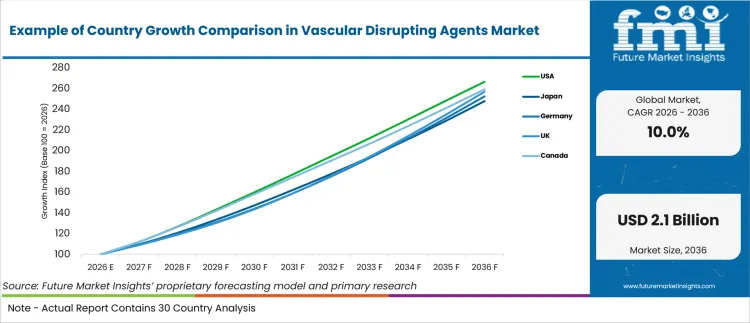
| Country | CAGR |
|---|---|
| South Korea | 11.2% |
| USA | 10.3% |
| Canada | 10.0% |
| UK | 9.9% |
| Australia | 9.8% |
How do country-level CAGRs compare in the Vascular Disrupting Agents Market?
The five profiled CAGRs span 1.4 percentage points and describe forecast pace without measuring current revenue or installed clinical volume.
- South Korea combines concentrated oncology infrastructure with strong competition for biomarker-ready patients and experienced investigators.
- The United States supports dose-ranging work through specialist networks although center activation remains costly and operationally demanding.
- Canada provides established clinical research capacity but provincial contracting and travel distances restrict access to repeated imaging.
- The United Kingdom combines regulatory reform with specialist centers although pharmacy coordination and imaging availability can delay activation.
- Australia supports early-phase oncology work through established governance routes while geographic distance complicates synchronized multicenter assessments.
Comparable CAGRs can produce different market entry conditions through differences in trial access and regulatory timing.
The full report covers country analysis across North America, Latin America, Europe, East Asia, South Asia and Pacific, and the Middle East and Africa.
Country-wise Analysis
- South Korean metropolitan cancer networks offer dense specialist coverage and rapid coordination across designated research institutions within major urban research corridors and referral systems. MFDS announced in May 2026 that an expedited process targeting 240-day approval and review timelines would take effect on June 1 for selected new drugs and biosimilars. Adoption of vascular disrupting agents in South Korea is estimated to expand at 11.2% CAGR through 2036, attributable to concentrated infrastructure and faster review targets. Intense competition for biomarker-ready patients and experienced oncology teams can constrain enrollment across imaging-intensive trials running at competing metropolitan centers with similar enrollment criteria.
- United States early-phase oncology centers combine perfusion imaging with research pharmacies and cardiac support across national referral networks and large specialist cancer hospitals. FDA began a combination-dose methods project in September 2025 to improve oncology dosage selection through tolerability, exposure and the contribution of each partner drug. In the United States, vascular disrupting agent demand is predicted to advance at 10.3% CAGR through 2036, supported by dose-ranging expertise despite costly center activation. Sponsors also face uneven imaging access and uncertainty about whether early vascular shutdown produces durable survival benefit across repeated combination cycles and geographically dispersed trial sites nationwide.
- Canadian academic oncology networks support monitored infusion studies and advanced tumor imaging through metropolitan centers with specialist safety services and cross-province referral pathways. Health Canada reported in May 2026 that Canada ranked third worldwide and represented four percent of global clinical trial activity, supported by USD 1.1 billion in research investment since 2020. Canada is estimated to post 10.0% CAGR over the forecast period, influenced by established trial capacity and specialist investigators. Provincial contracting delays and long travel distances can restrict patient access to repeated imaging during combination treatment cycles at qualified metropolitan centers during fixed protocol windows.
- United Kingdom early-phase oncology units combine radiology access with research pharmacies and national referral routes for complex pharmacodynamic protocols across commercial and academic centers. MHRA reforms took effect on 28 April 2026 and introduced faster pathways for lower-risk trials plus selected protocol modifications within the revised national framework. The United Kingdom vascular disrupting agents sector is projected to record 9.9% CAGR during the assessment period, aided by specialist capacity and current national regulatory reform. Hospital contracting and limited imaging slots can delay synchronized activation as pharmacy teams coordinate infusion timing with repeated perfusion assessments across participating specialist oncology hospitals.
- Australian oncology programs use established ethics and governance routes for unapproved therapeutic goods across specialist centers coordinating radiology and time-sensitive sample handling. TGA guidance updated in April 2025 confirms that sponsors submit Clinical Trial Notifications alongside ethics and institutional approvals before patient dosing begins. By 2036, Australia is projected to grow at 9.8% CAGR, driven by early-phase capability and established clinical governance. Geographic separation between major centers can disrupt imaging consistency and biospecimen transport across multicenter vascular-disruption protocols requiring synchronized perfusion imaging. National enrollment schedules must also accommodate distant hospitals and limited domestic referral pools during local specialist assessments.
Who are the notable companies in the Vascular Disrupting Agents Market?
Oncotelic Therapeutics, Inc., BeyondSpring Inc., Neuphoria Therapeutics Inc., Bristol Myers Squibb Company, AstraZeneca PLC, Novartis AG, Sanofi and Abbott Laboratories are the notable companies serving the vascular disrupting agents market.
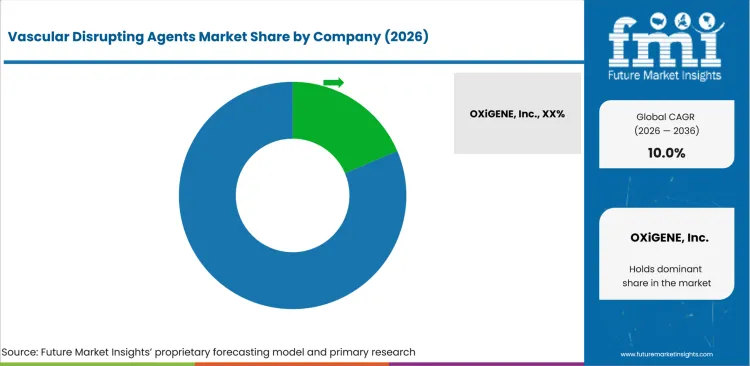
The vascular disrupting agent (VDA) landscape remains highly concentrated, as no direct VDA has achieved commercial approval to date. Consequently, competitive activity is largely defined by clinical-stage development programs and legacy assets with established clinical evidence. Oncotelic maintains the most prominent direct VDA portfolio, while BeyondSpring's late-stage vasculature-modulating candidate serves as a key clinical benchmark. Neuphoria retains a partnership-driven VDA asset, and several historical programs continue to provide important comparative reference points for efficacy and development strategies.
- Oncotelic holds the notable direct VDA positioning through CA4P (fosbretabulin) and OXi4503, although advancement of both programs remains dependent on funding availability and strategic development partnerships.
- BeyondSpring offers advanced vasculature-modulating comparator with plinabulin, a late-stage microtubule-targeting candidate, while Neuphoria's BNC105 remains available for potential partner-led oncology development.
Competitive Benchmarking: Vascular Disrupting Agents Market
| Company | Exact-market asset evidence | Clinical-stage depth | Development continuity | Geographic Reach |
|---|---|---|---|---|
| Oncotelic Therapeutics, Inc. | High | Medium | Medium | United States; licensed global rights |
| BeyondSpring Inc. | Medium | High | High | United States, China and global trial sites |
| Neuphoria Therapeutics Inc. | High | Medium | Medium | United States; legacy Australian development |
| Bristol Myers Squibb Company | Medium | Low | Low | Global intellectual-property reach |
| AstraZeneca PLC | High | Medium | Low | Global legacy trial reach |
| Novartis AG | High | High | Low | Global legacy trial reach |
| Sanofi | High | Medium | Low | Global legacy trial reach |
| Abbott Laboratories | Low | Medium | Low | Global legacy trial reach |
Key Developments in the Vascular Disrupting Agents Market
- In March 2026, BeyondSpring reported that it was advancing DUBLIN-4 as a global confirmatory Phase III study of plinabulin plus docetaxel following DUBLIN-3 results and discussions with FDA.
- In January 2026, Oncotelic entered a secured convertible-note agreement with Mast Hill Fund for about USD 0.4 million. The agreement included CA4P and OXi4503 among the secured company assets supporting the oncology financing arrangement.
- In September 2025, Neuphoria reported that BNC105 had been evaluated in six clinical trials and would advance through existing or new development partnerships.
Key Players in the Vascular Disrupting Agents Market
Direct and adjacent clinical developers
- Oncotelic Therapeutics, Inc.
- BeyondSpring Inc.
Partnership and licensing participants
- Neuphoria Therapeutics Inc.
- Bristol Myers Squibb Company
Legacy clinical developers
- AstraZeneca PLC
- Novartis AG
- Sanofi
- Abbott Laboratories
Vascular Disrupting Agents Market - Report Scope
| Coverage field | Report scope |
|---|---|
| Market breakdown | By agent type, mechanism of action, application, route of administration, end user and region. |
| Quantitative Units | Revenue in USD billion and CAGR in %. |
| Market Definition | Investigational agents designed to damage established tumor vasculature through vascular or endothelial disruption. |
| Regions Covered | North America, Latin America, Europe, East Asia, South Asia and Pacific, and Middle East and Africa. |
| Countries Covered | South Korea, USA, Canada, UK, Australia, and 20+ countries included in the full report. |
| Key Companies Profiled | Oncotelic Therapeutics, Inc., BeyondSpring Inc., Neuphoria Therapeutics Inc., Bristol Myers Squibb Company, AstraZeneca PLC, Novartis AG, Sanofi and Abbott Laboratories |
| Forecast Period | 2026 to 2036. |
| Approach | Primary and secondary research with market triangulation. |
Vascular Disrupting Agents Market - Research Methodology
| Method | Approach |
|---|---|
| Primary Research | FMI analysts gathered input from manufacturers, service providers, technology developers, distributors, end users, procurement teams, and subject-matter experts. Interviews examined purchasing decisions, product or service evaluation, adoption barriers, approval requirements, pricing considerations, and expectations for technical or commercial support. Respondents were also asked what evidence is required before a trial, pilot, or initial order develops into regular purchasing. |
| Desk Research | Desk research covered government statistics, regulatory publications, trade data, industry associations, technical literature, standards, company filings, product information, and official corporate announcements. Sources were reviewed for relevance, publication date, geographic coverage, and consistency with the defined market scope. Claims relating to performance, applications, approvals, capacity, investment, and commercial activity were retained only when supported by credible public evidence. |
| Market Sizing and Forecasting | The market model combined the baseline value with historical performance, segment structure, pricing and volume indicators, adoption levels, company participation, and country-level demand conditions. Forecast assumptions considered economic activity, investment trends, regulatory developments, technology adoption, purchasing cycles, supply availability, and barriers to wider market use. Segment and regional estimates were reconciled before the final market total was calculated. |
| Data Validation | Estimates were checked against multiple independent indicators, including public data, company activity, trade patterns, industry developments, and findings from primary interviews. Validation also tested whether products, services, applications, and company revenues fell within the defined market boundaries. Adjacent categories, unsupported claims, overlapping revenues, and activities without direct market relevance were excluded to reduce double counting and maintain consistency across segments and countries. |
Vascular Disrupting Agents Market by Segments
Vascular Disrupting Agents Market segmented by agent type:
- Tubulin-binding vascular disrupting agents
- Combretastatin derivatives
- Colchicine-site binding agents
- Flavonoid-based vascular disrupting agents
- Combretastatin A-4 phosphate
- Flavonoid analogues
- Microtubule-independent agents
- Vascular-targeting small molecules
- Endothelial cytoskeleton disruptors
- Other vascular disrupting agents
- Novel small-molecule agents
- Investigational vascular disruptors
Vascular Disrupting Agents Market segmented by mechanism of action:
- Microtubule disruption
- Tubulin polymerization inhibition
- Cytoskeletal destabilization
- Endothelial cell damage
- Endothelial cell apoptosis
- Vascular permeability disruption
- Blood-flow interruption
- Tumor blood vessel collapse
- Tumor ischemia induction
- Other mechanisms
- Vascular occlusion
- Multi-mechanism agents
Vascular Disrupting Agents Market segmented by application:
- Oncology
- Solid tumors
- Metastatic cancer
- Clinical research
- Clinical trials
- Combination therapy studies
- Drug discovery and development
- Preclinical research
- Novel vascular targeting
Vascular Disrupting Agents Market segmented by route of administration:
- Intravenous
- Infusion
- Intravenous bolus
- Oral
- Oral small-molecule agents
- Oral capsule formulations
- Other routes
- Intra-arterial administration
- Local administration
Vascular Disrupting Agents Market segmented by end user:
- Hospitals and cancer centers
- Oncology hospitals
- Comprehensive cancer centers
- Pharmaceutical and biotechnology companies
- Large pharmaceutical companies
- Biotechnology companies
- Academic and research institutes
- University research centers
- Cancer research institutes
- Contract research organizations
- Preclinical CROs
- Clinical CROs
Vascular Disrupting Agents Market by Region:
- North America
- United States
- Canada
- Mexico
- Latin America
- Brazil
- Chile
- Rest of Latin America
- Western Europe
- Germany
- United Kingdom
- Italy
- Spain
- France
- Nordics
- Benelux
- Rest of Western Europe
- Eastern Europe
- Russia
- Poland
- Hungary
- Balkan and Baltic States
- Rest of Eastern Europe
- East Asia
- China
- Japan
- South Korea
- South Asia and Pacific
- India
- ASEAN
- Australia and New Zealand
- Rest of South Asia and Pacific
- Middle East and Africa
- Kingdom of Saudi Arabia
- Other GCC Countries
- Türkiye
- South Africa
- Other African Union Countries
- Rest of Middle East and Africa
Research Sources and Bibliography
- ClinicalTrials.gov. (2026, July 24). Trends and Charts on Registered Studies.
- American Cancer Society. (2026, July 8). American Cancer Society reports latest global cancer statistics; cancer cases approach 21 million worldwide, with burden projected to surge 67% by 2050.
- Oncotelic Therapeutics, Inc. (2026, April 15). Form 10-K.
- BeyondSpring Inc. (2026, March 25). Form 10-K.
- ClinicalTrials.gov. (2026, January 23). Docetaxel Plus Plinabulin vs Docetaxel Plus Placebo in Advanced/Metastatic Non-Squamous NSCLC After PD-1/PD-L1 Therapy and Platinum Chemotherapy (DUBLIN-4).
- BeyondSpring Inc. (2026, June 4). BeyondSpring Announces Leadership Transition to Deliver Focused Execution on Its Confirmatory DUBLIN-4 Program and Long-Term Value.
- Ministry of Food and Drug Safety. (2026, May 28). MFDS Opens a New Era of Innovation in Medical Product Approval and Review (Target: 240-Day Approval).
- USAFood and Drug Administration. (2025, September 30). Statistical Designs and Considerations for Dose Optimization with Drug Combination and Multiple Indication.
- Health Canada. (2026, May 20). Message from the Minister of Health - International Clinical Trials Day.
- Medicines and Healthcare products Regulatory Agency. (2026, April 27). Launch of clinical trial reforms.
- Therapeutic Goods Administration. (2025, April 9). Clinical Trial Notification (CTN) scheme.
- Neuphoria Therapeutics Inc. (2025, September 29). Form 10-K.
- ClinicalTrials.gov. (Legacy record; last registry update posted 2011, record accessed 2026). Exploratory Study to Assess the Biological Activity of ZD6126 in Subjects With Newly Diagnosed Metastatic Renal Cell Carcinoma (Stage IV).
- ClinicalTrials.gov. (Legacy Phase III record; last registry update posted 2020, record accessed 2026). ASA404 or Placebo in Combination With Paclitaxel and Carboplatin as First-Line Treatment for Stage IIIb/IV Non-Small Cell Lung Cancer (ATRACT-1).
- ClinicalTrials.gov. (Legacy Phase I record; last registry update posted 2013, record accessed 2026). Dose Escalation, Safety and Pharmacokinetic Study of AVE8062 Combined With Docetaxel in Patients With Advanced Solid Tumors.
- ClinicalTrials.gov. (Legacy Phase II comparator record; last registry update posted 2007, record accessed 2026). A Study of ABT-751 in Patients With Colorectal Cancer.
- BeyondSpring Inc. (2026, March 25). BeyondSpring Reports 2025 Year-End Financial Results.
- Oncotelic Therapeutics, Inc. (2026, January 29). Form 8-K.
This bibliography is provided for reader reference and is not exhaustive. The full report contains the complete reference list and detailed citations.
This Report Answers
- How large is the vascular disrupting agents market through the 2036 forecast period?
- What clinical condition supports recurring vascular disrupting agent development across oncology programs?
- Which agent type accounts for the largest approved 2026 market share?
- How does mechanism choice influence dosing and repeat-treatment safety decisions?
- Which administration route supports monitored dosing across imaging-led oncology trials?
- How do country conditions change trial activation and commercial entry requirements?
- Which companies retain direct assets or verified legacy development evidence?
- What biological and safety constraints limit wider clinical adoption today?
Frequently Asked Questions
How big is the vascular disrupting agents market in 2026?
USD 0.8 billion is the value of the vascular disrupting agents market in 2026. The vascular disrupting agents market is forecast to reach USD 2.2 billion by 2036 as sponsors test whether vascular shutdown produces durable tumor control across monitored combination protocols.
What is the CAGR of the vascular disrupting agents market from 2026 to 2036?
A 10.0% CAGR is projected for the vascular disrupting agents market between 2026 and 2036. Expansion depends on dose selection with perfusion imaging plus treatment schedules that control surviving tumor cells around lesions during structured oncology development across monitored combination programs.
Which agent type leads the vascular disrupting agents market in 2026?
A 48.0% share is projected for tubulin-binding agents within the vascular disrupting agents market in 2026. Their position reflects the clinical history of combretastatin derivatives and related compounds that destabilize endothelial microtubules inside abnormal tumor vessels during clinical evaluation.
How much will the vascular disrupting agents market add between 2026 and 2036?
USD 1.4 billion is expected to be added by the vascular disrupting agents market between 2026 and 2036. Incremental value depends on programs demonstrating durable clinical benefit instead of relying on temporary perfusion changes alone during early oncology studies.
Which companies are active in the vascular disrupting agents market?
Companies in the vascular disrupting agents market are defined by current and legacy roles. Oncotelic and BeyondSpring provide direct or adjacent development evidence while Neuphoria, Bristol Myers Squibb, AstraZeneca, Novartis, Sanofi and Abbott contribute partnership, licensing or historical clinical records.
Preview the report firsthand - request a free sample
Get SampleGet the brochure for pricing and purchase details.
Get PDFTable of Content
- Key Takeaways
- Market Size and CAGR
- Top Growth Driver
- Fastest Growing Segment
- Leading Region
- Key Companies
- Emerging Opportunities
- Executive Summary
- Global Market Outlook
- Demand-side Trends
- Supply-side Trends
- Technology Roadmap Analysis
- Analysis and Recommendations
- Analyst Perspective (What is happening? Why now? What should investors know?)
- Key Questions Answered
- How large is the market?
- What is the CAGR?
- What are key trends?
- Which region dominates?
- Who are the leaders?
- Market Overview
- Market Coverage / Taxonomy
- Market Definition / Scope / Limitations
- Research Methodology
- Chapter Orientation
- Analytical Lens and Working Hypotheses
- Market Structure, Signals, and Trend Drivers
- Benchmarking and Cross-market Comparability
- Market Sizing, Forecasting, and Opportunity Mapping
- Research Design and Evidence Framework
- Desk Research Programme (Secondary Evidence)
- Expert Input and Fieldwork (Primary Evidence)
- Tooling, Models, and Reference Databases
- Data Engineering and Model Build
- Quality Assurance and Audit Trail
- Market Background
- Market Dynamics (Drivers, Restraints, Opportunity, Trends)
- Scenario Forecast (Optimistic, Likely, Conservative)
- Impact Analysis
- AI Impact
- Sustainability Impact
- Regulatory Impact
- Technology Impact
- Consumer / Buyer Analysis
- Purchase Drivers
- Adoption Barriers
- Buyer Journey
- Opportunity Map Analysis
- Product Life Cycle Analysis
- Supply Chain Analysis
- Investment Feasibility Matrix
- Value Chain Analysis
- PESTLE and Porter's Analysis
- Regulatory Landscape
- Regional Parent Market Outlook
- Production and Consumption Statistics
- Import and Export Statistics
- Global Market Analysis and Forecast, 2021 to 2036
- Historical Market Size Value (USD Billion) Analysis, 2021 to 2025
- Current and Future Market Size Value (USD Billion) Projections, 2026 to 2036
- Y-o-Y Growth Trend Analysis
- Absolute $ Opportunity Analysis
- Global Market Pricing Analysis, 2021 to 2036
- Global Market Analysis and Forecast, By Agent Type, 2021 to 2036
- Introduction / Key Findings
- Historical Market Size Value (USD Billion) Analysis By Agent Type, 2021 to 2025
- Current and Future Market Size Value (USD Billion) Analysis and Forecast By Agent Type, 2026 to 2036
- Tubulin-Binding Vascular Disrupting Agents
- Combretastatin Derivatives
- Colchicine-Site Binding Agents
- Flavonoid-Based Vascular Disrupting Agents
- Combretastatin A-4 Phosphate
- Flavonoid Analogues
- Microtubule-Independent Agents
- Vascular-Targeting Small Molecules
- Endothelial Cytoskeleton Disruptors
- Other Vascular Disrupting Agents
- Novel Small-Molecule Agents
- Investigational Vascular Disruptors
- Tubulin-Binding Vascular Disrupting Agents
- Y-o-Y Growth Trend Analysis By Agent Type, 2021 to 2025
- Absolute $ Opportunity Analysis By Agent Type, 2026 to 2036
- Global Market Analysis and Forecast, By Mechanism of Action, 2021 to 2036
- Introduction / Key Findings
- Historical Market Size Value (USD Billion) Analysis By Mechanism of Action, 2021 to 2025
- Current and Future Market Size Value (USD Billion) Analysis and Forecast By Mechanism of Action, 2026 to 2036
- Microtubule Disruption
- Tubulin Polymerization Inhibition
- Cytoskeletal Destabilization
- Endothelial Cell Damage
- Endothelial Cell Apoptosis
- Vascular Permeability Disruption
- Blood Flow Interruption
- Tumor Blood Vessel Collapse
- Tumor Ischemia Induction
- Other Mechanisms
- Vascular Occlusion
- Multi-Mechanism Agents
- Microtubule Disruption
- Y-o-Y Growth Trend Analysis By Mechanism of Action, 2021 to 2025
- Absolute $ Opportunity Analysis By Mechanism of Action, 2026 to 2036
- Global Market Analysis and Forecast, By Application, 2021 to 2036
- Introduction / Key Findings
- Historical Market Size Value (USD Billion) Analysis By Application, 2021 to 2025
- Current and Future Market Size Value (USD Billion) Analysis and Forecast By Application, 2026 to 2036
- Oncology
- Solid Tumors
- Metastatic Cancer
- Clinical Research
- Clinical Trials
- Combination Therapy Studies
- Drug Discovery & Development
- Preclinical Research
- Novel Vascular Targeting
- Oncology
- Y-o-Y Growth Trend Analysis By Application, 2021 to 2025
- Absolute $ Opportunity Analysis By Application, 2026 to 2036
- Global Market Analysis and Forecast, By Route of Administration, 2021 to 2036
- Introduction / Key Findings
- Historical Market Size Value (USD Billion) Analysis By Route of Administration, 2021 to 2025
- Current and Future Market Size Value (USD Billion) Analysis and Forecast By Route of Administration, 2026 to 2036
- Intravenous
- Infusion
- Intravenous Bolus
- Oral
- Oral Small-Molecule Agents
- Oral Capsule Formulations
- Other Routes
- Intra-arterial Administration
- Local Administration
- Intravenous
- Y-o-Y Growth Trend Analysis By Route of Administration, 2021 to 2025
- Absolute $ Opportunity Analysis By Route of Administration, 2026 to 2036
- Global Market Analysis and Forecast, By End User, 2021 to 2036
- Introduction / Key Findings
- Historical Market Size Value (USD Billion) Analysis By End User, 2021 to 2025
- Current and Future Market Size Value (USD Billion) Analysis and Forecast By End User, 2026 to 2036
- Hospitals & Cancer Centers
- Oncology Hospitals
- Comprehensive Cancer Centers
- Pharmaceutical & Biotechnology Companies
- Large Pharmaceutical Companies
- Biotechnology Companies
- Academic & Research Institutes
- University Research Centers
- Cancer Research Institutes
- Contract Research Organizations
- Preclinical CROs
- Clinical CROs
- Hospitals & Cancer Centers
- Y-o-Y Growth Trend Analysis By End User, 2021 to 2025
- Absolute $ Opportunity Analysis By End User, 2026 to 2036
- Global Market Analysis and Forecast, By Region, 2021 to 2036
- Introduction
- Historical Market Size Value (USD Billion) Analysis By Region, 2021 to 2025
- Current Market Size Value (USD Billion) Analysis and Forecast By Region, 2026 to 2036
- North America
- Latin America
- Western Europe
- Eastern Europe
- East Asia
- South Asia and Pacific
- Middle East & Africa
- Market Attractiveness Analysis By Region
- North America Market Analysis and Forecast, By Country, 2021 to 2036
- Historical Market Size Value (USD Billion) Trend Analysis By Market Taxonomy, 2021 to 2025
- Market Size Value (USD Billion) Forecast By Market Taxonomy, 2026 to 2036
- By Country
- USA
- Canada
- By Agent Type
- By Mechanism of Action
- By Application
- By Route of Administration
- By End User
- By Country
- Market Attractiveness Analysis
- By Country
- By Agent Type
- By Mechanism of Action
- By Application
- By Route of Administration
- By End User
- Key Takeaways
- Latin America Market Analysis and Forecast, By Country
- Historical Market Size Value (USD Billion) Trend Analysis By Market Taxonomy, 2021 to 2025
- Market Size Value (USD Billion) Forecast By Market Taxonomy, 2026 to 2036
- By Country
- Brazil
- Mexico
- Chile
- Rest of Latin America
- By Agent Type
- By Mechanism of Action
- By Application
- By Route of Administration
- By End User
- By Country
- Market Attractiveness Analysis
- By Country
- By Agent Type
- By Mechanism of Action
- By Application
- By Route of Administration
- By End User
- Key Takeaways
- Western Europe Market Analysis and Forecast, By Country
- Historical Market Size Value (USD Billion) Trend Analysis By Market Taxonomy, 2021 to 2025
- Market Size Value (USD Billion) Forecast By Market Taxonomy, 2026 to 2036
- By Country
- Germany
- UK
- Italy
- Spain
- France
- Nordic
- BENELUX
- Rest of Western Europe
- By Agent Type
- By Mechanism of Action
- By Application
- By Route of Administration
- By End User
- By Country
- Market Attractiveness Analysis
- By Country
- By Agent Type
- By Mechanism of Action
- By Application
- By Route of Administration
- By End User
- Key Takeaways
- Eastern Europe Market Analysis and Forecast, By Country
- Historical Market Size Value (USD Billion) Trend Analysis By Market Taxonomy, 2021 to 2025
- Market Size Value (USD Billion) Forecast By Market Taxonomy, 2026 to 2036
- By Country
- Russia
- Poland
- Hungary
- Balkan & Baltic
- Rest of Eastern Europe
- By Agent Type
- By Mechanism of Action
- By Application
- By Route of Administration
- By End User
- By Country
- Market Attractiveness Analysis
- By Country
- By Agent Type
- By Mechanism of Action
- By Application
- By Route of Administration
- By End User
- Key Takeaways
- East Asia Market Analysis and Forecast, By Country
- Historical Market Size Value (USD Billion) Trend Analysis By Market Taxonomy, 2021 to 2025
- Market Size Value (USD Billion) Forecast By Market Taxonomy, 2026 to 2036
- By Country
- China
- Japan
- South Korea
- By Agent Type
- By Mechanism of Action
- By Application
- By Route of Administration
- By End User
- By Country
- Market Attractiveness Analysis
- By Country
- By Agent Type
- By Mechanism of Action
- By Application
- By Route of Administration
- By End User
- Key Takeaways
- South Asia and Pacific Market Analysis and Forecast, By Country
- Historical Market Size Value (USD Billion) Trend Analysis By Market Taxonomy, 2021 to 2025
- Market Size Value (USD Billion) Forecast By Market Taxonomy, 2026 to 2036
- By Country
- India
- ASEAN
- Australia & New Zealand
- Rest of South Asia and Pacific
- By Agent Type
- By Mechanism of Action
- By Application
- By Route of Administration
- By End User
- By Country
- Market Attractiveness Analysis
- By Country
- By Agent Type
- By Mechanism of Action
- By Application
- By Route of Administration
- By End User
- Key Takeaways
- Middle East & Africa Market Analysis and Forecast, By Country
- Historical Market Size Value (USD Billion) Trend Analysis By Market Taxonomy, 2021 to 2025
- Market Size Value (USD Billion) Forecast By Market Taxonomy, 2026 to 2036
- By Country
- Kingdom of Saudi Arabia
- Other GCC Countries
- Türkiye
- South Africa
- Other African Union
- Rest of Middle East & Africa
- By Agent Type
- By Mechanism of Action
- By Application
- By Route of Administration
- By End User
- By Country
- Market Attractiveness Analysis
- By Country
- By Agent Type
- By Mechanism of Action
- By Application
- By Route of Administration
- By End User
- Key Takeaways
- Key Countries Market Analysis
- USA
- Pricing Analysis
- Market Share Analysis, 2025
- By Agent Type
- By Mechanism of Action
- By Application
- By Route of Administration
- By End User
- Canada
- Pricing Analysis
- Market Share Analysis, 2025
- By Agent Type
- By Mechanism of Action
- By Application
- By Route of Administration
- By End User
- Mexico
- Pricing Analysis
- Market Share Analysis, 2025
- By Agent Type
- By Mechanism of Action
- By Application
- By Route of Administration
- By End User
- Brazil
- Pricing Analysis
- Market Share Analysis, 2025
- By Agent Type
- By Mechanism of Action
- By Application
- By Route of Administration
- By End User
- Chile
- Pricing Analysis
- Market Share Analysis, 2025
- By Agent Type
- By Mechanism of Action
- By Application
- By Route of Administration
- By End User
- Germany
- Pricing Analysis
- Market Share Analysis, 2025
- By Agent Type
- By Mechanism of Action
- By Application
- By Route of Administration
- By End User
- UK
- Pricing Analysis
- Market Share Analysis, 2025
- By Agent Type
- By Mechanism of Action
- By Application
- By Route of Administration
- By End User
- Italy
- Pricing Analysis
- Market Share Analysis, 2025
- By Agent Type
- By Mechanism of Action
- By Application
- By Route of Administration
- By End User
- Spain
- Pricing Analysis
- Market Share Analysis, 2025
- By Agent Type
- By Mechanism of Action
- By Application
- By Route of Administration
- By End User
- France
- Pricing Analysis
- Market Share Analysis, 2025
- By Agent Type
- By Mechanism of Action
- By Application
- By Route of Administration
- By End User
- India
- Pricing Analysis
- Market Share Analysis, 2025
- By Agent Type
- By Mechanism of Action
- By Application
- By Route of Administration
- By End User
- ASEAN
- Pricing Analysis
- Market Share Analysis, 2025
- By Agent Type
- By Mechanism of Action
- By Application
- By Route of Administration
- By End User
- Australia & New Zealand
- Pricing Analysis
- Market Share Analysis, 2025
- By Agent Type
- By Mechanism of Action
- By Application
- By Route of Administration
- By End User
- China
- Pricing Analysis
- Market Share Analysis, 2025
- By Agent Type
- By Mechanism of Action
- By Application
- By Route of Administration
- By End User
- Japan
- Pricing Analysis
- Market Share Analysis, 2025
- By Agent Type
- By Mechanism of Action
- By Application
- By Route of Administration
- By End User
- South Korea
- Pricing Analysis
- Market Share Analysis, 2025
- By Agent Type
- By Mechanism of Action
- By Application
- By Route of Administration
- By End User
- Russia
- Pricing Analysis
- Market Share Analysis, 2025
- By Agent Type
- By Mechanism of Action
- By Application
- By Route of Administration
- By End User
- Poland
- Pricing Analysis
- Market Share Analysis, 2025
- By Agent Type
- By Mechanism of Action
- By Application
- By Route of Administration
- By End User
- Hungary
- Pricing Analysis
- Market Share Analysis, 2025
- By Agent Type
- By Mechanism of Action
- By Application
- By Route of Administration
- By End User
- Kingdom of Saudi Arabia
- Pricing Analysis
- Market Share Analysis, 2025
- By Agent Type
- By Mechanism of Action
- By Application
- By Route of Administration
- By End User
- Türkiye
- Pricing Analysis
- Market Share Analysis, 2025
- By Agent Type
- By Mechanism of Action
- By Application
- By Route of Administration
- By End User
- South Africa
- Pricing Analysis
- Market Share Analysis, 2025
- By Agent Type
- By Mechanism of Action
- By Application
- By Route of Administration
- By End User
- USA
- Market Structure Analysis
- Competition Dashboard
- Competition Benchmarking
- Market Share Analysis of Top Players
- By Regional
- By Agent Type
- By Mechanism of Action
- By Application
- By Route of Administration
- By End User
- Emerging Startups
- Innovation Benchmarking
- Competition Analysis
- Competition Deep Dive
- OXiGENE, Inc.
- Overview
- Product Portfolio
- Profitability by Market Segments
- Sales Footprint
- Strategy Overview
- Marketing Strategy
- Product Strategy
- Channel Strategy
- AstraZeneca PLC
- Bristol Myers Squibb
- Eli Lilly and Company
- Novartis AG
- Pfizer Inc.
- Johnson & Johnson
- Sanofi
- Bayer AG
- F. Hoffmann-La Roche Ltd.
- Others
- OXiGENE, Inc.
- Case Studies
- Success Stories
- Recent Developments
- Competition Deep Dive
- Assumptions & Acronyms Used


