

- Market Size (2026)
- USD 582.1 Mn
- Forecast (2036)
- USD 1824.1 Mn
- CAGR (2026 to 2036)
- 12.1%
How big is Vegan Cheesecake Market in 2026?
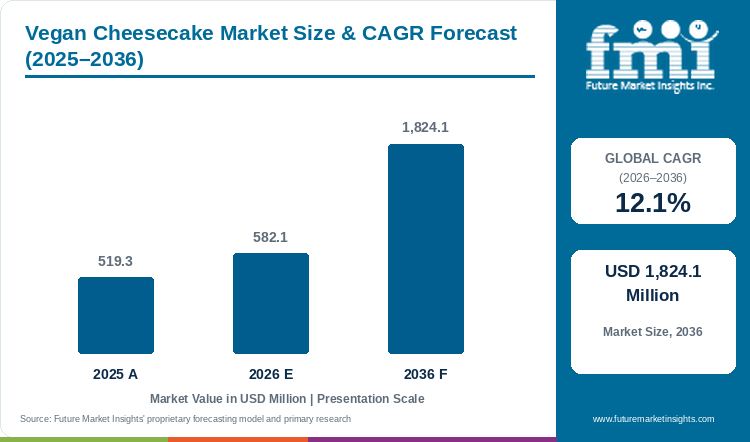
Demand for vegan cheesecake is projected to expand at a 12.1% CAGR between 2026 and 2036. Industry value grows from USD 519.3 million in 2025 to USD 582.1 million in 2026 and is projected to reach USD 1,824.1 million by 2036.
Vegan cheesecake has gained high attention in recent years due to increasing preference for plant-based food products and rising number of consumers reducing dairy products from their diet. The vegan cheesecake market is valued at USD 582.1 million in 2026, increasing from USD 519.3 million in 2025, and is expected to reach USD 1,824.1 million by 2036, expanding at a CAGR of 12.1%. Vegan cheesecake is prepared without dairy milk, cheese and eggs, while plant-based ingredients are used for providing creamy texture and familiar cheesecake taste. In January 2025, FDA stated that plant-based alternatives are increasingly developed in the same form and texture as conventional animal foods [1]. This is increasing consumer expectation for creamy filling, clean slicing and familiar presentation in plant-based desserts. FMI notes that growing availability through supermarkets, bakeries, online channels and foodservice is boosting the market growth.
Across key geographic markets, vegan cheesecake demand expands at varying paces shaped by hospitality growth, consumer familiarity, and labeling requirements. The UAE is expected to grow at 13.5% CAGR, supported by record tourism as Dubai welcomed 18.7 million international overnight visitors in 2025 [2]. The UK is anticipated to grow at 12.2% CAGR, while Germany is expected to rise at 11.8% CAGR due to established consumption of vegetarian and vegan alternatives. Japan is projected to grow at 11.2% CAGR, where documented vegan suitability and process control is very important. Fresh products are mainly preferred in bakery-led purchases, whereas frozen portions are gaining demand in foodservice due to easy handling and reduced preparation waste. Across these countries, texture, local labeling, cold-chain stability and proper product documentation are expected to drive the adoption of vegan cheesecake.
Key Takeaways
- Demand is driven by wider acceptance of plant-based alternatives, but vegan cheesecake must still compete on indulgence and familiar texture.
- Baked NY-style leads Product Type with a 29.0% share in 2026 because its dense profile gives buyers a familiar reference point for quality.
- Conventional leads Claim / Nature with a 52.0% share in 2026 because the standard vegan proposition avoids the added cost and formulation limits of stacked specialty claims.
- Fresh leads Format with a 32.0% share in 2026 because bakery presentation and immediate texture remain important in an indulgence-led purchase.
- The main purchasing friction is the need to balance taste and texture with allergen management, label accuracy and dependable shelf life.
- Notable companies in the vegan cheesecake market include Rich Products, Sara Lee Frozen Bakery, Dessert Holdings, Mademoiselle Desserts, Finsbury Food Group, Premier Foods, McKee Foods, Hostess Brands, Bauli, and Dr. Oetker.
Analyst Perspective
“A vegan claim opens consideration, but repeat purchasing still depends on texture, allergen controls, shelf life, and channel fit. In my experience, products progress faster when suppliers document these requirements before buyer trials.”
- Nandini Roy Choudhury, Principal Consultant, Future Market Insights.
How is the vegan cheesecake market segmented?
Vegan cheesecake market is segmented on the basis of product type, claim / nature, format, packaging format, sales channel, and region. Baked NY-style is projected at 29.0%, conventional at 52.0%, and fresh format at 32.0% in 2026.
By product type: Baked NY-style, no-bake / chilled, Basque burnt, and slices & minis.
By claim / nature: conventional, clean label, organic, gluten-free, and high-protein / fortified.
By format: fresh, frozen, ambient packaged, chilled, and par-baked / thaw-and-serve.
By packaging format: multipack, single-serve, family / loaf pack, and bulk foodservice.
By sales channel: supermarkets & hypermarkets, artisan & specialty bakeries, convenience & forecourt, online & DTC, and foodservice distributors.
By region: North America, Latin America, Western Europe, Eastern Europe, East Asia, South Asia and Pacific, and Middle East and Africa.
What makes Baked NY-style central to the Product Type category?
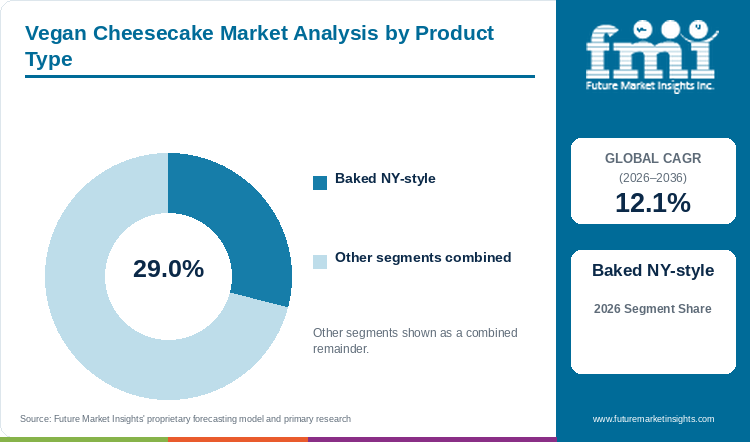
Based on product type, Baked NY-style is projected to account for 29.0% in 2026, supported by familiar structure and portioning.
Baked NY-style vegan cheesecake is facing high demand as it provides dense texture and familiar presentation similar to conventional cheesecake. The clean slicing and firm body makes it suitable for whole cake as well as pre-cut portion formats, often utilizing specialized bakery ingredients to mimic traditional dairy textures. Buyers can easily compare its texture and eating quality with dairy cheesecake, which reduces the need for explaining a new product style to consumers. In 2026, Daiya expanded its dessert portfolio with portioned dairy-free Cheesecake Bites designed to deliver conventional dense texture [3]. Due to its familiar structure and wide application across retail and foodservice, Baked NY-style is expected to remain central in Product Type category.
- Baked NY-style is projected at 29.0% in 2026 owing to its familiar texture and clean portioning.
- Clean slicing and structural stability support adoption across both retail and foodservice channels.
Why does Conventional anchor the Claim / Nature category?
By claim / nature, conventional is estimated to hold 52.0% in 2026, owing to wider formulation and price flexibility.
Conventional vegan cheesecake is expected to hold high share as it mainly offers one clear requirement, which is absence of animal-derived ingredients in the finished product. The addition of organic, gluten-free foods, clean label or fortified claims can increase formulation complexity and restrict ingredient selection. Germany’s Federal Ministry of Food and Agriculture (BMEL) reported in September 2024 that 39% of consumers regularly buy vegetarian or vegan alternatives [4]. Conventional products provide more flexibility to manufacturers for improving creaminess, taste and price.
- Conventional vegan cheesecake is estimated at 52.0% in 2026 due to formulation flexibility and cost advantages.
- Avoiding stacked specialty claims allows manufacturers to optimize texture and price for flexitarian consumers.
What keeps Fresh at the center of the Format category?
In 2026, fresh is expected to lead format with 32.0% share, driven by immediate texture and bakery presentation.
Fresh vegan cheesecake is highly preferred as it maintains immediate filling softness, crust texture and bakery-style presentation. Bakeries can prepare and decorate the product close to the selling time and can also change flavors or toppings according to local and seasonal demand. In May 2026, Mademoiselle Desserts highlighted its plant-based Speculoos Cheesecake specification requiring two-day chilled shelf life after defrosting to preserve freshness [5]. Frozen products are important for wider distribution; however, they require proper thawing to maintain the expected texture.
- Fresh format is expected to lead with 32.0% share in 2026 driven by bakery-style display and soft filling texture.
- Local customization and seasonal topping flexibility favor fresh production over thawed alternatives.
Why does Multipack lead the Packaging Format category?
By packaging format, multipack is forecast to represent 34.0% in 2026, supported by controlled portions and household value.
Multipack vegan cheesecake is gaining preference in grocery channels as it provides several portions in one purchase and also supports controlled serving. It allows households to share a specialty dessert without purchasing a full-size celebration cake. In April 2026, Finsbury Food Group acquired Flower & White to expand portioned sweet snacking and multi-pack dessert capability across European channels [6]. Multipacks can also include different flavors and provide better value perception when compared with individual products.
- Multipack packaging is forecast at 34.0% in 2026 as multi-serve cartons provide portion control and household sharing value.
- Variety packs and pre-portioned units offer superior value perception compared to whole celebration cakes.
What makes Supermarkets & hypermarkets the leading Sales Channel?
Supermarkets & hypermarkets are set to lead sales channel with 37.0% share in 2026, owing to broad traffic and cold-chain merchandising.
Supermarkets & hypermarkets are expected to remain the leading Sales Channel as they provide broad consumer reach and established chilled and frozen merchandising. UK Department for Environment, Food & Rural Affairs (Defra) data showed household food and non-alcoholic drink expenditure reached GBP 145 billion in 2024, driving dedicated cold-chain shelf placement [7]. Consumers can compare vegan cheesecake with conventional desserts during the same shopping visit, which supports trial and regular purchase. Artisan bakeries can offer more customized products, while online and foodservice channels support specific purchase occasions.
- Supermarkets & hypermarkets are projected at 37.0% in 2026 due to high foot traffic and dedicated cold-chain shelving.
- Side-by-side positioning with conventional desserts encourages flexitarian trial and repeat shopping.
What are the drivers, restraints, and opportunities in the vegan cheesecake market?
In the vegan cheesecake market, the key driver is mainstream plant-based adoption, the key restraint is allergen management and cross-contact, and the key opportunity is portion-controlled frozen and thaw-and-serve formats.
- Driver: Mainstream familiarity with plant-based alternatives expands the addressable dessert audience beyond strict vegans.
- Restraint: Taste expectations and allergen cross-contact controls can delay listing decisions or narrow who can safely buy the product.
- Opportunity: Portion-controlled frozen and thaw-and-serve formats create scalable routes to retail and foodservice expansion through 2036.
Mainstream Acceptance Expands Addressable Audience
Plant-based alternatives are becoming widely accepted among mainstream consumers, which is increasing the addressable demand for vegan cheesecake beyond strict vegan populations. The Good Food Institute reported that global retail sales of plant-based foods reached USD 29 billion in 2024, expanding the addressable base for indulgent dessert categories [8]. These developments are expected to boost vegan cheesecake demand among consumers purchasing the product for taste, health preference or reduced dairy intake. However, the product is still required to provide indulgent taste and familiar cheesecake texture for repeat purchasing.
Allergen Cross-Contact Controls Constrain Product Placement
Allergen management is one of the major restraining factors for vegan cheesecake market. In March 2024, the UK Food Standards Agency reported that 62% of consumers with animal-food allergies incorrectly assumed vegan labeling guarantees allergen-free status [9]. Mademoiselle Desserts also identifies egg, nuts and milk as possible cross-contact allergens for its vegan Speculoos Cheesecake. This creates a need for clear allergen statements and proper manufacturing controls. A vegan claim alone cannot be treated as an allergen-free claim, which can restrict product eligibility for sensitive consumers and delay buyer approval.
Portion-Controlled Formats Open Foodservice Positions
Pre-cut and portion-controlled vegan cheesecake is creating growth opportunities in retail and foodservice channels. In October 2024, Mademoiselle Desserts joined Emmi Group, creating an international cold-chain platform to scale pre-cut frozen premium desserts across international hospitality accounts [10]. This format allows operators to control portion cost, reduce preparation work and minimize product waste. Retailers can also use the same approach through controlled packs and multipacks. Manufacturers that maintain filling texture and crust quality after freeze-thaw processes are expected to gain opportunities in channels where fresh preparation is difficult.
Which country CAGRs are profiled in the vegan cheesecake market?
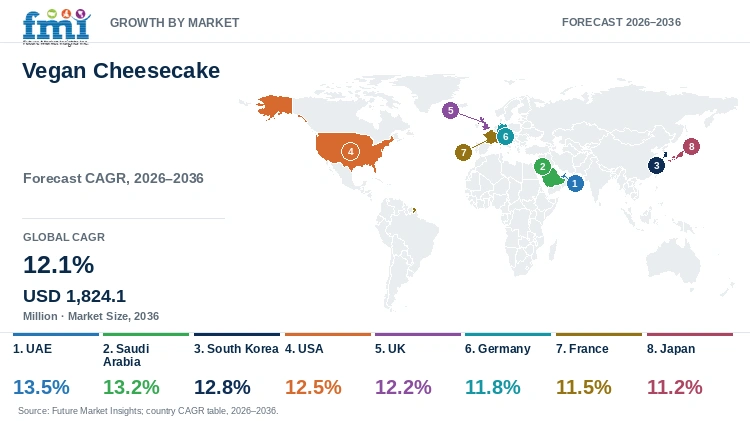
| Country | CAGR |
|---|---|
| UAE | 13.5% |
| Saudi Arabia | 13.2% |
| South Korea | 12.8% |
| USA | 12.5% |
| UK | 12.2% |
| Germany | 11.8% |
| France | 11.5% |
| Japan | 11.2% |
How do country-level CAGRs compare in the vegan cheesecake market?
Country demand follows foodservice expansion, local plant-based adoption, cold-chain maturity, and food labeling regulations. Countries with rapid tourism development generate strong hospitality demand, while retail-heavy markets create volume opportunities through grocery distribution. Local formulation alone is not sufficient, as cold-chain stability, allergen documentation, and compliant ingredient declarations are also required. Therefore, country growth depends on the prevailing channel structures and consumer dietary trends in each market.
- UAE: Hospitality breadth and international visitor traffic favor inclusive premium dessert menus, but cold-chain reliability is a core operating requirement.
- Saudi Arabia: Tourism growth creates more foodservice occasions, while Arabic labeling and nutrition-claim rules raise the compliance threshold for packaged imports.
- South Korea: New food-tech standards for plant-based alternatives give manufacturers clearer definitions and test expectations.
- USA: Plant-based alternatives have broad product visibility, while labeling and nutrition comparisons keep consumer communication under scrutiny.
- UK: Direct vegan cheesecake availability is visible, but allergen cross-contact communication can determine whether a product is suitable for sensitive shoppers.
- Germany: Frequent purchasing of vegetarian and vegan alternatives is comparatively established, making taste and value key competitive tests.
- France: Public foodservice policy supports protein diversification, yet plant-based desserts still compete within a strong traditional pastry culture.
- Japan: Domestic ethical consumption and JAS standards provide a clear framework, supported by growing plant-based foodservice adoption.
Full report country CAGRs cover: North America; Latin America; Western Europe; Eastern Europe; East Asia; South Asia and Pacific; Middle East and Africa.
Country-wise Analysis
- The UAE vegan cheesecake market is expected to grow at 13.5% CAGR through 2036, owing to increasing international visitors and expansion of premium hospitality. Hotels, restaurants and cafés are offering wider dessert choices for consumers with different dietary preferences. This is expected to increase the adoption of vegan cheesecake in buffet, café and plated dessert applications. However, the hot climate makes cold-chain performance very important for maintaining filling and crust texture. Products with clear labeling, controlled portions and predictable thawing are expected to witness higher demand in the UAE.
- Saudi Arabia vegan cheesecake market is anticipated to rise at 13.2% CAGR during the forecast period, supported by tourism and foodservice growth. The national tourism platform reported around 116 million domestic and inbound tourists in 2024, with tourism spending reaching nearly SAR 284 billion [11]. Hotels and restaurants are incorporating plant-based cheese alternatives to cater to evolving culinary demands. At the same time, the Saudi Food and Drug Authority strictly requires dual Arabic labeling and specific nutrition compliance for all packaged specialty food imports [12]. Therefore, localized labels, reliable distribution and cold-chain handling are expected to remain important for vegan cheesecake suppliers.
- Vegan cheesecake demand in South Korea is forecast to grow at 12.8% CAGR through 2036. In December 2024, the Ministry of Agriculture, Food and Rural Affairs announced the first four Korean Industrial Standards for food-tech fields, including requirements and product standards for plant-based alternatives [13]. These standards cover terminology, manufacturing requirements, performance indicators and labeling methods. This clearer framework is expected to support manufacturers in product claims and quality control. However, local taste preference and premium dessert positioning will continue to decide consumer acceptance.
- The USA vegan cheesecake market is estimated to expand at 12.5% CAGR through 2036, owing to established frozen dessert distribution and wide visibility of plant-based products. In February 2025, Rich Products reported that commercial foodservice operators are prioritizing pre-portioned plant-based desserts to mitigate kitchen labor constraints [14]. Companies such as Rich Products, Sara Lee Frozen Bakery and Dessert Holdings already have mature cheesecake or frozen dessert platforms. This supports the development of portioned and foodservice formats. However, consumers and buyers will compare the taste, texture and ingredient declaration with conventional cheesecake. Familiar product formats supported by credible vegan labeling are expected to create higher growth opportunities.
- The UK vegan cheesecake market is projected to register 12.2% CAGR during 2026 to 2036, supported by visible plant-based demand and availability of finished vegan cheesecake products. However, allergen communication remains a major consideration. Food safety agencies emphasize that vegan labels are not interchangeable with allergy-free claims, necessitating strict cross-contact declarations. Therefore, suppliers are required to provide clear information regarding cross-contact and product suitability. This can decide whether the product can be purchased by consumers with allergies.
- In Germany, vegan cheesecake demand is predicted to advance at 11.8% CAGR through 2036. Established consumer familiarity increases opportunity for vegan cheesecake, but it also makes taste and price more important than novelty. Manufacturers also need to decide whether the product will remain conventional vegan or include organic and clean label ingredients. Products offering indulgent taste with simple and understandable claims are expected to witness stronger demand.
- France vegan cheesecake market is estimated to grow at 11.5% CAGR over the forecast period, owing to premium dessert demand and increasing focus on protein diversification. In January 2024, the French Ministry of Agriculture and Food Sovereignty extended sustainable procurement and protein diversification rules across commercial and institutional catering [15]. This does not directly confirm vegan cheesecake demand, but it shows increasing visibility of plant-forward menu planning. Vegan cheesecake suppliers can target retail and foodservice with familiar flavors and attractive presentation. However, the product will compete with strong traditional pastry and dessert options in France.
- Vegan cheesecake sales in Japan are forecast to expand at 11.2% CAGR by 2036. According to the USDA Foreign Agricultural Service, Japan's domestic plant-based food market is projected to reach USD 730 million by fiscal year 2025, supported by recovery in inbound tourism and hotel dining [16]. JAS standards for foods suitable for vegetarians or vegans also provide a clearer framework for product suitability and process documentation. This is important in Japan, where labeling accuracy and production discipline supports consumer trust. Manufacturers are required to maintain consistent portion quality and clear ingredient information. Local flavor development and less sweet formulations can also support the adoption of vegan cheesecake against established Japanese and Western dessert products.
Who are the notable companies in the vegan cheesecake market?
Rich Products, Sara Lee Frozen Bakery, Dessert Holdings, Mademoiselle Desserts, Finsbury Food Group, Premier Foods, McKee Foods, Hostess Brands, Bauli, and Dr. Oetker are the notable companies profiled in this market.
The vegan cheesecake market consists of finished vegan cheesecake manufacturers, conventional cheesecake companies and broader bakery and dessert suppliers. Mademoiselle Desserts has direct public evidence of commercial vegan cheesecake products. Rich Products, Sara Lee Frozen Bakery and Dessert Holdings have established cheesecake or frozen dessert capabilities which can support production scale, portioning and foodservice distribution. Finsbury Food Group and Premier Foods provide bakery channel and vegan pastry development experience, while McKee Foods, Hostess Brands and Bauli have wide bakery reach. Dr. Oetker provides dessert products and vegan cheesecake formulation content. However, direct commercial vegan cheesecake products were not verified for every profiled company.
- Direct finished-product evidence: Mademoiselle Desserts documents commercial plant-based cheesecakes, including Speculoos and chocolate-based variants.
- Cheesecake and frozen-dessert platforms: Rich Products, Sara Lee Frozen Bakery, and Dessert Holdings document cheesecake or frozen dessert capabilities that are relevant to scale, portioning and foodservice logistics.
- Adjacent bakery and dessert platforms: Finsbury Food Group, Premier Foods, McKee Foods, Hostess Brands, Bauli, and Dr. Oetker bring bakery, sweet-snack or plant-based dessert capabilities. Direct finished vegan cheesecake evidence was not verified for all of these market participants.
Competitive Benchmarking: Vegan Cheesecake Market
| Company | Vegan Cheesecake Evidence | Cheesecake / Dessert Platform | Channel & Format Flexibility | Geographic Reach |
|---|---|---|---|---|
| Rich Products | Unscored | High | High | Global product and foodservice presence |
| Sara Lee Frozen Bakery | Unscored | High | High | United States; selected products also list Canada |
| Dessert Holdings | Unscored | High | High | North America; international customer scope disclosed |
| Mademoiselle Desserts | High | High | High | France, UK, Netherlands and Belgium; customers in 45+ countries |
| Finsbury Food Group | Unscored | Medium | High | UK and multiple European markets |
| Premier Foods | Unscored | Medium | High | UK core; international markets including Australia, North America and EMEA |
| McKee Foods | Unscored | Medium | Medium | United States |
| Hostess Brands | Unscored | Medium | Medium | United States |
| Bauli | Unscored | Medium | High | Products sold in 70+ countries |
| Dr. Oetker | Medium | High | Medium | International consumer markets |
Scoring basis: Vegan Cheesecake Evidence is High when a finished commercial vegan cheesecake is directly documented, Medium when vegan cheesecake formulation or consumer content is documented without a verified finished commercial SKU, and Unscored when direct evidence was not verified. Cheesecake / Dessert Platform is High for documented cheesecake or broad dessert capability and Medium for an adjacent sweet bakery platform. Channel & Format Flexibility is High when both multi-channel reach and multiple service formats are documented, while Medium indicates narrower evidence. Low is reserved for a documented limitation, and unavailable public information is left unscored.
Key Developments in the Vegan Cheesecake Market
- In May 2026, Mademoiselle Desserts reported that its Gluten Free & Vegan Chocolate, Vanilla & Cherry Cheesecake received a silver award at the Free From Food Awards [17]. Judges highlighted smooth texture and balance of chocolate with cherry, validating that sensory quality and familiar indulgence are becoming critical for commercial success.
- In April 2026, Finsbury Food Group acquired Flower & White to accelerate direct-to-consumer reach and expand portioned sweet snacking capabilities across UK and European retail.
- In December 2025, Dr. Oetker expanded its international vegan recipe platforms and plant-based baking hubs ahead of Veganuary 2026 [18], providing home baking and commercial dessert guidance for vegan cheesecakes.
- In February 2025, Rich Products highlighted growing demand for plant-based and grab-and-go frozen dessert formats in its foodservice trends outlook, demonstrating technical scaling capability for frozen cheesecake.
Key Players in the Vegan Cheesecake Market
Cheesecake and Frozen Dessert Platforms
- Rich Products
- Sara Lee Frozen Bakery
- Dessert Holdings
- Mademoiselle Desserts
Scaled Bakery and Sweet-Treat Manufacturers
- Finsbury Food Group
- Premier Foods
- McKee Foods
- Hostess Brands
International Baking and Dessert Brands
- Bauli
- Dr. Oetker
Vegan Cheesecake Market - Report Scope
| Coverage field | Report scope |
|---|---|
| Market breakdown | Product Type; Claim / Nature; Format; Packaging Format; Sales Channel; Region |
| Quantitative Units | USD Million |
| Market Definition | Includes revenue from finished vegan cheesecake products sold across the defined product, claim, format, packaging and channel universe. Excludes conventional dairy or egg cheesecake, other vegan cakes and desserts, ingredient systems sold separately, and downstream foodservice markup on prepared dessert service. |
| Regions Covered | North America; Latin America; Western Europe; Eastern Europe; East Asia; South Asia and Pacific; Middle East and Africa |
| Countries Covered | USA, Germany, France, UK, Saudi Arabia, UAE, Japan, South Korea |
| Key Companies Profiled | Rich Products, Sara Lee Frozen Bakery, Dessert Holdings, Mademoiselle Desserts, Finsbury Food Group, Premier Foods, McKee Foods, Hostess Brands, Bauli, Dr. Oetker |
| Forecast Period | 2026 to 2036 |
| Approach | Primary and secondary research with market triangulation. |
Vegan Cheesecake Market - Research Methodology
| Method | Approach |
|---|---|
| Primary Research | FMI analysts gathered input from manufacturers, service providers, technology developers, distributors, end users, procurement teams and subject-matter experts. Interviews examined purchasing decisions, product or service evaluation, adoption barriers, approval requirements, pricing considerations and expectations for technical or commercial support. Respondents were also asked what evidence is required before a trial, pilot, or initial order develops into regular purchasing. |
| Desk Research | Desk research covered government statistics, regulatory publications, trade data, industry associations, technical literature, standards, company filings, product information and official corporate announcements. Sources were reviewed for relevance, publication date, geographic coverage and consistency with the defined market scope. Claims relating to performance, applications, approvals, capacity, investment and commercial activity were retained only when supported by credible public evidence. |
| Market Sizing and Forecasting | The market model combined the baseline value with historical performance, segment structure, pricing and volume indicators, adoption levels, company participation and country-level demand conditions. Forecast assumptions considered economic activity, investment trends, regulatory developments, technology adoption, purchasing cycles, supply availability and barriers to wider market use. Segment and regional estimates were reconciled before the final market total was calculated. |
| Data Validation | Estimates were checked against multiple independent indicators, including public data, company activity, trade patterns, industry developments and findings from primary interviews. Validation also tested whether products, services, applications and company revenues fell within the defined market boundaries. Adjacent categories, unsupported claims, overlapping revenues and activities without direct market relevance were excluded to reduce double counting and maintain consistency across segments and countries. |
Vegan Cheesecake Market by Segments
Vegan Cheesecake Market segmented by Product Type:
- Baked NY-style
- No-bake / chilled
- Basque burnt
- Slices & minis
Vegan Cheesecake Market segmented by Claim / Nature:
- Conventional
- Clean label
- Organic
- Gluten-free
- High-protein / fortified
Vegan Cheesecake Market segmented by Format:
- Fresh
- Frozen
- Ambient packaged
- Chilled
- Par-baked / thaw-and-serve
Vegan Cheesecake Market segmented by Packaging Format:
- Multipack
- Single-serve
- Family / loaf pack
- Bulk foodservice
Vegan Cheesecake Market segmented by Sales Channel:
- Supermarkets & hypermarkets
- Artisan & specialty bakeries
- Convenience & forecourt
- Online & DTC
- Foodservice distributors
Vegan Cheesecake Market by Region:
- North America
- United States
- Canada
- Latin America
- Brazil
- Mexico
- Argentina
- Chile
- Western Europe
- Germany
- France
- United Kingdom
- Italy
- Spain
- Benelux
- Nordics
- Eastern Europe
- Poland
- Czech Republic
- Romania
- Hungary
- East Asia
- Japan
- South Korea
- South Asia and Pacific
- ASEAN
- Australia and New Zealand
- Middle East and Africa
- GCC Countries
- South Africa
- Türkiye
- Israel
Research Sources and Bibliography
- [1] U.S. Food and Drug Administration. (2025, January 6). Plant-Based Milk and Animal Food Alternatives.
- [2] Government of Dubai Media Office. (2026, February 9). Dubai’s tourism industry achieves third successive record-breaking year.
- [3] Daiya Foods Inc. (2026, January 15). Daiya introduces portioned dairy-free cheesecake bites.
- [4] Federal Ministry of Food and Agriculture, Germany. (2024, September 24). Ernährungsreport 2024.
- [5] Mademoiselle Desserts. (2026, May 15). Plant-based patisserie technical specification and shelf-life review.
- [6] Finsbury Food Group. (2026, April 30). Finsbury Food Group acquires Flower & White to accelerate snacking growth.
- [7] Department for Environment, Food & Rural Affairs, UK. (2025, July 10). Food statistics pocketbook 2024.
- [8] The Good Food Institute. (2025, May 12). State of the Global Plant-Based Food Industry 2024.
- [9] Food Standards Agency, UK. (2024, March 5). FSA campaign highlights allergy risks of vegan-labelled foods.
- [10] Emmi Group. (2024, October 18). Emmi acquires Mademoiselle Desserts to strengthen premium pastry presence.
- [11] National Platform, Saudi Arabia. (2025, June 22). Saudi Arabia tops 100 million visitors for second consecutive year in 2024.
- [12] Saudi Food and Drug Authority. (2024, February 28). Food labeling and import compliance guidelines.
- [13] Ministry of Agriculture, Food and Rural Affairs, South Korea. (2024, December 30). Standardization work for food-tech development begins in earnest.
- [14] Rich Products Corporation. (2025, February 5). Foodservice and in-store bakery trends outlook.
- [15] Ministry of Agriculture and Food Sovereignty, France. (2024, January 9). Sustainable catering and protein diversification policy framework.
- [16] U.S. Department of Agriculture, Foreign Agricultural Service. (2025, July 1). Japan: Exporter Guide Annual (Report No. JA2025-0034).
- [17] Free From Food Awards. (2026, May 14). Free From Food Awards 2026 Winners and Results.
- [18] Dr. Oetker. (2025, December 17). Expanding plant-based choices and recipes for Veganuary 2026.
This bibliography is provided for reader reference. The full report contains the complete reference list and detailed citations.
This Report Answers
- What is the Vegan Cheesecake Market size in 2026 and what value is forecast by 2036?
- Which industry pressures support demand for vegan cheesecake?
- Why does Baked NY-style hold the leading position in Product Type?
- Why does Conventional hold the leading position in Claim / Nature?
- How do the profiled country growth rates differ from 2026 to 2036?
- Which profiled companies supply relevant cheesecake, dessert or adjacent plant-based sweet-treat capabilities?
- What limits adoption or supplier switching in vegan cheesecake?
- What should buyers evaluate before purchasing vegan cheesecake?
Frequently Asked Questions
How large is the Vegan Cheesecake Market expected to be in 2026?
The vegan cheesecake market will reach USD 582.1 million in 2026. The market is projected to expand further and reach USD 1,824.1 million by 2036.
What CAGR is forecast for the Vegan Cheesecake Market through 2036?
As per FMI, the vegan cheesecake market is projected to grow at a 12.1% CAGR from 2026 to 2036. Growth is supported by wider plant-based dessert adoption and improved texture performance.
Which Product Type holds a notable vegan cheesecake demand share in 2026?
Future Market Insights projects Baked NY-style to hold 29.0% of Product Type demand in 2026. The segment benefits from familiar density, clean slicing, and portion consistency.
Which Claim / Nature segment holds a notable vegan cheesecake share in 2026?
FMI finds that Conventional will hold 52.0% of Claim / Nature demand in 2026. It supports broader formulation flexibility without stacking multiple specialty claims.
Which country has a notable vegan cheesecake expansion outlook during the forecast period?
Future Market Insights predicts the UAE to expand at a 13.5% CAGR during the 2026 to 2036 assessment period. Growth is supported by international hospitality and premium menu demand.
Which companies are active in the Vegan Cheesecake Market during 2026?
As per FMI analysis, notable companies include Rich Products, Sara Lee Frozen Bakery, Dessert Holdings, Mademoiselle Desserts, Finsbury Food Group, Premier Foods, McKee Foods, Hostess Brands, Bauli, and Dr. Oetker. These companies are focusing on production expansion, wider portfolio offerings, and cold-chain distribution capabilities.
Preview the report firsthand - request a free sample
Get SampleGet the brochure for pricing and purchase details.
Get PDFTable of Content
- Key Takeaways
- Market Size and CAGR
- Top Growth Driver
- Fastest Growing Segment
- Leading Region
- Key Companies
- Emerging Opportunities
- Executive Summary
- Global Market Outlook
- Demand-side Trends
- Supply-side Trends
- Technology Roadmap Analysis
- Analysis and Recommendations
- Analyst Perspective (What is happening? Why now? What should investors know?)
- Key Questions Answered
- How large is the market?
- What is the CAGR?
- What are key trends?
- Which region dominates?
- Who are the leaders?
- Market Overview
- Market Coverage / Taxonomy
- Market Definition / Scope / Limitations
- Research Methodology
- Chapter Orientation
- Analytical Lens and Working Hypotheses
- Market Structure, Signals, and Trend Drivers
- Benchmarking and Cross-market Comparability
- Market Sizing, Forecasting, and Opportunity Mapping
- Research Design and Evidence Framework
- Desk Research Programme (Secondary Evidence)
- Expert Input and Fieldwork (Primary Evidence)
- Tooling, Models, and Reference Databases
- Data Engineering and Model Build
- Quality Assurance and Audit Trail
- Market Background
- Market Dynamics (Drivers, Restraints, Opportunity, Trends)
- Scenario Forecast (Optimistic, Likely, Conservative)
- Impact Analysis
- AI Impact
- Sustainability Impact
- Regulatory Impact
- Technology Impact
- Consumer / Buyer Analysis
- Purchase Drivers
- Adoption Barriers
- Buyer Journey
- Opportunity Map Analysis
- Product Life Cycle Analysis
- Supply Chain Analysis
- Investment Feasibility Matrix
- Value Chain Analysis
- PESTLE and Porter's Analysis
- Regulatory Landscape
- Regional Parent Market Outlook
- Production and Consumption Statistics
- Import and Export Statistics
- Global Market Analysis and Forecast, 2021 to 2036
- Historical Market Size Value (USD Million) Analysis, 2021 to 2025
- Current and Future Market Size Value (USD Million) Projections, 2026 to 2036
- Y-o-Y Growth Trend Analysis
- Absolute $ Opportunity Analysis
- Global Market Pricing Analysis, 2021 to 2036
- Global Market Analysis and Forecast, By Product Type, 2021 to 2036
- Introduction / Key Findings
- Historical Market Size Value (USD Million) Analysis By Product Type, 2021 to 2025
- Current and Future Market Size Value (USD Million) Analysis and Forecast By Product Type, 2026 to 2036
- Baked NY-style
- No-bake / chilled
- Basque burnt
- Slices & minis
- Y-o-Y Growth Trend Analysis By Product Type, 2021 to 2025
- Absolute $ Opportunity Analysis By Product Type, 2026 to 2036
- Global Market Analysis and Forecast, By Claim / Nature, 2021 to 2036
- Introduction / Key Findings
- Historical Market Size Value (USD Million) Analysis By Claim / Nature, 2021 to 2025
- Current and Future Market Size Value (USD Million) Analysis and Forecast By Claim / Nature, 2026 to 2036
- Conventional
- Clean label
- Organic
- Gluten-free
- High-protein / fortified
- Y-o-Y Growth Trend Analysis By Claim / Nature, 2021 to 2025
- Absolute $ Opportunity Analysis By Claim / Nature, 2026 to 2036
- Global Market Analysis and Forecast, By Format, 2021 to 2036
- Introduction / Key Findings
- Historical Market Size Value (USD Million) Analysis By Format, 2021 to 2025
- Current and Future Market Size Value (USD Million) Analysis and Forecast By Format, 2026 to 2036
- Fresh
- Frozen
- Ambient packaged
- Chilled
- Par-baked / thaw-and-serve
- Y-o-Y Growth Trend Analysis By Format, 2021 to 2025
- Absolute $ Opportunity Analysis By Format, 2026 to 2036
- Global Market Analysis and Forecast, By Packaging Format, 2021 to 2036
- Introduction / Key Findings
- Historical Market Size Value (USD Million) Analysis By Packaging Format, 2021 to 2025
- Current and Future Market Size Value (USD Million) Analysis and Forecast By Packaging Format, 2026 to 2036
- Multipack
- Single-serve
- Family / loaf pack
- Bulk foodservice
- Y-o-Y Growth Trend Analysis By Packaging Format, 2021 to 2025
- Absolute $ Opportunity Analysis By Packaging Format, 2026 to 2036
- Global Market Analysis and Forecast, By Sales Channel, 2021 to 2036
- Introduction / Key Findings
- Historical Market Size Value (USD Million) Analysis By Sales Channel, 2021 to 2025
- Current and Future Market Size Value (USD Million) Analysis and Forecast By Sales Channel, 2026 to 2036
- Supermarkets & hypermarkets
- Artisan & specialty bakeries
- Convenience & forecourt
- Online & DTC
- Foodservice distributors
- Y-o-Y Growth Trend Analysis By Sales Channel, 2021 to 2025
- Absolute $ Opportunity Analysis By Sales Channel, 2026 to 2036
- Global Market Analysis and Forecast, By Region, 2021 to 2036
- Introduction
- Historical Market Size Value (USD Million) Analysis By Region, 2021 to 2025
- Current Market Size Value (USD Million) Analysis and Forecast By Region, 2026 to 2036
- North America
- Latin America
- Western Europe
- Eastern Europe
- East Asia
- South Asia and Pacific
- Middle East and Africa
- Market Attractiveness Analysis By Region
- North America Market Analysis and Forecast, By Country, 2021 to 2036
- Historical Market Size Value (USD Million) Trend Analysis By Market Taxonomy, 2021 to 2025
- Market Size Value (USD Million) Forecast By Market Taxonomy, 2026 to 2036
- By Country
- United States
- Canada
- By Product Type
- By Claim / Nature
- By Format
- By Packaging Format
- By Sales Channel
- By Country
- Market Attractiveness Analysis
- By Country
- By Product Type
- By Claim / Nature
- By Format
- By Packaging Format
- By Sales Channel
- Key Takeaways
- Latin America Market Analysis and Forecast, By Country
- Historical Market Size Value (USD Million) Trend Analysis By Market Taxonomy, 2021 to 2025
- Market Size Value (USD Million) Forecast By Market Taxonomy, 2026 to 2036
- By Country
- Brazil
- Mexico
- Argentina
- Chile
- By Product Type
- By Claim / Nature
- By Format
- By Packaging Format
- By Sales Channel
- By Country
- Market Attractiveness Analysis
- By Country
- By Product Type
- By Claim / Nature
- By Format
- By Packaging Format
- By Sales Channel
- Key Takeaways
- Western Europe Market Analysis and Forecast, By Country
- Historical Market Size Value (USD Million) Trend Analysis By Market Taxonomy, 2021 to 2025
- Market Size Value (USD Million) Forecast By Market Taxonomy, 2026 to 2036
- By Country
- Germany
- France
- United Kingdom
- Italy
- Spain
- Benelux
- Nordics
- By Product Type
- By Claim / Nature
- By Format
- By Packaging Format
- By Sales Channel
- By Country
- Market Attractiveness Analysis
- By Country
- By Product Type
- By Claim / Nature
- By Format
- By Packaging Format
- By Sales Channel
- Key Takeaways
- Eastern Europe Market Analysis and Forecast, By Country
- Historical Market Size Value (USD Million) Trend Analysis By Market Taxonomy, 2021 to 2025
- Market Size Value (USD Million) Forecast By Market Taxonomy, 2026 to 2036
- By Country
- Poland
- Czech Republic
- Romania
- Hungary
- By Product Type
- By Claim / Nature
- By Format
- By Packaging Format
- By Sales Channel
- By Country
- Market Attractiveness Analysis
- By Country
- By Product Type
- By Claim / Nature
- By Format
- By Packaging Format
- By Sales Channel
- Key Takeaways
- East Asia Market Analysis and Forecast, By Country
- Historical Market Size Value (USD Million) Trend Analysis By Market Taxonomy, 2021 to 2025
- Market Size Value (USD Million) Forecast By Market Taxonomy, 2026 to 2036
- By Country
- Japan
- South Korea
- By Product Type
- By Claim / Nature
- By Format
- By Packaging Format
- By Sales Channel
- By Country
- Market Attractiveness Analysis
- By Country
- By Product Type
- By Claim / Nature
- By Format
- By Packaging Format
- By Sales Channel
- Key Takeaways
- South Asia and Pacific Market Analysis and Forecast, By Country
- Historical Market Size Value (USD Million) Trend Analysis By Market Taxonomy, 2021 to 2025
- Market Size Value (USD Million) Forecast By Market Taxonomy, 2026 to 2036
- By Country
- ASEAN
- Australia and New Zealand
- By Product Type
- By Claim / Nature
- By Format
- By Packaging Format
- By Sales Channel
- By Country
- Market Attractiveness Analysis
- By Country
- By Product Type
- By Claim / Nature
- By Format
- By Packaging Format
- By Sales Channel
- Key Takeaways
- Middle East and Africa Market Analysis and Forecast, By Country
- Historical Market Size Value (USD Million) Trend Analysis By Market Taxonomy, 2021 to 2025
- Market Size Value (USD Million) Forecast By Market Taxonomy, 2026 to 2036
- By Country
- GCC Countries
- South Africa
- Türkiye
- Israel
- By Product Type
- By Claim / Nature
- By Format
- By Packaging Format
- By Sales Channel
- By Country
- Market Attractiveness Analysis
- By Country
- By Product Type
- By Claim / Nature
- By Format
- By Packaging Format
- By Sales Channel
- Key Takeaways
- Key Countries Market Analysis
- United States
- Pricing Analysis
- Market Share Analysis, 2025
- By Product Type
- By Claim / Nature
- By Format
- By Packaging Format
- By Sales Channel
- Canada
- Pricing Analysis
- Market Share Analysis, 2025
- By Product Type
- By Claim / Nature
- By Format
- By Packaging Format
- By Sales Channel
- Mexico
- Pricing Analysis
- Market Share Analysis, 2025
- By Product Type
- By Claim / Nature
- By Format
- By Packaging Format
- By Sales Channel
- Brazil
- Pricing Analysis
- Market Share Analysis, 2025
- By Product Type
- By Claim / Nature
- By Format
- By Packaging Format
- By Sales Channel
- Chile
- Pricing Analysis
- Market Share Analysis, 2025
- By Product Type
- By Claim / Nature
- By Format
- By Packaging Format
- By Sales Channel
- Germany
- Pricing Analysis
- Market Share Analysis, 2025
- By Product Type
- By Claim / Nature
- By Format
- By Packaging Format
- By Sales Channel
- United Kingdom
- Pricing Analysis
- Market Share Analysis, 2025
- By Product Type
- By Claim / Nature
- By Format
- By Packaging Format
- By Sales Channel
- Italy
- Pricing Analysis
- Market Share Analysis, 2025
- By Product Type
- By Claim / Nature
- By Format
- By Packaging Format
- By Sales Channel
- Spain
- Pricing Analysis
- Market Share Analysis, 2025
- By Product Type
- By Claim / Nature
- By Format
- By Packaging Format
- By Sales Channel
- France
- Pricing Analysis
- Market Share Analysis, 2025
- By Product Type
- By Claim / Nature
- By Format
- By Packaging Format
- By Sales Channel
- ASEAN
- Pricing Analysis
- Market Share Analysis, 2025
- By Product Type
- By Claim / Nature
- By Format
- By Packaging Format
- By Sales Channel
- Australia and New Zealand
- Pricing Analysis
- Market Share Analysis, 2025
- By Product Type
- By Claim / Nature
- By Format
- By Packaging Format
- By Sales Channel
- Japan
- Pricing Analysis
- Market Share Analysis, 2025
- By Product Type
- By Claim / Nature
- By Format
- By Packaging Format
- By Sales Channel
- South Korea
- Pricing Analysis
- Market Share Analysis, 2025
- By Product Type
- By Claim / Nature
- By Format
- By Packaging Format
- By Sales Channel
- Poland
- Pricing Analysis
- Market Share Analysis, 2025
- By Product Type
- By Claim / Nature
- By Format
- By Packaging Format
- By Sales Channel
- Hungary
- Pricing Analysis
- Market Share Analysis, 2025
- By Product Type
- By Claim / Nature
- By Format
- By Packaging Format
- By Sales Channel
- Türkiye
- Pricing Analysis
- Market Share Analysis, 2025
- By Product Type
- By Claim / Nature
- By Format
- By Packaging Format
- By Sales Channel
- South Africa
- Pricing Analysis
- Market Share Analysis, 2025
- By Product Type
- By Claim / Nature
- By Format
- By Packaging Format
- By Sales Channel
- UAE
- Pricing Analysis
- Market Share Analysis, 2025
- By Product Type
- By Claim / Nature
- By Format
- By Packaging Format
- By Sales Channel
- Saudi Arabia
- Pricing Analysis
- Market Share Analysis, 2025
- By Product Type
- By Claim / Nature
- By Format
- By Packaging Format
- By Sales Channel
- United States
- Market Structure Analysis
- Competition Dashboard
- Competition Benchmarking
- Market Share Analysis of Top Players
- By Regional
- By Product Type
- By Claim / Nature
- By Format
- By Packaging Format
- By Sales Channel
- Emerging Startups
- Innovation Benchmarking
- Competition Analysis
- Competition Deep Dive
- Rich Products
- Overview
- Product Portfolio
- Profitability by Market Segments
- Sales Footprint
- Strategy Overview
- Marketing Strategy
- Product Strategy
- Channel Strategy
- Sara Lee Frozen Bakery
- Dessert Holdings
- Mademoiselle Desserts
- Finsbury Food Group
- Premier Foods
- McKee Foods
- Hostess Brands
- Bauli
- Dr. Oetker
- Rich Products
- Case Studies
- Success Stories
- Recent Developments
- Competition Deep Dive
- Assumptions & Acronyms Used


