

- Market Size (2026)
- USD 1.2 Bn
- Forecast (2036)
- USD 2.3 Bn
- CAGR (2026 to 2036)
- 6.3%
How big is Vinyl Silane Additives Market in 2026?
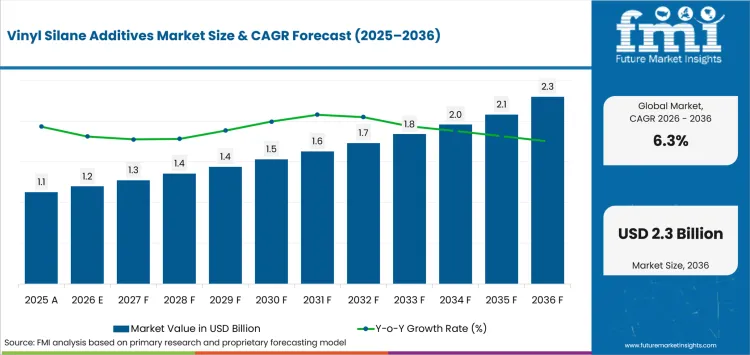
USD 1.2 billion in 2026 and USD 2.3 billion by 2036 at a 6.3% CAGR.
Sales of vinyl silane additives are estimated to rise at 6.3% CAGR through 2036, increasing valuation from USD 1.2 billion in 2026 to USD 2.3 billion by 2036. Compounders use silane coupling agents in polymer recipes that need predictable bonding or moisture-cure behavior. Gelest expanded silane support in India with Nordmann in February 2026, giving specialty-material accounts closer regional technical coordination. Qualified recipes depend on repeatable supply and fast application support alongside raw-material performance.
Country conversion rates depend on grid construction and the depth of local cable materials processing. Taipower reported in September 2025 that electricity customers in Taoyuan had risen 17.4% over ten years and annual consumption reached 27.1 billion kWh. That concentration expands cable qualification activity without proving vinyl silane orders, as each producer selects its own insulation chemistry. Japan and Germany convert new demand more slowly as established formulations extend raw-material change validation.
Key Takeaways of Vinyl Silane Additives Market
- Cable and pipe compounders sustain demand as moisture-crosslinked polyethylene needs controlled grafting and repeatable cure performance.
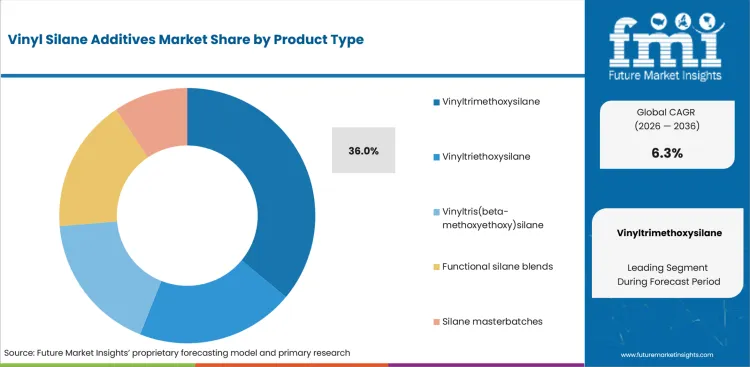
- Based on product type, vinyltrimethoxysilane is projected to account for 36.0% in 2026 due to established moisture-cure recipes.
- In 2026, moisture crosslinking is expected to lead function with 33.0% share because silane directly participates in curing.
- By polymer use, XLPE cable compounds are forecast to represent 34.0% in 2026 driven by qualified insulation recipes.
- Moisture sensitivity and methanol-forming hydrolysis raise handling requirements, and cable qualification increases switching costs once a formulation passes validation.
- Momentive, Wacker Chemie, Shin-Etsu Chemical, Evonik, Gelest / Mitsubishi Chemical Group, BRB International, Hubei Jianghan New Materials and Nanjing Union Silicon are profiled.
Analyst Perspective
"Vinyl silane additives should be judged inside the compound recipe as grafting response and hydrolysis rate affect line stability. Lower price loses value if a grade forces cable requalification or unstable moisture cure."
- Nikhil Kaitwade, Principal Consultant, Future Market Insights
How is the Vinyl Silane Additives Market segmented?
The vinyl silane additives market is segmented by product type, function, polymer use, application, sales channel and region.
Product type covers vinyltrimethoxysilane, vinyltriethoxysilane, vinyltris(beta-methoxyethoxy)silane, functional silane blends and silane masterbatches. Function covers moisture crosslinking, adhesion promotion, coupling/filler treatment, surface modification and grafting aid. Polymer use covers XLPE cable compounds, polyolefins, PVC compounds, elastomers and adhesives/sealants. Application covers wire and cable insulation, pipes and tubing, adhesives/sealants, coatings and composite fillers. Sales channel covers cable compounders, direct chemical supply, distributors and masterbatch suppliers.
What makes vinyltrimethoxysilane central to the product type category?
Vinyltrimethoxysilane gives compounders a familiar silane grafting route as its vinyl group reacts with polyolefins during extrusion. Hubei Jianghan New Materials disclosed in July 2026 that its 10,000-tonne-per-year vinyl-silane line had entered trial operation in February. The dedicated line adds current manufacturing capacity for crosslinking and coupling applications at industrial scale.
- By product type, vinyltrimethoxysilane is estimated to hold 36.0% in 2026 owing to its familiar reaction path in cable and pipe compounds.
- Processors retain the grade once qualified as changes in hydrolysis behavior can alter scorch margin plus cure timing and final test performance.
Why does moisture crosslinking lead the function category?
Moisture crosslinking separates extrusion from final network formation, letting processors shape polyethylene during extrusion and complete the siloxane cure with water later. Cable plants using peroxide-free XLPE crosslinking need thermoplastic handling during compounding plus stable heat performance in service.
- The function category is forecast to be led by moisture crosslinking at 33.0% share in 2026 due to its direct role in polyethylene curing.
- Qualified cable output requires crosslinking packages that reproduce thermal and electrical performance across repeated runs. Borealis announced an XLPE expansion at Stenungsund in October 2025 for medium- through extra-high-voltage cable insulation.
How do XLPE cable compounds anchor the polymer use category?
Cable compounders set the vinyl-silane recipe during compound preparation, and qualification locks that chemistry into insulation production as reformulation can disrupt line stability and final cable performance.
- XLPE cable compounds are projected to hold 34.0% share in 2026 owing to repeated qualification around insulation and sheathing recipes. Borouge reported in February 2026 that XLPE 2 commissioning had started in late 2025 for specialized wire and cable materials.
- Recurring orders follow approved recipes as formulation changes can alter extrusion stability plus hot-set performance and the electrical behavior of insulated wires and cables.
What supports wire & cable insulation in the application category?
Unlike secondary adhesion uses, wire and cable insulation puts vinyl silane inside a specification-sensitive material system with strict heat and moisture requirements. Application engineers compare repeatability across production lots as part of additive approval on a qualified cable line.
- In 2026, wire and cable insulation is expected to lead application with 37.0% share because moisture-crosslinked polyethylene fits qualified cable constructions.
- Borouge reported in May 2026 that its Borouge 4 XLPE plant would add 100,000 tonnes of annual capacity. The plant expands wire and cable plastics supply for high- and medium-voltage cable applications in power grids.
What are the drivers, restraints and opportunities in the Vinyl Silane Additives Market?
Grid investment expands cable-related demand while moisture-sensitive handling slows switching and formulated formats can reduce dosing friction.
- Driver: Transmission upgrades enlarge the project base for cable compounds that rely on stable crosslinking and repeatable insulation performance.
- Restraint: Methoxy-silane hydrolysis releases methanol, and moisture exposure can complicate storage plus formulation changes once a cable recipe is qualified.
- Opportunity: Regional distribution and technical support can shorten formulation trials for processors using formulated blends or masterbatch routes.
Grid Modernization Extends Qualified Cable Demand
The USA Department of Energy announced about USD 1.9 billion for SPARK grid upgrades in March 2026, enlarging the project base for qualified cable systems. Transmission work expands cable activity without creating direct vinyl-silane demand, as cable manufacturers select specific insulation chemistries for each project.
Hydrolysis and Qualification Raise Switching Cost
Handling friction begins with silane chemistry and becomes costlier once a cable recipe passes qualification. BRB International explained in April 2025 that methoxylated silanes hydrolyze faster and release methanol during reaction with moisture. Compounders therefore manage moisture exposure plus catalyst response carefully during approved raw-material grade changes on cable lines.
Regional Distribution Shortens Qualification Friction
Regional distribution reduces practical delays for processors that need local stock and technical help during formulation trials. BRB International reported in March 2026 that its Tennants collaboration serves UK manufacturers across a silane range containing vinyl grades used in cables and pipes. Local access also matters for masterbatch formulations and specialty-chemical formulation as processors repeat qualification work without long-distance replenishment.
Which country CAGRs are profiled in the Vinyl Silane Additives Market?
| Country | CAGR |
|---|---|
| South Korea | 6.2% |
| Taiwan | 6.0% |
| USA | 5.8% |
| Germany | 5.3% |
| Japan | 5.0% |
How do country-level CAGRs compare in the Vinyl Silane Additives Market?
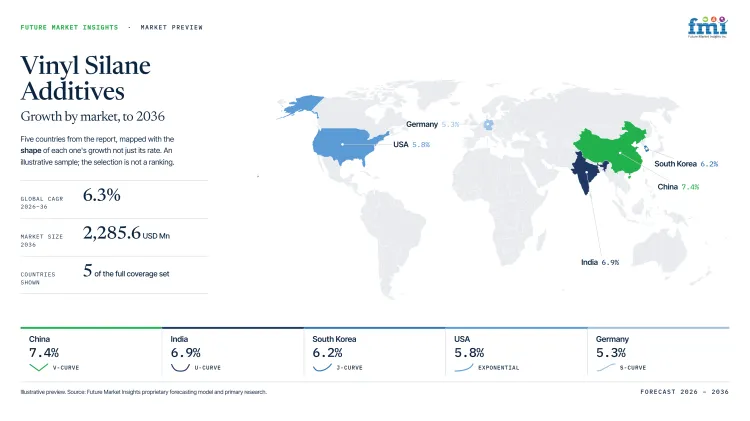
The five-country forecast range spans 1.2 percentage points and separates into a close South Korea-Taiwan pair, a USA transition point and a Germany-Japan lower pair. The narrow spacing reflects different grid investment cycles and material-qualification routines across mature cable markets, not current revenue or installed production capacity across these countries.
- South Korea ties semiconductor load growth to transmission planning and demanding cable qualification.
- Taiwan rewards nearby inventory because its compact electronics corridor concentrates cable demand.
- USA utility specifications lengthen raw-material validation across established cable and transmission accounts.
- Germany combines transmission approvals with REACH documentation and mature cable testing requirements.
- Japan finances transmission renewal as cable producers protect established recipes through long qualification cycles.
Similar forecasts therefore carry different qualification costs and service demands for entrants.
The full report provides country-level CAGR analysis across North America, Latin America, Europe, East Asia, South Asia, Oceania and the Middle East and Africa.
Country-wise Analysis
- South Korean cable compounders serve semiconductor and heavy-industry groups that expect stable lots plus rapid local troubleshooting during material qualification. The trade ministry's February 2025 power plan set 2038 target demand at 129.3 GW and linked additional load to semiconductors and data centers. Vinyl silane additive demand in South Korea is forecast to rise at 6.2% CAGR over the forecast period, supported by transmission work serving those concentrated loads. Established approved-material lists slow entry, and large cable accounts require production evidence prior to repeat orders. In-country application support also matters across high-volume manufacturing programs and tightly controlled production schedules for cable compounds.
- Taiwanese compounders work inside a compact electronics corridor that places cable plants and technical teams near industrial parks plus grid projects. Adoption of vinyl silane additives in Taiwan is estimated to expand at 6.0% CAGR through 2036, aided by concentrated electrical demand and short service distances. Humid handling and a smaller qualified account base reward moisture-protective packaging plus nearby inventory and local troubleshooting during scheduled cable runs. Taiwan's Ministry of Economic Affairs reported in November 2025 that distribution-related outages were 65% lower than in 2012 following sustained grid resilience work across industrial districts. Technical teams can respond quickly during qualification without carrying service distances across Taiwan's cable accounts.
- USA cable compounders purchase against detailed electrical specifications and long utility qualification cycles that make repeatable production evidence central to raw-material changes. Vinyl silane additive sales in the USA are forecast to expand at 5.8% CAGR by 2036, supported by grid-capacity work and replacement projects. The Department of Energy awarded USD 2.5 million in February 2026 for transmission studies at 20 under-used Pennsylvania interconnection points and noted federal permitting averages about four years. Long approval routes favor domestic inventory and detailed formulation records that reduce rework during qualification for utility cable accounts. Local technical teams also shorten response during plant trials and scheduled production changes for repeat qualification work.
- Bundesnetzagentur reported in January 2026 that roughly 2,000 kilometers of power lines gained approval during 2025 across Germany's mature transmission system. German cable processors work within REACH documentation and long-standing electrical specifications that raise the cost of changing qualified additives. Germany is estimated to post 5.3% CAGR over the forecast period, shaped by continuing grid construction and established cable manufacturing. Material changes remain slow as approved formulations carry established electrical and thermal records across long-standing cable accounts. Close application engineering therefore matters for crosslinking formulations that must enter existing qualification routines without disrupting scheduled production or forcing broad line revalidation.
- Japanese compounders protect established cable recipes with long evaluations as additive changes can alter crosslinking behavior across mature utility and industrial accounts. By 2036, Japan is projected to grow at 5.0% CAGR supported by transmission renewal and equipment replacement. High-purity grades and stable long-term supply reduce formulation risk, and local technical teams guide small-scale trials that precede wider plant use. METI reported in March 2026 that a Cabinet-approved bill would promote large intra-regional and inter-regional transmission lines with OCCTO financing for certified development plans. That policy enlarges the project pipeline, yet order conversion remains gradual as cable makers protect proven recipes and long supplier histories.
Who are the notable companies in the Vinyl Silane Additives Market?
Momentive, Wacker Chemie, Shin-Etsu Chemical, Evonik, Gelest / Mitsubishi Chemical Group, BRB International, Hubei Jianghan New Materials and Nanjing Union Silicon are the notable companies serving this market.
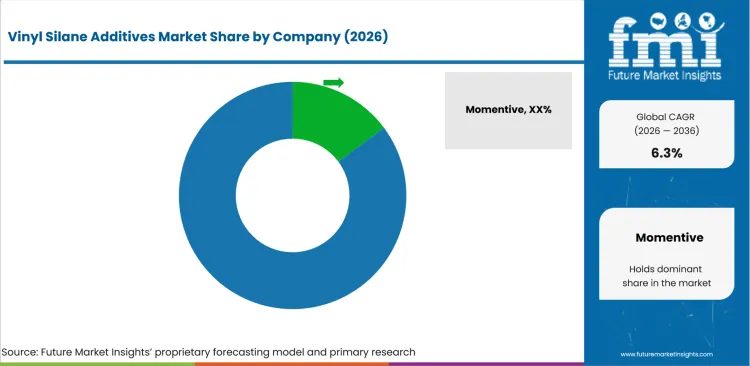
Global silane groups and specialty formulators compete with China-based producers in a fragmented field shaped by service depth. Cable compounders compare hydrolysis control and batch consistency as industrial adhesives extend coupling demand into filler treatment. Adhesives and sealants add another route, yet performance must be demonstrated ahead of any price-led switch.
- Integrated platforms: Momentive, Wacker Chemie, Shin-Etsu Chemical and Evonik pair silane chemistry with multi-region coverage.
- Specialty formulators: Gelest / Mitsubishi Chemical Group and BRB International pair silane portfolios with regional technical support.
- China-based manufacturers: Hubei Jianghan New Materials and Nanjing Union Silicon pair functional-silane production with export supply.
Competitive Benchmarking: Vinyl Silane Additives Market
| Company | Vinyl Monomer Coverage | Crosslinking Format Depth | Cable Application Evidence | Geographic Reach |
|---|---|---|---|---|
| Momentive | Unscored | Unscored | Unscored | North America, Europe and Asia |
| Wacker Chemie | Unscored | Unscored | Unscored | Europe, Asia and Americas |
| Shin-Etsu Chemical | Unscored | Unscored | Unscored | Japan, North America, Asia and Europe |
| Evonik | Unscored | Unscored | Unscored | Europe, Asia and Americas |
| Gelest / Mitsubishi Chemical Group | Unscored | Unscored | Unscored | North America with EMEA and India distribution support |
| BRB International | High | Unscored | Medium | Europe, United Kingdom and international distribution |
| Hubei Jianghan New Materials | High | High | Medium | China with export reach |
| Nanjing Union Silicon | Unscored | Unscored | Unscored | China, North America and export markets |
Key Developments in the Vinyl Silane Additives Market
- In January 2026, Gelest / Mitsubishi Chemical Group transferred EMEA silane sales to Nordmann and localized technical plus regulatory support.
- In February 2025, Momentive signed a definitive Asia-Pacific silanes joint-venture agreement with Jiangxi Hungpai New Material subject to regulatory approvals.
- In January 2025, Evonik launched Smart Effects by combining its silica and silanes businesses into one operating platform.
Key Players in the Vinyl Silane Additives Market
Global Organofunctional Silane Platforms
- Momentive
- Wacker Chemie
- Shin-Etsu Chemical
- Evonik
Specialty Silane and Formulation Companies
- Gelest / Mitsubishi Chemical Group
- BRB International
China-Based Functional Silane Producers
- Hubei Jianghan New Materials
- Nanjing Union Silicon
Vinyl Silane Additives Market - Report Scope
| Coverage field | Report scope |
|---|---|
| Market breakdown | By product type, function, polymer use, application, sales channel and region. |
| Quantitative Units | Revenue in USD million and CAGR in %. |
| Market Definition | Commercial vinyl-functional silane additives used for moisture crosslinking, adhesion promotion, filler coupling, surface modification and polymer grafting across qualified polymer formulations. |
| Regions Covered | North America, Latin America, Europe, East Asia, South Asia and Pacific, and Middle East and Africa. |
| Countries Covered | South Korea, Taiwan, USA, Germany, Japan, and 20+ countries included in the full report. |
| Key Companies Profiled | Momentive, Wacker Chemie, Shin-Etsu Chemical, Evonik, Gelest / Mitsubishi Chemical Group, BRB International, Hubei Jianghan New Materials, Nanjing Union Silicon. |
| Forecast Period | 2026 to 2036. |
| Approach | Primary and secondary research with market triangulation. |
Vinyl Silane Additives Market - Research Methodology
| Method | Approach |
|---|---|
| Primary Research | FMI analysts gathered input from manufacturers, service providers, technology developers, distributors, end users, procurement teams, and subject-matter experts. Interviews examined purchasing decisions, product or service evaluation, adoption barriers, approval requirements, pricing considerations, and expectations for technical or commercial support. Respondents were also asked what evidence is required before a trial, pilot, or initial order develops into regular purchasing. |
| Desk Research | Desk research covered government statistics, regulatory publications, trade data, industry associations, technical literature, standards, company filings, product information, and official corporate announcements. Sources were reviewed for relevance, publication date, geographic coverage, and consistency with the defined market scope. Claims relating to performance, applications, approvals, capacity, investment, and commercial activity were retained only when supported by credible public evidence. |
| Market Sizing and Forecasting | The market model combined the baseline value with historical performance, segment structure, pricing and volume indicators, adoption levels, company participation, and country-level demand conditions. Forecast assumptions considered economic activity, investment trends, regulatory developments, technology adoption, purchasing cycles, supply availability, and barriers to wider market use. Segment and regional estimates were reconciled before the final market total was calculated. |
| Data Validation | Estimates were checked against multiple independent indicators, including public data, company activity, trade patterns, industry developments, and findings from primary interviews. Validation also tested whether products, services, applications, and company revenues fell within the defined market boundaries. Adjacent categories, unsupported claims, overlapping revenues, and activities without direct market relevance were excluded to reduce double counting and maintain consistency across segments and countries. |
Vinyl Silane Additives Market by Segments
Vinyl Silane Additives Market segmented by Product Type:
- Vinyltrimethoxysilane
- Vinyltriethoxysilane
- Vinyltris(beta-methoxyethoxy)silane
- Functional silane blends
- Silane masterbatches
Vinyl Silane Additives Market segmented by Function:
- Moisture crosslinking
- Adhesion promotion
- Coupling / filler treatment
- Surface modification
- Grafting aid
Vinyl Silane Additives Market segmented by Polymer Use:
- XLPE cable compounds
- Polyolefins
- PVC compounds
- Elastomers
- Adhesives & sealants
Vinyl Silane Additives Market segmented by Application:
- Wire & cable insulation
- Pipes & tubing
- Adhesives / sealants
- Coatings
- Composite fillers
Vinyl Silane Additives Market segmented by Sales Channel:
- Cable compounders
- Direct chemical supply
- Distributors
- Masterbatch suppliers
Vinyl Silane Additives Market by Region:
- North America
- United States
- Canada
- Latin America
- Brazil
- Mexico
- Chile
- Rest of Latin America
- Western Europe
- Germany
- United Kingdom
- Italy
- Spain
- France
- Nordics
- Benelux
- Rest of Western Europe
- Eastern Europe
- Russia
- Poland
- Hungary
- Balkan and Baltic States
- Rest of Eastern Europe
- East Asia
- China
- Japan
- South Korea
- South Asia and Pacific
- India
- ASEAN
- Australia and New Zealand
- Rest of South Asia and Pacific
- Middle East and Africa
- Kingdom of Saudi Arabia
- Other GCC Countries
- Türkiye
- South Africa
- Other African Union Countries
- Rest of Middle East and Africa
Research Sources and Bibliography
- Gelest, Inc. (2026, February 12). Gelest Expands Customer Support in India Through Collaboration with Nordmann.
- Taiwan Power Company, Ministry of Economic Affairs. (2025, September 5). Reinforcing the Stability of Taoyuan's Power Supply-Taipower Plans Guanyuan Substation to Increase Assistance.
- Hubei Jianghan New Materials Co., Ltd. (2026, July 7). 湖北江瀚新材料股份有限公司关于部分募集资金投资项目延期的公告.
- Borealis. (2025, October 9). Borealis Expands XLPE Production in Sweden to Meet Rising Demand for Cable Insulation Materials.
- Borouge Plc. (2026, February 4). Borouge delivers outstanding $1.1 Billion 2025 net profit, boosted by exceptional operational performance and record sales.
- Borouge Plc. (2026, May 6). Borouge 4 Mega Project to Support UAE Energy Sector With First Batch of Materials.
- USA Department of Energy. (2026, March 12). Energy Department Announces $1.9B Investment in Critical Grid Infrastructure to Reduce Electricity Costs.
- BRB International B.V. (2025, April 25). BRB Ethoxylated Organo-Functional Silanes (OFS): A Comparison Between Ethoxy and Methoxy.
- BRB International B.V. (2026, March 27). Why are BRB Silanil Silanes gaining industry attention?
- Ministry of Trade, Industry and Energy, Republic of Korea. (2025, February 21). 「제11차 전력수급기본계획」 확정.
- Energy Administration, Ministry of Economic Affairs. (2025, November 20). Energy Transition Policy Direction Remains Unchanged with Diversified Deployment and Steady Promotion.
- USA Department of Energy. (2026, February 3). Energy Department Awards $2.5M to Accelerate Transmission, Lower Energy Costs, and Maintain a Reliable and Resilient Grid.
- Bundesnetzagentur. (2026, January 2). Energy transition clears crucial hurdle - significant progress in electricity grid expansion in 2025.
- Ministry of Economy, Trade and Industry, Japan. (2026, March 24). Cabinet Decision on the Bill for the Act for Partially Amending the Electricity Business Act.
- Momentive Performance Materials Inc. (2025, February 25). Momentive and Jiangxi Hungpai New Material Co., Ltd Announce Strategic Joint Venture Agreement in Asia Pacific
- Wacker Chemie AG. (2026, March 11). Key Products, Services and Business Processes.
- Shin-Etsu Chemical Co., Ltd. (2025, May). «Exhibition Report» 8th Paint & Coating Expo OSAKA.
- Evonik Industries AG. (2025, January 22). Evonik announces Smart Effects as a strategic merger of Silica and Silanes Business Line.
- Gelest, Inc. (2025, December 29). Gelest Appoints Nordmann as Primary EMEA Distribution Partner.
- Hubei Jianghan New Materials Co., Ltd. (n.d.). Development history. Retrieved August 11, 2026.
- Nanjing Union Silicon Chemical Co., Ltd. (2025, August 30). Radiation cross-linked cables and materials.
- Nanjing Union Silicon Chemical Co., Ltd. (n.d.). NANJING UNION SILICON CHEMICAL CO.,LTD. Retrieved August 11, 2026.
This bibliography is provided for reader reference and is not exhaustive. The full report contains the complete reference list and detailed citations.
This Report Answers
- How large is the vinyl silane additives market in 2026 and 2036?
- Which polymer mechanism converts vinyl silane into a recurring formulation input?
- Why do vinyltrimethoxysilane and moisture crosslinking hold the leading 2026 shares?
- How do XLPE cable compounds convert qualification into repeat purchasing?
- Which handling and hydrolysis conditions raise switching costs for vinyl-functional silanes?
- Why do the five profiled country CAGRs differ within a narrow spread?
- Which company capabilities matter most in competitive benchmarking beyond raw-material price?
- Which recent distribution and operating changes are altering commercial access to current silane portfolios?
Frequently Asked Questions
How big is the vinyl silane additives market in 2026?
The vinyl silane additives market is valued at USD 1.2 billion in 2026 and is projected to reach USD 2.3 billion by 2036. Qualified cable and pipe formulations support repeat demand for moisture-cure and bonding applications.
What is the CAGR of the vinyl silane additives market from 2026 to 2036?
The vinyl silane additives market is projected to grow at a CAGR of 6.3% between 2026 and 2036. Grid investment and established moisture-cure polyethylene routes support recurring demand across polymer compounds.
Which product type leads the vinyl silane additives market?
Vinyltrimethoxysilane is projected to account for 36.0% of the market in 2026. Its grafting and hydrolysis route fits qualified cable and pipe production recipes.
Which sales channel holds the largest share of the vinyl silane additives market?
Cable compounders are projected to account for 36.0% of the market in 2026. Their control of formulation qualification concentrates repeat purchasing before insulation and sheathing production.
Which companies are active in the vinyl silane additives market?
Key companies include Momentive, Wacker Chemie, Shin-Etsu Chemical, Evonik, Gelest / Mitsubishi Chemical Group, BRB International, Hubei Jianghan New Materials and Nanjing Union Silicon. They compete through silane platforms, formulation support and regional manufacturing or distribution.
Preview the report firsthand - request a free sample
Get SampleGet the brochure for pricing and purchase details.
Get PDFTable of Content
- Key Takeaways
- Market Size and CAGR
- Top Growth Driver
- Fastest Growing Segment
- Leading Region
- Key Companies
- Emerging Opportunities
- Executive Summary
- Global Market Outlook
- Demand-side Trends
- Supply-side Trends
- Technology Roadmap Analysis
- Analysis and Recommendations
- Analyst Perspective (What is happening? Why now? What should investors know?)
- Key Questions Answered
- How large is the market?
- What is the CAGR?
- What are key trends?
- Which region dominates?
- Who are the leaders?
- Market Overview
- Market Coverage / Taxonomy
- Market Definition / Scope / Limitations
- Research Methodology
- Chapter Orientation
- Analytical Lens and Working Hypotheses
- Market Structure, Signals, and Trend Drivers
- Benchmarking and Cross-market Comparability
- Market Sizing, Forecasting, and Opportunity Mapping
- Research Design and Evidence Framework
- Desk Research Programme (Secondary Evidence)
- Expert Input and Fieldwork (Primary Evidence)
- Tooling, Models, and Reference Databases
- Data Engineering and Model Build
- Quality Assurance and Audit Trail
- Market Background
- Market Dynamics (Drivers, Restraints, Opportunity, Trends)
- Scenario Forecast (Optimistic, Likely, Conservative)
- Impact Analysis
- AI Impact
- Sustainability Impact
- Regulatory Impact
- Technology Impact
- Consumer / Buyer Analysis
- Purchase Drivers
- Adoption Barriers
- Buyer Journey
- Opportunity Map Analysis
- Product Life Cycle Analysis
- Supply Chain Analysis
- Investment Feasibility Matrix
- Value Chain Analysis
- PESTLE and Porter's Analysis
- Regulatory Landscape
- Regional Parent Market Outlook
- Production and Consumption Statistics
- Import and Export Statistics
- Global Market Analysis and Forecast, 2021 to 2036
- Historical Market Size Value (USD Million) Analysis, 2021 to 2025
- Current and Future Market Size Value (USD Million) Projections, 2026 to 2036
- Y-o-Y Growth Trend Analysis
- Absolute $ Opportunity Analysis
- Global Market Pricing Analysis, 2021 to 2036
- Global Market Analysis and Forecast, By Product Type, 2021 to 2036
- Introduction / Key Findings
- Historical Market Size Value (USD Million) Analysis By Product Type, 2021 to 2025
- Current and Future Market Size Value (USD Million) Analysis and Forecast By Product Type, 2026 to 2036
- Vinyltrimethoxysilane
- Vinyltriethoxysilane
- Vinyltris(beta-methoxyethoxy)silane
- Functional silane blends
- Silane masterbatches
- Vinyltrimethoxysilane
- Y-o-Y Growth Trend Analysis By Product Type, 2021 to 2025
- Absolute $ Opportunity Analysis By Product Type, 2026 to 2036
- Global Market Analysis and Forecast, By Function, 2021 to 2036
- Introduction / Key Findings
- Historical Market Size Value (USD Million) Analysis By Function, 2021 to 2025
- Current and Future Market Size Value (USD Million) Analysis and Forecast By Function, 2026 to 2036
- Moisture crosslinking
- Adhesion promotion
- Coupling or filler treatment
- Surface modification
- Grafting aid
- Moisture crosslinking
- Y-o-Y Growth Trend Analysis By Function, 2021 to 2025
- Absolute $ Opportunity Analysis By Function, 2026 to 2036
- Global Market Analysis and Forecast, By Polymer Use, 2021 to 2036
- Introduction / Key Findings
- Historical Market Size Value (USD Million) Analysis By Polymer Use, 2021 to 2025
- Current and Future Market Size Value (USD Million) Analysis and Forecast By Polymer Use, 2026 to 2036
- XLPE cable compounds
- Polyolefins
- PVC compounds
- Elastomers
- Adhesives & sealants
- XLPE cable compounds
- Y-o-Y Growth Trend Analysis By Polymer Use, 2021 to 2025
- Absolute $ Opportunity Analysis By Polymer Use, 2026 to 2036
- Global Market Analysis and Forecast, By Application, 2021 to 2036
- Introduction / Key Findings
- Historical Market Size Value (USD Million) Analysis By Application, 2021 to 2025
- Current and Future Market Size Value (USD Million) Analysis and Forecast By Application, 2026 to 2036
- Wire & cable insulation
- Pipes & tubing
- Adhesives or sealants
- Coatings
- Composite fillers
- Wire & cable insulation
- Y-o-Y Growth Trend Analysis By Application, 2021 to 2025
- Absolute $ Opportunity Analysis By Application, 2026 to 2036
- Global Market Analysis and Forecast, By Sales Channel, 2021 to 2036
- Introduction / Key Findings
- Historical Market Size Value (USD Million) Analysis By Sales Channel, 2021 to 2025
- Current and Future Market Size Value (USD Million) Analysis and Forecast By Sales Channel, 2026 to 2036
- Cable compounders
- Direct chemical supply
- Distributors
- Masterbatch suppliers
- Cable compounders
- Y-o-Y Growth Trend Analysis By Sales Channel, 2021 to 2025
- Absolute $ Opportunity Analysis By Sales Channel, 2026 to 2036
- Global Market Analysis and Forecast, By Region, 2021 to 2036
- Introduction
- Historical Market Size Value (USD Million) Analysis By Region, 2021 to 2025
- Current Market Size Value (USD Million) Analysis and Forecast By Region, 2026 to 2036
- North America
- Latin America
- Western Europe
- Eastern Europe
- East Asia
- South Asia and Pacific
- Middle East & Africa
- Market Attractiveness Analysis By Region
- North America Market Analysis and Forecast, By Country, 2021 to 2036
- Historical Market Size Value (USD Million) Trend Analysis By Market Taxonomy, 2021 to 2025
- Market Size Value (USD Million) Forecast By Market Taxonomy, 2026 to 2036
- By Country
- USA
- Canada
- By Product Type
- By Function
- By Application
- By End Use
- By Sales Channel
- By Country
- Market Attractiveness Analysis
- By Country
- By Product Type
- By Function
- By Application
- By End Use
- By Sales Channel
- Key Takeaways
- Latin America Market Analysis and Forecast, By Country
- Historical Market Size Value (USD Million) Trend Analysis By Market Taxonomy, 2021 to 2025
- Market Size Value (USD Million) Forecast By Market Taxonomy, 2026 to 2036
- By Country
- Brazil
- Mexico
- Chile
- Rest of Latin America
- By Product Type
- By Function
- By Application
- By End Use
- By Sales Channel
- By Country
- Market Attractiveness Analysis
- By Country
- By Product Type
- By Function
- By Application
- By End Use
- By Sales Channel
- Key Takeaways
- Western Europe Market Analysis and Forecast, By Country
- Historical Market Size Value (USD Million) Trend Analysis By Market Taxonomy, 2021 to 2025
- Market Size Value (USD Million) Forecast By Market Taxonomy, 2026 to 2036
- By Country
- Germany
- UK
- Italy
- Spain
- France
- Nordic
- BENELUX
- Rest of Western Europe
- By Product Type
- By Function
- By Application
- By End Use
- By Sales Channel
- By Country
- Market Attractiveness Analysis
- By Country
- By Product Type
- By Function
- By Application
- By End Use
- By Sales Channel
- Key Takeaways
- Eastern Europe Market Analysis and Forecast, By Country
- Historical Market Size Value (USD Million) Trend Analysis By Market Taxonomy, 2021 to 2025
- Market Size Value (USD Million) Forecast By Market Taxonomy, 2026 to 2036
- By Country
- Russia
- Poland
- Hungary
- Balkan & Baltic
- Rest of Eastern Europe
- By Product Type
- By Function
- By Application
- By End Use
- By Sales Channel
- By Country
- Market Attractiveness Analysis
- By Country
- By Product Type
- By Function
- By Application
- By End Use
- By Sales Channel
- Key Takeaways
- East Asia Market Analysis and Forecast, By Country
- Historical Market Size Value (USD Million) Trend Analysis By Market Taxonomy, 2021 to 2025
- Market Size Value (USD Million) Forecast By Market Taxonomy, 2026 to 2036
- By Country
- China
- Japan
- South Korea
- By Product Type
- By Function
- By Application
- By End Use
- By Sales Channel
- By Country
- Market Attractiveness Analysis
- By Country
- By Product Type
- By Function
- By Application
- By End Use
- By Sales Channel
- Key Takeaways
- South Asia and Pacific Market Analysis and Forecast, By Country
- Historical Market Size Value (USD Million) Trend Analysis By Market Taxonomy, 2021 to 2025
- Market Size Value (USD Million) Forecast By Market Taxonomy, 2026 to 2036
- By Country
- India
- ASEAN
- Australia & New Zealand
- Rest of South Asia and Pacific
- By Product Type
- By Function
- By Application
- By End Use
- By Sales Channel
- By Country
- Market Attractiveness Analysis
- By Country
- By Product Type
- By Function
- By Application
- By End Use
- By Sales Channel
- Key Takeaways
- Middle East & Africa Market Analysis and Forecast, By Country
- Historical Market Size Value (USD Million) Trend Analysis By Market Taxonomy, 2021 to 2025
- Market Size Value (USD Million) Forecast By Market Taxonomy, 2026 to 2036
- By Country
- Kingdom of Saudi Arabia
- Other GCC Countries
- Türkiye
- South Africa
- Other African Union
- Rest of Middle East & Africa
- By Product Type
- By Function
- By Application
- By End Use
- By Sales Channel
- By Country
- Market Attractiveness Analysis
- By Country
- By Product Type
- By Function
- By Application
- By End Use
- By Sales Channel
- Key Takeaways
- Key Countries Market Analysis
- USA
- Pricing Analysis
- Market Share Analysis, 2025
- By Product Type
- By Function
- By Application
- By End Use
- By Sales Channel
- Canada
- Pricing Analysis
- Market Share Analysis, 2025
- By Product Type
- By Function
- By Application
- By End Use
- By Sales Channel
- Mexico
- Pricing Analysis
- Market Share Analysis, 2025
- By Product Type
- By Function
- By Application
- By End Use
- By Sales Channel
- Brazil
- Pricing Analysis
- Market Share Analysis, 2025
- By Product Type
- By Function
- By Application
- By End Use
- By Sales Channel
- Chile
- Pricing Analysis
- Market Share Analysis, 2025
- By Product Type
- By Function
- By Application
- By End Use
- By Sales Channel
- Germany
- Pricing Analysis
- Market Share Analysis, 2025
- By Product Type
- By Function
- By Application
- By End Use
- By Sales Channel
- UK
- Pricing Analysis
- Market Share Analysis, 2025
- By Product Type
- By Function
- By Application
- By End Use
- By Sales Channel
- Italy
- Pricing Analysis
- Market Share Analysis, 2025
- By Product Type
- By Function
- By Application
- By End Use
- By Sales Channel
- Spain
- Pricing Analysis
- Market Share Analysis, 2025
- By Product Type
- By Function
- By Application
- By End Use
- By Sales Channel
- France
- Pricing Analysis
- Market Share Analysis, 2025
- By Product Type
- By Function
- By Application
- By End Use
- By Sales Channel
- India
- Pricing Analysis
- Market Share Analysis, 2025
- By Product Type
- By Function
- By Application
- By End Use
- By Sales Channel
- ASEAN
- Pricing Analysis
- Market Share Analysis, 2025
- By Product Type
- By Function
- By Application
- By End Use
- By Sales Channel
- Australia & New Zealand
- Pricing Analysis
- Market Share Analysis, 2025
- By Product Type
- By Function
- By Application
- By End Use
- By Sales Channel
- China
- Pricing Analysis
- Market Share Analysis, 2025
- By Product Type
- By Function
- By Application
- By End Use
- By Sales Channel
- Japan
- Pricing Analysis
- Market Share Analysis, 2025
- By Product Type
- By Function
- By Application
- By End Use
- By Sales Channel
- South Korea
- Pricing Analysis
- Market Share Analysis, 2025
- By Product Type
- By Function
- By Application
- By End Use
- By Sales Channel
- Russia
- Pricing Analysis
- Market Share Analysis, 2025
- By Product Type
- By Function
- By Application
- By End Use
- By Sales Channel
- Poland
- Pricing Analysis
- Market Share Analysis, 2025
- By Product Type
- By Function
- By Application
- By End Use
- By Sales Channel
- Hungary
- Pricing Analysis
- Market Share Analysis, 2025
- By Product Type
- By Function
- By Application
- By End Use
- By Sales Channel
- Kingdom of Saudi Arabia
- Pricing Analysis
- Market Share Analysis, 2025
- By Product Type
- By Function
- By Application
- By End Use
- By Sales Channel
- Türkiye
- Pricing Analysis
- Market Share Analysis, 2025
- By Product Type
- By Function
- By Application
- By End Use
- By Sales Channel
- South Africa
- Pricing Analysis
- Market Share Analysis, 2025
- By Product Type
- By Function
- By Application
- By End Use
- By Sales Channel
- USA
- Market Structure Analysis
- Competition Dashboard
- Competition Benchmarking
- Market Share Analysis of Top Players
- By Regional
- By Product Type
- By Function
- By Application
- By End Use
- By Sales Channel
- Emerging Startups
- Innovation Benchmarking
- Competition Analysis
- Competition Deep Dive
- Momentive
- Overview
- Product Portfolio
- Profitability by Market Segments
- Sales Footprint
- Strategy Overview
- Marketing Strategy
- Product Strategy
- Channel Strategy
- Dow
- Wacker Chemie
- Shin-Etsu Chemical
- Evonik
- Gelest or Mitsubishi Chemical Group
- BRB International
- Hubei Jianghan New Materials
- Nanjing Union Silicon
- WD Silicone
- Momentive
- Case Studies
- Success Stories
- Recent Developments
- Competition Deep Dive
- Assumptions & Acronyms Used


