

- Market Size (2026)
- USD 1.0 Bn
- Forecast (2036)
- USD 4.8 Bn
- CAGR (2026 to 2036)
- 16.9%
How big is Viral Clearance Market in 2026?
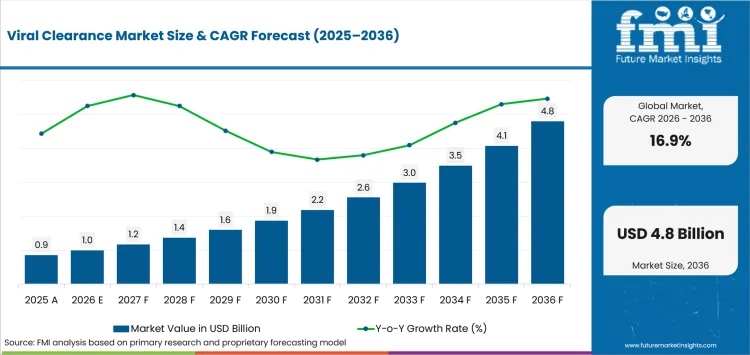
USD 1.0 billion in 2026 and USD 4.8 billion by 2036 at a 16.9% CAGR.
Sales in the viral clearance market are projected to grow from USD 1.0 billion in 2026 to USD 4.8 billion by 2036, expanding at a CAGR of 16.9% through the forecast period. Growth is tied directly to submission activity, since regulated biologics programs require documented viral safety controls not only at initial filing but at every significant manufacturing change thereafter, turning validation work into a recurring rather than one time cost. FDA's January 2025 CBER report recorded 17 biologics license applications and 26 biologics license application supplements during 2024 alone, and each of those filings requires defensible viral safety evidence for applicable cell-line-derived products and related manufacturing controls, a submission cadence that keeps clearance testing demand steady even between major product launches.
Restraints include the time and cost of running spiking studies and clearance validation for each manufacturing change, along with capacity constraints at specialized testing laboratories during peak filing periods. Opportunity lies in high throughput clearance testing platforms and modeling approaches that can reduce turnaround time without weakening regulatory defensibility. Segment level activity spans clearance validation studies, viral detection assays, and consulting or documentation services that support submissions. Regionally, North America leads on the density of biologics filings, while Europe and Asia Pacific adoption tracks the growth of domestic biologics manufacturing capacity.
Key Takeaways of Viral Clearance Market
- Viral safety guidance links raw-material controls with process reduction and product-stage testing across regulated biologics programs.
- Viral removal is projected at 51.0% of method demand in 2026 through filtration and chromatography steps.
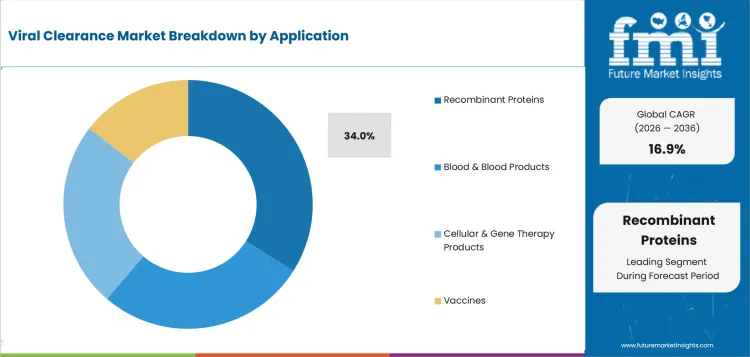
- Recombinant proteins are estimated at 34.0% of application demand through recurring antibody and therapeutic protein programs.
- Pharmaceutical and biotechnology companies are forecast at 51.0% of end-user demand through sponsor responsibility for processes and submissions.
- Scarce process material and assay interference can weaken detection limits or delay regulated study completion.
- Merck KGaA, Charles River Laboratories, WuXi Biologics, Sartorius AG, Texcell SA, Eurofins Scientific, Asahi Kasei Life Science Corp. and QuTEM AB cover testing, technology and characterization.
Analyst Perspective
“Commercial value depends on a scale-down model that reproduces the manufacturing step and preserves recovery within the product matrix. Sponsors should fix loading limits and neutralization controls before pivotal material enters regulated validation studies.”
- Anurag Sharma, Principal Consultant for Healthcare, Future Market Insights
How is the Viral Clearance Market segmented?
The viral clearance industry is segmented by method, application, end user, service type, product type and region.
The viral clearance market is segmented by method, application, end user, service type, product type and region. Method covers viral removal, viral inactivation and viral detection, while applications include recombinant proteins, blood products, cell and gene therapies and vaccines. End users span pharmaceutical and biotechnology companies, research organizations and specialized laboratories, while services cover testing, characterization and regulatory support and products include filtration, chromatography, inactivation and analytical tools.
How do biopharmaceutical developers evaluate recombinant proteins?
Commercial recombinant protein programs often reuse purification trains across antibodies and therapeutic products during development. Texcell presented a multi-virus-spiking assessment of chromatography steps at the PDA Virus Conference in June 2024, linking large molecule testing platform evidence with matrix-specific recovery checks.
- The recombinant proteins segment is likely to capture 34.0% share in 2026 attributable to recurring clearance studies across monoclonal antibodies and therapeutic proteins. Comparable unit operations across related processes support justified evidence reuse during regulated manufacturing changes and submissions.
- Formulation changes can alter low-pH exposure or filter performance, so development teams repeat recovery checks before extending earlier clearance evidence to a modified product.
What supports viral removal within the method category?
Virus-retentive filtration separates particles by size while chromatography removes viruses through selective binding or partition behavior. Process engineers compare virus removal filters with inactivation steps under the intended commercial operating range so one mechanism never carries the complete safety case.
- The method category is forecast to be led by viral removal at 51.0% share in 2026 due to measurable reduction across filtration and chromatography steps.
- Study design must establish representative loading and assay recovery before the formal reduction run begins. Asahi Kasei Life Science announced a fourth Planova spinning plant in July 2025 to expand supply for biotherapeutic manufacturing.
What makes pharmaceutical and biotechnology companies central to end-user demand?
Product sponsors define the commercial operating range and remain accountable for every viral safety argument submitted to regulators. Outsourced laboratory execution does not transfer responsibility for protocol approval or manufacturing-change assessment across clinical and commercial stages during regulated development.
- By end user, pharmaceutical and biotechnology companies are estimated to hold 51.0% in 2026 owing to sponsor-owned process definition and submission responsibility.
- Biopharmaceutical contract manufacturing arrangements require sponsors to convert laboratory results into a complete regulator-facing submission package. FDA’s October 2025 OTP town hall placed manufacturing controls and post-licensure change management within BLA planning for gene therapy facilities.
What role does viral clearance testing play within service-type demand?
Commercial viral clearance testing converts a manufacturing operation into quantitative reduction evidence through a representative scale-down model. WuXi Biologics reported in June 2026 that its Suzhou biosafety center supported 19 commercial biologics from 13 clients under a fourth EMA GMP certification.
- By service type, viral clearance testing is forecast to represent 42.0% in 2026 driven by recurring validation before submissions and significant manufacturing changes.
- Specialized laboratories retain repeat work by resolving matrix interference without consuming scarce additional process material. Reliable recovery and titration controls help sponsors schedule later studies around manufacturing changes and submission milestones.
What are the drivers, restraints and opportunities in the Viral Clearance Market?
Updated guidance expands validation while representative models complicate execution and early coordination supports justified evidence reuse.
- Driver: Updated viral safety guidance expands risk-based validation across established biologics and products that tolerate clearance operations.
- Restraint: Limited process material and nonrepresentative scale-down conditions can weaken assay sensitivity or regulatory interpretation.
- Opportunity: Early laboratory involvement aligns model design with process development and supports evidence reuse across comparable programs.
Biologics sponsors need one viral safety plan that links raw-material controls with pharmaceutical filtration and process reduction across regulated development. FDA adopted ICH Q5A(R2) in January 2024 and placed clearance planning within risk-based safety decisions.
Pharmaceutical sterility testing detects contamination but does not quantify virus reduction across a defined manufacturing step. Matrix interference can suppress recovery and force repeated method work with scarce pivotal material during formal validation.
Providers can pair biosimilar testing services with clearance studies across related purification programs during regulated development cycles. QuTEM reported in May 2026 that updated USP AAV8 certificates recognized cryogenic TEM for vector-particle characterization beside process-clearance evidence.
Which country CAGRs are profiled in the Viral Clearance Market?
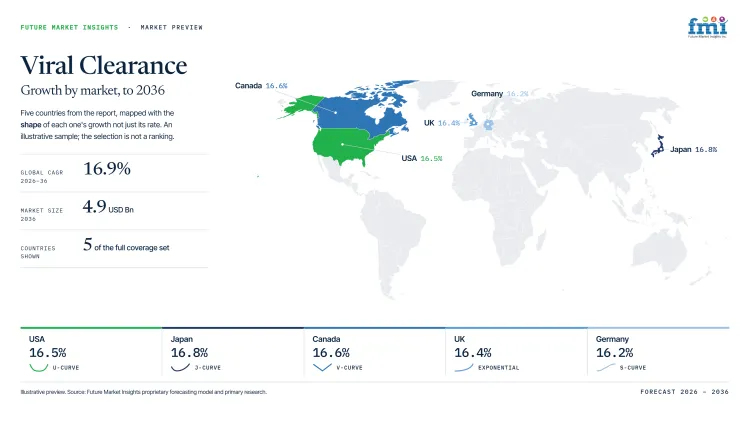
| Country | CAGR |
|---|---|
| South Korea | 17.8% |
| Japan | 16.8% |
| Canada | 16.6% |
| United States | 16.5% |
| United Kingdom | 16.4% |
| Germany | 16.2% |
How do country-level CAGRs compare in the Viral Clearance Market?
The country CAGR range spans 1.4 percentage points without measuring present revenue or installed testing capacity. Relative spacing reflects local manufacturing activity and analytical guidance alongside access to qualified biosafety laboratories.
- South Korea reflects concentrated commercial manufacturing that raises recurring demand for locally scheduled validation and submission-ready documentation.
- Japan shows structured consultation for molecular virus methods alongside established domestic biologics development and testing networks.
- Canada combines expanding biomanufacturing capacity with long sample routes between production sites and qualified laboratories.
- The United States combines broad biologics pipelines with several service networks, although pivotal studies depend on representative models and sensitive assays.
- The United Kingdom combines regional scale-up programs with specialist laboratory needs across multinational submission timelines.
Comparable CAGRs can produce different market entry conditions. The full report provides country-level CAGR analysis across North America, Latin America, Europe, East Asia, South Asia and Pacific, and the Middle East and Africa.
Country-wise Analysis
- Songdo concentrates large biologics plants near established logistics and regulatory infrastructure, shortening transfers of scarce validation material between manufacturing sites and qualified biosafety laboratories serving antibody and advanced-therapy programs alongside recombinant protein production worldwide. Invest Korea reported in April 2026 that the cluster roadmap targets production capacity above 2.14 million liters by 2030, expanding the number of commercial programs that require repeated process validation across several modalities. The South Korean viral clearance sector is projected to record 17.8% CAGR during the assessment period, supported by recurring commercial campaigns although limited laboratory slots can delay synchronized studies and submission-ready documentation.
- Japanese developers must justify molecular virus methods against established infectivity tests, so early regulatory discussion remains central whenever analytical packages change during late-stage development or commercial manufacturing transfers across domestic and multinational submissions. Adoption of viral clearance services in Japan is estimated to expand at 16.8% CAGR through 2036, aided by biologics programs and structured consultation routes for emerging detection methods across domestic and multinational programs. PMDA issued January 2026 considerations covering assay validation and specimen selection for proposed next-generation sequencing methods, yet sponsors require infectivity evidence whenever nucleic-acid detection cannot answer the complete viral safety question by itself.
- Canada’s vaccine and therapeutic facilities are distributed across several provinces, making validated sample logistics essential for studies using scarce process material and time-sensitive virus stocks between production sites and qualified biosafety laboratories nationwide domestically. Federal officials reported in September 2025 that public investment had supported 43 new or expanded biomanufacturing and life-sciences projects since March 2020, broadening domestic programs requiring regulated viral safety evidence for commercial submissions nationally. In Canada, viral clearance demand is predicted to advance at 16.6% CAGR through 2036, supported by broader domestic production as long transport routes require controlled sample handling and local project management.
- United States sponsors can access several testing networks across major biopharmaceutical regions, yet pivotal programs must preserve comparability through manufacturing changes and avoid repeated studies using irreplaceable process material for regulator-facing commercial validation packages. The United States is estimated to post 16.5% CAGR over the forecast period, reinforced by diverse antibody and advanced-therapy pipelines across active clinical development and commercial manufacturing within several domestic manufacturing clusters. FDA announced in July 2026 that a September workshop would examine next-generation sequencing for adventitious-agent detection, reinforcing sponsor responsibility for representative models and sensitive assays during later manufacturing changes across regulated commercial programs.
- United Kingdom biologics programs often progress from translational research into commercial validation through regional manufacturing networks, requiring specialist laboratories that support regulated multinational submissions and coordinated material transfers through clinical and commercial development stages. The government’s July 2025 Life Sciences Sector Plan links national research investment with advanced manufacturing across regional hubs, strengthening commercial scale-up routes for domestic biologics programs that need regulator-facing viral safety evidence. Viral clearance sales in the United Kingdom are forecast to expand at 16.4% CAGR by 2036, supported by scale-up activity although constrained specialist capacity can complicate scheduling and international sample transfers during validation.
Who are the notable companies in the Viral Clearance Market?
Merck KGaA, Charles River Laboratories, WuXi Biologics, Sartorius AG, Texcell SA, Eurofins Scientific, Asahi Kasei Life Science Corp. and QuTEM AB are the notable companies serving this market.
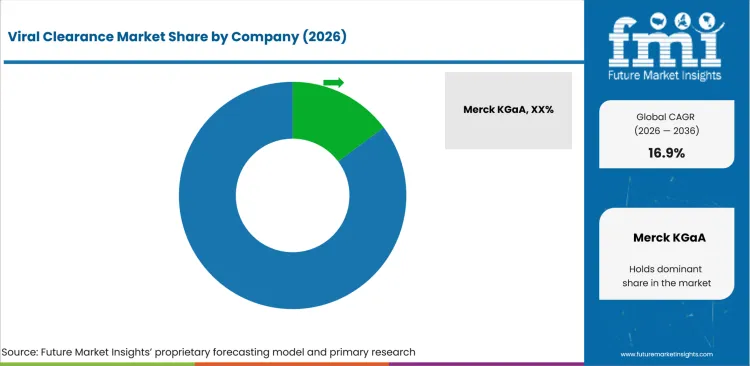
The field remains fragmented as no single provider covers every removal technology, biosafety assay and laboratory route. Entry barriers remain high as regulated studies require containment facilities and GLP systems alongside qualified virus stocks and staff who can reproduce unit operations at study scale.
- Merck KGaA, Sartorius AG and Asahi Kasei Life Science Corp. connect process technology with viral clearance studies or biosafety testing.
- Charles River Laboratories, WuXi Biologics, Texcell SA and Eurofins Scientific compete through GLP study execution and broader biosafety programs.
- QuTEM AB differentiates through GMP transmission electron microscopy for viral-vector characterization and therapeutic nanoparticle analysis services.
Competitive Benchmarking: Viral Clearance Market
| Company | Clearance Study Execution | Removal and Inactivation Coverage | Detection and Characterization | Geographic Reach |
|---|---|---|---|---|
| Merck KGaA | High | High | High | Global |
| Charles River Laboratories | High | High | High | North America and Europe |
| WuXi Biologics | High | High | High | Asia with global client programs |
| Sartorius AG | High | High | Medium | Global |
| Texcell SA | High | High | High | Europe, North America and Asia |
| Eurofins Scientific | High | High | High | Europe and North America |
| Asahi Kasei Life Science Corp. | High | High | High | Global |
| QuTEM AB | Low | Low | High | Europe and North America |
Scoring basis: Clearance Study Execution is High for current GLP evidence across several product or process families, Medium for narrower regulated execution and Low for specialists without full clearance studies. Removal and Inactivation Coverage is High for several unit-operation families, Medium for one or two families and Low for analytical specialists without process execution. Detection and Characterization is High for several infectivity or molecular methods alongside a documented microscopy capability. Medium applies to one analytical family, and Low applies to process-only offers without direct testing. Geographic Reach records documented operating scope and does not represent service quality or capability depth.
Key Developments in the Viral Clearance Market
- In May 2026, Merck KGaA signed a five-year agreement to provide analytical and biosafety release testing for three FDA-approved Genetix Biotherapeutics gene therapies as part of Merck's broader end-to-end biosafety testing portfolio
- In March 2026, Charles River Laboratories announced 200 square meters of additional Cologne laboratory space dedicated to viral clearance studies from the second quarter of 2026.
- In March 2026, QuTEM AB launched USA satellite laboratory operations with Boston University for localized AAV electron-microscopy analysis and completed its first client project through the new workflow.
Key Players in the Viral Clearance Market
Integrated Viral Safety Platforms
- Merck KGaA
- Sartorius AG
- Asahi Kasei Life Science Corp.
Contract Viral Clearance and Biosafety Laboratories
- Charles River Laboratories
- WuXi Biologics
- Texcell SA
- Eurofins Scientific
Viral Characterization Specialists
- QuTEM AB
Viral Clearance Market - Report Scope
| Coverage field | Report scope |
|---|---|
| Market breakdown | By method, application, end user, service type, product type and region. |
| Quantitative Units | USD billion. |
| Market Definition | Products and services that remove, inactivate, detect or validate viral risk in biological manufacturing. |
| Regions Covered | North America, Latin America, Europe, East Asia, South Asia and Pacific, and Middle East and Africa. |
| Countries Covered | South Korea, Japan, Canada, United States, United Kingdom and 20+ countries included in the full report. |
| Key Companies Profiled | Merck KGaA, Charles River Laboratories, WuXi Biologics, Sartorius AG, Texcell SA, Eurofins Scientific, Asahi Kasei Life Science Corp. and QuTEM AB |
| Forecast Period | 2026 to 2036. |
| Approach | Primary and secondary research with market triangulation. |
Viral Clearance Market - Research Methodology
| Method | Approach |
|---|---|
| Primary Research | FMI analysts gathered input from manufacturers, service providers, technology developers, distributors, end users, procurement teams, and subject-matter experts. Interviews examined purchasing decisions, product or service evaluation, adoption barriers, approval requirements, pricing considerations, and expectations for technical or commercial support. Respondents were also asked what evidence is required before a trial, pilot, or initial order develops into regular purchasing. |
| Desk Research | Desk research covered government statistics, regulatory publications, trade data, industry associations, technical literature, standards, company filings, product information, and official corporate announcements. Sources were reviewed for relevance, publication date, geographic coverage, and consistency with the defined market scope. Claims relating to performance, applications, approvals, capacity, investment, and commercial activity were retained only when supported by credible public evidence. |
| Market Sizing and Forecasting | The market model combined the baseline value with historical performance, segment structure, pricing and volume indicators, adoption levels, company participation, and country-level demand conditions. Forecast assumptions considered economic activity, investment trends, regulatory developments, technology adoption, purchasing cycles, supply availability, and barriers to wider market use. Segment and regional estimates were reconciled before the final market total was calculated. |
| Data Validation | Estimates were checked against multiple independent indicators, including public data, company activity, trade patterns, industry developments, and findings from primary interviews. Validation also tested whether products, services, applications, and company revenues fell within the defined market boundaries. Adjacent categories, unsupported claims, overlapping revenues, and activities without direct market relevance were excluded to reduce double counting and maintain consistency across segments and countries. |
Viral Clearance Market by Segments
Viral Clearance Market segmented by Method:
- Viral Removal Method
- Viral Filtration
- Chromatography-Based Viral Removal
- Viral Inactivation Method
- Low-pH Inactivation
- Solvent-Detergent Inactivation
- Viral Detection Method
- In Vitro Virus Detection
- Molecular Virus Detection
Viral Clearance Market segmented by Application:
- Recombinant Proteins
- Monoclonal Antibodies
- Recombinant Therapeutic Proteins
- Blood & Blood Products
- Plasma-Derived Products
- Blood Coagulation Factors
- Cellular & Gene Therapy Products
- Cell Therapy Products
- Gene Therapy Vectors
- Vaccines
- Viral Vaccines
- Non-Viral Vaccine Products
Viral Clearance Market segmented by End User:
- Pharmaceutical & Biotechnology Companies
- Biopharmaceutical Manufacturers
- Biotechnology Companies
- Contract Research Organizations
- Viral Clearance Testing CROs
- Biosafety Testing CROs
- Academic & Research Institutes
- University Research Centers
- Government Research Institutes
- Others
- Specialized Testing Laboratories
- Independent Biosafety Laboratories
Viral Clearance Market segmented by Service Type:
- Viral Clearance Testing
- Scale-Down Studies
- Process Validation Studies
- Viral Clearance Services
- Viral Removal Studies
- Viral Inactivation Studies
- Viral Detection & Characterization
- Virus Detection
- Virus Characterization
- Consulting & Regulatory Support
- Regulatory Consulting
- Process Development Support
Viral Clearance Market segmented by Product Type:
- Viral Filtration Products
- Virus Removal Filters
- Membrane-Based Filtration Systems
- Chromatography Products
- Chromatography Resins
- Membrane Chromatography
- Viral Inactivation Products
- Low-pH Inactivation Systems
- Solvent-Detergent Systems
- Other Products
- Virus Detection Kits
- Analytical Testing Products
Viral Clearance Market by Region:
- North America
- United States
- Canada
- Latin America
- Brazil
- Mexico
- Chile
- Rest of Latin America
- Western Europe
- Germany
- United Kingdom
- Italy
- Spain
- France
- Nordics
- Benelux
- Rest of Western Europe
- Eastern Europe
- Russia
- Poland
- Hungary
- Balkan and Baltic States
- Rest of Eastern Europe
- East Asia
- China
- Japan
- South Korea
- South Asia and Pacific
- India
- ASEAN
- Australia and New Zealand
- Rest of South Asia and Pacific
- Middle East and Africa
- Kingdom of Saudi Arabia
- Other GCC Countries
- Türkiye
- South Africa
- Other African Union Countries
- Rest of Middle East and Africa
Research Sources and Bibliography
- USA Food and Drug Administration. (2025, January 17). CY 2024 Report from the Director.
- Asahi Kasei Life Science Corp. (2025, July 29). Asahi Kasei Expands Planova™ Production with New Spinning Plant, Strengthening Life Science's Global Bioprocess Supply Capabilities.
- Texcell. (2024, June 24). Meet Texcell at the PDA Virus Conference in Amsterdam.
- USA Food and Drug Administration. (2025, October 22). OTP Town Hall: Gene Therapy Manufacturing CMC and Facility Readiness for BLAs and Post-licensure Changes.
- WuXi Biologics. (2026, June 18). WuXi Biologics’ Suzhou Biosafety Testing Center Received Fourth EMA GMP Certification, Enabling 19 Commercial Products for the European Market.
- USA Food and Drug Administration. (2024, January). Q5A(R2) Viral Safety Evaluation of Biotechnology Products Derived from Cell Lines of Human or Animal Origin.
- QuTEM AB. (2026, May 20). CryoTEM recognized as official analytical method in USP AAV8 reference standard certificates.
- Invest Korea. (2026, April 9). Korea’s Bio Clusters Leap Toward a Global Bio Hub: The Convergence of Global Manufacturing Capabilities and an Innovation Ecosystem.
- Pharmaceuticals and Medical Devices Agency. (2026, January 22). Points to Consider for Replacement of Conventional Tests for Viruses with Next Generation Sequencing (NGS) Assays (Early Consideration).
- Innovation, Science and Economic Development Canada. (2025, September 19). Government of Canada announces major milestone in the Canadian biomanufacturing sector.
- USA Food and Drug Administration. (2026, July 10). FDA SCIENTIFIC PUBLIC WORKSHOP: NEXT-GENERATION SEQUENCING FOR ADVENTITIOUS AGENT DETECTION IN BIOLOGICS - 09/23/2026.
- Department for Business and Trade, Department of Health and Social Care, Department for Science, Innovation and Technology, & Office for Life Sciences. (2025, July 16). Life Sciences Sector Plan.
- Merck KGaA. (2026, May 7). Merck Becomes Sole Testing Provider for Genetix Biotherapeutics’ FDA-Approved Gene Therapies.
- Charles River Laboratories. (2026, March 24). Expanding Biologics Testing in Cologne.
- QuTEM AB. (2026, March 10). QuTEM Collaborates with Boston University to Bring Advanced Quality Control Analysis to American Gene Therapy Developers.
- Sartorius AG. (2026). Virus Clearance Validation Services - Confidence®. Retrieved August 4, 2026.
- Texcell. (2026). Viral Clearance Studies. Retrieved August 4, 2026.
- Eurofins BioPharma Product Testing Europe. (2025, October). Eurofins BPT Italy offers enhanced access to viral clearance studies.
- Asahi Kasei Corp. (2025, April 1). Asahi Kasei Life Science begins operation.
- ViruSure GmbH. (2026). Viral Clearance Studies. Retrieved August 4, 2026.
- QuTEM AB. (2024, May 2). GMP certificates.
This bibliography is provided for reader reference and is not exhaustive. The full report contains the complete reference list and detailed citations
This Report Answers
- How large is the Viral Clearance Market in 2026 and 2036?
- Which method accounts for the significant 2026 market share?
- Why do recombinant proteins shape recurring viral clearance demand?
- Which end users retain responsibility for study design and submissions?
- How does ICH Q5A(R2) change viral safety planning?
- What execution constraints can delay pivotal clearance studies?
- How do country growth routes differ across regulated biopharma markets?
- Which companies provide direct viral clearance, biosafety or characterization capabilities?
- Which recent developments are changing regulated capacity and commercial service access?
Frequently Asked Questions
How big is the Viral Clearance Market in 2026?
USD 1.0 billion represents the viral clearance market value in 2026 across products and specialized testing services. Regulated biologics programs require representative scale-down studies and sensitive analytical controls before the viral clearance market reaches USD 4.9 billion by 2036.
What is the CAGR of the Viral Clearance Market from 2026 to 2036?
A 16.9% CAGR is projected for the viral clearance market from 2026 to 2036 across products and specialized services. Updated viral safety guidance connects raw-material testing with process reduction and product-stage controls throughout regulated biologics development and major manufacturing changes.
Which method leads the Viral Clearance Market?
Viral removal accounts for 51.0% of the viral clearance market by method in 2026 across regulated biological manufacturing. Filtration and chromatography provide measurable reduction steps that sponsors can evaluate alongside inactivation and detection controls within one defensible viral safety strategy.
How much will the Viral Clearance Market add between 2026 and 2036?
Approximately USD 3.9 billion is expected to be added to the viral clearance market between 2026 and 2036. Providers must expand qualified study capacity while maintaining assay sensitivity and representative process conditions across commercial biologics programs and regulated manufacturing changes.
Which companies are active in the Viral Clearance Market?
Companies active in the viral clearance market include Merck KGaA, Charles River Laboratories, WuXi Biologics, Sartorius AG, Texcell SA, Eurofins Scientific, Asahi Kasei Life Science Corp. and QuTEM AB. The group covers regulated study execution, virus-removal technology, biosafety testing and specialized characterization across major biologics modalities.
Preview the report firsthand - request a free sample
Get SampleGet the brochure for pricing and purchase details.
Get PDFTable of Content
- Key Takeaways
- Market Size and CAGR
- Top Growth Driver
- Fastest Growing Segment
- Leading Region
- Key Companies
- Emerging Opportunities
- Executive Summary
- Global Market Outlook
- Demand-side Trends
- Supply-side Trends
- Technology Roadmap Analysis
- Analysis and Recommendations
- Analyst Perspective (What is happening? Why now? What should investors know?)
- Key Questions Answered
- How large is the market?
- What is the CAGR?
- What are key trends?
- Which region dominates?
- Who are the leaders?
- Market Overview
- Market Coverage / Taxonomy
- Market Definition / Scope / Limitations
- Research Methodology
- Chapter Orientation
- Analytical Lens and Working Hypotheses
- Market Structure, Signals, and Trend Drivers
- Benchmarking and Cross-market Comparability
- Market Sizing, Forecasting, and Opportunity Mapping
- Research Design and Evidence Framework
- Desk Research Programme (Secondary Evidence)
- Expert Input and Fieldwork (Primary Evidence)
- Tooling, Models, and Reference Databases
- Data Engineering and Model Build
- Quality Assurance and Audit Trail
- Market Background
- Market Dynamics (Drivers, Restraints, Opportunity, Trends)
- Scenario Forecast (Optimistic, Likely, Conservative)
- Impact Analysis
- AI Impact
- Sustainability Impact
- Regulatory Impact
- Technology Impact
- Consumer / Buyer Analysis
- Purchase Drivers
- Adoption Barriers
- Buyer Journey
- Opportunity Map Analysis
- Product Life Cycle Analysis
- Supply Chain Analysis
- Investment Feasibility Matrix
- Value Chain Analysis
- PESTLE and Porter's Analysis
- Regulatory Landscape
- Regional Parent Market Outlook
- Production and Consumption Statistics
- Import and Export Statistics
- Global Market Analysis and Forecast, 2021 to 2036
- Historical Market Size Value (USD Billion) Analysis, 2021 to 2025
- Current and Future Market Size Value (USD Billion) Projections, 2026 to 2036
- Y-o-Y Growth Trend Analysis
- Absolute $ Opportunity Analysis
- Global Market Pricing Analysis, 2021 to 2036
- Global Market Analysis and Forecast, By Method, 2021 to 2036
- Introduction / Key Findings
- Historical Market Size Value (USD Billion) Analysis By Method, 2021 to 2025
- Current and Future Market Size Value (USD Billion) Analysis and Forecast By Method, 2026 to 2036
- Viral Removal Method
- Viral Filtration
- Chromatography-Based Viral Removal
- Viral Inactivation Method
- Low-pH Inactivation
- Solvent-Detergent Inactivation
- Viral Detection Method
- In Vitro Virus Detection
- Molecular Virus Detection
- Viral Removal Method
- Y-o-Y Growth Trend Analysis By Method, 2021 to 2025
- Absolute $ Opportunity Analysis By Method, 2026 to 2036
- Global Market Analysis and Forecast, By Application, 2021 to 2036
- Introduction / Key Findings
- Historical Market Size Value (USD Billion) Analysis By Application, 2021 to 2025
- Current and Future Market Size Value (USD Billion) Analysis and Forecast By Application, 2026 to 2036
- Recombinant Proteins
- Monoclonal Antibodies
- Recombinant Therapeutic Proteins
- Blood & Blood Products
- Plasma-Derived Products
- Blood Coagulation Factors
- Cellular & Gene Therapy Products
- Cell Therapy Products
- Gene Therapy Vectors
- Vaccines
- Viral Vaccines
- Non-Viral Vaccine Products
- Recombinant Proteins
- Y-o-Y Growth Trend Analysis By Application, 2021 to 2025
- Absolute $ Opportunity Analysis By Application, 2026 to 2036
- Global Market Analysis and Forecast, By End User, 2021 to 2036
- Introduction / Key Findings
- Historical Market Size Value (USD Billion) Analysis By End User, 2021 to 2025
- Current and Future Market Size Value (USD Billion) Analysis and Forecast By End User, 2026 to 2036
- Pharmaceutical & Biotechnology Companies
- Biopharmaceutical Manufacturers
- Biotechnology Companies
- Contract Research Organizations
- Viral Clearance Testing CROs
- Biosafety Testing CROs
- Academic & Research Institutes
- University Research Centers
- Government Research Institutes
- Others
- Specialized Testing Laboratories
- Independent Biosafety Laboratories
- Pharmaceutical & Biotechnology Companies
- Y-o-Y Growth Trend Analysis By End User, 2021 to 2025
- Absolute $ Opportunity Analysis By End User, 2026 to 2036
- Global Market Analysis and Forecast, By Service Type, 2021 to 2036
- Introduction / Key Findings
- Historical Market Size Value (USD Billion) Analysis By Service Type, 2021 to 2025
- Current and Future Market Size Value (USD Billion) Analysis and Forecast By Service Type, 2026 to 2036
- Viral Clearance Testing
- Scale-Down Studies
- Process Validation Studies
- Viral Clearance Services
- Viral Removal Studies
- Viral Inactivation Studies
- Viral Detection & Characterization
- Virus Detection
- Virus Characterization
- Consulting & Regulatory Support
- Regulatory Consulting
- Process Development Support
- Viral Clearance Testing
- Y-o-Y Growth Trend Analysis By Service Type, 2021 to 2025
- Absolute $ Opportunity Analysis By Service Type, 2026 to 2036
- Global Market Analysis and Forecast, By Product Type, 2021 to 2036
- Introduction / Key Findings
- Historical Market Size Value (USD Billion) Analysis By Product Type, 2021 to 2025
- Current and Future Market Size Value (USD Billion) Analysis and Forecast By Product Type, 2026 to 2036
- Viral Filtration Products
- Virus Removal Filters
- Membrane-Based Filtration Systems
- Chromatography Products
- Chromatography Resins
- Membrane Chromatography
- Viral Inactivation Products
- Low-pH Inactivation Systems
- Solvent-Detergent Systems
- Other Products
- Virus Detection Kits
- Analytical Testing Products
- Viral Filtration Products
- Y-o-Y Growth Trend Analysis By Product Type, 2021 to 2025
- Absolute $ Opportunity Analysis By Product Type, 2026 to 2036
- Global Market Analysis and Forecast, By Region, 2021 to 2036
- Introduction
- Historical Market Size Value (USD Billion) Analysis By Region, 2021 to 2025
- Current Market Size Value (USD Billion) Analysis and Forecast By Region, 2026 to 2036
- North America
- Latin America
- Western Europe
- Eastern Europe
- East Asia
- South Asia and Pacific
- Middle East & Africa
- Market Attractiveness Analysis By Region
- North America Market Analysis and Forecast, By Country, 2021 to 2036
- Historical Market Size Value (USD Billion) Trend Analysis By Market Taxonomy, 2021 to 2025
- Market Size Value (USD Billion) Forecast By Market Taxonomy, 2026 to 2036
- By Country
- USA
- Canada
- By Method
- By Application
- By End User
- By Service Type
- By Product Type
- By Country
- Market Attractiveness Analysis
- By Country
- By Method
- By Application
- By End User
- By Service Type
- By Product Type
- Key Takeaways
- Latin America Market Analysis and Forecast, By Country
- Historical Market Size Value (USD Billion) Trend Analysis By Market Taxonomy, 2021 to 2025
- Market Size Value (USD Billion) Forecast By Market Taxonomy, 2026 to 2036
- By Country
- Brazil
- Mexico
- Chile
- Rest of Latin America
- By Method
- By Application
- By End User
- By Service Type
- By Product Type
- By Country
- Market Attractiveness Analysis
- By Country
- By Method
- By Application
- By End User
- By Service Type
- By Product Type
- Key Takeaways
- Western Europe Market Analysis and Forecast, By Country
- Historical Market Size Value (USD Billion) Trend Analysis By Market Taxonomy, 2021 to 2025
- Market Size Value (USD Billion) Forecast By Market Taxonomy, 2026 to 2036
- By Country
- Germany
- UK
- Italy
- Spain
- France
- Nordic
- BENELUX
- Rest of Western Europe
- By Method
- By Application
- By End User
- By Service Type
- By Product Type
- By Country
- Market Attractiveness Analysis
- By Country
- By Method
- By Application
- By End User
- By Service Type
- By Product Type
- Key Takeaways
- Eastern Europe Market Analysis and Forecast, By Country
- Historical Market Size Value (USD Billion) Trend Analysis By Market Taxonomy, 2021 to 2025
- Market Size Value (USD Billion) Forecast By Market Taxonomy, 2026 to 2036
- By Country
- Russia
- Poland
- Hungary
- Balkan & Baltic
- Rest of Eastern Europe
- By Method
- By Application
- By End User
- By Service Type
- By Product Type
- By Country
- Market Attractiveness Analysis
- By Country
- By Method
- By Application
- By End User
- By Service Type
- By Product Type
- Key Takeaways
- East Asia Market Analysis and Forecast, By Country
- Historical Market Size Value (USD Billion) Trend Analysis By Market Taxonomy, 2021 to 2025
- Market Size Value (USD Billion) Forecast By Market Taxonomy, 2026 to 2036
- By Country
- China
- Japan
- South Korea
- By Method
- By Application
- By End User
- By Service Type
- By Product Type
- By Country
- Market Attractiveness Analysis
- By Country
- By Method
- By Application
- By End User
- By Service Type
- By Product Type
- Key Takeaways
- South Asia and Pacific Market Analysis and Forecast, By Country
- Historical Market Size Value (USD Billion) Trend Analysis By Market Taxonomy, 2021 to 2025
- Market Size Value (USD Billion) Forecast By Market Taxonomy, 2026 to 2036
- By Country
- India
- ASEAN
- Australia & New Zealand
- Rest of South Asia and Pacific
- By Method
- By Application
- By End User
- By Service Type
- By Product Type
- By Country
- Market Attractiveness Analysis
- By Country
- By Method
- By Application
- By End User
- By Service Type
- By Product Type
- Key Takeaways
- Middle East & Africa Market Analysis and Forecast, By Country
- Historical Market Size Value (USD Billion) Trend Analysis By Market Taxonomy, 2021 to 2025
- Market Size Value (USD Billion) Forecast By Market Taxonomy, 2026 to 2036
- By Country
- Kingdom of Saudi Arabia
- Other GCC Countries
- Türkiye
- South Africa
- Other African Union
- Rest of Middle East & Africa
- By Method
- By Application
- By End User
- By Service Type
- By Product Type
- By Country
- Market Attractiveness Analysis
- By Country
- By Method
- By Application
- By End User
- By Service Type
- By Product Type
- Key Takeaways
- Key Countries Market Analysis
- USA
- Pricing Analysis
- Market Share Analysis, 2025
- By Method
- By Application
- By End User
- By Service Type
- By Product Type
- Canada
- Pricing Analysis
- Market Share Analysis, 2025
- By Method
- By Application
- By End User
- By Service Type
- By Product Type
- Mexico
- Pricing Analysis
- Market Share Analysis, 2025
- By Method
- By Application
- By End User
- By Service Type
- By Product Type
- Brazil
- Pricing Analysis
- Market Share Analysis, 2025
- By Method
- By Application
- By End User
- By Service Type
- By Product Type
- Chile
- Pricing Analysis
- Market Share Analysis, 2025
- By Method
- By Application
- By End User
- By Service Type
- By Product Type
- Germany
- Pricing Analysis
- Market Share Analysis, 2025
- By Method
- By Application
- By End User
- By Service Type
- By Product Type
- UK
- Pricing Analysis
- Market Share Analysis, 2025
- By Method
- By Application
- By End User
- By Service Type
- By Product Type
- Italy
- Pricing Analysis
- Market Share Analysis, 2025
- By Method
- By Application
- By End User
- By Service Type
- By Product Type
- Spain
- Pricing Analysis
- Market Share Analysis, 2025
- By Method
- By Application
- By End User
- By Service Type
- By Product Type
- France
- Pricing Analysis
- Market Share Analysis, 2025
- By Method
- By Application
- By End User
- By Service Type
- By Product Type
- India
- Pricing Analysis
- Market Share Analysis, 2025
- By Method
- By Application
- By End User
- By Service Type
- By Product Type
- ASEAN
- Pricing Analysis
- Market Share Analysis, 2025
- By Method
- By Application
- By End User
- By Service Type
- By Product Type
- Australia & New Zealand
- Pricing Analysis
- Market Share Analysis, 2025
- By Method
- By Application
- By End User
- By Service Type
- By Product Type
- China
- Pricing Analysis
- Market Share Analysis, 2025
- By Method
- By Application
- By End User
- By Service Type
- By Product Type
- Japan
- Pricing Analysis
- Market Share Analysis, 2025
- By Method
- By Application
- By End User
- By Service Type
- By Product Type
- South Korea
- Pricing Analysis
- Market Share Analysis, 2025
- By Method
- By Application
- By End User
- By Service Type
- By Product Type
- Russia
- Pricing Analysis
- Market Share Analysis, 2025
- By Method
- By Application
- By End User
- By Service Type
- By Product Type
- Poland
- Pricing Analysis
- Market Share Analysis, 2025
- By Method
- By Application
- By End User
- By Service Type
- By Product Type
- Hungary
- Pricing Analysis
- Market Share Analysis, 2025
- By Method
- By Application
- By End User
- By Service Type
- By Product Type
- Kingdom of Saudi Arabia
- Pricing Analysis
- Market Share Analysis, 2025
- By Method
- By Application
- By End User
- By Service Type
- By Product Type
- Türkiye
- Pricing Analysis
- Market Share Analysis, 2025
- By Method
- By Application
- By End User
- By Service Type
- By Product Type
- South Africa
- Pricing Analysis
- Market Share Analysis, 2025
- By Method
- By Application
- By End User
- By Service Type
- By Product Type
- USA
- Market Structure Analysis
- Competition Dashboard
- Competition Benchmarking
- Market Share Analysis of Top Players
- By Regional
- By Method
- By Application
- By End User
- By Service Type
- By Product Type
- Emerging Startups
- Innovation Benchmarking
- Competition Analysis
- Competition Deep Dive
- Merck KGaA
- Overview
- Product Portfolio
- Profitability by Market Segments
- Sales Footprint
- Strategy Overview
- Marketing Strategy
- Product Strategy
- Channel Strategy
- Charles River Laboratories
- WuXi Biologics
- Sartorius AG
- Texcell SA
- Kedrion S.p.A.
- Vironova AB
- Clean Cells
- Thermo Fisher Scientific Inc.
- Eurofins Scientific
- Others
- Merck KGaA
- Case Studies
- Success Stories
- Recent Developments
- Competition Deep Dive
- Assumptions & Acronyms Used


