

- Market Size (2026)
- USD 6.2 Bn
- Forecast (2036)
- USD 12.0 Bn
- CAGR (2026 to 2036)
- 6.8%
How big is Viscoelastic Foam Market in 2026?
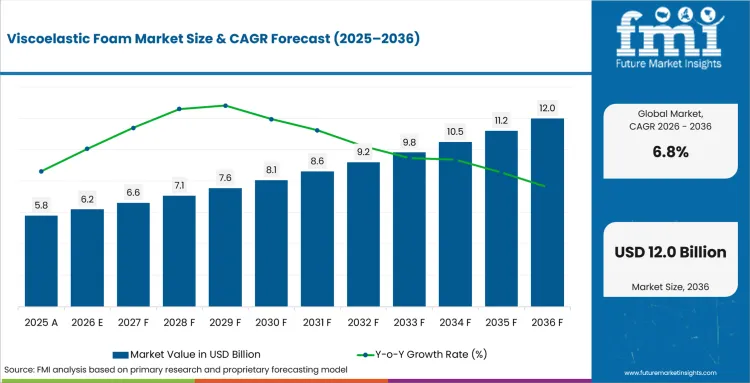
USD 6.2 billion in 2026 and USD 12.0 billion by 2036 at a 6.8% CAGR.
Demand for viscoelastic foam is projected to expand at 6.8% CAGR between 2026 and 2036, increasing valuation from USD 6.2 billion in 2026 to USD 12.0 billion by 2036. Mattress producers compare polyurethane foam demand across bedding categories during selection of slow-recovery grades for premium comfort layers. Flexible foam benchmarks also clarify how density and cell structure affect pressure distribution across adjacent cushioning applications.
Commercial performance depends on formulation yield as viscoelastic layers must retain recovery across several densities and finished constructions. Recent German manufacturing results illustrate this cost pressure across an established bedding base with mature foam conversion. The Federal Statistical Office reported in March 2025 that mattress-manufacturing turnover declined 5.5% during 2024. The contraction raises scrutiny of mattress components across price-sensitive lines and rewards formulations that reduce rework. Sleep accessories also require repeatable recovery across finished constructions and varied retail price points during qualification.
Key Takeaways
- Pressure relief and body-conforming performance support demand across mattresses, furniture seating and medical support-surface applications.
- Traditional memory foam is projected to represent 31.0% share in 2026 due to familiar comfort positioning and established conversion practices.
- Medium-density grades are estimated to account for 48.0% share in 2026 owing to balanced immersion and dependable load support.
- Mattresses are forecast to capture 46.0% share in 2026 driven by high-volume comfort-layer use across branded and private-label products.
- Heat retention and odor concerns constrain adoption across finished products lacking adequate airflow design or emissions documentation during qualification.
- Somnigroup International and Leggett & Platt compete with Carpenter and FXI through broad foam portfolios and finished-system support.
Analyst Perspective
"Viscoelastic foam economics depend on stable recovery across temperature changes within the complete mattress system. Producers that link airflow and compression recovery with repeatable density can protect margins across roll-packed designs and institutional support surfaces."
- Nikhil Kaitwade, Principal Consultant, Future Market Insights
How is the Viscoelastic Foam Market segmented?
The viscoelastic foam industry is segmented by foam type, density, application, distribution, chemistry and region.
The viscoelastic foam market is organized around foam type, density, application, distribution, chemistry and region because each category changes formulation or purchase criteria. Foam type covers traditional, gel-infused, plant-based, open-cell, high-density and slow-recovery specialty foams across three density grades. Applications include mattresses, pillows, furniture seating, medical support surfaces, protective padding and transport products across consumer and institutional use. Distribution separates five sales routes, while chemistry distinguishes TDI-based, MDI-based, bio-polyol modified and additive-enhanced formulations.
Why does traditional memory foam lead demand within the foam type category?
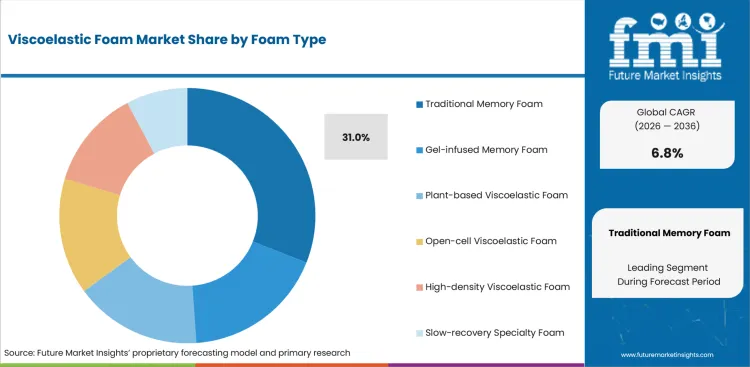
Traditional memory foam provides slow recovery and close contouring across bedding products that prioritize familiar pressure redistribution over rapid rebound.
- Traditional memory foam is set to lead the foam type category with 31.0% share in 2026 due to familiar comfort positioning and established conversion methods.
- Mattress producers vary layer thickness without redesigning the support core across commercial mattress toppers and full replacement products. Thermal performance then determines whether the familiar slow-recovery feel remains acceptable within thicker constructions and warmer sleeping environments. Sinomax USA expanded this commercial adoption route in March 2025 through a Therapedic partnership focused on USA-made memory foam products.
Why do medium-density grades lead demand within the density category?
Medium-density foam balances immersion with load support across mattresses and medical support surfaces that require repeatable recovery through several thicknesses and cover constructions. Leggett & Platt connected pressure mapping with breathable response in May 2025 through its Energex foam demonstration at Interzum.
- By density, medium-density foam is estimated to hold 48.0% in 2026 owing to balanced support across standard and premium comfort specifications.
- Support-surface engineers compare indentation force across repeated loading during material approval for rehabilitation and extended-care applications. Predictable recovery must survive different covers without adding qualification work across related medical beds and institutional programs.
What makes mattresses central to the application category?
Mattresses combine viscoelastic comfort layers with support cores inside one finished system that must retain recovery across normal use and compressed delivery.
- The mattresses segment is likely to capture 46.0% share in 2026 attributable to high-volume comfort-layer use across branded and private-label products.
- Manufacturers qualify layer thickness and density against roll-pack recovery across several firmness levels during national production approval. The process must connect material behavior with assembly and packaging performance throughout each finished design. Concentrated use in hospitality mattresses exposes recovery loss earlier than many residential replacement cycles and raises replacement costs at scale.
Why do mattress OEMs lead demand within the distribution category?
Mattress OEMs purchase foam at production scale and control final layering sequences across branded products and private-label memory foam accessories.
- The distribution category is forecast to be led by mattress OEMs at 34.0% share in 2026 due to direct control over formulation and assembly.
- Original equipment manufacturers coordinate foam blocks with cutting and compression schedules to verify batch consistency across national retail production. Integrated manufacturing reduces handoffs between formulation and finished-product testing across mattresses and memory foam pillows. Smaller programs face higher minimum volumes as factories prioritize long runs and standardized packaging schedules for retailers.
What are the drivers, restraints and opportunities in the Viscoelastic Foam Market?
Driver: Pressure redistribution lets mattress developers change surface comfort without redesigning support cores. Restraint: Slow-recovery foam can retain heat and delay finished-system approval. Opportunity: Application-specific grades can serve selected cushioning uses through established conversion equipment.
- Driver: Pressure redistribution lets mattress developers change surface comfort without redesigning support cores across established finished constructions.
- Restraint: Slow-recovery foam can retain heat and delay approval across warm-climate or heavily insulated finished products.
- Opportunity: Application-specific grades can serve selected cushioning uses through established conversion equipment and validated foam chemistry.
Pressure redistribution differentiates mattresses and care surfaces across residential and institutional use, allowing developers to adjust comfort-layer thickness without redesigning familiar support cores or established assembly equipment.
Slow-recovery foam can retain heat inside thick covers during extended body contact, requiring formulators to balance airflow improvements against recovery consistency across repeated compression and roll-packed delivery.
Automotive seating foams provide an adjacent route for formulations proven under repeated compression and changing cabin temperatures. Bio-based polyols offer chemistry differentiation, although production teams must verify recovery performance and dependable feedstock supply during volume conversion.
Which country CAGRs are profiled in the Viscoelastic Foam Market?
| Country | CAGR |
|---|---|
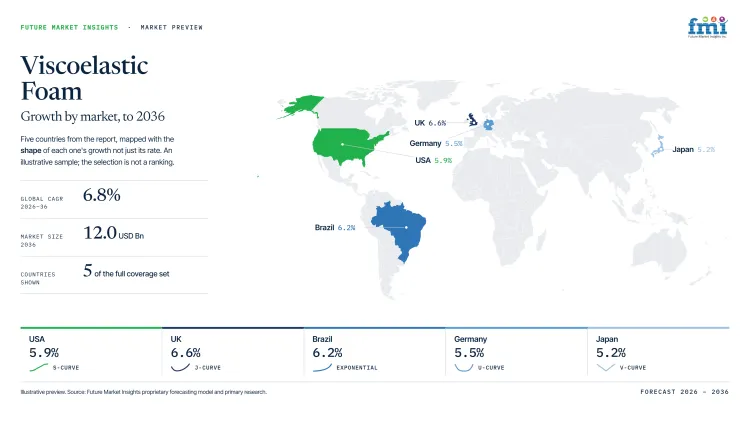
| United Kingdom | 6.6% |
| Brazil | 6.2% |
| United States | 5.9% |
| Germany | 5.5% |
| Japan | 5.2% |
How do country-level CAGRs compare in the Viscoelastic Foam Market?
The country forecasts remain relatively close across the viscoelastic foam market, with a 1.4 percentage point difference between the United Kingdom and Japan. The United Kingdom and Brazil form an upper group, reflecting steady demand for comfort-oriented and pressure-relieving foam products across bedding and furniture applications. The United States follows within a narrow range and benefits from a mature market for premium mattresses and sleep products. Germany and Japan create a lower pair with limited separation, indicating stable demand supported by established furniture and healthcare cushioning applications. The pattern suggests that growth is being driven by consumer preference for enhanced comfort, ergonomic support and specialty foam products rather than major regional differences in foam adoption.
- The United Kingdom benefits from growing demand for premium bedding products and increasing consumer focus on sleep quality and comfort.
- Brazil supports market expansion through rising adoption of viscoelastic foam in mattresses, furniture and cushioning applications.
- The United States reflects steady demand from the mature sleep products industry and continued innovation in specialty foam solutions.
- Germany maintains growth through demand for high-quality furniture materials and ergonomic cushioning products.
- Japan continues to support the market through applications in bedding, healthcare support surfaces and space-efficient furniture products.
Comparable CAGRs may still reflect different market conditions because consumer preferences, distribution channels, product positioning and end-use applications vary across countries. The full report provides country-level CAGR analysis across North America, Latin America, Europe, East Asia, South Asia, Oceania and the Middle East and Africa.
Country-wise Analysis
- United Kingdom bedding programs operate under national flammability requirements that shape filling selection and product files across mattress and topper ranges. Adoption of viscoelastic foam in the United Kingdom is estimated to expand at 6.6% CAGR through 2036, supported by established bedding retail and active replacement channels. Fire-performance failures can therefore stop national sales across several sizes within one finished product family. The Office for Product Safety and Standards recalled BHS Plush Mattress Enhancers in May 2026 for failing applicable flammability requirements across filling and cover materials. Material testing and size-level traceability remain frictions as manufacturers coordinate foam specifications with covers across national retail assortments.
- Brazilian mattress producers use formal Inmetro registration to place flexible polyurethane foam products into regulated retail channels across varied price points and product thicknesses. Inmetro granted active registration 006296/2025 in July 2025 for an Orthopur mattress containing viscoelastic D33 foam across several dimensions. Brazil's viscoelastic foam outlook is anticipated to advance at 6.2% CAGR over the assessment period, aided by domestic mattress production and recognized conformity routes. Registration records therefore tie commercial access to model-level formulation control across approved national construction families. Testing expense and model-specific registration remain material frictions for smaller brands expanding across national retail networks and established channels.
- United States mattress programs operate under mandatory flammability rules that require prototype records and production controls across every size and firmness combination sold nationally. Recall exposure makes documentation continuity commercially important across digital and store-based channels throughout product life cycles. The Consumer Product Safety Commission recalled about 2,700 foam mattresses in July 2025 for violating the federal mattress flammability standard across four consumer sizes. Viscoelastic foam sales in the United States are forecast to expand at 5.9% CAGR by 2036, shaped by broad replacement activity and domestic conversion capacity. Testing expense and fire-barrier consistency remain material frictions across national launches and online inventory programs.
- German mattress programs combine established foam conversion with environmental certification routes that help retailers compare emissions and material claims across premium bedding lines and export programs. Germany is estimated to post 5.5% CAGR over the forecast period, reinforced by specialized manufacturing expertise and organized retail channels. Certification access gives product teams a recognized route for substantiating lower-emission positioning across domestic and institutional purchases. Blue Angel promoted mattress certification under DE-UZ 119 at Heimtextil in January 2025 for companies seeking credible differentiation. Weak furniture turnover and certification costs remain material frictions during assortment reviews and product reformulation across national product launches.
- Japanese bedding sales combine domestic foam expertise with hotel replacement programs and retail networks that value consistent comfort and responsive local service across repeated purchasing cycles. Accommodation activity keeps refurbishment planning commercially relevant for mattress producers serving business and city hotels. The Japan Tourism Agency reported in July 2026 that the country recorded 661.11 million guest nights during 2025. Viscoelastic foam demand in Japan is forecast to rise at 5.2% CAGR over the forecast period, influenced by hospitality refurbishment and detailed domestic qualification. Separate validation for each construction remains a material friction across multi-property reviews and coordinated national replacement programs.
Who are the notable companies in the Viscoelastic Foam Market?
Somnigroup International, Leggett & Platt, Carpenter Co., FXI, The Vita Group, Future Foam, INOAC and Sinomax are the notable companies shaping this market.
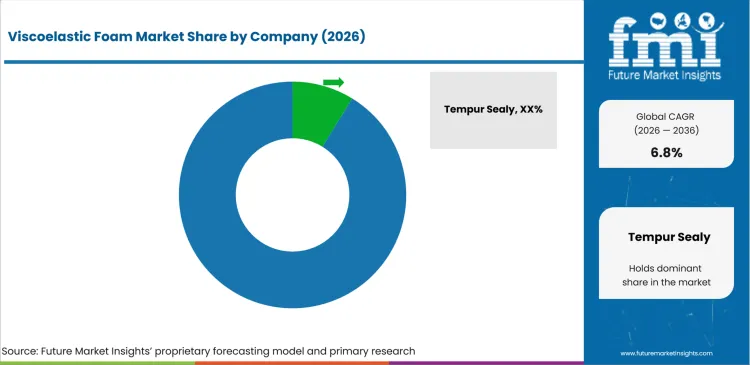
The industry remains moderately fragmented as integrated sleep groups compete with specialist foam formulators and regional converters. Entry remains viable in niche applications, although national bedding programs require repeatable density and finished-system support across multiple plants.
- Somnigroup International and Leggett & Platt connect bedding brands with component manufacturing and national retail access.
- Carpenter and FXI compete through specialty foam development alongside large-scale conversion and finished-mattress support services.
- The Vita Group and Future Foam compete with INOAC and Sinomax through differentiated memory-foam technologies.
Competitive Benchmarking: Viscoelastic Foam Market
| Company | Viscoelastic Foam Portfolio | Finished-System Integration | Manufacturing and Channel Coverage | Geographic Reach |
|---|---|---|---|---|
| Somnigroup International | High | High | High | Global |
| Leggett & Platt | High | High | High | Global |
| Carpenter Co. | High | High | High | Global |
| FXI | High | High | High | North America |
| The Vita Group | Medium | High | High | Europe and selected exports |
| Future Foam | High | High | High | North America, Europe and Asia |
| INOAC | Medium | High | High | Asia and North America |
| Sinomax | High | High | High | Global |
Scoring basis: Portfolio requires several verified viscoelastic formats for High, two for Medium and one exact-market format for Low. Integration requires mattresses and components for High, converted components for Medium and foam supply for Low. Coverage requires multi-plant operations for High, regional support for Medium and one verified route for Low.
Key Developments in the Viscoelastic Foam Market
- In March 2026, Sinomax USA announced a shared showroom program with EverRest and Malouf that combined memory-foam innovation with expanded manufacturing capabilities.
- In September 2025, The Vita Group reported pilot-plant success for a flexible polyurethane mattress using recycled polyol and bio-circular TDI.
- In February 2025, Somnigroup International completed the Mattress Firm acquisition and retained decentralized manufacturing and retail business units.
Viscoelastic Foam Market - Report Scope
| Coverage field | Report scope |
|---|---|
| Market breakdown | By foam type, density, application, distribution, chemistry and region. |
| Quantitative Units | Revenue in USD billion and CAGR in %. |
| Market Definition | The market covers viscoelastic polyurethane foam sold for bedding, furniture, medical, protective and transport cushioning applications. |
| Regions Covered | North America, Latin America, Europe, East Asia, South Asia and Pacific and Middle East and Africa. |
| Countries Covered | United Kingdom, Brazil, United States, Germany, Japan and 20+ countries included in the full report. |
| Key Companies Profiled | Somnigroup International, Leggett & Platt, Carpenter Co., FXI, The Vita Group, Future Foam, INOAC and Sinomax. |
| Forecast Period | 2026 to 2036. |
| Approach | Primary and secondary research with market triangulation. |
Viscoelastic Foam Market - Research Methodology
| Method | Approach |
|---|---|
| Primary Research | FMI analysts gathered input from manufacturers, service providers, technology developers, distributors, end users, procurement teams, and subject-matter experts. Interviews examined purchasing decisions, product or service evaluation, adoption barriers, approval requirements, pricing considerations, and expectations for technical or commercial support. Respondents were also asked what evidence is required before a trial, pilot, or initial order develops into regular purchasing. |
| Desk Research | Desk research covered government statistics, regulatory publications, trade data, industry associations, technical literature, standards, company filings, product information, and official corporate announcements. Sources were reviewed for relevance, publication date, geographic coverage, and consistency with the defined market scope. Claims relating to performance, applications, approvals, capacity, investment, and commercial activity were retained only when supported by credible public evidence. |
| Market Sizing and Forecasting | The market model combined the baseline value with historical performance, segment structure, pricing and volume indicators, adoption levels, company participation, and country-level demand conditions. Forecast assumptions considered economic activity, investment trends, regulatory developments, technology adoption, purchasing cycles, supply availability, and barriers to wider market use. Segment and regional estimates were reconciled before the final market total was calculated. |
| Data Validation | Estimates were checked against multiple independent indicators, including public data, company activity, trade patterns, industry developments, and findings from primary interviews. Validation also tested whether products, services, applications, and company revenues fell within the defined market boundaries. Adjacent categories, unsupported claims, overlapping revenues, and activities without direct market relevance were excluded to reduce double counting and maintain consistency across segments and countries. |
Viscoelastic Foam Market by Segments
Viscoelastic Foam Market segmented by Foam Type:
- Traditional Memory Foam
- Gel-infused Memory Foam
- Plant-based Viscoelastic Foam
- Open-cell Viscoelastic Foam
- High-density Viscoelastic Foam
- Slow-recovery Specialty Foam
Viscoelastic Foam Market segmented by Density:
- Medium Density
- Low Density
- High Density
Viscoelastic Foam Market segmented by Application:
- Mattresses
- Pillows
- Seating / Furniture
- Medical Support Surfaces
- Protective Padding
- Automotive / Transport
Viscoelastic Foam Market segmented by Distribution:
- Mattress OEMs
- Foam Converters
- Furniture Manufacturers
- Medical Product Makers
- Retail / Private Label
Viscoelastic Foam Market segmented by Chemistry:
- TDI-based Foams
- MDI-based Foams
- Bio-polyol Modified Foams
- Additive-enhanced Foams
Viscoelastic Foam Market by Region:
- North America
- United States
- Canada
- Latin America
- Brazil
- Chile
- Mexico
- Rest of Latin America
- Western Europe
- Germany
- United Kingdom
- Italy
- Spain
- France
- Nordics
- Benelux
- Rest of Western Europe
- Eastern Europe
- Russia
- Poland
- Hungary
- Balkan and Baltic States
- Rest of Eastern Europe
- East Asia
- China
- Japan
- South Korea
- South Asia and Pacific
- India
- ASEAN
- Australia and New Zealand
- Rest of South Asia and Pacific
- Middle East and Africa
- Kingdom of Saudi Arabia
- Other GCC Countries
- Türkiye
- South Africa
- Other African Union Countries
- Rest of Middle East and Africa
Research Sources and Bibliography
- Statistisches Bundesamt. (2025, March 20). Möbelindustrie verzeichnet 2024 Umsatzrückgang von 7,8 %.
- USA Consumer Product Safety Commission. (2025, July 31). Amazon Recalls Amazon Basics Premium Foam Eurotop Mattresses Due to Fire Hazard; Violates Federal Standard for Mattress Flammability; Sold on Amazon.
- Office for Product Safety and Standards. (2026, May 7). Product Recall: BHS Plush Mattress Enhancers (2602-0011).
- Instituto Nacional de Metrologia, Qualidade e Tecnologia. (2025, July 21). Registro 006296/2025.
- Blue Angel. (2025, January 23). The Blue Angel and EU Ecolabel at Heimtextil 2025.
- Japan Tourism Agency. (2026, July 6). 宿泊旅行統計調査(2026年(令和8年)4月・第2次速報、2026年(令和8年)5月・第1次速報及び2025年(令和7年)年間値(確定値)).
- Sinomax USA. (2025, March 31). Sinomax, Therapedic partner on USA-made Memory Foam Products.
- Leggett & Platt. (2025, May 20). PETERSON CHEMICAL TO DEMONSTRATE INNOVATIVE FOAM PRODUCTS AND TECHNOLOGY AT INTERZUM 2025.
- Carpenter Co. (2026, July 10). La technologie Casper Core+™ révolutionne le marché des matelas en mousse.
- Sinomax USA. (2026, March 4). One Showroom. Three Companies. Scaled for Success.
- The Vita Group. (2025, September 30). Vita Advanced Mattress Wins Prestigious ‘Best of the Best’ Award at Interzum 2025.
- Somnigroup International. (2025, February 5). Tempur Sealy Successfully Completes Acquisition of Mattress Firm.
This bibliography is provided for reader reference and is not exhaustive. The full report contains the complete reference list and detailed citations
This Report Answers
- How large is the viscoelastic foam market in 2026 and 2036?
- Which operating conditions support demand for viscoelastic foam?
- Which foam type holds the significant share in 2026?
- How does density selection shape commercial demand?
- Which application condition shapes viscoelastic foam adoption?
- How do country growth rates differ for viscoelastic foam?
- Which companies serve the viscoelastic foam market?
- What currently limits viscoelastic foam adoption?
- How should teams compare foam type and chemistry options?
Frequently Asked Questions
How big is the Viscoelastic Foam Market in 2026?
The viscoelastic foam market is valued at USD 6.2 billion in 2026 and is forecast to reach USD 12.0 billion by 2036. Growth is supported by mattress producers selecting slow-recovery grades for premium comfort layers alongside furniture seating and medical support-surface applications requiring repeatable pressure-redistribution performance.
What is the CAGR of the Viscoelastic Foam Market from 2026 to 2036?
The viscoelastic foam market grows at a CAGR of 6.8% between 2026 and 2036, supported by mattress OEMs and finished-system manufacturers adopting formulations that retain recovery across several densities, thicknesses, and roll-packed constructions throughout bedding, furniture, and healthcare cushioning applications.
Which foam type leads the Viscoelastic Foam Market?
Traditional memory foam accounts for 31.0% of the viscoelastic foam market by foam type in 2026, driven by familiar comfort positioning and established conversion practices that let mattress producers vary layer thickness without redesigning the support core across commercial toppers and replacement products.
How much will the Viscoelastic Foam Market add between 2026 and 2036?
The viscoelastic foam market is set to add USD 5.8 billion between 2026 and 2036, growing from USD 6.2 billion to USD 12.0 billion as mattress, furniture, and medical support-surface applications expand demand for pressure-relieving and body-conforming foam grades worldwide.
Who are the leading companies in the Viscoelastic Foam Market?
Eight companies lead the viscoelastic foam market, including Somnigroup International, Leggett & Platt, Carpenter Co., FXI, The Vita Group, Future Foam, INOAC, and Sinomax, competing through broad foam portfolios, finished-system integration, and multi-plant manufacturing and channel coverage worldwide.
Preview the report firsthand - request a free sample
Get SampleGet the brochure for pricing and purchase details.
Get PDFTable of Content
- Key Takeaways
- Market Size and CAGR
- Top Growth Driver
- Fastest Growing Segment
- Leading Region
- Key Companies
- Emerging Opportunities
- Executive Summary
- Global Market Outlook
- Demand-side Trends
- Supply-side Trends
- Technology Roadmap Analysis
- Analysis and Recommendations
- Analyst Perspective (What is happening? Why now? What should investors know?)
- Key Questions Answered
- How large is the market?
- What is the CAGR?
- What are key trends?
- Which region dominates?
- Who are the leaders?
- Market Overview
- Market Coverage / Taxonomy
- Market Definition / Scope / Limitations
- Research Methodology
- Chapter Orientation
- Analytical Lens and Working Hypotheses
- Market Structure, Signals, and Trend Drivers
- Benchmarking and Cross-market Comparability
- Market Sizing, Forecasting, and Opportunity Mapping
- Research Design and Evidence Framework
- Desk Research Programme (Secondary Evidence)
- Expert Input and Fieldwork (Primary Evidence)
- Tooling, Models, and Reference Databases
- Data Engineering and Model Build
- Quality Assurance and Audit Trail
- Market Background
- Market Dynamics (Drivers, Restraints, Opportunity, Trends)
- Scenario Forecast (Optimistic, Likely, Conservative)
- Impact Analysis
- AI Impact
- Sustainability Impact
- Regulatory Impact
- Technology Impact
- Consumer / Buyer Analysis
- Purchase Drivers
- Adoption Barriers
- Buyer Journey
- Opportunity Map Analysis
- Product Life Cycle Analysis
- Supply Chain Analysis
- Investment Feasibility Matrix
- Value Chain Analysis
- PESTLE and Porter's Analysis
- Regulatory Landscape
- Regional Parent Market Outlook
- Production and Consumption Statistics
- Import and Export Statistics
- Global Market Analysis and Forecast, 2021 to 2036
- Historical Market Size Value (USD Billion) Analysis, 2021 to 2025
- Current and Future Market Size Value (USD Billion) Projections, 2026 to 2036
- Y-o-Y Growth Trend Analysis
- Absolute $ Opportunity Analysis
- Global Market Pricing Analysis, 2021 to 2036
- Global Market Analysis and Forecast, By Foam Type, 2021 to 2036
- Introduction / Key Findings
- Historical Market Size Value (USD Billion) Analysis By Foam Type, 2021 to 2025
- Current and Future Market Size Value (USD Billion) Analysis and Forecast By Foam Type, 2026 to 2036
- Traditional Memory Foam
- Gel-infused Memory Foam
- Plant-based Viscoelastic Foam
- Open-cell Viscoelastic Foam
- High-density Viscoelastic Foam
- Slow-recovery Specialty Foam
- Traditional Memory Foam
- Y-o-Y Growth Trend Analysis By Foam Type, 2021 to 2025
- Absolute $ Opportunity Analysis By Foam Type, 2026 to 2036
- Global Market Analysis and Forecast, By Density, 2021 to 2036
- Introduction / Key Findings
- Historical Market Size Value (USD Billion) Analysis By Density, 2021 to 2025
- Current and Future Market Size Value (USD Billion) Analysis and Forecast By Density, 2026 to 2036
- Medium Density
- Low Density
- High Density
- Medium Density
- Y-o-Y Growth Trend Analysis By Density, 2021 to 2025
- Absolute $ Opportunity Analysis By Density, 2026 to 2036
- Global Market Analysis and Forecast, By Application, 2021 to 2036
- Introduction / Key Findings
- Historical Market Size Value (USD Billion) Analysis By Application, 2021 to 2025
- Current and Future Market Size Value (USD Billion) Analysis and Forecast By Application, 2026 to 2036
- Mattresses
- Pillows
- Seating / Furniture
- Medical Support Surfaces
- Protective Padding
- Automotive / Transport
- Mattresses
- Y-o-Y Growth Trend Analysis By Application, 2021 to 2025
- Absolute $ Opportunity Analysis By Application, 2026 to 2036
- Global Market Analysis and Forecast, By Distribution, 2021 to 2036
- Introduction / Key Findings
- Historical Market Size Value (USD Billion) Analysis By Distribution, 2021 to 2025
- Current and Future Market Size Value (USD Billion) Analysis and Forecast By Distribution, 2026 to 2036
- Mattress OEMs
- Foam Converters
- Furniture Manufacturers
- Medical Product Makers
- Retail / Private Label
- Mattress OEMs
- Y-o-Y Growth Trend Analysis By Distribution, 2021 to 2025
- Absolute $ Opportunity Analysis By Distribution, 2026 to 2036
- Global Market Analysis and Forecast, By Chemistry, 2021 to 2036
- Introduction / Key Findings
- Historical Market Size Value (USD Billion) Analysis By Chemistry, 2021 to 2025
- Current and Future Market Size Value (USD Billion) Analysis and Forecast By Chemistry, 2026 to 2036
- TDI-based Foams
- MDI-based Foams
- Bio-polyol Modified Foams
- Additive-enhanced Foams
- TDI-based Foams
- Y-o-Y Growth Trend Analysis By Chemistry, 2021 to 2025
- Absolute $ Opportunity Analysis By Chemistry, 2026 to 2036
- Global Market Analysis and Forecast, By Region, 2021 to 2036
- Introduction
- Historical Market Size Value (USD Billion) Analysis By Region, 2021 to 2025
- Current Market Size Value (USD Billion) Analysis and Forecast By Region, 2026 to 2036
- North America
- Latin America
- Western Europe
- Eastern Europe
- East Asia
- South Asia and Pacific
- Middle East & Africa
- Market Attractiveness Analysis By Region
- North America Market Analysis and Forecast, By Country, 2021 to 2036
- Historical Market Size Value (USD Billion) Trend Analysis By Market Taxonomy, 2021 to 2025
- Market Size Value (USD Billion) Forecast By Market Taxonomy, 2026 to 2036
- By Country
- USA
- Canada
- By Foam Type
- By Density
- By Application
- By Distribution
- By Chemistry
- By Country
- Market Attractiveness Analysis
- By Country
- By Foam Type
- By Density
- By Application
- By Distribution
- By Chemistry
- Key Takeaways
- Latin America Market Analysis and Forecast, By Country
- Historical Market Size Value (USD Billion) Trend Analysis By Market Taxonomy, 2021 to 2025
- Market Size Value (USD Billion) Forecast By Market Taxonomy, 2026 to 2036
- By Country
- Brazil
- Mexico
- Chile
- Rest of Latin America
- By Foam Type
- By Density
- By Application
- By Distribution
- By Chemistry
- By Country
- Market Attractiveness Analysis
- By Country
- By Foam Type
- By Density
- By Application
- By Distribution
- By Chemistry
- Key Takeaways
- Western Europe Market Analysis and Forecast, By Country
- Historical Market Size Value (USD Billion) Trend Analysis By Market Taxonomy, 2021 to 2025
- Market Size Value (USD Billion) Forecast By Market Taxonomy, 2026 to 2036
- By Country
- Germany
- UK
- Italy
- Spain
- France
- Nordic
- BENELUX
- Rest of Western Europe
- By Foam Type
- By Density
- By Application
- By Distribution
- By Chemistry
- By Country
- Market Attractiveness Analysis
- By Country
- By Foam Type
- By Density
- By Application
- By Distribution
- By Chemistry
- Key Takeaways
- Eastern Europe Market Analysis and Forecast, By Country
- Historical Market Size Value (USD Billion) Trend Analysis By Market Taxonomy, 2021 to 2025
- Market Size Value (USD Billion) Forecast By Market Taxonomy, 2026 to 2036
- By Country
- Russia
- Poland
- Hungary
- Balkan & Baltic
- Rest of Eastern Europe
- By Foam Type
- By Density
- By Application
- By Distribution
- By Chemistry
- By Country
- Market Attractiveness Analysis
- By Country
- By Foam Type
- By Density
- By Application
- By Distribution
- By Chemistry
- Key Takeaways
- East Asia Market Analysis and Forecast, By Country
- Historical Market Size Value (USD Billion) Trend Analysis By Market Taxonomy, 2021 to 2025
- Market Size Value (USD Billion) Forecast By Market Taxonomy, 2026 to 2036
- By Country
- China
- Japan
- South Korea
- By Foam Type
- By Density
- By Application
- By Distribution
- By Chemistry
- By Country
- Market Attractiveness Analysis
- By Country
- By Foam Type
- By Density
- By Application
- By Distribution
- By Chemistry
- Key Takeaways
- South Asia and Pacific Market Analysis and Forecast, By Country
- Historical Market Size Value (USD Billion) Trend Analysis By Market Taxonomy, 2021 to 2025
- Market Size Value (USD Billion) Forecast By Market Taxonomy, 2026 to 2036
- By Country
- India
- ASEAN
- Australia & New Zealand
- Rest of South Asia and Pacific
- By Foam Type
- By Density
- By Application
- By Distribution
- By Chemistry
- By Country
- Market Attractiveness Analysis
- By Country
- By Foam Type
- By Density
- By Application
- By Distribution
- By Chemistry
- Key Takeaways
- Middle East & Africa Market Analysis and Forecast, By Country
- Historical Market Size Value (USD Billion) Trend Analysis By Market Taxonomy, 2021 to 2025
- Market Size Value (USD Billion) Forecast By Market Taxonomy, 2026 to 2036
- By Country
- Kingdom of Saudi Arabia
- Other GCC Countries
- Türkiye
- South Africa
- Other African Union
- Rest of Middle East & Africa
- By Foam Type
- By Density
- By Application
- By Distribution
- By Chemistry
- By Country
- Market Attractiveness Analysis
- By Country
- By Foam Type
- By Density
- By Application
- By Distribution
- By Chemistry
- Key Takeaways
- Key Countries Market Analysis
- USA
- Pricing Analysis
- Market Share Analysis, 2025
- By Foam Type
- By Density
- By Application
- By Distribution
- By Chemistry
- Canada
- Pricing Analysis
- Market Share Analysis, 2025
- By Foam Type
- By Density
- By Application
- By Distribution
- By Chemistry
- Mexico
- Pricing Analysis
- Market Share Analysis, 2025
- By Foam Type
- By Density
- By Application
- By Distribution
- By Chemistry
- Brazil
- Pricing Analysis
- Market Share Analysis, 2025
- By Foam Type
- By Density
- By Application
- By Distribution
- By Chemistry
- Chile
- Pricing Analysis
- Market Share Analysis, 2025
- By Foam Type
- By Density
- By Application
- By Distribution
- By Chemistry
- Germany
- Pricing Analysis
- Market Share Analysis, 2025
- By Foam Type
- By Density
- By Application
- By Distribution
- By Chemistry
- UK
- Pricing Analysis
- Market Share Analysis, 2025
- By Foam Type
- By Density
- By Application
- By Distribution
- By Chemistry
- Italy
- Pricing Analysis
- Market Share Analysis, 2025
- By Foam Type
- By Density
- By Application
- By Distribution
- By Chemistry
- Spain
- Pricing Analysis
- Market Share Analysis, 2025
- By Foam Type
- By Density
- By Application
- By Distribution
- By Chemistry
- France
- Pricing Analysis
- Market Share Analysis, 2025
- By Foam Type
- By Density
- By Application
- By Distribution
- By Chemistry
- India
- Pricing Analysis
- Market Share Analysis, 2025
- By Foam Type
- By Density
- By Application
- By Distribution
- By Chemistry
- ASEAN
- Pricing Analysis
- Market Share Analysis, 2025
- By Foam Type
- By Density
- By Application
- By Distribution
- By Chemistry
- Australia & New Zealand
- Pricing Analysis
- Market Share Analysis, 2025
- By Foam Type
- By Density
- By Application
- By Distribution
- By Chemistry
- China
- Pricing Analysis
- Market Share Analysis, 2025
- By Foam Type
- By Density
- By Application
- By Distribution
- By Chemistry
- Japan
- Pricing Analysis
- Market Share Analysis, 2025
- By Foam Type
- By Density
- By Application
- By Distribution
- By Chemistry
- South Korea
- Pricing Analysis
- Market Share Analysis, 2025
- By Foam Type
- By Density
- By Application
- By Distribution
- By Chemistry
- Russia
- Pricing Analysis
- Market Share Analysis, 2025
- By Foam Type
- By Density
- By Application
- By Distribution
- By Chemistry
- Poland
- Pricing Analysis
- Market Share Analysis, 2025
- By Foam Type
- By Density
- By Application
- By Distribution
- By Chemistry
- Hungary
- Pricing Analysis
- Market Share Analysis, 2025
- By Foam Type
- By Density
- By Application
- By Distribution
- By Chemistry
- Kingdom of Saudi Arabia
- Pricing Analysis
- Market Share Analysis, 2025
- By Foam Type
- By Density
- By Application
- By Distribution
- By Chemistry
- Türkiye
- Pricing Analysis
- Market Share Analysis, 2025
- By Foam Type
- By Density
- By Application
- By Distribution
- By Chemistry
- South Africa
- Pricing Analysis
- Market Share Analysis, 2025
- By Foam Type
- By Density
- By Application
- By Distribution
- By Chemistry
- USA
- Market Structure Analysis
- Competition Dashboard
- Competition Benchmarking
- Market Share Analysis of Top Players
- By Regional
- By Foam Type
- By Density
- By Application
- By Distribution
- By Chemistry
- Emerging Startups
- Innovation Benchmarking
- Competition Analysis
- Competition Deep Dive
- Tempur Sealy
- Overview
- Product Portfolio
- Profitability by Market Segments
- Sales Footprint
- Strategy Overview
- Marketing Strategy
- Product Strategy
- Channel Strategy
- Leggett & Platt
- FoamPartner / Recticel
- Carpenter Co.
- FXI
- The Vita Group
- Future Foam
- Inoac
- Sinomax
- Woodbridge Foam
- Tempur Sealy
- Case Studies
- Success Stories
- Recent Developments
- Competition Deep Dive
- Assumptions & Acronyms Used


