

- Market Size (2026)
- USD 1.3 Bn
- Forecast (2036)
- USD 2.3 Bn
- CAGR (2026 to 2036)
- 5.9%
How big is Warm-Mix Additives Market in 2026?
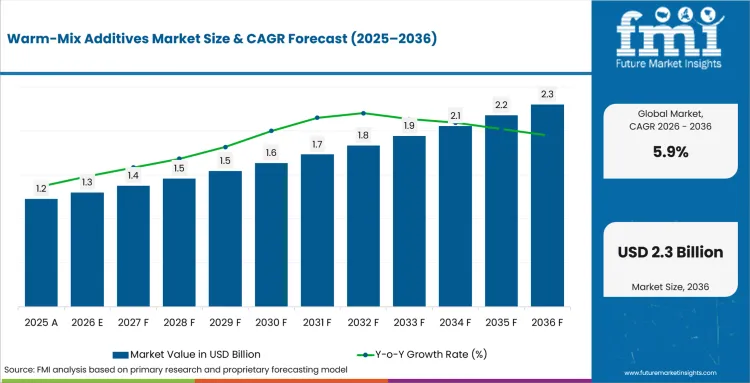
USD 1.3 billion in 2026 and USD 2.3 billion by 2036 at a 5.9% CAGR.
Demand for warm-mix additives is projected to expand at 5.9% CAGR between 2026 and 2036 as plants seek lower temperatures without losing compaction performance. Market valuation is expected to rise from USD 1.3 billion in 2026 to USD 2.3 billion by 2036 under that operating case. FHWA noted in February 2025 that conventional hot-mix production exceeds 300°F, which makes burner heat a direct operating cost that warm-mix chemistry can reduce.
Country adoption diverges according to how quickly reduced-temperature mixes enter standard road specifications and routine tender practice. EAPA reported in November 2025 that Germany targets 100% reduced-temperature asphalt production by 2026, while France remains among countries progressing toward wider implementation. The difference gives Germany a clearer near-term qualification path and leaves French road owners with more project-specific evaluation before recurring additive orders.
Key Takeaways of Warm Mix Additives Market
- Lower production temperatures increase additive demand when asphalt producers can lower burner heat and worker exposure without weakening pavement density or durability.
- Chemical surfactant additives are set to lead the additive type with 31.0% share in 2026 due to liquid dosing that fits established plant and terminal operations.
- Dense graded asphalt is projected to hold 32.0% share in 2026 owing to recurring road volumes and familiar job-mix qualification procedures.
- The 20-40°C reduction range is likely to capture 52.0% share in 2026 attributable to manageable plant and paving adjustments.
- Qualification remains a material restraint as road agencies require lower-temperature production to preserve density and moisture resistance under local mix specifications.
- Arkema, Ingevity, Sasol, BASF, Kraton Corporation, Iterchimica, Cargill and Nouryon supply surfactant, wax, modifier or application-support routes within the warm-mix additives market.
Analyst Perspective
"Warm-mix additive selection should begin with the temperature reduction a plant can document under its own binder and aggregate combination. A formulation earns repeat orders once that reduction preserves density, moisture resistance and paving-window control under the road agency’s specification."
- Nikhil Kaitwade, Principal Consultant, Future Market Insights
How is the Warm Mix Additives Market segmented?
The market is segmented by additive type, asphalt mix, temperature reduction, application, sales channel and region.
Additive type covers chemical surfactant, organic wax, foaming, zeolite-based and bio-based warm-mix additives. Asphalt mix includes dense graded, stone mastic, porous, reclaimed asphalt pavement and polymer modified asphalt. Temperature reduction covers 20-40°C, below 20°C and above 40°C. Applications include highways, urban roads, airport pavements, bridge decks and industrial yards. Sales channels include asphalt mix producers, road contractor direct supply, chemical distributors and government or project approved lists.
Why do highways lead the application category?
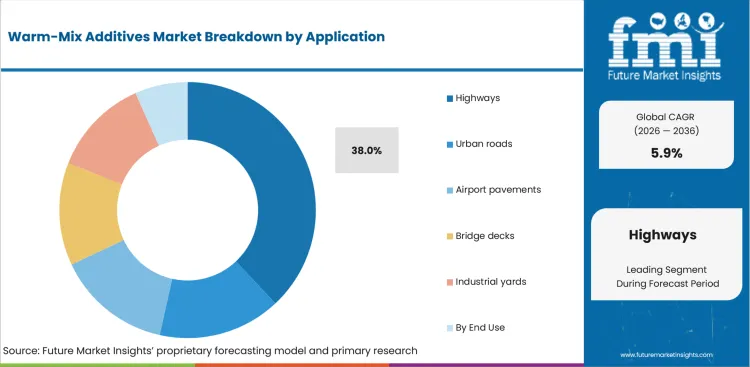
Highway contracts concentrate asphalt tonnage and specification control around asphalt pavers that must maintain consistent compaction across long production runs. Large paving programs also make plant fuel use and crew exposure easier to compare against additive cost.
- In 2026, highways are expected to lead application with 38.0% share because recurring public-road programs provide a broad volume base for qualified lower-temperature mixes.
- NAPA reported in December 2025 that warm-mix technologies produced 40.2% of USA asphalt mixture tonnage during 2024. That established operating base gives highway contractors a familiar route for qualifying lower-temperature mixes under public specifications.
Why do chemical surfactant additives lead the additive type category?
Chemical surfactants change binder and aggregate interactions so asphalt producers can improve coating and compaction without depending on bulk viscosity reduction alone. Their liquid form also fits existing plants that want low-impact asphalt additives without major equipment changes.
- Based on additive type, chemical surfactant additives are projected to account for 31.0% in 2026 due to liquid dosing that fits established plant and terminal operations.
- NAPA reported in December 2025 that chemical additive technologies represented 80.1% of USA warm-mix production during 2024. That operating familiarity lowers implementation friction for formulations that also address adhesion and moisture performance under local specifications.
Why does dense graded asphalt lead the asphalt mix category?
Dense graded asphalt anchors routine surface and structural paving because plants already understand its aggregate grading and compaction behavior across large road programs. FHWA reported in February 2025 that Advera WMA is dosed at 0.25% of mix weight and works with dense, gap and open graded mixtures.
- By asphalt mix, dense graded asphalt is forecast to represent 32.0% in 2026 driven by recurring road volumes and familiar job-mix qualification procedures.
- Producers can introduce temperature-reduction chemistry into established dense graded formulas while retaining familiar density checks and polymer modified bitumen options for projects that require them.
Why does the 20-40°C reduction range lead the temperature reduction category?
A 20-40°C reduction gives asphalt mixing plants a meaningful burner-temperature change while preserving operating margin for normal rolling controls, haul distance and weather variation across paving shifts.
- The temperature reduction category is forecast to be led by 20-40°C reduction at 52.0% share in 2026 due to manageable plant and paving adjustments. Arkema reported in June 2025 that Cecabase RT Bio 10 reduced application temperature from 160°C to 120°C while allowing up to 50% recycled asphalt.
- The range therefore suits projects that need temperature savings but require predictable coating, density and durability during local field qualification.
What are the drivers, restraints, and opportunities in the warm-mix additives market?
Lower-temperature plant economics support demand while mix qualification slows conversion, and higher reclaimed-asphalt use broadens the role of multifunctional additives.
- Driver: Asphalt producers gain a stronger purchase case when lower burner heat and worker exposure can be measured during normal plant operation.
- Restraint: Road-agency approval can delay routine use as lower production temperature must preserve density and moisture resistance in each approved mix design.
- Opportunity: Additives that pair lower-temperature workability with reclaimed-asphalt compatibility can address plant energy use and recycled-material performance in one qualification program.
Lower-Temperature Production Builds a Measurable Operating Case
Warm-mix additives have a stronger purchase case once plant managers can measure lower burner heat without changing expected paving output. Routine production makes that comparison credible as fuel use and compaction can be tracked against additive dosage. NAPA reported in December 2025 that USA producers made 178.3 million tons of pavement with warm-mix technologies during 2024, giving manufacturers a large operating base for repeat cost comparisons.
Qualification and Temperature Proof Slow Routine Conversion
Temperature-reduction claims do not remove the need to verify that a proposed mix actually reaches a meaningful lower operating temperature. In December 2025 NAPA reported that 48.7% of warm-mix tonnage achieved at least a 10°F reduction during 2024. Road agencies therefore retain asphalt testing equipment and field checks for density and moisture resistance before a formulation enters routine project specifications.
Reclaimed Asphalt Extends the Commercial Value Proposition
Reclaimed asphalt gives warm-mix additives a broader commercial role as one formulation can protect workability while producers reuse aged binder and aggregate in higher recycled-content job formulas. NAPA reported in December 2025 that USA producers incorporated 101.4 million tons of recycled asphalt pavement during 2024, linking additive selection with recycled-mix productivity and fuel savings.
Which country CAGRs are profiled in the warm-mix additives market?
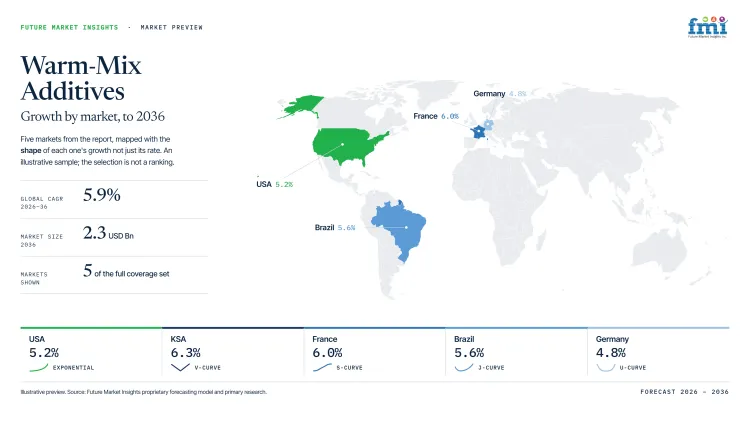
| Country | CAGR |
|---|---|
| KSA | 6.3% |
| France | 5.9% |
| Brazil | 5.6% |
| USA | 5.2% |
| Germany | 4.8% |
How do country-level CAGRs compare in the warm-mix additives market?
The 1.5-point CAGR range forms a compact upper group in KSA and France, with Brazil separating them from USA and Germany. The spacing reflects specification pathways more than current market size. Road agencies move additives into routine use at different speeds as qualification, recycled-asphalt practice and worker-exposure rules vary across these countries.
- KSA places temperature requirements inside road specifications tied to large infrastructure programs.
- France evaluates warm mixes in maintenance programs using reclaimed asphalt and service targets.
- Brazil relies on DNIT testing routes that require validation of recycled mixtures.
- USA converts producer familiarity into orders under state specifications and public-road contracts.
- Germany couples reduced-temperature paving with binding exposure limits and formal technical acceptance.
Similar CAGRs therefore conceal approval burdens and sales-cycle lengths for additive manufacturers.
The full report provides country-level CAGR analysis across North America, Latin America, Europe, East Asia, South Asia, Oceania and the Middle East and Africa.
Country-wise Analysis
- KSA road programs allow public authorities and major project owners to set mix requirements directly, and the Saudi Press Agency reported in January 2025 that an Al-Ahsa road project incorporated recycled construction and demolition waste into asphalt paving layers. By 2036, KSA is projected to grow at 6.3% CAGR, supported by project specifications that combine lower-temperature production with recycled-material requirements across large road packages and planned transport corridors. Severe heat and heavy traffic raise the proof burden for additive manufacturers, as contractors require local rutting and compaction evidence to change approved job formulas on high-value infrastructure work and summer paving schedules.
- Departmental road owners in France compare maintenance techniques against pavement condition and carbon targets, giving warm-mix additives a route into recurring resurfacing programs using reclaimed asphalt alongside other lower-temperature treatments from regional bitumen emulsion plants. France’s warm-mix additives outlook is anticipated to advance at 5.9% CAGR over the assessment period, supported by lower-temperature maintenance practices that already fit established public-road programs and contractor networks. Cerema reported in March 2026 that Loire-Atlantique manages more than 4,200 km of departmental roads and has used warm or cold mixes for over a decade, yet additive manufacturers still need lifecycle evidence that fits local budgets and contractor methods.
- Brazilian highway projects use a federal technical route for evaluating warm recycled asphalt, yet variation in road aggregates makes local mix validation essential for chemical dosing to become routine across federal and concession road corridors. In Brazil, warm-mix additive demand is predicted to advance at 5.6% CAGR through 2036, reinforced by a June 2025 DNIT study that evaluated warm recycled mixtures containing 50% reclaimed asphalt pavement and rejuvenator. That federal reference shortens the technical starting point for trials but does not remove field work, so additive manufacturers need Portuguese-language dosage support and contractor training matched to local materials and paving conditions.
- USA asphalt producers already use warm-mix technologies across many state specification systems, and NAPA reported in December 2025 that 130 producers in 39 states used them during the 2024 construction season. That installed operating base reduces the need for basic technology education but makes plant compatibility more important, since state agencies still expect density and moisture performance under local binders and aggregate combinations plus dosage guidance for seasonal haul distances and rolling windows. Warm-mix additive demand in USA is forecast to rise at 5.2% CAGR over the forecast period, supported by repeat paving work and state-level qualification routes across recurring highway programs.
- German asphalt producers face a formal transition to reduced-temperature paving, which makes documented worker-exposure control and regulator acceptance central to public-road access. Adoption of warm-mix additives in Germany is estimated to expand at 4.8% CAGR through 2036, supported by technical rules that make reduced-temperature asphalt standard road practice during the 2026 transition. BG BAU reported in August 2026 that the 1.5 mg/m³ workplace limit for bitumen fumes and aerosols becomes binding for rolled asphalt from January 1, 2027, so plant operators need qualified chemistry and field documentation that preserves density with local German binders and aggregates under routine production conditions.
Who are the notable companies in the warm-mix additives market?
Arkema, Ingevity, Sasol, BASF, Kraton Corporation, Iterchimica, Cargill and Nouryon are the notable companies profiled in this market.
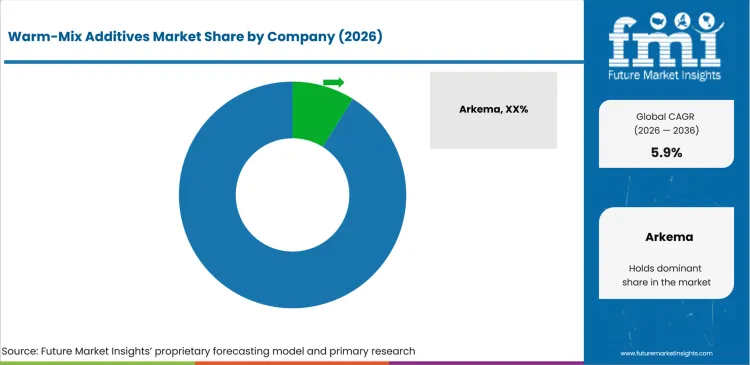
Competition remains fragmented across liquid surfactants, synthetic waxes and modifier chemistries that pair lower-temperature paving with recycled-asphalt performance. Asphalt producers compare modified bitumen compatibility and field evidence before inserting unfamiliar chemistry into recurring job formulas under public specifications. Entry therefore depends on technical support that can reproduce density and moisture performance with the binder and aggregate combinations used locally.
- Surfactant and liquid warm-mix platforms include Arkema, Ingevity and Cargill with plant-dosing routes for coating and compaction.
- Sasol and Iterchimica compete with dedicated temperature-reduction chemistry for projects requiring predictable workability across established paving operations.
- BASF and Kraton Corporation link recycled-asphalt performance with modifier chemistry, while Nouryon combines warm-mix functions with bitumen emulsifiers and regional asphalt application support.
Competitive Benchmarking: Warm-Mix Additives Market
| Company | Temperature-Reduction Fit | RAP and Mix Support | Qualification Support | Geographic Reach |
|---|---|---|---|---|
| Arkema | High | High | High | North America and Europe |
| Ingevity | High | Medium | High | North America and Europe |
| Sasol | High | Medium | Medium | Europe and international markets |
| BASF | Medium | High | Medium | Europe and North America |
| Kraton Corporation | Medium | High | Medium | Global paving markets |
| Iterchimica | High | Medium | Medium | Europe and Southeast Asia |
| Cargill | High | Medium | High | Global |
| Nouryon | High | Medium | High | Europe, Asia and Americas |
Key Developments in the Warm-Mix Additives Market
- In July 2026, Ingevity received German BASt approval for Evotherm P35 after technical evaluation under real traffic and environmental conditions and cleared a formal public-project eligibility barrier.
- In June 2025, Nouryon co-hosted the International Conference on Bitumen Emulsion in New Delhi and linked its Mumbai asphalt application laboratory with regional formulation support for road materials including warm-mix additives.
- In April 2025, Kraton Corporation launched the CirKular+ Paving Circularity Series for reclaimed asphalt reuse with C5000 supporting 50% or more reclaimed content and warm-mix compatibility.
Key Players in the Warm-Mix Additives Market
Chemical Surfactant and Liquid Warm-Mix Specialists
- Arkema
- Ingevity
- Cargill
- Nouryon
Wax and Dedicated Temperature-Reduction Suppliers
- Sasol
- Iterchimica
Modifier and Recycled-Asphalt Platforms
- BASF
- Kraton Corporation
Warm-Mix Additives Market - Report Scope
| Coverage field | Report scope |
|---|---|
| Market breakdown | By additive type, asphalt mix, temperature reduction, application, sales channel and region. |
| Quantitative Units | Revenue in USD billion and CAGR in %. |
| Market Definition | Warm-mix additives sold to lower asphalt production, placement or compaction temperatures. Scope includes surfactant, wax, foaming, zeolite and bio-based routes while excluding finished asphalt mixtures, bitumen, aggregates, equipment, construction services and cold-mix products. |
| Regions Covered | North America, Latin America, Europe, East Asia, South Asia and Pacific and Middle East and Africa. |
| Countries Covered | USA, Germany, Brazil, France, KSA, and 20+ countries included in the full report. |
| Key Companies Profiled | Arkema, Ingevity, Sasol, BASF, Kraton Corporation, Iterchimica, Cargill and Nouryon. |
| Forecast Period | 2026 to 2036. |
| Approach | Primary and secondary research with market triangulation. |
Warm-Mix Additives Market - Research Methodology
| Method | Approach |
|---|---|
| Primary Research | FMI analysts gathered input from manufacturers, service providers, technology developers, distributors, end users, procurement teams, and subject-matter experts. Interviews examined purchasing decisions, product or service evaluation, adoption barriers, approval requirements, pricing considerations, and expectations for technical or commercial support. Respondents were also asked what evidence is required before a trial, pilot, or initial order develops into regular purchasing. |
| Desk Research | Desk research covered government statistics, regulatory publications, trade data, industry associations, technical literature, standards, company filings, product information, and official corporate announcements. Sources were reviewed for relevance, publication date, geographic coverage, and consistency with the defined market scope. Claims relating to performance, applications, approvals, capacity, investment, and commercial activity were retained only when supported by credible public evidence. |
| Market Sizing and Forecasting | The market model combined the baseline value with historical performance, segment structure, pricing and volume indicators, adoption levels, company participation, and country-level demand conditions. Forecast assumptions considered economic activity, investment trends, regulatory developments, technology adoption, purchasing cycles, supply availability, and barriers to wider market use. Segment and regional estimates were reconciled before the final market total was calculated. |
| Data Validation | Estimates were checked against multiple independent indicators, including public data, company activity, trade patterns, industry developments, and findings from primary interviews. Validation also tested whether products, services, applications, and company revenues fell within the defined market boundaries. Adjacent categories, unsupported claims, overlapping revenues, and activities without direct market relevance were excluded to reduce double counting and maintain consistency across segments and countries. |
Warm-Mix Additives Market by Segments
Warm-Mix Additives Market segmented by Additive Type:
- Chemical surfactant additives
- Organic wax additives
- Foaming additives
- Zeolite-based additives
- Bio-based warm-mix additives
Warm-Mix Additives Market segmented by Asphalt Mix:
- Dense graded asphalt
- Stone mastic asphalt
- Porous asphalt
- Reclaimed asphalt pavement mixes
- Polymer modified asphalt
Warm-Mix Additives Market segmented by Temperature Reduction:
- 20-40°C reduction
- Below 20°C reduction
- Above 40°C reduction
Warm-Mix Additives Market segmented by Application:
- Highways
- Urban roads
- Airport pavements
- Bridge decks
- Industrial yards
Warm-Mix Additives Market segmented by Sales Channel:
- Asphalt mix producers
- Road contractor direct supply
- Chemical distributors
- Government / project approved lists
Warm-Mix Additives Market by Region
- North America
- United States
- Canada
- Latin America
- Brazil
- Mexico
- Chile
- Rest of Latin America
- Western Europe
- Germany
- United Kingdom
- Italy
- Spain
- France
- Nordics
- Benelux
- Rest of Western Europe
- Eastern Europe
- Russia
- Poland
- Hungary
- Balkan and Baltic States
- Rest of Eastern Europe
- East Asia
- China
- Japan
- South Korea
- South Asia and Pacific
- India
- ASEAN
- Australia and New Zealand
- Rest of South Asia and Pacific
- Middle East and Africa
- Kingdom of Saudi Arabia
- Other GCC Countries
- Türkiye
- South Africa
- Other African Union Countries
- Rest of Middle East and Africa
Research Sources and Bibliography
- Federal Highway Administration. (2025, February 12). Warm Mix Asphalt Technologies and Research.
- European Asphalt Pavement Association. (2025, November 12). Lessons and Insights from Europe’s WMA Transition.
- National Asphalt Pavement Association. (2025, December 16). Asphalt Pavement Industry Survey on Recycled Materials and Warm-Mix Asphalt Usage: 2024.
- Arkema. (2025, June 11). With the support of Carbone 4, Arkema implements the Net Zero Initiative methodology to measure avoided CO2 emissions.
- Saudi Press Agency. (2025, January 3). Saudi Arabia Paves the Way for Sustainable Roads with Recycled Construction Waste.
- Cerema. (2026, March 10). Adapter l'entretien des routes pour réduire les gaz à effet de serre et améliorer le niveau de service : un outil d'aide à la décision.
- Departamento Nacional de Infraestrutura de Transportes. (2025, June 17). AVALIAÇÃO MECÂNICA DE MISTURAS ASFÁLTICAS RECICLADAS MORNAS COM 50% DE REVESTIMENTO ASFÁLTICO FRESADO E ADIÇÃO DE AGENTE REJUVENESCEDOR.
- BG BAU. (2026, August). Bitumen beim Heißeinbau von Walzasphalt.
- Ingevity. (2026, July 16). Ingevity’s Evotherm® P35 receives BASt approval in Germany.
- Nouryon. (2025, July). Building Sustainable Roads: Nouryon Leads Global Dialogue on Bitumen Emulsion in India.
- Kraton Corporation. (2025, April 21). Kraton Launches CirKular+™ Paving Circularity Series for Reclaimed Asphalt Reuse Maximization.
- BASF. (2025, October 2). BASF Capital Market Update - Presentation PU Value Chain: Transcript Speech Oct. 2, 2025.
- Sasol. (2025, September 10). 70. NordBau 2025 - Neumünster, Germany.
- Iterchimica. (2025, October 13). Bitumen and Road Conference - Bituroad 2025.
- Arkema. (2026, May 21). The 2025 Corporate Social Responsibility edition.
This bibliography is provided for reader reference and is not exhaustive. The full report contains the complete reference list and detailed citations
This Report Answers
- What is the warm-mix additives market size in 2026 and what value is forecast for 2036?
- Which plant economics and worker-exposure conditions support lower-temperature asphalt production?
- Why do chemical surfactant additives hold the leading share within additive type?
- How does dense graded asphalt shape recurring demand for warm-mix additives?
- Why does the 20-40°C reduction range hold the largest temperature-reduction share?
- How do profiled country growth rates differ across KSA, France, Brazil, USA and Germany?
- Which qualification requirements slow conversion from technical trial to recurring additive purchase?
- How do recycled asphalt programs expand the commercial case for multifunctional warm-mix additives?
- Which supplier capabilities should asphalt producers compare before approving a warm-mix additive?
Frequently Asked Questions
How big is the Warm-Mix Additives Market in 2026?
The warm-mix additives market is expected to be valued at USD 1.3 billion in 2026 and reach USD 2.3 billion by 2036. Lower production temperatures support expansion as asphalt producers verify fuel savings and pavement performance within approved mixes.
What is the CAGR of the Warm-Mix Additives Market from 2026 to 2036?
The warm-mix additives market is projected to expand at a 5.9% CAGR between 2026 and 2036. Growth depends on asphalt producers converting lower burner demand and worker-exposure controls into qualified lower-temperature production.
Which temperature reduction segment leads the Warm-Mix Additives Market?
The 20–40°C reduction segment is estimated to hold 52.0% share in 2026. Its position reflects a practical temperature drop that preserves familiar production and compaction controls for asphalt plants and paving crews.
How much value will the Warm-Mix Additives Market add between 2026 and 2036?
The warm-mix additives market is expected to add USD 1.0 billion between 2026 and 2036 as valuation rises from USD 1.3 billion to USD 2.3 billion. The increase reflects broader qualified use of lower-temperature additives across recurring paving programs.
Which companies are active in the Warm-Mix Additives Market?
The warm-mix additives market includes Arkema, Ingevity, Sasol, BASF, Kraton Corporation, Iterchimica, Cargill and Nouryon among the active companies profiled. Competition centers on temperature-reduction chemistry, qualification support and recycled-asphalt performance under local road specifications.
Preview the report firsthand - request a free sample
Get SampleGet the brochure for pricing and purchase details.
Get PDFTable of Content
- Key Takeaways
- Market Size and CAGR
- Top Growth Driver
- Fastest Growing Segment
- Leading Region
- Key Companies
- Emerging Opportunities
- Executive Summary
- Global Market Outlook
- Demand-side Trends
- Supply-side Trends
- Technology Roadmap Analysis
- Analysis and Recommendations
- Analyst Perspective (What is happening? Why now? What should investors know?)
- Key Questions Answered
- How large is the market?
- What is the CAGR?
- What are key trends?
- Which region dominates?
- Who are the leaders?
- Market Overview
- Market Coverage / Taxonomy
- Market Definition / Scope / Limitations
- Research Methodology
- Chapter Orientation
- Analytical Lens and Working Hypotheses
- Market Structure, Signals, and Trend Drivers
- Benchmarking and Cross-market Comparability
- Market Sizing, Forecasting, and Opportunity Mapping
- Research Design and Evidence Framework
- Desk Research Programme (Secondary Evidence)
- Expert Input and Fieldwork (Primary Evidence)
- Tooling, Models, and Reference Databases
- Data Engineering and Model Build
- Quality Assurance and Audit Trail
- Market Background
- Market Dynamics (Drivers, Restraints, Opportunity, Trends)
- Scenario Forecast (Optimistic, Likely, Conservative)
- Impact Analysis
- AI Impact
- Sustainability Impact
- Regulatory Impact
- Technology Impact
- Consumer / Buyer Analysis
- Purchase Drivers
- Adoption Barriers
- Buyer Journey
- Opportunity Map Analysis
- Product Life Cycle Analysis
- Supply Chain Analysis
- Investment Feasibility Matrix
- Value Chain Analysis
- PESTLE and Porter's Analysis
- Regulatory Landscape
- Regional Parent Market Outlook
- Production and Consumption Statistics
- Import and Export Statistics
- Global Market Analysis and Forecast, 2021 to 2036
- Historical Market Size Value (USD Billion) Analysis, 2021 to 2025
- Current and Future Market Size Value (USD Billion) Projections, 2026 to 2036
- Y-o-Y Growth Trend Analysis
- Absolute $ Opportunity Analysis
- Global Market Pricing Analysis, 2021 to 2036
- Global Market Analysis and Forecast, By Additive Type, 2021 to 2036
- Introduction / Key Findings
- Historical Market Size Value (USD Billion) Analysis By Additive Type, 2021 to 2025
- Current and Future Market Size Value (USD Billion) Analysis and Forecast By Additive Type, 2026 to 2036
- Chemical surfactant additives
- Organic wax additives
- Foaming additives
- Zeolite-based additives
- Bio-based warm-mix additives
- Chemical surfactant additives
- Y-o-Y Growth Trend Analysis By Additive Type, 2021 to 2025
- Absolute $ Opportunity Analysis By Additive Type, 2026 to 2036
- Global Market Analysis and Forecast, By Asphalt Mix, 2021 to 2036
- Introduction / Key Findings
- Historical Market Size Value (USD Billion) Analysis By Asphalt Mix, 2021 to 2025
- Current and Future Market Size Value (USD Billion) Analysis and Forecast By Asphalt Mix, 2026 to 2036
- Dense graded asphalt
- Stone mastic asphalt
- Porous asphalt
- Reclaimed asphalt pavement mixes
- Polymer modified asphalt
- Dense graded asphalt
- Y-o-Y Growth Trend Analysis By Asphalt Mix, 2021 to 2025
- Absolute $ Opportunity Analysis By Asphalt Mix, 2026 to 2036
- Global Market Analysis and Forecast, By Temperature Reduction, 2021 to 2036
- Introduction / Key Findings
- Historical Market Size Value (USD Billion) Analysis By Temperature Reduction, 2021 to 2025
- Current and Future Market Size Value (USD Billion) Analysis and Forecast By Temperature Reduction, 2026 to 2036
- 20-40°C reduction
- Below 20°C reduction
- Above 40°C reduction
- 20-40°C reduction
- Y-o-Y Growth Trend Analysis By Temperature Reduction, 2021 to 2025
- Absolute $ Opportunity Analysis By Temperature Reduction, 2026 to 2036
- Global Market Analysis and Forecast, By Application, 2021 to 2036
- Introduction / Key Findings
- Historical Market Size Value (USD Billion) Analysis By Application, 2021 to 2025
- Current and Future Market Size Value (USD Billion) Analysis and Forecast By Application, 2026 to 2036
- Highways
- Urban roads
- Airport pavements
- Bridge decks
- Industrial yards
- Highways
- Y-o-Y Growth Trend Analysis By Application, 2021 to 2025
- Absolute $ Opportunity Analysis By Application, 2026 to 2036
- Global Market Analysis and Forecast, By Sales Channel, 2021 to 2036
- Introduction / Key Findings
- Historical Market Size Value (USD Billion) Analysis By Sales Channel, 2021 to 2025
- Current and Future Market Size Value (USD Billion) Analysis and Forecast By Sales Channel, 2026 to 2036
- Asphalt mix producers
- Road contractor direct supply
- Chemical distributors
- Government / project approved lists
- Asphalt mix producers
- Y-o-Y Growth Trend Analysis By Sales Channel, 2021 to 2025
- Absolute $ Opportunity Analysis By Sales Channel, 2026 to 2036
- Global Market Analysis and Forecast, By Region, 2021 to 2036
- Introduction
- Historical Market Size Value (USD Billion) Analysis By Region, 2021 to 2025
- Current Market Size Value (USD Billion) Analysis and Forecast By Region, 2026 to 2036
- North America
- Latin America
- Western Europe
- Eastern Europe
- East Asia
- South Asia and Pacific
- Middle East & Africa
- Market Attractiveness Analysis By Region
- North America Market Analysis and Forecast, By Country, 2021 to 2036
- Historical Market Size Value (USD Billion) Trend Analysis By Market Taxonomy, 2021 to 2025
- Market Size Value (USD Billion) Forecast By Market Taxonomy, 2026 to 2036
- By Country
- USA
- Canada
- By Additive Type
- By Asphalt Mix
- By Temperature Reduction
- By Application
- By Sales Channel
- By Country
- Market Attractiveness Analysis
- By Country
- By Additive Type
- By Asphalt Mix
- By Temperature Reduction
- By Application
- By Sales Channel
- Key Takeaways
- Latin America Market Analysis and Forecast, By Country
- Historical Market Size Value (USD Billion) Trend Analysis By Market Taxonomy, 2021 to 2025
- Market Size Value (USD Billion) Forecast By Market Taxonomy, 2026 to 2036
- By Country
- Brazil
- Mexico
- Chile
- Rest of Latin America
- By Additive Type
- By Asphalt Mix
- By Temperature Reduction
- By Application
- By Sales Channel
- By Country
- Market Attractiveness Analysis
- By Country
- By Additive Type
- By Asphalt Mix
- By Temperature Reduction
- By Application
- By Sales Channel
- Key Takeaways
- Western Europe Market Analysis and Forecast, By Country
- Historical Market Size Value (USD Billion) Trend Analysis By Market Taxonomy, 2021 to 2025
- Market Size Value (USD Billion) Forecast By Market Taxonomy, 2026 to 2036
- By Country
- Germany
- UK
- Italy
- Spain
- France
- Nordic
- BENELUX
- Rest of Western Europe
- By Additive Type
- By Asphalt Mix
- By Temperature Reduction
- By Application
- By Sales Channel
- By Country
- Market Attractiveness Analysis
- By Country
- By Additive Type
- By Asphalt Mix
- By Temperature Reduction
- By Application
- By Sales Channel
- Key Takeaways
- Eastern Europe Market Analysis and Forecast, By Country
- Historical Market Size Value (USD Billion) Trend Analysis By Market Taxonomy, 2021 to 2025
- Market Size Value (USD Billion) Forecast By Market Taxonomy, 2026 to 2036
- By Country
- Russia
- Poland
- Hungary
- Balkan & Baltic
- Rest of Eastern Europe
- By Additive Type
- By Asphalt Mix
- By Temperature Reduction
- By Application
- By Sales Channel
- By Country
- Market Attractiveness Analysis
- By Country
- By Additive Type
- By Asphalt Mix
- By Temperature Reduction
- By Application
- By Sales Channel
- Key Takeaways
- East Asia Market Analysis and Forecast, By Country
- Historical Market Size Value (USD Billion) Trend Analysis By Market Taxonomy, 2021 to 2025
- Market Size Value (USD Billion) Forecast By Market Taxonomy, 2026 to 2036
- By Country
- China
- Japan
- South Korea
- By Additive Type
- By Asphalt Mix
- By Temperature Reduction
- By Application
- By Sales Channel
- By Country
- Market Attractiveness Analysis
- By Country
- By Additive Type
- By Asphalt Mix
- By Temperature Reduction
- By Application
- By Sales Channel
- Key Takeaways
- South Asia and Pacific Market Analysis and Forecast, By Country
- Historical Market Size Value (USD Billion) Trend Analysis By Market Taxonomy, 2021 to 2025
- Market Size Value (USD Billion) Forecast By Market Taxonomy, 2026 to 2036
- By Country
- India
- ASEAN
- Australia & New Zealand
- Rest of South Asia and Pacific
- By Additive Type
- By Asphalt Mix
- By Temperature Reduction
- By Application
- By Sales Channel
- By Country
- Market Attractiveness Analysis
- By Country
- By Additive Type
- By Asphalt Mix
- By Temperature Reduction
- By Application
- By Sales Channel
- Key Takeaways
- Middle East & Africa Market Analysis and Forecast, By Country
- Historical Market Size Value (USD Billion) Trend Analysis By Market Taxonomy, 2021 to 2025
- Market Size Value (USD Billion) Forecast By Market Taxonomy, 2026 to 2036
- By Country
- Kingdom of Saudi Arabia
- Other GCC Countries
- Türkiye
- South Africa
- Other African Union
- Rest of Middle East & Africa
- By Additive Type
- By Asphalt Mix
- By Temperature Reduction
- By Application
- By Sales Channel
- By Country
- Market Attractiveness Analysis
- By Country
- By Additive Type
- By Asphalt Mix
- By Temperature Reduction
- By Application
- By Sales Channel
- Key Takeaways
- Key Countries Market Analysis
- USA
- Pricing Analysis
- Market Share Analysis, 2025
- By Additive Type
- By Asphalt Mix
- By Temperature Reduction
- By Application
- By Sales Channel
- Canada
- Pricing Analysis
- Market Share Analysis, 2025
- By Additive Type
- By Asphalt Mix
- By Temperature Reduction
- By Application
- By Sales Channel
- Mexico
- Pricing Analysis
- Market Share Analysis, 2025
- By Additive Type
- By Asphalt Mix
- By Temperature Reduction
- By Application
- By Sales Channel
- Brazil
- Pricing Analysis
- Market Share Analysis, 2025
- By Additive Type
- By Asphalt Mix
- By Temperature Reduction
- By Application
- By Sales Channel
- Chile
- Pricing Analysis
- Market Share Analysis, 2025
- By Additive Type
- By Asphalt Mix
- By Temperature Reduction
- By Application
- By Sales Channel
- Germany
- Pricing Analysis
- Market Share Analysis, 2025
- By Additive Type
- By Asphalt Mix
- By Temperature Reduction
- By Application
- By Sales Channel
- UK
- Pricing Analysis
- Market Share Analysis, 2025
- By Additive Type
- By Asphalt Mix
- By Temperature Reduction
- By Application
- By Sales Channel
- Italy
- Pricing Analysis
- Market Share Analysis, 2025
- By Additive Type
- By Asphalt Mix
- By Temperature Reduction
- By Application
- By Sales Channel
- Spain
- Pricing Analysis
- Market Share Analysis, 2025
- By Additive Type
- By Asphalt Mix
- By Temperature Reduction
- By Application
- By Sales Channel
- France
- Pricing Analysis
- Market Share Analysis, 2025
- By Additive Type
- By Asphalt Mix
- By Temperature Reduction
- By Application
- By Sales Channel
- India
- Pricing Analysis
- Market Share Analysis, 2025
- By Additive Type
- By Asphalt Mix
- By Temperature Reduction
- By Application
- By Sales Channel
- ASEAN
- Pricing Analysis
- Market Share Analysis, 2025
- By Additive Type
- By Asphalt Mix
- By Temperature Reduction
- By Application
- By Sales Channel
- Australia & New Zealand
- Pricing Analysis
- Market Share Analysis, 2025
- By Additive Type
- By Asphalt Mix
- By Temperature Reduction
- By Application
- By Sales Channel
- China
- Pricing Analysis
- Market Share Analysis, 2025
- By Additive Type
- By Asphalt Mix
- By Temperature Reduction
- By Application
- By Sales Channel
- Japan
- Pricing Analysis
- Market Share Analysis, 2025
- By Additive Type
- By Asphalt Mix
- By Temperature Reduction
- By Application
- By Sales Channel
- South Korea
- Pricing Analysis
- Market Share Analysis, 2025
- By Additive Type
- By Asphalt Mix
- By Temperature Reduction
- By Application
- By Sales Channel
- Russia
- Pricing Analysis
- Market Share Analysis, 2025
- By Additive Type
- By Asphalt Mix
- By Temperature Reduction
- By Application
- By Sales Channel
- Poland
- Pricing Analysis
- Market Share Analysis, 2025
- By Additive Type
- By Asphalt Mix
- By Temperature Reduction
- By Application
- By Sales Channel
- Hungary
- Pricing Analysis
- Market Share Analysis, 2025
- By Additive Type
- By Asphalt Mix
- By Temperature Reduction
- By Application
- By Sales Channel
- Kingdom of Saudi Arabia
- Pricing Analysis
- Market Share Analysis, 2025
- By Additive Type
- By Asphalt Mix
- By Temperature Reduction
- By Application
- By Sales Channel
- Türkiye
- Pricing Analysis
- Market Share Analysis, 2025
- By Additive Type
- By Asphalt Mix
- By Temperature Reduction
- By Application
- By Sales Channel
- South Africa
- Pricing Analysis
- Market Share Analysis, 2025
- By Additive Type
- By Asphalt Mix
- By Temperature Reduction
- By Application
- By Sales Channel
- USA
- Market Structure Analysis
- Competition Dashboard
- Competition Benchmarking
- Market Share Analysis of Top Players
- By Regional
- By Additive Type
- By Asphalt Mix
- By Temperature Reduction
- By Application
- By Sales Channel
- Emerging Startups
- Innovation Benchmarking
- Competition Analysis
- Competition Deep Dive
- Arkema
- Overview
- Product Portfolio
- Profitability by Market Segments
- Sales Footprint
- Strategy Overview
- Marketing Strategy
- Product Strategy
- Channel Strategy
- Ingevity
- Sasol
- Evonik
- BASF
- Kraton Corporation
- Iterchimica
- Cargill
- Nouryon
- PQ Corporation
- Arkema
- Case Studies
- Success Stories
- Recent Developments
- Competition Deep Dive
- Assumptions & Acronyms Used


