

- Industry Size (2026)
- USD 5.52 Bn
- Forecast (2036)
- USD 9.97 Bn
- CAGR (2026 to 2036)
- 6.1%
802.15.4/ZigBee Market Size, Market Forecast and Outlook By FMI
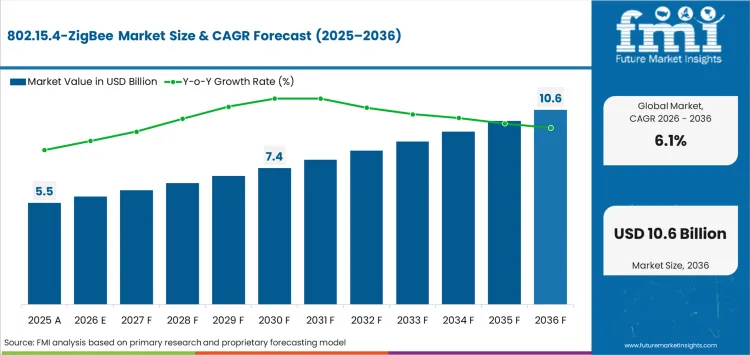
The 802.15.4/ZigBee market was valued at USD 5.20 billion in 2025, projected to reach USD 5.52 billion in 2026, and is forecast to expand to USD 9.97 billion by 2036 at a 6.1% CAGR. As per FMI, the absolute dollar opportunity across the forecast period amounts to USD 4.45 billion, reflecting steady conversion of latent demand into measurable procurement activity across end-use buyer segments.
Summary of 802.15.4/ZigBee Market
- Market Snapshot
- The market is valued at USD 5.20 billion in 2025 and is projected to reach USD 9.97 billion by 2036.
- The industry is expected to grow at a 6.1% CAGR from 2026 to 2036, creating an incremental opportunity of USD 4.45 billion.
- The market remains a specification-driven category where product performance, regulatory compliance, and supply chain reliability define competitive positioning.
- Demand and Growth Drivers
- Demand is rising as end-use sectors face tightening performance specifications and compliance requirements that favour qualified product sources.
- Technology upgrade cycles and capacity expansion programmes across primary verticals are accelerating procurement schedules.
- Growth is further supported by expanding capacity in Asia Pacific and policy incentive frameworks in North America and Europe.
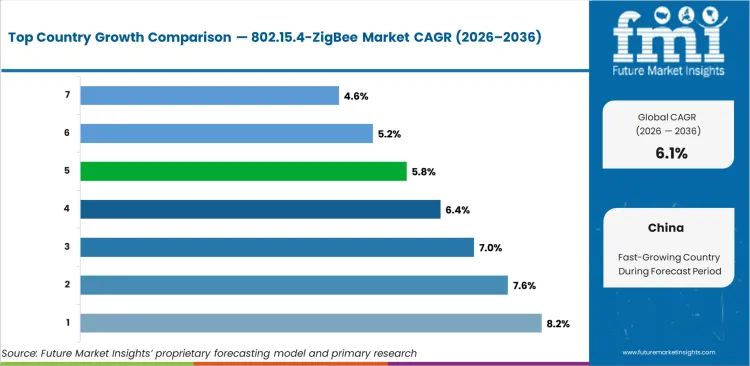
- Among key countries, China at 8.2%, India at 7.6%, Germany at 7%, France at 6.4%, UK at 5.8%, USA at 5.2%, Brazil at 4.6%.
- Product and Segment View
- The market includes the 802.15.4/zigbee market encompasses wireless networking devices, modules, and protocol stacks implementing the ieee 802.15.4 physical and mac layer standard with zigbee application layer profiles for low-power, short-range mesh networking.
- Industrial leads by End User with 34.6% share in 2026.
- Scope includes market scope includes global and regional revenue sizing for 802.15.4/zigbee devices segmented by end user.
- Geography and Competitive Outlook
- China and India are the fastest-growing markets, while mature economies sustain high-value demand through established procurement channels.
- Competition is shaped by product specification compliance, distribution network breadth, and supplier qualification track records.
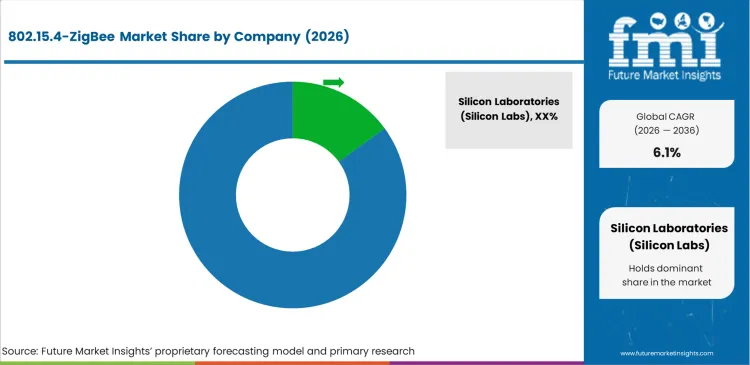
- Key players include Silicon Laboratories (Silicon Labs), NXP Semiconductors, Texas Instruments, STMicroelectronics, Microchip Technology, Qualcomm, Cypress Semiconductor.
- Analyst Opinion at FMI
- Sudip saha, Principal Consultant at Future Market Insights, opines: 'In my analysis, I have observed that the 802.15.4/ZigBee market is transitioning from commodity procurement to specification-driven sourcing structures. Buyers delaying alignment with updated qualification frameworks risk supply disruptions as certified suppliers prioritize long-term contract holders. Capital allocation toward qualified capacity and regional distribution infrastructure will define competitive positioning through the forecast period.'
- Strategic Implications / Executive Takeaways
- Suppliers must secure product qualification certifications ahead of procurement cycle deadlines to qualify for multi-year contract awards.
- Capital project directors should prioritize capacity expansion in high-growth geographies where demand density and incentive frameworks reduce payback periods.
- Product development teams must invest in next-generation specification compliance capabilities to maintain competitiveness.
Based on FMI's report, the industrial IoT sector's requirement for low-power, mesh-capable wireless sensor networks is the structural demand anchor for 802.15.4/ZigBee protocol devices. Factory automation, building management, and agricultural monitoring deployments favour ZigBee's self-healing mesh topology and battery-operated endpoint longevity over Wi-Fi and Bluetooth alternatives in environments where thousands of sensors must operate for years without maintenance. FMI opines that the residential smart home segment's adoption of ZigBee-based lighting controls, thermostats, and security sensors through Amazon Alexa and Philips Hue ecosystems adds consumer-volume procurement. Healthcare facility asset tracking and patient monitoring networks represent an emerging vertical where ZigBee's low electromagnetic interference profile meets clinical environment requirements.
All tracked country markets reflect differentiated growth trajectories. China leads at 8.2% CAGR, propelled by smart home ecosystem expansion through Xiaomi and Aqara platforms and industrial IoT sensor network deployments. India leads at 7.6% CAGR, supported by smart city infrastructure sensor network procurement and agricultural IoT monitoring pilot programme scaling. Germany leads at 7% CAGR, driven by building management system sensor network modernization and Industrie 4.0 factory floor wireless sensor adoption. France leads at 6.4% CAGR, backed by Schneider Electric smart building controller ecosystem and agricultural precision farming sensor deployments. UK leads at 5.8% CAGR, sustained by smart home adoption through Amazon Alexa ecosystem and NHS facility asset tracking deployments. USA leads at 5.2% CAGR, anchored by Amazon/Signify smart home ecosystem penetration and industrial facility wireless sensor network procurement. Brazil registers a 4.6% pace, supported by agricultural IoT monitoring expansion and smart city pilot programme sensor network procurement.
802.15.4/ZigBee Market Key Takeaways
| Metric | Details |
|---|---|
| Industry Size (2026) | USD 5.52 billion |
| Industry Value (2036) | USD 9.97 billion |
| CAGR (2026-2036) | 6.1% |
Source: Future Market Insights, 2026
802.15.4/ZigBee Market Definition
The 802.15.4/ZigBee market encompasses wireless networking devices, modules, and protocol stacks implementing the IEEE 802.15.4 physical and MAC layer standard with ZigBee application layer profiles for low-power, short-range mesh networking. The market covers semiconductor components, modules, gateways, and end devices deployed across industrial automation, agricultural monitoring, smart home, automotive, and healthcare sensor network applications. Primary procurement is driven by IoT sensor network deployments requiring battery-operated endpoints with multi-year operational lifetimes.
802.15.4/ZigBee Market Inclusions
Market scope includes global and regional revenue sizing for 802.15.4/ZigBee devices segmented by end user. Coverage spans industrial, agricultural, automotive, residential, and healthcare application verticals with a 2026 to 2036 forecast period and country-level analysis.
802.15.4/ZigBee Market Exclusions
The scope excludes Wi-Fi, Bluetooth Low Energy, LoRaWAN, and cellular IoT (NB-IoT/LTE-M) devices. Thread protocol-only devices without ZigBee application layer support are excluded. Complete industrial automation PLC systems and SCADA platforms fall outside the valuation boundary unless ZigBee sensor module value is isolated.
802.15.4/ZigBee Market Research Methodology
- Primary Research: Analysts engaged with procurement leads, product specification engineers, and supply chain managers to map purchase decision triggers and qualification requirements.
- Desk Research: Data collection phases aggregated regulatory standards documentation, industry association publications, and company disclosure filings.
- Market-Sizing and Forecasting: Baseline values derive from a bottom-up aggregation of product shipments and contract values, applying region-specific adoption curves to project demand velocity.
- Data Validation and Update Cycle: Projections are tested against publicly reported revenue guidance from leading suppliers and cross-referenced with trade association data.
Why is the 802.15.4-ZigBee Market Growing?
The 802.15.4-ZigBee Market is experiencing steady growth, driven by the increasing adoption of wireless communication protocols in industrial automation, smart home systems, and energy management applications. Demand is being fueled by the protocol’s low power consumption, reliable data transmission, and compatibility with Internet of Things ecosystems. Industrial organizations are leveraging ZigBee-enabled devices to enhance operational efficiency, improve process automation, and enable real-time monitoring of equipment and systems.
The standard’s ability to support large-scale device networks with minimal interference and secure communication further strengthens its adoption. Increasing investments in smart factories, predictive maintenance, and industrial IoT initiatives are accelerating market growth. The growing focus on energy efficiency, remote monitoring, and reduced operational costs is shaping industry dynamics.
Regulatory emphasis on standardized wireless communication and interoperability is also encouraging deployment As organizations continue to prioritize automation and digitalization, the 802.15.4-ZigBee Market is expected to maintain robust growth, with advancements in network scalability, device integration, and data security driving long-term adoption.
Segmental Analysis
The 802.15.4-ZigBee Market is segmented by end user, and geographic regions. By end user, 802.15.4-ZigBee Market is divided into Industrial, Agricultural, Automobile & Automotive, Residential, and Healthcare. Regionally, the 802.15.4/zigbee industry is classified into North America, Latin America, Western Europe, Eastern Europe, Balkan & Baltic Countries, Russia & Belarus, Central Asia, East Asia, South Asia & Pacific, and the Middle East & Africa.
Insights into the Industrial End User Segment
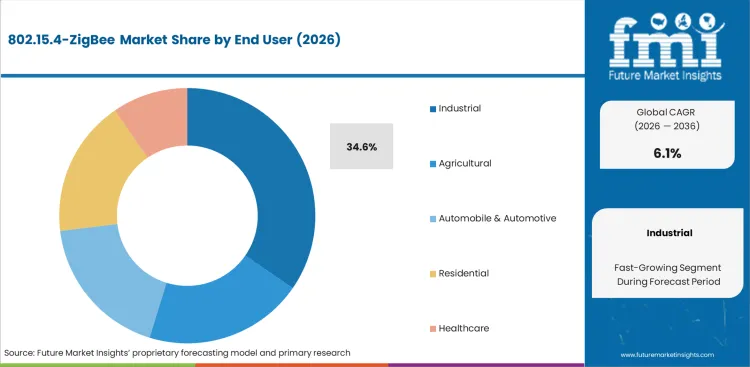
The industrial end-user segment is projected to hold 34.6% of the market revenue in 2026, establishing it as the leading segment. Growth in this segment is being driven by the increasing implementation of smart factory and industrial automation solutions that rely on ZigBee-enabled wireless communication. These networks allow real-time monitoring of machinery, predictive maintenance, and process optimization, improving operational efficiency while reducing downtime.
ZigBee’s low power consumption and reliable connectivity are particularly suited to industrial environments where large-scale device networks must operate continuously with minimal maintenance. Adoption is further supported by the need for scalable, secure, and cost-effective communication protocols in manufacturing plants, warehouses, and production facilities. Integration with industrial IoT platforms enables centralized data management, analytics, and remote control of equipment.
The combination of energy efficiency, operational reliability, and ease of deployment reinforces the industrial sector’s leadership within the market As industries increasingly embrace digital transformation and smart operations, the industrial end-user segment is expected to continue driving market growth.
Market Overview
802.15.4-ZigBee Market Overview
ZigBee technology was invented in 1998, commercialized in 2003, and revised in 2006. ZigBee is one of the global standards of communication protocol formulated by the significant task force under the IEEE (Institute for Electrical and Electronics Engineers) 802.15 working group. 802.15.4/ZigBee has low power consumption limits and transmission distance ranges between 10-100 meters line-of-sight, depending on power output and environmental characteristics.
ZigBee network layer star, tree and generic mesh networking. ZigBee has media access control defined in IEEE standard 802.15.4 for low-rate WPANs. The major ZigBee specifications are network layer, application layer, ZigBee device objects (ZDOs) and manufacturer-defined application objects which allow for customization and favor total integration. 802.15.4/ZigBee transmits data over long distances by passing data through a mesh network of intermediate devices to reach more distant devices.
Analysis of 802.15.4-ZigBee Market By Key Countries
.webp "Top Country Growth Comparison 802")
| Country | CAGR |
|---|---|
| China | 8.2% |
| India | 7.6% |
| Germany | 7.0% |
| France | 6.4% |
| UK | 5.8% |
| USA | 5.2% |
| Brazil | 4.6% |
Country-wise Analysis
The 802.15.4-ZigBee Market is expected to register a CAGR of 6.1% during the forecast period, exhibiting varied country level momentum. China leads with the highest CAGR of 8.2%, followed by India at 7.6%. Developed markets such as Germany, France, and the UK continue to expand steadily, while the USa is likely to grow at consistent rates. Brazil posts the lowest CAGR at 4.6%, yet still underscores a broadly positive trajectory for the global 802.15.4-ZigBee Market. In 2024, Germany held a dominant revenue in the Western Europe market and is expected to grow with a CAGR of 7.0%. The USA 802.15.4-ZigBee Market is estimated to be valued at USD 2.0 billion in 2026 and is anticipated to reach a valuation of USD 3.2 billion by 2036. Sales are projected to rise at a CAGR of 5.2% over the forecast period between 2026 and 2036. While Japan and South Korea markets are estimated to be valued at USD 237.2 million and USD 157.9 million respectively in 2026.
Key Players in the 802.15.4-ZigBee Market
- Silicon Laboratories (Silicon Labs)
- NXP Semiconductors
- Texas Instruments
- STMicroelectronics
- Microchip Technology (and Atmel)
- Qualcomm
- Cypress Semiconductor
- Honeywell International
- Schneider Electric
- Philips Lighting / Signify
- Belkin
- Osram
- Amazon
Scope of the Report
| Metric | Value |
|---|---|
| Quantitative Units | USD 5.52 billion to USD 9.97 billion, at a CAGR of 6.1% |
| Market Definition | The 802.15.4/ZigBee market encompasses wireless networking devices, modules, and protocol stacks implementing the IEEE 802.15.4 physical and MAC layer standard with ZigBee application layer profiles for low-power, short-range mesh networking. The market covers semiconductor components, modules, gateways, and end devices deployed across industrial automation, agricultural monitoring, smart home, automotive, and healthcare sensor network applications. |
| Segmentation | End User: Industrial, Agricultural, Automobile and Automotive, Residential, Healthcare |
| Regions Covered | North America, Latin America, Europe, East Asia, South Asia, Oceania, Middle East & Africa |
| Countries Covered | China, India, Germany, France, UK, USA, Brazil, and 40 plus countries |
| Key Companies Profiled | Silicon Laboratories (Silicon Labs), NXP Semiconductors, Texas Instruments, STMicroelectronics, Microchip Technology, Qualcomm, Cypress Semiconductor, Honeywell International, Schneider Electric, Philips Lighting / Signify, Belkin, Osram, Amazon |
| Forecast Period | 2026 to 2036 |
| Approach | Forecasting models apply a bottom-up methodology starting with global installed base and consumption metrics, projecting conversion rates to advanced specifications. |
802.15.4-ZigBee Market by Segments
End User:
- Industrial
- Agricultural
- Automobile & Automotive
- Residential
- Healthcare
Region:
- North America
- USA
- Canada
- Mexico
- Latin America
- Brazil
- Chile
- Rest of Latin America
- Western Europe
- Germany
- UK
- Italy
- Spain
- France
- Nordic
- BENELUX
- Rest of Western Europe
- Eastern Europe
- Russia
- Poland
- Hungary
- Balkan & Baltic
- Rest of Eastern Europe
- East Asia
- China
- Japan
- South Korea
- South Asia and Pacific
- India
- ASEAN
- Australia & New Zealand
- Rest of South Asia and Pacific
- Middle East & Africa
- Kingdom of Saudi Arabia
- Other GCC Countries
- Turkiye
- South Africa
- Other African Union
- Rest of Middle East & Africa
Bibliography
- 1. Institute of Electrical and Electronics Engineers. (2024). IEEE 802.15.4-2020: Low-rate wireless personal area networks, amendment updates. IEEE.
- 2. Connectivity Standards Alliance. (2024). ZigBee PRO 2023 specification: Mesh networking protocol enhancements. CSA.
- 3. Silicon Laboratories. (2025). Annual Report 2024: IoT wireless connectivity segment review. Silicon Labs.
- 4. International Electrotechnical Commission. (2024). IEC 62591: Industrial networks, wireless communication network and communication profiles. IEC.
- 5. European Commission. (2024). Radio Equipment Directive 2014/53/EU: IoT device certification harmonised standards update. European Commission.
This bibliography is provided for reader reference. The full Future Market Insights report contains the complete reference list with primary research documentation.
Frequently Asked Questions
How large is the demand for 802.15.4/ZigBee in the global market in 2026?
Demand for 802.15.4/ZigBee in the global market is estimated to be valued at USD 5.52 billion in 2026.
What will be the market size of 802.15.4/ZigBee in the global market by 2036?
Market size for 802.15.4/ZigBee is projected to reach USD 9.97 billion by 2036.
What is the expected demand growth for 802.15.4/ZigBee between 2026 and 2036?
Demand for 802.15.4/ZigBee is expected to grow at a CAGR of 6.1% between 2026 and 2036.
Which End User is poised to lead global sales by 2026?
Industrial accounts for 34.6% in 2026 based on established procurement patterns across primary end-use sectors.
What is driving demand in China?
China leads with a 8.2% CAGR through 2036, driven by expanding capacity, policy support, and growing end-user adoption.
What is the India growth outlook in this report?
India is projected to grow at a CAGR of 7.6% during 2026 to 2036.
What is 802.15.4/ZigBee and what is it mainly used for?
The 802.15.4/ZigBee market encompasses wireless networking devices, modules, and protocol stacks implementing the IEEE 802.15.4 physical and MAC layer standard with ZigBee application layer profiles for low-power, short-range mesh networking. The market covers semiconductor components, modules, gateways, and end devices deployed across industrial automation, agricultural monitoring, smart home, automotive, and healthcare sensor network applications.
How does FMI build and validate the 802.15.4/ZigBee forecast?
Forecasting models apply a bottom-up methodology starting with global installed base metrics and cross-validate projections against quarterly industry revenue volumes and primary research inputs.
Preview the report firsthand - request a free sample
Get SampleGet the brochure for pricing and purchase details.
Get PDFTable of Content
- Executive Summary
- Global Market Outlook
- Demand-side Trends
- Supply-side Trends
- Technology Roadmap Analysis
- Analysis and Recommendations
- Market Overview
- Market Coverage / Taxonomy
- Market Definition / Scope / Limitations
- Research Methodology
- Chapter Orientation
- Analytical Lens and Working Hypotheses
- Market Structure, Signals, and Trend Drivers
- Benchmarking and Cross-market Comparability
- Market Sizing, Forecasting, and Opportunity Mapping
- Research Design and Evidence Framework
- Desk Research Programme (Secondary Evidence)
- Company Annual and Sustainability Reports
- Peer-reviewed Journals and Academic Literature
- Corporate Websites, Product Literature, and Technical Notes
- Earnings Decks and Investor Briefings
- Statutory Filings and Regulatory Disclosures
- Technical White Papers and Standards Notes
- Trade Journals, Industry Magazines, and Analyst Briefs
- Conference Proceedings, Webinars, and Seminar Materials
- Government Statistics Portals and Public Data Releases
- Press Releases and Reputable Media Coverage
- Specialist Newsletters and Curated Briefings
- Sector Databases and Reference Repositories
- FMI Internal Proprietary Databases and Historical Market Datasets
- Subscription Datasets and Paid Sources
- Social Channels, Communities, and Digital Listening Inputs
- Additional Desk Sources
- Expert Input and Fieldwork (Primary Evidence)
- Primary Modes
- Qualitative Interviews and Expert Elicitation
- Quantitative Surveys and Structured Data Capture
- Blended Approach
- Why Primary Evidence is Used
- Field Techniques
- Interviews
- Surveys
- Focus Groups
- Observational and In-context Research
- Social and Community Interactions
- Stakeholder Universe Engaged
- C-suite Leaders
- Board Members
- Presidents and Vice Presidents
- R&D and Innovation Heads
- Technical Specialists
- Domain Subject-matter Experts
- Scientists
- Physicians and Other Healthcare Professionals
- Governance, Ethics, and Data Stewardship
- Research Ethics
- Data Integrity and Handling
- Primary Modes
- Tooling, Models, and Reference Databases
- Desk Research Programme (Secondary Evidence)
- Data Engineering and Model Build
- Data Acquisition and Ingestion
- Cleaning, Normalisation, and Verification
- Synthesis, Triangulation, and Analysis
- Quality Assurance and Audit Trail
- Market Background
- Market Dynamics
- Drivers
- Restraints
- Opportunity
- Trends
- Scenario Forecast
- Demand in Optimistic Scenario
- Demand in Likely Scenario
- Demand in Conservative Scenario
- Opportunity Map Analysis
- Product Life Cycle Analysis
- Supply Chain Analysis
- Investment Feasibility Matrix
- Value Chain Analysis
- PESTLE and Porter’s Analysis
- Regulatory Landscape
- Regional Parent Market Outlook
- Production and Consumption Statistics
- Import and Export Statistics
- Market Dynamics
- Global Market Analysis 2021 to 2025 and Forecast, 2026 to 2036
- Historical Market Size Value (USD Million) Analysis, 2021 to 2025
- Current and Future Market Size Value (USD Million) Projections, 2026 to 2036
- Y-o-Y Growth Trend Analysis
- Absolute $ Opportunity Analysis
- Global Market Pricing Analysis 2021 to 2025 and Forecast 2026 to 2036
- Global Market Analysis 2021 to 2025 and Forecast 2026 to 2036, By End User
- Introduction / Key Findings
- Historical Market Size Value (USD Million) Analysis By End User , 2021 to 2025
- Current and Future Market Size Value (USD Million) Analysis and Forecast By End User , 2026 to 2036
- Industrial
- Agricultural
- Automobile & Automotive
- Residential
- Healthcare
- Industrial
- Y-o-Y Growth Trend Analysis By End User , 2021 to 2025
- Absolute $ Opportunity Analysis By End User , 2026 to 2036
- Global Market Analysis 2021 to 2025 and Forecast 2026 to 2036, By Region
- Introduction
- Historical Market Size Value (USD Million) Analysis By Region, 2021 to 2025
- Current Market Size Value (USD Million) Analysis and Forecast By Region, 2026 to 2036
- North America
- Latin America
- Western Europe
- Eastern Europe
- East Asia
- South Asia and Pacific
- Middle East & Africa
- Market Attractiveness Analysis By Region
- North America Market Analysis 2021 to 2025 and Forecast 2026 to 2036, By Country
- Historical Market Size Value (USD Million) Trend Analysis By Market Taxonomy, 2021 to 2025
- Market Size Value (USD Million) Forecast By Market Taxonomy, 2026 to 2036
- By Country
- USA
- Canada
- Mexico
- By End User
- By Country
- Market Attractiveness Analysis
- By Country
- By End User
- Key Takeaways
- Latin America Market Analysis 2021 to 2025 and Forecast 2026 to 2036, By Country
- Historical Market Size Value (USD Million) Trend Analysis By Market Taxonomy, 2021 to 2025
- Market Size Value (USD Million) Forecast By Market Taxonomy, 2026 to 2036
- By Country
- Brazil
- Chile
- Rest of Latin America
- By End User
- By Country
- Market Attractiveness Analysis
- By Country
- By End User
- Key Takeaways
- Western Europe Market Analysis 2021 to 2025 and Forecast 2026 to 2036, By Country
- Historical Market Size Value (USD Million) Trend Analysis By Market Taxonomy, 2021 to 2025
- Market Size Value (USD Million) Forecast By Market Taxonomy, 2026 to 2036
- By Country
- Germany
- UK
- Italy
- Spain
- France
- Nordic
- BENELUX
- Rest of Western Europe
- By End User
- By Country
- Market Attractiveness Analysis
- By Country
- By End User
- Key Takeaways
- Eastern Europe Market Analysis 2021 to 2025 and Forecast 2026 to 2036, By Country
- Historical Market Size Value (USD Million) Trend Analysis By Market Taxonomy, 2021 to 2025
- Market Size Value (USD Million) Forecast By Market Taxonomy, 2026 to 2036
- By Country
- Russia
- Poland
- Hungary
- Balkan & Baltic
- Rest of Eastern Europe
- By End User
- By Country
- Market Attractiveness Analysis
- By Country
- By End User
- Key Takeaways
- East Asia Market Analysis 2021 to 2025 and Forecast 2026 to 2036, By Country
- Historical Market Size Value (USD Million) Trend Analysis By Market Taxonomy, 2021 to 2025
- Market Size Value (USD Million) Forecast By Market Taxonomy, 2026 to 2036
- By Country
- China
- Japan
- South Korea
- By End User
- By Country
- Market Attractiveness Analysis
- By Country
- By End User
- Key Takeaways
- South Asia and Pacific Market Analysis 2021 to 2025 and Forecast 2026 to 2036, By Country
- Historical Market Size Value (USD Million) Trend Analysis By Market Taxonomy, 2021 to 2025
- Market Size Value (USD Million) Forecast By Market Taxonomy, 2026 to 2036
- By Country
- India
- ASEAN
- Australia & New Zealand
- Rest of South Asia and Pacific
- By End User
- By Country
- Market Attractiveness Analysis
- By Country
- By End User
- Key Takeaways
- Middle East & Africa Market Analysis 2021 to 2025 and Forecast 2026 to 2036, By Country
- Historical Market Size Value (USD Million) Trend Analysis By Market Taxonomy, 2021 to 2025
- Market Size Value (USD Million) Forecast By Market Taxonomy, 2026 to 2036
- By Country
- Kingdom of Saudi Arabia
- Other GCC Countries
- Turkiye
- South Africa
- Other African Union
- Rest of Middle East & Africa
- By End User
- By Country
- Market Attractiveness Analysis
- By Country
- By End User
- Key Takeaways
- Key Countries Market Analysis
- USA
- Pricing Analysis
- Market Share Analysis, 2025
- By End User
- Canada
- Pricing Analysis
- Market Share Analysis, 2025
- By End User
- Mexico
- Pricing Analysis
- Market Share Analysis, 2025
- By End User
- Brazil
- Pricing Analysis
- Market Share Analysis, 2025
- By End User
- Chile
- Pricing Analysis
- Market Share Analysis, 2025
- By End User
- Germany
- Pricing Analysis
- Market Share Analysis, 2025
- By End User
- UK
- Pricing Analysis
- Market Share Analysis, 2025
- By End User
- Italy
- Pricing Analysis
- Market Share Analysis, 2025
- By End User
- Spain
- Pricing Analysis
- Market Share Analysis, 2025
- By End User
- France
- Pricing Analysis
- Market Share Analysis, 2025
- By End User
- India
- Pricing Analysis
- Market Share Analysis, 2025
- By End User
- ASEAN
- Pricing Analysis
- Market Share Analysis, 2025
- By End User
- Australia & New Zealand
- Pricing Analysis
- Market Share Analysis, 2025
- By End User
- China
- Pricing Analysis
- Market Share Analysis, 2025
- By End User
- Japan
- Pricing Analysis
- Market Share Analysis, 2025
- By End User
- South Korea
- Pricing Analysis
- Market Share Analysis, 2025
- By End User
- Russia
- Pricing Analysis
- Market Share Analysis, 2025
- By End User
- Poland
- Pricing Analysis
- Market Share Analysis, 2025
- By End User
- Hungary
- Pricing Analysis
- Market Share Analysis, 2025
- By End User
- Kingdom of Saudi Arabia
- Pricing Analysis
- Market Share Analysis, 2025
- By End User
- Turkiye
- Pricing Analysis
- Market Share Analysis, 2025
- By End User
- South Africa
- Pricing Analysis
- Market Share Analysis, 2025
- By End User
- USA
- Market Structure Analysis
- Competition Dashboard
- Competition Benchmarking
- Market Share Analysis of Top Players
- By Regional
- By End User
- Competition Analysis
- Competition Deep Dive
- Silicon Laboratories (Silicon Labs)
- Overview
- Product Portfolio
- Profitability by Market Segments (Product/Age /Sales Channel/Region)
- Sales Footprint
- Strategy Overview
- Marketing Strategy
- Product Strategy
- Channel Strategy
- NXP Semiconductors
- Texas Instruments
- STMicroelectronics
- Microchip Technology (and Atmel)
- Qualcomm
- Cypress Semiconductor
- Honeywell International
- Schneider Electric
- Philips Lighting / Signify
- Belkin
- Osram
- Amazon
- Silicon Laboratories (Silicon Labs)
- Competition Deep Dive
- Assumptions & Acronyms Used


