

- Market Size (2026)
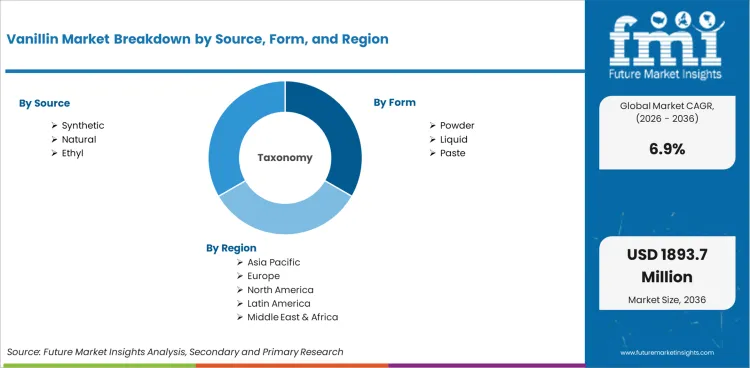
- USD 909.0 Mn
- Forecast (2036)
- USD 1771.4 Mn
- CAGR (2026 to 2036)
- 6.9%
Vanillin Market Size, Market Forecast and Outlook By FMI
Summary of the Vanillin Market
- Demand and Growth Drivers
- Stable demand for vanillin is driven by its essential role in bakery and dairy formulations, where manufacturers require consistent vanilla notes at low dosage, supporting steady baseline consumption across large‑scale food production.
- Market growth is supported by the expansion of packaged and processed foods, as producers increasingly rely on vanillin to standardize flavor profiles across high‑volume, multi‑site manufacturing operations.
- Rising use of vanillin as a taste‑masking and flavor‑balancing agent in reduced‑sugar and functional food formulations is reinforcing demand beyond traditional sweet applications and widening the market base.
- Growth is further enabled by supply reliability and formulation flexibility, as synthetic and blended vanillin grades provide predictable pricing compatibility with dry and liquid processing systems used by industrial buyers.
- Product and Segment View
- Synthetic vanillin leads the Source segment with 64.5% share in 2026 as price control matters for large plants.
- Powder form leads the Form segment with 65.0% share in 2026 as dry blending gives processors easier factory handling.
- Food leads the Application segment with 45.0% share in 2026 as bakery and confectionery remain the main flavor uses.
- Food manufacturers lead the End Use segment with 55.5% share in 2026 as industrial buyers drive repeat orders.
- Geography and Competitive Outlook
- India and China are expected to record the fastest country pace at 9.4% and 8.9% CAGR respectively.
- Japan and South Korea are projected above the global pace due to processed food and premium dairy applications.
- Solvay, Camlin Fine Sciences and Borregaard keep the clearest supplier positions across synthetic and wood-based routes.
- Lallemand is changing the natural vanillin discussion through Evolva-linked precision fermentation capability.
- Analyst Opinion
- Nandini Roy Choudhury, Senior Analyst for Food and Beverage at FMI, observes, "Vanillin is not bought only as a flavor molecule anymore. Large food makers now treat it as a supply-risk ingredient with price, origin and label exposure. Synthetic material will keep the volume center. The premium pool will shift toward natural and fermentation-derived grades where buyers need cleaner claims without losing dosing consistency."
- Vanillin Market Value Analysis
- Value expansion is tied to high-volume sweet flavor systems that serve food flavors in bakery and dairy products.
- The wider flavors category gives vanillin a larger value-chain role across sweet products and beverage systems.
- Synthetic vanillin keeps unit costs manageable while natural grades lift value in clean-label and premium formulations.
- Powder form supports higher factory use since dry blends reduce dosing errors in premix and instant beverage lines.
- Trade pressure around Chinese vanillin is pushing buyers to hold alternate supply routes and longer contract cover.
- The premium layer is expanding through bio vanillin where fermentation helps reduce exposure to vanilla bean supply swings.
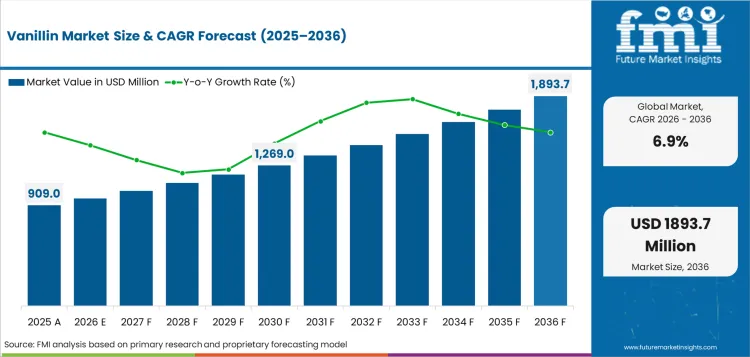
Key Takeaways, Market Size, and Forecast
| Metric | Value |
|---|---|
| Market Size (2025) | USD 850.3 Million |
| Market Size (2036) | USD 1,771.4 Million |
| CAGR (2026–2036) | 6.9% |
| Incremental Opportunity (2026–2036) | USD 862.4 Million |
| Leading Nature (2026) | Synthetic Vanillin |
| Synthetic Vanillin Share (2026) | 64.5% |
| Leading Form (2026) | Powder Form |
| Powder Form Share (2026) | 65.0% |
| Fastest-Growing Country | India |
| India CAGR | 9.4% |
| 2nd Fastest-Growing Country | China |
| China CAGR | 8.9% |
Vanillin sourcing is now shaped by trade controls, local production and ingredient origin. The European Commission imposed 131.1% anti-dumping duties on Chinese vanillin in June 2025. European food and fragrance users reviewed supplier concentration because landed cost risk increased. Syensqo’s September 2025 restart plan added another signal for regional supply. Its Saint-Fons unit had been mothballed since May 2024 and was scheduled to resume by the end of 2025. This gave buyers a stronger reason to compare local availability with imported material. Bio-based routes also became more relevant for premium positioning. EuropaBio reported in October 2024 that Lallemand’s fermentation route produced 98% pure vanillin from sugar. This supported use in products where natural claims and supply reliability both mattered.
Vanillin Market Definition
The sector covers vanillin and ethyl vanillin sold as flavor, fragrance and masking ingredients. Included products cover synthetic guaiacol-based vanillin, lignin-derived vanillin and natural grades linked with vanilla extract systems. The scope includes powder, liquid, paste and granular forms sold to industrial food, beverage, pharmaceutical and personal care users. The scope includes industrial ethyl vanillin but excludes vanillic acid when it is sold as a separate intermediate. Vanilla beans sold as whole agricultural produce and finished consumer goods containing vanilla notes are outside the scope.
Vanillin Market Inclusions
The study includes synthetic vanillin, natural vanillin, ethyl vanillin, blended vanillin, powder form, liquid form, paste form, granular form, food use, beverage use, pharmaceutical use, nutraceutical use, personal care use, direct sales, distributor sales, online sales, specialty supply and global geography for flavor houses, food processors and ingredient distributors.
Vanillin Market Exclusions
The study excludes whole vanilla beans, pure retail vanilla extract, finished bakery products, finished perfumes, retail food additives and lab reagents sold without industrial flavor or fragrance use.
Vanillin Market Research Methodology
- Primary Research: FMI analysts reviewed ingredient distributors, food processors and flavor houses that buy vanillin for industrial use. Interviews focused on grade selection, price sensitivity and origin controls.
- Desk Research: The desk review used public food processing data and trade remedy records to assess demand signals. Company filings and product pages were reviewed for supplier presence.
- Market Sizing and Forecasting: The forecast used the provided 2026 value and 2036 anchor. CAGR math was checked against the ten-year growth curve and end-use demand signals.
- Data Validation: Final values were checked against food processing output, supplier activity and country demand strength. Segment shares were tested against buyer use patterns and product handling needs.
Why is the Vanillin Market Growing?
- Bakery plants need stable vanilla notes across multi-site production and this favors synthetic grades over crop-linked extract supply.
- Powder vanillin works well in dry mixes since it improves dosing control in premix, confectionery and instant beverage plants.
- Clean-label pressure is raising interest in natural flavors and fermentation-derived aroma molecules.
- The natural food flavors shift gives premium food makers a reason to test natural vanillin routes.
- Food processors are using vanillin to mask off-notes in protein products and sugar-reduced formulations.
- Fragrance brands keep a smaller but high-value outlet through gourmand scents and sweet personal care notes.
Food manufacturing gives vanillin its largest daily-use outlet. India offers a clear example as USDA’s foreign agriculture service reported a food processing sector moving from USD 355 billion in 2024 toward USD 535 billion by fiscal 2026. That scale supports ingredient buyers who need flavor systems that work across packaged bakery and dairy lines. Vanillin suppliers gain when processors standardize recipes for national retail reach.
Regulatory flexibility is giving food formulators more room to rework recipes. The USA Food and Drug Administration said in July 2025 that it was revoking or proposing to revoke 52 food standards after finding them obsolete. That does not change basic flavor safety rules. It does create more room for product developers to reformulate sweet foods and dressings where vanilla notes support taste balancing.
Market Segmentation Analysis
- With an estimated 64.5% share in 2026, synthetic vanillin is expected to lead Source as industrial buyers prioritize stable price and large lots.
- Buyers opting for powder form are projected to account for 65.0% of Form in 2026 as dry blending cuts factory handling issues.
- Food applications are anticipated to hold 45.0% of Application in 2026 with bakery and confectionery using repeat sweet-note recipes.
- Food manufacturers are expected to represent 55.5% of End Use in 2026 as large processors sign longer supply contracts.
- Direct sales are projected to direct 58.0% of Distribution Channel value in 2026 toward large accounts that need specification control.
The market is segmented by source, form, application, end use and distribution channel. Source decisions separate synthetic grades from natural and fermentation routes. Form choices show how buyers handle dosing inside dry factories and liquid flavor systems. Application demand connects vanillin with bakery ingredients, confectionery, beverages, pharmaceuticals and personal care.
Vanillin Market Analysis by Source
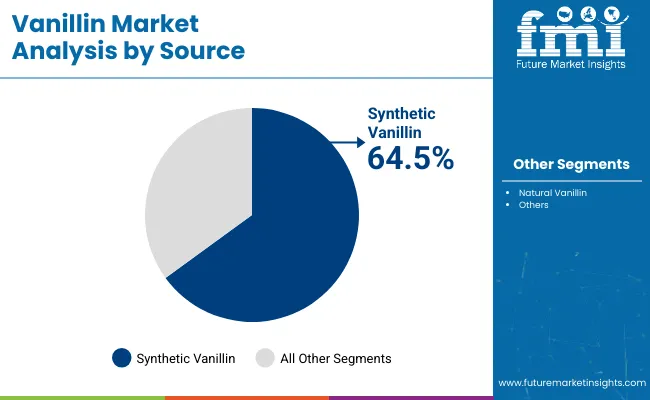
- Synthetic vanillin is projected to account for 64.5% share in 2026 as high-volume food plants need predictable price and steady purity. Guaiacol-based material keeps the strongest position where buyers run costed recipes at scale.
- Natural vanillin attracts premium accounts, but smaller buyers often face supply cost limits. Lignin and fermentation routes help close the gap between clean-label demand and practical manufacturing volume.
Vanillin Market Analysis by Form
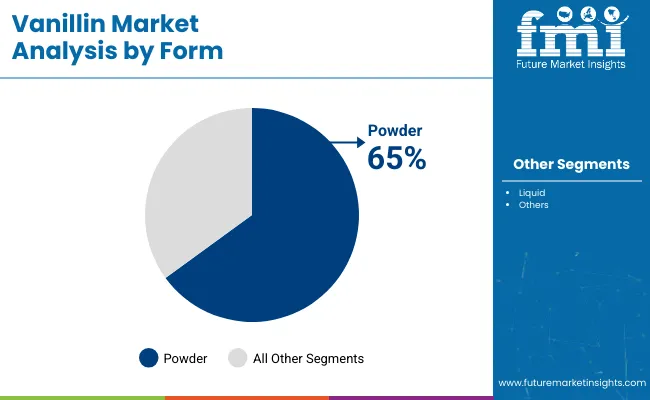
- Powder form is estimated to hold 65.0% share in 2026 as dry mixing and bulk storage fit most industrial flavor plants. Crystalline powder also supports consistent dispersion in bakery mixes.
- Liquid form remains useful for beverage makers and syrup producers that need faster incorporation. Paste forms are more selective and often tied to premium dessert applications.
Vanillin Market Analysis by Application
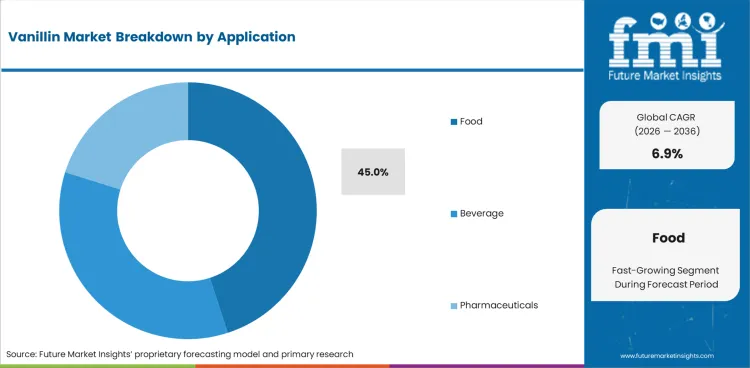
- Food is anticipated to command 45.0% share in 2026 as cakes, cookies and chocolate need repeat vanilla-note profiles. This segment depends on flavor intensity at very low dosage.
- Beverage use is growing through coffee mixes and ready-to-drink products. Pharmaceutical applications use vanillin mainly for taste masking in syrups and oral dosage formats.
Vanillin Market Analysis by End Use
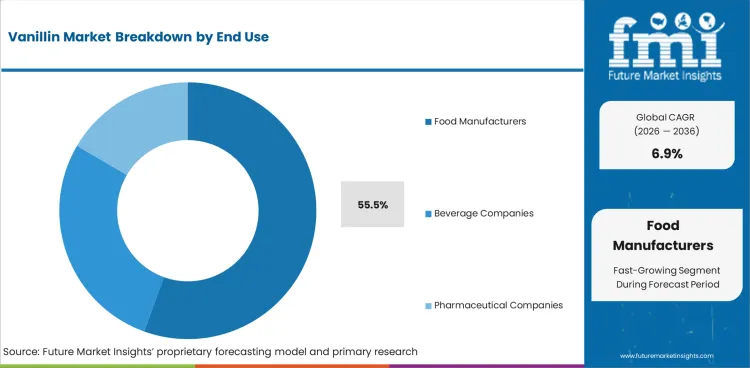
- Food manufacturers are expected to capture 55.5% share in 2026 as large bakery and confectionery producers buy repeat lots. Their buying teams focus on lot quality and origin documentation.
- Beverage companies compare vanillin with compound flavors that support sweetness perception. Pharmaceutical companies buy smaller volumes but require tighter documentation and supplier traceability.
Vanillin Market Analysis by Distribution Channel
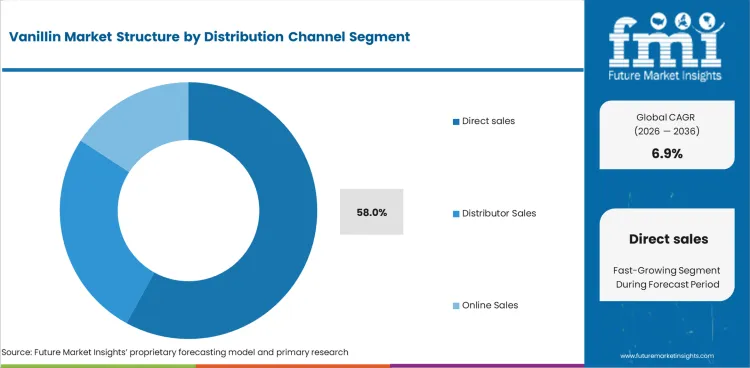
- Direct sales are projected to account for 58.0% share in 2026 as large food and flavor accounts prefer technical support. Contract buying gives suppliers better forecast visibility.
- Distributor sales serve regional food processors and cosmetic brands that need smaller lots. Online channels support sampling and small-batch purchase but rarely decide large industrial supply.
Vanillin Market Drivers, Restraints, and Opportunities
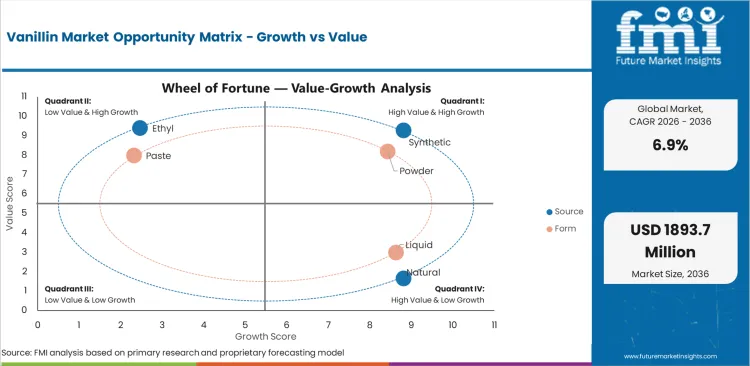
- Bakery dosing consistency will sustain synthetic vanillin buying as large factories need repeat flavor output.
- Vanilla bean price exposure will keep natural extract buyers open to fermentation-derived alternatives.
- Trade remedy risk may raise sourcing costs for USA buyers using Chinese vanillin.
- Natural labeling pressure creates a premium opportunity for suppliers with fermentation route proof.
- Low-cost imports can restrain margins when buyers treat vanillin as a commodity input.
Bakery Dosing Consistency
Industrial bakery buyers place a high value on recipes that work the same way every shift. The confectionery ingredients and bakery ingredient chains both rely on sweet-note consistency in mixes, fillings and coatings. Powder vanillin fits this buying need since it is easy to weigh and blend. This keeps the leading form segment tied closely to factory execution rather than consumer flavor fashion.
Natural Route Price Gap
Natural and fermentation grades open a value channel beyond standard synthetic supply. The clean label flavors shift gives premium brands a reason to pay for better origin claims. The same buyer pool watches natural X flavoring options when teams want named-source claims. The restraint is cost discipline in mass-market bakery and beverage formulas. Suppliers will need proof that natural grades give label benefit without disrupting batch cost.
Trade Remedy Exposure
USA supply risk increased after the Commerce Department initiated antidumping and countervailing duty investigations of vanillin from China in June 2024. The case covered vanillin under HS 2912.41.00 and ethyl vanillin under HS 2912.42.00. This pushed buyers to review origin exposure and contract coverage. The issue supports suppliers that can offer documented non-Chinese material or flexible global sourcing.
Analysis of Vanillin Market By Key Countries
.webp "Top Country Growth Comparison Vanillin Market Cagr (2026 2036)")
| Country | CAGR 2026 to 2036 |
|---|---|
| India | 9.4% |
| China | 8.9% |
| Japan | 7.5% |
| Brazil | 7.3% |
| South Korea | 7.2% |
| United Kingdom | 5.9% |
| United States | 4.6% |
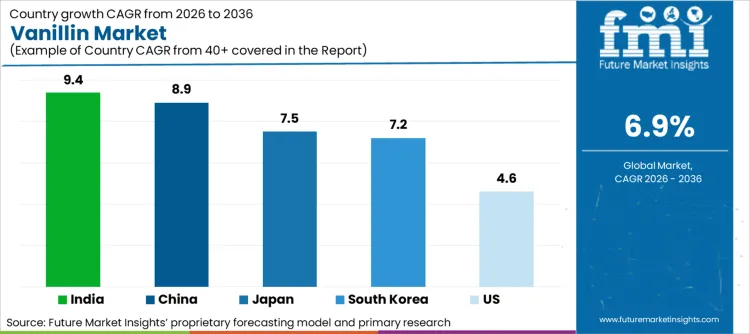
- India is projected to record a 9.4% CAGR through 2036 as packaged food output lifts industrial flavor use.
- China is expected to expand at 8.9% CAGR through 2036 since large food processing output supports high-volume buying.
- Japan is forecast to grow at 7.5% CAGR through 2036 as premium dairy and confectionery recipes use stable vanilla notes.
- Brazil is expected to advance at 7.3% CAGR through 2036 given its large regional food processing role.
- South Korea is projected to rise at 7.2% CAGR through 2036 as convenience food and beverage makers use more flavor systems.
- United Kingdom is forecast at 5.9% CAGR through 2036 where food manufacturing remains large but mature.
- United States is expected to post 4.6% CAGR through 2036 as trade scrutiny and mature food output keep expansion measured.
Demand Outlook for Vanillin in India
India is projected to record a 9.4% CAGR through 2036 as packaged bakery and dairy output widen industrial flavor use. USDA’s 2026 food processing review placed India’s sector at USD 355 billion in 2024 with an expected move to USD 535 billion by fiscal 2026. That scale gives vanillin suppliers a larger pool of regional manufacturers. Local buyers are expected to favor powder grades that fit dry mix and sweet goods production.
- Bakery and confectionery plants need cost-effective vanillin for mass products sold through modern retail.
- Flavor houses can gain accounts by offering stable synthetic material and natural alternatives for premium brands.
- Food manufacturers will keep direct buying important as large plants seek lot consistency and price cover.
Sales Analysis of Vanillin in China
China is expected to expand at 8.9% CAGR through 2036 as its food processing sector keeps a large industrial flavor pull. USDA reported that China’s food processing sector grew 2.2% in 2024 to USD 1.26 trillion. This makes China both a large demand center and a key supply-linked geography. Buyers will remain sensitive to trade and origin documentation after USA investigations on Chinese vanillin.
- Large food producers use synthetic vanillin in biscuits, dairy desserts and beverage powders that need repeat profiles.
- Origin documentation is becoming more important as export buyers review supply exposure and duty risk.
- Domestic suppliers compete strongly on cost but face higher scrutiny in regulated export channels.
Industry Outlook for Vanillin in Japan
Japan is forecast to grow at 7.5% CAGR through 2036 as premium processed foods keep steady flavor input demand. The country’s food processing sector rose 3.9% in 2024 and reached USD 174 billion according to USDA’s 2025 exporter guide. This market values taste balance and specification discipline. Vanillin suppliers gain when they support dairy, confectionery and beverage makers with clean sensory profiles.
- Premium dessert and dairy brands use vanilla notes to support mild sweetness and smooth mouthfeel.
- Food processors often prefer suppliers with stable documentation and small-lot technical support.
- Natural and fermentation-derived grades have room in high-end bakery and confectionery launches.
Demand Analysis of Vanillin in Brazil
Brazil is expected to advance at 7.3% CAGR through 2036 as regional food processors raise demand for industrial ingredients. USDA’s 2026 review cited 2024 food service revenue of USD 83 billion and noted Brazil’s dependence on imported food additives. That import need supports vanillin distributors and global flavor houses. Price pressure remains important as mass bakery and confectionery producers compare synthetic grade options.
- Regional processors need vanillin for cakes, chocolates and dairy desserts sold through broad retail channels.
- Imported additive dependence supports distributors with reliable stock and local technical service.
- Natural grades will be selective as mainstream food makers focus on cost and supply regularity.
Sales Forecast for Vanillin in South Korea
South Korea is projected to rise at 7.2% CAGR through 2036 as convenience food and home-meal replacement producers expand flavor systems. Korean retail food data in 2025 showed imports of basic and intermediate agricultural products at USD 16.9 billion in 2024. Ingredient reliance supports buying routes for specialty flavors and aroma chemicals. Vanillin demand will track ready meals, dairy desserts and confectionery products.
- Convenience food makers use vanilla notes for sweet sauces, dairy snacks and bakery-style products.
- Importers need reliable documentation since food processors rely on outside ingredients for many formulations.
- Direct supply works for large accounts while distributors serve smaller confectionery and beverage makers.
Industry Analysis of Vanillin in the United Kingdom
United Kingdom is forecast at 5.9% CAGR through 2036 as its food and drink sector remains a large manufacturing base. The UK government states that food and drink is the country’s biggest manufacturing sector by turnover at GBP 104.4 billion. This size supports steady industrial flavor purchasing. Growth is more measured than Asia since the buyer base is mature and well supplied.
- Bakery and dessert brands use vanillin to keep sweetness notes stable in reformulated products.
- Food manufacturers assess ingredient claims carefully as retailers place pressure on label clarity.
- Distributors keep an important role for small and mid-sized producers needing lower minimum order quantities.
Adjacent EU vanillin demand gives suppliers a regional benchmark for sourcing behavior and food formulation use.
Industry Outlook for Vanillin in the United States
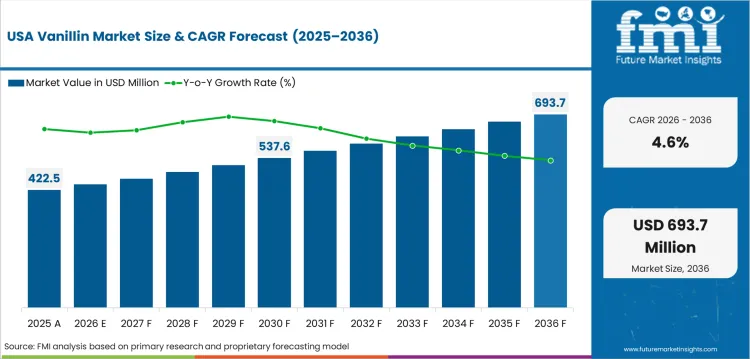
United States is expected to post 4.6% CAGR through 2036 as a mature food manufacturing sector buys vanillin steadily. USDA economic research estimated that food processors added USD 291 billion of value on average from 2017 to 2023. This demand base is large but less likely to expand quickly. The key issue is not volume growth alone but supply route security after trade action on Chinese vanillin.
- Large food companies use long-term contracts to reduce price and duty exposure in synthetic vanillin.
- FDA action on 52 obsolete food standards may give product developers more room to adjust recipes.
- Natural and bio-based grades can grow in premium snacks, nutraceuticals and personal care products.
Competitive Landscape and Strategic Positioning
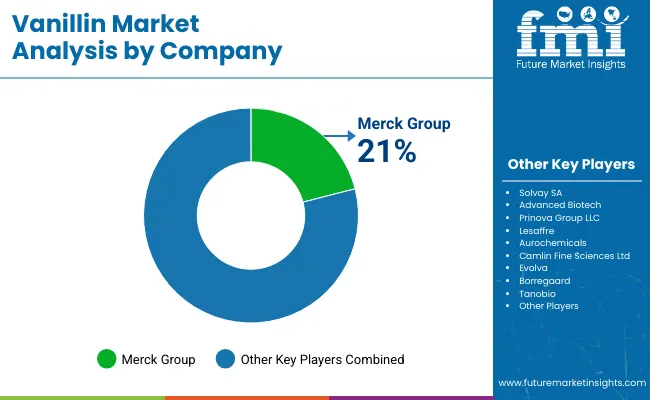
- Competition is moderately concentrated at the supply-origin level but broader at distribution and application support level.
- Solvay holds the clearest USA and global synthetic vanillin position through Rhovanil supply and trade action visibility.
- Camlin Fine Sciences competes through Indian aroma ingredient production and backward integration at Dahej.
- Borregaard stands apart through wood-based biovanillin and lignin chemistry capability.
- Smaller suppliers win in regional distribution, natural extract blends and low-volume custom flavor accounts.
Large suppliers compete on purity, origin control and reliable plant output. Solvay has a strong position in synthetic vanillin and ethyl vanillin tied to food and fragrance accounts. The company’s 2024 trade petition showed how supply discipline can become a competitive tool when imports disrupt price bands. That action matters for buyers because supply security affects recipe costs and contract planning. Specialist players must therefore show more than product availability. They need documentation, alternative origin choices and technical support for flavoring agents used across food and personal care.
Camlin Fine Sciences competes through scale in India and downstream aroma products. Its 2024 to 2025 annual report states that aroma ingredients include vanillin, ethyl vanillin and natural vanillin made at the Dahej unit [9]. This gives the company a route into price-sensitive food customers and export markets. The practical result is a stronger case for integrated suppliers that control intermediates. Buyers value this when synthetic precursor pricing shifts or shipment timing becomes tight.
Borregaard brings a different position through wood-based vanillin. Its 2024 annual report describes the company as the only producer of wood-based vanillin [10]. That gives it a niche in natural-origin and sustainability-led purchasing. Lallemand’s acquisition of Evolva and Hevani launch add a fermentation route to the same premium discussion. These routes do not displace synthetic volumes quickly. They create higher value outlets in gourmand fragrance, premium dairy and clean-label food products.
Entry remains difficult because vanillin buyers need consistent odor profile and contaminant control across repeated lots. Food companies do not change suppliers quickly once a recipe has passed quality checks. Distributors can enter through small accounts but struggle with large contracts without upstream supply access. The strongest entrants will combine origin documentation with application support and local inventory. This favors companies that can bridge factory reliability with label and sustainability demands.
Key Companies in the Vanillin Market
Competition spans synthetic producers, bio-based specialists and distributors serving food and fragrance buyers.
- Solvay SA and Camlin Fine Sciences Ltd. anchor synthetic vanillin supply through branded aroma products and industrial production assets. Solvay’s Rhovanil line gives it recognition among food and fragrance buyers. Camlin Fine Sciences supports aroma ingredient output from India and serves global markets through subsidiaries and distribution routes.
- Borregaard ASA and Lallemand Inc. compete in the premium natural space through wood-based and fermentation-derived supply routes. Borregaard holds a clear wood-based vanillin identity. Lallemand gained Evolva’s precision fermentation platform and introduced Hevani in March 2026 for natural aroma applications.
- Prinova Group LLC, Advanced Biotech, Aurochemicals and Merck Group serve buyers through distribution, natural extracts and specialty chemical access. These companies matter where smaller accounts need sampling, documentation and flexible order quantities. Their role is strongest in regional supply and product development support.
Competitive Benchmarking: Vanillin Market
| Company | Synthetic Supply Depth | Natural Route Proof | Application Support | Footprint |
|---|---|---|---|---|
| Solvay SA | High | Moderate | High | Global |
| Camlin Fine Sciences Ltd. | High | Moderate | Moderate | India and global exports |
| Borregaard ASA | Low | High | Moderate | Europe and global |
| Lallemand Inc. | Low | High | Moderate | Global biotechnology |
| Prinova Group LLC | Moderate | Moderate | High | North America and Europe |
| Advanced Biotech | Low | High | Moderate | United States |
| Aurochemicals | Moderate | Moderate | Moderate | United States and export |
Capability ratings reflect public product evidence, company filings and visible route strength. High does not imply total market leadership in every country. It indicates stronger evidence for that capability within vanillin supply.
Key Developments in Vanillin Market
- In January 2024, Lallemand completed the acquisition of Evolva through Danstar Ferment AG. This added precision fermentation know-how relevant to natural vanillin supply.
- In June 2024, Solvay USA filed petitions that started USA antidumping and countervailing duty investigations on vanillin from China. This raised origin scrutiny.
- In October 2024, Borregaard reported that the biovanillin market was affected by high global supply of synthetic vanillin products. This showed price pressure in premium routes.
- In July 2025, Camlin Fine Sciences reported that aroma ingredients include vanillin and ethyl vanillin made at Dahej. This confirmed active supply from India.
- In March 2026, Lallemand introduced Hevani as a vanillin ingredient made through precision fermentation. This widened natural supply options.
Key Players in the Vanillin Market
- Solvay SA
- Camlin Fine Sciences Ltd.
- Borregaard ASA
- Lallemand Inc.
- Prinova Group LLC
- Advanced Biotech
- Aurochemicals
- Merck Group
- Lesaffre Group
Report Scope and Coverage
| Item | Value |
|---|---|
| Market value in 2025 | USD 850.3 million |
| Market value in 2026 | USD 909.0 million |
| Market value in 2036 | USD 1,771.4 million |
| CAGR from 2026 to 2036 | 6.9% |
| Quantitative units | USD million |
| Market definition | Vanillin and ethyl vanillin used as industrial flavor and fragrance ingredients |
| By source | Synthetic Vanillin, Natural Vanillin, Ethyl Vanillin, Blended Vanillin |
| By form | Powder Form, Liquid Form, Paste Form, Granular Form |
| By application | Food, Beverage, Pharmaceuticals, Nutraceuticals, Personal Care, Other Applications |
| By end use | Food Manufacturers, Beverage Companies, Pharmaceutical Companies, Nutraceutical Brands, Cosmetic Companies, Household Product Companies |
| By distribution channel | Direct Sales, Distributor Sales, Online Sales, Specialty Ingredient Suppliers |
| Regions covered | North America, Latin America, Europe, East Asia, South Asia and Pacific, Middle East and Africa |
| Countries covered | India, China, Japan, Brazil, South Korea, United Kingdom, United States |
| Key companies profiled | Solvay, Camlin Fine Sciences, Borregaard, Lallemand, Prinova, Advanced Biotech, Aurochemicals |
| Forecast period | 2026 to 2036 |
| Approach | FMI public demand model aligned with food processing output, supplier evidence and trade signals |
Source: Future Market Insights analysis, 2026.
Vanillin Market by Segments
Vanillin Market Segmented by Source
- Synthetic Vanillin
- Natural Vanillin
- Ethyl Vanillin
- Blended Vanillin
Vanillin Market Segmented by Form
- Powder Form
- Liquid Form
- Paste Form
- Granular Form
Vanillin Market Segmented by Application
- Food
- Beverage
- Pharmaceuticals
- Nutraceuticals
- Personal Care
- Other Applications
Vanillin Market Segmented by End Use
- Food Manufacturers
- Beverage Companies
- Pharmaceutical Companies
- Nutraceutical Brands
- Cosmetic Companies
- Household Product Companies
Vanillin Market Segmented by Distribution Channel
- Direct Sales
- Distributor Sales
- Online Sales
- Specialty Ingredient Suppliers
Vanillin Market by Region
- North America
- United States
- Canada
- Latin America
- Brazil
- Mexico
- Europe
- United Kingdom
- Germany
- France
- East Asia
- China
- Japan
- South Korea
- South Asia and Pacific
- India
- Australia
- Middle East and Africa
- GCC Countries
- South Africa
Research Sources and Bibliography
- USA Department of Agriculture, Foreign Agricultural Service. (2026, March 27). Food Processing Ingredients Annual: India.
- USA Department of Agriculture, Foreign Agricultural Service. (2026, April 1). Food Processing Ingredients Annual: China.
- USA Department of Agriculture, Foreign Agricultural Service. (2025, July 1). Exporter Guide Annual: Japan.
- USA Department of Agriculture, Foreign Agricultural Service. (2026, March 31). Food Processing Ingredients Annual: Brazil.
- USA Department of Agriculture, Foreign Agricultural Service. (2025, November 19). Retail Foods Annual: South Korea.
- Department for Business and Trade. (2026). Food and drink investment sector overview.
- Baker, Q., Canning, P., & Krupin, A. (2026, March). A More Detailed Food Dollar: Enhanced Accounting of USA Food Costs. USA Department of Agriculture, Economic Research Service.
- Camlin Fine Sciences Limited. (2025, July 18). Annual Report 2024-25.
- Borregaard ASA. (2025, March 19). Annual Report 2024.
- USA International Trade Commission. (2024, June 11). Vanillin from China; Institution of Antidumping and Countervailing Duty Investigations. Federal Register.
- USA Food and Drug Administration. (2025, July 16). FDA to revoke 52 obsolete standards of identity for food products.
- Lallemand Bio-Ingredients. (2026, March 9). Lallemand introduces Hevani: A new generation aroma ingredient.
This Report Answers
- What is the expected value of the Vanillin Market in 2026 and 2036?
- Which source segment is projected to lead the Vanillin Market in 2026?
- Why does powder form account for the largest share of vanillin use?
- Which countries are expected to grow fastest in the Vanillin Market by 2036?
- How does trade action on Chinese vanillin affect sourcing decisions?
- Where do natural and fermentation-derived vanillin grades create value?
- Which companies hold the strongest positions in vanillin supply?
- How do distributors and direct sales differ in vanillin buying routes?
- What restraints could limit margin expansion for vanillin suppliers?
Frequently Asked Questions
How big is the Vanillin Market in 2026?
The vanillin market is expected to reach USD 909.0 million in 2026 after growing from USD 850.3 million in 2025.
What will be the value of the Vanillin Market by 2036?
The vanillin market is projected to reach USD 1,771.4 million by 2036 as food and fragrance applications widen industrial use.
What is the Vanillin Market CAGR from 2026 to 2036?
The vanillin market is expected to expand at 6.9% CAGR from 2026 to 2036 across global applications.
Which source leads the Vanillin Market in 2026?
Synthetic vanillin is projected to lead the Vanillin Market with 64.5% share in 2026 due to stable industrial supply.
Which form leads the Vanillin Market in 2026?
Powder form is estimated to lead the Vanillin Market with 65.0% share in 2026 as dry blending supports factory dosing.
Which country grows fastest in the Vanillin Market?
India is projected to record the fastest Vanillin Market pace at 9.4% CAGR by 2036 due to packaged food expansion.
Who are the leading Vanillin Market companies?
Leading vanillin market companies include Solvay, Camlin Fine Sciences, Borregaard, Lallemand, Prinova, Advanced Biotech and Aurochemicals.
What is the main restraint in the Vanillin Market?
The main Vanillin Market restraint is price pressure from low-cost synthetic supply and trade-related sourcing uncertainty in key import markets.
Preview the report firsthand - request a free sample
Get SampleGet the brochure for pricing and purchase details.
Get PDFTable of Content
- Executive Summary
- Global Market Outlook
- Demand-side Trends
- Supply-side Trends
- Technology Roadmap Analysis
- Analysis and Recommendations
- Market Overview
- Market Coverage / Taxonomy
- Market Definition / Scope / Limitations
- Research Methodology
- Chapter Orientation
- Analytical Lens and Working Hypotheses
- Market Structure, Signals, and Trend Drivers
- Benchmarking and Cross-market Comparability
- Market Sizing, Forecasting, and Opportunity Mapping
- Research Design and Evidence Framework
- Desk Research Programme (Secondary Evidence)
- Company Annual and Sustainability Reports
- Peer-reviewed Journals and Academic Literature
- Corporate Websites, Product Literature, and Technical Notes
- Earnings Decks and Investor Briefings
- Statutory Filings and Regulatory Disclosures
- Technical White Papers and Standards Notes
- Trade Journals, Industry Magazines, and Analyst Briefs
- Conference Proceedings, Webinars, and Seminar Materials
- Government Statistics Portals and Public Data Releases
- Press Releases and Reputable Media Coverage
- Specialist Newsletters and Curated Briefings
- Sector Databases and Reference Repositories
- FMI Internal Proprietary Databases and Historical Market Datasets
- Subscription Datasets and Paid Sources
- Social Channels, Communities, and Digital Listening Inputs
- Additional Desk Sources
- Expert Input and Fieldwork (Primary Evidence)
- Primary Modes
- Qualitative Interviews and Expert Elicitation
- Quantitative Surveys and Structured Data Capture
- Blended Approach
- Why Primary Evidence is Used
- Field Techniques
- Interviews
- Surveys
- Focus Groups
- Observational and In-context Research
- Social and Community Interactions
- Stakeholder Universe Engaged
- C-suite Leaders
- Board Members
- Presidents and Vice Presidents
- R&D and Innovation Heads
- Technical Specialists
- Domain Subject-matter Experts
- Scientists
- Physicians and Other Healthcare Professionals
- Governance, Ethics, and Data Stewardship
- Research Ethics
- Data Integrity and Handling
- Primary Modes
- Tooling, Models, and Reference Databases
- Desk Research Programme (Secondary Evidence)
- Data Engineering and Model Build
- Data Acquisition and Ingestion
- Cleaning, Normalisation, and Verification
- Synthesis, Triangulation, and Analysis
- Quality Assurance and Audit Trail
- Market Background
- Market Dynamics
- Drivers
- Restraints
- Opportunity
- Trends
- Scenario Forecast
- Demand in Optimistic Scenario
- Demand in Likely Scenario
- Demand in Conservative Scenario
- Opportunity Map Analysis
- Product Life Cycle Analysis
- Supply Chain Analysis
- Investment Feasibility Matrix
- Value Chain Analysis
- PESTLE and Porter’s Analysis
- Regulatory Landscape
- Regional Parent Market Outlook
- Production and Consumption Statistics
- Import and Export Statistics
- Market Dynamics
- Global Market Analysis 2021 to 2025 and Forecast, 2026 to 2036
- Historical Market Size Value (USD Million) Analysis, 2021 to 2025
- Current and Future Market Size Value (USD Million) Projections, 2026 to 2036
- Y-o-Y Growth Trend Analysis
- Absolute $ Opportunity Analysis
- Global Market Pricing Analysis 2021 to 2025 and Forecast 2026 to 2036
- Global Market Analysis 2021 to 2025 and Forecast 2026 to 2036, By Source
- Introduction / Key Findings
- Historical Market Size Value (USD Million) Analysis By Source , 2021 to 2025
- Current and Future Market Size Value (USD Million) Analysis and Forecast By Source , 2026 to 2036
- Synthetic
- Natural
- Ethyl
- Synthetic
- Y-o-Y Growth Trend Analysis By Source , 2021 to 2025
- Absolute $ Opportunity Analysis By Source , 2026 to 2036
- Global Market Analysis 2021 to 2025 and Forecast 2026 to 2036, By Form
- Introduction / Key Findings
- Historical Market Size Value (USD Million) Analysis By Form, 2021 to 2025
- Current and Future Market Size Value (USD Million) Analysis and Forecast By Form, 2026 to 2036
- Powder
- Liquid
- Paste
- Powder
- Y-o-Y Growth Trend Analysis By Form, 2021 to 2025
- Absolute $ Opportunity Analysis By Form, 2026 to 2036
- Global Market Analysis 2021 to 2025 and Forecast 2026 to 2036, By Application
- Introduction / Key Findings
- Historical Market Size Value (USD Million) Analysis By Application, 2021 to 2025
- Current and Future Market Size Value (USD Million) Analysis and Forecast By Application, 2026 to 2036
- Food
- Beverage
- Pharmaceuticals
- Food
- Y-o-Y Growth Trend Analysis By Application, 2021 to 2025
- Absolute $ Opportunity Analysis By Application, 2026 to 2036
- Global Market Analysis 2021 to 2025 and Forecast 2026 to 2036, By End Use
- Introduction / Key Findings
- Historical Market Size Value (USD Million) Analysis By End Use, 2021 to 2025
- Current and Future Market Size Value (USD Million) Analysis and Forecast By End Use, 2026 to 2036
- Food Manufacturers
- Beverage Companies
- Pharmaceutical Companies
- Food Manufacturers
- Y-o-Y Growth Trend Analysis By End Use, 2021 to 2025
- Absolute $ Opportunity Analysis By End Use, 2026 to 2036
- Global Market Analysis 2021 to 2025 and Forecast 2026 to 2036, By Distribution Channel
- Introduction / Key Findings
- Historical Market Size Value (USD Million) Analysis By Distribution Channel, 2021 to 2025
- Current and Future Market Size Value (USD Million) Analysis and Forecast By Distribution Channel, 2026 to 2036
- Direct sales
- Distributor Sales
- Online Sales
- Direct sales
- Y-o-Y Growth Trend Analysis By Distribution Channel, 2021 to 2025
- Absolute $ Opportunity Analysis By Distribution Channel, 2026 to 2036
- Global Market Analysis 2021 to 2025 and Forecast 2026 to 2036, By Region
- Introduction
- Historical Market Size Value (USD Million) Analysis By Region, 2021 to 2025
- Current Market Size Value (USD Million) Analysis and Forecast By Region, 2026 to 2036
- North America
- Latin America
- Western Europe
- Eastern Europe
- East Asia
- South Asia and Pacific
- Middle East & Africa
- Market Attractiveness Analysis By Region
- North America Market Analysis 2021 to 2025 and Forecast 2026 to 2036, By Country
- Historical Market Size Value (USD Million) Trend Analysis By Market Taxonomy, 2021 to 2025
- Market Size Value (USD Million) Forecast By Market Taxonomy, 2026 to 2036
- By Country
- USA
- Canada
- Mexico
- By Source
- By Form
- By Application
- By End Use
- By Distribution Channel
- By Country
- Market Attractiveness Analysis
- By Country
- By Source
- By Form
- By Application
- By End Use
- By Distribution Channel
- Key Takeaways
- Latin America Market Analysis 2021 to 2025 and Forecast 2026 to 2036, By Country
- Historical Market Size Value (USD Million) Trend Analysis By Market Taxonomy, 2021 to 2025
- Market Size Value (USD Million) Forecast By Market Taxonomy, 2026 to 2036
- By Country
- Brazil
- Chile
- Rest of Latin America
- By Source
- By Form
- By Application
- By End Use
- By Distribution Channel
- By Country
- Market Attractiveness Analysis
- By Country
- By Source
- By Form
- By Application
- By End Use
- By Distribution Channel
- Key Takeaways
- Western Europe Market Analysis 2021 to 2025 and Forecast 2026 to 2036, By Country
- Historical Market Size Value (USD Million) Trend Analysis By Market Taxonomy, 2021 to 2025
- Market Size Value (USD Million) Forecast By Market Taxonomy, 2026 to 2036
- By Country
- Germany
- UK
- Italy
- Spain
- France
- Nordic
- BENELUX
- Rest of Western Europe
- By Source
- By Form
- By Application
- By End Use
- By Distribution Channel
- By Country
- Market Attractiveness Analysis
- By Country
- By Source
- By Form
- By Application
- By End Use
- By Distribution Channel
- Key Takeaways
- Eastern Europe Market Analysis 2021 to 2025 and Forecast 2026 to 2036, By Country
- Historical Market Size Value (USD Million) Trend Analysis By Market Taxonomy, 2021 to 2025
- Market Size Value (USD Million) Forecast By Market Taxonomy, 2026 to 2036
- By Country
- Russia
- Poland
- Hungary
- Balkan & Baltic
- Rest of Eastern Europe
- By Source
- By Form
- By Application
- By End Use
- By Distribution Channel
- By Country
- Market Attractiveness Analysis
- By Country
- By Source
- By Form
- By Application
- By End Use
- By Distribution Channel
- Key Takeaways
- East Asia Market Analysis 2021 to 2025 and Forecast 2026 to 2036, By Country
- Historical Market Size Value (USD Million) Trend Analysis By Market Taxonomy, 2021 to 2025
- Market Size Value (USD Million) Forecast By Market Taxonomy, 2026 to 2036
- By Country
- China
- Japan
- South Korea
- By Source
- By Form
- By Application
- By End Use
- By Distribution Channel
- By Country
- Market Attractiveness Analysis
- By Country
- By Source
- By Form
- By Application
- By End Use
- By Distribution Channel
- Key Takeaways
- South Asia and Pacific Market Analysis 2021 to 2025 and Forecast 2026 to 2036, By Country
- Historical Market Size Value (USD Million) Trend Analysis By Market Taxonomy, 2021 to 2025
- Market Size Value (USD Million) Forecast By Market Taxonomy, 2026 to 2036
- By Country
- India
- ASEAN
- Australia & New Zealand
- Rest of South Asia and Pacific
- By Source
- By Form
- By Application
- By End Use
- By Distribution Channel
- By Country
- Market Attractiveness Analysis
- By Country
- By Source
- By Form
- By Application
- By End Use
- By Distribution Channel
- Key Takeaways
- Middle East & Africa Market Analysis 2021 to 2025 and Forecast 2026 to 2036, By Country
- Historical Market Size Value (USD Million) Trend Analysis By Market Taxonomy, 2021 to 2025
- Market Size Value (USD Million) Forecast By Market Taxonomy, 2026 to 2036
- By Country
- Kingdom of Saudi Arabia
- Other GCC Countries
- Turkiye
- South Africa
- Other African Union
- Rest of Middle East & Africa
- By Source
- By Form
- By Application
- By End Use
- By Distribution Channel
- By Country
- Market Attractiveness Analysis
- By Country
- By Source
- By Form
- By Application
- By End Use
- By Distribution Channel
- Key Takeaways
- Key Countries Market Analysis
- USA
- Pricing Analysis
- Market Share Analysis, 2025
- By Source
- By Form
- By Application
- By End Use
- By Distribution Channel
- Canada
- Pricing Analysis
- Market Share Analysis, 2025
- By Source
- By Form
- By Application
- By End Use
- By Distribution Channel
- Mexico
- Pricing Analysis
- Market Share Analysis, 2025
- By Source
- By Form
- By Application
- By End Use
- By Distribution Channel
- Brazil
- Pricing Analysis
- Market Share Analysis, 2025
- By Source
- By Form
- By Application
- By End Use
- By Distribution Channel
- Chile
- Pricing Analysis
- Market Share Analysis, 2025
- By Source
- By Form
- By Application
- By End Use
- By Distribution Channel
- Germany
- Pricing Analysis
- Market Share Analysis, 2025
- By Source
- By Form
- By Application
- By End Use
- By Distribution Channel
- UK
- Pricing Analysis
- Market Share Analysis, 2025
- By Source
- By Form
- By Application
- By End Use
- By Distribution Channel
- Italy
- Pricing Analysis
- Market Share Analysis, 2025
- By Source
- By Form
- By Application
- By End Use
- By Distribution Channel
- Spain
- Pricing Analysis
- Market Share Analysis, 2025
- By Source
- By Form
- By Application
- By End Use
- By Distribution Channel
- France
- Pricing Analysis
- Market Share Analysis, 2025
- By Source
- By Form
- By Application
- By End Use
- By Distribution Channel
- India
- Pricing Analysis
- Market Share Analysis, 2025
- By Source
- By Form
- By Application
- By End Use
- By Distribution Channel
- ASEAN
- Pricing Analysis
- Market Share Analysis, 2025
- By Source
- By Form
- By Application
- By End Use
- By Distribution Channel
- Australia & New Zealand
- Pricing Analysis
- Market Share Analysis, 2025
- By Source
- By Form
- By Application
- By End Use
- By Distribution Channel
- China
- Pricing Analysis
- Market Share Analysis, 2025
- By Source
- By Form
- By Application
- By End Use
- By Distribution Channel
- Japan
- Pricing Analysis
- Market Share Analysis, 2025
- By Source
- By Form
- By Application
- By End Use
- By Distribution Channel
- South Korea
- Pricing Analysis
- Market Share Analysis, 2025
- By Source
- By Form
- By Application
- By End Use
- By Distribution Channel
- Russia
- Pricing Analysis
- Market Share Analysis, 2025
- By Source
- By Form
- By Application
- By End Use
- By Distribution Channel
- Poland
- Pricing Analysis
- Market Share Analysis, 2025
- By Source
- By Form
- By Application
- By End Use
- By Distribution Channel
- Hungary
- Pricing Analysis
- Market Share Analysis, 2025
- By Source
- By Form
- By Application
- By End Use
- By Distribution Channel
- Kingdom of Saudi Arabia
- Pricing Analysis
- Market Share Analysis, 2025
- By Source
- By Form
- By Application
- By End Use
- By Distribution Channel
- Turkiye
- Pricing Analysis
- Market Share Analysis, 2025
- By Source
- By Form
- By Application
- By End Use
- By Distribution Channel
- South Africa
- Pricing Analysis
- Market Share Analysis, 2025
- By Source
- By Form
- By Application
- By End Use
- By Distribution Channel
- USA
- Market Structure Analysis
- Competition Dashboard
- Competition Benchmarking
- Market Share Analysis of Top Players
- By Regional
- By Source
- By Form
- By Application
- By End Use
- By Distribution Channel
- Competition Analysis
- Competition Deep Dive
- Solvay SA
- Overview
- Product Portfolio
- Profitability by Market Segments (Product/Age /Sales Channel/Region)
- Sales Footprint
- Strategy Overview
- Marketing Strategy
- Product Strategy
- Channel Strategy
- Camlin Fine Sciences Ltd.
- Borregaard ASA
- Lallemand Inc.
- Prinova Group LLC
- Advanced Biotech
- Solvay SA
- Competition Deep Dive
- Assumptions & Acronyms Used


