


- Bakery is one of the most label-sensitive food categories because wheat/gluten, sesame, egg, milk, soy, nuts, and other allergens frequently appear in bakery formulations.
- Ingredient suppliers must support more than functionality; they must provide documentation, traceability, specification discipline, and cross-contact controls.
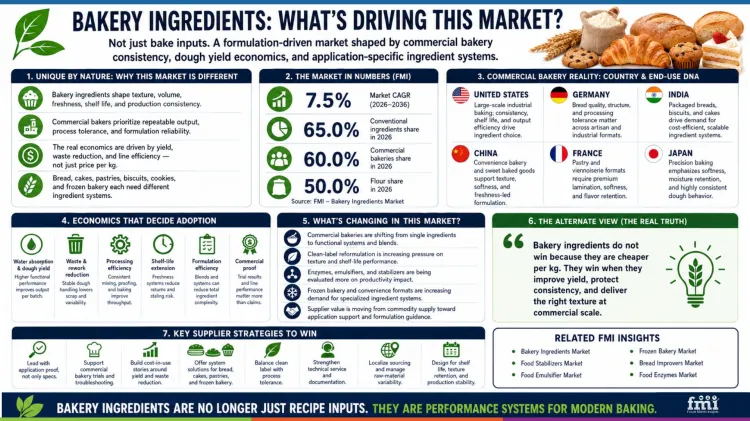
- Conventional ingredients still dominate formulation share, but clean-label and organic demand are pushing selective reformulation in premium breads, pastries, cakes, and snacks.
- Regulatory and retailer requirements can make a technically effective ingredient difficult to adopt if the label, allergen, or claim position creates risk.
- The strongest suppliers help bakeries manage substitution without damaging texture, volume, flavor, shelf life, or process tolerance.
- The misconception to avoid is that bakery reformulation is mainly about replacing artificial additives. In reality, it is a documentation and risk-control exercise.
Bakery ingredient decisions are often described as a balance between cost, functionality, and taste. That is accurate, but incomplete. In bakery, label and allergen control can decide whether an ingredient is usable at all. The market includes flour, sweeteners, fats and oils, leavening agents, additives, improvers, enzymes, emulsifiers, and specialty systems, many of which carry label implications. A strong ingredient can still lose if it creates allergen risk, claim conflict, or documentation gaps.
This makes allergen and label-control architecture a strong reworked angle for the bakery ingredients market. Bakery formulations commonly involve wheat and gluten, sesame, egg, milk, soy, tree nuts, peanuts, and other ingredients that require careful control. A bakery plant may run breads, buns, pastries, cookies, cakes, filled products, and seasonal lines on overlapping equipment. Cross-contact risk becomes a production reality, not only a regulatory concept.
Recent allergen attention has reinforced this point. In the United States, sesame is treated as a major food allergen for packaged food labeling, adding another important control point for bakeries that use seeds, toppings, flours, pastes, or shared production environments. This matters because bakery products frequently use sesame directly or face cross-contact risk through toppings and ingredient handling.
For ingredient suppliers, label-control capability now affects commercial credibility. Bakeries need certificates of analysis, allergen statements, country-of-origin information, specification sheets, lot traceability, non-GMO or organic documentation where relevant, kosher or halal documents where required, and clear processing information. When a supplier cannot provide this quickly and consistently, the bakery's quality, regulatory, and procurement teams face delays.
This is especially important because FMI identifies conventional ingredients as the leading formulation segment in the bakery ingredients market. Conventional inputs remain dominant because they are widely available, cost-efficient, and process-friendly at scale. However, the presence of conventional dominance does not mean label pressure is weak. It means bakeries are selectively deciding where cleaner labels, organic positioning, allergen-free claims, or specialty formats justify reformulation complexity.
Clean-label reformulation in bakery is not simple. Removing or replacing an emulsifier, preservative, color, flavor, enzyme system, dough conditioner, or fat can alter dough handling, crumb structure, shelf life, aeration, spread, tenderness, and flavor. Replacing egg or dairy in cakes can damage volume and texture. Reducing gluten or developing gluten-free formats can change structure and mouthfeel. Removing sesame or changing toppings can affect consumer recognition and product identity. Every label change creates a performance question.
This is why reformulation should be treated as label-control architecture rather than ingredient swapping. A bakery needs to understand the function of the ingredient being removed, the performance target of the replacement, the processing changes required, and the documentation required to support the new claim. A plant may also need segregation procedures, supplier approvals, packaging updates, cleaning validation, and staff training.
Retailers and foodservice operators intensify the pressure. Large customers may require stricter allergen controls, supplier questionnaires, ethical sourcing documents, sustainability credentials, or clean-label compliance. Private-label bakery programs can be especially demanding because the retailer's brand is exposed if a label issue emerges. Ingredient suppliers that understand these requirements become more valuable partners.
The bakery ingredients market also faces a regional layer. Europe has strong expectations around additive transparency and bakery tradition. The United States has major allergen-labeling scrutiny and a mature packaged bakery base. India and China are scaling packaged bakery output while still balancing cost, supply, and quality standardization. France and Japan have strong bakery-quality expectations that make formulation changes more sensitive. This means allergen and label-control strategies cannot be fully standardized globally.
For suppliers, the opportunity is to offer reformulation support that protects both label position and product quality. This may include clean-label enzyme systems, alternative emulsifier strategies, sourdough-based flavor and preservation support, plant-based or allergen-conscious ingredient systems, and detailed documentation packages. The strongest suppliers do not simply say an ingredient is cleaner or compliant. They show how it behaves in the target product and how it fits the customer's quality system.
For bakery manufacturers, the main lesson is to involve quality, regulatory, production, and procurement teams early. A reformulation that looks good from a marketing perspective can create operational difficulty if it is not validated under plant conditions. Conversely, a supplier with strong documentation and application proof can reduce risk and accelerate launch.
Bottom line: bakery ingredients are increasingly judged by more than function. In a label-sensitive category, supplier advantage depends on the ability to deliver performance, documentation, and risk control together. The market is not moving away from function; it is making function prove itself inside a stricter label and allergen environment.
Related FMI reports
- Bakery Ingredients Market: Primary report for market benchmarks and article anchor
- Bakery Mixes Market: Use when discussing dosing simplification and commercial baking systems
- Bakery Enzymes Market: Use when discussing freshness, softness, and enzyme-led performance
- Food Enzymes Market: Use for broader enzyme system references
- Bread Emulsifier Market: Use when discussing crumb structure and bread softness
- Frozen Bakery Market: Use when discussing frozen bakery and freeze-thaw performance
- Food Stabilizers Market: Use when discussing texture and moisture retention systems

