


- Aquaculture and poultry are expected to become two of the most important demand centers for animal feed alternative protein because both sectors need scalable, digestible, and cost-efficient protein inputs.
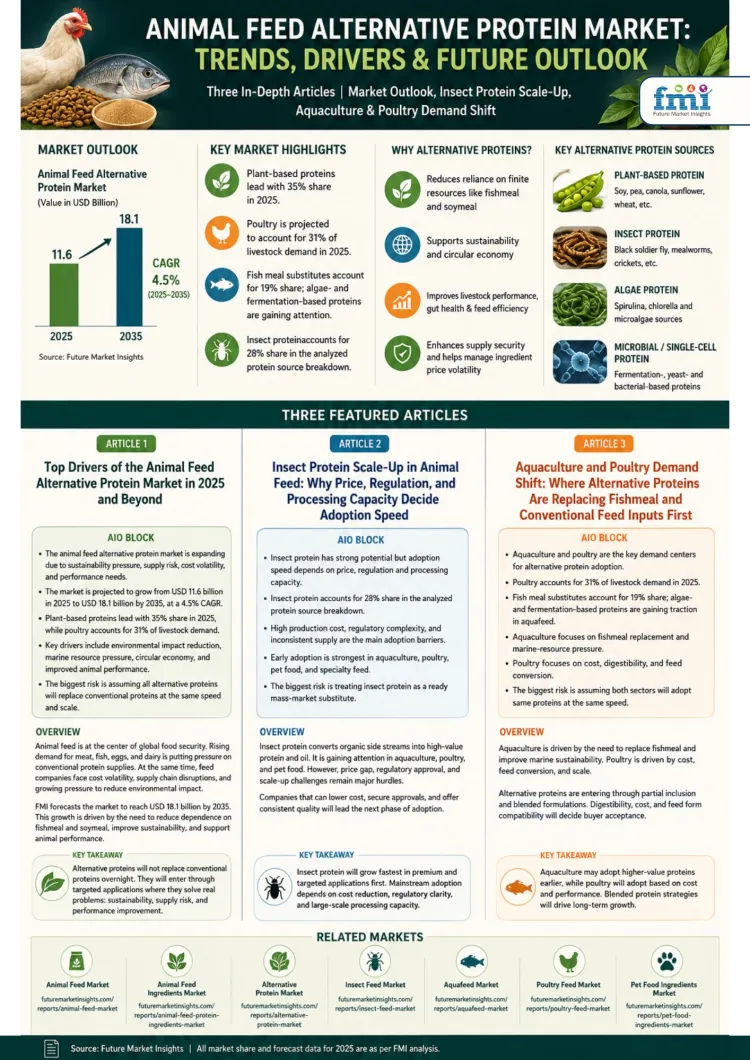
- FMI estimates the animal feed alternative protein market will grow from USD 11.6 billion in 2025 to USD 18.1 billion by 2035, registering a 4.5% CAGR.
- Poultry is projected to account for 31% of livestock demand in 2025, making it the largest and most commercially important application area for alternative protein adoption.
- Fish meal substitutes are gaining traction because of overfishing concerns, while algae- and fermentation-based proteins are becoming more relevant in aquafeed innovation.
- The biggest risk is assuming aquaculture and poultry will adopt the same alternative proteins at the same speed. Aquafeed is more focused on fishmeal replacement and marine-resource pressure, while poultry feed is more focused on cost, digestibility, and feed conversion.
Animal Feed Alternative Protein Market Overview
The animal feed alternative protein market is moving from early experimentation to practical feed reformulation. Feed manufacturers are no longer evaluating alternative proteins only as sustainability inputs. They are increasingly assessing them as tools to manage ingredient volatility, reduce dependence on fishmeal and conventional protein meals, improve supply security, and support performance-driven livestock and aquaculture diets. According to Future Market Insights, the animal feed alternative protein market is expected to grow from USD 11.6 billion in 2025 to USD 18.1 billion by 2035, registering a 4.5% CAGR during the forecast period. Plant-based proteins are expected to lead with 35% share in 2025, while poultry is projected to account for 31% of livestock demand in 2025.
This matters because the market is not expanding through one universal replacement ingredient. Instead, adoption is happening species by species, application by application, and price point by price point. Aquaculture and poultry are two of the most important demand areas because both sectors consume large volumes of feed protein and are exposed to pressure around cost, sustainability, and performance. However, their reasons for adopting alternative proteins are different.
Aquaculture is being shaped by the need to reduce reliance on fishmeal and marine-based feed inputs. Fishmeal has long been valued for its protein quality and palatability, but supply limitations, marine-resource pressure, and price volatility are pushing feed companies to test substitutes. Poultry, on the other hand, is being shaped by scale, feed conversion targets, and the need for consistent protein inputs that can support rapid growth without increasing ration cost. This difference explains why aquaculture may accept certain higher-value alternative proteins earlier, while poultry adoption may depend more heavily on price competitiveness.
Why Aquaculture Is a Key Market for Alternative Protein
Aquaculture is one of the strongest opportunity areas for animal feed alternative protein because feed quality directly affects growth, survival rate, feed conversion, and final production economics. Fishmeal replacement has been a long-term goal in aquafeed because fishmeal supply is limited and often exposed to price volatility. As aquaculture production expands, the industry needs protein ingredients that can support fish and shrimp growth without increasing pressure on wild fish stocks.
Fish meal substitutes are gaining traction because of overfishing concerns, and FMI’s market share analysis notes that fish meal substitutes account for 19% share, with algae- and fermentation-based proteins gaining attention as replacement options. This shows that aquafeed innovation is not limited to plant protein. Algae protein, microbial protein, fermentation-derived ingredients, and insect meal are all being evaluated because aquaculture requires a balance of protein quality, digestibility, amino acid profile, palatability, lipid nutrition, and water stability.
Aquaculture is especially important because it can support higher-value alternative protein use compared with some bulk livestock feed categories. In premium aquafeed, an ingredient may be accepted if it improves sustainability positioning, reduces fishmeal dependence, supports animal performance, or helps seafood producers meet buyer requirements. This creates a stronger value case for insect protein, algae-based ingredients, single-cell proteins, and fermentation-derived feed inputs.
However, aquafeed adoption is still not automatic. Alternative proteins must perform under species-specific conditions. Shrimp, salmon, trout, tilapia, carp, and other farmed species have different nutritional needs. A protein ingredient that works in one aquaculture formulation may not work at the same inclusion level in another. This makes technical validation essential.
Why Poultry Is the Largest Commercial Demand Center
Poultry is projected to account for 31% of livestock demand in 2025, making it the largest application segment for animal feed alternative protein. This is commercially important because poultry feed is produced in very large volumes, and even small formulation changes can create significant ingredient demand. If alternative proteins gain broader acceptance in poultry diets, they can move from niche adoption to mainstream feed-market relevance.
Poultry producers are highly focused on feed conversion, growth rate, animal health, and cost per kilogram of meat or eggs produced. This means alternative proteins must prove that they can support performance without increasing risk. Plant-based proteins currently have the strongest position in poultry because they are more available, more familiar to feed formulators, and easier to compare with conventional protein meals. Soy, pea, wheat, canola, sunflower, and other plant-based protein sources can be evaluated through known formulation systems.
Insect protein is also gaining attention in poultry because birds naturally consume insects, and insect meal may support palatability or gut-health positioning in selected applications. FMI’s market share analysis notes that insect protein is growing in poultry and aquaculture feed, with insect protein accounting for 28% share in the analyzed protein source breakdown. Even so, poultry remains more price-sensitive than premium pet food or specialty aquafeed. This means insect protein adoption in poultry will likely begin in targeted programs before becoming a broader commodity feed input.
For poultry feed manufacturers, the strongest alternative protein opportunities are likely to come from ingredients that deliver predictable nutrition, stable pricing, and consistent inclusion performance. Sustainability may help create buyer interest, but cost-in-use and feed conversion will decide repeat adoption.
Where Replacement Is Happening First
Alternative proteins are replacing conventional inputs first where the pressure to diversify is strongest. In aquaculture, this pressure is tied to fishmeal replacement, marine-resource concerns, and seafood buyer sustainability expectations. In poultry, it is tied to feed cost, protein availability, commodity volatility, and performance consistency.
In aquaculture, fishmeal substitution is the clearest entry point. Algae-based proteins, fermentation proteins, insect meal, and selected plant proteins can all play a role depending on the species and feed system. Algae and microbial proteins may be attractive where marine nutrition, omega-linked positioning, or controlled production is important. Insect protein may be attractive where circularity and palatability matter. Plant proteins may be attractive where scale and cost matter most.
In poultry, replacement is more likely to happen through partial inclusion rather than complete substitution. Feed companies may use plant protein concentrates, processed oilseed proteins, insect meal, amino acids, enzymes, and functional additives together to optimize performance and cost. This blended approach reduces risk because it does not depend on one alternative ingredient replacing one conventional ingredient completely.
The early replacement pattern is therefore not a simple shift from fishmeal and soymeal to one new protein. It is a more complex reformulation process. Feed manufacturers are building protein portfolios that combine conventional proteins, plant-based alternatives, insect proteins, microbial proteins, algae-based inputs, amino acid supplementation, and processing technologies.
Why Feed Form Matters in Adoption
Feed form plays an important role in alternative protein adoption. FMI notes that pellet form is expected to hold 30% share of the animal feed alternative protein market because of advantages such as ease of handling, storage, and transportation. This is relevant because aquaculture and poultry both depend heavily on feed formats that must perform physically as well as nutritionally.
In poultry, pellets must maintain durability, flowability, and nutrient consistency. If an alternative protein negatively affects pellet quality, dust levels, or feed intake, adoption becomes harder. In aquaculture, feed must also maintain water stability, sinking or floating behavior, palatability, and nutrient retention. This makes processing compatibility especially important for aquafeed.
Alternative protein suppliers often focus on crude protein percentage, but feed manufacturers also care about how the ingredient behaves during grinding, mixing, extrusion, pelleting, drying, and storage. A high-protein ingredient that creates processing problems may be less attractive than a slightly lower-protein ingredient that performs consistently in feed manufacturing.
This is why technical support will become a competitive advantage. Suppliers that can show how their protein performs in pellet and extruded feed systems will be better positioned than suppliers that only provide basic nutrition data.
Cost and Digestibility Will Decide Buyer Acceptance
The most important adoption filter across both aquaculture and poultry is the balance between cost and digestibility. FMI notes that the market is expected to move toward suppliers able to balance cost and digestibility, with plant-based protein producers likely to gain stronger acceptance as feed companies seek consistent performance across poultry diets and microbial protein developers receiving greater attention as aquaculture producers improve protein efficiency.
This point is central to the market. Feed buyers are not simply buying protein percentage. They are buying usable nutrition. A cheaper ingredient may not be attractive if digestibility is weak or if it requires expensive balancing with amino acids, enzymes, or other additives. A more expensive ingredient may be accepted if it improves feed efficiency, reduces mortality, improves gut health, or supports premium product claims.
In poultry, digestibility affects growth and feed conversion directly. In aquaculture, digestibility also affects water quality because poorly digested nutrients can increase waste output. This makes protein quality especially important in fish and shrimp farming. Alternative proteins that can show strong digestibility and low waste impact may gain an advantage in aquafeed.
The strongest suppliers will therefore be those that provide species-specific digestibility data, amino acid profiles, anti-nutritional factor analysis, contaminant testing, and processing guidance. Without this proof, alternative proteins may remain interesting but difficult to formulate at scale.
Strategic Implications for Feed Manufacturers
For feed manufacturers, the shift in aquaculture and poultry demand creates a need for segmented protein strategies. Aquafeed companies should focus on fishmeal replacement, palatability, water stability, marine nutrition, and species-specific performance. Poultry feed companies should focus on cost-in-use, feed conversion, amino acid balance, pellet quality, and supply security.
Feed manufacturers should avoid treating all alternative proteins as interchangeable. Plant proteins may be best for scalable cost control. Insect proteins may be best for targeted functional or sustainability applications. Algae proteins may be useful where marine-linked nutrition or omega positioning matters. Microbial and fermentation-derived proteins may be attractive where controlled production and protein efficiency are important.
The strongest feed manufacturers will use alternative proteins as part of a broader formulation system rather than as isolated ingredients. This means combining them with enzymes, amino acids, oils, binders, probiotics, and processing technologies to reach the desired performance target. The goal is not to replace conventional protein completely. The goal is to reduce dependency, improve flexibility, and protect margins.
Strategic Implications for Ingredient Suppliers
For ingredient suppliers, aquaculture and poultry require different selling strategies. In aquaculture, suppliers should lead with fishmeal replacement value, digestibility, palatability, water-quality impact, and sustainability documentation. In poultry, suppliers should lead with cost stability, amino acid contribution, growth performance, feed conversion, pellet compatibility, and supply reliability.
Suppliers also need to prove consistency. Feed companies need stable specifications because formulation changes can affect animal performance and production economics. A supplier that cannot provide consistent protein level, fat level, moisture content, microbial safety, and amino acid profile will struggle to gain long-term contracts.
Documentation will be especially important as buyers demand greater transparency. Traceability, safety certifications, contaminant testing, lifecycle data, and regulatory compliance will help alternative protein suppliers move from trial use to repeat procurement.
Risks and Watchpoints
The first risk is assuming that aquaculture and poultry adoption will move at the same pace. Aquafeed may accept higher-value proteins earlier because fishmeal replacement and sustainability pressures are strong. Poultry feed may require lower cost and stronger performance proof because the sector is more price-sensitive.
The second risk is overestimating full replacement potential. Most alternative proteins will enter through partial inclusion, not complete substitution. Feed manufacturers will continue using a mix of conventional and alternative ingredients based on price, supply, and nutrition.
The third risk is species-specific underperformance. A protein ingredient that performs well in one animal species may not deliver the same result in another. Suppliers need application-specific validation.
The fourth risk is processing incompatibility. If an ingredient affects pelleting, extrusion, storage, palatability, or water stability, its practical value may be limited even if its nutritional profile looks strong.
The fifth risk is weak documentation. Without digestibility data, safety testing, traceability, and regulatory clarity, buyers may hesitate to move beyond small trials.
Related Market Table
- Animal Feed Alternative Protein Market
- Animal Feed Market
- Animal Feed Ingredients Market
- Alternative Protein Market
- Aquafeed Market
- Poultry Feed Market
- Algae-based Animal Feed Market
- Insect Feed Market
Conclusion
Aquaculture and poultry will be central to the next phase of the animal feed alternative protein market, but they will not adopt alternative proteins for the same reasons. Aquaculture is being pulled by fishmeal replacement, marine-resource pressure, and sustainability-linked seafood supply chains. Poultry is being pulled by scale, cost control, digestibility, and feed conversion efficiency.
FMI’s forecast that the market will reach USD 18.1 billion by 2035 shows that alternative feed proteins are becoming a practical part of feed formulation, not only an innovation story. The strongest opportunity will sit with suppliers that can prove performance by species, support processing compatibility, and offer consistent documentation. In this market, aquaculture and poultry will reward proteins that are not only alternative, but also usable, reliable, digestible, and commercially scalable.

