


- Clean-label fish protein is gaining pricing power because buyers are no longer evaluating only protein percentage; they are evaluating source, traceability, processing perception, odor control, solubility, and application fit.
- Fish protein isolate, fish protein hydrolysate, and fish protein concentrate are becoming premium marine-origin ingredients where brands need differentiation from common dairy, plant, collagen, and commodity animal proteins.
- Powder formats are commercially important because they support shelf-stable distribution, sports nutrition, dietary supplements, pet food, aquafeed, food formulations, and personal care applications.
- The clean-label premium is strongest when fish protein improves both the label story and finished-product performance; poor taste, odor, bitterness, or solubility cannot be rescued by a marine-origin claim alone.
- The biggest risk is treating clean label as a generic marketing add-on. In fish protein, clean label must be supported by traceable sourcing, controlled processing, sensory quality, and grade-specific documentation.
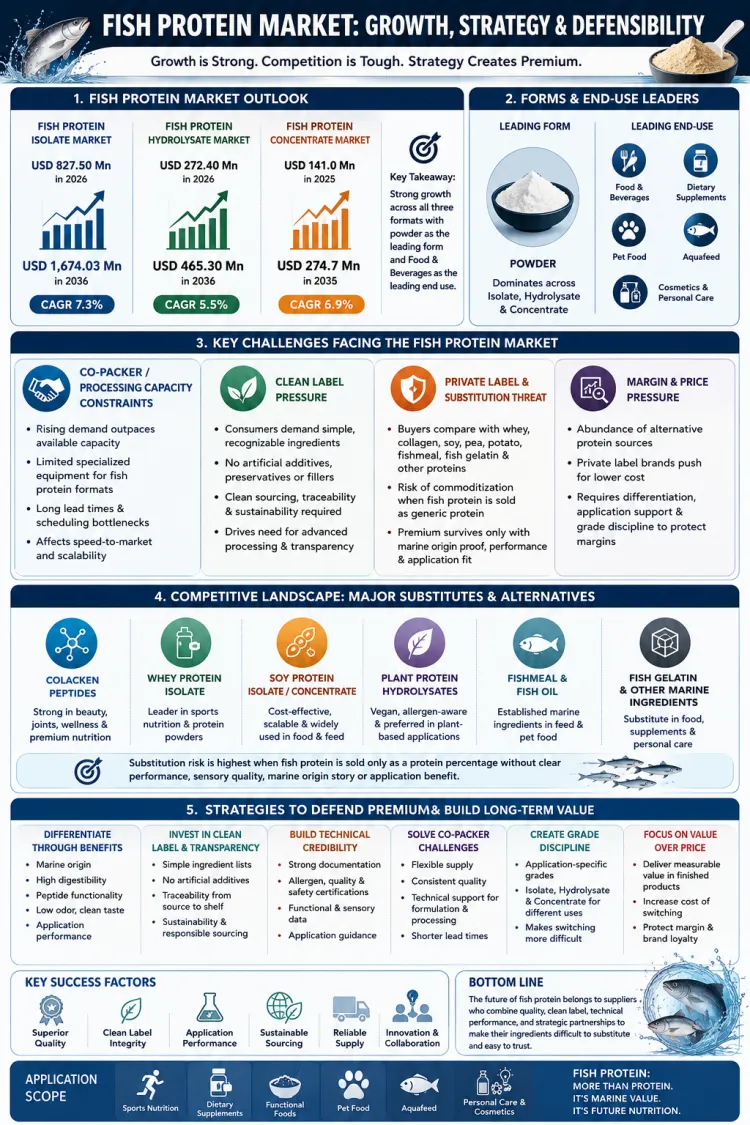
Fish protein is entering a more premium phase of growth. The market is no longer driven only by marine by-product recovery, fishmeal adjacency, or protein enrichment. The sharper question is now: which fish protein ingredients can justify a premium because they deliver clean-label positioning, marine-origin differentiation, sustainability credibility, and reliable performance in finished products?
This is an important shift. In the earlier stage of marine protein utilization, fish protein was often treated as a value-recovery opportunity from seafood processing streams. Today, the market is moving toward higher-value ingredient positioning. Fish protein isolate, fish protein hydrolysate, and fish protein concentrate are increasingly being assessed as functional marine protein systems for food and beverages, dietary supplements, sports nutrition, pet food, aquafeed, cosmetics, and personal care.
FMI’s Fish Protein Isolate Market shows that the category is already moving toward premium applications, with the market projected to expand from USD 827.50 million in 2026 to USD 1,674.03 million by 2036. FMI also identifies powder as the leading form and food and beverages as the leading end-use industry. That matters because isolate is not only a protein-concentration story. It is a clean-label formulation story, where buyers need a protein-rich, shelf-stable, easy-to-use marine ingredient that can work in consumer-facing products.
Fish protein hydrolysate supports a slightly different but equally important premium logic. FMI’s Fish Protein Hydrolysate Market is projected to expand from USD 272.40 million in 2026 to USD 465.30 million by 2036. FMI identifies enzymatic hydrolysis as the leading technology and powder as the leading form. This is important because hydrolysate is not valued only for being fish-derived. It is valued for controlled peptide formation, digestibility, solubility, palatability, and functional performance in feed, pet food, supplements, and nutritional applications.
Fish protein concentrate also fits the clean-label premium narrative. FMI’s Fish Protein Concentrate Market is projected to grow from USD 141.0 million in 2025 to USD 274.7 million by 2035, with powder leading the form segment. Concentrate gives brands a marine-derived protein option that can sit between highly refined isolate and peptide-focused hydrolysate. It can support food, feed, supplement, cosmetic, and personal care applications where buyers want a recognizable marine protein source with functional and nutritional value.
Clean label matters in fish protein because the ingredient carries a story that many competing proteins cannot easily replicate. Fish protein can be positioned around marine origin, natural protein recovery, traceable sourcing, circular-economy use of seafood streams, amino acid quality, digestibility, and functional application value. This gives fish protein a differentiated platform against whey, soy, pea, collagen, egg, and other protein ingredients.
However, clean label in fish protein is not only about having fewer ingredients on the label. It is about how the ingredient is sourced, processed, documented, and used. Buyers increasingly want to know the species source, production method, sustainability position, food-grade controls, allergen declaration, odor profile, solubility, and batch consistency. This makes the clean-label premium more technical than cosmetic.
The broader clean-label ingredient environment supports this shift. FMI’s Clean-label Ingredients Market is projected to grow strongly through 2036, reflecting how clean-label expectations are becoming a wider formulation principle across food and beverage categories. For fish protein suppliers, this creates an opportunity to position marine protein not only as a nutritional ingredient, but also as a cleaner, more transparent, and more differentiated protein source for brands that need stronger label credibility.
The broader protein ingredients market also reinforces the opportunity. FMI’s Protein Ingredients Market includes animal, plant, and alternative protein sources and shows continued demand for dry protein formats. This is relevant because fish protein must compete inside a crowded protein ecosystem. It cannot win only by claiming protein content. It must prove that marine origin, digestibility, sustainability, and application performance justify a premium versus more established protein ingredients.
The clean-label premium is strongest where fish protein helps a brand tell a more specific story. In sports nutrition, fish protein isolate can support high-protein positioning, recovery nutrition, and marine-origin differentiation. Powder formats are especially important because they can be used in protein powders, dry nutritional blends, fortified mixes, and specialty supplements. In this application, the key challenge is sensory quality. A clean-label fish protein must be low-odor, soluble, and easy to flavor.
In dietary supplements, fish protein hydrolysate and concentrate can benefit from growing demand for marine-derived wellness ingredients. Hydrolysates are especially relevant because they can be positioned around peptides, digestibility, and bioavailability. However, the premium depends on whether the ingredient has technical documentation and a clear use case. A generic fish hydrolysate will have limited pricing power if it does not show consistent peptide profile, solubility, and quality specifications.
In pet nutrition, fish protein has a strong clean-label opportunity because pet owners increasingly value recognizable animal proteins, digestible ingredients, limited-ingredient positioning, and premium nutrition claims. Fish protein hydrolysate can support sensitive-diet and digestibility positioning, while concentrate and isolate can support animal-protein enrichment. The clean-label premium here is not about “human-style wellness” alone. It is about trust, digestibility, palatability, and recognizable protein sourcing.
In aquafeed, fish protein hydrolysate can support palatability, amino acid availability, and functional feed performance. The premium is more performance-led than consumer-label-led, but clean sourcing and marine-origin consistency still matter. Feed customers will not pay simply for a clean story. They will pay when the ingredient improves feed acceptance, growth outcomes, or formulation efficiency.
In food and beverages, the clean-label premium is attractive but more difficult to capture. Fish protein can help brands differentiate from soy, pea, dairy, and collagen proteins, but food applications have the strictest sensory expectations. Odor, marine aftertaste, bitterness, color, solubility, and mouthfeel can become barriers. This means clean label can open the door, but sensory performance decides whether the ingredient stays in the formulation.
In cosmetics and personal care, fish protein concentrate and hydrolysate can benefit from marine biotechnology, skin health, anti-aging, and beauty-from-the-sea narratives. This is a smaller but strategically attractive premium route because beauty and wellness brands often look for distinctive ingredient stories. However, the same rule applies: the ingredient must be documented, consistent, and suitable for the final formulation.
The sustainability angle is one of the strongest reasons fish protein can command a clean-label premium. Fish protein can be produced from seafood side streams that would otherwise be underutilized. This supports circular-economy positioning, waste reduction, and higher-value use of marine biomass. For brands, this is attractive because it links nutrition with responsible sourcing. For suppliers, it creates a way to move beyond commodity fishmeal-style positioning.
But sustainability claims must be handled carefully. A vague “marine protein” claim is not enough. Buyers increasingly need traceability, species clarity, sourcing documentation, processing transparency, and quality controls. The strongest suppliers will be those that can connect clean-label language with evidence. This includes product specifications, origin documentation, certifications where available, allergen statements, and application testing.
The clean-label premium in fish protein should therefore be evaluated through four lenses: source premium, claim premium, processing premium, and performance premium. Source premium comes from marine origin and species traceability. Claim premium comes from clean label, protein-rich, sustainable, natural, digestible, or responsibly sourced positioning. Processing premium comes from controlled hydrolysis, deodorization, drying, filtration, and grade separation. Performance premium comes from solubility, sensory neutrality, powder stability, palatability, and finished-product compatibility.
The strongest fish protein suppliers are those that can combine all four. A fish protein ingredient with marine origin but poor odor control will struggle in premium human nutrition. A technically strong hydrolysate without traceability will struggle with clean-label buyers. A sustainable by-product story without application performance will remain a weak commercial argument. The premium is paid when the ingredient helps the brand sell a better finished product.
Price premium versus baseline should therefore be calculated carefully. The baseline may differ by application. In sports nutrition, fish protein may be benchmarked against whey, collagen, or plant protein. In pet food, it may be benchmarked against fish meal, poultry protein, egg protein, or hydrolyzed animal protein. In aquafeed, it may be compared with fishmeal, krill meal, soy protein concentrate, or other functional feed ingredients. In cosmetics, it may compete with collagen, peptides, and marine bioactives.
This means fish protein suppliers should avoid one-size-fits-all pricing. A food-grade fish protein isolate with low odor and high solubility should not be priced like a basic marine protein powder. A controlled hydrolysate for premium pet nutrition should not be sold like a commodity feed ingredient. A cosmetic-grade fish protein concentrate should not be positioned the same way as a bulk animal nutrition input. Premium positioning requires grade-specific pricing and application-specific proof.
For brands, fish protein creates a clear segmentation opportunity. Mass-market products may continue to rely on lower-cost protein systems where price is the dominant factor. Premium and better-for-you products can use fish protein where marine origin, clean-label sourcing, digestibility, and sustainability provide a stronger story. Hybrid formulations may combine fish protein with whey, collagen, pea, soy, or other proteins depending on cost, taste, nutrition, and claim requirements.
For suppliers, the opportunity is to avoid selling clean label as a vague promise. Buyers need proof. They need product specifications, source traceability, allergen documentation, non-contaminant assurance, sensory data, solubility guidance, shelf-life support, and application testing. The winning suppliers will not simply say their fish protein is clean label. They will show how it performs in protein powders, fortified foods, pet food systems, aquafeed, capsules, tablets, beverages, and personal care formats.
For co-packers and processing partners, clean-label fish protein creates a different type of capability requirement. Fish protein behaves differently from dairy, soy, pea, or collagen systems. It may require stronger odor controls, moisture management, cleaning protocols, allergen handling, oxidation prevention, and formulation support. This means clean-label fish protein is not only an ingredient sourcing decision. It is also a manufacturing readiness decision.
For food processors, the key question is whether the clean-label premium can be passed through to the customer. In premium supplements, high-end pet food, specialty sports nutrition, marine wellness products, and personal care, the premium may be easier to justify. In mass food and feed applications, the premium may be harder to recover unless the ingredient improves yield, digestibility, palatability, formulation efficiency, or brand positioning.
The regional angle also matters. In markets where seafood consumption is familiar and marine-origin ingredients are trusted, fish protein may have stronger acceptance. In regions where fish odor or allergen concerns are more sensitive, suppliers must work harder on sensory quality and documentation. Europe, North America, Japan, and other premium nutrition markets may be important for clean-label positioning because buyers are more focused on traceability, sustainability, and ingredient transparency. Seafood-producing regions may be important for raw material availability, but value capture will depend on processing and quality control.
Clean-label fish protein also intersects with the broader marine ingredient ecosystem. Fishmeal and fish oil remain established marine ingredient categories, but fish protein isolate, hydrolysate, and concentrate offer a more specialized route into premium nutrition and functional formulation. This does not mean fish protein will replace fishmeal. It means selected marine raw materials and side streams can be upgraded into higher-value ingredient systems when processing quality supports the application.
The misconception to avoid is that clean label automatically means minimally processed. Fish protein isolate, hydrolysate, and concentrate are processed ingredients. The real clean-label question is not whether processing exists. The question is whether the processing is controlled, transparent, acceptable, and necessary to deliver the intended functionality. In fish protein, clean label is about trusted source, responsible recovery, clear documentation, and finished-product suitability.
Another misconception is that marine origin alone creates a premium. Marine origin can create differentiation, but it cannot compensate for poor sensory performance. If the ingredient smells too fishy, tastes bitter, clumps in powder blends, destabilizes beverages, or creates formulation challenges, the premium will disappear. Clean label can increase buyer interest, but performance protects repeat demand.
The market is therefore likely to move toward a layered structure. Basic fish protein outputs will continue to serve feed and lower-cost applications. Better-controlled concentrates will serve food, pet nutrition, and personal care where moderate protein standardization is required. High-purity isolates will target sports nutrition, food, and supplement applications where protein concentration and clean formulation matter. Controlled hydrolysates will target pet food, aquafeed, supplements, and functional nutrition where peptide profile, digestibility, and solubility are valued.
Bottom line: the clean-label premium in fish protein will not be captured by every supplier that offers a marine-origin protein. It will be captured by suppliers that combine traceable sourcing, controlled processing, sensory quality, application support, and documentation. In fish protein, the premium is not paid for the marine claim alone. It is paid when the marine claim helps the brand sell a better, more credible, and better-performing finished product.
Fish protein is therefore moving from by-product recovery to value-added marine nutrition. The market’s winners will be those that can make fish protein clean, traceable, stable, functional, and formulation-ready. The opportunity is not simply to produce more fish protein. The opportunity is to produce fish protein that brand owners can trust, formulate, and premiumize.

