


- The dental tourism market is projected to grow at a CAGR of 13.6% during the forecast period. The market size is valued at USD 11.4 billion in 2026 and is projected to reach USD 40.7 billion by 2036. Increasing cross-border mobility of patients and increasing demand for affordable dental procedures are driving the market growth.
- Chinese dental equipment and consumables manufacturers are steadily increasing their foothold in key dental tourism destinations, offering cost-competitive options to entrenched Western and Japanese brands.
- Dental clinics and hospital chains serving international patients are progressively evaluating Chinese imaging systems, CAD/CAM equipment, dental chairs, implants and consumables to improve operational margins.
- China’s greatest weapon in the competitive arena remains its cost advantage, with many dental products selling at a substantial discount to comparable products from European and North American suppliers.
- Top Chinese manufacturers are putting money into regulatory certifications, product innovation and international distribution networks and quality perceptions continue to evolve.
- When making procurement decisions, they are weighing affordability of a product against concerns regarding long-term reliability, clinical performance, technical support, and brand reputation.
- We expect the competitive environment to become more fragmented as Chinese suppliers increase their footprint in budget and mid-tier dental tourism facilities.
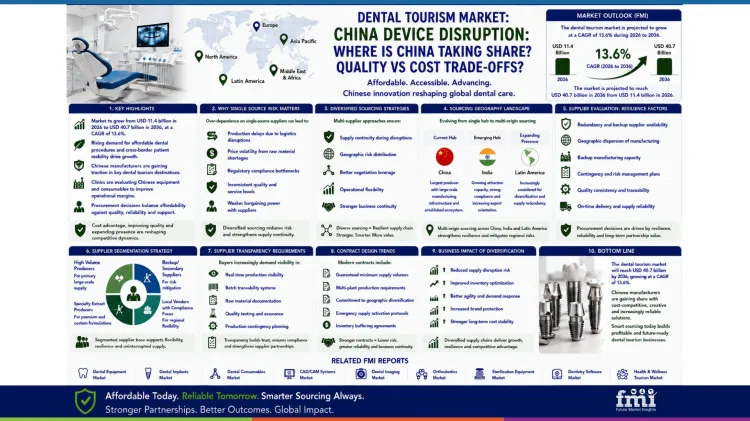
The dental tourism market is growing as patients look for high quality dental treatments for a whole lot less than they would pay in their own countries. The market is expected to grow at a CAGR of 13.6% from 2026 to 2036, to reach USD 40.7 billion in 2036 from USD 11.4 billion in 2026. The growth is driven by increasing health care affordability concerns, rising international travel connectivity, and increased confidence in overseas dental treatment providers.
As the industry becomes more competitive, providers are looking for new ways to increase profitability while delivering clinical quality. One of the major trends influencing procurement strategies is the growing power of Chinese dental equipment and consumables manufacturers.
For decades, suppliers from Germany, Switzerland, the United States, Japan and South Korea dominated the market for premium dental technologies. These were often the manufacturers on which dental tourism providers built their reputation with potential overseas patients looking for the highest standards of treatment.
But the competitive environment is changing.
Chinese manufacturers have greatly improved their capabilities in many categories of dental products, including dental imaging systems, intraoral scanners, CAD/CAM solutions, treatment chairs, sterilization equipment, orthodontic products, implant systems and dental consumables. Increased manufacturing abilities and increased investments in research and development have allowed Chinese suppliers to compete beyond simply low-cost segments.
The most immediate area of gains for China is in equipment procurement.
Dental tourism clinics also often require a large capital expenditure for new facilities or increased treatment capacity. High end imaging systems, digital scanners, milling machines and treatment units are substantial investments and directly impact profitability. Chinese alternatives are typically able to offer similar functional capabilities at much lower acquisition costs, and thus are attractive to expanding providers.
The economic argument is particularly compelling in highly competitive dental tourism destinations where clinics are aggressive on price. The lower cost of acquiring equipment enables providers to reduce the total operating cost and offer competitive treatment packages to international patients.
China is also growing its presence in dental consumables.
Chinese manufacturers are increasingly providing products such as impression materials, orthodontic accessories, disposable supplies, restorative materials, and laboratory components. Procurement teams often see these items as opportunities to save money quickly because they are frequently used and directly impact operating expenses.
Another key battleground is the implant systems.
Premium implant brands from Europe and North America have been traditionally favored by international patients. Many patients asked for implant systems with world-wide recognition, long clinical history and established reputation. While these premium brands continue to be strong, the sector has seen the entry of several Chinese manufacturers who offer cheaper alternatives that attract budget-conscious providers and patients.
At the core of procurement decisions is the trade-off between quality and cost.
Supporters of Chinese suppliers argue that manufacturing quality has improved substantially in the past decade. Many of China’s leading companies now have international certifications, state-of-the-art production facilities and increasingly sophisticated quality management systems. Investments in automation, digital manufacturing and product testing have helped close performance gaps in several product categories.
Chinese manufacturers have shown strong technical abilities in fields like imaging equipment and digital dentistry technologies, challenging the traditional supplier hierarchies. Dental clinics are often interested in these products as attractive alternatives to more expensive Western systems, because they want to maximize their return on investment.
But some providers still have concerns.
Clinical reputation is important in dental tourism because patients will travel thousands of miles based on trust and perceived quality. Hospitals and clinics must weigh the savings in acquisition costs against potential concerns about long-term durability, service support, product consistency and patient perception.
Brand recognition remains a factor in the purchase decision of premium dental tourism facilities serving patients from North America, Western Europe and Australia. Patients tend to associate better quality with internationally known equipment and implant brands, even though the objective performance differences are narrowing.
Service infrastructure also influences competitive positioning.
Established multinational suppliers usually have extensive training programs, technical support networks, spare parts inventories and clinical education initiatives. Such support systems can be useful for dental tourism providers managing high volume practices where equipment downtime can have a direct impact on patient scheduling and revenue generation.
Chinese manufacturers have put more focus on after-sales support and international distribution capabilities, but the maturity of these channels is very different between suppliers. Therefore, procurement teams look beyond the initial purchase price, considering long-term operational reliability and service responsiveness.
Market segmentation trends point to where Chinese suppliers might have the most traction.
Dental implants continue to be one of the biggest revenue generators in the dental tourism service category. Premium implant brands still hold sway in the high-end market, but there is a growing consideration among mid-tier and value-oriented clinics to seek alternative suppliers to boost affordability.
Cosmetic dentistry is another area experiencing growing adoption of competitively priced materials and digital technologies. Since cosmetic procedures are often paid entirely out-of-pocket, providers face strong pressure to control treatment costs while preserving acceptable aesthetic outcomes.
Large hospital chains and organized dental networks have more buying power and go through extensive procurement evaluations before adding new suppliers. Still, smaller clinics might be more willing to experiment with emerging manufacturers due to budget limitations and the need for flexibility.
Regional dynamics are also fueling China’s growth.
Many of the leading dental tourism destinations across Southeast Asia, Latin America, Eastern Europe and the Middle East have strong trade ties to Chinese manufacturers. Expanding distributor networks, attractive pricing models and streamlined logistics systems enable wider deployment of Chinese dental technologies across these regions.
Chinese products compete on price alone is a myth.
In fact, leading Chinese suppliers are increasingly competing on the basis of innovation, digital capabilities, product breadth, and manufacturing scale. Cost is still a key advantage, but the competitive environment is shifting more and more to a more balanced assessment of value, performance and service.
As the dental tourism market matures, procurement teams need to be more data-driven in their supplier evaluations. Purchasing decisions will be increasingly driven by clinical outcomes, equipment uptime, regulatory compliance, patient satisfaction and total cost of ownership.
Bottom line
The changing face of procurement in the dental tourism market is being shaped by the growing influence of China. Lower costs are still the main driver for adoption, but Chinese manufacturers will need to prove consistent quality, support and clinical performance long term to be successful. The future competitive environment is likely to be defined not by cost alone, but by which suppliers can deliver the strongest overall value proposition to dental tourism providers and their international patients.

