


- The dental tourism market size is valued at USD 11.4 billion in 2026 and is projected to reach USD 40.7 billion by 2036, registering a CAGR of 13.6% during the forecast period, as more international patients seek affordable and high-quality dental care in foreign countries.
- As providers expand operations to accommodate increasing volumes of medical travelers, procurement practices are becoming a critical competitive factor for hospitals and dental networks.
- Large dental hospital groups are increasingly weighing up the efficiency of single-supplier sourcing against the flexibility of multi-supplier sourcing for implants, orthodontic systems, imaging equipment, dental consumables and laboratory services.
- Multi-supplier procurement is still being practiced by high-volume dental tourism destinations as it helps them mitigate supply chain risks and get better access to specialized technologies.
- Standardized treatment protocols, easier inventory management and better vendor support are driving integrated hospital chains towards single-supplier agreements.
- As contract negotiations evolve beyond simple product pricing, they increasingly encompass training support, technology upgrades, warranty coverage, logistics commitments and digital integration capabilities.
- As competition between dental tourism providers heats up, procurement decisions are increasingly driven by clinical quality, operational efficiency and long term value creation.
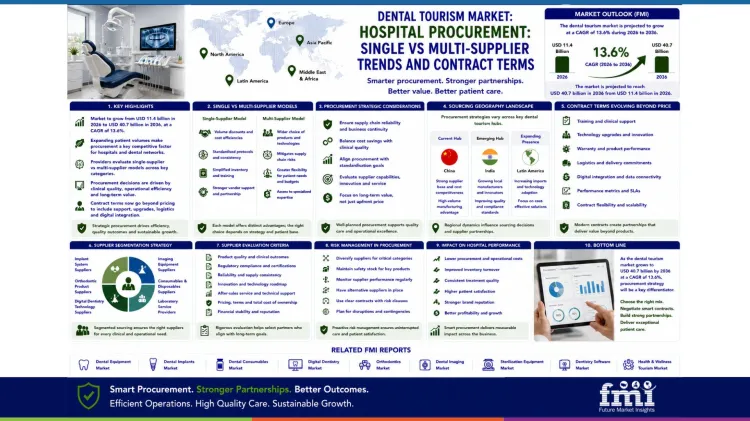
The dental tourism market has experienced an enormous growth as patients are increasingly crossing borders to avail quality dental procedures at a cheaper cost. The market is projected to grow from USD 11.4 billion in 2026 to USD 40.7 billion in 2036, at a CAGR of 13.6% during the forecast period. Growing market growth is attributed to improved treatment outcomes in emerging destinations, expanding international travel infrastructure, and rising healthcare costs in developed countries.
With patient volumes on the rise, the way a hospital sources its products is becoming an ever more important factor in a provider’s competitiveness and profitability. High standards of treatment and control of operational costs are required of dental tourism providers, which increases the strategic importance of procurement decisions and reduces their transactional nature.
Historically, procurement decisions in dental facilities were typically handled independently by individual departments or specialist teams. Each implantologist chose the implant system of his choice. Each orthodontist chose individual bracket manufacturers. And each laboratory built up separate supplier relations. But the rapid growth of dental tourism has forced hospitals and dental chains to adopt more centralized procurement frameworks.
Among the most important questions facing dental tourism providers today is whether to build long-term relationships with a single supplier or have relationships with multiple vendors across key product categories.
There are lots of operational advantages of single supplier procurement models. Dental hospitals can realize benefits from pooling their buying power with one major supplier, including volume discounting, simplified inventory control, easier staff training and more uniform treatment protocols. These are important benefits because high-volume international patient organizations often have multiple facilities.
Standardization also makes hospital treatment outcomes predictable. Consistency of clinicians with implant systems, prosthetic materials and digital dentistry platforms enables procedural workflows that are more efficient and easier to reproduce at different locations. Consistency supports quality assurance efforts and improves the patient satisfaction.
Single supplier contracts also mean superior technical support, faster service response, dedicated account management and good financing deals. Many vendors are willing to offer full partnership programs if hospitals commit to large volumes of purchasing.
But relying on a single supplier may carry operational risks. Limited alternative sourcing channels can adversely affect service delivery in the event of supply disruption, product recalls, manufacturing delays or price changes. These interruptions can directly affect patient fulfillment and reputation for dental tourism providers in highly competitive markets.
So many large providers still favour multi-supplier procurement strategies.
Having multiple suppliers extends the range of treatments and technologies available to hospitals. Different suppliers often have a particular expertise in certain areas such as premium implant systems, digital scanners, orthodontic appliances, CAD/CAM restorations or cosmetic dentistry materials. Hospitals can partner with a variety of vendors to build relationships, and then can tailor treatment plans for the requirements and budgets of their patients.
This flexibility is particularly crucial in dental tourism, where patient expectations differ widely, depending on country of origin, objectives of treatment, and spending capacity. Some patients want recognized elite premium implant brands, while some want to keep the cost down. Multi-supplier procurement allows providers to do both segments well.
The increasing proliferation of digital dentistry technologies only makes the case for diversified supplier portfolios. Dental tourism providers are investing more and more in intraoral scanners, 3D imaging systems, CAD/CAM equipment, AI-based treatment planning tools, and digital workflow platforms. Hospitals often like to have access to multiple technology ecosystems, because these categories have fast moving innovation cycles.
Contract structures themselves are becoming increasingly sophisticated.
Acquisition negotiations now go far beyond product acquisition costs. Dental hospitals are increasingly evaluating suppliers on the basis of total value contribution over the life of the contract. Terms often include implementation support, clinician training programs, software upgrades, equipment maintenance, technical assistance and replacement guarantees.
The importance of digital integration requirements has become particularly. Hospitals seek vendors whose technologies work well with electronic health records, treatment planning systems, patient interaction platforms and laboratory management software. Integration features can make a significant difference in buying decisions as efficiency of operations ultimately affects patient throughput and profitability.
Risk management is also becoming a major procurement consideration. International patient volumes increase the need for round-the-clock availability of services. As a result, hospitals are increasingly rating suppliers on their ability to manufacture reliably, provide an adequate inventory, deliver on time and plan for business continuity.
Quality assurance requirements also influence procurement practices. To attract patients from abroad, dental tourism providers must show that they meet international clinical standards and are well thought of by patients from abroad. Suppliers that provide recognized certifications, proven clinical results, and complete documentation often have a competitive edge in the procurement evaluation.
Quantifiable treatment results are also increasingly driving purchasing decisions. Hospitals want evidence products and technologies are associated with long term patient satisfaction, success rates of procedures and lower complication rates. Vendors who can show clinical effectiveness through data and research are often in a better place when it comes to contract negotiations.
Trends in market segmentation provide further insight into changing procurement priorities. Dental implants are likely to continue to be among the biggest categories of services in dental tourism, as there is a high demand for restorative procedures from international patients. Cosmetic dentistry and orthodontic treatments continue to be the drivers of procurement activity for advanced materials, imaging systems and laboratory services.
From a provider perspective, hospital chains and organized dental networks are expected to account for a growing share of market demand as patients increasingly prefer institutions offering comprehensive treatment packages and internationally recognized quality standards. These organizations are particularly influential in shaping procurement standards and supplier expectations.
Geographic expansion further complicates procurement strategies. Leading dental tourism destinations across Asia-Pacific, Latin America, Eastern Europe, and the Middle East often operate under different regulatory environments and reimbursement structures. Hospitals serving international patients must balance global standardization with local market requirements when negotiating supplier contracts.
The misconception that procurement decisions are driven solely by price is increasingly outdated. While cost competitiveness remains important, hospitals evaluate suppliers across multiple dimensions including clinical performance, operational reliability, technological innovation, regulatory compliance, scalability, and long-term partnership potential.
As the dental tourism market continues to mature, procurement sophistication is expected to increase substantially. Strategic sourcing decisions will play an increasingly important role in determining provider competitiveness, patient satisfaction, and financial performance.
Bottom line
Procurement strategies are becoming a major differentiator within the dental tourism market. While single-supplier partnerships offer operational simplicity and standardization benefits, multi-supplier models provide flexibility and innovation access. The most successful providers will be those that align procurement structures with long-term growth objectives, clinical excellence goals, and the evolving expectations of international dental patients.

