


- Bakery ingredients are not selected only as recipe inputs; commercial bakeries use them to control dough behavior under real production conditions.
- FMI positions flour as the leading product segment in the Bakery Ingredients Market, making flour calibration central to supplier selection.
- Bread is the largest application, so water absorption, gluten strength, mixing tolerance, proofing response, and crumb consistency drive practical adoption.
- The strongest suppliers are those that connect flour testing, enzyme selection, emulsifier systems, yeast performance, and improver dosage into a working line-control package.
- Large bakeries do not want a catalog of ingredients alone; they want predictable behavior across shifts, flour lots, weather, operators, and oven conditions.
- The misconception to avoid is that flour dominance makes the market commodity-led. In practice, flour variability is exactly why formulation and technical service matter.
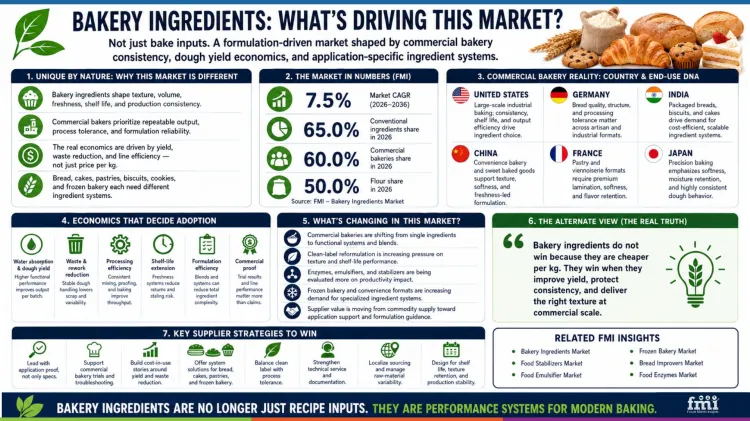
The common narrative around the bakery ingredients market is that growth follows the expansion of bread, cakes, pastries, biscuits, and packaged bakery output. That is true, but it does not explain how suppliers actually win accounts. In the Bakery Ingredients Market, FMI identifies flour as the leading product segment and bread as the largest application. This makes flour behavior the central operating question, not simply the central raw material question.
A commercial bakery does not evaluate flour only by protein percentage, price per ton, or supplier availability. It evaluates how flour behaves when the plant is running.
These are the questions that determine supplier preference.
- Does it absorb water predictably?
- Does it tolerate mixing variation?
- Does it retain gas during proofing?
- Does it work with the chosen enzyme system?
- Does it produce stable volume, crumb, softness, and sliceability under daily production pressure?
This is why the revised angle for bakery ingredients should begin with flour calibration and line control. A bakery ingredient supplier that sells flour, enzymes, emulsifiers, fats, sweeteners, leavening agents, and improvers as isolated products is weaker than a supplier that understands the entire dough system. Bakeries need the ingredient set to behave as a process-control tool. The product is not just flour or an improver; the product is repeatable bakery performance.
Flour variation is unavoidable because wheat quality changes by origin, crop year, storage condition, milling specification, protein quality, starch damage, ash content, enzyme activity, and particle size. Even when flour specifications look similar on paper, dough behavior can change in the mixer. A plant that produces packaged bread at scale cannot afford to discover that change after several batches have failed. The cost of correction includes downtime, scrap, rework, labor pressure, delayed dispatch, and inconsistent customer experience.
This creates a clear opening for ingredient suppliers with application labs and baking technologists. They can test flour lots, recommend absorption adjustments, select enzyme blends, tune emulsifier levels, and support improver systems before problems reach full production. Their value is not only in supplying ingredients. It is in reducing uncertainty between the mill and the baking line.
Bread lines reveal this most clearly. In packaged loaves, buns, sandwich bread, wraps, and pizza bases, flour quality must align with hydration, mixing energy, fermentation time, yeast activity, divider performance, proofing conditions, oven spring, crust development, and final moisture. If any link is weak, the finished product can lose volume, softness, resilience, sliceability, or shelf appeal. A low-priced ingredient can become expensive if it increases handling corrections or batch variability.
Cakes and pastries need a different calibration logic. Cake systems depend more on aeration, emulsification, tenderness, sweetness, fat behavior, batter viscosity, and crumb softness. Pastries require fat plasticity, lamination performance, shortening behavior, and controlled flake. Biscuits and cookies require spread control, texture, browning, and break strength. Yet even across these applications, the supplier who understands ingredient interaction is better positioned than the supplier who treats each input separately.
Direct sales matter in this environment because large bakery accounts need technical discussion before switching ingredients. FMI identifies direct sales as the leading channel in the bakery ingredients market. This is logical because commercial bakeries do not buy high-volume ingredient systems the way households buy retail baking products. They need trials, formulation support, specification reviews, delivery planning, allergen documents, and troubleshooting pathways. Direct relationships allow the supplier to participate in line decisions rather than simply submit a quotation.
The practical implications are clear. Suppliers should invest in flour analytics, pilot baking, application testing, water absorption guidance, enzyme response data, and troubleshooting teams. They should also build account-specific formulation records so that when wheat quality shifts, the bakery can adjust quickly. Generic product sheets are not enough for high-volume bakery plants.
For buyers, the lesson is also clear. Ingredient procurement should not be separated from production performance. A cheaper flour or improver can be attractive in a spreadsheet but damaging on the line if it reduces tolerance, increases waste, or causes inconsistent finished goods. The right procurement model compares total operating performance, not just purchase price.
The alternative view is that bakery ingredients do not win because they are basic inputs. They win when they help bakeries control the uncertainty of live production. In this market, formulation support is not an add-on. It is part of the value proposition.
Bottom line: bakery ingredients are moving from recipe inputs to line-control systems. Flour may dominate the product mix, but the winning supplier is the one that helps convert flour variability into predictable commercial output.
Related FMI reports
- Bakery Ingredients Market: Primary link for market value, ingredient type, application share, functionality trends, and industry benchmarks
- Bakery Mixes Market: Use when discussing dosing simplification, pre-blended formulations, and commercial baking systems
- Bakery Enzymes Market: Use when discussing freshness extension, dough conditioning, softness, and enzyme-led baking performance
- Food Enzymes Market: Use when discussing broader enzyme technologies and food processing applications
- Bread Emulsifier Market: Use when discussing crumb structure, dough stability, bread softness, and emulsifier functionality
- Frozen Bakery Market: Use when discussing frozen bakery products, freeze-thaw stability, and foodservice bakery applications
- Food Stabilizers Market: Use when discussing texture improvement, moisture retention, shelf-life enhancement, and product stability

