


- Frozen food demand is not only a supermarket story; foodservice, catering, cafés, hotels, institutions, QSRs, and commercial kitchens are critical volume drivers.
- Foodservice buyers use frozen food to manage labor pressure, reduce waste, standardize quality, and simplify menu execution.
- Frozen bakery, frozen fries, vegetables, seafood, appetizers, ready meals, sauces, desserts, and prepared components are closely linked to foodservice recovery.
- FMI’s Frozen Food Market shows frozen ready meals as a leading product type, but broader frozen food growth also depends on bulk and semi-prepared formats.
- Foodservice recovery favors suppliers that can deliver portion consistency, case-pack efficiency, preparation reliability, and stable quality across locations.
- The biggest misconception is that frozen food growth is driven only by household freezers. In many categories, commercial kitchens are equally important.
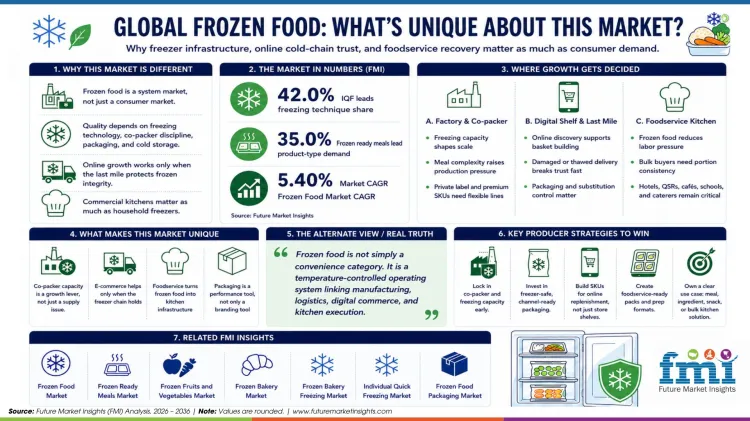
The Frozen Food Market is often discussed through the retail freezer aisle: supermarkets, online grocery, family packs, frozen meals, vegetables, snacks, desserts, and ice cream. That view is useful, but incomplete. Frozen food is also deeply tied to foodservice recovery.
Restaurants, QSRs, cafés, hotels, caterers, schools, hospitals, airlines, workplace canteens, and institutional kitchens use frozen food for reasons that go beyond consumer convenience. They use it because it helps manage labor, reduce waste, standardize output, stabilize procurement, simplify menu execution, and improve back-of-house efficiency. For foodservice buyers, frozen food is not merely a backup. It is part of kitchen infrastructure.
This is why Food & Beverage Angle #6, Foodservice Recovery, fits frozen food better than many generic consumer angles. A household buyer may choose frozen food because it saves time. A foodservice buyer chooses frozen food because it helps the kitchen deliver the same menu item across shifts, locations, and staff skill levels. That makes reliability, portion control, and operating efficiency more important than novelty.
Frozen bakery is one of the clearest examples. The Frozen Bakery Market supports cafés, hotels, retail bakeries, convenience stores, foodservice operators, and quick-service formats that need consistent bake-off quality. Products such as croissants, pastries, bread rolls, pizza bases, parathas, doughs, and ready-to-bake items allow operators to serve fresh-finished products without running a full bakery operation on-site. For a café or hotel, frozen bakery reduces production complexity while preserving menu breadth.
Frozen fruits and vegetables also have strong foodservice relevance. The Frozen Fruits and Vegetables Market connects with portion control, menu planning, year-round availability, reduced trimming waste, and kitchen prep efficiency. A commercial kitchen using frozen spinach, peas, broccoli, corn, berries, mango, or mixed vegetables can reduce prep time and manage seasonality better than relying only on fresh supply. The value is not only convenience; it is operational predictability.
The Frozen Vegetable Market is especially relevant for institutions and commercial kitchens because vegetables are repeat-use ingredients. Schools, hospitals, workplace cafeterias, hotels, and caterers need consistent quality, predictable yield, and easy storage. Frozen vegetables support those needs by reducing spoilage and simplifying portion planning.
Frozen ready meals and cooked formats add another layer. The Frozen Ready Meals Market is often interpreted through household demand, but ready-to-heat and semi-prepared formats also matter in institutional and commercial settings. Hospitals, schools, offices, travel caterers, and workplace dining operators may need controlled portioning, reliable nutrition, and simplified heating. The Frozen Cooked Ready Meals Market is relevant here because cooked formats reduce preparation time while maintaining meal consistency.
QSRs and casual dining operators use frozen food differently. Their focus is speed, consistency, cost control, and execution across multiple outlets. Frozen fries, breaded proteins, buns, appetizers, vegetables, sauces, desserts, and meal components help standardize the back-of-house process. A supplier that can deliver consistent case packs, clear preparation instructions, stable holding performance, and reliable supply becomes valuable to operators trying to protect service speed.
Foodservice recovery also changes product specifications. Retail frozen food must persuade the shopper through packaging, claims, and appetite appeal. Foodservice frozen food must satisfy chefs, procurement teams, kitchen managers, operations leads, and finance teams. The pack may be less consumer-facing, but the requirements are often stricter: portion weight, case yield, thawing behavior, cooking time, allergen information, storage density, labor savings, and consistency across batches.
The role of packaging is different as well. The Frozen Food Packaging Market matters in foodservice because packaging must support bulk storage, freezer durability, case handling, kitchen workflow, and sometimes resealability. A product that is difficult to store, open, portion, reseal, or prepare can create operational friction even when the food itself is good.
Foodservice recovery also supports regional customization. A hotel breakfast buffet, Indian QSR, Japanese convenience foodservice counter, U.S. casual dining chain, European bakery café, Middle Eastern catering kitchen, or airline meal supplier will not need the same frozen assortment. Global standardization has limits. Frozen food suppliers need to understand local menus, cooking methods, taste expectations, kitchen equipment, and service formats.
This is where frozen food differs from many other packaged categories. A product may have one consumer-facing name but several operating use cases. Frozen fries may be a retail side dish, QSR staple, or institutional kitchen product. Frozen bakery may be a household convenience product, café ingredient, or hotel breakfast solution. Frozen vegetables may be a family freezer staple or a foodservice yield-management tool. The same broad category can serve different buyers with very different decision criteria.
The strongest opportunities in foodservice-linked frozen food include frozen bakery, potato products, vegetables, appetizers, seafood, breaded proteins, desserts, sauces, soups, and prepared meal components. These categories help operators reduce labor intensity while maintaining menu variety. The weakest opportunities are products that do not solve a clear kitchen problem or create more preparation complexity than they remove.
For manufacturers, the strategic lesson is to design for the kitchen, not only for the consumer. Retail products must win the shelf. Foodservice products must win the prep station. That means portion control, cooking consistency, case-pack efficiency, storage fit, yield stability, and operational simplicity are critical.
The misconception to avoid is that frozen food is mainly a household convenience category. It is not. In many product families, foodservice buyers are central because they use frozen products to make commercial kitchens more predictable, scalable, and cost-efficient.
Bottom line: foodservice recovery strengthens frozen food demand by turning frozen products into operating infrastructure for kitchens. The suppliers that win will be those that deliver consistency, portion control, freezer efficiency, and menu-ready performance at scale.
Related FMI Reports
- Frozen Food Market
- Frozen Bakery Market
- Frozen Fruits and Vegetables Market
- Frozen Vegetable Market
- Frozen Ready Meals Market
- Frozen Cooked Ready Meals Market
- Frozen Food Packaging Market

