


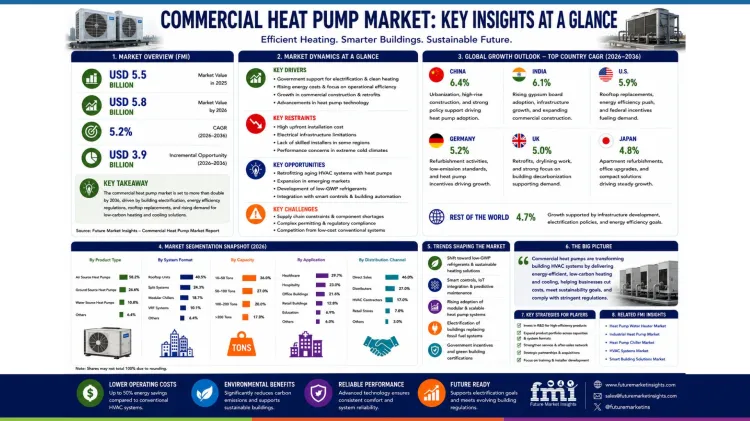
- Healthcare buildings lead the FMI application view, with 29.7% share of commercial heat pump demand in 2026.
- Hospitals and clinics create strong demand because they need year-round hot water, ventilation, redundancy, and reliable thermal comfort.
- Hotels are highly attractive for heat pump water heaters and modular hydronic systems because guest comfort and hot-water stability directly affect operations.
- Offices create a large retrofit pool, particularly where packaged rooftop units, VRF systems, and electrification goals align with lease and refurbishment cycles.
- The strongest end use depends on the measure. Healthcare leads by FMI share, hotels offer high thermal-load intensity, and offices provide broad retrofit volume.
- Suppliers should not treat commercial buildings as one category. Healthcare, hospitality, and offices each require different equipment formats and sales arguments.
Commercial heat pump demand is shaped less by building labels and more by load profiles. A hospital does not use heat like an office. A hotel does not manage hot water like a retail store. An office tower does not approve HVAC retrofits the same way as a clinic. The best end-use opportunity depends on whether the supplier is selling rooftop units, modular chillers, hydronic heat pumps, VRF systems, or heat pump water heaters.
FMI identifies healthcare as the leading application segment, with a projected 29.7% share in 2026. The same report states that healthcare demand is guided by steady hot-water and ventilation needs. That makes healthcare the strongest demand pool in the published segmentation.
Healthcare buildings have one of the clearer heat pump use cases because they operate continuously. Hospitals, clinics, laboratories, and care facilities require thermal comfort, ventilation, sterilization-related support functions, laundry, kitchens, domestic hot water, and sometimes process-like loads. Unlike many offices, they do not simply shut down every evening or weekend. Continuous operation increases the value of efficient heating and cooling.
The challenge is reliability. A hospital cannot adopt equipment that creates uncertainty around hot-water supply, infection-control ventilation, patient comfort, or critical spaces. Heat pump suppliers therefore need to sell redundancy, staged capacity, controls, service response, and commissioning support. The equipment itself is only part of the procurement decision.
This is why modular hydronic heat pump systems have strong relevance in healthcare. FMI identifies modular hydronic systems as a practical opportunity in hospitals and hotels because these buildings need staged capacity and continuous service. Modular capacity can help owners add or maintain equipment in phases, preserve redundancy, and reduce the risk of a single large asset becoming a failure point.
Hotels create a different but highly attractive demand profile. Guest rooms, kitchens, laundries, pools, spas, conference areas, and domestic hot-water systems create steady thermal demand. A hotel's heating and hot-water performance is visible to guests, which gives reliability a direct revenue and reputation link. Energy cost also matters because hospitality properties often operate long hours with variable occupancy.
Heat pump water heaters can be especially relevant in hotels. A system that can provide reliable hot water while reducing energy use can affect operating expenses without requiring a full building-system transformation. Modular chillers and hydronic heat pumps may also fit hotels that need staged replacement, zoning, and service access.
FMI notes that hospitality gains value where hotels replace boilers while keeping guest comfort and hot-water stability. This phrasing captures the buying concern. Hotels may support electrification, but not at the expense of guest experience. Suppliers must prove recovery rate, storage strategy, low-ambient performance, redundancy, service support, and control integration.
Offices represent the broadest commercial retrofit base. Office buildings vary widely, from small suburban sites with packaged rooftop units to large central business district towers with hydronic systems. The demand opportunity is spread across rooftop replacements, VRF systems, tenant fit-outs, central-plant upgrades, and landlord decarbonization plans.
Offices may not have the same hot-water intensity as hotels or hospitals, but they can create large equipment volume. Aging packaged units, renovation cycles, corporate sustainability targets, and building-performance standards all support adoption. The office market is also influenced by lease structures. Owners may approve heat pump upgrades when they help reposition the building, reduce energy cost exposure, or meet tenant expectations.
The commercial office case is stronger when HVAC replacement coincides with refurbishment. If a building is already undergoing tenant improvements, facade upgrades, controls modernization, or energy-efficiency work, a heat pump retrofit can be bundled into a broader project. If the building is fully occupied and the HVAC system is functioning, owners may delay.
Retail and education also matter, even though the question focuses on hotels, offices, and healthcare. FMI identifies rooftop units as leading system format because direct packaged-unit replacement suits schools and retail buildings. This matters because offices and retail chains can often use similar repeatable rooftop replacement logic. Multi-site commercial owners may adopt heat pumps faster when the same equipment approach can be replicated across a portfolio.
Capacity class gives another clue. FMI projects the 10 to 50 tons segment to hold 36.0% share in 2026 due to mid-size school and clinic demand. Clinics sit inside the healthcare demand pool, while schools and similar public buildings support packaged and rooftop formats. This suggests the strongest demand is not only in very large central plants. Mid-size commercial buildings are a major adoption zone.
The IEA heat pump analysis shows why building segments with continuous heating needs matter. IEA notes that heat pumps met more than 10% of global heating demand in buildings in 2023, with much greater deployment needed by 2030 under net-zero pathways. Commercial buildings with regular heating, cooling, and hot-water loads are therefore natural targets for electrification.
Building policy is pulling all three end uses forward. The European Commission Energy Performance of Buildings Directive and zero-emission building framework put pressure on new and renovated building stock to improve performance and reduce fossil-fuel dependence. This affects hospitals, hotels, offices, public buildings, and commercial portfolios differently, and the direction is the same, namely owners need cleaner heating strategies over time.
The end-use comparison is best made through four commercial dimensions.
Load intensity favours healthcare and hotels. These buildings often need heating, cooling, hot water, and ventilation over extended hours.
Retrofit volume favours offices and retail-like commercial buildings. The installed base is large, and rooftop or VRF replacement can be repeated across portfolios.
Reliability premium favours healthcare. Hospitals and clinics are more likely to pay for redundancy, service guarantees, and engineered solutions.
Hot-water opportunity favours hotels and healthcare. Heat pump water heaters and modular hydronic systems can target these loads directly.
Healthcare leads the FMI application share because it combines continuous operation, hot-water needs, ventilation needs, and high reliability requirements. Hotels may offer stronger project-level economics where hot-water loads are high and guest comfort supports investment. Offices create the broadest retrofit runway, particularly when aging rooftop units and decarbonization goals coincide.
A supplier focused on rooftop packaged heat pumps may find offices, retail, schools, and clinics attractive because the replacement workflow is clear. A supplier focused on heat pump water heaters may prioritise hotels and healthcare facilities. A company selling modular hydronic systems may target hospitals, hotels, campuses, and large mixed-use buildings. A VRF provider may target offices, hotels, and tenant-driven retrofit projects.
The sales message should also differ by segment.
- For healthcare, the message is resilience, hot water, ventilation support, redundancy, service response, and lifecycle reliability.
- For hotels, it is guest comfort, hot-water stability, operating cost, quiet operation, and phased retrofit.
- For offices, it is energy cost reduction, tenant appeal, equipment replacement timing, decarbonization, and low-disruption installation.
The strongest demand pool in the FMI segmentation is healthcare, with 29.7% share in 2026. The wider commercial interpretation is more layered. Healthcare leads on need intensity and reliability value. Hotels create attractive hot-water and comfort-driven projects. Offices provide broad retrofit volume when capital cycles align.
Commercial heat pump suppliers will win more consistently when they stop selling one commercial solution and start matching system format to building behaviour.

