


- Market shares of shrimp are being driven not by consumer preferences of the species, but rather by economic factors such as production cycle time, scalability of production through farming, sizing, and pricing structure.
- Vannamei shrimp is increasing its share since it allows for a faster production cycle time, scalability, sizing, and lower cost of production.
- Black Tiger shrimp will retain its significance in premium food service and specialty retail applications, where size, taste, and visual presentation are prioritized over volume.
- The winners in the race for shrimp species will be determined based on their adaptability to frozen foods and large-volume retail procurement systems.
- By far, the largest misunderstanding regarding shrimp species is that they compete for the same customers. Actually, Vannamei competes for volume, whereas Black Tiger competes for premium value.
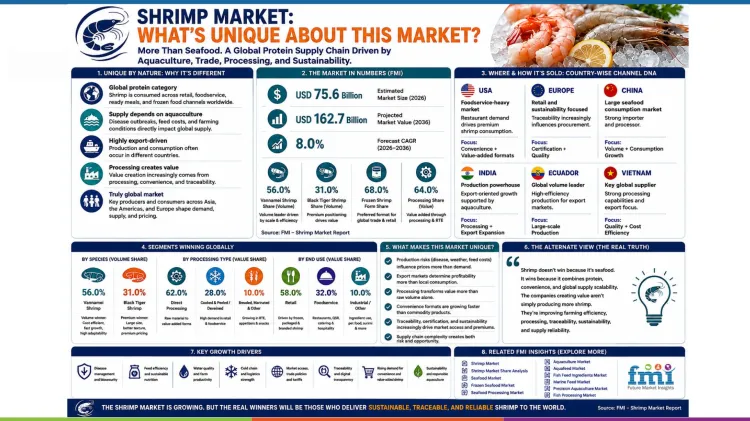
The global Shrimp Market is often discussed as one broad seafood category, but the real competitive shift is happening at the species level. The question is no longer simply whether shrimp demand is rising. The sharper question is which shrimp species are gaining share, which ones are losing scale, and which species are being pushed into premium niches.
Vannamei shrimp is the clear volume winner.
Its rise is not mainly because consumers are asking for Vannamei by name. In most retail settings, shoppers buy shrimp by size, price, form, pack type, freshness, and convenience. Species identity is usually secondary. Vannamei has gained because it works better for the modern shrimp supply chain. It is easier to farm at scale, easier to process consistently, and easier to supply into export-led frozen seafood programs.
That matters because shrimp is no longer only a raw seafood item. It is increasingly part of the broader Seafood Market, where retail, foodservice, frozen formats, processed products, and convenience-led consumption are changing what buyers value.
Why Vannamei Is Winning the Volume Game
Vannamei shrimp has become the market share winner because it solves the industry’s biggest operational problems.
For farmers, Vannamei supports more predictable production economics. It is widely used in aquaculture because it can be produced at scale, supports intensive farming systems, and fits export-oriented production models. For processors, it offers more consistent supply and sizing. For retailers, it allows dependable pack formats and price points. For importers, it reduces procurement complexity.
This is why Vannamei has become the backbone of many large shrimp supply chains.
The species fits the economics of the Frozen Seafood Market, where buyers need steady volumes, standardized product forms, stable cold-chain handling, and reliable pricing. Frozen shrimp programs depend on repeatable supply, not just premium appeal. Vannamei performs well in this environment because it can support peeled, deveined, cooked, tail-on, tail-off, and value-added formats at scale.
The same logic applies to the Fish Processing Market. Although the market is broader than shrimp, the processing logic is similar. Species that support consistent raw material supply, better yield management, freezing efficiency, and traceability are more attractive to processors. Vannamei fits this system better than most competing shrimp species.
Why Black Tiger Shrimp Still Has a Role
Black Tiger shrimp is not endangered, but their position has changed.
They are not always the volume leaders in most markets anymore, rather premium products. What matters for premium products are size, texture, appearance, and quality. All these qualities are more important for upscale foodservice establishments, hotels, specialty seafood retail, and certain export markets.
The point is that a big Black Tiger shrimp has more premium value than a small commodity product, especially in restaurants. The dark shell of the product and bigger sizes contribute to creating premium perception for them among others in premium seafood counters. This advantage will continue in some Asia-Pacific and European markets.
This creates a dilemma.
If the Black Tiger shrimp product does not maintain the premium status, it gets vulnerable. They cannot compete with Vannamei when it comes to price or production capabilities. In other words, it should be careful about getting stuck between premium buyers who want differentiation and cheaper buyers looking for cheaper prices.
Species Share Is Being Decided by Processing Compatibility
Another key factor that drives share between species is processing compatibility.
Consumers of shrimp are now looking for more processed products rather than just raw or whole forms. Shrimp suppliers have to provide products that can be peeled, deveined, cooked, breaded, marinated, seasoned, skewered, portioned, or pre-cooked before consumption. Shrimp species that are compatible with the needs of such large volume industrial processing benefit greatly.
Vannamei is such a species.
Food processors can control product specifications, yields, and even cater to multiple customer formats using the same species. Black Tiger shrimp is best suited for use cases where the name of the species provides added value. It performs much better where high-end presentations are needed. In fact, if processed in a way that takes away its uniqueness, then there isn’t much that distinguishes it from other species.
This means that the war between species is really a business decision.
The superior species depends on which application provides the highest margins.
Feed Costs and Aquaculture Efficiency Are Reinforcing Vannamei’s Lead
Species share is also connected to feed economics.
Shrimp farming depends heavily on feed efficiency, survival rates, pond productivity, and disease management. As the Aquafeed Market expands, producers are paying closer attention to how feed formulations, functional ingredients, and farming intensity affect profitability.
Vannamei benefits when producers prioritize cost-efficient growth.
If feed prices rise, farmers become even more focused on species that can deliver predictable output and manageable production costs. This gives Vannamei a structural advantage in price-sensitive export markets.
The Marine Feed Market and Fish Feed Ingredients Market also matter because feed ingredient volatility can affect the cost base of aquaculture producers. When feed input costs increase, species that require less risky production economics become more attractive.
This does not remove opportunities for premium species, but it makes efficiency harder to ignore.
Precision Aquaculture Could Deepen the Species Gap
Technology may further strengthen the species winners.
The Precision Aquaculture Market is relevant because advanced monitoring, feeding systems, water-quality tools, and farm analytics are becoming more important in shrimp farming. These systems are especially valuable where production is intensive and output consistency matters.
Vannamei producers stand to gain faster from these technologies, considering that the species has been widely incorporated in efficient aquaculture practices. The benefits include better survival rates, improved feed conversion, disease prevention, and proper harvesting. This would further enhance its desirability in export markets.
Precision farming technology could similarly work for Black Tigers, although the strategy here differs from that of the Vannamei. In this case, it might be used to protect its position as a high-end prawn.
Retail Buyers Are Rewarding Consistency Over Species Storytelling
Retailers need to ensure that there is sufficient margin, availability, quality claims, packaging flexibility, and reliable promotion.
Vannamei emerges as the winner here.
The supermarket shrimp program requires a constant supply through the combination of frozen bags, cooked shrimp rings, peeled shrimp, and meal preparation options. While the retailers may not focus so much on creating an interesting species story, they would be looking to create a consistent product at a reasonable price point.
Here, the Vannamei shines since it allows for repeatable retail programs.
Black Tiger Shrimp is ideal when there is an attempt by the retailer to sell premium seafood. It could be used for specialty packs, festival seafood assortments, premium frozen foods, and premium counter items. However, it will not do so well with ordinary value-oriented shrimp items.
This is the same structure found in the seafood industry.
Foodservice Creates a Split Market
Demand from food service channels has many layers.
Fast food chains, QSR chains, and bulk catering customers generally prefer shrimp items that are relatively inexpensive, reliable in their supply, and easy to prepare. It is very possible that these segments would favor products based on Vannamei due to reliability of their supply rather than anything else.
There are differences in how high-end foodservice buyers act.
They would opt for Black Tiger if size, plating, flavor, and quality are justifiable by the extra expense. In such a case, having a specific species name helps differentiate the menu.
There is a dual approach here.
Vannamei captures overall foodservice volume.
Black Tiger fights for premium foodservice dollars.
The risk with Black Tiger is underestimating its appeal through perception only. Foodservice operators need a reason to charge their customers extra.
The Biggest Misconception
- The biggest misunderstanding here would be the belief that the consumers themselves are requesting for the Vannamei species.
- This is not true.
- Consumers usually do not visit the store and demand for Vannamei shrimp specifically. The only thing they are looking for is shrimp that looks fresh, tastes good, and fits their recipe and budget requirements. Hence, species share is not influenced by consumer species preference per se.
- This is what allows Vannamei to keep on dominating the market.
- It is simply well suited to the dynamics of today’s shrimp business.
- Black Tiger is also an important species, but needs to be able to compete in situations where it has an advantage because of its premium qualities.
Bottom Line
- There is emerging species-based competition in the shrimp market - a competition that revolves around efficiency versus premiumization.
- Vannamei shrimp is gaining traction since they are scalable, affordable, flexible, and reliable to export. Black Tiger shrimp will be relevant since they are able to hold their value as premium in selective distribution channels where size, texture, and appearance count.
- The species that will succeed in the shrimp market will not necessarily have the greatest history. The successful species will be those that suit the most viable commercial application.
- Vannamei owns the volume narrative.
- Black Tiger must own the premium narrative.
Related FMI Reports
- Shrimp Market
- Seafood Market
- Frozen Seafood Market
- Fish Processing Market
- Aquafeed Market
- Marine Feed Market
- Fish Feed Ingredients Market
- Precision Aquaculture Market

